

Ko au te awa, ko te awa ko au – I am the river, the river is me
(Cribb, Mika & Leberman, Reference Cribb, Mika and Leberman2022, p. 569)
A Māori whakatauki (proverb)
Introduction
The unprecedented expansion of the global economy has generated immense material wealth, yet it has also intensified pressure on our planetary systems. Recent assessments indicate that of the nine Earth planetary boundaries that regulate planetary stability, seven have been breached, threatening economic stability and human wellbeing (Herweijer et al., Reference Herweijer, Evison, Mariam, Khatri, Albani, Semov and Long2020; Kitzmann et al., Reference Kitzmann, Caesar, Sakschewski, Rockström, Andersen, Bechthold, Bergfeld, Beusen, Billing and Bodirsky2025). Drawing on paradox theory, which holds that organisations face persistent, interrelated, and competing demands (Smith & Lewis, Reference Smith and Lewis2011), environmental sustainability is often understood as an enduring tension between economic viability and the protection and regeneration of the natural environment (Carmine & De Marchi, Reference Carmine and De Marchi2023; Hahn, Figge, Pinkse & Preuss, Reference Hahn, Figge, Pinkse and Preuss2018). Within dominant Western management thinking, however, this tension is still approached through a binary logic that treats economic and ecological goals as separate and often opposing domains (Carmine & De Marchi, Reference Carmine and De Marchi2023; Hahn et al., Reference Hahn, Figge, Pinkse and Preuss2018). Although such separation may simplify bounded problems, in the context of sustainability, it can encourage reductionist solutions that compartmentalise complex ecological systems into isolated components, thereby overlooking interdependence across the wider system (Keller & Lewis, Reference Keller and Lewis2016; Schad, Lewis, Raisch & Smith, Reference Schad, Lewis, Raisch and Smith2016).
In contrast, Indigenous knowledge systems reject this separation, positioning humans as intrinsically embedded within the natural world. This holistic ontology supports navigating ambiguity and complexity through commitments to unity, balance, and reciprocity (Martinez, Cannon, McInturff, Alagona & Pellow, Reference Martinez, Cannon, McInturff, Alagona and Pellow2023; Rout, Spiller, Reid, Mika & Haar, Reference Rout, Spiller, Reid, Mika and Haar2025; Royal, Reference Royal2002). Yet, management scholarship has paid limited attention to Indigenous world views in sustainability research (Salmon, Chavez & Murphy, Reference Salmon, Chavez and Murphy2023). Addressing this omission, this paper draws on te ao Māori, the Māori world view, to examine how a relational approach can reorient how sustainability tensions are understood in business.
Mainstream sustainability frameworks, including Corporate Social Responsibility (CSR) and the Circular Economy (CE), have advanced important managerial responses, yet they often remain shaped by anthropocentric and reductionist assumptions that preserve a separation between economic activity and ecological systems (Barnett, Reference Barnett2019; Daddi, Ceglia, Bianchi & de Barcellos, Reference Daddi, Ceglia, Bianchi and de Barcellos2019; Korhonen, Honkasalo & Seppälä, Reference Korhonen, Honkasalo and Seppälä2018). Although paradox scholars advocate for a both/and approach to managing inherent tensions (Carmine & De Marchi, Reference Carmine and De Marchi2023; Hahn et al., Reference Hahn, Figge, Pinkse and Preuss2018; Smith & Lewis, Reference Smith and Lewis2011), sustainability can still reproduce this separation when economic and ecological logics are treated as distinct systems. Te ao Māori challenges this premise by framing sustainability as a kin-based obligation, in which the environment is not an external stakeholder to be balanced against commercial goals, but the senior system within which economic activity takes place. From this perspective, sustainability is not experienced primarily as an internal trade-off between profit and planet. Rather, tensions become most visible where relational obligations to people, place, and the more-than-human world encounter dominant institutional arrangements that privilege optimisation, standardisation, and short-term financial performance.
Māori are the Indigenous people of Aotearoa New Zealand, who migrated from East Polynesia as early as 950AD, part of the broader Polynesian Triangle, which stretches from Hawaii to Easter Island and to Aotearoa New Zealand (Bellwood, Reference Bellwood1987). The history of Māori development in Aotearoa New Zealand spans over 1,000 years, linked to 5,000 years of prior Austronesian development (Orange, Reference Orange2015; Petrie, Reference Petrie2002). Traditional Māori society was organised based on whakapapa (genealogy) in decentralised groups known as whānau (extended family), hapū (kinship groups), and iwi (tribes) led by rangatira (chiefs) who held authority over villages and their natural resources (Henare, Reference Henare, Nicholson, Lythberg and Salmond2021; Petrie, Reference Petrie2002; Rout et al., Reference Rout, Mika, Reid, Whitehead, Wiremu, Gillies, McLellan and Ruha2023). Following initial Dutch and English encounters with the Māori in 1641 and 1769, respectively, New Zealand was eventually established as a British colony via the Treaty of Waitangi of 1840 (Mika, Dell, Elers, Dutta & Tong, Reference Mika, Dell, Elers, Dutta and Tong2022c; Orange, Reference Orange2015; Walker, Reference Walker1990). Despite the intentional oppression of te ao Māori by the colonial system (Love & Waa, Reference Love, Waa, Deeks and Enderwick1997; Winiata & Luke, Reference Winiata and Luke2021), Māori continue to retain their traditional knowledge, social systems, language and culture (Hill, Reference Hill2021; Smith, Reference Smith2006).
Te ao Māori is an Indigenous way of knowing, being, and doing (Mead, Reference Mead2016). At its core, te ao Māori emphasises a holistic perspective in which ngā tāngata (people) and te taiao (nature) are interconnected entities (Ruwhiu & Cone, Reference Ruwhiu and Cone2013; Spiller, Pio, Erakovic & Henare, Reference Spiller, Pio, Erakovic and Henare2011b). Intellectual framing of the world as a unified whole renders te ao Māori essential for managing complexity (Mika & O’Sullivan, Reference Mika and O’Sullivan2014; Nicholson, Spiller & Pio, Reference Nicholson, Spiller and Pio2019; Spiller et al., Reference Spiller, Pio, Erakovic and Henare2011b). Within this world view, key concepts such as whakapapa (genealogy), mauri (vitality), and utu (reciprocity) function as interwoven principles that frame environmental sustainability as a relational and ethical obligation (Mead, Reference Mead2016; Mika, Dell, Newth & Houkamau, Reference Mika, Dell, Newth and Houkamau2022a; Spiller et al., Reference Spiller, Pio, Erakovic and Henare2011b). Associated concepts, including kaitiakitanga (stewardship), whanaungatanga (relationship), and tino rangatiratanga (sovereignty), help explain how these principles are expressed in business practice.
This study employs a qualitative research design grounded in kaupapa Māori research principles and Te Ara Tika research ethics (Hudson, Milne, Reynolds, Russell & Smith, Reference Hudson, Milne, Reynolds, Russell and Smith2010). Data are drawn from 11 in-depth kōrero, a Māori narrative approach, with a purposive sample of knowledgeable participants. Data were analysed using a reflexive thematic analysis incorporating mahi ngātahi, a collaborative analytical process, to ensure that interpretations remained aligned with Māori values, meanings, and ways of knowing. The paper addresses the question: how do Māori understand and navigate sustainability tensions in business?
This paper contributes to paradox theory by showing how sustainability tensions are reframed when organisations are understood as genealogically embedded within spiritual and ecological systems. Drawing on participants’ narratives, this paper articulates the Whakapapa–Mauri–Utu Regenerative Cycle, a conceptual model that explains how responsibility, evaluation, and reciprocity interact to guide decision-making. While whakapapa, mauri, and utu are well established in Māori scholarship, the contribution here lies in theorising how they operate together as a recursive mechanism that links genealogical responsibility, mauri-centred evaluation, and reciprocal restoration in business decision-making.
The remainder of the paper provides theoretical background before explaining the kaupapa Māori-informed qualitative research design. Findings are presented to highlight insights from the kōrero. The discussion develops the conceptual model of the Whakapapa–Mauri–Utu Regenerative Cycle for paradox theory and sustainability management, followed by research implications, limitations, and future research. The paper concludes with a summary of insights.
Theoretical background
Limitations of current approaches to sustainability management
Conventional approaches such as CSR and CE have been instrumental in operationalising sustainability by translating complex ecological issues into manageable metrics, enabling firms to improve resource efficiency, manage stakeholder expectations, and mitigate immediate environmental risks (Barnett, Reference Barnett2019; Geissdoerfer, Savaget, Bocken & Hultink, Reference Geissdoerfer, Savaget, Bocken and Hultink2017; Hörisch, Freeman & Schaltegger, Reference Hörisch, Freeman and Schaltegger2014). Although they are useful technical tools, critics argue that their neoclassical economic grounding often confines sustainability to instrumentalism, privileging efficiency, compliance, and risk mitigation over ecological relations (Gladwin, Kennelly & Krause, Reference Gladwin, Kennelly and Krause1995; Hahn, Figge, Pinkse & Preuss, Reference Hahn, Figge, Pinkse and Preuss2010; Landrum, Reference Landrum2018). Even where industrial ecology and strong sustainability, which emphasise ecological limits and the non-substitutability of natural capital, advocate for systems thinking, managerial logic often retains a separation between humans and nature, treating the environment primarily as a resource rather than as an interconnected living system (Hoffman & Sandelands, Reference Hoffman and Sandelands2005; Klein, Reference Klein2000; Whiteman & Cooper, Reference Whiteman and Cooper2000).
This separation rests on reductionism, through which complex, non-linear ecological systems are rendered more manageable by being dismantled into discrete components that fit existing business structures (Hengst, Jarzabkowski, Hoegl & Muethel, Reference Hengst, Jarzabkowski, Hoegl and Muethel2020; Winn & Pogutz, Reference Winn and Pogutz2013). Fragmentation reinforces short-termism by incentivising firms to discount future value and neglect long-term ecological integrity (Bansal & DesJardine, Reference Bansal and DesJardine2014). Slawinski and Bansal (Reference Slawinski and Bansal2015) show that managers with a linear temporal orientation prioritise immediate business imperatives over long-term considerations such as climate mitigation. Because CSR remains largely voluntary, firms can set their own standards, enabling business-as-usual practices to be presented as sustainability and, at times, to slip into greenwashing (Hahn & Figge, Reference Hahn and Figge2011; van Bommel, Reference van Bommel2018; Wright & Nyberg, Reference Wright and Nyberg2017). Fragmented and inconsistent standardisation can also facilitate selective reporting, allowing firms to curate a positive public image while obscuring adverse environmental impacts (Lyon & Montgomery, Reference Lyon and Montgomery2015). More consistent standards may improve comparability and reduce selective disclosure, but standardisation alone is unlikely to prevent symbolic compliance where underlying incentives remain unchanged (Delmas & Burbano, Reference Delmas and Burbano2011; Lyon & Montgomery, Reference Lyon and Montgomery2015). As a result, enterprise reliance on goodwill and inclusive morality can therefore lead to tokenism, where CSR primarily serves legitimacy and reputational risk management rather than driving systemic transformation for genuine sustainability (Landrum, Reference Landrum2018; Scherer, Palazzo & Seidl, Reference Scherer, Palazzo and Seidl2013; van Bommel, Reference van Bommel2018).
Similarly, although CE approaches aim to replace the linear model of production and consumption with restorative and regenerative resource flows, implementation remains constrained by barriers such as the cost of redesigning products, limited repair and recovery infrastructure, and poor coordination across the supply chain (Daddi et al., Reference Daddi, Ceglia, Bianchi and de Barcellos2019; Korhonen et al., Reference Korhonen, Honkasalo and Seppälä2018; Pickering et al., Reference Pickering, Barton, Beg, Collins, Mika and Oxley2025). CE also faces systemic limits, including rebound effects, where efficiency gains in resource use are offset by higher aggregate consumption as prices fall or economic activity expands (Govindan & Hasanagic, Reference Govindan and Hasanagic2018; Zink & Geyer, Reference Zink and Geyer2017). Together, these critiques suggest that efficiency-oriented sustainability approaches, while necessary, are insufficient without a sufficiency logic that limits overall consumption and material use. Accordingly, such frameworks often struggle to resolve sustainability tensions because they remain constrained by the same profit-oriented rationality and instrumental logics that contributed to ecological degradation (Laasch, Suddaby, Freeman & Jamali, Reference Laasch, Suddaby, Freeman and Jamali2020; van Bommel, Reference van Bommel2018; Van Der Byl & Slawinski, Reference Van Der Byl and Slawinski2015).
Māori perspectives on environmental sustainability
In this paper, Māori perspectives refer to ways of understanding and responding to environmental sustainability grounded in te ao Māori and shaped by the lived realities of Māori in contemporary organisational and institutional contexts. Te ao Māori is a Māori world view in which spiritual and physical realities are inseparable, and the natural world is understood through genealogical relationships among people, land, waters, ancestors, and other living and non-living entities (Hēnare, Reference Hēnare2015; Marsden, Reference Marsden and Royal2003; Mead, Reference Mead2016). This world view is articulated and sustained through mātauranga Māori, a knowledge system continually refined across generations through observation, interaction, and adaptation to local ecosystems (Hikuroa, Reference Hikuroa2017). Te ao Māori can therefore be characterised as a relational ontology, in which reality is constituted through relationships rather than separate, self-contained entities (Mead, Reference Mead2016; Spiller et al., Reference Spiller, Pio, Erakovic and Henare2011b).
Te ao Māori and mātauranga Māori provide a relational basis for guiding decision-making, authority, and responsibility regarding the natural world (Mika et al., Reference Mika, Rout, Reid, Bodwitch, Gillies, Lythberg, Hikuroa, Mackey, Awatere, Wiremu, Rakena, Davies and Robertson2022b; Wehi, Whaanga & Roa, Reference Wehi, Whaanga and Roa2009). This perspective matters for environmental sustainability because it reframes decision-making away from instrumental rationality, where nature is treated primarily as a resource for human needs, and towards relational obligation, in which people hold enduring responsibilities to maintain the wellbeing and integrity of human and more-than-human relationships. In this paper, whakapapa (genealogy), mauri (life force), and utu (reciprocity) form as the primary conceptual foundation, while tino rangatiratanga (sovereignty), kaitiakitanga (stewardship), and whanaungatanga (relationship) are treated as enabling and enactment conditions through which these principles are expressed in business settings (Mead, Reference Mead2016; Mika, Reference Mika2021a; Spiller et al., Reference Spiller, Pio, Erakovic and Henare2011b).
Whakapapa as responsibility and decision rights
Whakapapa traces genealogical relationships that connect tāngata (people), te taiao (nature), and the spiritual realm, establishing kinship among people, land, waters, ancestors, and other entities (Mead, Reference Mead2016; Mika et al., Reference Mika, Dell, Elers, Dutta and Tong2022c). This ontological inseparability is rooted in Māori cosmogony. One common creation narrative tells us that, in the beginning, the primordial parents, Ranginui (Sky Father) and Papatūānuku (Earth Mother), existed in a tight embrace, enveloping the world in Te Pō (darkness) (Hēnare, Reference Hēnare2015; Royal, Reference Royal2005). It was their son, Tāne Mahuta (god of the forest), who eventually separated them to bring forth te ao mārama (the world of light) (Hēnare, Reference Hēnare2015; Royal, Reference Royal2005). According to Rangiwai (Reference Rangiwai2018), Tāne later formed Hineahuone, the first woman, from the red clay, or earth, of Papatūānuku at Kurawaka, and through this act, human life entered the world. Humanity is therefore viewed as part from nature, as the teina (younger kin) of the natural features, such as mountains, rivers, and forests, which are revered as tuākana (elder siblings and ancestors) (Hēnare, Reference Hēnare2015; Mead, Reference Mead2016; Royal, Reference Royal2005). This ancestral connection establishes a logic of genealogical integrity, in which the legitimacy of an action is judged by whether it maintains, enhances, or serves these relationships across generations.
In organisational and environmental contexts, whakapapa provides a foundation for responsibility by clarifying who holds obligations and to which places and relations those obligations apply (Mika & O’Sullivan, Reference Mika and O’Sullivan2014; Mrabure, Ruwhiu & Gray, Reference Mrabure, Ruwhiu and Gray2021; Spiller, Erakovic, Henare & Pio, Reference Spiller, Erakovic, Henare and Pio2011a). The exercise of these responsibilities depends on tino rangatiratanga, namely the authority and autonomy of Māori to self-determination and leadership in matters affecting their people and places (Durie, Reference Durie2013). Grounded in whakapapa, tino rangatiratanga provides the basis for legitimate decision-making within particular communities and environments (Durie, Reference Durie2013; Kawharu, Reference Kawharu2000). In environmental contexts, tino rangatiratanga refers to the authority of tangata whenua (people of the land) to make decisions about lands, waters, and other places with which they retain customary relationships, responsibilities, and claims, regardless of whether these are fully recognised through contemporary legal ownership arrangements (Harmsworth, Awatere & Robb, Reference Harmsworth, Awatere and Robb2016; Mika et al., Reference Mika, Dell, Elers, Dutta and Tong2022c). This authority connects genealogical responsibility to decision rights in practice and enables kaitiakitanga in ways that are locally grounded and collectively legitimate (Kawharu, Reference Kawharu2000).
Mauri as an evaluative indicator
Mauri refers to the life force or essential vitality that connects the physical and spiritual realms, and it flows through interconnected relationships among people, waters, lands, and ecosystems (Mead, Reference Mead2016; Spiller et al., Reference Spiller, Pio, Erakovic and Henare2011b). When these flows are sustained, life regenerates and environments flourish, whereas disruption diminishes the system’s vitality and regenerative capacity (Hēnare, Reference Hēnare2015; Spiller et al., Reference Spiller, Pio, Erakovic and Henare2011b). Mauri thus functions as a dynamic evaluative indicator of environmental wellbeing, both metaphysical and physical (Harmsworth & Awatere, Reference Harmsworth and Awatere2013; Morgan, Reference Morgan2006). Morgan (Reference Morgan2006) explains that environments exhibit mauri ora (flourishing vitality) when their natural state is stable or enhanced, or mauri mate (languishing or extinguished vitality) when degraded. Maintaining and restoring mauri, therefore, becomes a primary aim of Māori environmental initiatives (Morgan, Reference Morgan2006; Spiller et al., Reference Spiller, Pio, Erakovic and Henare2011b).
Kaitiakitanga is the practical expression of relational responsibility to protect and enhance mauri, grounded in enduring relationships among tangata, whenua, waters, ancestors, and descendants (Awatere, Harmsworth, Rolleston & Pauling, Reference Awatere, Harmsworth, Rolleston, Pauling, Walker, Jojola and Natcher2013; Kawharu, Reference Kawharu2000; Spiller et al., Reference Spiller, Pio, Erakovic and Henare2011b). More than guardianship in a narrow conservation sense, kaitiakitanga is an active practice of care grounded in whakapapa, through which genealogical connection becomes responsibility for monitoring, protecting, using, and restoring the conditions that enable mauri to flourish across generations (Kawharu, Reference Kawharu2000; Mika et al., Reference Mika, Dell, Newth and Houkamau2022a; Nicholson et al., Reference Nicholson, Spiller and Pio2019; Roberts, Norman, Minhinnick, Wihongi & Kirkwood, Reference Roberts, Norman, Minhinnick, Wihongi and Kirkwood1995). A kaitiaki may be an individual, whānau, hapū, or iwi with recognised responsibilities for the spiritual and physical wellbeing of particular places, species, or ecosystems (Kawharu, Reference Kawharu2000; Rout, Awatere, Mika, Reid & Roskruge, Reference Rout, Awatere, Mika, Reid and Roskruge2021; Spiller et al., Reference Spiller, Erakovic, Henare and Pio2011a). In practice, kaitiaki actively monitor the state of mauri and act to sustain the generative capacity of lands and waters for future generations (Kawharu, Reference Kawharu2000; Roberts et al., Reference Roberts, Norman, Minhinnick, Wihongi and Kirkwood1995; Spiller et al., Reference Spiller, Pio, Erakovic and Henare2011b). This perspective reorients organisational and environmental management away from treating nature as a stock of resources for short-term extraction, and towards sustaining or restoring mauri over time, including through reciprocal obligations captured in utu (reciprocity) (Rout et al., Reference Rout, Awatere, Mika, Reid and Roskruge2021).
Utu as reciprocity and restoration
Utu is the binding principle of reciprocity, the obligation to maintain balance and harmony within relationships through appropriate responses to both gifts and grievances (Mika et al., Reference Mika, Dell, Newth and Houkamau2022a; Nicholson, Reference Nicholson2019; Reid, Rout, Whitehead & Katene, Reference Reid, Rout, Whitehead and Katene2021). In pre-European Māori society, utu also functioned as a practical system of accountability through which benefits, injuries, and wrongdoing were addressed to restore social order and relational balance (Best, Reference Best1924; Henare, Reference Henare, Nicholson, Lythberg and Salmond2021). This obligation extends beyond human social relations to include the natural world (Kawharu, Reference Kawharu2000; Reid et al., Reference Reid, Rout, Whitehead and Katene2021). In the context of sustainability, utu does not preclude resource use but reframes it by requiring that extraction or benefit from the environment be accompanied by acts of care, replenishment, or restoration that maintain balance in relation to Papatūānuku (Hēnare, Reference Hēnare2015; Reid, Rout, Whaanga Schollum, Ruha & Hania, Reference Reid, Rout, Whaanga Schollum, Ruha and Hania2025).
Utu operates within whanaungatanga, the web of kinship obligations that binds people to the land and to each other through deep interconnectedness (Mika et al., Reference Mika, Dell, Elers, Dutta and Tong2022c; Nicholson et al., Reference Nicholson, Spiller and Pio2019; Spiller et al., Reference Spiller, Erakovic, Henare and Pio2011a). Within this relational network, individual wellbeing is inseparable from the collective, including that of land, water, plants, animals, and spiritual entities (Mika et al., Reference Mika, Dell, Elers, Dutta and Tong2022c; Nicholson et al., Reference Nicholson, Spiller and Pio2019; Spiller et al., Reference Spiller, Erakovic, Henare and Pio2011a). The responsibility for the environment is thus shared by the entire kin group (Mead, Reference Mead2016; Spiller et al., Reference Spiller, Pio, Erakovic and Henare2011b). Utu and Whanaungatanga are interwoven. Whanaungatanga offers the relational network of shared responsibility, while utu provides the reciprocal practice that sustains balance and constrains commercial imperatives within the ecosystem’s regenerative capacity (Awatere et al., Reference Awatere, Mika, Hudson, Pauling, Lambert and Reid2017; Reid et al., Reference Reid, Rout, Whitehead and Katene2021).
Te ao Māori, expressed through mātauranga Māori, offers a relational world view in which people, land, waters, and other living systems are understood through interconnected responsibilities. This world view frames sustainability as a matter of organising economic activity within enduring obligations to the more-than-human world, rather than optimising across separable economic and ecological goals. However, whether and how this relational logic is enacted in contemporary business contexts remains an empirical question, which this study examines.
Method
This qualitative study employed an interpretive approach guided by kaupapa Māori research principles (Bishop, Reference Bishop1999; Walker, Eketone & Gibbs, Reference Walker, Eketone and Gibbs2006) and the Te Ara Tika, an ethical framework widely used in research by, with, or for Māori (Hudson et al., Reference Hudson, Milne, Reynolds, Russell and Smith2010). Data collection and analysis were conducted by the first co-author, a Han Chinese researcher and long-term resident of Aotearoa New Zealand, who understands his place in this context through the position of tangata tiriti (person of the treaty). In general terms, tangata tiriti refers to non-Māori whose belonging in Aotearoa is understood in relation to te Tiriti o Waitangi (Tan, Reference Tan2023). This positionality acknowledges Te Tiriti o Waitangi of 1840 as one of the founding documents of Aotearoa New Zealand, whose nationhood was forged on the basis of an implied partnership between Māori and the British Crown as signatories (Coxhead, Morris, Ngatai, Walker & Hill, Reference Coxhead, Morris, Ngatai, Walker and Hill2014; Orange, Reference Orange2015). For the researcher, identifying as tangata tiriti signals an ethical commitment to conduct research in ways that recognise Māori as tangata whenua and respect the standing of te Tiriti in shaping relationships between Māori and non-Māori, including later migrants, in Aotearoa. In this research, this commitment was expressed as an intention to uphold reciprocity and accountability in research relationships, including avoiding harm and protecting Māori interests where possible (Brown, Reference Brown2023; Dam, Reference Dam2023).
The researcher did not claim insider standing within te ao Māori, but approached the research with humility, guidance, and reflexivity. Cultural safety was treated as active attention to how cultural assumptions, power relations, and interpretive authority may shape participant engagement, analytic decisions, and the representation of Māori knowledge (Curtis et al., Reference Curtis, Jones, Tipene-Leach, Walker, Loring, Paine and Reid2019; Hudson et al., Reference Hudson, Milne, Reynolds, Russell and Smith2010). To support a culturally grounded approach, the research was conducted under the guidance of Māori academic supervisors and co-authors, with ongoing reflexive discussion and collaborative checking of the research design, participant engagement, and conceptual interpretation. Kōrero and analysis were approached as relational exchanges that recognised participants’ mana (dignity) and treated their mātauranga as knowledge to be carefully interpreted and respectfully represented.
Research design
Ethics approval was obtained from the University of Waikato and the University of Auckland Human Participants Ethics Committee. Data were collected between October 2024 and October 2025 through one-off, semi-structured kōrero, which are guided conversations with practitioners in Māori business management, governance, and cultural expertise (Creswell & Creswell, Reference Creswell and Creswell2018; Cribb, Mika, Leberman & Bennett, Reference Cribb, Mika, Leberman and Bennett2024). Kōrero focused on how participants make decisions about environmental sustainability and navigate tensions between responsibilities to te taiao (nature) and contemporary organisational, regulatory, and market expectations. An indicative interview guide ensured coverage of core topics, including participants’ understandings of te ao Māori and sustainability, decision-making practices, lived experiences of tension, and future aspirations, with questions adapted slightly to each participant’s role and experience (see Appendix B). Kōrero were conducted as a dialogic, participant-led form of engagement that privileges participants’ framing, sequencing, and emphasis, thereby supporting depth and contextual richness (Cribb et al., Reference Cribb, Mika, Leberman and Bennett2024; Ware, Breheny & Forster, Reference Ware, Breheny and Forster2018).
Kanohi-ki-te-kanohi (face-to-face) kōrero were prioritised to establish trust and rapport. Where geographical or time constraints existed, sessions were conducted via secure online video conferencing. Sessions typically lasted 60–90 minutes and were audio-recorded with participant consent. Tikanga (customary practices) was central to the process. For example, Whakawhanaungatanga (relationship building) before data collection allowed participants to share both their successes and struggles. Reciprocity was upheld through sharing kai (food) and koha (gifts), acknowledging participants’ mana by ensuring the exchange of mātauranga and time was relational rather than extractive. Participants were also offered the opportunity to review transcripts and summaries to support interpretive accuracy and acknowledge their ownership of the information shared. This opportunity was taken up selectively. In most cases, participants chose not to review these materials and instead placed trust in the researcher to interpret and represent their kōrero appropriately.
Participants and sampling
This research employed a purposive sampling method guided by the principle of information power (Malterud, Siersma & Guassora, Reference Malterud, Siersma and Guassora2016). From this perspective, sample adequacy is determined by the richness and relevance of the material in relation to the study aim, rather than on a predetermined sample size (Malterud et al., Reference Malterud, Siersma and Guassora2016). In this study, information power was supported by a focused research question, a specific participant group with direct experience of Māori business and environmental management, and in-depth kōrero that generated rich narratives of practices. Ten participants who self-identify as tangata whenua and one as tangata tiriti were recruited through the researcher’s existing network and referrals, consistent with the principle and practice of whanaungatanga, where one’s family, friends, and acquaintances become the initial source of participants and referrals.
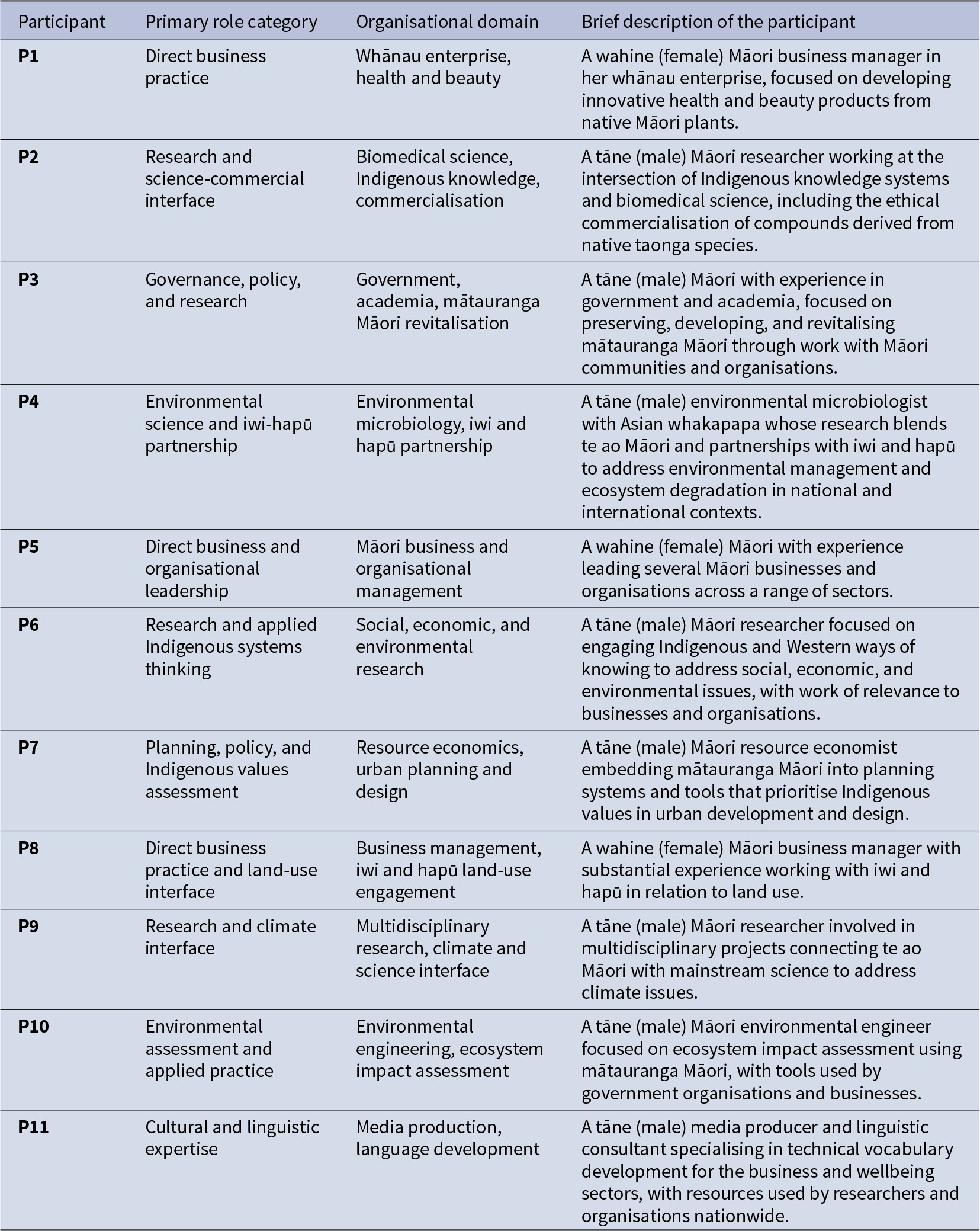
Participants were purposively selected for their knowledge and experience at the interface between te ao Māori governance responsibilities and mainstream organisational and market expectations, including moments of tension and alignment. The sample was intentionally mixed, including business practitioners alongside participants from governance, policy, research, resource management, and cultural advisory roles. This diversity of samples provides insight not only into perspectives grounded in business practice but also those shaped by wider institutional and interpretative engagements with Māori sustainability practices. Table 1 provides a general description of each participant’s primary role category and organisational domains.
Participants details
Data analysis
Audio recordings were transcribed verbatim by the first co-author. Data were analysed using a reflexive thematic analysis supported by NVivo (Clarke & Braun, Reference Clarke and Braun2017). Given the Māori cultural context of the research and the study’s engagement with paradox theory, analysis followed an abductive approach, moving iteratively between inductive interpretation grounded in participants’ narratives and the relevant Māori concepts as sensitising resources, while maintaining a focus on how sustainability responsibilities were described and implemented in practice (Blumer, Reference Blumer2017; Dubois & Gadde, Reference Dubois and Gadde2002).
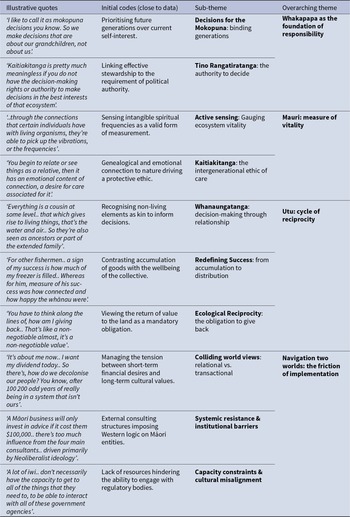
Coding proceeded in multiple cycles. First, the co-author generated initial codes that stayed close to the participants’ language, capturing how they described obligations, decision-making processes, and sustainability-related tensions in practice. At this stage, coding was not structured around pre-set theoretical categories, but remained grounded in participants’ own terms and examples. Second, these initial codes were compared and clustered into sub-themes that captured recurring patterns in how responsibilities were framed and carried out. Third, sub-themes were reviewed and refined for internal coherence and distinctiveness, and then interpreted in dialogue with relevant Māori concepts, particularly whakapapa, mauri, and utu, which were used as sensitising resources rather than predetermined coding frames. This interpretive stage helped clarify how participants’ accounts point to broader relational mechanisms recognised in Māori scholarship, while ensuring that the final themes remained anchored in the empirical evidence rather than imposed from the literature. Table 2 summarises the progression from illustrative quotes to initial codes, sub-themes, and overarching themes.
Example coding tree
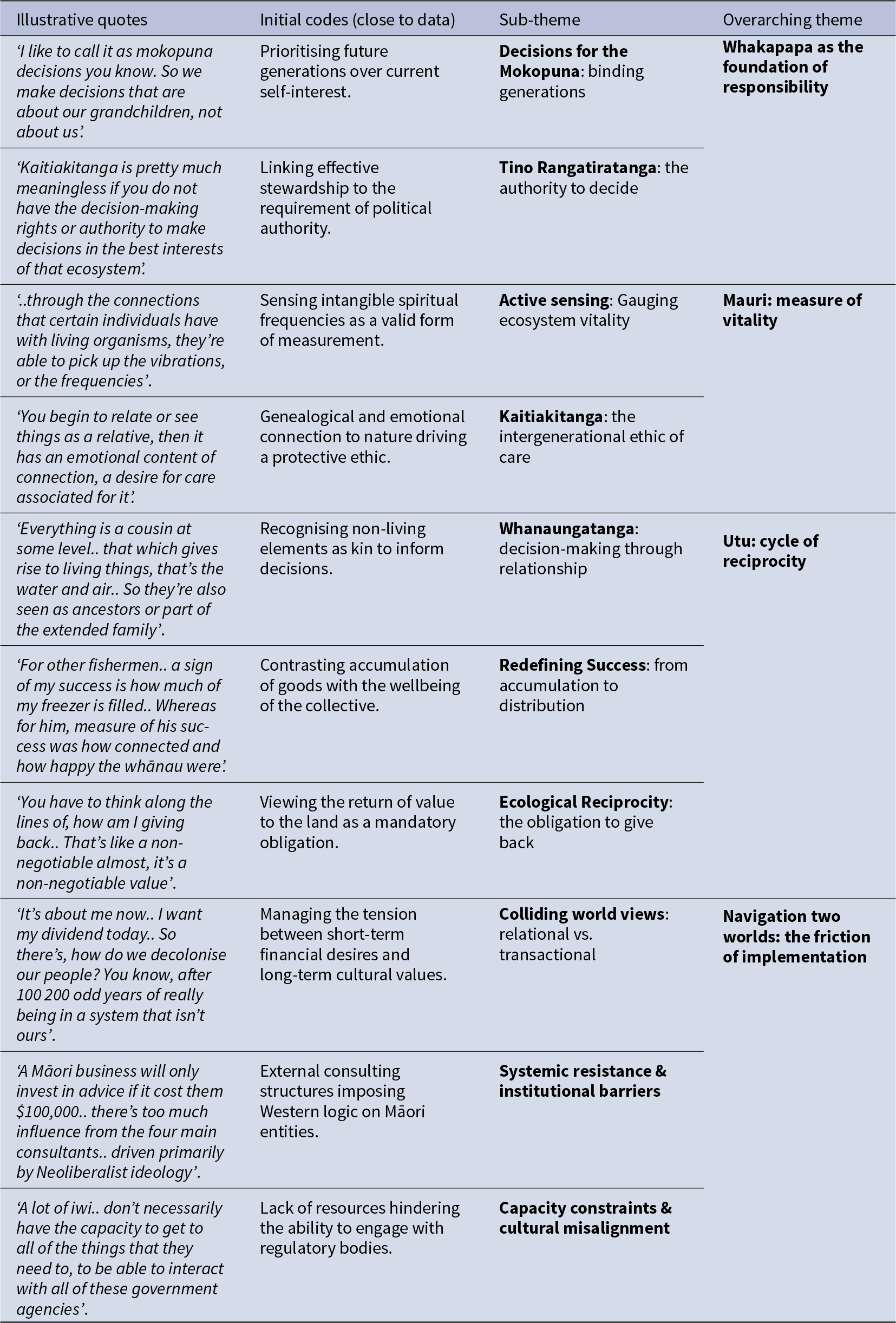
Note: Quotes are illustrative rather than exhaustive, coding was iterative and interpretive.
Mahi ngātahi, which Henry, Mika, and Wolfgramm (Reference Henry, Mika and Wolfgramm2020) describe as collaborative thematic analysis, was employed in reviewing the data. This collective approach has the effect of curtailing dominant Western logics being projected onto the Indigenous narrative. The first co-author conducted initial coding, which was systematically interrogated and refined in collaboration with Māori co-authors with expertise in Māori management research. This process served as a critical check on interpretation. For instance, an initial code labelled as risk aversion, describing a participant’s decision against scaling operations. Through mahi ngātahi, this interpretation was revised because the narrative was not primarily concerned with uncertainty avoidance in a conventional managerial sense. Instead, the participant framed the decision in terms of obligations to whenua, whānau, and future generations. The code was therefore changed to whakapapa obligation, which better captured the relational and intergenerational logic described in this kōrero. This collaborative process helped ensure that the themes reflected the participants’ realities rather than the assumptions inherent in the researcher’s positionality.
The analysis also identified negative cases by actively seeking instances in which participants described trade-offs, tensions, or the partial inability to implement te ao Māori under prevailing market and institutional conditions. Documenting such tensions avoids romanticising Indigenous knowledge (Manganda, Reference Manganda2021) and grounds the findings in the complexity of participants’ lived realities. Through this collaborative analysis, themes were developed that were culturally robust, nuanced, and methodologically sound (Creswell & Creswell, Reference Creswell and Creswell2018; Niu et al., Reference Niu, Mika, Spiller, Haar, Rout, Reid and Karamaina2025).
Findings
The findings draw on a mixed group of knowledgeable participants. Across these kōrero, participants generally do not frame environmental sustainability as a binary trade-off between economic activity and ecological responsibility, nor as a problem to be solved through compromise or optimisation. Instead, the kōrero suggest a relational understanding in which tensions are accepted as a natural state of being. As a tikanga expert explains, there is no singular Māori word for the English term paradox, yet Māori are familiar with the phenomenon, aptly exemplified by the distinction between tapu (sacred) and noa (common):
Tapu is often seen as something important and sacred… and noa is not as important… but when it comes to rituals… you automatically have to invoke noa at the same time because tapu…[can be] really dangerous, and you can’t have one without the other (P11).
This co-dependent relationship suggests that opposing forces are not treated as inherently problematic, but as complementary states necessary for maintaining spiritual safety and social order. As shown in Table 2, the analysis clustered participants’ narratives into three interconnected principles for managing sustainability tensions: whakapapa as a foundation of responsibility, mauri as a measure of vitality, and utu as a cycle of reciprocity. Participants also describe recurring friction in enacting these principles within dominant Western politico-economic systems.
Whakapapa as a foundation of responsibility
Participants posit that whakapapa is a foundational influence on orientation and behaviour because it defines responsibility, grounds decision rights, and sets boundaries on acceptable actions. Rather than treating the environment as an external resource to be exploited and managed, participants describe it as a senior relation (tuakana) to whom respect and service are owed, with business positioned as a junior relation operating within a wider ecological system.
In this sense, whakapapa operates as a binding constraint on business activity. One participant describes this non-negotiable principle as mokopuna (grandchildren) decisions,
I like to call it mokopuna [grandchild] decisions. So we make decisions that are about our grandchildren, not about us … it’s more about ‘Is this going to be good for my kids, grandkids? How do we make sure that we leave it [the environment] better for them than we found it? (P5).
This sentiment is echoed by another, who explains that her family business is founded upon an explicit goal of creating ‘something that’s… intergenerational’ (P1). Rather than functioning only as a general value statement, participants describe mokopuna decisions as an active decision rule that removes some commercially attractive options from consideration where these are seen to compromise long-term ecological integrity or intergenerational responsibility (P5, P8). Across the kōrero, participants suggest that this perspective transforms environmental degradation from a commercial dilemma into an identity breach, because damage to the environment also harms ancestral and descendant relationships.
Participants also emphasise that upholding whakapapa-based responsibilities requires tino rangatiratanga, the authority to decide. Without decision rights, they argue, cultural obligations remain vulnerable to manipulation. As one participant states, ‘kaitiakitanga is pretty much meaningless if you do not have the decision-making rights or authority to make decisions in the best interests of that ecosystem you whakapapa to’ (P7). This authority enables communities to set their priorities rather than acceding to ‘someone else’s’ (P8).
At the same time, participants observe barriers to exercising such authority through institutional rigidity, namely the limited capacity of legal and regulatory systems to recognise Māori concepts of knowledge, authority, and responsibility. One participant highlights ‘a lack of protective legislation to safeguard mātauranga Māori and taonga (treasured) species from commercial exploitation’ (P2). In response, some Māori organisations are developing their own protective regimes. For instance, one participant proposes what they call the ‘flipped intellectual property (IP) model’, where ‘the kaitiaki ([guardian] gets all the IP, and they can choose to give it to the commercialisation people, the scientists’ (P2). In this account, the flipped model reverses that sequence by locating authority first with those who hold whakapapa-based responsibilities to the taonga, and only then allowing access to others on terms they set (P2).
Mauri as a measure of vitality
With authority and decision rights grounded in whakapapa, participants describe decision-making as focused on mauri as a measure of a system’s vitality over time. In this view, environmental wellbeing is not separate from economic activity, but the condition that both enables and constrains business action. Participants therefore suggest using mauri as the primary indicator of wellbeing.
At the same time, participants note the difficulty of making mauri visible within conventional managerial and reporting systems. One participant (P6) acknowledges that spiritual values are difficult to express in standard data formats, but cautions that leaving such values and principles undefined can allow conventional models to ignore them. As a result, some participants describe the efforts to develop mauri-based assessment models as culturally grounded alternatives to ‘Western assessment tools like cost-benefit analysis, which were seen as culturally biased and inadequate for supporting holistic decision-making’ (P10). In these kōrero, incorporating mauri ensures that the spiritual and cultural dimensions, which are often treated as unquantifiable externalities, are given equal weight in decision-making.
Across the kōrero, participants connect the mauri-centred evaluation to the principle of kaitiakitanga, an ‘ethic of intergenerational sustainability’ (P6). One business manager articulates it as,
Being a kaitiaki, you expect to see it 10, 20, 30 years down the track…you make decisions today based on your grandchildren and your great grandchildren, not [based] on yourself and what economic or personal gain you can get (P9).
Participants also provide concrete examples of how kaitiakitanga informs practice. One participant recalls the decision to switch from twice-a-day milking to once-a-day on her dairy farm because it was ‘better for the cows’ (P5). In her kōrero, the issue is not simply whether production could be maintained, but whether the system as a whole is functioning well. The earlier routine placed greater pressures on the cows, the land, and staff, whereas the reduced milking practice is understood as more consistent with caring for the herd and the wider ecosystem. She associates this decision with enhancing the mauri of the herd and explains the outcome as a more resilient and ethical system, characterised by healthier animals, less-stressed land, and happier staff, without material loss in production.
In contrast, participants critique reductionist approaches that isolate ecosystem elements of an ecosystem from the wider whole. A biomedical researcher reflects a failed attempt to grow a native plant in a lab, ‘it was almost funny to me that the Western [scientific] approach was trying to grow it in isolation, whereas the kaitiaki see it completely connected [to the entire ecosystem]’ (P2). For this participant, the issue is not technical, but a deeper mismatch between an experimental approach that isolated the plant as an object and a kaitiaki understanding in which the plant’s vitality depends on its relationship with the broader ecosystem (P2).
Utu as the cycle of reciprocity
The third theme concerns the purpose of business activity. Participants consistently reorient this purpose away from accumulation, including profit maximisation, towards utu (reciprocity). In these kōrero, taking from the land creates a temporary deficit or debt that has to be repaid. Utu therefore establishes a binding obligation to balance consumption with active restoration, ensuring that the act of taking is paired with a reciprocal return of value, energy, or care to the system. As one business owner explains, ‘It’s always about giving back. You have to give back, you have to share, and you have to be reciprocal’ (P1).
Participants note that utu is enacted through whanaungatanga, the intricate web of kin relationships that sustains belonging and mutual responsibility. This relational grounding shapes the decision-making framework by prioritising whānau prosperity and discouraging purely transactional relationships. As one participant reflects on her family business, ‘whānau for us is the number one thing that we find drives us’ (P1). Participants also articulate a shift from extraction to reciprocity, treating land and water as whānau. As one participant reflects, ‘If plants, animals, environment are your kin, then you have a different relationship with them, you treat them in a different way… there are these sort of responsibilities [to your family] that sit there’ (P8).
Furthermore, participants connect whanaungatanga to a shift from rapid decision-making to consensus-building, which they associated with durability and accountability. One participant explains, ‘If people are engaged in the process [of decision-making], they come to their own conclusion…it’s more sustainable because now they have a sense of ownership’ (P4). By making decisions collectively, participants suggest that environmental commitments become hard to reverse for short-term gain, reducing volatility in stewardship strategies and supporting a longer time horizon for ecological restoration.
This orientation also reframes financial viability as a consequence of spiritual and ecological wellbeing rather than the primary goal. One participant draws on a whakataukī (proverb) to express this deep appreciation: ‘Whatu ngarongaro te tangata, toitū te whenua: people will perish, but not the land’ (P1). Another participant observes, ‘Kaitiaki is looking after the land and the people. The money will follow through if you’re doing a good job in the right way’ (P8). Success is therefore evaluated less through individual accumulation than through collective distribution. As one participant contrasts:
their [other fishermen] main driver is to hoard, and the more I put in my deep freezer, the more it is a sign of my success. Whereas for him [a Māori fisherman], the measure of his success was how connected and how happy the whānau were in order to receive some of that kai that he was distributing (P7).
This contrast shows that the difference lies not only in behaviour, but in the underlying logic of value. In one case, success is measured by accumulated surplus, and in the other, by whether resources circulated in ways that reinforced kin relationships and collective wellbeing (P7).
The friction of implementation
Although te ao Māori provides a relational approach to sustainability, participants emphasise that their organisations operate within a dominant Western politico-economic context. This environment creates a lived reality of navigating two worlds, where relational obligations meet market expectations shaped by transactional imperatives.
At a foundational level, participants describe a clash in how nature is understood. One participant contrasts a dominant Western instrumentalist view that treats nature as objects with a Māori relational view ‘where everything is kin’ (P6). This ontological difference creates tension in daily practice, particularly around time and decision-making. A tikanga Māori expert describes the collision between Māori values and the market relationships as a ‘grey area or paradox’, one that triggers wānanga (deliberative discussion) and ‘causes us to pause, reflect, and think “how do we make it work?”’ (P11). Participants also note that tikanga-informed processes prioritise consensus-building, which can conflict with commercial environments demanding certainty and haste. As another participant explains, ‘In a more mainstream society, we want things to be a defined timeline…but if you look at tikanga Māori, it’s much more about consensus building… that means that your timeline is out of the window’ (P4). In these kōrero, participants suggest that the tension is often not between environmental care and profitability in the abstract, but between tikanga-informed processes of deliberation and institutional settings that demand speed, standardisation, and pre-defined outputs (P4, P7, P11)
Participants also observe pressure to position Māori organisations within the dominant economic system in more conventional terms. A resource economist recalls seeing a mission statement in a Māori organisation that reads, ‘our purpose, our mission in life, is to maximise profit’ (P7). While this statement reflects the heterogeneity of the Māori organisations, for this participant, it illustrates systemic pressures that narrow organisational attention to profit. In this view, the tension is not the pursuit of economic viability, but the risk that profit maximisation displaces relational obligations central to te ao Māori. Sustainability practice is therefore described as an accumulation of decision moments in which leaders evaluate what to privilege, what to defer, and what consequences follow for relationships with people and the environment.
The kōrero also suggests that these tensions are reinforced by institutional rigidity, including the limited capacity of policy settings, reporting standards, and business norms to recognise and accommodate relational Māori concepts and practices. Several participants observe that conventional systems create structural barriers to implementing relational approaches (P4, P7, P10). One participant states bluntly that ‘the biggest challenge [to embed te ao Māori] is cultural prejudice and greed, capitalism’ (P10). In environmental reporting, existing standards operate on ‘a Western environmental aim and structure’ that lacks the conceptual capacity to recognise that ‘everything’s about nature’ (P6). Consequently, participants describe having to translate relational outcomes into transactional metrics, with limited space to express mauri or holistic integrity within conventional reporting systems. This systemic pressure also constrains the uptake of Māori-centred alternatives. For instance, one participant notes, ‘We’ve come up with these tools to help with assessing investments that are framed from a Māori perspective, but the uptake is pretty low, and it’s [the tool is] free’ (P7).
Participants further describe the friction of navigating two worlds as a capacity constraint. They refer to a ‘knowledge barrier’ (P9) within mainstream organisations, questioning whether external partners could ‘understand not just the concepts but some of the depth behind it…how does it [te ao Māori] translate into practice’ (P9). They also emphasise that misalignment within Māori organisations, where some Māori leaders may be ‘trained in conventional Western business schools, like the … MBAs’ (P7), alongside a shortage of senior management with the capability ‘to make decisions that incorporate a diverse set of values [such as kaitiakitanga]’ (P7). These challenges are compounded by limited time and resources at the community level, as several participants stress. One participant notes this cultural labour ‘has to get done after hours for free and voluntary hours’ (P3), creating a structural barrier to exercising their guardianship roles and challenging unsustainable development.
Discussion
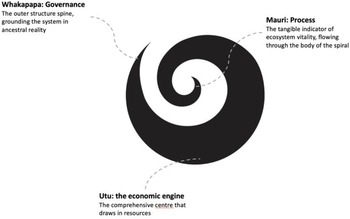
This study asked how Māori understand and navigate sustainability tensions in business. Mainstream managerial approaches to sustainability, often shaped by anthropocentrism and reductionism, tend to treat economic and ecological goals as analytically separable, necessitating trade-offs or optimisation across competing demands (Carmine & De Marchi, Reference Carmine and De Marchi2023; Gladwin et al., Reference Gladwin, Kennelly and Krause1995; Klein, Reference Klein2000). Although responsible management frameworks such as CSR and CE increasingly acknowledge environmental harm, their reliance on voluntary metrics can enable symbolic adoption, including tokenism and greenwashing (Banerjee, Reference Banerjee2012; Delmas & Burbano, Reference Delmas and Burbano2011). Across this mixed sample of knowledgeable participants, sustainability was not framed as only an optimisation problem. Instead, participants describe drawing on te ao Māori to position the organisation as teina (younger kin), seeing the te taiao (nature) as tuākana (elder siblings and ancestors), a relationship mandated by whakapapa. These narratives, however, should not be read as suggesting a singular Māori organisational response, but rather a range of attempts to implement relational principles in contemporary organisational settings. Building on these insights, this paper presents the Whakapapa–Mauri–Utu Regenerative Cycle (Fig. 1) as a conceptual model of how participants relate responsibility, evaluation, and reciprocity in practice. While these concepts are well-established in Māori scholarship (Mead, Reference Mead2016; Mika et al., Reference Mika, Dell, Newth and Houkamau2022a; Spiller et al., Reference Spiller, Erakovic, Henare and Pio2011a), the contribution here lies in theorising how they operate together as a recursive mechanism through which sustainability responsibilities are authorised, evaluated, and enacted in business.
Whakapapa–Mauri–Utu regenerative cycle.

Consistent with the Indigenous epistemological roots of this research, the model is visualised as a koru (spiral). Whakapapa forms the outer structural spine, grounding the system in genealogical reality as a non-negotiable foundation of responsibility. Mauri flows through the spiral, representing an evaluative indicator of ecosystem vitality as a dynamic, continuous signal that guides organisational decision-making. Utu sits at the centre, orienting economic activity towards reciprocity and restoration. The spiral form emphasises that sustainability is enacted through repeated decision moments, rather than through incremental efficiency gains alone, as resource use is continually assessed against responsibilities, vitality, and reciprocity.
Environment as a tuakana (senior system) and whakapapa-based responsibility
Mainstream sustainability models are criticised for treating the natural world as instrumental for human needs and for privileging short-term performance over long-term responsibility (Bansal & DesJardine, Reference Bansal and DesJardine2014; Hahn & Figge, Reference Hahn and Figge2011; Purser, Park & Montuori, Reference Purser, Park and Montuori1995). The findings here indicate that the principle of whakapapa shifts the premise of decision-making by positioning te taiao (the environment) as kin and ancestor rather than as a pool of resources, with some extractive options removed from consideration because they are understood as breaches of obligations to ancestors and descendants (Klein, Reference Klein2000; Spiller et al., Reference Spiller, Pio, Erakovic and Henare2011b).
This genealogical embeddedness changes how sustainability tensions are conceptualised. Instead of asking how much ecological harm is acceptable for economic gain, the question becomes how economic activity can proceed without violating whakapapa-based obligations and ecological integrity across time. From this perspective, the environment is not an external stakeholder to be negotiated with, but the tuakana (senior system) within which economic activity must operate. Addressing sustainability tensions, therefore, relies less on optimisation across separable goals and more on maintaining obligations across generations, kin relations, and ecosystems.
Tino rangatiratanga as the capacity to act
The findings also indicate that enacting whakapapa-based obligations, including maintaining mauri and practising utu-based reciprocity, depends on tino rangatiratanga (self-determination), the authority and the capacity of tangata whenua to exercise decision rights in relation to lands, waters, taonga, and associated knowledge in contemporary institutional settings (McLellan, Reference McLellan2020; Mika, Reference Mika, Joseph and Benton2021b; Paora, Tuiono, Flavell, Hawksley & Howson, Reference Paora, Tuiono, Flavell, Hawksley and Howson2011). Stewardship is therefore not simply an operational requirement or an ethical preference. Rather, it is a political and institutional capacity, in which governance and leaders can exercise authority, particularly where legal, regulatory, and commercial pressures can diminish Māori control over taonga and mātauranga Māori.
Within te ao Māori, responsibilities are enacted through tikanga and collective accountability that guide decision-making, address breaches, and restore balance within relationships (McLellan, Reference McLellan2020; Paora et al., Reference Paora, Tuiono, Flavell, Hawksley and Howson2011). Where Māori environmental responsibilities must be exercised within a wider institutional context; however, the ability to enact and uphold these responsibilities depends on whether tino rangatiratanga is recognised and can be exercised in practice (McLellan, Reference McLellan2020; Mika, Reference Mika, Joseph and Benton2021b; Paora et al., Reference Paora, Tuiono, Flavell, Hawksley and Howson2011). This perspective, therefore, reframes environmental sustainability from an ethical stance alone into a question of practical capacity to act within a dominant politico-economic system.
Countering reductionism
Conventional sustainability management has been criticised for fragmenting complex ecological systems into separate indicators and disclosures (Banerjee, Reference Banerjee2012; Gladwin et al., Reference Gladwin, Kennelly and Krause1995). The findings further show that mauri functions as an integrated evaluative indicator that resists fragmentation by treating ecological, spiritual, social, and economic wellbeing as inseparable (Mead, Reference Mead2016; Spiller et al., Reference Spiller, Pio, Erakovic and Henare2011b). Consistent with this, participants describe efforts to make mauri visible within organisational evaluation, for example, by developing Māori-centred assessment tools as alternatives to conventional cost-benefit analysis. These cost-benefit tools are regarded as culturally biased because they privilege commercial outcomes and short-term efficiency, with limited capacity to account for relational, spiritual, and intergenerational obligations. This shift challenges weak sustainability logics in which ecological degradation can be offset or obscured by financial performance (Landrum, Reference Landrum2018). Under a mauri-centred perspective, a decline of mauri in water or herd signals organisational underperformance, even when short-term financial metrics remain positive.
Reorienting circularity with reciprocity
While circular economy aims to close material loops, the concept and practice often remain vulnerable to market volatility, with firms tempted to revert to linear models if circularity proves unprofitable (Daddi et al., Reference Daddi, Ceglia, Bianchi and de Barcellos2019; Govindan & Hasanagic, Reference Govindan and Hasanagic2018; Korhonen et al., Reference Korhonen, Honkasalo and Seppälä2018). The findings suggest that utu shifts the motivation for circularity away from market efficiency and towards reciprocity. Across participants’ kōrero, taking and consumption create a binding obligation to return through care, replenishment, or restoration, shifting transactional circularity into relational circularity. This reciprocal exchange is enacted within whanaungatanga, which organises shared responsibility and decision-making through relationships. Success is measured by the circulation of resources and collective wellbeing rather than individual wealth accumulation, which directly challenges the capitalist logic of success (Banerjee, Reference Banerjee2012).
Navigating contextual friction
Although the proposed framework offers a coherent model for addressing the tensions of environmental sustainability, it operates within a wider politico-economic context shaped by colonisation and dominant market institutions. The findings show that implementation is hindered by structural friction between relational obligations in te ao Māori and institutional settings that privilege universal metrics, short timelines, and individualised accountability (Amoamo, Ruwhiu & Carter, Reference Amoamo, Ruwhiu and Carter2018; Dell, Staniland & Nicholson, Reference Dell, Staniland and Nicholson2018; Houkamau & Sibley, Reference Houkamau and Sibley2019). These pressures align with institutional isomorphism, in which organisations are pressured to adopt dominant structures and logics to secure legitimacy (DiMaggio & Powell, Reference DiMaggio and Powell1983). For Māori organisations, this reality may mean adopting corporate structures that compromise preferences for holism and collectivism.
Participants stress that barriers are both external and internal: rigid reporting standards, low uptake of Māori-centred assessment tools, capability gaps when leaders are trained primarily in conventional business logics, and reliance on unpaid cultural labour. These conditions help explain why cultural values and principles like whakapapa, mauri, and utu are not simply incorporated, because they require sustained authority, translation work, and resources to remain operational within mainstream governance and measurement paradigms. At the same time, these narratives should not be reduced to a simple binary between uniformly relational Māori practice and uniformly reductionist Western systems. Participants describe varied and often hybrid attempts to enact these principles within institutional settings shaped by reporting requirements, market expectations, and other dominant politico-economic logics. In this sense, the tensions lie at the interface between Māori relational obligations and dominant institutional arrangements shaped by different ontological assumptions about value, accountability, and performance.
Theoretical implications
These findings contribute to paradox theory by offering an alternative ontology for managing environmental sustainability in business. Paradox literature tends to frame sustainability as the management of ecological and economic imperatives as separate and competing demands (Freeman, Reference Freeman, Dmytriyev and Freeman2023; Hahn et al., Reference Hahn, Figge, Pinkse and Preuss2010; Wright & Nyberg, Reference Wright and Nyberg2017). This research indicates that participants do not see these elements of organisational life as conflicting forces requiring trade-offs, but as genealogically embedded, where economic viability relies upon the vitality of te taiao (environment) (Whiteman & Cooper, Reference Whiteman and Cooper2000). This perspective reframes the paradox of sustainability from a problem of balance to one of maintaining genealogical integrity and governance boundaries. In this view, the environment is not an external stakeholder to the firm, but rather the senior system within which the firm operates. Navigating paradox, therefore, relies less on optimisation and more on meeting whakapapa-based obligations, mauri-centred evaluation, and utu-based reciprocity within a regenerative cycle.
Practical implications
Practically, the findings suggest that organisations cannot address sustainability tensions through technical solutions alone. Governance structures that prevent the separation of business from nature, and evaluative practices that keep ecological vitality visible, are also required. For Māori business leaders, the Whakapapa–Mauri–Utu framework can provide a strategic shield against institutional isomorphism by codifying whakapapa-based obligations in mission statements, governance documents, and decision-making protocols. In practice, businesses may recognise responsibilities to whenua, waters, whānau, and future generations as foundational to organisational legitimacy, rather than treating environmental concerns as secondary stakeholder issues. For Māori organisations that embrace te ao Māori, a decline of mauri in ecosystems is interpreted as a primary indicator of organisational underperformance, even if short-term financial returns appear favourable. A mauri-centred performance system would therefore extend assessment beyond financial metrics to include the vitality, integrity, and regenerative capacity of the relationships and environments affected by organisational activity. For non-Māori stakeholders, particularly investors and partners, working with Māori organisations requires cultural humility and a willingness to treat mauri as a legitimate evaluative indicator. More broadly, the findings suggest that tino rangatiratanga must be supported as a practical decision-making capacity, including meaningful authority over strategic priorities, evaluative criteria, and acceptable trade-offs, rather than being acknowledged only as a principle in theory. These findings have implications for how enterprises form partnerships and define risk and performance.
Limitations and future research
This research approach examines kōrero with a relatively small sample of knowledgeable participants, leading to rich and relevant insights. Whilst academy norms may not deem these findings as readily generalisable beyond this context their perspectives, nonetheless, offer valuable insights into the theory guiding environmental practice in business. Future research could build upon the findings by employing quantitative methods to evaluate the prevalence of the relevant values and barriers across Māori and non-Māori enterprises. We are aware of scholars who began to examine the application of Indigenous frameworks in non-Indigenous organisations and business systems (Cribb et al., Reference Cribb, Mika, Leberman and Bennett2024; Elers, Dutta, Jayan, Rahman & Elers, Reference Elers, Dutta, Jayan, Rahman, Elers, Jack, Evans, Lythberg and Mika2024; Stephenson & Mikic, Reference Stephenson and Mikic2025), but further research is needed. Longitudinal case studies would also help explore how organisations maintain genealogical integrity as they scale. Finally, comparative research across Indigenous enterprise contexts would be valuable. For example, a study of the Barunga Festival in Australia describes the challenge as balancing community focus with financial viability (Ensign, Reference Ensign2024), where the present study suggests that many Māori participants placed greater emphasis on preventing profit maximisation from displacing genealogical obligations. Examining such differences more systemically would provide useful insight into where sustainability tensions converge and where they remain contextually distinct across culturally grounded economies.
Conclusion
This paper reframes paradox theory by articulating a culturally grounded model of embedded sustainability. In this model, sustainability is enacted through genealogical responsibility and relational evaluation rather than being treated as a separable set of objectives to be balanced. Whereas conventional approaches often frame sustainability as a persistent tension managed through trade-offs and managerial calculations, the findings indicate an alternative ontology in which economy and environment are understood as genealogically entwined. In this view, the environment is not a competing stakeholder to be negotiated with, but a senior relation within which economic activity is authorised and constrained. Sustainability tensions, therefore, shift from a problem of optimisation across competing goals to a relational practice of maintaining genealogical integrity through whakapapa-based governance, mauri-centred assessment, and utu-based reciprocity, as outlined in the proposed Whakapapa–Mauri–Utu Regenerative Cycle framework.
Practically, this framework challenges dominant assumptions about time and decision horizons in Western management. By shifting from short-term efficiency to intergenerational decision-making, participants articulated a collapse of the distance between present performance and future wellbeing, making intergenerational outcomes a binding constraint on current decisions. The findings also suggest that tino rangatiratanga is a critical enabling condition. This authority empowers organisations to protect whakapapa-based responsibilities, sustain mauri-oriented indicators, and resist institutional isomorphism that would otherwise revert governance and measurement towards narrow profit-centred logics.
Rather than showing how Māori manage a conventional profit-planet paradox, this research suggests that te ao Māori reorients sustainability as a relational obligation and locates the tensions at the interface between genealogical responsibility and dominant politico-economic systems. By exploring how Māori practitioners conceptualise and navigate the sustainability tensions in business, this research demonstrates that Indigenous world views can offer significant insights for addressing contemporary management issues, including the global sustainability crisis. Moving beyond separation and reductionism towards relationality and reciprocity, te ao Māori reframes sustainability tensions as obligations of balance across social and ecological relationships. While enacting this world view remains constrained by institutional structures, the framework offers a credible pathway for designing business structures and practices in which economic activity is accountable to the conditions of life that enable it.
Acknowledgements
The authors declare no competing interests. We are pleased to submit our manuscript titled Genealogical integrity: How Māori manage the paradox of environmental sustainability in business, for consideration for publication in the Journal of Management & Organization. We would like to highlight that an earlier version of this manuscript titled: Beyond reductionism: How Māori manage the paradox of environmental sustainability in business was presented at the 2025 Australia & New Zealand Academy of Management (ANZAM) Conference, where it was honoured with three awards: Best Conference Paper (Overall), Best Student Paper, and Best Paper in the Gender, Diversity, and Indigeneity Stream.
Appendix A Indicative semi-structured kōrero/interview guide
This guide was used to support kōrero on how te ao Māori informs environmental sustainability in organisational and business contexts. Questions were adapted slightly depending on participant role, expertise, and the direction of the kōrero. Core topics included participants’ background, understandings of te ao Māori and sustainability, decision-making practices, lived experiences of tension, and future aspirations.
Opening & whakawhanaungatanga
Thank you for taking the time to speak with me. Before we begin, if that is okay with you, I would like to do a brief mihi, introduce myself, and share a little about my research topic so that you have a clearer sense of my positionality and the purpose of this kōrero. I am interested in your perspectives and experiences of how te ao Māori shapes environmental sustainability in your work or organisation. There are no right or wrong answers. I am interested in your own views and examples. With your permission, I would like to record this interview for transcription and analysis.
Interview questions
1. Could you tell me a little about yourself, including where you were born and raised, and how you came into your current role or position?
Potential follow-up questions: key influences, pathway into this work, experiences that shaped your thinking.
2. What does te ao Māori mean to you, and how does it shape your everyday life and work?
Potential follow-up questions: how you came to learn or deepen these values, concepts or relationships that matter most.
3. What is your understanding of sustainability, particularly from a te ao Māori perspective?
Potential follow-up questions: how this differs from mainstream understandings, key values or responsibilities involved.
4. People often talk about tensions or conflicts between making a profit and protecting the environment. How do you understand these tensions or conflicts, particularly from your cultural perspective?
Potential follow-up questions: whether you see this as a conflict, a balance, a responsibility, or something else.
5. Could you walk me through a recent decision where cultural values informed what you did?
Potential follow-up questions: who was involved, what options were available, what happened next.
6. How do you apply environmental stewardship in day-to-day operations without undermining financial goals?
Potential follow-up questions: tikanga Māori, values, indicators, or other ways of assessing whether decisions are appropriate.
7. Could you share an example of when tensions between profit-making and stewardship responsibilities arose, and how you responded?
Potential follow-up questions: what shaped the outcome, any trade-offs, regrets, or lessons.
8. In what ways, if any, has weaving cultural values into business practice provided strategic or competitive advantages?
Potential follow-up questions: effects on markets, customers, community, trust, or long-term resilience.
9. What do you think is the hardest part of balancing cultural principles with modern business systems, and what has helped you respond to these challenges?
Potential follow-up questions: whānau, community, policy, technology, regulation, government, or funding.
10. How does your organisation work with whānau, hapū, local communities, suppliers, or other partners to live out these cultural values?
Potential follow-up questions: reciprocity, mutual benefit, and any tensions, especially with non-Māori partners.
11. Looking 5 to 10 years ahead, what role do you see te ao Māori and mātauranga Māori playing in helping your organisation respond to environmental challenges?
Potential follow-up questions: future opportunities, partnerships, policy support, or global relevance.
Closing
Is there anything else you would like to add that we have not covered, but that you think is important for understanding this topic?
Appendix B Glossary of Māori terms

Xiaoliang Niu is of Han ethnicity. He was born and raised in Yangxin County, Hubei Province, China. In 2010, he moved to Aotearoa New Zealand to pursue tertiary education. Xiaoliang is currently a PhD student and research assistant at Te Raupapa | Waikato Management School. His research centres on the influence of traditional worldviews and knowledge systems on organisations’ strategies, decision-making, and practices when addressing contemporary management challenges, such as environmental sustainability. His work aims to bridge the gap between traditional wisdom and modern organisational practices, highlighting the importance of cultural understanding in today’s globalised business landscape to guide organisations towards more sustainable, culturally responsive, and socially responsible practices.
Jason Mika, Tūhoe, Ngāti Awa, Te Whakatōhea, Ngāti Kahungunu ki te Wairoa. Jason is a Professor of Māori Management and Associate Dean Māori in He Manga Tauhokohoko | University of Auckland Business School. His research, teaching, writing, and practice centres on Māori and Indigenous business philosophy and practice in multiple sites, sectors, and scales.
Dr. Amber Nicholson is an uri o Ngāruahine and a māmā of two. She has been affiliated with the centre since 2009 in both professional and academic capacities. Amber has been involved in various research projects in the areas of Treaty of Waitangi claims, Māori health disparities, Māori governance, Māori history, child poverty, and Economies of Mana. She completed her PhD in 2021, exploring ways to enhance Māori wellbeing through recognising and honouring the ancestral landscapes in which business operates. Amber has research interests in Māori concepts of wellbeing, economies of mana and kaitiakitanga.
Dr. Paresha Sinha is an Associate Professor in the School of Management and Marketing, Waikato Management School, University of Waikato, New Zealand. She obtained her Ph.D. in Management from the Victoria University of Wellington, New Zealand in 2006. She teaches International Management and Strategic Innovation, and supervises a number of doctoral students researching these issues in emerging markets. She researches at the intersection of international business, strategy, and entrepreneurship domains. Her work builds on institutional, legitimacy, stakeholder, and imprinting theories, and she is interested in investigating the microfoundations of strategic decision-making and legitimacy-building in the cross-border context. Her specialist areas are Emerging markets, Role of the State, MNE practices, Corporate Social Responsibility, Green Innovation and Firm Internationalisation.

 Open access

