

Inclusive education has become a central policy priority across the Pacific, with governments committing to frameworks such as the United Nations Convention on the Rights of Persons With Disabilities (CRPD; United Nations, 2006), the Sustainable Development Goals (SDGs; United Nations, 2015), and the Pacific Framework for the Rights of Persons With Disabilities 2016–2025 (PFRPD; Pacific Islands Forum Secretariat [PIFS], 2016). Regionally, the Pacific Regional Inclusive Education Review (UNICEF, 2022) highlighted that although policy development has accelerated, implementation remains uneven, with many learners with disability still excluded from quality education.
Pacific governments have adopted a range of disability and education policies, as mapped in the 2012 review of disability frameworks (Pacific Disability Forum [PDF] & PIFS, 2012), which noted both recognition of rights and persistent fragmentation in practice. Vanuatu, a Melanesian small island state in the South Pacific, reflects this trajectory but also stands out for embedding inclusive education within its national legal and strategic architecture: the Constitution of the Republic of Vanuatu (Republic of Vanuatu, 1980; hereafter referred to as the Constitution) affirms the right to education and equality before the law; the Education Act No. 9 of 2014 (Republic of Vanuatu, 2014; hereafter referred to as the Education Act) provides the legal framework for non-discrimination and the structure of formal schooling (Years 1–13); and Vanuatu 2030: The People’s Plan: National Sustainable Development Plan 2016–2030 (Government of the Republic of Vanuatu, 2016; hereafter referred to as the People’s Plan) positions inclusive education as central to national identity, cultural continuity, and sustainable development.
The Vanuatu Education and Training Sector Strategy 2021–2030 (Ministry of Education and Training [MoET], 2021) further identified inclusive education, plurilingualism, and equity-based reforms as policy priorities, aligning the sector with Sustainable Development Goal 4 (SDG 4; United Nations, 2015) and emphasising the need for evidence-based and community-grounded practice. Vanuatu reflects this trajectory. Since 2011, the country has progressively introduced inclusive education policies, supported by civil society organisations and international partners (Eldads Vira et al., Reference Eldads Vira, Page and Ledger2026). However, the scale of the implementation challenge remains significant, with only approximately 0.05% of teachers having received formal training in inclusive education (UNICEF, 2022), highlighting critical gaps in capacity to translate policy into classroom practice.
Regionally, policy ambitions are often constrained by resourcing, teacher preparation, and the need for culturally legitimate, community-owned implementation approaches (UNICEF, 2022). These findings illustrate that the persistent policy–practice gap is a regional phenomenon and not limited to Vanuatu. Across the Pacific, policies often establish ambitious commitments, consistent with international frameworks such as the CRPD (United Nations, 2006) and SDG 4 (United Nations, 2015), but translating these into classroom realities is constrained by teacher training gaps, low community awareness, weak data systems, and the absence of culturally responsive implementation approaches (UNICEF, 2022). This suggests that technical solutions alone are insufficient; reforms must be grounded in local knowledge systems, languages, and community practices if they are to achieve legitimacy and sustainability.
In this context, the article applies the Kokonas Research Methodology (KRM) as a culturally grounded approach for translating inclusive education policy into practice in Vanuatu. The purpose of this article is to demonstrate how KRM can guide the implementation of Vanuatu’s new Inclusive Education and Training Policy 2025–2030 (MoET, 2024; hereafter referred to as the IET Policy), closing the gap between high-level commitments and practice in schools and communities. The article first introduces KRM, then outlines the core goals and challenges of the IET Policy, before applying each stage of KRM to show practical routes for implementation. In doing so, it contributes a Vanuatu-born approach to the global literature on inclusive education and policy implementation.
Barriers to Implementing Inclusive Education
To understand why inclusive education policies frequently fail to translate into classroom practice, it is necessary to first identify and prioritise the key barriers that shape implementation. Globally, barriers to the implementation of inclusive education are understood to be complex and multifaceted, operating across individual, institutional, and systemic levels. Commonly cited barriers include limited teacher preparation and ongoing professional learning, negative or uncertain teacher attitudes, insufficient resources and specialist support, weak data systems, and fragmented governance and accountability structures (Ainscow, Reference Ainscow2020; Florian & Black-Hawkins, Reference Florian and Black-Hawkins2011; Mariga et al., Reference Mariga, McConkey and Myezwa2014; Slee, Reference Slee2011), particularly where inclusive education policies are enacted through existing school structures rather than implemented as technical reforms (Ball et al., Reference Ball, Maguire and Braun2012).
These barriers also encompass rigid curriculums and assessment regimes, medicalised identification models, physical and transport barriers, multilingual challenges, and unstable funding environments that undermine sustained implementation (Ainscow, Reference Ainscow2020; Florian & Black-Hawkins, Reference Florian and Black-Hawkins2011; Slee, Reference Slee2011). In Vanuatu, these barriers do not operate as discrete factors but manifest primarily through the five interrelated priority barriers identified in this study, most notably through constrained teacher capacity and confidence, attitudes shaped by structural limitations, chronic resource and specialist support gaps, weak disability-related data systems, and fragmented governance and policy enactment processes. While these barriers are evident internationally, evidence from the Pacific region and Vanuatu indicates that they are intensified and shaped by local contextual factors, requiring contextually grounded responses rather than the direct transfer of externally developed models (Eldads Vira et al., Reference Eldads Vira, Page and Ledger2025; Hlatywayo & Hlatywayo, Reference Hlatywayo and Hlatywayo2025).
Drawing on empirical studies conducted in Vanuatu, including teacher interviews, classroom observations, quantitative analyses of teacher attitudes, and regional scoping reviews, five interrelated barriers are prioritised as most critical to address when implementing inclusive education policy in this context (Eldads Vira et al., Reference Eldads Vira, Page and Ledger2025, Reference Eldads Vira, Page and Ledger2026; Hlatywayo & Hlatywayo, Reference Hlatywayo and Hlatywayo2025).
Across the Pacific, implementation is constrained by medicalised assessment models, weak institutional capacity, limited participatory approaches, and structural and geographic exclusions (Partnerships for Social Protection, 2024). Weak disability-related data, characterised by inconsistent identification and limited disaggregation, undermines planning, resourcing, and monitoring (Croft, Reference Croft2013; Pacific Community, 2020).
Teacher preparation remains uneven across the region and is particularly limited in Vanuatu, where only 0.05% of teachers have received formal inclusive education training (UNICEF, 2022). These system-level constraints are compounded by persistent resource gaps, community-level stigma, and limited awareness, particularly in remote areas (PDF, 2022).
Taken together, this evidence indicates that inclusive education in the Pacific is constrained not by the absence of policy but by the lack of effective, contextually grounded mechanisms for implementation, particularly in relation to teacher capacity and professional learning; teacher attitudes and beliefs about inclusion; resource constraints and specialist support; disability-related data and monitoring systems; and governance, coordination, and policy enactment challenges, which will be further elaborated on as follows.
1. Teacher Capacity and Professional Learning (Priority Barrier)
Across global and local literature, inadequate teacher preparation is consistently identified as a major barrier to inclusive education. Research on inclusive education implementation highlights the importance of sustained, practice-focused professional learning rather than one-off training interventions (Florian & Beaton, Reference Florian and Beaton2018; Sharma et al., Reference Sharma, Loreman and Forlin2012). In Vanuatu, this challenge is particularly acute. Teachers report limited preservice preparation for inclusive practices and few opportunities for sustained, contextually relevant professional learning once in schools (Hlatywayo & Hlatywayo, Reference Hlatywayo and Hlatywayo2025). Rather than resistance to inclusion, teachers frequently express strong motivation but low confidence, particularly in supporting learners with disability in overcrowded classrooms and with minimal specialist support. Quantitative evidence from Vanuatu further demonstrates a clear relationship between teacher attitudes, self-efficacy, and subsequent classroom practices, underscoring professional learning as a critical leverage point for change (Eldads Vira et al., Reference Eldads Vira, Page and Ledger2026).
2. Teacher Attitudes and Beliefs About Inclusion
Globally, teacher attitudes are recognised as a key determinant of inclusive practice (Florian & Black-Hawkins, Reference Florian and Black-Hawkins2011; Sharma et al., Reference Sharma, Loreman and Forlin2012). In Vanuatu, attitudes towards inclusion are shaped not only by knowledge and training but also by perceived support, workload, and cultural expectations of teachers as community leaders. Evidence from Vanuatu classrooms indicates that neutral or hesitant attitudes towards inclusion are often linked to structural constraints rather than ideological opposition, suggesting that shifts in attitudes are likely to occur alongside improvements in training, support, and resourcing rather than through attitudinal interventions alone (Eldads Vira et al., Reference Eldads Vira, Page and Ledger2026).
3. Resource Constraints and Limited Specialist Support
Insufficient teaching and learning resources, lack of assistive technologies, and minimal access to specialist services are widely reported barriers to inclusive education internationally. In Vanuatu, these challenges are compounded by geographic dispersion, transport limitations, and reliance on generalist teachers to meet diverse learner needs without specialist backup (Hlatywayo & Hlatywayo, Reference Hlatywayo and Hlatywayo2025). Teachers frequently describe the need to improvise low-cost, locally available strategies, highlighting both the resilience of educators and the limits of policy expectations that are not matched with material support. Similar patterns have been documented in low-resource and low-income contexts, where inclusive practices emerge through adaptation rather than formal system support (Mariga et al., Reference Mariga, McConkey and Myezwa2014; Miles & Singal, Reference Miles and Singal2010).
4. Weak Disability-Related Data and Monitoring Systems
Reliable data are essential for planning, monitoring, and resourcing inclusive education systems. However, both global and Pacific literature identify weaknesses in disability identification, data collection, and use for decision-making (Eldads Vira et al., Reference Eldads Vira, Page and Ledger2025). In Vanuatu, inconsistent data on learners with disability constrains targeted support, resource allocation, and policy monitoring, limiting the capacity of schools and the system to respond effectively to learner diversity (Croft, Reference Croft2013; Pacific Community, 2020; UNICEF, 2022).
5. Governance, Coordination, and Policy Enactment Challenges
Finally, challenges related to governance and coordination persist. Internationally, inclusive education reforms often struggle due to fragmented responsibilities across ministries and levels of the system (Ainscow, Reference Ainscow2020; Honig, Reference Honig2006). In Vanuatu, teachers report limited guidance on how inclusive education policies should be enacted in daily practice, resulting in a disconnect between policy intentions and classroom realities (Hlatywayo & Hlatywayo, Reference Hlatywayo and Hlatywayo2025).
Global and Local Dimensions of Barriers
Although these barriers mirror those documented internationally, their effects in Vanuatu are intensified by geographic dispersion, multilingual classrooms, strong kastom (customary knowledge) obligations, limited specialist infrastructure, and the central role of teachers as community leaders. As a result, global challenges related to teacher preparation, data systems, resourcing, and governance manifest locally as minimal training coverage, inconsistent disability identification, reliance on generalist teachers, and limited guidance on everyday policy enactment. Recognising both global commonalities and local specificities is therefore essential for designing culturally responsive, locally led implementation approaches.
These five barriers are interrelated and prioritised according to how inclusive education is most feasibly implemented in practice. Teacher capacity and professional learning represent the most immediate leverage points for classroom-level change, while improvements in disability-related data systems and governance are critical for sustaining and scaling reform. Resource availability and teacher attitudes are understood to shift through supported practice rather than as preconditions for inclusion, reinforcing the need for sequenced implementation rather than simultaneous reform across all domains.
Positioning for the Kokonas Research Methodology
Identifying and prioritising these barriers provides the foundation for applying the Kokonas Research Methodology (KRM) in the implementation of Vanuatu’s IET Policy. Consistent with policy enactment scholarship, KRM recognises that policies are realised through relationships, practices, and local conditions rather than linear implementation processes (Ball et al., Reference Ball, Maguire and Braun2012), aligning with systems-level approaches that emphasise context-responsive change over prescriptive models (Nilholm, Reference Nilholm2021). Together, these prioritised barriers define the core implementation problem facing inclusive education in Vanuatu and provide the basis for examining how the IET Policy can be enacted in practice through a culturally grounded implementation framework.
The Inclusive Education and Training Policy 2025–2030
The IET Policy (MoET, 2024) was developed by the Government of Vanuatu in response to many of the barriers identified above, particularly inequitable access, limited teacher capacity, weak data systems, and challenges in translating national commitments into school-level practice. Vanuatu’s government has positioned inclusive education as a national priority through this policy, building on earlier commitments and framing equitable access to quality education and training for all learners, including those with disability.
At its core, the policy outlines three interlinked goals:
-
1. Equity of access — removing barriers so learners with disability, those in remote areas, and other marginalised groups can enrol, attend, and succeed
-
2. Teacher development — supporting teachers with training, resources, and professional learning to adopt inclusive pedagogy
-
3. School transformation — adapting environments, curriculums, and governance to foster inclusive cultures.
The policy aligns with CRPD Article 24, SDG 4, and the PFRPD, affirming inclusive education as both a legal obligation and a development imperative. Despite strong commitments, the challenges to implementing inclusive education in Vanuatu remain significant. As noted by UNICEF (2022), only a very small proportion of Vanuatu’s teachers have formal training in inclusive education (0.05%). Resource constraints persist (limited aides, specialist personnel, and adapted materials), and community attitudes continue to pose barriers, with stigma and low expectations reducing participation and achievement. Monitoring and evaluation systems are weakened by limited, disaggregated disability data (Croft, Reference Croft2013).
Taken together, the IET Policy represents an ambitious and necessary step. Its success will depend not only on technical solutions such as teacher training and data systems but also on culturally grounded, community-owned approaches capable of addressing the persistent policy–practice gap.
Why Indigenous Methodology Matters
Inclusive education reforms in the Pacific are often framed through international instruments such as the CRPD (United Nations, 2006) and the SDGs (United Nations, 2015). Although these commitments are essential, they frequently enter education systems as externally driven mandates that risk overlooking local cultural contexts.
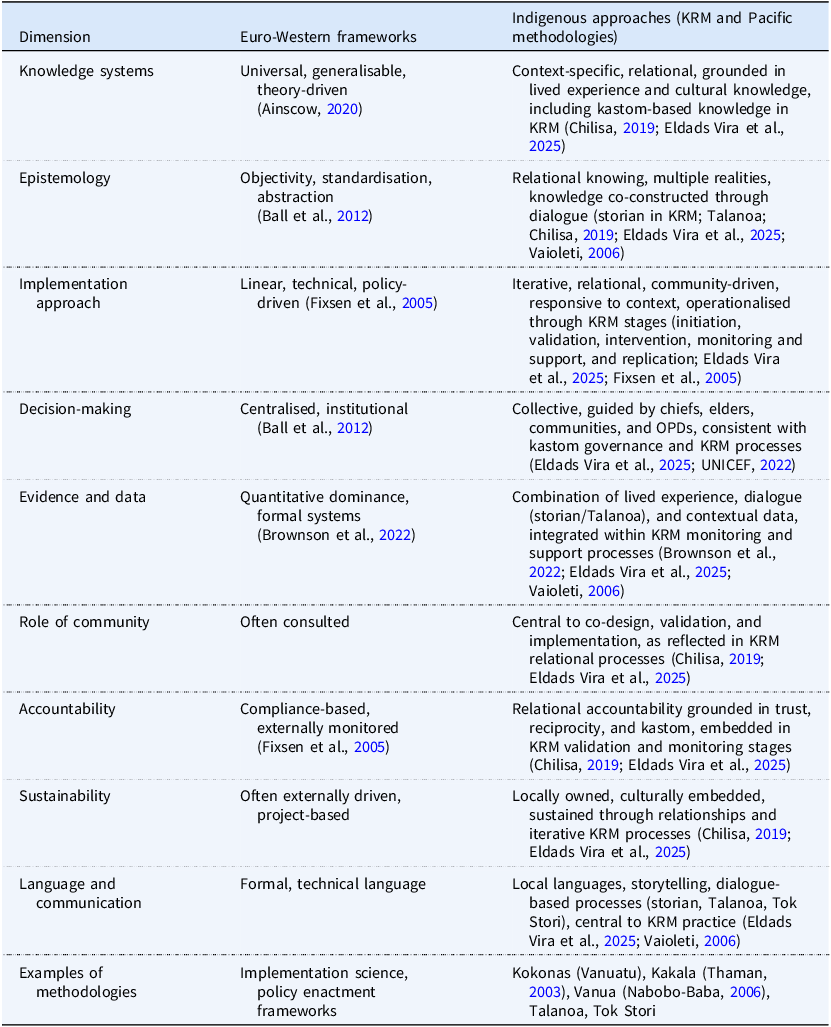
To further clarify the distinction between dominant Euro-Western approaches and Indigenous methodologies in the Pacific, a comparative summary is presented in Table 1. This comparison highlights key differences in how knowledge, implementation, and accountability are conceptualised across contexts. Euro-Western frameworks are often characterised by standardisation, generalisability, and technical approaches to implementation (Ainscow, Reference Ainscow2020; Ball et al., Reference Ball, Maguire and Braun2012), whereas Indigenous methodologies emphasise relational accountability, cultural legitimacy, and community ownership (Chilisa, Reference Chilisa2019; Vaioleti, Reference Vaioleti2006). The KRM is situated within this Indigenous tradition, drawing on kastom and storian (dialogue) as culturally grounded processes for knowledge generation, validation, and implementation. This comparison highlights the misalignment between standardised policy approaches and the relational, culturally grounded realities of Pacific education systems, reinforcing the need for implementation frameworks such as the KRM.
Comparison of Euro-Western Frameworks and Indigenous Methodologies in Inclusive Education Implementation

Table 1. Long description
A table comparing Euro-Western frameworks and Indigenous approaches in inclusive education implementation across various dimensions. The table has 10 rows and 3 columns. The columns are labeled Dimension, Euro-Western frameworks, and Indigenous approaches (KRM and Pacific methodologies). The rows are labeled Knowledge systems, Epistemology, Implementation approach, Decision-making, Evidence and data, Role of community, Accountability, Sustainability, Language and communication, and Examples of methodologies. Row 1: Knowledge systems, Universal, generalisable, theory-driven, Context-specific, relational, grounded in lived experience and cultural knowledge, including kastom-based knowledge in KRM. Row 2: Epistemology, Objectivity, standardisation, abstraction, Relational knowing, multiple realities, knowledge co-constructed through dialogue (storian in KRM; Talanoa; Chilisa, 2019; Eldads Vira et al., 2025; Vaioleti, 2006). Row 3: Implementation approach, Linear, technical, policy-driven (Fixsen et al., 2005), Iterative, relational, community-driven, responsive to context, operationalised through KRM stages (initiation, validation, intervention, monitoring and support, and replication; Eldads Vira et al., 2025; Fixsen et al., 2005). Row 4: Decision-making, Centralised, institutional (Ball et al., 2012), Collective, guided by chiefs, elders, communities, and OPDs, consistent with kastom governance and KRM processes (Eldads Vira et al., 2025; UNICEF, 2022). Row 5: Evidence and data, Quantitative dominance, formal systems (Brownson et al., 2022), Combination of lived experience, dialogue (storian/Talanoa), and contextual data, integrated within KRM monitoring and support processes (Brownson et al., 2022; Eldads Vira et al., 2025; Vaioleti, 2006). Row 6: Role of community, Often consulted, Central to co-design, validation, and implementation, as reflected in KRM relational processes (Chilisa, 2019; Eldads Vira et al., 2025). Row 7: Accountability, Compliance-based, externally monitored (Fixsen et al., 2005), Relational accountability grounded in trust, reciprocity, and kastom, embedded in KRM validation and monitoring stages (Chilisa, 2019; Eldads Vira et al., 2025). Row 8: Sustainability, Often externally driven, project-based, Locally owned, culturally embedded, sustained through relationships and iterative KRM processes (Chilisa, 2019; Eldads Vira et al., 2025). Row 9: Language and communication, Formal, technical language, Local languages, storytelling, dialogue-based processes (storian, Talanoa, Tok Stori), central to KRM practice (Eldads Vira et al., 2025; Vaioleti, 2006). Row 10: Examples of methodologies, Implementation science, policy enactment frameworks, Kokonas (Vanuatu), Kakala (Thaman, 2003), Vanua (Nabobo-Baba, 2006), Talanoa, Tok Stori.
Note. Storian refers to culturally grounded dialogic processes in Vanuatu. KRM = Kokonas Research Methodology; OPDs = organisations of persons with disabilities.
Scholars have long highlighted the limitations of applying Euro-Western frameworks in non-Western settings. For example, Slee (Reference Slee2011) critiques how global inclusion discourses often reproduce the regular/special divide, while Florian and Black-Hawkins (Reference Florian and Black-Hawkins2011) argue for pedagogies that extend the learning opportunities available to all learners rather than categorising learners. Ainscow (Reference Ainscow2020) calls for system-wide, collaborative inquiry, and Mariga et al. (Reference Mariga, McConkey and Myezwa2014) demonstrate the importance of community mobilisation in low-resource contexts. These insights resonate with Pacific realities but require translation into locally meaningful processes — this is where Indigenous methodologies assume significance. As Chilisa (Reference Chilisa2019) argues, postcolonial Indigenous methodologies challenge dominant deficit-driven and externally imposed research approaches, emphasising relational accountability, respectful representation, reciprocity, and responsibility. They recognise that knowledge is situated in specific sociohistorical and cultural contexts, and that credible research must emerge from the lived realities of the communities it serves.
In Vanuatu, knowledge exchange has long been mediated through kastom and storian, which are dialogic, relational, and community-owned. The KRM translates these Indigenous principles into a structured implementation process grounded in kastom and storian. Consistent with established implementation science principles (Damschroder et al., Reference Damschroder, Reardon, Widerquist and Lowery2022; Fixsen et al., Reference Fixsen, Naoom, Blase, Friedman and Wallace2005), KRM enacts leadership, capacity-building, and feedback through culturally legitimate practices of kastom and storian. The alignment between KRM and implementation science is elaborated in a later section.
At a regional scale, KRM positions Vanuatu as a contributor to Pacific and wider Asia-Pacific debates on culturally grounded approaches that move inclusive education beyond imported technical solutions. Thus, Indigenous methodologies matter not only for decolonising knowledge production but also for ensuring that reforms such as Vanuatu’s IET Policy (MoET, 2024) are translated into practice in ways that are sustainable, equitable, and culturally resonant.
Purpose and Outline
The purpose of this article is to demonstrate how the KRM can guide the implementation of Vanuatu’s IET Policy. Although the policy establishes ambitious commitments for equitable access, teacher development, and system transformation, its success will depend on culturally grounded approaches that translate high-level goals into practice. The article proceeds by outlining KRM, introducing the IET Policy and its implementation challenges, applying each KRM stage to demonstrate practical pathways for enactment, and concluding with implications for policymakers, educators, communities, and the wider Pacific region.
Overview of the Kokonas Research Methodology
The KRM is a Vanuatu-developed, culturally grounded framework that structures inclusive education research and policy implementation through kastom and storian. Drawing its metaphor and structure from the coconut (kokonas) — a symbol of growth, nourishment, resilience, and regeneration in Ni-Vanuatu life — KRM ensures that implementation processes are culturally resonant and accessible. Embedded in kastom and storian, KRM reflects Ni-Vanuatu ways of knowing and decision-making, emphasising relational accountability, collective reflection, and community ownership in the enactment of policy and practice.
KRM is structured around five interconnected stages that mirror the growth of the coconut palm (kokonas), using leaf development imagery to represent participatory change:
-
1. Initiation — identifying needs and priorities through culturally appropriate entry points and dialogue with chiefs, parents, organisations of persons with disabilities (OPDs), and other stakeholders
-
2. Validation — confirming the relevance and legitimacy of proposed directions through storian, collective reflection, and multi-level agreement (community and provincial)
-
3. Intervention — implementing agreed initiatives (e.g., teacher training, curriculum adaptation, inclusive school practices) in partnership with local actors
-
4. Monitoring and support — sustaining change through feedback loops, peer networks, and regular community dialogue
-
5. Replication — adapting and scaling practices that have been validated locally, ensuring fidelity to kastom while adjusting to new contexts.
KRM offers a theoretical contribution to global inclusive education and implementation science while providing Vanuatu with a practical, culturally legitimate framework for translating policy into practice.
The Coconut Metaphor
In KRM (Eldads Vira et al., Reference Eldads Vira, Page and Ledger2025), the coconut is a guiding metaphor for the growth of knowledge and the implementation of change. Each stage aligns with the growth of the coconut palm, represented through coconut leaf development:
-
• Initiation is symbolised by the first fused leaves of a seedling, representing early baseline knowledge and priority setting.
-
• Validation is likened to the leaflets forming from a coconut leaf, symbolising strengthening knowledge through storian and evidence.
-
• Intervention is represented by the developing leaf, reflecting professional learning and classroom/application.
-
• Monitoring and support are symbolised by a healthy crown producing new leaves, representing feedback, encouragement, and sustained growth.
-
• Replication is depicted by the many leaflets on a mature palm and the potential for new trees, symbolising the spread of good practice across schools and islands.
This metaphor ensures that KRM is culturally resonant and accessible, grounding implementation in imagery familiar to Ni-Vanuatu.
Supporting Cultural and Contextual References
KRM is strengthened by its grounding in Pacific Indigenous research traditions that privilege dialogue, reciprocity, and collective ownership. Frameworks such as Talanoa (Vaioleti, Reference Vaioleti2006), Vanua (Nabobo-Baba, Reference Nabobo-Baba2006), and Kakala (Thaman, Reference Thaman2003) emphasise relationality, respect, and the embedding of research in cultural protocols and values. These approaches are recognised across the Pacific as legitimate alternatives to Western methodologies, ensuring research is not only about communities but also for and with them. KRM stands within this tradition while offering a Vanuatu-born articulation through kastom and storian.
OPDs further demonstrate the importance of community ownership. The Pacific Regional Inclusive Education Review (PDF, 2022) highlights how OPDs provide technical advice, mobilise communities, and advocate to bridge gaps between policy commitments and lived realities.
At the same time, KRM contributes to global debates. Ainscow (Reference Ainscow2005, Reference Ainscow2020) argues for whole-system reform and collaborative inquiry; Slee (Reference Slee2011) critiques exclusionary cultures and calls for dismantling the regular/special divide; Florian and Black-Hawkins (Reference Florian and Black-Hawkins2011) propose inclusive pedagogy that extends what is ordinarily available to all; and Mariga et al. (Reference Mariga, McConkey and Myezwa2014) highlight community mobilisation and low-cost adaptations. KRM aligns with these perspectives but is distinctive in its codified five-stage process rooted in Vanuatu’s cultural logics.
Core Document: The Vanuatu Inclusive Education and Training Policy 2025–2030
The central document guiding this analysis is the Vanuatu IET Policy (MoET, 2024). The policy articulates a vision of a future where all learners are supported to reach their full potential in inclusive schools and training institutions (p. 11) and anchors inclusive education in equity, human rights, and alignment with international and regional commitments, including the CRPD, SDGs, and the PFRPD.
As the policy affirms, teachers are at the heart of inclusive education, and sustained training and support are essential for transforming classroom practice (MoET, 2024, p. 14). This emphasis highlights the need for implementation approaches that translate policy commitments into locally meaningful professional learning and sustained classroom change.
Supporting Policy Alignment Documents
The IET Policy sits within broader frameworks that establish inclusive education as a legal right and development priority:
-
• CRPD (2006): Article 24 obliges States Parties to ensure an inclusive education system at all levels, prohibiting exclusion and mandating reasonable accommodation and individualised support.
-
• SDGs (2015): Goal 4 calls for ‘inclusive and equitable quality education and lifelong learning opportunities for all’, linking national progress to global monitoring.
-
• PFRPD (2016–2025): This framework bridges global commitments and Pacific realities, calling for inclusive education, stronger evidence systems, and inclusion in disaster risk reduction.
Together, these documents provide legitimacy, coherence, and accountability, while KRM offers a culturally grounded mechanism for translating commitments into practice.
Foundations of the Kokonas Research Methodology
Part A: Why KRM Was Developed
Despite strong global and regional commitments to inclusive education, including those articulated through the CRPD and SDG 4, a persistent gap remains between policy intentions and classroom practice. Inclusive education reforms have frequently been introduced through externally derived policy frameworks and implementation models that assume stable systems, specialist infrastructure, and individualised accountability structures that do not align with small-island, resource-constrained, and culturally relational contexts. As a result, policies are often adopted at the national level but fail to translate into sustained change in schools and communities. This policy–practice gap highlights the need for an implementation approach that is culturally grounded, relational, and responsive to the realities of Pacific education systems.
Part B: What KRM Is (Purpose and Design)
The KRM was originally developed to support inclusive education research and professional learning in Vanuatu, specifically to address the persistent gap between inclusive education policy commitments and classroom practice. Its application to the IET Policy therefore extends, rather than repurposes, the original intent of the methodology.
KRM is a culturally grounded Indigenous methodology developed through empirical research with teachers, schools, and communities in Vanuatu, drawing on kastom and storian as foundational processes for knowledge generation, validation, and action. The methodology is structured around five interconnected stages — initiation, validation, intervention, monitoring and support, and replication — which reflect how change is negotiated, enacted, and sustained within Ni-Vanuatu social systems. KRM integrates these processes into a single framework that emphasises relational accountability, collective ownership, and iterative adaptation. Overall, KRM provides a structured yet flexible approach that aligns formal policy goals with everyday school and community practices, ensuring that inclusive education reforms are both evidence-informed and culturally legitimate.
Part C: KRM and Implementation Science (Fixsen vs. CFIR Clarified)
Implementation science provides a useful lens for understanding why inclusive education policies frequently fail to translate into sustained practice. Two influential bodies of work — implementation drivers (Fixsen et al., Reference Fixsen, Naoom, Blase, Friedman and Wallace2005; Fixsen & Blase, Reference Fixsen and Blase2009) and the Consolidated Framework for Implementation Research (CFIR; Damschroder et al., Reference Damschroder, Aron, Keith, Kirsh, Alexander and Lowery2009, Reference Damschroder, Reardon, Widerquist and Lowery2022) — offer complementary but distinct perspectives on implementation processes.
Fixsen et al.’s (Reference Fixsen, Naoom, Blase, Friedman and Wallace2005) implementation drivers focus on how change is enacted. They identify three core sets of drivers necessary for effective implementation:
-
1. Competency drivers, such as training, coaching, and performance assessment
-
2. Organisational drivers, including data systems, administrative support, and facilitative leadership
-
3. Leadership drivers, which address both technical and adaptive challenges.
By contrast, CFIR (Damschroder et al., Reference Damschroder, Aron, Keith, Kirsh, Alexander and Lowery2009, Reference Damschroder, Reardon, Widerquist and Lowery2022) provides a comprehensive framework for understanding why implementation succeeds or fails by identifying domains that shape implementation contexts. These include characteristics of the intervention, inner and outer settings, individual characteristics, and implementation processes. CFIR is particularly useful for diagnosing contextual barriers, such as limited resources, competing priorities, or weak institutional readiness. KRM aligns with implementation science by operationalising these drivers and contextual domains through Indigenous processes rather than treating them as abstract constructs.
The five stages of KRM provide a culturally grounded pathway through which implementation drivers are enacted and contextual barriers addressed. For example, initiation and validation function as leadership and organisational drivers by establishing legitimacy, shared purpose, and collective ownership through kastom-based authority and storian. Intervention aligns with competency drivers by embedding professional learning, practice adaptation, and peer support within schools. Monitoring and support correspond with organisational drivers and CFIR’s emphasis on feedback and learning systems, combining technical data collection with relational accountability. Replication addresses sustainability and scale, aligning with both Fixsen’s emphasis on system-level drivers and CFIR’s focus on adaptation across settings.
Taken together, KRM operationalises implementation drivers through culturally legitimate processes suited to contexts where community relationships play a central role. KRM provides a practical mechanism for translating policy into practice.
Applying KRM to the Inclusive Education and Training Policy
The IET Policy sets ambitious goals for equity of access, teacher development, and school transformation. Achieving these aims requires implementation approaches that are technically sound, culturally grounded, and community owned. Building on the challenges identified earlier, particularly teacher capacity, data limitations, resourcing constraints, and governance gaps, this section demonstrates how the KRM operationalises the IET Policy across schools, communities, and governance systems.
Stage 1. Initiation: Co-design With Stakeholders
In KRM, initiation begins with respectful entry points and the identification of priorities. Applied to the IET Policy, this stage emphasises co-design with chiefs, parents, teachers, and OPDs. OPD-led initiatives in Vanuatu and Solomon Islands demonstrate the value of disability-led design and advocacy (PDF, 2022). UNICEF (2022) similarly underscores that early community and parental engagement is essential for awareness and ownership. Practical actions for Stage 1 include mapping local priorities, convening chief-led storian, and establishing school–community agreements that name responsibilities and timelines. This stage directly addresses the IET Policy’s priority on equity of access and community awareness by ensuring that implementation priorities are co-defined with those most affected by exclusion.
At this stage, the policy is operationalised through practical actions such as identifying priority schools, mapping teachers requiring inclusive education training, establishing baseline community awareness, and clarifying governance roles between schools, provincial offices, and OPDs. In operational terms, initiation is led at the school and community level, with support from provincial education offices and OPDs.
School leaders and teachers work with chiefs, parents, and OPDs to identify priority learners, schools, and professional learning needs through storian-based meetings (Honig, Reference Honig2006; PDF, 2022). Tools at this stage include priority school lists, mapping of teacher professional learning needs, and documented community agreements. Evidence of progress includes documented priorities, community endorsement of inclusion goals, and an agreed starting point for implementation.
Stage 2. Validation: Storian and Community Ownership
Validation formalises the process of ensuring that policy directions resonate with community values and practices. Historically, consultation gaps in Pacific disability frameworks (PDF & PIFS, 2012) have weakened legitimacy. By embedding storian dialogues at provincial and community levels, the IET Policy can confirm shared ownership before implementation.
In KRM, this stage is likened to the leaflets forming from a coconut leaf, symbolising clarity and illumination, just as burning coconut leaves provide light along a dark path. Validation is not only about dialogue but also about following kastom protocols — respecting hierarchy, speaking in a shared language, and observing cultural gestures — so that storian is both relational and legitimate. Indigenous approaches such as Talanoa, Vanua, and Kakala reinforce that relational dialogue is central to trust and legitimacy (Nabobo-Baba, Reference Nabobo-Baba2006; Thaman, Reference Thaman2003; Vaioleti, Reference Vaioleti2006). Practical actions for Stage 2 involve participatory feedback circles, consent-seeking protocols with chiefs and OPDs, and translation of policy messages into local languages.
Validation responds to a key implementation risk identified in Pacific reforms — weak legitimacy arising from limited consultation — which often undermines policy uptake at school and community levels. Validation operationalises the policy by confirming training priorities, resource expectations, and implementation responsibilities through storian. This includes validating teacher professional learning plans, agreeing on culturally appropriate data-collection approaches, and confirming community roles in supporting learners with disability.
Operationally, validation is coordinated primarily at the provincial level, with oversight from the MoET and participation from schools and OPDs. Provincial and community storian sessions are used to confirm priorities, clarify roles, and agree on training focus, data approaches, and implementation timelines (Nabobo-Baba, Reference Nabobo-Baba2006; Vaioleti, Reference Vaioleti2006). Tools include storian summaries, validated implementation plans, and translated policy messages. Evidence of progress is demonstrated through provincial and community sign-off, shared understanding of responsibilities, and agreed sequencing of implementation activities.
Stage 3. Intervention: Practical Rollout
Once validated, KRM turns to intervention: the classroom and school-level rollout of inclusive practices. The Pacific-INDIE project revealed persistent needs for teacher training, classroom adaptations, and accessible materials. Guidance from Mariga et al. (Reference Mariga, McConkey and Myezwa2014) provides low-cost strategies and community mobilisation approaches.
International theory complements this: Ainscow (Reference Ainscow2020) on system levers and Florian and Black-Hawkins (Reference Florian and Black-Hawkins2011) on extending what is ordinarily available align with the IET Policy’s emphasis on professional learning and curriculum reform. Practical actions for Stage 3 include school-based professional learning communities, peer coaching, universal design adjustments, and individual education plan light templates that are feasible in low-resource settings.
In practice, culturally responsive inclusive pedagogy within KRM is enacted through a small number of named, low-intensity teaching practices that are already familiar within Ni-Vanuatu classrooms, which include
-
• storian-based reflective teaching, where teachers and learners use dialogue to reflect on learning, participation, and inclusion
-
• peer learning and mixed-ability grouping, which enable collaborative learning and reduce reliance on individualised pull-out support
-
• use of local languages alongside English or French, supported by visual aids and concrete materials to strengthen access and understanding
-
• integration of community knowledge as a curriculum resource, drawing on local examples, livelihoods, and cultural practices
-
• flexible pacing and assessment, allowing learners to demonstrate understanding through varied modes rather than standardised written tasks alone.
This stage operationalises the IET Policy’s commitments to teacher development and school transformation by translating professional learning into feasible classroom practices in low-resource settings.
At the intervention stage, the policy is enacted through concrete actions including delivery of school-based teacher training, use of low-cost inclusive pedagogy strategies, classroom adaptations, and deployment of locally available resources. Pedagogical change is prioritised through peer coaching, universal design adjustments, and feasible individual learning supports rather than specialist-dependent models (Florian & Beaton, Reference Florian and Beaton2018; Miles & Singal, Reference Miles and Singal2010).
Action focuses on school-based teacher professional learning, curriculum adaptation, and classroom-level inclusive practices using low-cost, locally available strategies. Tools include teacher training materials, adapted lesson plans, peer-coaching records, and simple learning-support templates. Evidence of progress includes teacher participation in professional learning, documented classroom adaptations, and reflective records indicating changes in teaching practice.
Stage 4. Monitoring and Support: Feedback and Circles
Monitoring and support in KRM emphasise continuous feedback and collective problem-solving. Vanuatu’s Education and Training Sector Strategy (2020–2030) provides technical monitoring (e.g., Open VEMIS), but these must be complemented by storian-based school and community circles to capture lived realities.
Symbolically, this stage is represented by the sword leaf that grows into a healthy crown, producing 30–40 leaves, showing how feedback and encouragement sustain healthy growth. Just as kastom guides respectful, indirect communication and collective unity, storian ensures that feedback is not experienced as judgement but as support. Equity-focused implementation evidence further supports combining problem, solution, and implementation evidence in monitoring systems (Brownson et al., Reference Brownson, Shelton, Geng and Glasgow2022). The Background to the Pacific Group on Disability Statistics (Pacific Community, 2020) highlights ongoing data challenges, particularly lack of disaggregation, that must be addressed if monitoring is to drive outcomes. Practical actions for Stage 4 encompass simple disability-disaggregated school registers, termly storian reviews, and provincial-level learning collaboratives to share what works.
This stage directly responds to the IET Policy’s acknowledged weaknesses in disability-disaggregated data and monitoring systems by combining technical reporting with culturally grounded feedback mechanisms.
Monitoring and support operationalise the policy through routine collection of disability-disaggregated school data, regular storian-based review meetings, and feedback loops between schools and provincial offices. These mechanisms strengthen accountability, inform resource allocation, and enable timely adjustment of training and support strategies.
Monitoring and support are shared responsibilities across schools, provincial offices, and MoET. Schools maintain simple disability-disaggregated registers and participate in regular storian-based review meetings to reflect on attendance, participation, and learning (Brownson et al., Reference Brownson, Shelton, Geng and Glasgow2022; Croft, Reference Croft2013). Provinces and MoET provide targeted follow-up support based on identified needs. Tools include school registers, storian review notes, and support action plans. Evidence of progress includes improved participation data, documented challenges and responses, and evidence of ongoing adjustment rather than one-off implementation.
Stage 5. Replication: Scaling Across Islands
Replication mirrors the coconut’s capacity to seed new trees. In policy terms, this means scaling adaptive practices across islands and provinces. In KRM, replication is symbolised by the many leaflets on a mature palm and the permanent scars on its trunk — markers of resilience and lasting impact.
Replication is also guided by kastom adoption protocols, ensuring that when practices move to new schools or provinces, respect for local chiefs, titles, and ways of decision-making is observed. The Pacific Regional Inclusive Education Review (PDF, 2022) documents community-driven initiatives that spread once validated locally as well as regional examples of scaling inclusive practice. Implementation science (Fixsen & Blase, Reference Fixsen and Blase2009) and CFIR (Damschroder et al., Reference Damschroder, Aron, Keith, Kirsh, Alexander and Lowery2009, Reference Damschroder, Reardon, Widerquist and Lowery2022) emphasise champions, learning collaboratives, and feedback loops — mechanisms aligned with KRM’s emphasis on storian and cultural validation. Practical actions for Stage 5 involve identifying champions, creating provincial mentor schools, and developing replication toolkits anchored in kastom. Replication aligns with the IET Policy’s system-level ambitions by enabling adaptive scaling across provinces without imposing uniform, externally designed models. Moreover, replication translates policy goals into system-level practice by scaling validated training models, data tools, and inclusive pedagogy strategies across provinces. This includes identifying mentor schools, formalising governance pathways for expansion, and adapting resources to new island contexts while maintaining fidelity to kastom.
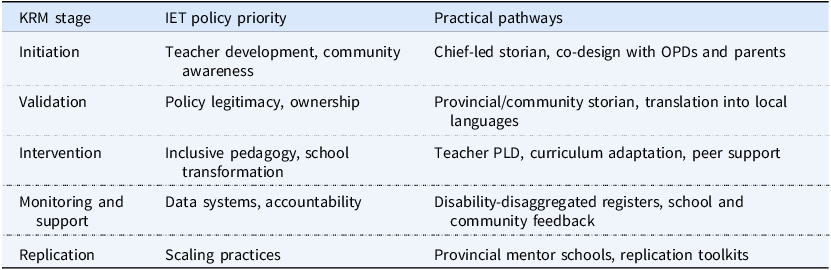
Replication is coordinated by MoET and provincial offices, with mentor schools playing a central role. Practices that have been validated locally are adapted for new schools or islands through peer-to-peer learning, identification of champions, and replication resources anchored in kastom (Fixsen & Blase, Reference Fixsen and Blase2009; UNICEF, 2022). Tools include mentor school profiles, adapted training resources, and scaling plans. Evidence of progress includes increased uptake across schools, adaptation of practices to new contexts, and sustained implementation over time. Table 2 summarises the alignment between the five stages of the KRM, the priorities of the IET Policy, and the practical pathways proposed for implementation.
Mapping the Kokonas Research Methodology (KRM) to the Vanuatu Inclusive Education and Training (IET) Policy 2025–2030
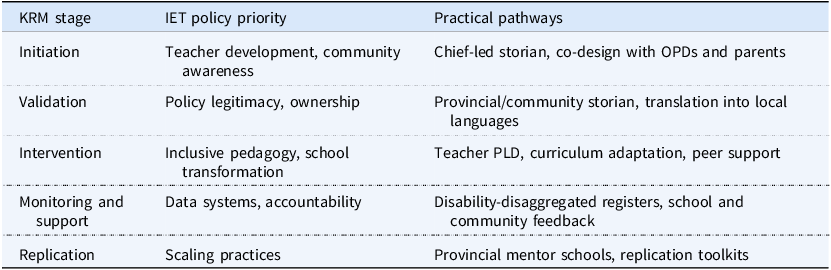
Note. KRM stages are aligned with the IET Policy’s priorities and illustrated with practical actions for implementation. OPDs = organisations of persons with disabilities; PLD = professional learning development.
Implications
Applying KRM to the IET Policy carries implications for multiple audiences — specifically, policymakers, teachers, communities, donors and development partners, as well as Pacific and global audiences — which will be discussed as follows.
Policymakers
KRM provides a culturally grounded roadmap for policy uptake beyond technical directives. Embedding kastom and storian at each stage aligns reforms with CRPD, SDGs, and PFRPD, while also fulfilling national obligations under the Constitution (1980), the Education Act (2014), the People’s Plan (2016–2030), and the Vanuatu Education and Training Sector Strategy (2021–2030). KRM strengthens legitimacy, accountability, and coherence across education and disability strategies.
Teachers
KRM offers practical entry points for inclusive pedagogy. Initiation and validation foster collaboration with teacher networks; intervention structures professional learning, curriculum adaptation, and peer support. Teachers are positioned as active agents of transformation.
Communities
KRM builds agency and collective responsibility. By centring dialogue and validation, it affirms the role of chiefs, parents, and OPDs as co-creators of inclusion. Community ownership strengthens resilience and ensures reforms are responsive to local realities.
Donors and Development Partners
KRM also has implications for how international aid is designed and delivered. Too often, donor-funded programs import technical solutions that lack cultural legitimacy or fade once external funding ends. By providing a structured, Indigenous framework rooted in kastom and storian, KRM offers development partners a way to align investments with community-owned processes. For regional NGOs and international agencies, adopting KRM principles can reshape practice towards ‘development by the people, for the people’, making aid more accountable and impactful.
Pacific and Global Audiences
The KRM provides evidence that Indigenous frameworks can bridge the policy–practice gap. It offers transferable lessons for other small-island and low-resource contexts where cultural grounding and community ownership are essential for sustaining reform.
The challenges identified in Vanuatu are consistent with patterns observed across Pacific Island countries, where inclusive education policies are well established through commitments to the CRPD (United Nations, 2006) and SDG 4 (United Nations, 2015), but implementation remains uneven. Regional evidence indicates that, despite significant progress in policy development, inclusive education across the Pacific continues to face challenges related to teacher capacity, resource availability, data systems, and the translation of policy commitments into practice (UNICEF, 2022). These findings suggest that the challenges observed in Vanuatu are not unique but reflect broader regional patterns across Pacific education systems.
These shared challenges suggest that culturally grounded approaches such as the KRM may offer relevant and adaptable pathways for strengthening policy implementation across similar small-island and low-resource contexts. For Pacific Island countries and territories facing comparable implementation challenges, KRM provides a comparative reference point that can complement existing inclusive education policies by embedding culturally grounded practices, community dialogue, and relational accountability into implementation.
Conclusion
The IET Policy reflects Vanuatu’s commitment to equity, rights, and educational transformation. Yet, like many Pacific policies, its success depends on translation into practice across schools, communities, and governance systems. The KRM provides a culturally grounded framework to guide this process. By embedding kastom and storian within its five stages, KRM ensures that reforms are co-designed, validated, and owned by those they serve.
Reaffirming the value of KRM underscores three principles: sustainability is strengthened when reforms grow from within communities; equity advances when learners with disability, teachers, and families are active participants; and cultural legitimacy ensures that practices resonate with Ni-Vanuatu ways of knowing, making policy uptake more effective and enduring.
Beyond Vanuatu, KRM has wider implications for Pacific education reform. It demonstrates that Indigenous methodologies can bridge persistent policy–practice gaps, offering both a model for small-island contexts and a meaningful contribution to global debates on inclusive education. These parallels reinforce that sustainable reform requires more than technical fixes; it demands frameworks that resonate with local cultural logics while fulfilling global obligations. By placing culture and community at the centre, KRM helps policies move beyond paper to become sustainable practices that transform classrooms, schools, and systems. As Vanuatu implements the IET Policy, policymakers, educators, donors, and communities are invited to embrace KRM as a guiding framework, ensuring that reform is achieved in ways that are culturally grounded, equitable, and aligned with the nation’s constitutional values, legal mandates, and long-term development vision (Eldads Vira et al., Reference Eldads Vira, Page and Ledger2025).
Acknowledgements
The author acknowledges the people of Vanuatu for their generosity in sharing and sustaining traditions of kastom and storian, which underpin the development of the Kokonas Research Methodology. Gratitude is extended to teachers, students, parents, people with disability, and disability organisations in Vanuatu, whose lived experiences and advocacy continue to shape inclusive education. The author also thanks the Vanuatu Ministry of Education and Training for leading the development of the Inclusive Education and Training Policy 2025–2030, together with line ministries, partner organisations, and donor partners who supported this process.
The author further acknowledges the University of Newcastle for the PhD scholarship that enabled the development of the first Vanuatu-born, peer-reviewed research methodology. Special thanks are extended to my PhD supervisors, Associate Professor Angela Page and Professor Susan Ledger, for their ongoing guidance and support.
The author acknowledges the use of ChatGPT-5 (OpenAI, 2025) to assist with language refinement, formatting, and reference management in preparing this manuscript. All analysis, arguments, and conclusions are entirely the author’s own.

 Open access

