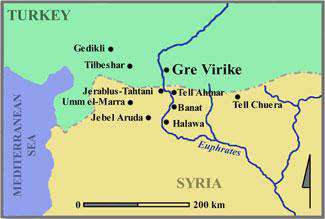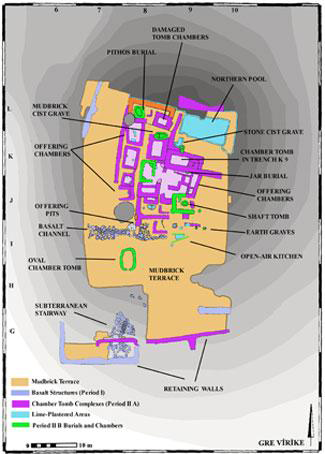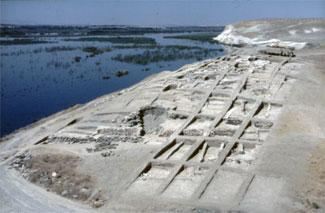


Gre Virike (Figure 1) lies on the east bank of the Euphrates River, c. 10km to the north of Carchemish (Ökse 2001, 2002, 2004). It consists of a rectangular platform 35x50m with rounded corners (Figures 2 and 3, Ökse in press a). The southern edge and north-western corner are supported by thick basalt walls preserved to a height of c. 1.40m. The shape and height of the platform are similar to the early third millennium BC Mesopotamian terraces (Reference HeinrichHeinrich 1982: 68, 90-91, 100). Contemporary sites similar to Gre Virike are known from Tilbeshar (Reference Kepinski-LecomteKepinski-Lecomte & Ergeç 1999), Jebel Aruda (Reference Van Drielvan Driel 1983: 2-5) and Tell Halawa B (Reference LüthLüth 1989: 91-97, 109).
Location of Gre Virike

Plan and cross-sections of Gre Virike.

View from the south.

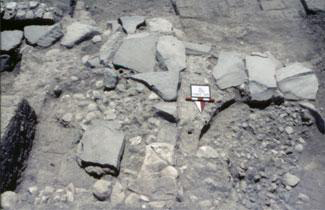
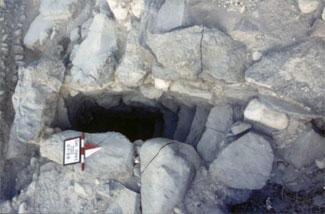
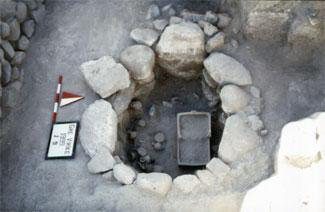
The three earliest phases all featured installations of a non-domestic character. In Period I, two plastered pools were built into the north-eastern corner of the platform (Ökse in press b). The undisturbed northern pool is 10.20 x 5.40m and is 2.20m deep; the base and sides are coated with a thick lime plaster and the floor is covered with a fine clay deposit. On the southern slope, a 15m-long channel was built and covered with large basalt slabs. Four circular pits, each with a diameter of c. 1.60m and a depth of 0.20m, with limestone walls and basalt covering slabs were dug at its western part (Figure 4). The pits contained handfuls of grain, animal bones and votive objects such as unbaked clay figurines and miniature stone axes, and were covered with hard clay-plaster. These pits resemble the offering pits at Gedikli (Alkim & Alkim 1966: 21, 498). At the south-western skirt of the platform, a subterranean structure with a narrow tunnel containing stairs had been built with large basalt blocks (Figure 5). The stairway ended in a fine homogeneous clay deposit. This structure is interpreted as a spring-grotto, similar to those at Gedikli and Kiriskal Höyük (Reference AlkimAlkim & Alkim 1966: 42; Reference AlkimAlkim 1974). Period 1 structures contain sherds dating to the first half of the third millennium BC.
Offering pits.

Basalt stairway

In Period IIA (middle of the third millennium BC), subterranean chamber tombs and small chambers were built with large limestone blocks on the mound summit (Ökse 2005). A chamber tomb in trench K 9 has a large (2.30 x 3.70m) rectangular main chamber with 1.20m thick and 1.90m high limestone walls. Grave goods found in the main chamber included a bronze spear head, an agate bead, three toggle pins, a silver hair-roundle, a tanged triangular arrowhead, triangular and lozenge shaped pieces of inlay made from shells, and 66 ceramic vessels. A passageway, closed on the east with an upright limestone slab, connects the main chamber with an ante-chamber, which had two small chambers attached to its southern wall.
In the northern part of the platform, there was a limestone wall (2.15m long and 1.05m wide) with an arched wall (4.00m long and 1.20m wide) to its east. In the western part of the terrace, two rows of chambers, which were built with 1m thick limestone walls preserved to a height of 1.20m, were uncovered. On the floors of northern chambers, there are plastered pits with broken jar bottoms, and on the floors of southern chambers similar pits were full of ash and charcoal. The largest chamber of the western row has two plastered pits with cooking pots in them. These chambers resemble the two chambers attached to the chamber tomb in trench K 9. The vessels from the chamber tomb and chambers belong to the second half of the third millennium BC.
The practice of burial in chamber tombs of stone masonry is widespread in the third millennium BC (Carter & Parker 1995: 104 ff). The monumental chamber tombs related to complex structures at Gre Virike resemble the Tomb 302 at Jerablus-Tahtani (Reference PeltenburgPeltenburg 1999: 428-431), the hypogeum of Tell Ahmar (Reference Thureau-DanginThureau-Dangin & Dunand 1936: 96, Fig. 28; Reference RoobaertRoobaert & Bunnens 1999: 165), Tomb 7 at Tell Banat (Reference RoobaertPorter & McClellan 1998: 32; Reference PorterPorter 2002: 10 ff), Building 3-35 at Tell Halawa A (Hampelmann 2001: 158-160), and Tomb 1 at Umm el-Marra (Reference SchwartzSchwartz et al. 2003: 330-340).
In Period IIB, infant and child graves of various types were dug into the platform (Ökse 2006). Two graves were cut into the mudbrick pavement, one furnished with six vessels. There were two jar burials, one laid sideways with its mouth facing towards the west, where the opening was covered with an erected flat limestone. The second burial jar was set into the southern wall of the chamber tomb in Trench K 9 and five small vessels were placed north of the jar's mouth. A pithos grave set in the limestone structure in Trench L 8 is the only adult grave of this period. Its rim faces to the north-west and its surroundings were paved with broken stones; two miniature jars are placed under the pithos. A shaft grave in Trench J 9 (Figure 6) was constructed and covered with large limestone slabs. In a circular shaft grave, two small children were buried with 32 ceramic vessels, a ceramic bird-shaped bell and two wheels of model oxcarts, and a ceramic basin was used as a larnax for an infant. Only one mudbrick and one stone cist grave are represented on the platform. An oval structure 4.30 x 2.25m had been cut into the southern slope of the platform. Its north side was 1.35m deep and there was an entrance on the south side.
Shaft grave

The mudbrick steps on the south-eastern slope were covered with lime plaster. On this plaster, several pits filled with ash and cooking pots were found, forming an open-air kitchen. The pottery from this area and the graves are dated to the last quarter of the third millennium BC. In nearly all graves, one or more bronze toggle pins and one agade bead were laid for each infant. All these grave types are observed in the Near East throughout the third millennium BC (Reference CarterCarter & Parker 1995: 104 ff).
Interpretation The structures of Period I can be interpreted as installations for cultic purposes, where water, grain and ash were used as ritual substances. The plastered pools, the channel and the spring-grotto seem to have been related to a water cult and the channel with offering pits show a complex in which water, grain and fire meet together. The grain would sprout when put into water, so the grain must have been used as a ritual substance. Small ash-filled pits might have been places for incense, which reflects a ritual character.
The walls of the chambers and chamber tombs of Period II A were probably visible from the surface and the chambers were probably unroofed free standing structures, since no debris related to their upper structures was found. Moreover, the free-standing oval chamber tomb of Period II B reflects a tomb-sanctuary. The cooking pots on ash-filled plastered pits indicate that the large chamber of the western row and the plastered area on the southern slope seem to have been used for cooking, consumption and offering of food, and animal bones found inside and outside several tombs are probably remnants of mortuary meals. The plastered pits on the floors of some chambers containing jars with broken bottoms are similar to those uncovered at Tell Chuera (Reference MoortgatMoortgat 1962: 35, 37, 40), which are suggested to be used for libation. Other plastered pits on the floors of some chambers containing ash and charcoal point to rituals with burning incense.
The monumental chamber tombs on the Middle Euphrates region are suggested to be a part of architectural complexes for mortuary feasts, such as commemorative banquets or funerary offerings (Reference SchwartzSchwartz et al. 2003: 330-340). The Period II A complexes at Gre Virike might well have been used in the same manner. In Period II B, nearly all regional grave types were represented and some of the earlier offering structures were renewed and used, emphasising the ritual character of the site until the end of the third millennium BC.
The monumental tombs with rich inventory are frequently suggested to have belonged to members of a higher class in the society (Reference OrthmannOrthmann 1980: 102; Reference McClellanMcClellan & Porter 1999: 111). Seventeen Early Bronze Age sites have been recorded within the flooding area of the Carchemish dam (Reference AlgazeAlgaze et al. 1994: 12-14). These are small settlements up to 1.4 ha, so, all these sites were sparsely populated small villages belonging to rural communities around Gre Virike, which is situated in the middle of the area flooded by the Carchemish dam. Gre Virike might have served rural communities within a c. 20km long area, as a local ceremonial place.