


1. Introduction
Design teams have greater opportunities to collaborate with artificial intelligence (AI) to enhance their roles in the design process and maximize team performance (Reference Verganti, Dell’Era and SwanVerganti et al., 2021; Reference Figoli, Rampino, Mattioli, Lockton, Lloyd and LenziFigoli et al., 2022; Reference Sreenivasan and SureshSreenivasan & Suresh, 2024). Previous studies on Human-AI Collaboration have treated AI as a support system for humans. For instance, repetitive tasks that designers do not need to utilise their expertise, but AI excels beyond humans (Reference Figoli, Rampino, Mattioli, Lockton, Lloyd and LenziFigoli et al., 2022). However, as AI technology rapidly advances and is increasingly accepted by society, AI is considered a team member to collaborate with (Reference Figoli, Rampino, Mattioli, Lockton, Lloyd and LenziFigoli et al., 2022; Reference SiemonSiemon, 2022; Reference Alshahrani and QueirozAlshaharani & Queiroz, 2025). The objective of this study is to examine the effect of AI on creativity and the design thinking (DT) process when AI is added to teams as an alternative to human application of the designed AI-based Application.
1.1. The effect of AI on creativity
Creativity is the first step to innovation (Reference Amabile, Conti, Coon, Lazenby and HerronAmabile et al, 1996; Reference WestWest, 2002), focusing on idea generation (Reference Rank, Pace and FreseRank et al., 2004). In the previous studies that attempted to add AI as a team member, two perspectives were investigated to indicate its effect on creativity. First, the studies explored the effect of an AI team member on the team’s creativity. Reference Alshahrani and QueirozAlshaharani & Queiroz (2025) proposed a model that proportionates AI members in hybrid teams, leading to team creativity and process satisfaction, although the test hasn’t been conducted yet. Reference Wei, Wang, Lee and LiuWei et al. (2025) conducted experiments in educational settings using PBL-based digital story creation, requiring students to use Generative AI and traditional digital tools to clarify the effects of AI on students’ creativity. The results indicated enhanced students’ collaborative problem-solving skills and better team creativity. Also, Reference Saritepeci and DurakSaritepeci & Durak (2023) reported that students’ creative self-efficacy developed through intensive use of AI support. Although the relationship between AI use and team creativity is beginning to be clarified, debates persist about how AI affects team members’ creativity, which, in turn, affects team creativity. Second, the studies indicated the role that AI plays in teams. Reference SiemonSiemon (2022) clarified the role of AI as the coordinator, creator, perfectionist, and doer. Reference Figoli, Rampino, Mattioli, Lockton, Lloyd and LenziFigoli et al. (2022) indicated that when the team uses AI simultaneously, AI assumes the role of bossy groupmate. On the other hand, when AI was used alongside humans only, it served as an expert, leading to a human-driven creative process. In light of this result, we delayed the use of AI in the DT workshop to support learning among the human participants.
1.2. AI in design thinking process
Design thinking (DT) is a “commonly used innovation method that affects company culture, customer involvement, and the driving principles of the innovation process” (p.297: Reference Sreenivasan and SureshSreenvasan & Suresh, 2024). Reference Sreenivasan and SureshSreenvasan & Suresh (2024) conducted a systematic literature review based on the perception that DT and AI become more powerful when combined. In line with that perception, several studies mapped the AI use in the DT process (Reference Böckle and KourisBöckle & Kouris, 2023; Reference Saeidnia and AusloosSaeidnia & Ausloos, 2024). Reference David, Krebs and RosenbaumDavid et al. (2023) held an academic makeathon designed to apply the DT Double Diamond process, requiring students to use AI, which resulted in a limited traditional use of AI as an assistive or guiding tool. Based on that study, we designed the DT workshop and an AI-based Application to guide effective AI use.
In this study, we aim to examine the effect of AI on individual creativity and creative mindset, whether it enhances or hinders creativity, by comparing workshop results with and without AI. Also, we designed the AI-based Application to serve as the team’s partner, supporting both divergent and convergent phases and guiding effective human-AI collaboration. We attempt to suggest the AI’s specific role in each DT phase.
The remainder of the paper is devoted to answering the following questions: “Will AI enhance or hinder the individual creativity of the DT workshop participants?” and “How does AI affect the divergent and convergent phases when collaborating within teams?”
2. Research method
In this section, we described the design of the DT workshop, the AI-based Application alternating human team member, and the survey items for validation. We analysed results by pre-post surveys as the quantitative method and an open-ended questionnaire as the qualitative method.
2.1. Workshop design
In this study, we designed and conducted two types of workshops to examine the effects of introducing AI, drawing on the Double Diamond framework (Discover, Define, Develop, Deliver) proposed by the UK Design Council (2004). The Double Diamond framework is widely recognized as one of the DT frameworks that systematizes the process from problem discovery to the creation, selection, and delivery of solutions through alternating phases of divergence and convergence.
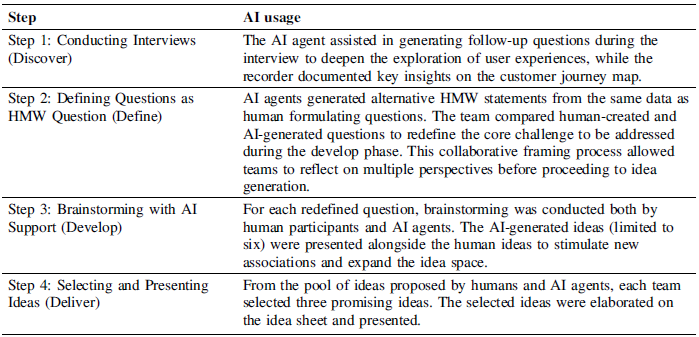
The workshops were structured into four stages within the limited 90-minute timeframe to examine and compare the collaborative process between humans and human-AI.
Process of the workshop

Workshop A (with AI) was conducted under the theme “New Space Hotel Business,” while Workshop B (human-only) addressed the theme “New Food Business”. A brief introduction to each theme was provided one week before the workshops. Both workshops were held in Japanese.
2.2. AI-based application design
We designed the AI-based Application to support the ideation activities in the DT process. Referring to the scheme proposed by Song et al. (2024), the AI-based Application is designed as “AI as a prompter”, “general knowledge”, and “synthesis oriented”. Each stage was structured through alternating modes of divergence and convergence to encourage creativity while keeping the ideation process focused. The methods applied at each stage were interviews, the How might we (HMW) question, brainstorming, and idea selection and presentation.
AI-based application design in each step

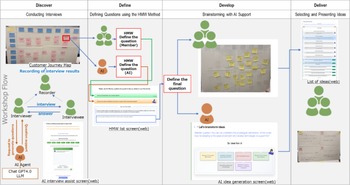
The figure below shows the system configuration flow of the AI-based Application. We provided a tablet to each team as an interface for collaborating with AI while offline.
System configuration flow

The figure below shows a detailed prompt example translated from Japanese to English to define HMW Question input for the AI-based Application.
Prompt example (defining HMW question)

2.3. Survey items
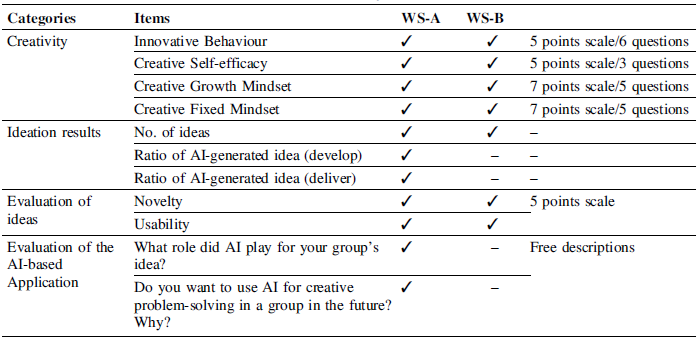
We analysed the survey items below to clarify the effect of the developed AI-based Application on creativity and ideation from four perspectives. First, we attempted to clarify whether AI enhanced the participants’ creativity through the workshop. Items measuring creativity were used in the pre- and post-surveys to allow participants to self-evaluate their behaviours. Each item is validated in the previous research: Innovative Behaviour (IB) (Reference Scott and BruceScott & Bruce, 1994), Creative Self-efficacy (CSE) (Reference Tierney and FarmerTierney & Farmer, 2002), Creative Growth (CGM), and Fixed Mindset (CFM) (Reference KarwowskiKarwowski, 2014). We selected the scales to identify how the workshops affect the participants’ mindset and behaviour related to creativity.
Secondly, to measure the AI’s effect on idea generation, we counted the number of post-its generated during brainstorming. For workshop A (WS-A), we confirmed the AI data and calculated the ratio of AI-generated ideas among the brainstormed ideas. As participants were asked to converge on the best three ideas, we also counted the ratio of AI-generated ideas included in the final three ideas for WS-A. Third, we used the average scores of three converged ideas, measured by third-party experts outside the team, from two perspectives: novelty and usability (Reference Dean, Hender, Rodgers and SantanenDean et al., 2006). There were five evaluators in total: two senior designers, a professional engineer, and two bachelor’s students from a different university from the one where the workshops were held. Finally, we collected the free descriptions from WS-A participants, asking about the role of AI in the group’s idea and motivation to use AI in the future. Quantitative analysis was performed using IBM SPSS Statistics.
Survey items

Both WS-A and WS-B were held in the class attended by the bachelor students majoring in economics and management. The students were informed and confirmed that their participation in the survey and the survey results will definitely not affect their class scores. Details of the participants and the number of answers utilized in this paper are shown below. The quantitative analysis responses were extracted by excluding those that lacked pre- or post-survey responses or either creativity item. We utilised the ideas of the groups that the extracted respondents belonged to.
Number of data used in the analysis

3. Result
3.1. The effect of AI on creativity
A paired t-test was conducted, and the results were compared between WS-A and WS-B to indicate the effect of the AI team member on the participants’ creativity. As a result, participants’ creativity was further enhanced at WS-B without the use of an AI-based Application. In particular, three items, such as IB (p<.001), CSE (p<.001), and CGM (p=.030), significantly increased through the workshop. On the other hand, only one item (IB, p=.001) significantly increased through WS-A. Therefore, the results indicated that the use of an AI-based Application hindered participants’ self-evaluated CSE and CGM.
Paired t-test result of creativity items (workshop A) N=43

Paired t-test result of creativity items (workshop B) N=45

3.2. The effect of AI on idea divergence and convergence
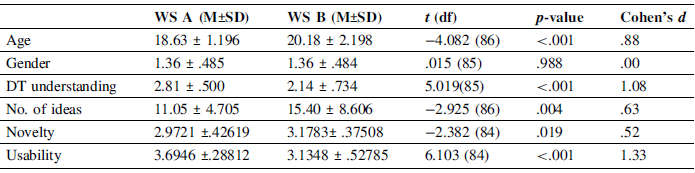
The table below shows the result of the paired t-test comparing the background and number of generated ideas between WS-A (with AI) and WS-B (without AI). As a result, WS-B participants generated significantly more ideas in the brainstorming session. Since WS-A participants had a significantly higher understanding of DT than WS-B, this result indicated that the use of AI had a stronger effect on hindering the divergence of ideas than the understanding of DT. Also, we confirmed that there was no significant difference in creativity between WS-A and B participants. Comparing the evaluation results of the three ideas selected at the final idea sheet, WS-A was significantly higher in usability, and WS-B was significantly higher in novelty. As the significant rate is higher, the difference in usability is more pronounced.
Paired t-test result comparing workshop A vs B (N=88)

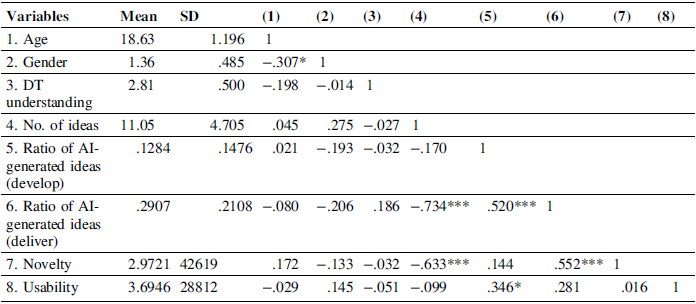
Regarding the second diamond (develop and deliver) in WS-A, we conducted the correlation analysis to investigate the relationship among the variables. The results below indicate that the number of generated ideas during brainstorming had a significant negative correlation with the ratio of AI-generated ideas at the deliver phase (p<.001) and with the novelty of the ideas (p<.001). When teams generate more ideas, they don’t select AI-generated ideas, and the novelty of those ideas decreases. It implies that AI’s contribution to the novelty of ideas, along with the result that the ratio of AI-generated ideas at the convergence phase and novelty had a significant and positive correlation (p<.001).
Also, the ratio of AI generated ideas at the develop phase had significant and positive correlations with AI-generated ideas at the deliver phase (p<.001) and usability of the ideas (p<.05). When the team more collaborated with the AI at the divergent phase, the more select the ideas generated by AI at the convergent phase leading to higher usability of the ideas.
Correlation analysis result of workshop A (n=43)

Compared with teams without AI, an application enhances the usability of the idea and hinders the team members’ creative mindset, generating more ideas. Among teams with an AI team member, the results indicated that AI contributed to generating useful ideas. As AI suggests ideas based on past learning, the usability of the generated ideas is strengthened. Also, AI contributed to the team’s selection of novel ideas during the convergent phase. Although the AI generally improved the usability of the ideas, the human selected the novel ideas generated by the AI.
3.3. Evaluation of the AI-based application
To clarify the role of AI in creative problem-solving processes and participants’ perceptions of future AI use, qualitative coding was conducted on open-ended comments from workshop participants.
3.3.1. Role played by AI in the teams
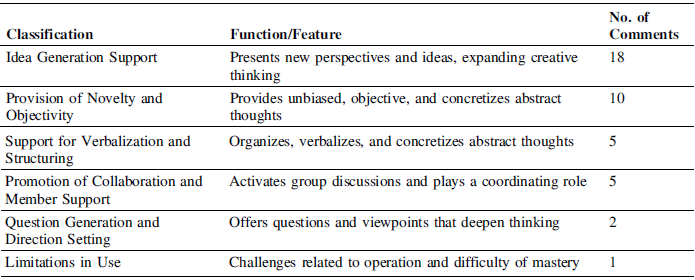
The open-ended comments in response to the question, “what role did AI play for your group’s idea?” were analysed. Meaningful units of the statements were extracted and organized, and codes with common themes were classified into six main functional categories, as shown in the table below.
Classification of free comments on “What role did AI play for your group’s idea?”

The most frequently mentioned role was “Idea Generation Support”. This indicates that AI provided functions that expanded participants’ thinking and stimulated creativity. The second most common role was “Provision of Novelty and Objectivity”. AI contributed by offering “completely new perspectives” and “fresh ideas free from preconceptions,” encouraging participants to think beyond their own fixed notions and biases.
These primary roles were found to function effectively during the divergent phase of the creative process, in which ideas are generated. Participants commented that “AI taught us to think from different perspectives” and “It presented ideas from unexpected angles that inspired new thoughts.”
During the convergent phase, “Support for Verbalization and Structuring” and “Question Generation and Direction Setting” were observed. For example, AI helped “make abstract opinions more concrete” and “articulated what we were thinking into sentences,” supporting group consensus by transforming vague thoughts into clear expressions. It also contributed to generating questions that deepened thinking, such as “coming up with new questions from different perspectives.”
In the collaborative phase, AI served as “Promotion of Collaboration and Member Support” (5 instances). Participants perceived AI as “something to rely on when in trouble,” “a helper in answering questions,” or “a facilitator when ideas got stuck,” suggesting that AI acted as a catalyst for revitalizing discussions and breaking deadlocks.
On the other hand, one comment under “Limitations in Use” noted operational difficulties: “I couldn’t make full use of AI,” suggesting challenges in handling and effectively using the system.
The figure below summarizes the AI roles on the team, focusing on the DT phase. During the divergent phase, AI supports the idea generation and adds objective novelty to the generated ideas. During the convergent phase, AI provides questions and guidance to help the team converge and support the verbalization and structuring of their thoughts. Furthermore, through team collaboration, AI supports the team to encourage interactions when the team is struggling.
Process Diagram of AI roles in creative problem-solving in teams

Figure 4 Long description
The diagram represents the roles of AI in creative problem-solving within teams during different phases of design thinking. It is divided into three main phases: Divergent Phase, Convergent Phase, and Group Collaboration Phase. Each phase includes specific AI support functions. The Divergent Phase includes Idea Generation Support and Provision of Novelty and Objectivity. The Convergent Phase includes Support for Verbalization and Structuring, and Question Generation and Direction Setting. The Group Collaboration Phase includes Promotion of Collaboration and Member Support. The Limitation Section highlights limitations in the use of AI. Each phase and section is accompanied by brief descriptions and examples of how AI aids in these processes.
3.3.2. Future intentions to use AI
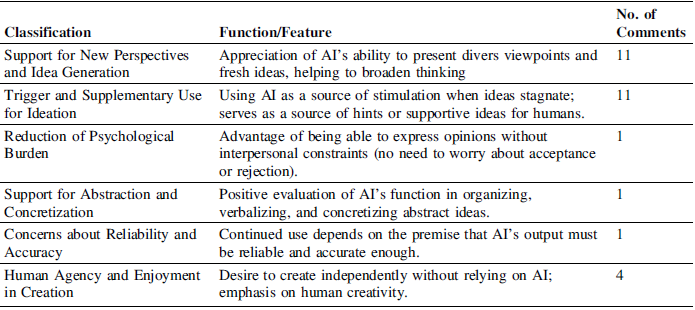
Analysis of the open-ended responses to the question, “Do you want to use AI for creative problem-solving in a group in the future? Why?” revealed that the answers could be classified into six categories. Overall, the majority of responses expressed a positive attitude toward the AI. In particular, the main reasons supporting continued use centred on two key contributions of AI to the creative process.
Classification of free comments on future intentions to use AI

The most frequent positive responses were appreciation for AI’s ability to present diverse perspectives and fresh ideas. For example, participants commented, “It was refreshing because it sometimes provided ideas from angles I hadn’t thought of,” or “It said things I wouldn’t have come up with.” These statements indicate that AI played a motivating role by expanding participants’ cognitive boundaries and supporting ideation beyond individual thought patterns. Many participants perceived AI as a useful source of stimulation or hints when group thinking became stagnant. Typical responses included: “I plan to use it only as a supplement,” and “When we were stuck, it provided helpful references for new ideas.” These comments suggest a strong tendency to position AI as a supportive tool that assists, rather than replaces, human creativity. Other positive aspects were also noted. Under Reduction of Psychological Burden, one participant highlighted the advantage of expressing ideas freely without social constraints: “It gives ideas, but I don’t have to worry about whether to accept or reject them.” Additionally, under Support for Abstraction and Concretization, AI was praised for helping to organize thoughts; “It helps make abstract ideas more concrete.”.While positive opinions predominated, participants generally regarded AI not as an autonomous creator, but rather as a supportive partner. In the classification Human Agency and Enjoyment in Creation, some participants expressed a desire to create independently, stating, “It’s fun to come up with ideas ourselves”. Furthermore, under Concerns about Reliability and Accuracy, one participant commented, “If AI’s accuracy becomes more stable, I would use it.” This underscores that trustworthiness and quality of AI output are critical preconditions for continued use. The figure below summarizes future intentions for AI use across three categories: positive, conditionally positive, and cautious. The positive comments suggest that AI is becoming a team member in team collaboration, playing an important role in expanding creativity. Conditionally positive comments imply that the relationship between human and AI is that of a user and a supporter. The teams use the AI not as a team member but as a computer to support them. Cautious comments are still unsure whether they should use AI in the DT process to solve problems creatively.
Structural diagram of future intentions to use AI

3.3.3. Improvements of the AI-based applications
While AI played a multifaceted role as a co-creation partner in the creative process, this study’s findings suggest two major areas for improvement in application design and usage methods to enable more effective use.
The first suggestion is to eliminate utilization constraints and fundamentally improve operability. Participants’ open-ended comments clearly revealed issues related to limitations in use due to the difficulty of operating AI. Additionally, the AI-generated group produced significantly fewer ideas than the human-only group. This suggests that participants may have either spent too much time operating the AI-based Application or relied too heavily on AI-generated suggestions. Therefore, they might have experienced suppression of their own spontaneous idea generation, which needs improvement to enhance AI literacy and achieve seamless integration. To address this, the application should explicitly present AI’s strengths (e.g., offering novel perspectives) and limitations (e.g., imperfect understanding of human intent), and incorporate guidance features that encourage users to adopt an AI-as-a-supplementary-tool stance. In particular, to prevent AI operations from obstructing the brainstorming process, the interface should allow AI to intervene at optimal moments when users feel stuck with minimal operational effort.
The second improvement is to design collaborative processes that respect human agency. Although the human-AI collaboration is moving toward treating AI as a team member, participants’ attitudes toward AI were predominantly conditionally positive, with a preference for using AI as a trigger or supplementary tool for ideation. Many participants also expressed a strong preference for the enjoyment of generating ideas ourselves, emphasizing the importance of human creativity and autonomy. Based on user situations, we propose adding features that support humans as the final decision-makers. While AI effectively broadened the idea space, the selection of higher-novelty ideas was ultimately performed by humans. In addition, analytical support in the convergent phase is another potential improvement. During the convergent phase, the AI-based Application should provide analytical feedback on each idea’s potential novelty and feasibility, thereby assisting users in making final decisions. This would enable AI’s objective perspectives to be effectively utilized even in the process of narrowing down ideas. Furthermore, since AI also functions as collaboration facilitation and member support, helping summarize discussions and break through stagnation, incorporating this supportive role into the idea evaluation and selection process would further enhance human-AI co-creation in the DT process.
4. Conclusions and future research
We designed and evaluated an AI-based Application to enhance human creativity in DT workshops. Although we attempted to enhance creativity through human-AI collaboration, the results indicated that AI hindered the CSE and CGM of humans. Also, the quantity of ideas generated during brainstorming was lower in only-human teams. As some participants recognized AI as a team member that enhanced their creativity, users relied too much on AI, which hindered their own creativity. The further development of the application should consider how collaboration with AI enhances human creativity. At the same time, humans should learn to utilise AI-based applications effectively during the DT process.
Regarding the AI’s effect on the divergent and convergent phases, the results had findings in both quantitative and qualitative analyses. During the divergent phase, AI supports the team in generating more usable ideas, which the team can recognize as novel. During the convergent phase, through the questions and directions provided by AI, humans selected ideas with higher novelty. This result clarified the role of humans as decision-makers. From a different perspective, while maintaining the active role of humans, AI can serve as a competitor to generate more novel ideas in the future design of AI-based Applications.
There is a limitation to this study: it is not possible to control for the effects of different themes or participants joining the workshops, which were difficult to avoid, given that we held two workshops in different classes. However, although we perceived that usable ideas for the space business should be difficult, WS-A’s usability was significantly higher than WS-B, whose theme was more familiar to the participants’ daily life. It can be predicted that AI strongly affected the idea’s usability.
As the research topic on human-AI collaboration offers further perspectives, future studies can build on those results from the actual AI-based Application we conducted in this study.
Acknowledgement
We would like to thank the members of Smart Process Co., Ltd. for their cooperation and valuable input throughout the project. We also acknowledge the company’s financial support for this research, which was provided to cover personnel costs related to the research activities. The company will utilise the results of this research to develop the AI-based Application; therefore, this research is not biased by commercial interests.








 Open access

