
Skip to main content Accessibility help
×
  • Cited by 47
    • Show more authors
    • You may already have access via personal or institutional login
    • Select format
    • Publisher:
      Cambridge University Press
      Publication date:
      19 July 2017
      10 July 2017
      ISBN:
      9781316181669
      9781107101142
      9781107498471
      Dimensions:
      (228 x 152 mm)
      Weight & Pages:
      0.66kg, 382 Pages
      Dimensions:
      (228 x 152 mm)
      Weight & Pages:
      0.55kg, 382 Pages
    You may already have access via personal or institutional login
  • Selected: Digital
    Add to cart View cart Buy from Cambridge.org

    Book description

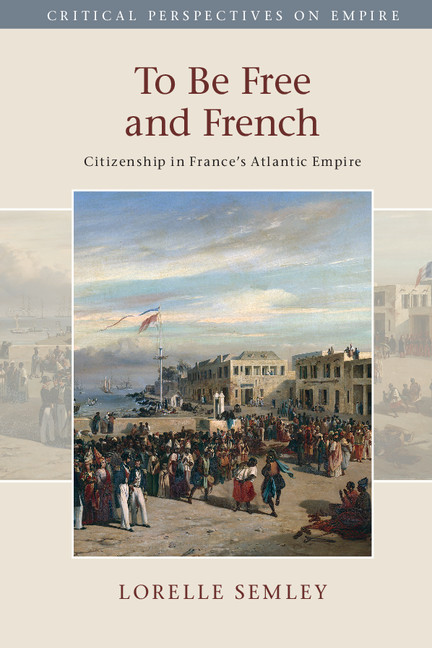
    The Haitian Revolution may have galvanized subjects of French empire in the Americas and Africa struggling to define freedom and 'Frenchness' for themselves, but Lorelle Semley reveals that this event was just one moment in a longer struggle of women and men of color for rights under the French colonial regime. Through political activism ranging from armed struggle to literary expression, these colonial subjects challenged and exploited promises in French Republican rhetoric that should have contradicted the continued use of slavery in the Americas and the introduction of exploitative labor in the colonization of Africa. They defined an alternative French citizenship, which recognized difference, particularly race, as part of a 'universal' French identity. Spanning Atlantic port cities in Haiti, Senegal, Martinique, Benin, and France, this book is a major contribution to scholarship on citizenship, race, empire, and gender, and it sheds new light on debates around human rights and immigration in contemporary France.

    Awards

    Co-winner, 2018 Bentley Book Prize, World History Association

    Reviews

    'Semley seeks to understand the intersection of citizenship, race, and gender within the 19th- and 20th-century French Atlantic empire. She does this through a series of engaging and well-researched chapters centered on important imperial events where the local and imperial intersect and where imperial subjects see themselves within both French and local identities. … As a whole, the work illustrates the complexity of race, citizenship, and gender in that they often worked together while they were also at odds. Many of the figures described in the book embraced the larger revolutionary ideals of citizenship, but then had to negotiate them within their local contexts. Finally, even as slaves became free and freed men became citizens, women had to wait. … Recommended. Upper-division undergraduates and above.'

    T. M. Reese Source: Choice

    'Semley combines outstanding archival research from three continents with insightful analysis and engaging prose. She consistently shows her ability to tell a good a story in an intriguing location. To Be Free and French is full of surprises and fascinating individuals who actively sought to define themselves within the context of French imperialism. Like her subjects, Semley refuses to fall into the simplistic dualities of colonizer and colonized, French or not-French, and white or black.'

    Michael G. Vann Source: World History Connected

    '… this book responds brilliantly to a decades-old call to better represent Africa, Africans and their diaspora in Atlantic history. In doing so, Semley provides us with an exemplary model for grounding broad historical concerns in close readings of primary evidence from disparate and connected places. I field-tested this book in an upper-division undergraduate course. To Be Free and French received high praise from young people in need of nuanced analysis and innovative methods to critique racialized and gendered inequities in their own complex and globalizing worlds.'

    Sarah Zimmerman Source: European History Quarterly

    'Lorelle Semley’s work ambitiously integrates the fields of African diaspora and Atlantic studies with the history of citizenship, French empire, gender, law, transnationalism, and urban studies. … Semley’s work offers a praiseworthy contribution to the existing literature on French empire and colonial citizenship as well as an important foundation for understanding contemporary debates about citizenship in France.'

    Elizabeth Heath Source: The American Historical Review

    Refine List

    Actions for selected content:

    Select all | Deselect all
    • View selected items
    • Export citations
    • Download PDF (zip)
    • Save to Kindle
    • Save to Dropbox
    • Save to Google Drive

    Save Search

    You can save your searches here and later view and run them again in "My saved searches".

    Please provide a title, maximum of 40 characters.
    ×

    Contents

    • Prologue: Citizens of the World
      pp 3-23

    Metrics

    Altmetric attention score

    Full text views

    Total number of HTML views: 0
    Total number of PDF views: 0 *
    Loading metrics...

    Book summary page views

    Total views: 0 *
    Loading metrics...

    * Views captured on Cambridge Core between #date#. This data will be updated every 24 hours.

    Usage data cannot currently be displayed.

    Accessibility standard: Unknown

    Why this information is here

    This section outlines the accessibility features of this content - including support for screen readers, full keyboard navigation and high-contrast display options. This may not be relevant for you.

    Accessibility Information

    Accessibility compliance for the HTML of this book is currently unknown and may be updated in the future.
