




Becoming-wild in education
Transformations in education are needed to address issues such as climate change, ecosystem degradation, social inequalities, species extinction, biodiversity loss and more. Humanism, the dominant ontology that has prevailed across the “global North,”Footnote 1 is often implicated in our current ecological predicaments where humans are viewed as separate from (and superior too) other animals, landscapes and technologies (Jukes et al., Jukes et al., Reference Jukes, Stewart and Morse2022). Williams (Reference Williams, Braidotti and Hlavajova2018, p. 372) discusses how within humanism, “boundaries are described between human and animal, or human and plant life, or human and inert technology, in order to preserve the special status of humanity.” For us authors, both educators and researchers in (environmental)Footnote 2 education, posthumanism and (new)Footnote 3 materialisms offer possibilities for responding beyond individualism and human exceptionalism to help account for the more-than-human world/s that we all co-exist with/in. This ontological turn re-positions the relationships that emerge from/with/in assemblages as entangled, intra-connected, co-creators of agency, shifting, changing and influencing each other/s existence, as opposed to being separated and individualised. Therefore, to re-imagine environmental education pedagogies, this paper attends to the dynamic relationships that emerge between entities and the ways that they co-constitute one another within and for more-than-human worlds.
EducationFootnote 4 is acknowledged to be both capable of perpetuating the crises that we are currently facing and able to lead change that responds to the disruptions we face if conceptualised and practised differently. In UNESCO’s Futures of Education Report (2021), it is asserted that “knowledge and education can shape more sustainable, just, and equitable futures for humanity and the planet” and concluded that “we now need a different education, both to address past inequities and to harness education’s transformative potential in the face of present and future disruptions” (Giannini, Reference Giannini2024, p. 255). Blenkinsop et al. (Reference Blenkinsop, Morse, Jickling, Paulsen and Hawke2022, p. 34) explain, “education must be a necessary part of any response that requires such a fundamental rethinking of ideas and practices.” This special issue focuses particularly on wild pedagogies as an aspect of education that, by approaching the doing differently, makes alternatives possible. Wild pedagogies work to respond to ecological disruptions by addressing complex concerns about control, which “often plays out in our educational institutions in ways that make things measurable, routine, universal, and that work to delineate ways of being” (Blenkinsop, Morse & Jickling Reference Blenkinsop, Morse, Jickling, Paulsen and Hawke2022: 34). This desire for (educational) control can restrict and limit living experiences and educational opportunities. To counter this taming approach, pedagogical responses that are “imaginative, creative, courageous, and radical” (Blenkinsop et al., Reference Blenkinsop, Morse, Jickling, Paulsen and Hawke2022) are required. Wildness refers to many aspects of pedagogy including what kinds of learning emerge, where education takes place, how knowledge is created (not delivered) and who educates. Wild pedagogies offer “touchstones” to support this re-negotiation of education that include “nature” as “co-teacher,” “complexity, the unknown and spontaneity,” “locating the wild,” “time and practice,” “socio-cultural change” and “building alliances” (Jickling, Reference Jickling, Jickling, Blenkinsop, Timmerman and Sitka-Sage2018). Wild pedagogies invoke relational approaches to education which foster closer, deeper relations giving rise to transformations, resistance, disruption and/or transgression. We suggest that “wildness” is a dynamic, emergent process of becoming and therefore acknowledges the ways in which things (people, animals, plants, things) are always in relations.
Inspired by the children we are researching with, we suggest that objects in education are agentic and have the capacity to respond with humans as co-learners and co-researchers rather than used by humans as pedagogical tools. Indigenous ontologies have always recognised objects’ vitality (Jones & Hoskins, Reference Jones, Hoskins, Taylor, Hughes and Mizuta2016) and have focused on ethical relations with more-than-humans in environments (Rosiek, Snyder & Pratt, Reference Rosiek, Snyder and Pratt2020). These Indigenous ontologies offer alternatives to minority worldviews that render objects dead, inanimate and inert. The recent “material turn” and increase in scholars working with “posthuman philosophy” has led to a rise in relational ontologies that explore who and what is excluded from dominant, humanistic narratives in our world/s, “making room for both the familiar and otherness, encompassing humans and non-humans, the material and the social” (Taylor et al., Reference Taylor, Blaise and Giugni2013, p. 55). A “relational ontology within education means recognizing and prioritizing the deeply entangled relationships existing between all things” (Kuchta, Reference Kuchta, Paulsen, Jagodzinski and Hawke2022, p. 55), as well as working towards acknowledging how these relationships give force to exploitative, extractive, uneven experiences with/in our world/s. “Posthuman object pedagogies” encourage educators and educational researchers to attend to “an object’s vibrancy” claiming that it “is often fugitive, ephemeral, momentary and… can unleash forceful, affective, and powerful effects” (Taylor, Hogarth, Hacking & Bastos, Reference Taylor, Hogarth, Hacking and Bastos2022, p. 218). Drawing on Indigenous agent ontologies (Rosiek et al., 2018) and Bennett’s object-ontology (Reference Bennett2004, Reference Bennett2010), we consider objects part of educational assemblages and have the power to quietly provoke and challenge the ways that humans are entangled in myriads of asymmetric power relationships.
In this paper, we draw on two educational doctoral inquiries to discuss how immanent encounters with Chalk and Paintbrush produced emergent, unpredictable forces of friction and flow, demonstrating how objects are also capable of invoking wild pedagogies. This aligns with (Paulsen, Reference Paulsen, Činčera, Johnson, Goldman, Alkaher and Medek2023, p. 95) who argues that in the Anthropocene, there is “no pure wild world of nature that is untouched by human beings” and builds on the notion that wild pedagogies take place in natural world spaces with more-than-human beings as co-teachers; objects can be co-teachers, too. Further, wildness is not a static, fixed, preserved place consisting of various undomesticated geologies and biodiversity; wildness is an assemblage, in constant frictions and flows of becoming; a multiplicitous “becoming-wild.” As such, we consider wildness as a “theory-praxis-pedagogy,”Footnote 5 a capacity with/in ourselves, materials and the ways that we think-feel-do in relation to the world/s around us. We co-create knowledge to research, resist, transform, transgress and disrupt.
Becoming-wild with theory-praxis-pedagogy
Becoming-wild is a conglomeration of posthumanist, feminist (new) materialist theory, wild pedagogies and Indigenous relational ontologies. We are inspired by Barad’s agential realism that suggests that “we” (all matter) are “mutually constituted” (Reference Barad2007) by the world/s we are situated with/in. Becoming-wild also draws on Haraway’s “becoming-with” (2016), acknowledging that we are always in relations (Fairchild et al., fc Reference Fairchild, Hogarth, Hankin, Luna, Wright and Tesar2025), that everything is in a process of change (becoming) and that there are always multiple actors in any event (Jukes et al., Reference Jukes, Stewart and Morse2022; Riley, Reference Riley, Thomas, Dyment and Prince2021). Indigenous worldviews acknowledge the aliveness of objects (Nelson & Vucetich, Reference Nelson, Vucetich, Nelson and Shilling2018, p. 130), which troubles the animate/inanimate, dead/alive dichotomies by reminding that the material world is agentic. As a relational paradigm, becoming-wild rewilds all relations, diverging from traditional approaches to nature education to challenge distinctions of nature/culture, indoor/outdoor, human/nonhuman and wild/domestic that are prevalent in environmental education pedagogies.
We were drawn to the concept of becoming-wild in response to two research events where we encountered Chalk and Paintbrush. Rather than thinking about these in a traditional educational sense where humans used materials, we explore the events as relational, where Chalk and Paintbrush hailed the children and co-produced art, co-produced experiences and co-produced knowledge. Our theoretical and analytical insights emerged as becoming-wild, acknowledging how wildness can be found in everyday educational encounters. For this reason, to recognise the contributions that Chalk and Paintbrush have offered to the becoming-wild theory-praxis-pedagogy, this article has been co-authored by a material-multispecies assemblage that includes Charlotte, Hannah and two seemingly everyday objects: Chalk and Paintbrush. We write together as intra-actingFootnote 5 (Barad, Reference Barad2007) co-creators of knowledge, engaging with relational ontologies and experimental practices to explore how education might be re-imagined for ecosocial transformation.
In the next sections, we share the theoretical, methodological and empirical “contact zones” (Hankin, Reference Hankin2022; Haraway, Reference Haraway2008; Pratt, Reference Pratt1992) for becoming-wild through material-multispecies moments (Hankin, Reference Hankin2022; Taylor, Reference Taylor2018) with Chalk and Paintbrush. We demonstrate “there is no human in isolation, no form of human life that has not arisen in dialogue with a wider world” (Dooren et al., Reference Dooren, Kirksey and Münster2016, p. 14). As we think-with becoming-wild, we are called to ask: if we acknowledge objects as agentic intra-acting co-creators of knowledge, how might Chalk and Paintbrush enact wild pedagogies?
Becoming-wild in contact zones
We — Charlotte and Hannah — each research in educational settings or “contact zones” (Haraway, Reference Haraway2008; Pratt, Reference Pratt1992) that offer unique opportunities for wilding pedagogies, but we assert that these wild pedagogies can take place anywhere. As a concept, contact zones replace “context” to attend to the spaces of human and more-than-human relations. Haraway (Reference Haraway2008, p. 7) considers these “world-making entanglements” as the communication that develops/might develop between, and with, humans and animals in naturalcultural contact zones that can give rise to anthropocentric manifestations of power. Additionally, Youngblood Jackson and Mazzei (Reference Youngblood Jackson, Mazzei, Taylor, Hughes and Mizuta2016, p. 95) consider “context” to be humanist, “as a stable, referential and foundational site of meaning-making,” which is challenged by the intra-connectedness posed by Indigenous and posthumanist thought. Taylor, Blaise and Giugni (Reference Taylor, Blaise and Giugni2013, p. 53) explore how working with contact zones challenges the contextual perspective of educational systems, whereby the child is constituted “within an exclusively human sociocultural context.” Employing contact zones to explore the relations between materials and multispecies in education therefore steps away from such human-centric worldly perspectives and creates possibilities to explore further more-than-human relations. Contact zones encourage us to rethink the expected, usual, familiar pre-conceived boundaries and explore alternative ways that materials, bodies and discourse influence and shape relationships and entanglements with others.
Our current doctoral research takes place with an urban forest school with children from an inner-city primary school in London, UK, and a wall-less school in a jungle in Bali, Indonesia. “Wild” comes to mean different things in these spaces and places. In the following sections, we introduce these contact zones.
An urban forest school, park, North London, UK, 2021
Chalk: inanimate?
Hails the boy who has no words
“Make me sprinkle dust!”
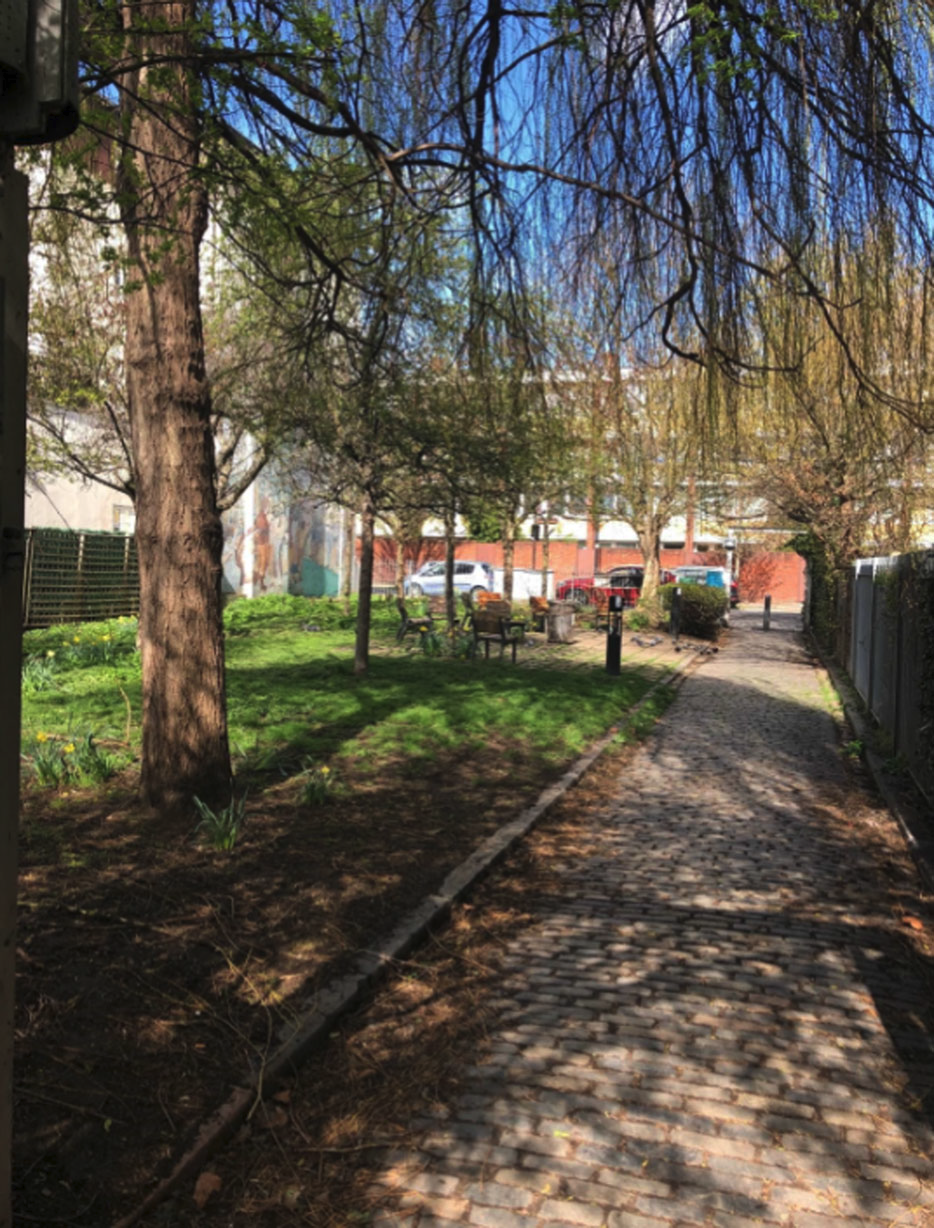
Hannah spent two years researching with children (aged 3–5 years old) who attended an inner-city primary school in London, UK. Every Wednesday morning, the children left their Victorian school building and concrete playground to explore a neighbouring urban park. At first glance, neither space seems particularly wild, but the inquiry sought to investigate the “nature relations” (Hacking et al., Reference Hacking, Bastos, Hogarth, Sands, Dunkley, Wenham, Saputra, McCabe, Fletcher, Nashid and Anjani2023) that emerged during “childhoodnature play” (Hogarth, Reference Hogarth2024). Slowly, with attention to the more-than-human relations that unfolded, the wildness of the pedagogical approach, the research and the space were revealed. The outdoor learning sessions in the urban park were a form of “forest school,” which is an alternative educational approach that has been growing “exponentially” (Hume, Reference Hume2022, p. 3) across the globe. Forest school refers to a pedagogical approach that takes learners outside on a regular basis to learn. It involves a mix of play-based and arts-based activities, often with “child-led” or “free” play. However, the pedagogical approach is based on developmentalism (Osgood et al., Reference Osgood, Axelsson, Cavaliero, Hanniffy and Mc Donnell2023) and tends to place value on the experience in terms of the physical, cognitive, social and emotional development that takes place in individual children. There has been critique of the ways in which forest school is delivered in the UK and a concern that as it starts to become more integrated into mainstream education, it fails to maintain the principles on which the movement was based (Leather, Reference Leather2018). This means reducing the wildness of the pedagogy by maintaining traditional power structures between adult teachers and child learners, to standardised and measurable outcomes and to taking fewer risks.
Hannah sought to research beyond individual human development and instead followed wilder lines of inquiry by researching within more-than-human assemblages. Challenging the dominant discourses around play-based and nature-based learning that view children as developing and nature and play as facilitating this learning, the research sought to understand childhoodnature play as relational events. Over the year together, Hannah, the children and the flora and fauna in the urban park spent time “hanging out” (Somerville & Powell, Reference Somerville and Powell2019). The children and Hannah started noticing the ways in which play emerged through encounters. Throughout the inquiry, stories of play, named “play tales,” were co-created (Hogarth et al., Reference Hogarth, Wonderboy, Miss, Tinkerbell and Fatima2024) by the more-than-human playmates. They wanted to explore play as a wild pedagogy, where pre-determined activities are replaced by an openness to experimentations and explorations. The human is decentred in these encounters as children and Hannah attend to all the relations that co-create play in these moments including materials, plants, animals, weather, memories, buildings and sounds. In these moments of play, there are not “teachers” and “learners” but co-creators of knowledge. This challenges “adult as teacher,” “nature as teacher” or pedagogy as “child-led,” all of which assume a separation between the child learner and their worlds. Instead, we attempt to become-with playmates through experimental, open, messy and speculative practices. We acknowledge the limits of our humanness and instead embrace the mysteries and the not-knowing. As such, we cannot speak for more-than-human worlds, but we can notice, attend to and speculate how experiences with/in our shared world/s might differ using all our human perceptions (Figures 1 and 2).
Urban park, the setting for a forest school.
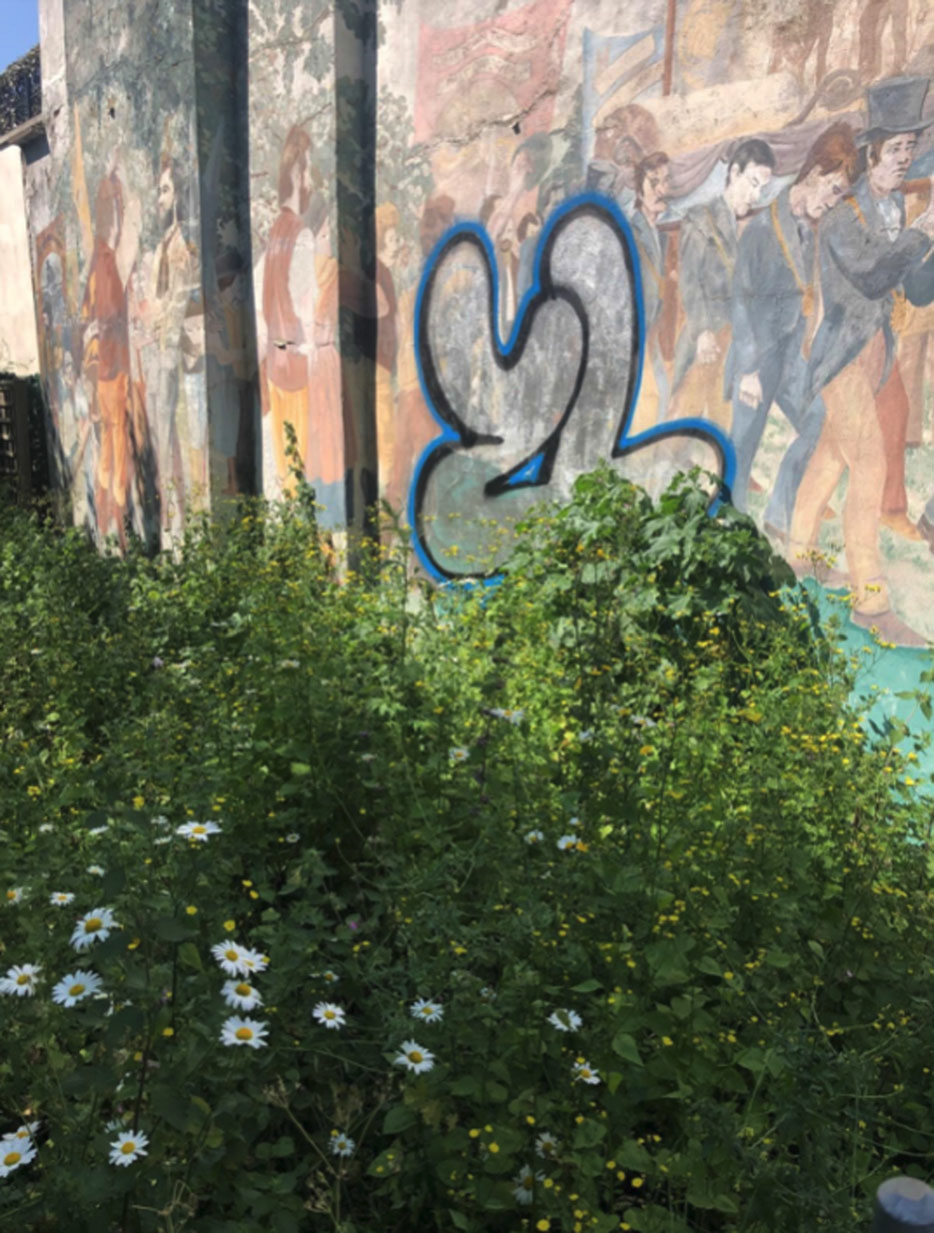
Locating the “wild”: untamed expressions and plants growing in a corner of the forest school site.
A wall-less “classroom” in Bali, 2024
Smooth, moist bristle hair,
Fractured, brittle, twig, bone, spine
Animal bodies?
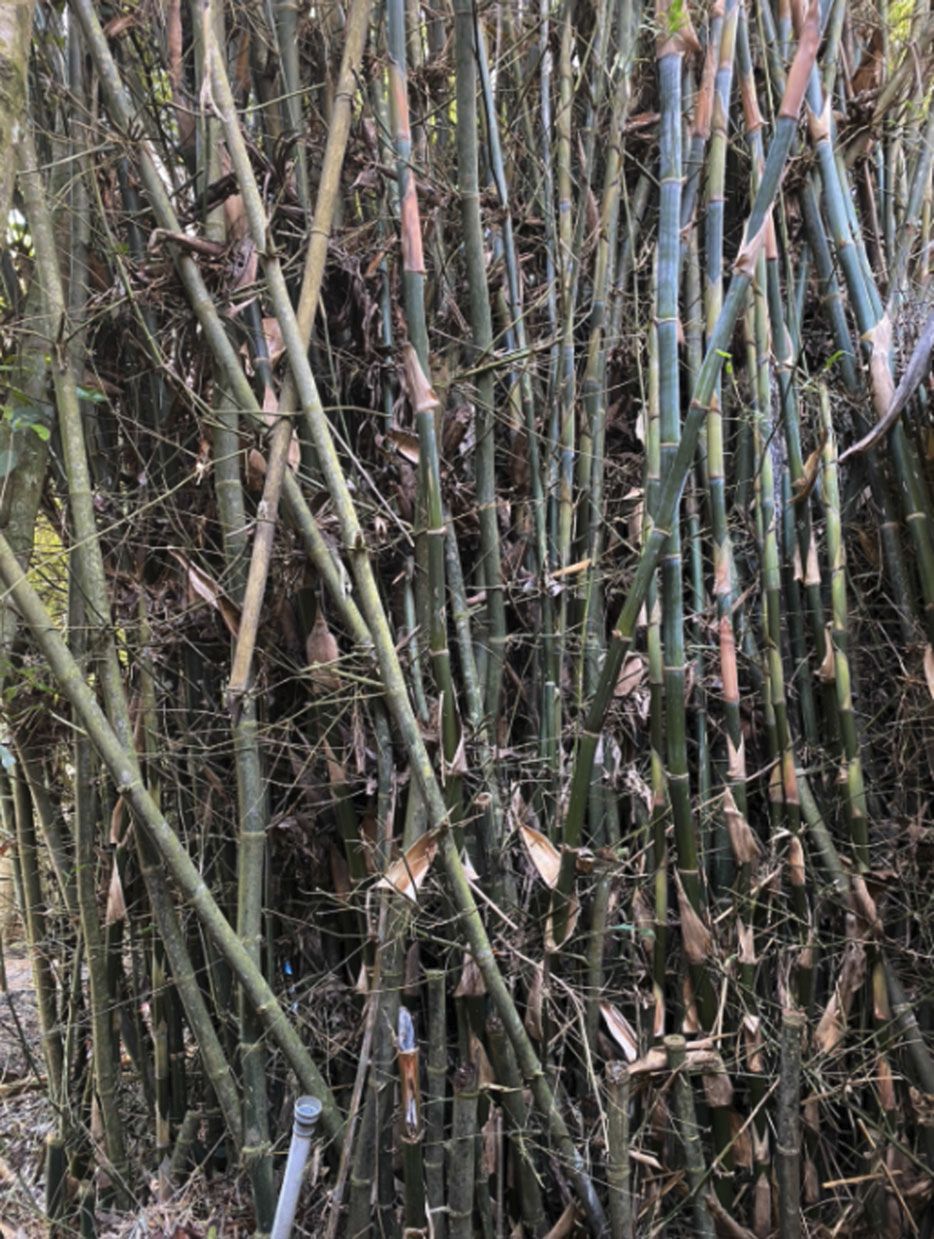
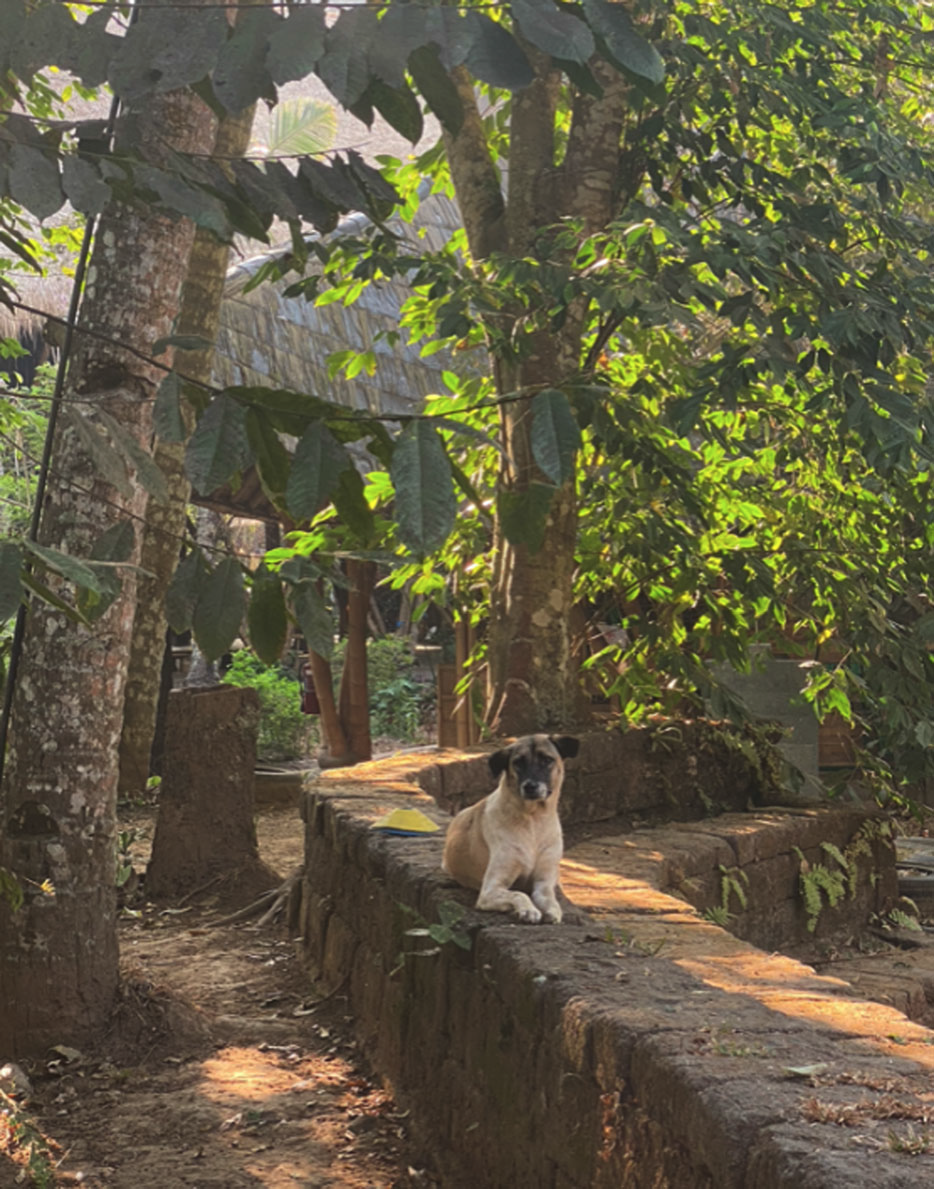
Charlotte’s research considers animal-child relationships in the contact zones of an international school campus in Bali. This inquiry employs a range of arts-based approaches to produce knowledge about how animals and children “become with” (Haraway, Reference Haraway2008) through their school experiences. The school does not have any classroom walls or other traditional physical boundaries that you might expect. Instead, it is situated in a hot and humid tropical rainforest, surrounded by lush, leafy vegetation and constructed entirely with the bamboo that sprouts organically, all around. The sounds of a loud, gushing river can be heard nearby, chinks of verdant green paddy fields loom through the gaps of trees in the distance, and rocky, muddy footpaths interconnect all areas of the campus in sympathetically natural ways. The campus is abundant with unanticipated animal encounters including brightly coloured butterflies, huge spiders attached to their huge webs and the loud, harmonious tones of unseen cicadas. It would be completely normal to be in a math lesson when a lizard lands on your desk or a stray dog curls up at your feet. This sensory, embodied campus experience, with its experiential pedagogical approach, feels wild. Charlotte is interested in re-thinking how the animal-child relations that emerge with/in the learning experiences and research activations of this place could inform ways in which education might shift its anthropocentric attitudes and behaviours towards more regenerative practices. This ontology shifts traditional nature education pedagogy from being what the human child learns in the space (from animals, from campus) to a relational pedagogy where there are multiple learners co-constituting one another. Learning is not contained by learning outcomes or intentional plans, but practices that become far more random, dynamic and enlivening with/in our shared worlds. This forces us to consider the importance of the everyday, the unseen and often ignored events that come to matter (Figures 3 and 4).
Wild “window” views from a wall-less classroom in a tropical rainforest, Bali.
Stray dog from the local area wanders into this wall-less school.
Becoming-wild with material-multispecies moments
Material-multispecies moments (Hankin, Reference Hankin2022; Taylor, Reference Taylor2018) is an immanent inquiry approach that we employed in our doctoral research inquiries, to decentre and deprioritise humanist, anthropocentric forces and instead, open practices for posthumanist “bodies, things and concepts in motion” (Taylor, Reference Taylor2018, p. 20). Material-multispecies moments explore small, immanent moments of relationality between/amongst more-than-human bodies. Taylor’s (Reference Taylor2018) material moments are considered as “instances, occurrences and interactions which inhere in, and are enacted through, the materiality of bodily relations” which are “materially dense and specific,” “time-bound and spatially-located” (p. 2). Hankin’s (Reference Hankin2022) multispecies moments are inspired by this but focus specifically on the spacetime materiality of relational exchange between humans and other species. These are everyday, taken-for-granted moments between and amongst material-multispecies assemblages, which illuminate how asymmetric power relations emerge through intra-actions, thus giving force to anthropocentric attitudes and behaviours. Material-multispecies moments, therefore, attend to tiny and trivial moments that involve both “vibrant materialities” (Bennett, Reference Bennett2010) and multispecies assemblages with human bodies-in-relation. We employed this inquiry approach in our research-pedagogic encounters with Chalk and Paintbrush to help resist human exceptionalism that can be ignited, galvanised and reinforced in typical school learning environments. This illuminated the process of becoming-wild in our very different educational settings.
We think it is wild to follow the forces produced with Chalk and Paintbrush in an uninhibited and unrestrained manner, regardless of how traditionally wild the physical environment might appear to be. Instead, we suggest that there is a wildness in this theory-praxis-pedagogy that works with different boundaries, where agential cuts can be enacted at any moment, by anything, even with materials that have been domesticated by humans, like Chalk and Paintbrush. This builds on wild pedagogies. In the section below, we share two material-multispecies moments that inspired our conceptualisation of becoming-wild, outlining how notions of wildness may emerge in novel and surprising ways in everyday classrooms across the world (Figure 5).
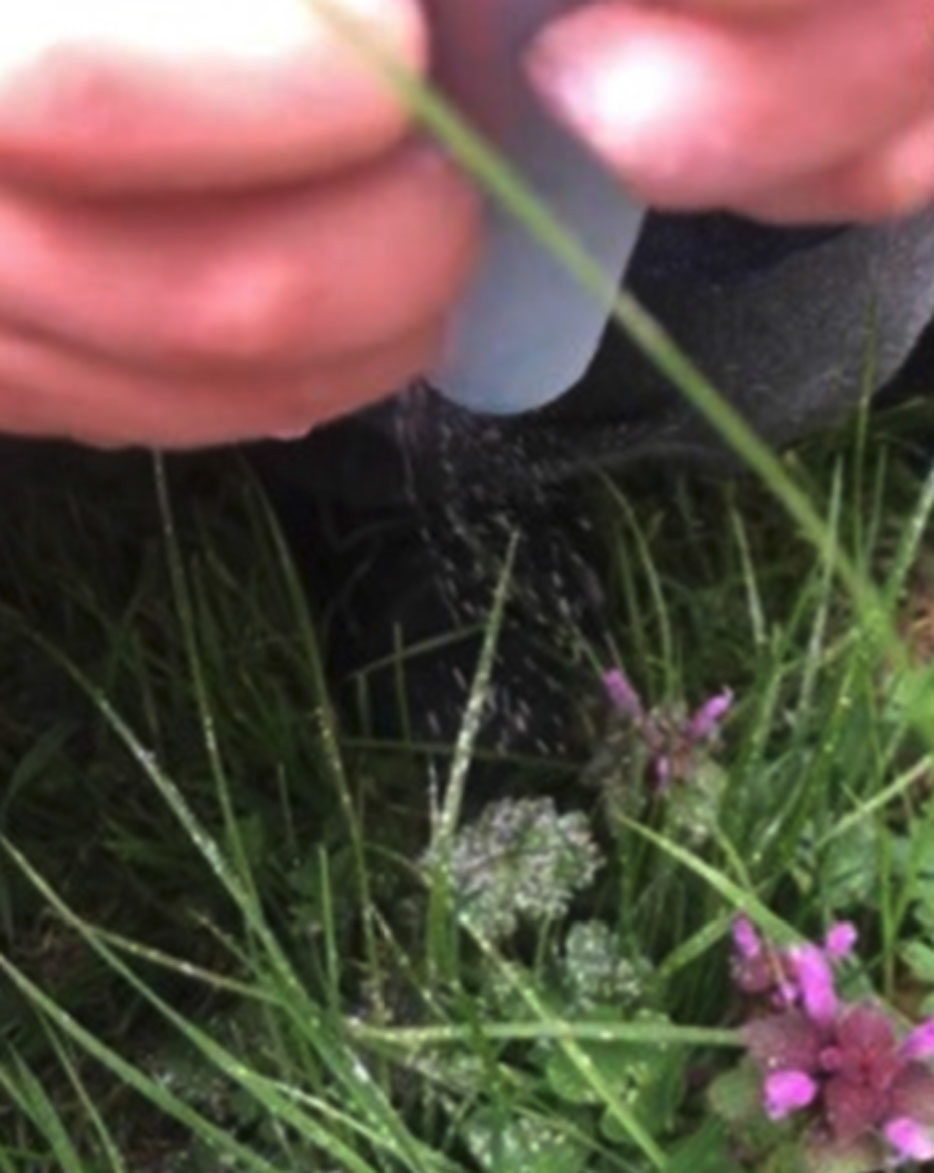
Chalk-grass-Stegosaurus at play.
Material-multispecies moment: Chalk
Stegosaurus Footnote 6 is crouching and looking down intently at something on the ground. He has been in this position for at least ten minutes and I am hailed to go over to him and look. As I get closer, I notice two pieces of chalk in his hands. He is rubbing them together and as I squat down next to him, I notice the chalk dust gently sprinkling over the blades of grass. The grass is moist with morning dew and I can feel the damp from the cold soil start to saturate my trousers around my knees. In the background, there are the sounds of other children playing chase around us and further away children in the playground of a neighbouring school. There is the constant din of construction work, and traffic, and sirens. The sound of a city. Right in front, though, Stegosaurus seems unaware of all that is going on around him. He continues to stare intently at the two pieces of chalk and the dust as it moves and flies over the grass.
There is the sound of friction, of two pieces of chalk gently sliding over one another in opposite directions. With each movement, chalk dust starts to scatter over and into the undulations of the rock, and then onto the leaves of grass. Suddenly, my attention shifts from Stegosaurus to Chalk and I realise that Chalk and grass is guiding this pedagogical event. Each leaf of grass becomes gently coated in chalk dust, illuminating each individual blade with the white powdery substance.
Stegosaurus and Chalk, playing deeply with one another. I continue to look at Chalk and grass and the art-making that is emerging and take a short video. I ask Stegosaurus if this is okay and he nods and smiles. Together, we attend to the wildness of Chalk and for the first time, I am able to co-research with Stegosaurus and the more-than-human playmates.
At forest school, Stegosaurus always seemed happy to engage in worlding without other children and adults. Stegosaurus has been diagnosed with autism and many of his learning encounters “fell outside of linguistic and a particularly rationalized and logical knowing” (Heggen, Jickling, Morse & Blenkinsop Reference Heggen, Jickling, Morse, Blenkinsop, Paulsen, Jagodzinski and Hawke2022, p. 97). He preferred to play with materials and plants than with other children and was labelled “non-verbal.” What happens, however, when we attend to this moment as becoming-wild? Stegosaurus and Chalk are engaging with one another, actively co-creating the world. With becoming-wild pedagogy, these intra-actions are not considered as deficient but as a way of knowing the world beyond adult-human subjects. In this way, we follow Hultman and Lenz-Taguchi’s work with Barad’s concept of intra-action, where they work post-anthropocentrically with photographs of children playing. When looking at a photograph of a girl in a sandbox, they suggest that in “a relational materialist understanding, the sand can be understood as ‘active’ and ‘playing with the girl’ just as much as the girl plays with the sand” (2010, p. 530). Stegosaurus was hailed by Chalk and here, Chalk co-produced a shared pedagogical encounter that enabled Stegosaurus to take part in the research. We speculate that Stegosaurus was guided by the chalk and Chalk’s aliveness. The peculiarities and specificities of chalk make a difference. We do not wish to follow an anthropomorphic conceptualisation of Chalk-as-teacher but instead as part of a material-multispecies assemblage.
Material-multispecies moment: Paintbrush
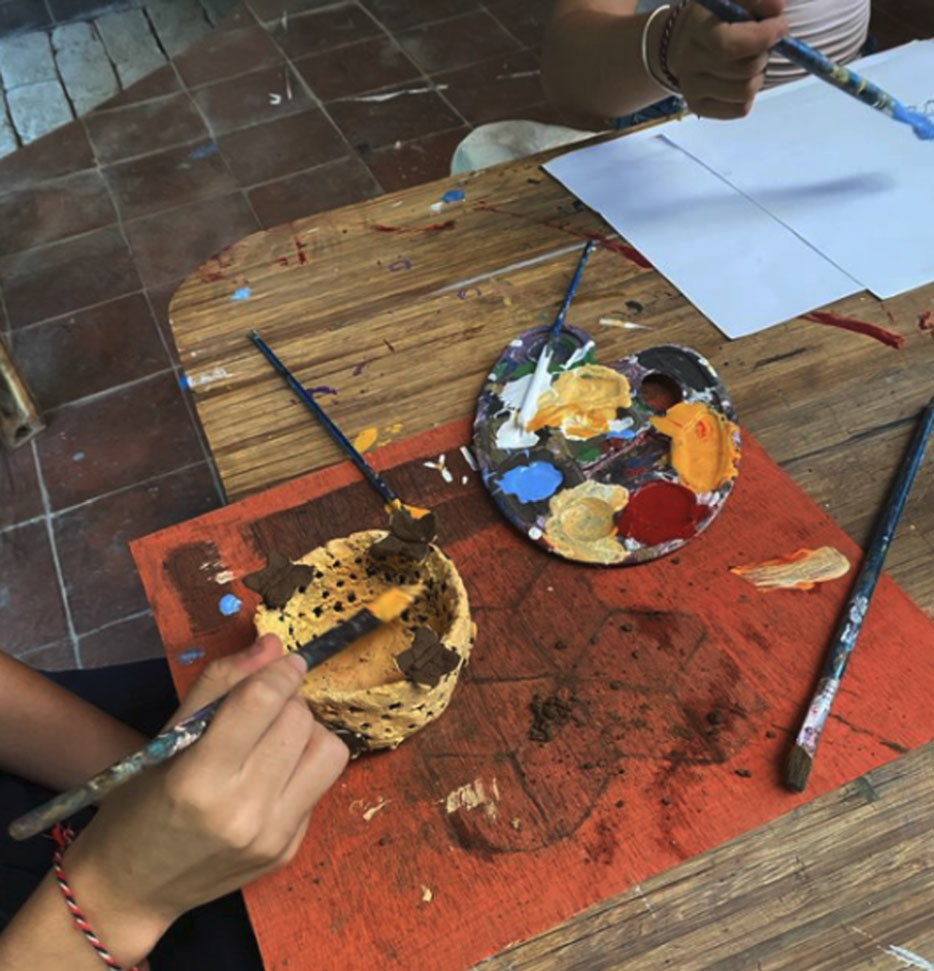
I am sitting in a bamboo chair, at a bamboo table, in a wall-less bamboo structure surrounded by bamboo trees. Another warm morning, which means it’s going to be another hot day, I warn myself. The skin on the back of my neck is starting to feel sticky, my hair starting to frizz up. I look up at the fan to check it is angled sufficiently at us. I remind myself to drink water to remain hydrated. In the backdrop, calm music is playing. Delicate bird sounds are heard overhead, and the chorus of insects come and go in waves of orchestration. As I sip my water, I look around at the high schoolers who are mostly all seated and working on their art pieces quietly. There is both a hush and a hum in our space. As usual, I am amazed at how some of them are wearing hoodies in such temperatures. One is sketching a beach-side location from her memory on a canvas with a pencil whilst her head is on the table. Across the room, another is standing up, creating a large bird sculpture with clay, her hands and metal tools. Close to me, a boy is intently using a glue gun and wooden sticks to create the anatomical structure of a fly. We are all in flow. I take this moment to survey all the different materials that the students are employing to communicate their special relationships with non-human animals. My thinking trailed off to an article that I read recently about the materiality in a learning environment (Osgood & Odegard, Reference Osgood and Odegard2022). The authors describe how they were “hailed” by cork, “a granular story,” which took them on a journey of colonised, affective, historic explorations. It is with this theory and in this sensory environment that I glance down at the table because Paintbrush hailed me. I pick her up, stroking her smooth, moist bristles likening them to fur. Between my fingers, I roll her brittle wooden handle backwards and forwards, imagining that this could be a twig, bone or spine. I think about how early humans must have constructed their paintbrushes out of animal parts when they wanted to paint. But surely, modern-day paintbrushes are not constructed with animal parts anymore? A perverse thought entered my mind: what if, right now, in this class, students are expressing their intimate, emotional relationships of love, care and hope for animals with the body parts of other animals? I reached for my computer and started a Google search: “what are paintbrushes made of?”
Becoming-wild: Whom and what do we touch when we touch Chalk and Paintbrush?
Inspired by Haraway (Reference Haraway2008), we question how our encounters with Chalk and Paintbrush touch and shape our material-multispecies worlds in vibrant, complex, unanticipated ways. In this section, we discuss the materiality of Chalk and Paintbrush, considering where they originate/d, how they have evolved and how we come to know our situated material-multispecies entanglements. We consider these contemplations to be “a rush of stories” (Tsing, Reference Tsing2015) and “granular stories” (Osgood & Odegard, Reference Osgood and Odegard2022) that might reveal ways that human activities contribute/d to the ecological concerns of today. As we consider the materialism of Chalk and Paintbrush, we are compelled to ask: How are we mutually constituted with Chalk and Paintbrush? What if we were to take this further and attend to the peculiarities of these encounters?
For most of us, the first time we encounter chalk and paintbrushes is when we attend school. They are commonly found objects in classrooms across the world because they are accessible, provide quick, easy and efficient ways to demonstrate teaching and learning and are useful tools to express personal thoughts, ideas and beliefs. In many ways, they are embroiled with an education of high standards, measurable targets, high-stakes testing, curriculums and assessments. This makes chalk and paintbrushes complicit in the process of knowledge transmission between teachers and learners, adult and child, often perpetuating uneven power relationships where the “business as usual” approach to learning does not sufficiently address the human-induced ecological destruction we are witnessing (Figure 6).
Student uses a variety of paintbrushes to decorate her clay bowl with butterflies.
Chalk is a material often associated with childhood and education. Chalkboards have long appeared at the front of classrooms as a way for the teacher to share work with a large classroom of children facing the board. As former students and educators who have been inside classrooms like this, we have a visceral response to the embodied memories of the sounds and feelings of chalk on the board. A recent study found that chalk dust gets into the lungs of teachers and students (Mbazima et al., Reference Mbazima, Moolla and Joseph2024) and acknowledges that whilst many classrooms across the globe have replaced blackboards and chalks with whiteboards and/or interactive digital devices, many classrooms continue to use chalk. Chalk is predominantly used in low-to-middle-income countries because of its cost-effectiveness and of course, there are many children, particularly girls, who continue not to have access to any schooling at all. This is where “thinking-with chalk” can take us. This is how we can attend to the workings of “human social-material and historical power/knowledge intra-actions” (Lenz Taguchi, Reference Lenz Taguchi2023, p. np). Chalk as a material is imbued with approaches to pedagogy where traditional educational settings have the teacher as holder of the chalk and the children as recipients of knowledge. This continues to be the case in schools where there is high student-to-teacher ratios and where education is still enacted on the premise of adults as experts and children as receivers of knowledge.
Sea bed, English Channel, 356 B.C.
Coccolithophores,
Who swam in sunlit waters,
Collapse to sea floor.
In the multispecies-material moment with Stegosaurus, Chalk becomes a co-learner, as does the grass that the chalk dust falls on. Chalk is a multispecies assemblage, a form of limestone composed of calcite shells and the skeletons of plankton. Heinrich’s (Reference Heinrich2013, p. 166) study of what happens to animals after death, found that whilst whales “are recycled down to the level of molecules, making their way back to new biological life, marine plankton endure after death as chalk.” In 1868, Huxley found that chalk “consisted of ‘hundreds of thousands of…. bodies, compacted together” (cited in Heinrich, Reference Heinrich2013, p. 166). Chalk as a multispecies assemblage quietly challenges the idea that this object is inert matter. A multispecies material contests the possibility of identifying objects as inanimate or animate or as animal or object.
Egypt, 1400 B.C.E
Bundled reed brushes
Murals, pottery, statues
Awash with colour
Human relationships with paintbrushes can be traced back to the pre-historic era and have undergone significant evolution over time. Earliest humans and Indigenous peoples made their paintbrushes using resources that were found locally, including plant fibres, animal hair, feathers, sticks, wood and bones. The hair was often tied to the handle or glued with natural adhesives such as pine resin and birch bark tar (Clottes, Reference Clottes2020). The Ancient Egyptians used hair from a variety of animals such as pigs, boar, goat, horses and even domesticated cats as bristles, and in Ancient China, some paintbrush handles were constructed with ivory and bamboo, whilst the bristles were made from the hair of goat, deer, wolf and rabbit. The Ancient Greeks applied several plant-based pigments to pottery and other surfaces using bristles from the fur of oxen, horses and boars. In all ancient civilisations, archaeologists found a variety of animal proteins (organ tissues, milk, eggs), glycolipids (animal fats) and waxes (beeswax) in the artworks of this period, of which, the paintbrush is inseparable from Colombini and Modugno (Reference Colombini and Modugno2009).
Han Dynasty, 210 CE, China
Goat, wolf, rabbit hair
Calligraphy and landscapes
Intricate paintings.
In modern history, the paintbrush continued to evolve. During the Renaissance period, oil painting became more popular and the demand for paintbrushes increased. Different animal furs, such as squirrel and goat, allowed for experimentation, enhanced techniques and greater control. Egg yolks, beeswax and other animal fats continued to be used for painting, gluing and other artistic methods (Laurie, Reference Laurie1967). At the end of the 18th century, technological innovations during the Industrial Revolution led to an explosion in machinery and factories whilst the invention of the metal ferrule meant that animal bristles could be clamped together, ensuring greater durability. This enabled the mass production of paintbrushes and an increased accessibility of artistic pursuits. After World War II, materials like plastic and synthetic fibres began to be used in place of natural hair and wood, leading to the construction of brushes with greater consistency and affordable pricing. Today, some well-known global companies continue to manufacture artistic materials for schools using animal products (a quick Google search will reveal paintbrushes are still manufactured with a selection of animal fur including cat, squirrel, horse, pig, boar).
Paintbrush Factory, 1853, Lancashire, UK
Manufacturing
Efficient, accessible
Mass produced paintbrush
In all historic periods, frictions and flows have emanated from paintbrush-human relationships, defining eras in instrumental ways. Early paintbrushes helped humans to convey stories and traditions on cave walls and rocks, forming the foundation of (visual) art and communication (Bahn, Reference Bahn1998; Curtis, Reference Curtis2008; Layton, Reference Layton1992). During Ancient Egypt, paintbrushes helped to create famed hieroglyphics, murals, tomb and coffin paintings, as well as other decorative art. For the Ancient Chinese, paintbrushes created beautiful characters and paintings on silk and paper, becoming so meaningful to culture that the Chinese word “ (wen),” meaning culture or civilisation, is etymologically related to the concept of the brush. In Ancient Greece, paintbrushes helped to develop the infamous Greek pottery, the black and red figures that have become a defining feature of this civilisation. Leonardo da Vinci’s experimentations with paintbrushes significantly influenced Renaissance art, innovating different techniques and materials in his tireless quest for perfection in his work. Artwork during the Industrial Revolution was the product of rapid social and economic change, characterised by the extraction of fossil fuels and the increased demand for animal products. This period fundamentally altered the relationship between humans and their environment. Across all periods, we come to know that paintbrush is not just a paintbrush; it is a paintbrush in a more-than-paintbrush world, capable of enacting agentic forces to support and enhance human expression and communication.
As we (continue to) follow the “thingly scent” (Bennett, 2015) of Chalk and Paintbrush, we unravel the threads of material-multispecies histories. Despite being considered non-living, we propose that Chalk and Paintbrush are very much alive. We align with Bennett’s (2015) notion that materials are vibrant and part of agentic assemblages with the capacity to shape and influence the world/s around them in multiple, unpredictable ways: these ways are not controlled solely by humans. We, therefore, propose, that chalk and paintbrushes, common, everyday objects in classrooms across the world, can be considered wild. Further, these material-multispecies bodies can be co-learners with humans in messy, playful, experimental educational approaches. These approaches seek to resist, disrupt, transgress and transform the humanistic hubris that has given force to the control, power, linearity and compliance in educational institutions across the world.
In the contact zones with Chalk and Paintbrush, implications for education come to light in new ways. We are provoked to ask, when children and young people hold objects in their hands, what are they actually touching? When we create art, which multispecies live and which ones die to enable human expression? When we are communicating our ideas, feelings and emotions about environmental issues, how might our materials contribute to the environmental degradation of the world/s we claim to care about? And are our only alternatives to multispecies bodies, plastic? Chalk and Paintbrush compel us to confront ethical dilemmas that are entangled with the materiality of everyday classroom objects and to consider ways that schools could live more responsibly with/in material-multispecies world/s. This is theory-practice-pedagogy in action.
Becoming-wild with Chalk and Paintbrush
In this section, we consider: what might becoming-wild with Chalk and Paintbrush do?
Becoming-wild challenges the human/non-human binary and demands a response to the acknowledgement that all life is entangled in more-than world/s. The idea that we are always in relation and part of nature is an important premise of posthuman philosophy. However, we also acknowledge there are risks when we suggest that everything is “part of nature” (TwoTrees & Kolan, Reference TwoTrees, Kolan and Rosile2016) and agree that we need “hyper vigilance to the ways in which such lines of thinking are reappropriated by anthropocentric biases, desires, and discourses” (Kopnina et al., Reference Kopnina, Sitka-Sage, Blenkinsop and Piersol2020).
Becoming-wild shifts how we conceptualise children, often the subject of educational pedagogies, from individuals to children-in-relations. We are becoming-wild when we become-child rather than commit to helping child-become-adult. Whilst education has tended to be positioned as a maturation process, helping the immature, innocent, uncultured child become a civilised adult with the skills and understanding needed to be an obedient, cultured, hard-working citizen, we argue that these deficit models of children and childhood position children as sub-human and inferior; this dismisses children as knowledge-consumers, not knowledge-producers (Giorza & Murris, Reference Giorza and Murris2021). Instead, adult/child relations are re-wilded by moving beyond developmental approaches in education and instead perceive education as a process of mutual becoming between relations (Murris, Reference Murris2019). The teacher becomes a “diffractive teacher as sympoietic system,” and this “disrupts the nature/culture binary and patriarchal notions of the self on which modern schooling has been built” (Murris, Reference Murris, Cutter-Mackenzie, Malone and Hacking2018, p. 31). Chalk and Paintbrush evoke arts-and-play-based, messy pedagogies as a way to enable child-in-relation as “diffractive educator” (Murris, Reference Murris, Cutter-Mackenzie, Malone and Hacking2018) and “take children seriously” (Heggen et al., Reference Heggen, Jickling, Morse, Blenkinsop, Paulsen, Jagodzinski and Hawke2022, p. 102) as co-pedagogues in these educational encounters. There is a wildness to these pedagogies in the way they involve “mess-making” (Hogarth & Hankin, Reference Hogarth and Hankin2024, p. 344), a creative process “that encourages us to sit-with, slow down and attend to the tangled worlds we find ourselves in” by “going deeper, backwards, sideways, slow rather than only going forwards.” Becoming-wild is related to becoming-child, as both resist “fast paced outcomes-focused approaches in environmental education research and practice” (Hogarth & Hankin, Reference Hogarth and Hankin2024, p. 344).
We are becoming-wild when we quell the urge to tidy, order, categorise, sort data, learn and live. Instead, we advocate for “mess-making as a force for resistance” (Hogarth & Hankin, Reference Hogarth and Hankin2024) to challenge standardised, controlling and linear narratives that are perpetuated for/with/in educational systems. This aligns with Blenkinsop et al.’s (Reference Blenkinsop, Morse, Jickling, Paulsen and Hawke2022) “Touchstone #4: Time and Practice” that suggest “the world does not work in a clean, predictable, linear fashion and that something important is lost when we assume that it does.” To work with this notion in our research — and to some extent, in this paper — we employ arts-based practices, such as poetry, to irrupt and disrupt the linearity of academic writing to generate the kinds of responses that cannot be easily contained. Arts-based approaches involve sensing the world around in detail, feeling and creating with minor gestures (Manning, Reference Manning2016), considering what they might mean in more-than-material worlds. We believe that messy methodologies could inspire messy pedagogies so that children and young people learn how to inquire with more arts-based experiences in schools, exploring how they are becoming-wild in the entangled, complex and “radically alive” (Barad, Reference Barad2007: 18) world/s that they co-inhabit.
Becoming-wild with friction and flow
Friction
Twist / touch / rub / heat / burn.
Notice, acknowledge, create.
Diverge and resist!
Flow
Cascading and free
Rippling, trickling, floating by
Generating more
In this section, we outline four broad implications for the frictions and flows that emerge/d with the material-multispecies moments with Chalk and Paintbrush and how this relates with wild pedagogies.
Firstly, the forces co-produced with Chalk and Paintbrush showed us how to attend to the vibrant materiality of the world/s we encounter and of the materials we hold in our hands. We are provoked to consider which educational materials come to matter and how they make a difference to the ways that we might account for the contributions of others. In our material-multispecies moments, friction and flow inspired us to trace the threaded, more-than-human histories of Chalk and Paintbrush, taking us on journeys across time, geographies, multispecies relationality, ethics, power, economics and more. Caring for Chalk and Paintbrush means that we are caring for the world/s that they come from, and this is an endeavour that should involve all humans. We understand that our everyday, taken-for-granted educational materials do not have clear start and end dates, governed by manufacturing processes, but they have evolved (and will continue to do so) in relation to the intra-acting, dynamic (wild) flows of relationality. “Touching impermanence” (Fries, Reference Fries2017) in this way encourages schools and teachers to consider how we are all becoming-wild, living and dying together (Haraway, Reference Haraway2008) and complicit in anthropocentric, unsustainable actions through the educational materials that are purchased and then placed into the hands of children and young people. This insight illuminates how the forces that emerged through intra-actions with Chalk and Paintbrush build on wild pedagogies through “Touchstone #3: Locating the Wild” (Blenkinsop et al., Reference Blenkinsop, Morse, Jickling, Paulsen and Hawke2022, p. 41). Educators are encouraged to “be constantly aware of how language, metaphors, the structures they work within, and the tools they employ, can either challenge or sustain the status quo” (Blenkinsop et al., Reference Blenkinsop, Morse, Jickling, Paulsen and Hawke2022, p. 41). Becoming-wild with friction and flow “pushes back against the desire to control—both as humans controlling the more-than-human world and as centralized institutions controlling learners and educators” (Blenkinsop et al., Reference Blenkinsop, Morse, Jickling, Paulsen and Hawke2022, p. 41). Becoming-wild has the potential to emerge anywhere with any thing if we are open to listening with our everyday encounters.
Chalk and Paintbrush encourage us to ask:
What power imbalances emerge through the materials we hold in our hands?
Secondly, in these material-multispecies moments, friction and flow illuminate/d how chalk-rock-grass-Stegosaurus-and-and-and, and paintbrush-clay-paint-table-bamboo-student-and-and-and become-wild together not as separate, predictable boundaried bodies and objects but as dynamic multispecies assemblages. The learners (ourselves included) are “emergent in a relational field, where non-human forces are equally at play in constituting children’s becomings” (Hultman & Lenz Taguchi, Reference Hultman and Lenz Taguchi2010, p. 525). We (the researcher, the iPhone creating a photograph, the theories, the materials and, and, and) are all performative mutually intra-active agents who co-produce through our encounter (Barad 2008). Here, we learn with friction and flow that humans are not the only knowledge creators. We make knowledge-in-relation. This is humbling and decentres humans. It shifts our reliance on the ocular to more sensorial, bodily relations and ways of meeting the world. Becoming-wild is a thinking-feeling-doing pedagogical process that involves touching, moving, friction and flow. This builds on Wild Pedagogies through “Touchstone #1: Nature as Co-teacher” (Blenkinsop et al., Reference Blenkinsop, Morse, Jickling, Paulsen and Hawke2022, p. 39). The forces that emerged through our material-multispecies assemblages demonstrate how we should consider more than just the natural world as “a vibrant, active, agential place that is worth listening to and learning from” (Blenkinsop et al., Reference Blenkinsop, Morse, Jickling, Paulsen and Hawke2022, p. 39) and to instead include all matter as capable of knowledge co-creation.
Chalk and Paintbrush encourage us to ask:
How are we noticing the intra-acting forces that materials produce and attending to the ways in which they co-create our world/s?
Thirdly, Chalk and Paintbrush give rise to flow(s) and illuminate the importance of space and time for pedagogic processes to emerge. “Pedagogy is an ongoing occurrence, a happening in the here-and-now, something that does not sit still but changes moment by moment, group by group and class by class” (Taylor, Reference Taylor2018: 157). Flow theory suggests that flow is a state that people enter when they engage in an “autotelic” activity (an activity that is intrinsically motivated, auto = self, telos = goal). We suggest that Chalk and Paintbrush co-create flow states an “experience seamlessly unfolds from moment to moment and one enters a subjective state” (Nakamura & Csikszentmihalyi, Reference Nakamura, Csikszentmihalyi and Csikszentmihalyi2014, p. 253). Here, the human experiences intense and focused concentration, a merging of action and awareness, loss of self-consciousness and distortion of temporal experience (Nakamura et al., Reference Nakamura, Csikszentmihalyi and Csikszentmihalyi2014, p. 253). In many ways, we were hailed to the more-than-human bodies in the material-multispecies moments we described due to the ways in which there was intense concentration and focus. We have found ourselves in a similar “state” whilst writing this article. We have sensed that time has passed faster than normal, lost hours to the thinking involved in theorising with Chalk and Paintbrush, forgotten to do mundane household tasks and missed a meeting. There is a wildness to flow. We have diverged and taken less efficient paths to article co-production. We wrote whole sections that we ended up cutting. However, we argue that this flow state is not something that a human experiences and achieves but is something that emerges in between the material-multispecies assemblages we might become entangled with/in. In relation to wild pedagogies, flow leads us to think-with “Touchstone #2: Complexity, the Unknown and Spontaneity.” Flow illuminates how “Knowledge, if given space, is wondrously dynamic” and that celebrating this “pushes back against the desire to categorize, limit, and contain” (Blenkinsop et al., Reference Blenkinsop, Morse, Jickling, Paulsen and Hawke2022, p. 40). Becoming-wild, therefore, creates alternative ways for thinking with flow and accepting that we need divergence from normative ways of thinking-doing-being. Flow provokes as it “listens for a diversity of voices, especially those that are marginalized or lost in learning environments where the standardized, the measurable, and the definable are the focus” (Blenkinsop et al., Reference Blenkinsop, Morse, Jickling, Paulsen and Hawke2022, p. 40).
Chalk and Paintbrush encourage us to ask:
How open are our educational systems to provide for deeper states of flow?
Fourthly — and not finally — Chalk and Paintbrush teach us that the forces of friction are worth noticing. The sensations of heat, tension and discomfort arise when two or more materials, bodies, ideas and feelings slide against each other, slowing down movements and resisting one another’s power/s. Whilst writing this paper, several examples of friction have emerged to illuminate the courageous, generative nature of this multifaceted force in education. For example, when creating art, friction can lead to frustrations, but it may also lead to creative insights. One example is the haikus that are littered throughout this paper: we found the syllable patterns of haikus restrictive in some ways but also a possibility for precise wordplay in others. Further, as we wrote this paper, we experienced friction on many occasions: settling into a structure, trying to meet deadlines, staying within the word count, struggling with research and trying to find the right words to convey our sensings, but this enabled us to co-create this worthwhile learning experience. In education, friction emerges through many encounters with animals, trees, geologies, children, families, teachers’ time, educational provisions, resource management, student stress and so on. Perhaps becoming-wild means that friction is about resisting compliance and norms, fidgeting, looking out of the window, daydreaming, becoming immersed, forgetting what time it is and not requiring children to be productive, standardised, busy and “on task” all the time. Working with wild pedagogies, especially “Touchstone #6: Building Alliances and the Human Community” (Blenkinsop et al., Reference Blenkinsop, Morse, Jickling, Paulsen and Hawke2022, p. 42), we consider how friction illustrates that “Diverse platforms bring more perspectives to our conversations and can lend support to each other” (Blenkinsop et al., Reference Blenkinsop, Morse, Jickling, Paulsen and Hawke2022, p. 42). Friction might lead us to consider how we are all mutually co-constituted as well as responsible for each other. Friction can, therefore, be perceived in different ways, from an enactment of homogeneity and discrimination to a process of messy ideation that leads to a creative rebirth. Our becoming of the world depends on how we respond to this force.
Chalk and Paintbrush encourage us to ask:
How might we co-create friction as both a courageous resistant force and a generative possibility?
Becoming-wild because what matters…
To respond to this special issue, we situate two material-multispecies moments with/in posthumanist, feminist materialist theory, wild pedagogies and Indigenous relational ontologies to offer becoming-wild as an alternative that re-imagines environmental education pedagogies. Inspired by “Touchstone #7: The Imagination—Limits and Possibilities” (Blenkinsop et al., Reference Blenkinsop, Morse, Jickling, Paulsen and Hawke2022, p. 43) — which could also be, friction and flow — we co-authored this paper with Chalk and Paintbrush as performative experiments, “to increase the imaginative range and the creative impetus in wild pedagogical work” (Blenkinsop et al., Reference Blenkinsop, Morse, Jickling, Paulsen and Hawke2022, p. 43). Our thinkings and doings with these limits and possibilities — or frictions and flows — have illuminated Haraway’s oft cited quote: “it matters what matter we use to think other matters with” (2016, p. 12). In this case, the “matter” (paintbrushes, chalk, grass, paint, clay, children, ourselves) in becoming-wild led us to think of other matters including the subjugation of other-than-human animals, eco-geo-politico-ethico-histories of educational materials and the childist developmentalism that permeates education. It matters because it enables us to find alternative ways of becoming-wild by resisting education as a civilising process. It matters because these thinkings and doings encourage us to be “braver in forging a less anthropocentric” practice where the force and reach of objects are acknowledged (Taylor et al., Reference Taylor, Hogarth, Hacking and Bastos2022, p. 219). It matters because even traditional approaches to nature education seem limiting when we consider how explorations with materiality have the potential to challenge the status quo, the power imbalances and the boundaries of thinking-feeling-doing that hold us back from deepening and extending our relationality with complex phenomena. It matters because it allows for frictions and flows to emerge as lines of flight, taking us beyond the perceived limits of imaginative and creative practices to consider alternatives. It matters because it can illuminate the ways in which we might become response-able when we become-wild. It matters because becoming-wild enables conditions for resistance, transformation, transgression and disruption. It matters because…
Acknowledgements
We acknowledge the immeasurable contributions that more-than-humans make to school communities across our worlds in pastpresentfuture ways. We acknowledge some of the systems, behaviours and attitudes of dominance, extraction, exceptionalism that have led to human gains at the expense of the natural world. We commit to continuing a slow practice of scholarship that enables more generative, caring and loving relationships to emerge so that all life may thrive, not just the few. We would like to thank the respective children, teachers, parents at both schools where the research took place for engaging with integrity, curiosity, generosity and enthusiasm. Hannah gives special thanks to the outdoor learning charity facilitators and to Stegosaurus for helping her to stop, slow down and notice the wildness of even the smallest moments. Charlotte gives special thanks to Bali, Indonesia, for welcoming and hosting her with ongoing generosity, patience and warmth. And, last but absolutely not least, to Chalk and Paintbrush for encouraging us to find the wildness in the everyday.
Financial support
The author, Hannah Hogarth, disclosed receipt of the following financial support for the research, authorship and/or publication of this article: The PhD research that this article draws on was funded by the University of Bath, with a URSA grant. The author, Charlotte Hankin, received no specific grant from any funding agency, commercial or not-for-profit sectors for the research.
Ethical standards
Both our research inquiries received ethical approval from the University of Bath Social Sciences Research Ethics Committees (Hogarth, S21-051; Hankin, 0763-8018). Throughout the inquiry, at every stage, ethical considerations were given to the human and more-than-human participants we research with. The inquiries adhere to the ethical principles outlined by the British Educational Research Association (BERA). Informed consent was secured from all participants, with clear communication of their rights, including the right to withdraw at any time. Our inquiries acknowledge ethical entanglements with more-than-humans and align with posthuman ethico-onto-epistemologies. The research process has been approached with care, response-ability and attentiveness to the relational dimensions of knowledge-creation.
Author Biographies
Charlotte Hankin is a PhD researcher in the Department of Education, University of Bath. Her doctoral inquiry explores animal-child relations to consider how international schools might shift from human-exceptionalism to more regenerative pedagogical practices. Charlotte employs posthumanist and feminist new materialist theories and practices to co-create research with animals and children.
Hannah Hogarth is a Lecturer in the Department of Education, University of Bath. Her research interests include childhoodnature relations, posthuman, postdevelopmental approaches to childhood and post-anthropocentric approaches to early childhood education. She recently completed a postqualitative doctoral inquiry exploring the possibilities of/for childhoodnature play during childhoodnature encounters in an urban forest school in London, UK.


 Open access

