

A voice is like a dress; playing a record is sonic drag.
—Wayne Reference Koestenbaum Koestenbaum (1993 :43)
I think I underestimated the importance of the economic exploitation of impersonators and street fairies when I first wrote about them.
—Esther Reference Newton Newton (1972 :xvi)
It could have been Sally’s Hideaway in New York, or the Baton in Chicago, but the number to open this article hails from the Monster Ball on 18 September 2018 at The Clapham Grand club in London, where the nightlife collective Klub Kids held the third annual monster ball (London Drag Shows 2018). One of the invitees, a formerly Chicago-based drag performance artist known as Daphne, is seen in the video taking the mic to exclaim, “Historically, there have been two jobs open to trans women and only two; one is sex work and the other is drag.” The audience cheered. “RuPaul’s Drag Race,” she continued, “has created a caste system and a glass ceiling in the drag community that trans women cannot break.” The cheering continued as Daphne finished her statement: “RuPaul’s trans exclusionary casting practices are keeping trans women poor, they are keeping trans women in physical danger, and they are keeping trans women from becoming our true fucking selves” (London Drag Shows 2018).
While Daphne criticized RuPaul’s Drag Race’s (RPDR) contemporaneous policy that denied trans drag queens who had previously begun their public transitions, the “caste” system to which she refers was not in fact created by RPDR. The discrimination against trans femme entertainers—especially transsexual entertainersFootnote 1 —has a long history within queer night/life institutions. From Esther Newton’s midcentury accounts of Midwest drag scenes to Leo Bersani’s reflections on the desirability hierarchies of gay life, racial and sexual discrimination have long been enshrined in gay and queer social worlds, often overlapping with spaces where the business of drag operates (Newton Reference Newton1972; Bersani Reference Bersani1987:197–222). To amend Daphne’s declaration, RPDR didn’t invent barriers for trans women in the drag world so much as it ratified them on a global scale. Only by accounting for patriarchy within gay and queer subcultures does it become clear that the business of female impersonation, a world whose lingua franca is the performance of trans femininity,Footnote 2 is largely run by men, for men.Footnote 3
Drag, as most theatre histories will tell you, is something anyone (and everyone) can do.Footnote 4
This definition genericizes drag, rendering it as a timeless set of technical practices to be engaged at will. Yet in Daphne’s telling, the practice of drag remains specific—tethered to certain people with specific embodiments, namely trans feminine people and transsexual women. What is it about drag that remains “historically […] open” to trans people, especially transsexual women? What would demographic specificity bring to reigning accounts of drag? And whose histories of drag give context to these material realities?
Daphne’s interlude reflects longstanding disputes over drag’s object, definition, history, place, rubric, audience, and practice. To contextualize Daphne’s claim about drag’s specificity, I return to contemporary drag’s founding “mothers”—stage queens (female impersonators who live as men) and street queens (transsexual drag queens who live as women).Footnote 5 As Esther Newton notes in her foundational study Mother Camp, female impersonators and their empresarios distinguished between different “patterns” of cross-gender dressing: those who got up “in drags” for a performance at the nightclub (i.e., a stage queen) and those who pursued social transition and lived their life
“in drags” (i.e., a street queen or street transvestite) (1972:7–8). In an era when public cross-dressing was a punishable offense,Footnote 6 stage queens were performers who sought to “pass” for men in everyday “straight” society.Footnote 7 Typically white and upper (middle) class,Footnote 8 stage queens offered elaborate if anachronistic accounts of their cross-dressing proclivities to justify their participation in the profession and, in removing their cross-gender dress upon the show’s conclusion, maintain a semblance of respectability.Footnote 9
Stage and street queens, in Newton’s estimation, reflect opposing orientations toward the “moral stigmatization” of embodied effeminacy in society: where the street impersonator fused the “street fairy” life with female impersonation, the stage queen “segregate[d]” the stigma as much as possible from their personal life (1972:8). For the stage queen, sex itself was constative, not performative: their participation in drag was not intended to reflect any shift in their sex-ed or gender-ed presentation. Because street queens dared to “drag” or cross-dress in public, they were targeted both by mainstream society and by their professional counterparts, driving many into the erotic economies of (trans femme) sex work. Composed primarily of younger, poorer Black and brown trans femme people, sex-working street queens’ visibility in public drew even more contempt from their gay brothers and sisters who aspired to straight society’s fantasy of national belonging.Footnote 10
Largely disqualified from professionalizing their femininity and blamed for visibilizing the “bad” side of gay life, street transvestitesFootnote 11 who pursued drag thus had to navigate hostilities
not only within public culture, but critically, within gay and queer counterpublics as well.Footnote 12
Only with the 1949 commercialization of the 7-inch, 45 rpm recorded single were street queens allowed to join the nightlife revue’s lineup by performing a new kind of nightlife number: “the record act.”
The foundational dispute between the stage queen and the street queen underscores the need to understand drag performance as a form that both draws on and subjugates a specific genre of femininity: trans femininity.Footnote 13 Trans femininity carries a certain charge when it circulates in public. Although the underlying patterns of discrimination facing street queen entertainers have not changed much since the mid-20th century, language certainly has. What used to be called “the record act” was in fact a modified or bootleg pantomime act, using recorded music as opposed to a live band or orchestra, where the cross-dressing performer would emulate the diva who carried the tune—paying tribute to the star in the process. Today, it’s known around the world as lip-syncing, and it’s an expressive cultural practice innovated by street queens and “transsexual performers,” as the late Chicago drag legend and former Miss Continental winner Chilli Pepper would say ([1985] 1986:16). Transforming the club or bar into a scene of interpretation and a stage for diva worship, lip-syncing would come to signal a stylistic reconstitution of drag performance, indexing the influx of street queens and remixing traditional female impersonation as a performance of audiovisual trans femininity.
While much has been written about lip-syncing as an audiovisual technique merging sight (site) to sound, less writing attends to the conditions and context from which it transformed beyond a technological trick into its own genre of performance. That lip-syncing now stands in as a metonym for drag writ large underscores the influence of sex-working trans femme people on drag, gay/queer culture, and popular culture more broadly. The history of lip-syncing’s emergence contextualizes the cultural politics of transvestism within the US, both in public life and in scholarship. Focusing on my own practice as a drag artist, transsexual showgirl, and self-identified body queen, my work deidealizes queer nightlife’s enduring characterization as radical or resistant to attend to the demands, pressures, expectations, stigmas, representations, and misconceptions of transsexual performers.Footnote 14 I draw on Kadji Amin’s notion of deidealization as a scholarly mood within queer studies that “acknowledges messiness and damage, refuses the repudiating operations of idealization, and acknowledges the ways in which complicity is sometimes necessary for survival” (2017:11). I extend deidealization to trans/queer nightlife industries and illicit economies precisely because the supposed theoretical import hinges, according to intellectual formations like queer theory for example, on their expressive cultures and performances being “radically anticipatory” (Berlant and Warner Reference Berlant and Warner1995:344). According to this rubric, the value of trans/queer entertainers depends on the ability of their performances to strive to “bring a new world into being” rather than of intracommunal tensions, issues, and discriminatory conventions (Amin Reference Amin2017:11). Conceiving “drag” performance via the street queen and her “record act” reappraises lip-syncing as an expressive practice that detraumatizes the charge of trans femininity through its performance of disidentity, and invites us all, in the process, to take part.
We’re All Born Naked, the Rest is…a Caste System?
Queens, Acts, Records
In 1964 Chicago experienced a drag boom, with over a dozen bars and clubs featuring female impersonation shows. Before the 1960s, performers sang with their own voices, but the 1960s queens pantomimed to 45 rpm records.
Lip-synching opened the floodgates to pretty boys who could carry off a female impersonation but couldn’t carry a tune.
—St. Sukie Reference de la Croix de la Croix (2012 :286)
If the field of drag studies were to have a slogan, it might echo the drag queen millionairess RuPaul herself: “we’re all born naked, the rest is drag.”Footnote 15 According to the institutionalized generic model, drag is routinely employed as a performatic technique to invoke a certain dynamic, situation,
characterization, stereotype, or scenario, as a mode of political performance.Footnote 16 Diana Taylor proposes “performatic” as an adjective for performance, as opposed to performative, which in J.L. Austin’s rendering names sayings that constitute doings. Universal drag is constative: if we are all doing drag, then it can be deduced that no one is.Footnote 17 Curiously, the histories of trans femme exclusion from professional spheres of drag and gender illusionism rarely make their way into these drag discourses. “We’re all born naked”: whether in academic monographs or on network televised shows, drag (vis-à-vis lip-syncing) is something anyone can put on, participate in, and perform as. “[A]nd the rest is drag”: the situated practice of drag cultivated by street queens and trans performers across the late 20th century fades in favor of its universal appeal—although, if we take Daphne at her word, a more apt rephrasing might be “and the rest is a caste system.”
What the generic approach to drag tends to miss is that while, yes, all drag performance involves playing with gender or embodiment (even when “playing it straight”), there is a historical charge to trans feminine drag because trans femininity remains one of the most pejorated forms of gendered sociality. As Esther Newton put it, “professional drag queens […] represent the stigma of the gay world” (1972:3; emphasis added). Street queens take this stigma to the extreme by making their trans femininity public, whether outside the club or on the street corner.
While the street queen appears initially as a professional distinction (in Newton’s ethnography), most academic reception tends to center the street queen as a political figure.Footnote 18 In many now-
canonical queer and gay historical accounts, street queens emerge as subjects worthy of study for their political import.Footnote 19 Take the Stonewall Inn—gay pride’s fabled origin story. According to pop culture, street queens play an almost superhuman role within conventional accounts of queer liberation: they throw the first brick.Footnote 20 Temporarily setting aside what Amin calls the “idealizing impulse” of this amnesiatic misremembering (2017:11), street queens were certainly among those pummeled by the police, dragged into the street, robbed by the officers, boarded into the paddywagons, and locked away for the night as part of routine gay bar raids.Footnote 21 Because they were frequently targeted by henchmen of state power through violence and the threat of violence, it is perhaps unsurprising the street queen has figured within queer theory and queer of color critique, however anonymously or unevenly, as a political actor.
Given the representational influence that street queens and street transvestites played in revolutionary social movements and discourses from the mid-20th century onward, their outsized role as political agitators may strike some as fitting. Nearly four years before the Combahee River Collective published their galvanizing Statement (1977), the Street Transvestite Action Revolutionaries (STAR) offered up their own manifesto, raising nine demands against the state and calling for a revolutionary people’s army forged between incarcerated “transvestites, gay street people, women, and homosexuals,” alongside Black, Indigenous, and “all oppressed people” (STAR 1970).Footnote 22 The manifesto is a pathfinding document, registering not only the way gay street people and transvestites were (are) discriminated against in the straight world but also the ways that even within “the homosexual world,” street transvestites remain exploited and discriminated against by their cissexed (straight-passing) counterparts.
While street queens have been criticized and memorialized as political figures, the earliest distinctions within gay life concern her manner of performance. Although Newton offers her own ethnographic analysis of the different “patterns” of female impersonation, stage queens sublimated their disdain for street queens through the language of style and skill: stage impersonators tended to sing live, perform with live bands, engage in verbal as well as visual impersonation, and as a result garnered more pay and held more prestige than “record performers” (1972:7–8,42–43,64). While the distinction made professional rather than demographic claims, the material effects of said distinction resulted in a lack of employability and concomitant disenfranchisement that contributed to demographic differences across people who engaged in cross-gender dressing for different ends. As part of the institutionalized discrimination against street queens, stage queens hosts and bar management alike did not hire street queens, effectively barring them from employment.
Besides the nightlife industry’s cultural imperialism that deemed live female impersonation as more respectable than the street style of recorded performance, professional and cultural attitudes congealed around the argument that the “art” of female impersonation is more commendable when the performer traverses the supposedly dimorphic and opposing poles of sex, crossing magically from one fixed position to the other.Footnote 23 Take, for example, the standard practice in drag rags and anthologies like Female Impersonators or Femme Mimics to publish photo essays that document the “startling transformation” from “everyday faces” into “beautifully stunning chicks!” (Roberts Reference Roberts1970:7; Winford Reference Winford1954). Just as the wig snatch at the end of the drag show played a cultural role in allaying spectators reported dis-ease toward female impersonators, drag’s print and visual consumer cultures popularized narrative accounts of “transformation” that emphasized the shock between the out-of-drags headshot and the in-drags
body shot (a precursor to the pre-/post-op diptych common among daytime television shows and certain trans influencers).Footnote 24 Within this model of drag, transsexual performers—those who had surgically or hormonally modified their bodies—are seen by stage impersonators and drag aficionados as having an unfair advantage and thus an easier time impersonating women.
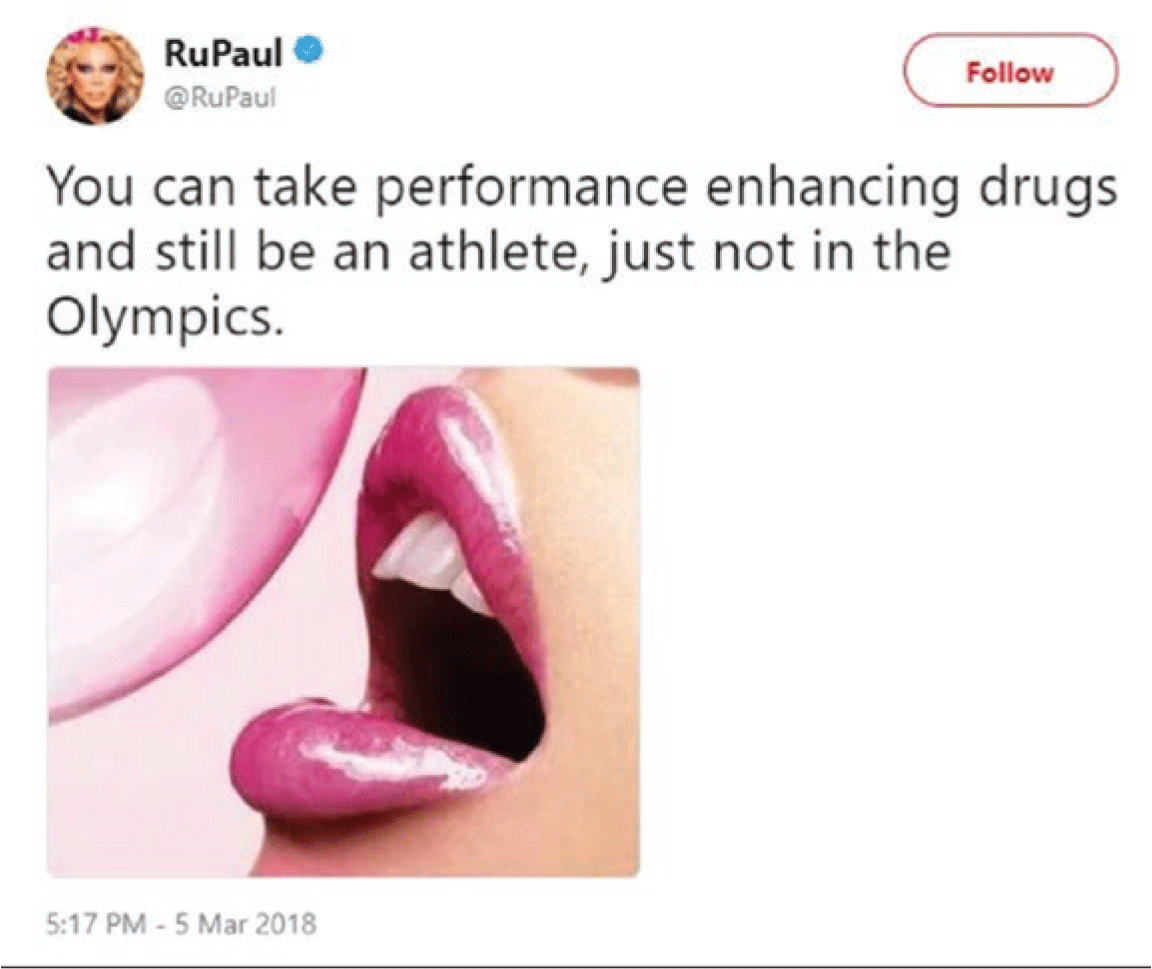
Or, in the words of RuPaul
some decades later, “You can take performance enhancing drugs and still be an athlete, just not
in the Olympics” (2018; see fig. 1).
Tweet from RuPaul, 5 March 2018. (Screenshot by eva pensis)

While the “drugs” in question refer to sex hormones, RuPaul’s exclamation is endemic of broader (sub)cultural attitudes when it comes to trans femme drag queens whose transitions
(no matter the cost, toll, or risks—medical and social—that these processes involve) were seen derogatively as “performance enhancing.” Painting performers who take hormones as cheaters stands as an intra-community example of the ways that transsexual people are societally portrayed as “evil-deceivers and make-believers,” to borrow Talia Mae Bettcher’s phrase (2007). The irony can’t be overstated: where success for the female impersonator depends on her ability to perform or ape femininity and then expose the illusion (its fakeness), the street impersonator is maligned precisely for “faking it” by pursuing embodied transition (its realness).
It may seem alarming that decades before the bans on trans girls in school sports, trans femme people were (and continue to be) subjected to bans and stipulations within the gay community. Nightlife industries—both gay (queer) and straight—remain overwhelmingly owned and managed by cissexed men. Long before RuPaul’s Drag Race, transsexual performers were commonly disqualified from female impersonation or drag pageants. Entering the microcosm of female impersonation, trans femme drag performers were constantly judged according to the respectability politics of predominantly white and straight-passing cross-dressers (when out of drag). As a primary document, Esther Newton’s ethnography is littered with examples of professional drag queens talking down and belittling street queen entertainers simply because their record acts were thought to be simpler, less intricate, and requiring less faculty to perform.Footnote 25
Due to the state’s criminalization of cross(-gender) dressing and society’s stigmatization of effeminacy, the business of female impersonation had to constantly justify its own existence as, well, one site of professionalized cross-dressing. Perhaps the industry’s cultural elitism in favoring live singing opposed to the record act was related to its own exegetical burden. Take the female impersonator Ricky Renée who got her big break after WWII at the Jewel Box Revue replacing one of the cast’s pantomime artists. As Winford chronicles in Femme Mimics, Renée was performing her record act when the record machine broke, leaving her miming to silence (a veritable nightmare for a drag performer). That’s when Renée cued up the live orchestra, who started playing a number that she could dance to. As legend had it, her live act was born; and Renée twirled and danced until her gown had split up the sides to uproarious applause (Winford Reference Winford1954:109).
In an interview with entertainer David de Alba, Renée debunked Winford’s account, noting that it wasn’t until she later saw Josephine Baker perform in Pittsburgh that she began her live dance acts (de Alba n.d.). Still, the story stands as a testament to the perceived superiority of the live act to the record act, elevated further in its retelling by association with the burlesque superstar Josephine Baker herself. Lip-syncing was perceived as a novice’s practice, fallible and subject to technology’s snafus; the professionals sang live and earned more because of it. After all, no matter how the night of Renée’s pantomime blunder unfolded, it was ultimately her ability to improvise to a live orchestra that secured her spot with the aficionados of female impersonation at the Jewel Box Revue.
Live singing and dancing acts during the heyday of female impersonation required extensive knowledge of the celebrity starlets on the screen and in the theatre; after all, to emulate the divas was to rival them. In some ways, the invention of recording technology across the early 20th century challenged traditional modes of musical transmission. As Andre Millard notes in America on Record, “the beautiful music which was the preserve of the very rich […] was to become a mass-produced consumer good—a sound recording—which would be cheap enough to be available to all” ([1995] 2005:2). Fast forward nearly a decade to the drag scenes that Esther Newton studied where the appeal of the record act was that the production of electronic records made music, as a commodity, relatively accessible. In response to a stage impersonator’s criticism of the record act, Newton captured the queen’s response: “Records are boring, Mary, but it’s the easiest thing you can do” (1972:11).
In terms of cultural production, the shift from live singing act to record act was coterminous with two related consolidations: the rollout of the 7-inch record and the decline of theatrical production value in nightlife scenes. Music industry scholars stress that the 7-inch format was rather inexpensive for audio technology and “held the three-minute pop single in its grasp, which remained the standard into the 1960s and beyond” (Scott Reference Scott2024:122).Footnote 26 Recorded sound was a “technology for the masses,” as scholar Andre Millard writes, and as such was “at the heart of a new mass culture of entertainment” ([1995] 2005:11). With the record act taking advantage of the 7-inch record’s popularity, street queens actively innovated and hustled this culture of entertainment to their own ends.
Where recordings of music offered the prospect of privatizing one’s relationship with music (the ability to listen to it on your own), postwar nightlife economies were undergoing their own changes, stepping away from elaborate, costly nightlife productions in theatre houses and entering what journalist Jim Waltzer calls “the era of the definitive nightclub,” from roughly the ’40s to the ’60s (2009). These shifts in space and artistic reproduction created the conditions for lip-syncing to exceed the frame of the pantomime in melding together elements of burlesque, striptease, and diva worship. In the wake of a series of technological advances that threatened to privatize the experience of music, street queens innovated a form of performance that socialized the experience of music through witnessing and embracing cross-identification.Footnote 27 The record act was a watershed moment for Black, brown, and poor trans feminine people in that it provided a frame and a format in which street queens could take the popular act of female impersonation and transform it through one of the most hallowed of the arts of cross-identification, diva worship and the performance of disidentity.
“Real Feminists”
Transsexuals, Cross-Identification, and the Performance of Disidentity
a voice, once recorded, doesn’t speak the same meanings that it originally intended. Every playing of a record is a liberation of a shut-in meaning—a movement, across the groove’s boundary, from silence into sound, from code into clarity.
—Wayne Reference Koestenbaum Koestenbaum (1993 :51)
Despite stage impersonators’ patronizing and elitist dismissal of the record act, street queens devised counterintuitive and meaningful performances through the record act. As an object lesson, lip-syncing shows that giving up your voice doesn’t mean you have nothing to say. As a performance genre, lip-syncing retools the relation between voice and identification, evincing that in the world of mass culture, the voice is not the sole locus of self-making.Footnote 28 Where many critics at the time debased the record act due to a too-literal interpretation of its form (i.e., to simply move your mouth to a prerecorded track), street queens experimented and devised ways around the genre’s formal constrictions.Footnote 29
One performer known for playing with the boundaries of lip-syncing was Chilli Pepper, former Miss Gay Chicago winner (1974) and the first ever winner of the Miss Continental Pageant (1980) (Keehnen Reference Keehnen2024). After immigrating to the US from Chile, Pepper pursued her career in nightlife, entering female impersonation pageants across the states. Pepper belongs to a generation of showgirls who spanned the transition from conventional pantomime imitation acts to lip-syncing. Breaking out into the national drag circuit in the 1980s, Pepper preferred to call herself a female impersonator or a showgirl (as opposed to drag queen) and emphasized in interviews that she belonged to an echelon of performers who did not rely on the curves of their bodies or the make of their dress.Footnote 30
In some ways, Pepper’s rhetorical strategies help to position her as a venerable artist as opposed to
a drag queen, but in terms of her performance, Pepper remained strictly a lip-sync performer.
In an interview with the Chicago Sun-Times, Pepper teases the reader with the winning formula of her acts where she mixes speech and lip-sync performance together in what the interviewer described as “strictly a Pepper creation” (Coburn [Reference Coburn1985] 1986).
The bulk of the Sun-Times reporter’s introduction to Pepper concerns the cis woman reporter’s equivocations over precisely how to present Chilli: the author reports meeting Pepper for “some girl talk. Which is what Chili Pepper and I are doing. Or is it?” (Note the misspelling of Pepper’s first name.) The author continues, “what does Pepper […] want to be called? ‘He’ or ‘she’?” The reporter’s obsession with Pepper’s incongruence with her physical appearance and her “birth certificate” reflects a standard media framing that contributes to the sensationalized treatment of trans feminine people in the public eye. In response to the woman’s condescension, Pepper’s reply—“Let’s settle the he-she question like this: What do I look like to you?”—is resolute: she identifies herself as “a transsexual performer. Transvestite is really the wrong term. To me, that’s primarily heterosexual men who get an erotic thrill from wearing women’s undergarments. So I think ‘transsexual performer’ best fits me” (in Coburn [Reference Coburn1985] 1986:16).
After frequent appearances on daytime talk shows like The Phil Donahue Show and The Oprah Winfrey Show, Chilli Pepper’s responses to the Chicago Sun-Times interviewer’s questions regarding trans femme entertainers are seismically attuned to the ways public media resorts to stereotypes to delineate the faultlines of womanhood. A consummate showgirl, Pepper knows that the success of her interview is tied to the amount of interest she can generate in her show. When asked about her show at the Baton, Pepper anticipates the charge that drag is misogynistic by controlling the terms of debate: “As a woman performer, I’m a real feminist. I love tough women who stand up for what they believe” (in Coburn Reference Coburn1985). Not only does Pepper assert her womanhood in the interview; she also identifies herself as a “real feminist,” playfully wresting semantic control from the interviewer.
Another way to understand the bombardment of questions about Pepper’s identification concerns proprietary anxiety around the category of womanhood. According to the heteronational fantasy, womanhood is imagined to be a property, one of the three juridical structures that undergird patriarchy (Perry Reference Perry2018:17). The opening of Pepper’s Sun-Times interview, later reprinted in Female Mimics International, is devoted to safeguarding womanhood by parsing her social difference: interrogating her self-identity, her medical history, her dysphoria, her desirability, which bathroom she uses, and whether she discloses her transsexed status to the men who approach her in everyday life. Pepper expertly navigates the barrage of questions before turning to the matter at hand: her style of drag and her upcoming performances.
Where earlier generations of illusionists engaged female impersonation as a vehicle to achieve verisimilitude with the silver screen starlets of yesteryear, Chilli Pepper used lip-syncing as an opportunity to commune with and channel the “tough women” she looked up to, women who stand up for their beliefs: “women who have a lot of nerve.” Pepper’s cross-identification with these tough women signals that unpropertied and ungovernable femininity is a source of strength, a figure worth emulating and spotlighting for a captive audience.
Real feminism, for Pepper, is what happens when the “tough woman” becomes one’s creative mother lode. Pepper’s onstage persona (she called it her “cartoon” [(1985) 1986:43]) sheds light on processes of cross-identification that are central to any practice of drag. By cross-identification, I invoke a psychic process of identification with another being that has been variously glossed by scholars of queer/gay performance as proxy identity, appropriation, and disidentification. In his excavation of “gay male culture,” historian David Halperin peers into what he considers the cultural origin of gay drag queens with another dichotomy: camp queens and beauty queens. Halperin discusses this polarity in relation to the conflictual ideals of gay culture, arguing that gay men’s turn to femininity—“through feminine identification and appropriation”—makes available a position “that would otherwise be difficult for them to claim in their own positions […] namely, a position at once dignified and degraded” (2012:211–12). Although Halperin imagines this kind of drag to be bound to “gay male culture,” the historical influx of transsexual performers alongside the formal consolidation of the art of lip-syncing suggests that drag belongs less (or not only) to gay men than to a broad conception of trans feminine people, not unlike Chilli Pepper herself.
For Halperin, the appropriation of certain kinds of femininity enables the subject to more clearly articulate its constitutive self in a process that resonates with José Esteban Muñoz’s theory of disidentification. Disidentification names the “survival strategies [that] the minority subject practices in order to negotiate a phobic majoritarian public sphere that continuously elides or punishes the existence of subjects who do not conform to the phantasm of normative citizenship” (1999:4). Drawing on Eve Sedgwick’s writings on the “cross-gender inventions of homosexuality” ([1989] 1994:169), Muñoz stresses that identification is never a simple or finished project; on the contrary, every identification is also a counter- or partial identification “with different aspects of the social and psychic world” (1999:8). Disidentification thus takes account of the ways that subjects are formed, what they latch onto within worlds hostile to them, and how performance helps them to disidentify with aspects of those worlds. Cross-identification names the broader spectrum of identifications and attachments (what Sedgwick called “new hypotheses and new clusterings-together”) that a subject forms to tether herself within worlds that render her subjectivity an anomaly in the social order ([1989] 1994:177). In the overlap between these two frames, Pepper’s affinity for the tough woman stands as one form of cross-identification.
By lifting up the figure of the tough woman, Pepper signals to her audience that unruly/ungovernable femininity is a source of strength and a desirable construction of womanhood—and she articulates these ideas at the height of Ronald Reagan’s US presidency (1981–1989). What’s more: because toughness is a cultural and not essential quality, Pepper’s performances exemplify what might be called the performance of disidentity. Rather than disidentifying with the tough woman (although, according to Muñoz and Sedgwick, this is to some degree inevitable), street queen record acts and transsexual lip-sync acts perform disidentity in the subject positions they appropriate, inhabit, emulate, impersonate, and otherwise bring to life. The notion of performing disidentity I borrow from Lauren Berlant who, in an essay published over a decade before Muñoz’s Disidentifications, was grappling with “the dominating fantasy of female self-identity,” one of the composite fantasies that makes up what Muñoz called “normative citizenship.”Footnote 31 Aptly referring to the scene of essential identity as a “monstrous doubling,” Berlant arrives at what she calls a “policy of female disidentification at the level of female essence,” by which feminists must commit themselves to resisting any notion of essentialized identity (Berlant Reference Berlant1988:253).
Within this rubric, the history of drag as innovated by street queens and transsexual performers stands not as mere imitation of some feminine essence or stereotype therein (although with any performance genre there are many examples of less-than-imaginative numbers); diva worship becomes a cultural practice where the performance of disidentity becomes the ground for fashioning a self. What lip-syncing reveals is that time after time the structure of cross-identification lies at the heart of all acts of becoming within mass culture. Rather than merely transporting female impersonation to the realm of lip-syncing, street queens and transsexual performers innovated a palimpsestic form of performance that identifies with womanhood precisely by performing its disidentity.
I Don’t Want a President at All
Body Queens and Bad Drag
In an interview later in her career, Chilli Pepper is quoted at length on what she defines as successful drag performance:
Unfortunately, [drag pageants] used to be a little more about [talent]. It wasn’t about who had the bigger breasts and who had the bigger hips and who had the bigger all that. It was really, literally a performance […] It’s changed because now, for some, they think that talent has changed or they thought that you basically show[ed] your body and that made you more talented […] The whole thing is supposed to be a little bit about everything. It’s not about, I’ll show you my breasts, or, I’ll show you a gorgeous dress. (in Drucker Reference Drucker2018)
Straddling the shift from female impersonation to today’s lip-syncing acts, Pepper’s perspective shares kinship with both performance philosophies. “Talented” drag depends on the skill of the lip-sync artist. Un-talented drag—which I gloss here as “bad” drag—places more value on look, body, flesh, effect, and gimmick, according to Pepper. The following alternative genealogy for what my drag sisters and I provisionally call the “body queen” comes from one of my early performances as a showgirl.
In my years studying and performing drag among other transsexual entertainers, I routinely heard performers discuss drag as the gateway to their trans femininity. Drag allowed them a sort of play and bounded freedom with their comportment and expression that they might later shuttle into their everyday life. This was where I diverged from my drag mother; I started cross-sex hormones months before I started performing as a drag queen. Part of this was because the kind of drag I was drawn to was high femme transsexual showgirl drag, like the world-renowned transsexual entertainers of Chicago’s Baton or the Kit Kat Lounge, where the likes of Shantell D’Marco and Mokha Montrese have held residency. “Body queen” names a transsexual performance archetype that shares iconicity with ballroom’s figure of the sex siren and emphasizes the materiality of transition for transsexual women and their enduring traffic within sexual economies.Footnote 32 In Pepper’s formulation, the body queen’s corporeal form is her effect. A hustler true-to-form, the “body queen” showgirl is the transsexual equivalent to the strip club’s dancer. Her body becomes the site where the (hyper)scrutiny that faces transsexual women is reworked and transformed into a spectacle for economic exchange.
If transsexual drag discloses the truth that drag mobilizes a specific trans femme visibility, transsexed performers, especially body queens, have long capitalized off this visibility to fund their transitions through sex work. Because street queens and transsexual performers tend to be composed of Black and brown trans women,Footnote 33 the trans femme visibility that drag mobilizes subtends to what nightlife scholar Siobhan Brooks has called racialized erotic capital (2010:7). Taken together, racialized erotic capital and trans femme visibility’s centrality to drag industries evince the role that drag plays as a cultural spectacle for trans feminine performers. To revisit Daphne’s provocations: for transsexual performers, it isn’t so much that there are two, discrete professions available to trans women (i.e., drag and sex work); rather, both lip-sync performance and sex work are contiguous cultural forms that respond to the sexualization and subjugation of trans femininity by (counter)publicizing and monetizing it. Both drag and sex work respond to the public stigma of effeminacy/trans femininity by harnessing its charge for their own aim.
In my early days as a performer, I spent a lot of time daydreaming about how the anecdotal insight among transexual drag entertainers that street queens invented lip-sync drag might shift and inform my own practice as a drag performer. Perhaps because I was a student of queer theory and queer-of-color criticism’s generic approach to drag, and also because I came into my performance career at a time when trans visibility was being established in contradistinction to drag,Footnote 34 I was hellbent on taking the TS showgirl body queen archetype back to her roots. Even my drag name, APoliticalGirl, I had devised in response to Kim Petras’s 2018 press tour, when she drew heat from trans bloggers. When Petras, who had been subject of a sensationalized documentary as a teen for being one of the youngest trans girls to receive sexual reassignment surgery, was asked how she felt about being one of the most famous trans pop stars, she responded ambivalently, confessing that her desire was to be known in her own right as a pop star rather than solely as a trans pop star (Moran Reference Moran2017; see also Farber Reference Farber2018; and Michelson Reference Michelson2018). While I understand the representational burden that Petras faces as she navigates the music industry, I also understood this German girl’s fantasy to be apolitical as a fantasy only achievable (in name) by those raced as white (Clemens Reference Clemens2018). To be apolitical, after all, one’s position within the world must be undisputed, belonging to the social center that delineates the margins. APoliticalGirl was my earnest attempt to reinject the trans femme presentational styles of drag with an expressly political bend, camping the desire to be apolitical as, in truth, a political desire nonetheless. In all my performances, APoliticalGirl seeks to disidentify with the fantasy of being apolitical.
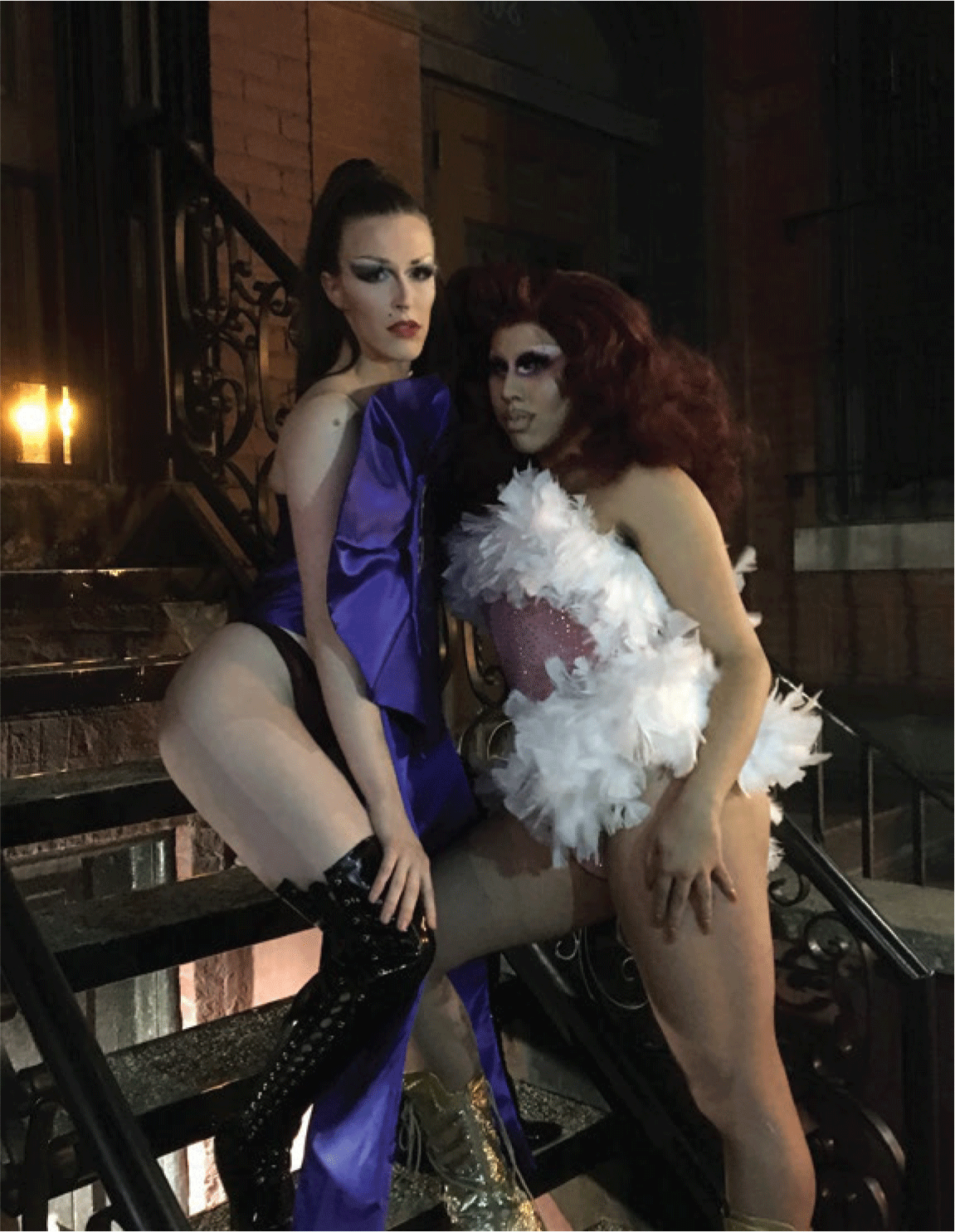
Tasking myself with surfacing the political within my performances, I adapted Pepper’s text and song lip-sync for a drag show I programmed as part of an afterparty for performance studies scholar Joseph Roach’s retirement party in April 2019 at Arbella in Chicago. The first half of the show featured one of Chicago’s legendary club kid drag performers, Pangaea (who is now based in the Bay area). Pangaea cued up Paula Abdul’s 1988 hit “Cold Hearted” for a campy and punchy lip-sync rendition that had the crowd hanging on every beat from start to finish (see fig. 2). Pangaea’s look compliments her lip-syncing and hearkens back to the ’80s with her big hair, feathered corset, and sequined platform-heeled boots. Mod showgirl meets Mattel, Pangaea strutted across the floor and delivered a captivating rendition of Abdul’s anthem.
APoliticalGirl and Pangaea outside of Arbella in Chicago, 12 April 2019. (Photo by Gervais Marsh)

I, on the other hand, occupied myself with asking how my performance could convert the excess of trans feminine visibility that drag monopolizes into a political message fit for a lettered academic’s retirement party.
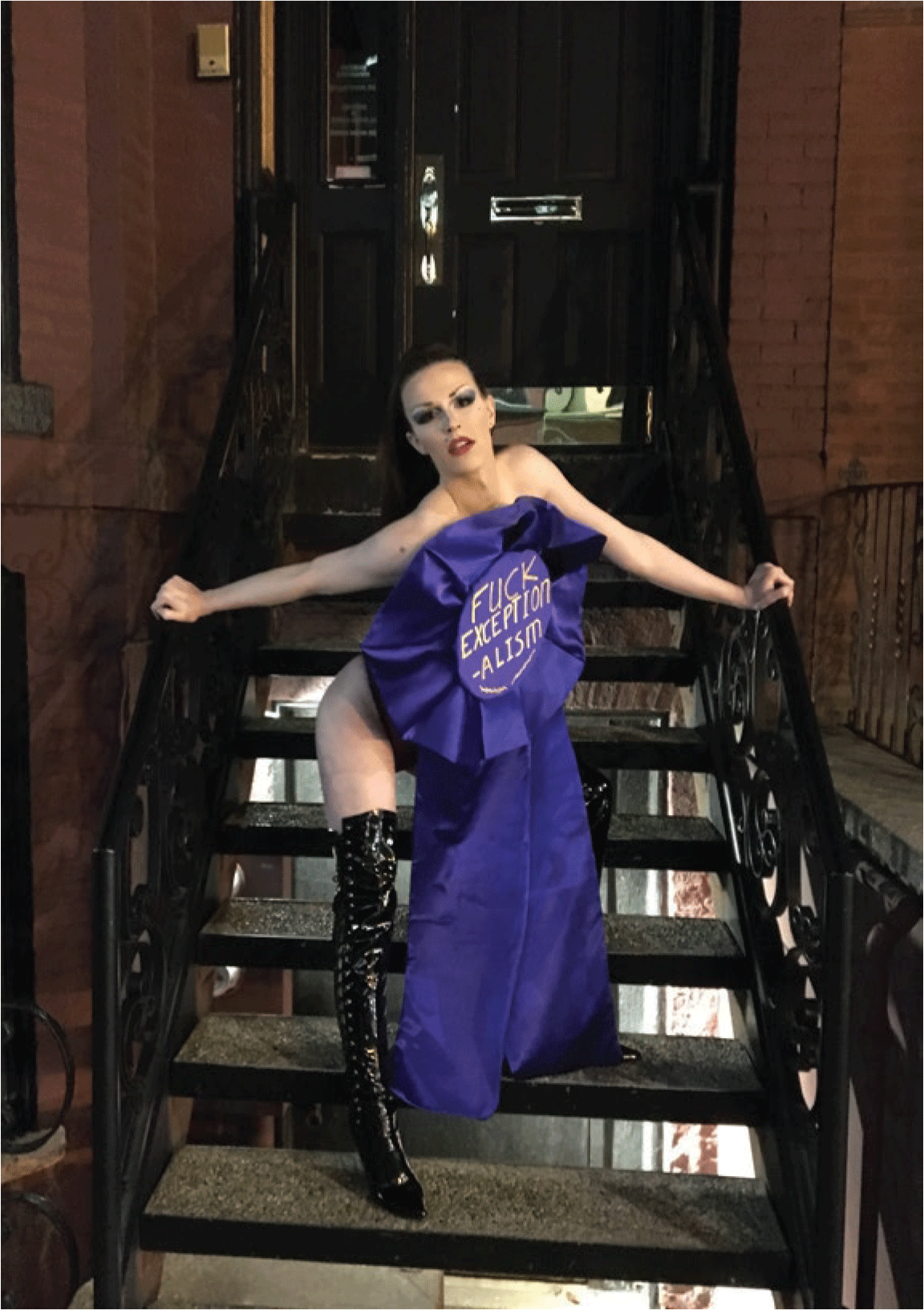
I decided to mash together and juxtapose two of my earworm obsessions at the time: Kim Petras’s 2017 breakout single, “I Don’t Want It at All,” and Mykki Blanco’s rendition of Zoe Leonard’s 1992 poem “I want a president.” While the sound editing and splicing made for no doubt a politicized performance, I quickly realized, above the loud chatter in the tight physical enclosure of the bar, that in dropping the high-frequency pop mix of Petras’s anthem to cut to Blanco’s more stripped, introspective poetic delivery, I ended up confusing the audience by pushing the lip-sync act to its formal limit: everyone could hear Petras’s mix but few could hear Blanco’s voice over the noise in the bar.Footnote 35 Realizing that my formal experimentation may have been too out-of-place for the bustling restaurant-turned-drag bar, my saving grace was twofold: half of the crowd was composed of performance studies scholars curious about my number and my look was particularly striking (see fig. 3).
APoliticalGirl on a stairwell outside of Arbella, Chicago, 12 April 2019. (Photo by Gervais Marsh)

In the days leading up to the event, I designed the concept for my look and sewed it together: a life-sized Best-in-Show blue ribbon bow with thigh-high patent leather showgirl boots to match. Across the bow’s oversized face was its prizewinning message: “Fuck Exceptionalism.” How else to honor an illustrious academic career than by camping the very ideologies that subtend professional respectability and meritocracy?Footnote 36 Even in the face of my performance’s relative success or failure (e.g., “relying on her look/body”), drag here was not so much a technique used to expose some truth about gender or sex but rather, in chopping and screwing Kim Petras’s materialistic bop with Mykki Blanco’s reading, a method to skewer the ideologies of difference and exceptionalism that inhere and structure institutional life.
Lip-syncing for Your Life
Reprising Drag’s Social Meanings
In a 2018 roundtable book review section of American Anthropologist, several queer anthropologists returned to Esther Newton’s Mother Camp and reflected on its significance (Valentine 2018). In one of the reviews, “Street Fairies Have Nothing to Lose,” V. Varun Chaudhry points to “transy drag” to illustrate the “deeper logics of difference” that contemporary terms like transmisogyny and transmisogynoir, in Chaudhry’s account, fail to engage (2018:859). Chaudhry concludes that “transy drag,” which aspires to a sense of privatized cross-gender embodiment described as “‘ordinary,’ impl[ies] a normative whiteness and middle-class status.”Footnote 37 They continue, “Such a desire—especially if experienced by a poor black person—would push otherwise respectable female impersonators from ‘professional’ to ‘freakish’” (Chaudhry Reference Chaudhry2018:859).
While Chaudhry correctly identifies that the distinction, as Newton notes, pertains to the primarily white, male-by-day stage queens, their discussion misrepresents the drag queens’ fears of “the transvestite thing.” The supposed deviance of transy drag was not so much that it aspired to normative femininity (although this does violate the female impersonation’s glamour standard) but that it occurred for some “sexual purpose outside the context of performance” (Newton Reference Newton1972:51). Impersonators demarcated sexual transvestism from female impersonation according to whether the cross-gender dress led to privatized consumption (“The typical transy mode is to wear feminine attire underneath men’s clothes” [52]) or to performance (“the effect of the female impersonator subculture is to socialize individual deviance” [51]). As we see with Newton’s interlocutors, “transy drag” acts like a valve where the consumption of femininity vis-à-vis its attire occurs clandestinely, in the privatized, domestic sphere, while the subject continues to pass in “men’s clothes” in everyday life. Yet, as Newton observes throughout, the vast majority of poor queens have no access to this privatized domestic sphere, let alone the resources to purchase the requisite intimate feminine fineries associated with sexual transvestism. What’s more, Chaudhry’s discussion sidesteps Newton’s schema two pages earlier, where she distinguishes between “transy drag” and “tacky drag” (drag that stage queens considered to be shoddy or “of poor quality”) (1972:49). Newton continues,
No single word was more consistently used by the older, more show-business oriented performers to describe the appearance of lower-status street oriented performers and the street fairies themselves. “Tacky” is thus indirectly a class descriptive term as it is used by female impersonators. (1972:49)
Even if the “poor black person” Chaudhry imagines were to pursue an “ideal of feminine beauty” deemed “ordinary” by the stage queens, her femininity would likely be perceived as tacky as opposed to transy given that her femininity circulates publicly given her classed and racialized status.Footnote 38
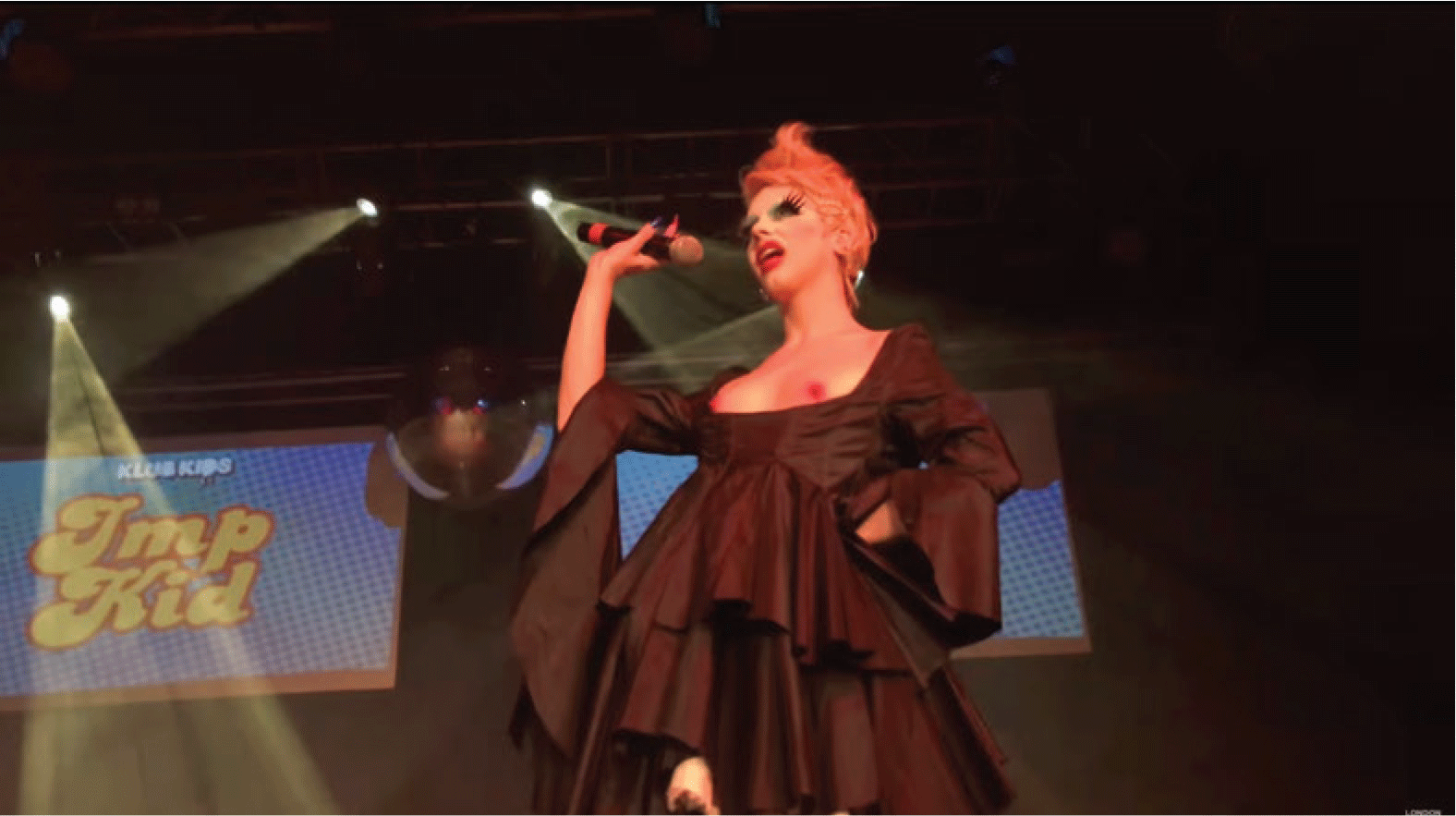
Imp Kid performing at Monster Ball 3 at the Clapham Grand, 18 September 2018. (Screenshot by TDR)

Far from simply adding an additional cast of characters to drag histories, the influx of street queens with their innovation of lip-syncing to the practice we now know as drag requires what scholars have called the “undoing” of queer and gay history when it comes to drag (Herring Reference Herring2007). It isn’t possible to tell the story of the origin of lip-syncing as a presentational performance genre without attending to the material conditions and precarious social position of street queens that both straight and queer worlds produce. The story of lip-syncing as a performance genre is also one of an erasure of street queens from the story; this is all the more glaring given the popularization of lip-syncing in the 21st century. The history of contemporary drag, then, is insufficient without foregrounding the exclusion of the poor, sex-working trans femmes and transsexual women from the queer counterpublic’s infrastructure (not to mention their frequent elision from subsequent scholarly theorizations).Footnote 39
The argument that trans femininity’s charge in public is related to cultural practices of trans femme visibility might seem to suggest that trans women are the “appropriate” performers of drag—as though trans women’s persistent ability to partake in drag (as Daphne mentions at the outset) is somehow less complicated than other people’s engagement with the art form. To be clear, I do not adhere to this essentializing view of drag. In truth, most of the queens I performed with in Chicago’s DIY drag scene from 2017–2020 were not transsexed beyond their comportment onstage.Footnote 40
What I find myself increasingly concerned with as a transsexual performer and performance scholar who has witnessed the public and institutional erasure of marginalized trans femme entertainers from nightlife spaces and drag histories, is how theatre histories of drag and gender illusionism make it difficult to ask how performers (regardless of gender/sex) engage with, relate to, and profit from the visibility that the performance of trans femininity generates. One only has to think of RuPaul’s marketing and monetization of the term “shemale/shemail” to give one example. Far from banishing non-transsexual and non-trans femme performers from participating in drag, I find it more productive pedagogically to ask how said performers engage with the forms of visibility that lip-
syncing draws on. “What are you doing in the space” becomes “what are you doing with the space?”
The second concern returns us to the rubric of the political endemic to the generic approach to drag. As a queen who herself insisted on making each of my performances “political,” I began to wonder about the limitations of what I imagined as political within performance. As Muñoz detailed in his chapter on Félix González-Torres, “minority cultural producers” are assumed to be apolitical when they do not “critique the dominant culture through predictable routes” (1999:166). Did my own attachment to body queens recognize within their spectacularized corporeality a different kind of political performance? If Newton still rings true—that trans femininity vis-à-vis the street queen remains the most pejorated form of bodily self-expression—then the transsexual showgirl’s intentional display and insistence on her corporeal form takes on a new dimension in relation to a gay/queer culture heady for cissexual, rights-based incorporation into official structure and the same old clone desirability politics.
The distinction of stage vs. street spatializes two camps of trans femme embodiment within the drag worlds and how they responded to the public stigma of effeminacy in the 20th century: one outfitted itself with theatre histories and ties to showbiz in order to confine itself to the stage and stave off associations with societal fears of (trans) feminization. The other camp was relegated to the street because of its embrace of (trans) feminization. In the midst of this hierarchy, lip-syncing
offered a watershed moment for street queens to crystallize their record acts into vernacular performances of diva worship. That lip-syncing now functions as drag’s primary performance mode speaks to the centrality of street queens—and their corporeal embrace of effeminacy—to gay and queer cultures writ large.