
Skip to main content Accessibility help
×
  • Cited by 45
    • Show more authors
    • You may already have access via personal or institutional login
    • Select format
    • Publisher:
      Cambridge University Press
      Publication date:
      22 September 2009
      14 September 2000
      ISBN:
      9780511484391
      9780521773485
      9780521028202
      Dimensions:
      (228 x 152 mm)
      Weight & Pages:
      0.55kg, 296 Pages
      Dimensions:
      (228 x 152 mm)
      Weight & Pages:
      0.445kg, 296 Pages
    You may already have access via personal or institutional login
  • Selected: Digital
    Add to cart View cart Buy from Cambridge.org

    Book description

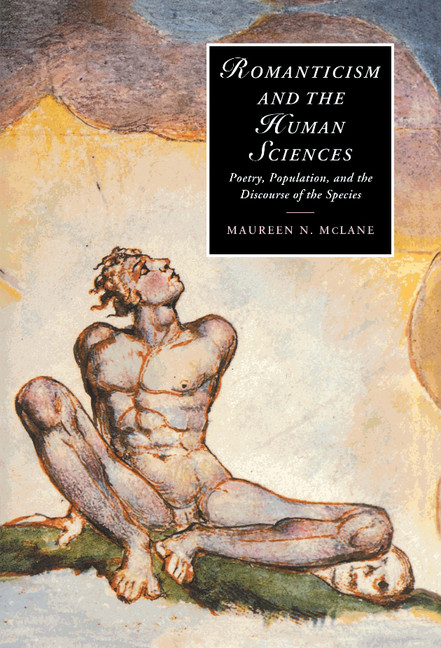
    This study, published in 2000, examines the dialogue between Romantic poetry and the human sciences of the period. Maureen McLane reveals how Romantic writers participated in a new-found consciousness of human beings as a species, by analysing their work in relation to discourses on moral philosophy, political economy and anthropology. Writers such as Wordsworth, Coleridge, Mary Shelley and Percy Shelley explored the possibilities and limits of human being, language and hope. They engaged with the work of theorisers of the human sciences - Malthus, Godwin and Burke among them. The book offers original readings of canonical works, including Lyrical Ballads, Frankenstein and Prometheus Unbound, to show how the Romantics internalised and transformed ideas about the imagination, perfectibility, immortality and population which so energised contemporary moral and political debates. McLane provides a defence of poetry in both Romantic and contemporary theoretical terms, reformulating the predicament of Romanticism in general and poetry in particular.

    Reviews

    "Romanticism and the Human Sciences offers fresh perspectives on canonical texts and ultimately seeks to sketch a position that both recontextualizes romantic arguments and remains sensitive to how those arguments themselves test the boundaries of any merely contextual reading. In raising far-reaching questions with seriousness and candor, it does not shy away from the very real difficulties of its subject, and it makes a compelling case that the challenge posed by romanticism to today's readers--whether humanist, anti-humanist, or none of the above--remains as potent and problematic as ever." Deborah Elise White, Emory University, Studies in Romanticism

    "a thought-provoking reflection on the value of Romantic literature... a valuable contribution to our understanding of the period. [McLane] demonstrates that the new ways of understanding human beings in society, the new modes of calculating human worth, envisioning human possibility, and quantifying human lives exerted a powerful influence on Romantic writing." Romanticism on the Net

    "Intriguing....the overall quetion of the connection between literature and anthropology during the Romantic age proves to be very fertile ground for elaborate and detailed discussions of both literary and theoretical texts of that period." Variations

    "Her [McLane's] readings of individual works are...frequently brilliant..." Albion

    "A book of wide scope and intellectual ambition." RedNova News

    Refine List

    Actions for selected content:

    Select all | Deselect all
    • View selected items
    • Export citations
    • Download PDF (zip)
    • Save to Kindle
    • Save to Dropbox
    • Save to Google Drive

    Save Search

    You can save your searches here and later view and run them again in "My saved searches".

    Please provide a title, maximum of 40 characters.
    ×

    Contents

    Metrics

    Full text views

    Total number of HTML views: 0
    Total number of PDF views: 0 *
    Loading metrics...

    Book summary page views

    Total views: 0 *
    Loading metrics...

    * Views captured on Cambridge Core between #date#. This data will be updated every 24 hours.

    Usage data cannot currently be displayed.

    Accessibility standard: Unknown

    Why this information is here

    This section outlines the accessibility features of this content - including support for screen readers, full keyboard navigation and high-contrast display options. This may not be relevant for you.

    Accessibility Information

    Accessibility compliance for the PDF of this book is currently unknown and may be updated in the future.
