
Skip to main content Accessibility help
×
  • Cited by 18
    • Show more authors
    • You may already have access via personal or institutional login
    • Select format
    • Publisher:
      Cambridge University Press
      Publication date:
      22 September 2009
      30 June 2005
      ISBN:
      9780511487972
      9780521849098
      9780521090834
      Dimensions:
      (216 x 138 mm)
      Weight & Pages:
      0.47kg, 252 Pages
      Dimensions:
      (216 x 140 mm)
      Weight & Pages:
      0.33kg, 252 Pages
    You may already have access via personal or institutional login
  • Selected: Digital
    Add to cart View cart Buy from Cambridge.org

    Book description

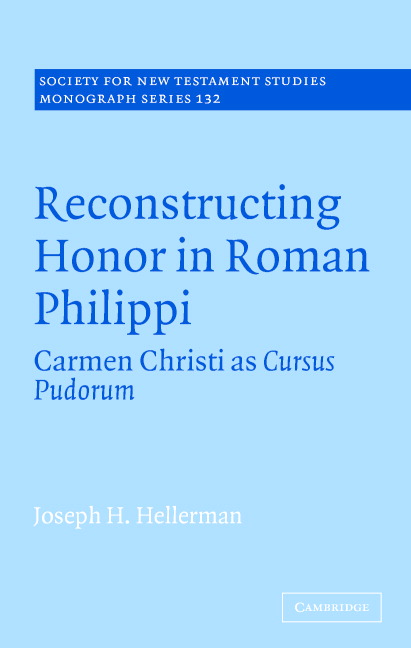
    This book examines Paul's letter to the Philippians against the social background of the colony at Philippi. After an extensive survey of Roman social values, Professor Hellerman argues that the cursus honorum, the formalized sequence of public offices that marked out the prescribed social pilgrimage for aspiring senatorial aristocrats in Rome (and which was replicated in miniature in municipalities and in voluntary associations), forms the background against which Paul has framed his picture of Jesus in the great Christ hymn in Philippians 2. In marked contrast to the values of the dominant culture, Paul portrays Jesus descending what the author describes as a cursus pudorum ('course of ignominies'). The passage has thus been intentionally framed to subvert Roman cursus ideology and, by extension, to redefine the manner in which honour and power were to be utilized among the Christians at Philippi.

    Reviews

    Review of the hardback:'Hellerman jumps into the deep waters of Phil. 2.6–11 with an attractively simple thesis … The whole argument is carried through straightforwardly and effectively. … a good contribution to the task of situating 2.6–11 in its context at Philippi.'

    Source: Journal for the Study of the New Testament

    Review of the hardback:'This is a valuable book, … the structure as it stands does give the book an extra possible use as an interesting introduction to, and case-study on, the relevance of honour for the understanding of first-century texts from the Roman Empire.'

    Peter Oakes - University of Manchester

    Refine List

    Actions for selected content:

    Select all | Deselect all
    • View selected items
    • Export citations
    • Download PDF (zip)
    • Save to Kindle
    • Save to Dropbox
    • Save to Google Drive

    Save Search

    You can save your searches here and later view and run them again in "My saved searches".

    Please provide a title, maximum of 40 characters.
    ×

    Contents

    References
    Alcock, Susan E. (1993). Graecia Capta: The Landscapes of Roman Greece. Cambridge, Cambridge University Press
    Alcock, Susan E. (1994). “Minding the Gap in Hellenistic and Roman Greece,” in Placing the Gods: Sanctuaries and Sacred Space in Ancient Greece, ed. Alcock, Susan E. and Osborne, Robin. Oxford, Clarendon Press: 247–61
    Alexander, Loveday (1989). “Hellenistic Letter-Forms and the Structure of Philippians.” Journal for the Study of the New Testament 37: 87–101
    Arlandson, James Malcolm (1997). Women, Class and Society in Early Christianity. Peabody, MA, Hendrickson
    Ascough, Richard S. (1998). “Civic Pride at Philippi: The Text-Critical Problem of Acts 16.21.” New Testament Studies 44: 93–103
    Ascough, Richard S. (2003). Paul's Macedonian Associations: The Social Context of Philippians and 1 Thessalonians. Tübingen, Mohr-Siebeck
    Barrett, Anthony A. (2002). Livia: First Lady of Imperial Rome. New Haven, Yale University Press
    Bartchy, S. Scott (1991). “Community of Goods in Acts: Idealization or Social Reality?,” in The Future of Early Christianity: Essays in Honor of Helmut Koester, ed. Pearson, Birger. Minneapolis, Fortress: 309–18
    Bartchy, S. Scott (1992). “Slavery (Greco-Roman),” in Anchor Bible Dictionary (ed. D. N. Freedman), ed. David, Noel Freedman. New York, Doubleday: vol. Ⅸ, 65–73
    Bartchy, S. Scott (2003). “Who Should Be Called Father? Paul of Tarsus between the Jesus Tradition and Patria Potestas.” Biblical Theology Bulletin 33: 135–47
    Barton, Carlin A. (2001). Roman Honor: The Fire in the Bones. Berkeley, University of California Press
    Basevi, Claudio and Juan Chapa (1993). “Philippians 2:6–11: The Rhetorical Function of a Pauline ‘Hymn,’” in Rhetoric and the New Testament: Essays from the 1992 Heidelberg Conference, ed. Porter, S. E. and Olbricht, T. H.. Sheffield, Sheffield Academic Press: 338–56
    Bauckam, Richard (1998). “The Worship of Jesus in Philippians 2:9–11,” in Martin and Dodds (1998): 128–39
    Bauer, W., Danker, F., Arndt, W., and Gingrich, F., eds. (2000). A Greek–English Lexicon of the New Testament and other Early Christian Literature. Chicago, University of Chicago Press
    Beacham, Richard C. (1992). The Roman Theater and Its Audience. Cambridge, MA, Harvard University Press
    Beacham, Richard C. (1999). Spectacle Entertainments of Early Imperial Rome. New Haven, Yale University Press
    Beard, Mary and John, North, eds. (1990). Pagan Priests: Religion and Power in the Ancient World. Ithaca, Cornell University Press
    Beard, Mary, North, John, and Price, Simon (1998). Religions of Rome: A History. Cambridge, Cambridge University Press
    Beare, F. W. (1959). A Commentary on the Epistle to the Philippians. Peabody, MA, Hendrickson
    Beck, Robert (1996). “The Mysteries of Mithras,” in Kloppenborg and Wilson (1996): 176–85
    Best, Ernest (1968). “Bishops and Deacons: Philippians 1,1.” Studia Evangelica 4: 371–76
    Béteille, André (1985). “Stratification,” in The Social Science Encyclopedia, ed. Adam, Kuper and Jessica, Kuper. London, Routledge & Kegan Paul: 831–34
    Betz, Otto (1977). “Paulus als Pharisäer nach dem Gesetz. Phil. 3.5–6 als Beitrag zur Frage des frühen Pharisäismus,” in Treue zur Thora. Beiträge zur Mitte des christlich-jüdischen Gesprächs. Festschrift für Günther Harder zum 75. Geburtstag, ed. Osten-Sacken, P. von. Berlin, Institut Kirche und Judentum: 54–64
    Birley, Eric (1986). “The Flavian Colonia at Scupi.” Zeitschrift für Papyrologie und Epigraphik 64: 209–16
    Blass, F., Debrunner, A., and Funk, R. (1961). A Greek Grammar of the New Testament and Other Early Christian Literature. Chicago, University of Chicago Press
    Bloomquist, L. Gregory (1993). The Function of Suffering in Philippians. Sheffield, Sheffield Academic Press
    Bockmuehl, Markus (1997). “The Form of God (Phil. 2.6): Variations on a Theme of Jewish Mysticism.” Journal of Theological Studies 48: 1–23
    Bockmuehl, Markus (1998). The Epistle to the Philippians. Peabody, MA, Hendrickson
    Bormann, Lukas (1995). Philippi: Stadt und Christengemeinde zur Zeit des Paulus. Leiden, Brill
    Bornhäuser, Karl. (1933). “Philipper 2,5–11.” Neue kirchliche Zeitschrift 44: 428–34, 453–62
    Bourdieu, Pierre (1977). Outline of a Theory of Practice. Cambridge, Cambridge University Press
    Breeze, David J. (1971). “Pay Grades and Ranks below the Centurionate.” Journal of Roman Studies 61: 130–35
    Breeze, David J. (1974). “The Career Structure below the Centurionate during the Principate,” in Aufstieg und Niedergang der römischen Welt (ed. H. Temporini) 2.1: 435–51
    Brown, Colin (1998). “Ernst Lohmeyer's Kyrios Jesus,” in Martin and Dodds (1998): 6–42
    Bruce, Frederick F. (1990). The Acts of the Apostles: Greek Text with Introduction and Commentary. Grand Rapids, Eerdmans
    Brunt, P. A. (1971). Italian Manpower 225 B.C.–A.D. 14. Oxford, Clarendon Press
    Brunt, P. A. (1984). “The Role of the Senate in the Augustan Regime.” The Classical Quarterly 34(2): 423–44
    Burnett, Andrew, Amandry, Michael, and Ripollès, Père Pau, eds. (1992). Roman Provincial Coinage Ⅰ: From the Death of Caesar to the Death of Vitellius (44 BC–AD 69). London, British Museum Press
    Caird, G. B. (1976). “Paul's Letters from Prison: Ephesians, Philippians, Colossians, and Philemon.” New Clarendon Bible. Oxford, Oxford University Press
    Calhoun, Craig (2002). “Stratification,” in Dictionary of the Social Sciences, ed. Craig, Calhoun. Oxford, Oxford University Press: 466–67
    Campbell, J. B. (1984). The Emperor and the Roman Army, 31 BC–AD 235. Oxford, Clarendon Press
    Campbell, R. Alistair (1994). The Elders: Seniority within Earliest Christianity. Edinburgh, T. & T. Clark
    Campenhausen, Hans (1969). Ecclesiastical Authority and Spiritual Power in the Early Church. London, Black
    Castelli, Elizabeth A. (1991). Imitating Paul: A Discourse of Power. Louisville, Westminster and John Knox Press
    Cerfaux, Lucien (1959). Christ in the Theology of St. Paul. New York, Herder and Herder
    Clarke, Andrew (2000). Serve the Community of the Church: Christians as Leaders and Ministers. Grand Rapids, Eerdmans
    Collart, Paul (1928). “Le théâtre de Philippes.” Bulletin de Correspondance Hellénique 52: 74–124
    Collart, Paul (1937). Philippes, ville de Macédoine, depuis ses origines jusqu’à la fin de l’époque romaine. Paris, E. de Boccard
    Conzelmann, Hans (1987). Acts of the Apostles. Philadelphia, Fortress
    Cotter, W. (1993). “‘Our Politeuma Is in Heaven’: The Meaning of Philippians 3:17–21,” in Origins and Method: Towards a New Understanding of Judaism and Christianity, ed. McLean, B. H.. Sheffield, Journal for the Study of the New Testament Press: 92–104
    Creighton, Millie R. (1990). “Revisiting Shame and Guilt Cultures: A Forty-Year Pilgrimage.” Ethos 18: 279–307
    Crossan, John Dominic (1998). The Birth of Christianity. San Francisco, HarperSanFrancisco
    Curchin, L. A. (1990). The Local Magistrates of Roman Spain. Toronto, University of Toronto Press
    Cushman, Philip (1990). “Why the Self Is Empty: Toward a Historically Situated Psychology.” AP 45: 599–611
    Cushman, Philip (1995). Constructing the Self, Constructing America: A Cultural History of Psychotherapy. Reading, MA, Addison-Wesley Publishing Company
    Dalton, W. J. (1979). “The Integrity of Philippians.” Biblica 60(1): 97–102
    Davis, Kingsley (1953). “Reply.” American Sociological Review 18: 394–97
    Davis, Kingsley and Moore, Wilbert E. (1945). “Some Principles of Stratification.” American Sociological Review 10: 242–49
    Vos, Craig S. (1999a). Church and Community Conflicts: The Relationships of the Thessalonian, Corinthian, and Philippian Churches with their Wider Communities. Atlanta, Scholars
    Vos, Craig S. (1999b). “Finding a Charge that Fits: The Accusation against Paul and Silas at Philippi (Acts 16.19–21).” Journal for the Study of the New Testament 74: 51–63
    deSilva, David (1994). “No Confidence in the Flesh: The Meaning and Function of Philippians 3:2–21.” Trinity Journal 15(1): 27–54
    deSilva, David (1999). The Hope of Glory: Honor Discourse and New Testament Interpretation. Collegeville, MN, Liturgical Press
    deSilva, David (2000). Honor, Patronage, Kinship & Purity: Unlocking New Testament Culture. Downers Grove, IL, InterVarsity
    Dobson, B. (1972). “Legionary Centurion or Equestrian Officer?Ancient Society 3: 193–207
    Donahue, John F. (2003). “Toward a Typology of Roman Public Feasting.” American Journal of Philology 124(3): 423–41
    Dorcey, Peter F. (1992). The Cult of Silvanus: A Study in Roman Folk Religion. Leiden, Brill
    Downing, F. G. (1999). “‘Honor’ among Exegetes.” Catholic Biblical Quarterly 61: 53–73
    Dumont, Louis (1967). Homo hierarchicus, essai sur le système des castes. Paris, Gallimard
    Dunn, James D. G. (1980). Christology in the Making. Philadelphia, Westminster
    Dunn, James D. G. (1998). “Christ, Adam, and Preexistence,” in Martin and Dodds (1998): 74–83
    Edwards, Douglas R. (1996). Religion and Power: Pagans, Jews, and Christians in the Greek East. New York, Oxford
    Edwards, Mark J., ed. (1999). Galatians, Ephesians, Philippians. Ancient Christian Commentary on Scripture. Downers Grove, IL, InterVarsity
    Elliott, John H. (2002). “Jesus Was Not an Egalitarian. A Critique of an Anachronistic and Idealist Theory.” Biblical Theology Bulletin 32(2): 75–91
    Elliott, John H. (2003). “Elders as Honored Household Heads and Not Holders of ‘Office’ in Earliest Christianity.” Biblical Theology Bulletin 33(2): 77–82
    Everitt, Anthony (2003). Cicero: The Life and Times of Rome's Greatest Politician. New York, Random House
    Fears, Rufus J. (1981a). “The Cult of Virtues and Roman Imperial Ideology,” in ANRW 2.17.2: 827–948
    Fears, Rufus J. (1981b). “The Theology of Victory at Rome: Approaches and Problems,” in ANRW 2.17.2: 736–826
    Fee, Gordon D. (1992). “Philippians 2:5–11: Hymn or Exalted Prose?BBR 2: 29–46
    Fee, Gordon D. (1995). Paul's Letter to the Philippians. Grand Rapids, Eerdmans
    Feinberg, Paul D. (1980). “The Kenosis and Christology: An Exegetical-Theological Analysis of Phil 2:6–11.” Trinity Journal 1: 21–46
    Fishwick, Duncan (1987). The Imperial Cult in the Latin West: Studies in the Ruler Cult of the Western Provinces of the Roman Empire. New York, E. J. Brill
    Fitzgerald, John T. (1992). “Philippians, Epistle to the,” in Anchor Bible Dictionary (ed. D. N. Freedman), ed. David Noel Freedman. New York, Doubleday: vol. Ⅴ, 318–26
    Fitzmyer, Joseph A. (1988). “The Aramaic Background of Phil 2:6–11.” Catholic Biblical Quarterly 50: 470–83
    Flower, Harriet I. (1996). Ancestor Masks and Aristocratic Power in Roman Culture. Oxford, Clarendon Press
    Forbis, Elizabeth (1996). Municipal Virtues in the Roman Empire: The Evidence of Italian Honorary Inscriptions. Stuttgart and Leipzig, B. G. Teubner
    Fowl, Stephen E. (1990). The Story of Christ in the Ethics of Paul: An Analysis of the Function of the Hymnic Material in the Pauline Corpus. Sheffield, Sheffield Academic Press
    Fowl, Stephen E. (1998). “Christology and Ethics in Philippians 2: 5–11,” in Martin and Dodds (1998): 140–53
    Frank, Robert H. (1985). Choosing the Right Pond. Oxford, Oxford University Press
    Fukuyama, Francis (1999). The Great Disruption. New York, The Free Press
    Fuller, R. H. (1965). The Foundations of New Testament Christology. London, Lutterworth
    Gaebler, Hugo (1929). “Die erste Colonialprägung in Philippi (Zur Münzekunde Makedoniens. Ⅹ).” Zeitschrift für Numismatik 39: 260–69
    Gagé, Jean (1933). “La théologie de la Victoire impériale.” Revue historique 171: 1–43
    Gardner, J. F. (1986). “Proofs of Status in the Roman World.” Bulletin of the Institute of Classical Studies of the University of London 33: 1–14
    Garland, David E. (1985). “The Composition and Unity of Philippians: Some Neglected Literary Factors.” Novum Testamentum 27: 141–73
    Garnsey, Peter (1970). Social Status and Legal Privilege in the Roman Empire. Oxford, Oxford University Press
    Garnsey, Peter (1996). Ideas of Slavery from Aristotle to Augustine. Cambridge, Cambridge University Press
    Garnsey, Peter and Saller, Richard (1987). The Roman Empire: Economy, Society and Culture. Berkeley, University of California Press
    Geoffrion, T. C. (1993). The Rhetorical Purpose and the Political and Military Character of Philippians: A Call to Stand Firm. Lampeter, Mellen Biblical Press
    Glancy, Jennifer A. (2004). “Boasting of Beatings (2 Corinthians 11:23–25).” Journal of Biblical Literature 123(1): 99–135
    Glare, P. G. W., ed. (1985). Oxford Latin Dictionary. Oxford, Clarendon Press
    Gnilka, Joachim (1976). Der Philipperbrief: Auslegung. Freiburg, Herder
    Gradel, I. (2002). Emperor Worship and Roman Religion. Oxford, Oxford University Press
    Griffin, Miriam (1996). “Cynicism and the Romans: Attractions and Repulsions,” in The Cynics: The Cynic Movement in Antiquity and Its Legacy, ed. Bracht, R. Branham and Marie-Odile, Goulet-Cazé. Berkeley, University of California Press: 190–204
    Gruen, Erich S. (1998). “Rome and the Myth of Alexander,” in Ancient History in a Modern University: The Ancient Near East, Greece and Rome, ed. Hillard, T. W., Kearsley, R. A., Nixon, C. E. V., and Nobbs, A. M.. Grand Rapids, Eerdmans: 178–91
    Grusky, David B., ed. (1994). Social Stratification: Class, Race, and Gender in Sociological Perspective. Social Inequality Series. Boulder, Westview Press
    Habermann, Jürgen (1990). Präexistenzaussagen im Neuen Testament. Frankfurt am Main, Peter Lang
    Haenchen, Ernst (1971). The Acts of the Apostles. Oxford, Basil Blackwell
    Halfmann, Helmut (1979). Die Senatoren aus dem östlichen Teil des Imperium Romanum bis zum Ende des 2. Jahrhunderts n. Chr. Göttingen, Vandenhoeck & Ruprecht
    Hamel, G. (1989). Poverty and Charity in Roman Palestine, First Three Centuries C.E.Berkeley, University of California Press
    Hawthorne, Gerald F. (1983). Philippians. Waco, TX, Word Books
    Hawthorne, Gerald F. (1998). “In the Form of God and Equal with God (Philippians 2:6),” in Martin and Dodds (1998): 96–110
    Hemer, Colin (1989). The Book of Acts in the Setting of Hellenistic History. Tübingen, J. C. B. Mohr
    Hendrix, Holland L. (1992). “Philippi,” in Anchor Bible Dictionary (ed. D. N. Freedman), ed. David Noel Freedman. New York, Doubleday: vol. Ⅴ, 315–17
    Hengel, Martin (1977). Crucifixion in the Ancient World and the Folly of the Message of the Cross. Philadelphia, Fortress
    Hengel, Martin (1991). The Pre-Christian Paul. Philadelphia, Trinity Press International
    Hofius, O. (1976). Der Christushymnus Philipper 2:6–11. Tübingen, J. C. B. Mohr
    Holloway, Paul A. (2001). Consolation in Philippians: Philosophical Sources and Rhetorical Strategy. Cambridge, Cambridge University Press
    Hooker, Morna D. (1978). “Philippians 2, 6–11,” in Jesus und Paulus: Festschrift für W. G. Kümmel, ed. Ellis, E. E. and Erich, Grässer. Göttingen, Vandenhoeck & Ruprecht: 151–64
    Hoover, Roy W. (1971). “The HARPAGMOS Enigma: A Philological Solution.” Harvard Theological Review 64: 95–119
    Hopkins, Keith (1965). “Elite Mobility in the Roman Empire.” Past & Present 32: 12–26
    Hopkins, Keith (1978). Conquerors and Slaves. Cambridge, Cambridge University Press
    Houston, George W. (1977). “Vespasian's Adlection of Men In Senatum.” American Journal of Philology 98(1): 35–63
    Howard, George (1978). “Phil 2:6–11 and the Human Christ.” Catholic Biblical Quarterly 40: 368–87
    Hurst, Lincoln D. (1998). “Christ, Adam, and Preexistence,” in Martin and Dodds (1998): 84–95
    Hurtado, Larry W. (1984). “Jesus as Lordly Example in Philippians 2:5–11,” in From Jesus to Paul: Essays in Honour of Francis Wright Beare, ed. Richardson, P. and Hurd, J. C.. Waterloo, Wilfrid Laurier University Press: 113–26
    Hurtado, Larry W. (1993). “Lord,” in Dictionary of Paul and his Letters, ed. Gerald, F. Hawthorne, Ralph, P. Martin, and Daniel, G. Reid. Downers Grove, IL, InterVarsity: 560–69
    Hurtado, Larry W. (2003). Lord Jesus Christ: Devotion to Jesus in Earliest Christianity. Grand Rapids, Eerdmans
    Jahn, J. (1984). “Zur Entwicklung römischer Soldzahlungen von Augustus bis auf Diokletian.” Studien zu den Fundmünzen der Antike. 2: 53–74
    Jeremias, Joachim (1963). “Zu Phil. 2: EAϒTON EKENΩΣEΝ.” Novum Testamentum 6: 182–88
    Johnson, Luke Timothy (1992). The Acts of the Apostles. Collegeville, MN, Michael Glazier
    Joshel, Sandra R. (1992). Work, Identity, and Legal Status at Rome: A Study of the Occupational Inscriptions. Norman, OK, University of Oklahoma Press
    Käsemann, Ernst (1950). “Kritische Analyse von Phil. 2, 5–11.” Zeitschrift für Theologie und Kirche 47: 313–60
    Käsemann, Ernst (1968). “A Critical Analysis of Philippians 2:5–11. God and Christ: Existence and Province.” Journal for Theology and the Church 5: 45–88; English version of Käsemann (1950)
    Kautsky, John H. (1982). The Politics of Aristocratic Empires. Chapel Hill, NC, University of North Carolina Press
    Keppie, Lawrence J. F. (1983). Colonisation and Veteran Settlement in Italy, 47–14 B.C.London, British School at Rome
    Keppie, Lawrence J. F. (1984). “Colonisation and Veteran Settlement in Italy in the First Century A.D.Papers of the British School at Rome 52: 77–114
    Kloppenborg, John S. (1996). “Collegia and Thiasoi,” in Kloppenborg and Wilson (1996): 16–30
    Kloppenborg, John S. and Stephen, G. Wilson, eds. (1996). Voluntary Associations in the Graeco-Roman World. London, Routledge
    Koester, Helmut (1976). “Philippians, Letter to the.” Interpreter's Dictionary of the Bible (ed. G. A. Buttrick) Supplement. Nashville, Abingdon: 665–66
    Kolendo, Jerzy (1981). “La répartition des places aux spectacles et la stratification sociale dans l'empire romain.” Ktema 6: 301–16
    Koukouli-Chrysantaki, Chaido (1998). “Colonia Iulia Augusta Philippensis,” in Philippi at the Time of Paul and after His Death, ed. Charalambos, Bakirtzis and Helmut, Koester. Harrisburg, PA, Trinity: 5–35
    Kreitzer, Larry J. (1998). “Where He at Last is First. Philippians 2:9–11 and the Exaltation of the Lord,” in Martin and Dodds (1998): 111–27
    Krentz, E. M. (1993). “Military Language and Metaphors in Philippians,” in Origins and Method: Towards a New Understanding of Judaism and Christianity, ed. , B. H. McLean. Sheffield, Journal for the Study of the New Testament Press: 105–27
    Larson, Jennifer (2004). “Paul's Masculinity.” Journal of Biblical Literature 123(1): 85–97
    Lendon, Jon E. (1997). Empire of Honour: The Art of Government in the Roman World. Oxford, Clarendon Press
    Lenski, Gerhard E. (1966). Power and Privilege: A Theory of Social Stratification. New York, McGraw-Hill
    Lenski, Gerhard E. (1994). “New Light on Old Issues: The Relevance of ‘Really Existing Socialist Societies’ for Stratification Theory,” in Social Stratification: Class, Race, and Gender in Sociological Perspective, ed. David, B. Grusky. Boulder, Westview Press: 77–84
    Lentz, J. C. (1993). Luke's Portrait of Paul. Cambridge, Cambridge University Press
    Levick, Barbara (1967). Roman Colonies in Southern Asia Minor. Oxford, Oxford University Press
    Lewis, Naphtali and Meyer, Reinhold, eds. (1966). Roman Civilization: Sourcebook Ⅱ: The Empire. New York, Harper Torchbooks
    Lipset, Seymour Martin, Reinhard Bendix, and Hans I. Zetterberg (1994). “Social Mobility in Industrial Society,” in Social Stratification: Class, Race, and Gender in Socological Perspective, ed. David, B. Grusky. Boulder, Westview Press: 309–18
    Littlejohn, James (1972). Social Stratification. London, George Allen & Unwin Ltd
    Lohmeyer, Ernst (1953). Die Briefe an die Philipper, an die Kolosser und an Philemon. Göttingen, Vandenhoeck & Ruprecht
    Lohmeyer, Ernst (1961). Kyrios Jesus: Eine Untersuchung zu Phil 2,5–11. Heidelberg, Carl Winter Universitätsverlag
    MacMullen, Ramsay (1974). Roman Social Relations: 50 B.C. to A.D. 284. New Haven, Yale University Press
    MacMullen, Ramsay (1984). “The Legion as Society.” Historia 33: 440–56 (reprinted in MacMullen, Changes in the Roman Empire: Essays in the Ordinary [Princeton: Princeton University Press, 1990] 225–35)
    Malina, Bruce J. (1996). “Understanding New Testament Persons,” in The Social Sciences and New Testament Interpretation, ed. Richard, Rohrbaugh. Peabody, MA, Hendrikson: 41–61
    Malina, Bruce J. and Jerome H. Neyrey (1991). “Honor and Shame in Luke–Acts: Pivotal Values of the Mediterranean World,” in The Social World of Luke–Acts, ed. Jerome, H. Neyrey. Peabody, MA, Hendrikson: 25–65
    Malina, Bruce J. and Richard, L. Rohrbaugh, eds. (1992). Social Science Commentary on the Synoptic Gospels. Minneapolis, Fortress
    Marshall, I. Howard (1980). Acts. Leicester, Inter-Varsity
    Marshall, Thomas H. (1950). Citizenship and Social Class. Cambridge, Cambridge University Press
    Martin, Dale B. (1990). Slavery as Salvation: The Metaphor of Slavery in Pauline Christianity. New Haven, Yale University Press
    Martin, Ralph P. (1976). Philippians. Grand Rapids, Eerdmans
    Martin, Ralph P. (1983). Carmen Christi: Philippians 2:5–11 in Recent Interpretation and in the Setting of Early Christian Worship. Grand Rapids, Eerdmans
    Martin, Ralph P. (1998). “Carmen Christi Revisited,” in Martin and Dodds (1998): 1–5
    Martin, Ralph P. and Dodds, B., eds. (1998). When Christology Began: Essays on Philippians 2. Louisville, TN, Westminster/John Knox
    Maxfield, V. A. (1981). The Military Decorations of the Roman Army. Berkeley, University of California Press
    McLean, B. Hudson (1996). “The Place of Cult in Voluntary Associations and Christian Churches on Delos,” in Kloppenborg and Wilson (1996): 186–225
    Merk, Otto (1968). Handeln aus Glauben. Die Motivierungen der paulinischen Ethik. Marburg, N. G. Elwert
    Meyer, H. A. W. (1875). Critical and Exegetical Handbook to the Epistles of Philippians and Colossians. Edinburgh, T. & T. Clark
    Millar, Fergus (1990). “The Roman Coloniae of the Near East: A Study in Cultural Relations,” in Roman Eastern Policy and Other Studies in Roman History, ed. Heikki, Solin and Mika, Kajava. Helsinki, Societas Scientiarum Fennica 91: 7–58
    Minnen, Peter (1994). “Paul the Roman Citizen.” Journal for the Study of the New Testament 56: 43–53
    Moore, Stephen D. (1994). Poststructuralism and the New Testament: Derrida and Foucault at the Foot of the Cross. Minneapolis, Fortress Press
    Morgan, Robert (1998). “Incarnation, Myth, and Theology. Ernst Käsemann's Interpretation of Philippians 2:5–11,” in Martin and Dodds (1998): 43–73
    Moule, C. D. F. (1970). “Further Reflexions on Philippians 2.5–11,” in Apostolic History and the Gospel. Biblical and Historical Essays Presented to F. F. Bruce, ed. Ward., W. Gasque and Ralph, P. Martin. Exeter, Paternoster: 264–76
    Moxnes, Halvor (1991). “Patron–Client Relations and the New Community in Luke–Acts,” in The Social World of Luke–Acts, ed. Jerome, Neyrey. Peabody, MA, Hendrickson: 241–68
    Moxnes, Halvor (1993). “Honor and Shame: A Reader's Guide.” Biblical Theology Bulletin 23: 167–76
    Moxnes, Halvor (1996). “Honor and Shame,” in The Social Sciences and New Testament Interpretation, ed. Richard, Rohrbaugh. Peabody, MA, Hendrickson: 19–40
    Murphy-O'Connor, Jerome (1976). “Christological Anthropology in Phil. Ⅱ, 6–11.” Revue biblique 83: 25–50
    Neyrey, Jerome H. (2002). “Spaces and Places, Whence and Whither.” Biblical Theology Bulletin 32(2): 60–74
    Nicols, J. (1980). “Pliny and the Patronage of Communities.” Hermes – Zeitschrift für Klassische Philologie 108: 365–85
    O'Brien, Peter T. (1991). The Epistle to the Philippians. Grand Rapids, Eerdmans
    O'Neill, J. C. (1988). “Hoover on Harpagmos Reviewed, with a Modest Proposal Concerning Philippians 2:6.” Harvard Theological Review 81: 445–49
    Oakes, Peter (2001). Philippians: From People to Letter. Cambridge, Cambridge University Press
    Ollrog, Wolf-Henning (1979). Paulus und seine Mitarbeiter. Neukirchen-Vluyn, Neukirchener
    Ostrow, S. E. (1990). “The Augustales in the Augustan Scheme,” in Between Empire and Republic: Interpretations of Augustus and His Principate, ed. Kurt, A. Raaflaub and Mark, Toher. Berkeley, University of California Press: 364–79
    Papazoglou, Fanoula (1982). “Le territoire de la colonie de Philippes.” Bulletin de Correspondance Hellénique 106: 89–106
    Peterman, G. W. (1997). Paul's Gift from Philippi. Cambridge, Cambridge University Press
    Pilch, John J. (1993). “Honor/Shame,” in Biblical Social Values and Their Meaning, ed. John, J. Pilch and Bruce, J. Malina. Peabody, MA, Hendrickson: 95–104
    Pilhofer, Peter (1995). Philippi. Band 1: Die erste christliche Gemeinde Europas. Tübingen, J. C. B. Mohr
    Pilhofer, Peter (2000). Philippi. Band 2: Katalog der Inschriften von Philippi. Tübingen, J. C. B. Mohr
    Pitt-Rivers, J. A. (1966). “Honour and Social Status,” in Honour and Shame: The Values of Mediterranean Society, ed. Peristiany, J. G.. Chicago, University of Chicago Press: 21–77
    Portefaix, Lilian (1988). Sisters Rejoice. Paul's Letter to the Philippians and Luke–Acts as Seen by First-Century Philippian Women. Stockholm, Almqvist & Wiksell International
    Pretorius, Emil (1998). “Role Models for a Model Church. Typifying Paul's Letter to the Philippians.” Neotestamentica 32(2): 547–71
    Price, S. R. F. (1984). Rituals and Power: The Roman Imperial Cult in Asia Minor. Cambridge, Cambridge University Press
    Purcell, Nicholas (1983). “The Apparitores: A Study in Social Mobility.” Papers of the British School at Rome 51: 125–73
    Raleigh, M., M. McGuire, W. Melega, S. Cherry, S.-C. Huang, and M. Phelps (1996). “Neural Mechanisms Supporting Successful Social Decisions in Simians,” in Neurobiology of Decision-Making, ed. Antonio, Damasio. New York, Springer: 68–71
    Rapske, Brian M. (1994). The Book of Acts and Paul in Roman Custody. Grand Rapids, Eerdmans
    Rawson, E. D. (1987). “Discrimina ordinum: The Lex Iulia Theatralis.” Papers of the British School at Rome 55: 83–114
    Reinhold, Meyer (1970). History of Purple as a Status Symbol in Antiquity. Brussels, Latomus
    Reinhold, Meyer (1971). “Usurpation of Status and Status Symbols in the Roman Empire.” Historia 20(1): 275–302
    Reumann, John (1996). “Philippians, Especially Chapter 4, as a ‘Letter of Friendship’: Observations on a Checkered History of Scholarship,” in Friendship, Flattery, and Frankness of Speech: Studies on Friendship in the New Testament World, ed. John, T. Fitzgerald. Leiden, Brill: 83–106
    Richardson, Cyril C., ed. (1970). Early Christian Fathers. New York, Macmillan
    Robbins, Charles J. (1980). “Rhetorical Structure of Philippians 2:6–11.” Catholic Biblical Quarterly 42: 73–82
    Robinson, H. Wheeler (1955). The Cross in the Old Testament. Philadelphia, Westminster
    Rohrbaugh, Richard (2002). “Ethnocentrism and Historical Questions about Jesus,” in The Social Setting of Jesus and the Gospels, ed. Wolfgang, Stegemann, Bruce, J. Malina, and Gerd, Theissen. Minneapolis, Fortress: 27–43
    Runcimann, W. G. (1968). “Class, Status, and Power,” in Social Stratification, ed. John, A. Jackson. New York, Cambridge: 25–61
    Sack, Robert D. (1986). Human Territoriality. Its Theory and History. Cambridge, Cambridge University Press
    Saller, Richard P. (1982). Personal Patronage under the Early Empire. Cambridge, Cambridge University Press
    Saller, Richard P. (1994). Patriarchy, Property and Death in the Roman Family. Cambridge, Cambridge University Press
    Saller, Richard P. (2000). “Status and Patronage,” in The Cambridge Ancient History, ed. Alan, K. Bowman, Peter, Garnsey, and Dominic, Rathbone. Cambridge, Cambridge University Press: vol. Ⅺ, 817–54
    Salmon, Edward T. (1969). Roman Colonization under the Republic. London, Thames & Hudson
    Sanders, E. P. (1986). “Paul on the Law, His Opponents, the Jewish People in Philippians 3 and 2 Corinthians 11,” in Anti-Judaism in Early Christianity. Paul and the Gospels, ed. Peter, Richardson and David, Granskou. Waterloo, Ontario, Canada, Wilfrid Laurier University Press: vol. Ⅰ, 80–84
    Sass, G. (1941). “Zur Bedeutung von δου̃λος bei Paulus.” Zeitschrift für NumismatikW 40: 24–32
    Scheid, John (1997). “Augustales,” in Der Neue Pauly. Enzyklopädie der Antike, ed. Hubert Cancik and Helmuth Schneider. Stuttgart: vol. Ⅱ, cols. 291–92
    Schenk, Wolfgang (1984). Die Philipperbrief des Paulus: Kommentar. Stuttgart, W. Kohlhammer
    Schneider, J. (1971). “σταυρός κτλ.,” in Theological Dictionary of the New Testament (ed. G. Kittel), ed. Gerhard Kittel. Grand Rapids, Eerdmans: vol. Ⅶ, 572–80
    Schumpeter, Joseph (1953). Aufsätze zur Soziologie. Tübingen, Mohr-Siebeck
    Schwartz, Daniel R. (1984). “The Accusation and the Accusers at Philippi (Acts 16.20–21).” Biblica 65: 357–63
    Schweizer, Eduard (1955). Erniedrigung und Erhöhung bei Jesus und seinen Nachfolgern. Zurich, Zwingli
    Schweizer, Eduard (1961). Church Order in the New Testament. Naperville, IL, A. R. Allenson
    Seeley, David (1994). “The Background of the Philippians Hymn (2:6–11).” Journal of Higher Criticism 1: 49–72
    Sève, Michel (1989–90). Recherches sur les Places Publiques dans le monde Grec du Premier au Septième Siècle de Notre Ere. Lille: Lille-Thèses
    Sève, Michel (1996). “Nouveautés épigraphiques au forum de Philippes: Questions de méthode,” in Inscriptions of Macedonia. Third International Symposium on Macedonia. Thessaloniki, Aristotle University of Thessaloniki: 173–83
    Sève, Michel and Weber, P. (1988). “Un Monument Honorifique au Forum de Philippes.” Bulletin de Correspondance Hellénique 112: 477–79
    Shelton, Jo-Ann (1988). As the Romans Did: A Sourcebook in Roman Social History. New York, Oxford University Press
    Sherwin-White, A. N. (1992). Roman Law and Roman Society in the New Testament. Grand Rapids, Baker Book House
    Silva, Moisés (1992). Philippians. Grand Rapids, Baker Book House
    Spawforth, A. J. S. (1996). “Roman Corinth: The Formation of a Colonial Elite,” in Roman Onomastics in the Greek East: Social and Political Aspects, ed. Rizakis, A. D.. Athens, Kentron Hellenikes kai Romaikes Archaiotetos. 21: 167–82
    Speidel, M. A. (1970). “The Captor of Decebalus: A New Inscription from Philippi.” Journal of Roman Studies 60: 142–53
    Speidel, M. A. (1992). “Roman Army Pay Scales.” Journal of Roman Studies 82: 87–106
    Staley, Jeffrey L. (1999). “Changing Woman: Postcolonial Reflections on Acts 16.6–40.” Journal for the Study of the New Testament 73: 113–35
    Stanley, Christopher D. (1999). “‘Pearls Before Swine’: Did Paul's Audiences Understand His Biblical Quotations?Novum Testamentum 41: 124–44
    Stanton, Graham N. (1974). Jesus of Nazareth in New Testament Preaching. Cambridge, Cambridge University Press
    Stegemann, W. Ekkehard and Stegemann, Wolfgang (1999). The Jesus Movement: A Social History of Its First Century. Minneapolis, Fortress
    Stegemann, Wolfgang (1987). “War der Apostel Paulus ein römischer Bürger?Zeitschrift für die neutestamentliche Wissenschaft 78: 200–29
    Stowers, Stanley K. (1991). “Friends and Enemies in the Politics of Heaven: Reading Theology in Philippians,” in Pauline Theology, ed. Bassler, J. M.. Minneapolis, Fortress: vol. Ⅰ, 105–21
    Strimple, R. B. (1979). “Philippians 2.5–11 in Recent Studies: Some Exegetical Conclusions.” Westminster Theological Journal 41(2): 247–68
    Sumi, Geoffrey S. (2002). “Impersonating the Dead.” American Journal of Philology 123(4): 559–85
    Syme, Ronald (1939). The Roman Revolution. Oxford, Oxford University Press
    Talbert, C. H. (1967). “The Problem of Pre-Existence in Philippians 2:6–11.” Journal of Biblical Literature 86: 141–53
    Taylor, Lily R. (1931). The Divinity of the Roman Emperor. Middletown, CT, American Philological Association
    Taylor, Ralph B. (1988). Human Territorial Functioning: An Empirical Evolutionary Perspective on Individual and Small Group Territorial Cognitions, Behaviors and Consequences. Cambridge, Cambridge University Press
    Tellbe, Mikael (1994). “The Sociological Factors behind Philippians 3.1–11 and the Conflict at Philippi.” Journal for the Study of the New Testament 55: 97–121
    Tellbe, Mikael (2001). Paul between Synagogue and State. Stockholm, Almqvist & Wiksell International
    Theissen, Gerd (1999). The Religion of the Earliest Churches: Creating a Symbolic World. Minneapolis, Fortress Press
    Treggiari, Susan (1996). “Social Status and Social Legislation,” in The Cambridge Ancient History, ed. Alan, K. Bowman, Garnsey, Peter, and Rathbone, Dominic. Cambridge, Cambridge University Press: vol. Ⅹ, 873–82
    Tumin, Melvin M. (1953). “Some Principles of Stratification: A Critical Analysis.” American Sociological Review 18: 378–94
    Udoh, Fabian E. (2000). “Paul's View on the Law: Questions about Origin (Gal. 1:6–2:21; Phil. 3:2–11).” Novum Testamentum 42(3): 214–37
    Vermes, Geza (1995). The Dead Sea Scrolls in English. London, Penguin Books
    Vollenweider, Samuel (1999). “Der ‘Raub’ der Gottgleichheit. Ein religionsgeschichtlicher Vorschlag zu Phil 2.6(–11).” New Testament Studies 45(3): 413–33
    Walker-Ramisch, Sandra Walker (1996). “Graeco-Roman Voluntary Associations and the Damascus Document: A Sociological Analysis,” in Kloppenborg and Wilson (1996): 128–45
    Wallace-Hadrill, A. (1990). “Roman Arches and Greek Honours: The Language of Power at Rome.” Proceedings of the Cambridge Philological Society 36: 143–81
    Watkins, Thomas H. (1979). “Roman Citizen Colonies and Italic Right,” in Studies in Latin Literature and Roman History. Deroux, C. Brussels, Latomus. CollLat 164: 59–99
    Watkins, Thomas H. (1983). “Coloniae and Ius Italicum in the Early Empire.” The Classical Journal 78(4): 319–336
    Watson, Duane F. (1988). “A Rhetorical Analysis of Philippians and Its Implications for the Unity Question.” Novum Testamentum 30: 57–88
    Weaver, P. R. C. (1967). “Social Mobility in the Early Roman Empire: The Evidence of the Imperial Freedmen and Slaves.” Past & Present 37: 3–20
    Webster, Graham (1969). The Roman Imperial Army of the First and Second Centuries A.D.London, Black
    Weiss, Johannes (1959). Earliest Christianity. New York, Harper & Bros
    White, L. Michael (1990). “Morality between Two Worlds: A Paradigm of Friendship in Philippians,” in Greeks, Romans and Christians: Essays in Honor of Abraham J. Malherbe, ed. David, L. Balch, Everett, Ferguson, and Wayne, A. Meeks. Minneapolis, Fortress: 201–15
    White, L. Michael (1995). “Visualizing the ‘Real’ World of Acts 16. Toward Construction of a Social Index,” in The Social World of the First Christians: Essays in Honor of W. A. Meeks, ed. White, L. M. and Yarbrough, O. L.. Minneapolis, Fortress: 234–61
    Whittaker, Charles R. (1997). “Imperialism and Roman Culture: The Roman Initiative,” in Dialogues in Roman Imperialism: Power, Discourse, and Discrepant Experience in the Roman Empire, ed. Mattingly, D. J.. Portsmouth, RI, Journal of Roman Archaeology: vol. ⅩⅫⅠ, 143–63
    Wick, Peter (1994). Der Philipperbrief. Der Formale Aufbau des Briefs als Schlüssel zum Verständnis seines Inhalts. Stuttgart, W. Kohlhammer
    Williams, Demetrius K. (2002). Enemies of the Cross of Christ: The Terminology of the Cross and Conflict in Philippians. London, Sheffield Academic Press
    Winter, Bruce (1994). Seek the Welfare of the City: Christians as Benefactors and Citizens. Grand Rapids, Eerdmans
    Ben, Witherington I. (1998). The Acts of the Apostles: A Socio-Rhetorical Commentary. Grand Rapids, Eerdmans
    Wolf, Charlotte (1985). “Status,” in The Social Science Encyclopedia, ed. Kuper, Adam and Kuper, Jessica. London, Routledge & Kegan Paul: 825–27
    Wright, N. Thomas (1986). “ἁρπαγμὸς and the Meaning of Philippians 2:5–11.” Journal of Theological Studies 37: 321–52
    Wright, N. Thomas (2000). “Paul's Gospel and Caesar's Empire,” in Paul and Politics, ed. Horsley, Richard A.. Harrisburg, PA, Trinity Press International: 160–83
    Wright, N. Thomas (2001). “A Fresh Perspective on Paul?Bulletin of the John Rylands Library 83(1): 21–40
    Wright, N. Thomas (2003). The Resurrection of the Son of God. Minneapolis, Fortress
    Zahrnt, Michael (1988). “Vermeintliche Kolonien des Kaisers Hadrian.” Zeitschrift für Papyrologie und Epigraphik 71: 229–49
    Zanker, Paul (1988). The Power of Images in the Age of Augustus. Ann Arbor, The University of Michigan Press

    Metrics

    Altmetric attention score

    Full text views

    Total number of HTML views: 0
    Total number of PDF views: 0 *
    Loading metrics...

    Book summary page views

    Total views: 0 *
    Loading metrics...

    * Views captured on Cambridge Core between #date#. This data will be updated every 24 hours.

    Usage data cannot currently be displayed.

    Accessibility standard: Unknown

    Why this information is here

    This section outlines the accessibility features of this content - including support for screen readers, full keyboard navigation and high-contrast display options. This may not be relevant for you.

    Accessibility Information

    Accessibility compliance for the PDF of this book is currently unknown and may be updated in the future.
