
Skip to main content Accessibility help
×
  • Cited by 345
    • Show more authors
    • You may already have access via personal or institutional login
    • Select format
    • Publisher:
      Cambridge University Press
      Publication date:
      22 September 2009
      23 March 2006
      ISBN:
      9780511488962
      9780521840910
      9780521600750
      Dimensions:
      (228 x 152 mm)
      Weight & Pages:
      0.53kg, 252 Pages
      Dimensions:
      (228 x 152 mm)
      Weight & Pages:
      0.415kg, 252 Pages
    • Subjects:
      Sociology of Gender, Political Sociology, Sociology
    You may already have access via personal or institutional login
  • Selected: Digital
    Add to cart View cart Buy from Cambridge.org
    Subjects:
    Sociology of Gender, Political Sociology, Sociology

    Book description

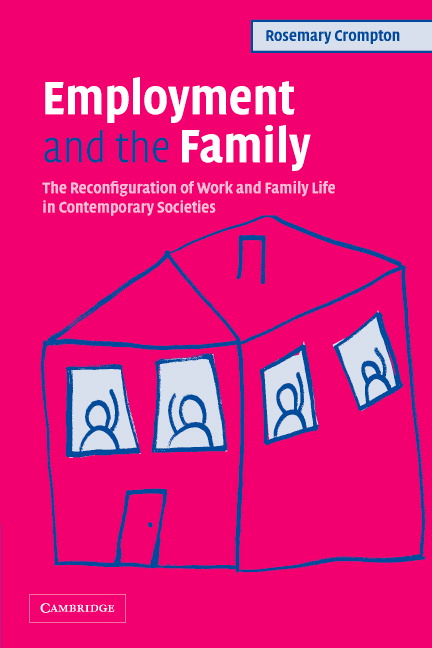
    Rates of employment amongst mothers of young children have risen rapidly in recent years. Attitudes to gender roles have changed, and both employers and governments have had to adjust to new realities. But some argue that recent changes in employment relations are making work more family 'unfriendly'. What are the real consequences of change? Rosemary Crompton explores the origins and background of this radical shift in the gendered division of labour. Topics covered include the changing attitudes to gender roles and family life, the gendered organisational context, and recent changes in employment relations and their impact on work-life articulation. A comparative analysis of Britain, France, Norway, Finland, the United States and Portugal provides an assessment of the varying impact of state policies, and the changing domestic division of labour. Crompton draws on original research and situates her findings within contemporary theoretical and empirical debates.

    Reviews

    'A comparative analysis of the United Kingdom, France, Norway, Finland, the United States and Portugal provides an assessment of the varying impact of state policies, and the changing domestic division of labour.'

    Source: International Social Security Review

    ‘A useful, important and well-written study, sure to be of value to those interested in work-family issues and gender equality.’

    Source: Work and Occupations

    ‘…a critically engaging and theoretically rigorous read.’

    Source: Sociology

    ‘This book is a valuable companion for anyone wanting to know about the interactions between paid work and family life. Its highly readable style and pertinence to so many people’s live mean that its audience will include interested lay people - as well as students, academics, researchers and policy makers.’

    Source: British Journal of Industrial Relations

    '… this is an important and useful book for students at different levels and disciplines, but also for a wider set of readers seeking deeper insights into how life is affected by contemporary developments in work and politics.'

    Source: Acta Sociologica

    Refine List

    Actions for selected content:

    Select all | Deselect all
    • View selected items
    • Export citations
    • Download PDF (zip)
    • Save to Kindle
    • Save to Dropbox
    • Save to Google Drive

    Save Search

    You can save your searches here and later view and run them again in "My saved searches".

    Please provide a title, maximum of 40 characters.
    ×

    Contents

    Bibliography
    Bibliography
    Abercrombie, N. and Urry, J. 1983 Capital, labour and the middle classes, Allen and Unwin, London
    Acker, J. 1973 ‘Women and stratification: a case of intellectual sexism’ in Huber, J. (ed.), Changing women in a changing society, Chicago
    Acker, J. 1990Hierarchies, jobs, bodies: a theory of gendered organisations’, Gender and Society 4.2: 139–58
    Adkins, L. 2002a ‘Sexuality and economy: historicisation vs. deconstruction’, Australian Feminist Studies 17, 37: 31–41
    Adkins, L. 2002b Revisions: gender and sexuality in late modernity, Open University, Buckingham
    Anderson, B. 2000 Doing the dirty work? The global politics of domestic labour, Zed Books, London
    Anderson, M. 1985The emergence of the modern life cycle in Britain’, Social History 10, 1: 69–87
    Anthias, F. and Lazaridis, G. 2000 Gender and migration in southern Europe, Berg: Oxford.
    Anttonen, A. 2002Universalism and social policy: a Nordic-feminist revaluation’, NORA 10, 2: 71–80
    Appelbaum, E., T. Bailey, P. Berg and A. Kalleberg 2003 ‘Organisations and the intersection of work and family: a comparative perspective’, Center for Women and Work, Rutgers, NJ
    Atkinson, J. 1984Manpower strategies for flexible organisations’, Personnel Management 16: 28–31
    Badgett, M. V. L. and Folbre, N. 1999Assigning care: gender norms and economic outcomes’, International Labour Review 138, 3: 311–26
    Bagilhole, B. M. A. R., Dainty, J. and Neale, R. H. 2000Women in the construction industry in the UK: a cultural discord?Journal of Women and Minorities in Science and Engineering 6, 1: 73–86
    Bailyn, L. 1993 Breaking the mold, The Free Press, New York
    Ball, S. 2003 Class strategies and the education market, Routledge/Falmer, London
    Banks, J. A. 1954 Prosperity and parenthood, Routledge and Kegan Paul, London
    Barlow, A., S. Duncan and G. James 2002 ‘New Labour, the rationality mistake and family policy in Britain’ in Carling, A., Duncan, S. and Edwards, R. (eds.), Analysing families, Routledge, London
    Barrett, M. and Mackintosh, M. 1991 The anti-social family, Verso, London
    Barron, R. D. and G. M. Norris 1976 ‘Sexual divisions and the dual labour market’ in Barker, D. L. and Allen, S. (eds.), Feminism and materialism, Routledge, London
    Baudrillard, J. 1993Hyperreal America’, Economy and Society, 22, 2: 243–52
    Bauman, Z. 2002 in Beck U. and E. Beck-Gernsheim, Individualization, Sage, London
    Baxter, J. 2000The joys and justice of housework’, Sociology 43, 4: 609–31
    Baxter, J., B. Hewitt and M. Western 2004 ‘Post-familial families and the domestic division of labour’, School of Social Science, University of Queensland
    Beck, U. 1992 Risk society, Sage, London
    Beck, U. 2000 The brave new world of work, Polity, Cambridge
    Beck, U. and Beck-Gernsheim, E. 2002 Individualization, Sage, London
    Beck, U., Giddens, A. and Lash, S. 1994 Reflexive modernisation, Polity, Cambridge
    Becker, G. 1991 A treatise on the family, Harvard University Press, Cambridge, MA
    Becker, P. E. and Moen, P 1999Scaling back: dual-earner couples’ work-family strategies', Journal of Marriage and the Family 61: 995–1007
    Berg, P. A., Kalleberg, L. and Appelbaum, E. 2003Balancing work and family: the role of high-commitment environments’, Industrial Relations 42, 2: 168–87
    Beynon, H. 1973 Working for Ford, Allen Lane, London
    Bianchi, S. M., Milkie, M. A., Sayer, L.C. and Robinson, J. P. 2000Is anyone doing the housework? Trends in the gender division of household labor’, Social Forces 79, 1: 191–228
    Bishop, K. 2004 ‘Working time patterns in the UK, France, Denmark and Sweden’, Labour Market Trends (March): 113–22
    Blackburn, R. M., Jarman, J. and Brooks, B. 2000The puzzle of gender segregation and inequality: a cross-national analysis’, European Sociological Review 16, 2: 119–35
    Blau, P. and Duncan, O. D. 1967 The American occupational structure, John Wiley, New York
    Blauner, R. 1964 Alienation and freedom, University of Chicago Press, Chicago
    Blood, R. and Wolfe, D. 1960 Husbands and wives: the dynamics of married living, Free Press, Glencoe, IL
    Blossfeld, H.-P. and Drobnic, S. (eds.) 2001 Careers of couples in contemporary societies, Oxford University Press, Oxford
    Bock, G. and Thane, P. (eds.) 1991 Maternity and gender policies, Routledge, London
    Bottero, W. and Irwin, S. 2003Locating difference: class, race and gender, and the shaping of social inequalities’, Sociological Review 51, 4: 463–83
    Bourdieu, P. 1973 Distinction: a social critique of the judgement of taste, Routledge, London/New York
    Bourdieu, P. 1990 Reproduction in education, society and culture, 2nd edn, Sage, London
    Bowlby, J. 1965 Child care and the growth of love, Penguin, Harmondsworth
    Bradley, H. 1989 Men's work, women's work, Polity, Cambridge
    Bradley, H. 1998 Gender and power in the workplace, Macmillan, Basingstoke
    Brandth, B. and Kvande, E. 2001Flexible work and flexible fathers’, Work, Employment and Society 15, 2: 251–67
    Brannen, J., Moss, P. and Mooney, A. 2004 Working and caring over the twentieth century, Palgrave Macmillan, Basingstoke
    Braverman, H. 1974 Labor and monopoly capital, Monthly Review Press, New York
    Burchell, B., Ladipo, D. and Wilkinson, F. (eds.) 2002 Job insecurity and work intensification, Routledge, London
    Bussemaker J. and L. Kersbergen 1999 ‘Introduction’ in Bussemaker, J. (ed.), Citizenship and welfare state reform in Europe, Routledge, London
    Butler, J. 1998Merely cultural’, New Left Review 227: 33–44
    Castells, M. 1997 The power of identity, Blackwell, Oxford
    Castells, M. 2000Materials for an exploratory theory of the network society’, British Journal of Sociology 51: 14–24
    Charles, N., C. Davies and C. Harris 2004 ‘Continuity and change in work–life balance choices’, Paper presented at a conference organised by the Centre for Research on Families and Relationships, University of Edinburgh, July
    Cheal, D. 1991 Family and the state of theory, Harvester Wheatsheaf, Hemel Hempstead
    Clarkberg, M. and S. S. Merola 2003 ‘Competing clocks: work and leisure’ in Moen, P. (ed.), It's about time, Cornell University Press, Ithaca and London
    Cockburn, C. 1983 Brothers: male dominance and technological change, Pluto Press, London
    Cockburn, C. 1991 In the way of women, Macmillan, Basingstoke
    COM 2001 ‘Employment and social policies: a framework for investing in quality’, Brussels 20 June
    Connell, R. W. 2002 Gender, Blackwell, Oxford
    Cox, R. and Watt, P. 2002Globalisation, polarisation and the informal sector: the case of paid domestic workers in London’, Area 34, 1: 39–47
    Crompton, R. 1993 [1998] Class and stratification, Polity, Cambridge
    Crompton, R. 1989Women in banking’, Work, Employment and Society 3, 2: 141–56
    Crompton, R. 2001a ‘Gender restructuring, employment, and caring’, Social Politics (Fall): 266–91
    Crompton, R. 2001b ‘Gender, comparative research and biographical matching’, European Societies 3, 2: 167–90
    Crompton, R. 2002 ‘The gendered restructuring of the middle classes' in Baxter, J. and Western, M. (eds.), Reconfigurations of class and gender, Stanford University Press, Stanford, CA
    Crompton, R. (ed.) 1999 Restructuring gender relations and employment, Oxford University Press, Oxford
    Crompton, R. and Birkelund, G. 2000Employment and caring in British and Norwegian banking: an exploration through individual careers’, Work, Employment and Society 14, 2: 331–52
    Crompton, R. and Harris, F. 1998a ‘Explaining women's employment patterns: “Orientations to work” revisited’, British Journal of Sociology 49, 1: 118–36
    Crompton, R. and Harris, F. 1998b ‘Gender relations and employment: the impact of occupation’, Work, Employment and Society 12, 2: 297–315
    Crompton, R. and Jones, G. 1984 White-collar proletariat, Macmillan, London
    Crompton, R. and C. Lyonette 2005 ‘Family, gender and work–life articulation: Britain and Portugal compared’, Instituto de Ciencias Sociais, Lisbon
    Crompton, R. and Feuvre, N. 2000Gender, family and employment in comparative perspective: the realities and representations of equal opportunities in Britain and France’, Journal of European Social Policy 10, 4: 334–48
    Crompton, R. and Sanderson, K. 1986Credentials and careers’, Sociology 20, 1: 25–42.
    Crompton, R. and Sanderson, K. 1990 Gendered jobs and social change, Unwin Hyman, London
    Crompton, R., M. Brockmann and D. Wiggins 2003a ‘A woman's place … employment and family life for men and women’ in Park, A., Curtice, J., Thomson, K., Jarvis, L. and Bromley, C. (eds.), British Social Attitudes, the 20th Report, Sage, London
    Crompton, R., Dennett, J. and Wigfield, A. 2003b Organisations, careers and caring, Policy Press, Bristol
    Crompton, R., Gallie, D. and Purcell, K. (eds.) 1996 Changing forms of employment, Routledge, London
    Crompton, R., M. Brockmann and C. Lyonette 2005 ‘Attitudes, women's employment and the domestic division of labour: a cross-national analysis in two waves’, Work, Employment and Society 19, 2: 213–33
    Crook, S., Pakulski, J. and Waters, M 1992 Postmodernisation: change in advanced society, Sage, London
    Crouch, C. 1999 Social change in Western Europe, Oxford University Press, Oxford
    Crouch, C. and Streeck, W. (eds.) 1997 Political economy of modern capitalism, Sage, London
    Daniel, W. 1969Industrial behaviour and orientations to work’, Journal of Management Studies 6: 152–69
    Daniel, W. 1971Productivity bargaining and orientation to work: a rejoinder to Goldthorpe’, Journal of Management Studies 8: 329–35
    Davidoff, L. and Hall, C. 1987 Family fortunes, Hutchinson, London
    Davidson, M. J. and Cooper, C. 1992 Shattering the glass ceiling, Chapman, London
    Davis, J. A. 1986 ‘British and American attitudes: similarities and contrasts’ in R. Jowell, S. Witherspoon and L. Brook, British social attitudes, the 1986 Report, Gower/SCPR, London
    Davis, J. A. and Roger Jowell 1989 ‘Measuring national differences’ in Jowell, R., Witherspoon, S. and Brook, L.British social attitudes: Special International Report, Gower, Aldershot
    Dench, G. (ed.) 1999 Rewriting the sexual contract, Transaction, New Brunswick, NJ
    Dench, S., Aston, J., Evans, C., Meager, N., Williams, M. and Willison, R. 2002 Key indicators of women's position in Britain, Department of Trade and Industry, London
    Department of Trade and Industry 2000 Work and parents: competitiveness and choice, Stationery Office, London
    Department of Trade and Industry/HM Treasury (2003) Balancing work and family life: enhancing choice and support for parents, Stationery Office, London
    Devine, F. 2004 Class practices: how parents help their children get good jobs, Cambridge University Press, Cambridge
    Dex, S. 1987 Women's occupational mobility, Macmillan, Basingstoke
    Dex, S. and McCulloch, A. 1997 Flexible employment, Macmillan, Basingstoke and London
    Dex, S. and Scheibl, F. 1999Business performance and family-friendly policies’, Journal of General Management 24, 4: 22–37
    Dex, S. and Shaw, L. B. 1986 British and American women at work: do equal opportunities policies matter?Macmillan, Basingstoke
    Dex, S. and Smith, C. 2002 The nature and patterns of family-friendly employment policies in Britain, York Publishing Services, York
    Dex, S. and Walters, P. 1989 ‘Women's occupational status in Britain, France and the USA: explaining the difference’, Industrial Relations Journal 20, 3: 203–12
    Doeringer, P. B. and Piore, M. J. 1971 Internal labor markets and manpower analysis, Heath, Lexington, MA
    Doyle, L. 2001 The surrendered wife: a practical guide for finding intimacy, passion and peace with a man, Simon and Schuster, New York
    Drago, R. and Hyatt, D. 2003Symposium: the effect of work–family policies on employees and employers’, Industrial Relations 42, 2: 139–43
    Drew, E. 1998 ‘Re-conceptualising families’ in Drew, E., Emerek, R. and Mahon, E.Women, work and the family in Europe, Routledge, London
    Drew, E., Emerek, R. and Mahon, E. 1998 Women, work and the family in Europe, Routledge, London
    Gay, Du P. 1996 Consumption and identity at work, Sage, London
    Gay, Du P. and Pryke, M. 2002 Cultural economy, Sage, London
    Duncan, S. 2003 ‘Mothers, care and employment: values and theories’, CAVA Working Paper No 1, University of Leeds
    Duncan, S. 2005Mothering, class and rationality’, Sociological Review 53: 2
    Duncan, S. and Edwards, R. 1999 Lone mothers, paid work, and gendered moral rationalities, Macmillan, Houndmills
    Duncan, S., Edwards, R., Reynolds, T. and Alldred, P. 2003Motherhood, paid work and partnering’, Work, Employment and Society 17, 2: 309–30
    Eaton, S. C. 2003If you can use them: flexibility policies, organizational commitment, and perceived performance’, Industrial Relations, 42, 2: 145–67
    Ehrenreich, B. 2003 ‘Maid to order’ in Ehrenreich, B. and Hochschild, A. R.Global Woman, Granta Books, London
    Einhorn, B. 1993 Cinderella goes to market, Verso, London
    Ellingsaeter, A.-M. 1999 ‘Dual breadwinners between state and market’ in Crompton, R. (ed.), Restructuring gender relations and employment, Oxford University Press, Oxford
    Ellingsaeter, A. L. 2003 The complexity of family policy reform: the case of Norway, European Societies 5, 4: 419–43
    Erikson, R. and Goldthorpe, J. H. 1992 The constant flux, Clarendon Press, Oxford
    Esping-Andersen, G. 1990 The three worlds of welfare capitalism, Polity, Cambridge
    Esping-Andersen, G. 1999 Social foundations of postindustrial economies, Oxford University Press, Oxford
    Esping-Andersen, G. 2000Interview on post-industrialism and the future of the welfare state’, Work, Employment and Society 14, 4: 757–69
    Esping-Andersen, G. 2002 (with Gallie, D., Hemerijck, A. and Myles, J.), Why we need a new welfare state, Oxford University Press, Oxford
    Evans, J. 2001 Firms' contribution to the reconciliation between work and family life, OECD Labour Market and Social Policy Occasional Papers, Paris
    Fagan, C. 2001Time, money and the gender order: work orientations and working-time preferences in Britain’, Gender, Work and Organization 8, 3: 239–66
    Fagan, C 2002 ‘How many hours? Work-time regimes and preferences in European countries’ in Crow, G. and Heath, S. (eds.), Social conceptions of time – structure and process in work and everyday life, Palgrave/Macmillan, London
    Fagan, C. and B. Burchell 2002 Gender, jobs and working conditions in the European Union, European Foundation for the Improvement of Living and Working Conditions, Dublin
    Featherstone, M. 1991 Consumer culture and postmodernism, Sage, London
    Fein, E. and Schneider, S. 2002 The rules: time-tested secrets for capturing the heart of Mr Right, Warner Books,
    Ferguson, K. E. 1984 The feminist case against bureaucracy, Temple University Press, Philadelphia
    Finch, J. 1983 Married to the job, George Allen and Unwin, London
    Finch, J. 1989 Family obligations and social change, Basil Blackwell, Oxford
    Finch, J. and Mason, J. 1993 Negotiating family responsibilities, Tavistock/Routledge, London
    Folbre, N. and Nelson, J. A. 2000For love or money – or both?Journal of Economic Perspectives 14, 4: 123–40
    Forth, J., Lissenburgh, S., Callender, C. and Millward, N. 1997 Family friendly working arrangements in Britain, Research Report No 16, Department for Education and Employment, London
    Fraad, H. 2003Class transformation in the household: an opportunity and a threat’, Critical Sociology 29, 1: 47–65
    Franco, A. and K. Winqvist 2002 ‘Women and men reconciling work and family life’, Statistics in focus, Eurostat
    Frank, T. 2000 One market under God, Doubleday, New York
    Fraser, N. 1994After the family wage’, Political Theory 22: 591–618
    Fraser, N. 1998Heterosexism, misrecognition and capitalism: a response to Judith Butler’, New Left Review 228: 140–9
    Fraser, N2000 ‘Rethinking recognition’, New Left Review (May/June)
    Freedman, M. 1984 ‘The search for shelters’ in K Thompson (ed.), Work, employment and unemployment, Open University Press, Milton Keynes
    Freeman, R. B. 2000 ‘The US economic model at Y2K: lodestar for advanced capitalism?’ NBER (National Bureau of Economic Research) Working Paper 7757
    Friedan, B. 1965 The feminine mystique, Penguin, Harmondsworth
    Fukuyama, F. 1999 The great disruption, Profile Books, London
    Gallie, D. 2002 ‘The quality of working life in welfare strategy’ in Esping-Andersen, G.et al., Why we need a new welfare state, Oxford University Press, Oxford
    Gallie, D. 2003 ‘The quality of working life: is Scandinavia different?European Sociological Review 19, 1: 61–79
    Gardiner, J. 2000Rethinking self-sufficiency: employment, families and welfare’, Cambridge Journal of Economics 24: 671–89
    Gershuny, J. and Sullivan, O. 2003Time use, gender and public policy regimes’, Social Politics 10, 2: 205–28
    Gershuny, J., M. Godwin and S. Jones 1994 ‘The domestic labour revolution: a process of lagged adaptation’ in Anderson, M., Bechhofer, F. and Gershuny, J. (eds.), The social and political economy of the household, Oxford University Press, Oxford
    Giddens, A. 1982 ‘Hermeneutics and social theory’ in Profiles and critiques in social theory, Macmillan, Basingstoke
    Giddens, A. 1991 Modernity and self identity, Polity, Cambridge
    Gittins, D. 1993 The family in question, Macmillan, Basingstoke
    Glass, J. L. and Estes, S. B. 1999The family responsive workplace’, Annual Review of Sociology, 23: 289–313
    Glover, J. 1992Studying working women cross-nationally’, Work, Employment and Society, 6, 3: 489–98
    Glover, J. 2002 ‘The “balance model”: theorising women's employment behaviour’ in Carling, A., Duncan, S. and Edwards, R. (eds.), Analysing families, Routledge, London
    Glucksmann, M. 1995Why “work”? Gender and the “total social organisation of labour” ’, Gender, Work and Organisation 2, 2: 63–75
    Glucksmann, M. 2000 Cottons and casuals: the gendered organisation of labour in time and space, Sociology Press, Durham
    Goldthorpe, J. H. 1972Daniel on orientations to work: a final comment’, Journal of Management Studies 9: 266–73
    Goldthorpe, J. H. 1980 [1987] Social mobility and class structure in modern Britain, Clarendon Press, Oxford
    Goldthorpe, J. H. 1985On economic development and social mobility’, British Journal of Sociology 36, 4: 549–60
    Goldthorpe, J.H.1994 ‘Current issues in comparative macrosociology’, ISO-RAPPORT no. 6, University of Oslo
    Goldthorpe, J. H. 1996Class analysis and the reorientation of class theory: the case of persisting differentials in educational attainment’, British Journal of Sociology 47, 3: 481–505
    Goldthorpe, J. H., Lochwood, D., Bechhofer, F. and Platt, J. 1968 The affluent worker: industrial attitudes and behaviour, Cambridge University Press, Cambridge
    Gonyea, J. G. and B. Googins 1996 ‘The restructuring of work and family in the United States’ in Lewis, S. and Lewis, J. (eds.), The work–family challenge, Sage, London
    Gonzalez-Lopez, M. J. 2002 ‘A portrait of Western families’ in Carling, A., Duncan, S. and Edwards, R., Analysing families, Routledge, London
    Goode, W. J. (ed.) 1964 Readings on the family and society, Prentice-Hall, New York
    Goodman, A., Johnson, P. and Webb, S. 1997 Inequality in the UK, Oxford University Press, Oxford
    Gorman, T. J. 2000Reconsidering worlds of pain: life in the working class(es)’, Sociological Forum 15, 4: 693–717
    Gornick, J. C. and Meyers, M. K. 2003 Families that work, Russell Sage Foundation, New York
    Gottfried, H. 2000Compromising positions: emergent neo-Fordisms and embedded gender contracts’, British Journal of Sociology 51, 2: 235–59
    Gottfried, H. 2003Temp(t)ing bodies: shaping gender at work in Japan’, Sociology 37, 2: 257–76
    Granovetter, M. and Swedberg, R. (eds.) 1992 The sociology of economic life, Westview Press, Boulder, CO
    Gray, J. 1992 Men are from Mars, women are from Venus: how to get what you want from your relationships, HarperCollins, London
    Green, F. 2001It's been a hard day's night: the concentration and intensification of work in late twentieth-century Britain’, British Journal of Industrial Relations 39, 1: 53–80
    Gregory, A. and Windebank, J. 2000 Women's work in Britain and France, Macmillan, Houndmills
    Gregson, N. and Lowe, M. 1994 Servicing the middle classes, Routledge, London
    Grimshaw, D., Beynon, H., Rubery, J. and Ward, K. 2002The restructuring of career paths in large service sector organisations: “delayering” upskilling and polarisation’, Sociological Review 51, 1: 89–115
    Grimshaw, D., Ward, K. G., Rubery, J. and Beynon, H. 2001Organisations and the transformation of the internal labour market in the UK’, Work, Employment and Society 15, 1: 25–54
    Haas, L. L. and Hwang, P. 1995Company culture and men's use of family leave benefits in Sweden’, Family Relations 44: 28–36
    Hakim, C. 1979 Occupational segregation, Department of Employment, Research Paper No 9
    Hakim, C. 1992Explaining trends in occupational segregation: the measurement, causes, and consequences of the sexual division of labour’, European Sociological Review 8, 2: 127–52
    Hakim, C. 2000 Work–lifestyle choices in the 21st century, Oxford University Press, Oxford
    Hakim C2003a ‘Models of the family in modern societies’, Ashgate, Aldershot
    Hakim, C. 2003b ‘Public morality versus personal choice’, British Journal of Sociology 53, 3: 339–46
    Hakim, C. 2004 Key issues in women's work, GlassHouse Press, London
    Halford, S., Savage, M. and Witz, A. 1997 Gender, careers and organisations, Macmillan, Basingstoke and London
    Halsey, A. H., Lauder, H., Brown, P. and Wells, A. S. (eds.) 1997 Education: culture, economy and society, Oxford University Press, Oxford
    Handy, C. B. 1984 The future of work, Blackwell, Oxford
    Handy, C. 1994 The empty raincoat, Hutchinson, London
    Hantrais, L. 1990 Managing professional and family life: a comparative study of British and French women, Dartmouth, Aldershot
    Hantrais, L. 1993 ‘Women work and welfare in France’ in Lewis, J. (ed.), Women and social policies in Europe, Edward Elgar, Aldershot
    Hartmann, H. 1976 ‘Capitalism, patriarchy and job segregation by sex’ in Blaxall, M. and Reagan, B. M. (eds.), Women and the workplace, Chicago University Press, Chicago
    Hernes, H. 1987 Welfare state and woman power, Norwegian University Press, Oslo
    Hills, J. 2004 Inequality and the state, Oxford University Press, Oxford
    Hills, J. and O. Lelkes 1999 ‘Social security, selective universalism and patchwork redistribution’ in Jowell, R., Curtice, J., Park, A. and Thompson, K., British Social Attitudes, 16th Report, Ashgate, Aldershot
    Himmelweit, S. and M. Sigala 2003 ‘Internal and external constraints on mothers’ employment', Working Paper no. 27, ESRC Future of Work Programme
    Hirdman, Y. 1998 ‘State policy and gender contracts’ in Drew, E., Emerek, R. and Mahon, E. (eds.), Women, work and the family in Europe, Routledge, London
    Hirsch, F. and Goldthorpe, J. H. (eds.) 1978 The political economy of inflation, Martin Robertson, London
    Hirst, P. and J. Zeitlin 1997 ‘Flexible specialisation’ in Hollingsworth, J. R. and Boyer, R. (eds.), Contemporary capitalism, Cambridge University Press, Cambridge
    Hochschild, A. 1983 The managed heart, University of California Press, Los Angeles
    Hochschild, A. 1997 The time bind, Metropolitan Books, New York
    Hochschild, A. 2000 ‘Global care chains and emotional surplus value’ in Hutton, W. and Giddens, A. (eds.), On the edge: living with global capitalism, Jonathan Cape, London
    Hojgaard, L. 1997Working fathers; caught in the web of the symbolic order of gender’, Acta Sociologica, 40: 245–61
    Hudson, R. and Williams, A. M. 1995 Divided Britain, John Wiley and Sons, Chichester, England
    Humphries, J. 1982 ‘Class struggle and the persistence of the working-class family’ in Giddens, A. and Held, D. (eds.), Classes, power and conflict, Macmillan, Basingstoke
    Humphries, J 1984 ‘Protective legislation, the capitalist state and working-class men’ in Pahl, R. (ed.), Divisions of labour, Basil Blackwell, Oxford
    Hutton, W. 2002 The world we're in, Little, Brown, London
    Irwin, S. 2003a ‘Interdependencies, values and the reshaping of difference: gender and generation at the birth of twentieth-century modernity’, British Journal of Sociology 54, 4: 565–84
    Irwin S2003b ‘The changing shape of values, care and commitments’, Paper prepared for ESPAnet conference, Danish National Institute of Social Research, Copenhagen
    Irwin, S. and Bottero, W. 2000Market returns? Gender and theories of change in employment relations’, British Journal of Sociology 51, 2: 261–80
    Jacobs, J. and Gerson, K. 1998Who are the overworked Americans?’, Review of Political Economy 56, 4: 442–59
    Jenson, J. 1986Gender and reproduction’, Studies in Political Economy 20: 9–46
    Rowntree, Joseph Foundation 1995 Inquiry into income and wealth, York
    Jowell, R. 1998How comparative is comparative research?’, American Behavioral Scientist 42, 3: 168–77
    Brook, Jowell R., L. and Dowds, L. 1993 International social attitudes, Dartmouth, Aldershot
    Kaase, M. and K. Newton 1998 ‘What people expect from the state’ in Jowell, R., Curtice, J., Park, A., Brook, L., Thompson, K. and Bryson, C., British and European social attitudes: how Britain differs, Ashgate, Aldershot
    Kanter, R. M. 1977 Men and women of the corporation, Basic Books, New York
    Kanter, R. M. 1990 When giants learn to dance, Unwin, London
    Kohn, M. L. 1987Cross-national research as an analytical strategy’, American Sociological Review 52: 713–31
    Korpi, W. 2000Faces of inequality’, Social Politics 7, 2: 127–91
    Kristol, W 1998 ‘A Conservative perspective on public policy and the family’ in Wolfe, C. (ed.), The family, civil society, and the state, Rowman and Littlefield, Oxford
    Valle, I., Arthur, S., Millward, C., Scott, J. with Clayden, M. 2002 Happy families? Atypical work and its influence on family life, Final Report, Joseph Rowntree Foundation, York
    Ladipo, D. and F. Wilkinson 2002 ‘More pressure, less protection’ in Burchell, B., Ladipo, D. and Wilkinson, F. (eds.), Job insecurity and work intensification, Routledge, London
    Lan, P. C. 2003 ‘Among women: migrant domestics and their Taiwanese employers across generations’ in Ehrenreich, B. and Hochschild, A. R., Global woman, Granta Books, London
    Land, H. 1986 Women and economic dependency, Equal Opportunities Commission, Manchester
    Land, H. 2002Spheres of care in the UK: separate and unequal’, Critical Social Policy 22, 1: 13–32
    Lash, S. 2002 ‘Introduction’ in U. Beck and E. Beck-Gernsheim, Individualization, Sage, London
    Lash, S. and Urry, J. 1994 Economies of signs and space, Sage, London
    Laslett, P. 1965 The world we have lost, Methuen, London
    Lazaridis, G. 2000 ‘Filipino and Albanian women migrant workers in Greece: multiple layers of oppression’ in Anthias, F. and Lazaridis, G., Gender and migration in southern Europe, Berg, Oxford
    , Lee E., Clements, S., Ingham, R. and Stone, N. 2004 A matter of choice? Explaining national variation in teenage abortion and motherhood, Joseph Rowntree Foundation, York
    Leira, A. 1992 Welfare states and working mothers, Cambridge University Press, Cambridge
    Leira, A 2002 Working parents and the welfare state, Cambridge University PressCambridge
    Lewis, J. 1992Gender and the development of welfare regimes’, Journal of European Social Policy 2, 3: 159–73
    Lewis, J. 2002Gender and welfare state change’, European Societies 4, 4: 331–57
    Lewis, J. and Astrom, G. 1992Equality, difference and state welfare: labor market and family policies in Sweden’, Feminist Studies 18, 1: 59–87
    Lewis, S. 1997Family friendly employment policies: a route to changing organisational culture or playing about at the margins?’, Gender Work and Organisation 4, 1: 1–23
    Lewis, S. and Lewis, J. (eds.) 1996 The work–family challenge, Sage, London
    Lister, R. 2003 Citizenship: feminist perspectives, Palgrave Macmillan, Basingstoke
    Lockwood, D. 1958 [1989] The black coated worker, Allen and Unwin, London; Oxford University Press, Oxford
    Lockwood, D. 1966Sources of variation in working-class images of society’, Sociological Review 14, 3: 244–67
    Lowe, G. S. and Krahn, H. 2000Work aspiration and attitude in a era of labour market restructuring’, Work, Employment and Society 14, 1: 1–22
    Lutz, H. 2002At your service madam! The globalisation of domestic service’, Feminist Review 70: 89–104
    MacInnes, J. 1998 The end of masculinity, Open University Press, Buckingham
    Marshall, B. 1994 Engendering modernity, Polity, Cambridge
    Marshall, G., Roberts, R. and Burgoyne, C. 1996Social class and underclass in Britain and the United States’, British Journal of Sociology 47, 1: 22–44
    Marshall, G., Swift, A. and Roberts, S. 1997 Against the odds?, Clarendon Press, Oxford
    Marshall, J. 1984 Women managers, Wiley, Chichester
    Marshall, T. H. 1948 [reprinted 1963] ‘Citizenship and social class’ in Sociology at the crossroads, Heinemann, London
    Maurice, M., Sellier, F. and Silvestre, J. J. 1986 The social foundations of industrial power, MIT Press, Cambridge, MA
    McDowell, L. 1997 Capital culture: gender and work in the City, Blackwell, Oxford
    McDowell, L. 2003 Redundant masculinities?, Blackwell, Oxford
    McGovern, P., Hope-Hailey, V. and Stiles, P. 1998The managerial career after downsizing’, Work, Employment and Society 12, 3: 457–77
    McRae, S. 2003Constraints and choices in mothers' employment careers’, British Journal of Sociology 53, 3: 317–38
    Millar, J. and Warman, A. 1996 Family obligations in Europe, Family Policy Studies Centre, London
    Mincer, J. and Polachek, S. 1974Family investments in human capital: earnings of women’, Journal of Political Economy 82: 76–108
    Mitchell, W. and Green, E. 2002I don't know what I'd do without our Mam: motherhood, identity and support networks’, Sociological Review 50, 1: 1–22
    Moen, P. (ed.) 2003 It's about time: couples and careers, Cornell University Press, Ithaca and London
    Morgan, D. H. J. 1985 The family, politics and social theory, Routledge and Kegan Paul, London
    Morgan, P. 1999 ‘Evaluating the effects on children of mothers' employment’ in Dench, G. (ed.), Rewriting the sexual contract, Transaction, New Brunswick, NJ
    Murray, C. A. (ed.) 1990 The emerging British underclass, IEA Health and Welfare Unit, London
    Nakano, Glenn 1992From servitude to service work: historical continuities in the racial division of paid reproductive labour’, Signs 18, 1: 1–43
    Newson, J. and Newson, E. 1968 Four years old in an urban community, Allen and Unwin, London
    Nolan, P. 2003Reconnecting with history’, Work, Employment and Society 17, 3: 473–80
    Nussbaum, M. C. 2000 Women and human development, Cambridge University Press,Cambridge
    O'Connor, J. S., Orloff, A. S. and Shaver, S. 1999 States, markets, families, Cambridge University Press, Cambridge
    O'Neill J 1999 ‘Economy, equality and recognition’ in Ray and Sayer (eds.) Culture and Economy after the Cultural Turn, Sage, London
    O'Reilly, J. 1992Where do you draw the line?’, Work Employment and Society 6, 3: 369–96
    OECD 2000 Firms' contribution to the reconciliation between work and family life, Occasional paper, Directorate for Education, Employment, Labour and Social Affairs, Paris
    OECD 2001 ‘Balancing work and family life: helping parents into paid employment’, chapter 4, Employment Outlook, Paris
    OECD 2002 Employment Outlook, Paris
    Olsen, F. E. 1983The family and the market: a study of ideology and legal reform’, Harvard Law Review 96, 7: 1497–578
    Orloff, A. S. 1999 ‘Motherhood, work and welfare in the United States, Britain, Canada and Australia’ in Steinmetz, G., State/Culture: state formation after the cultural turn, Cornell University Press, Ithaca and London
    Osterman, P. 1995Work–family programs and the employment relationship’, Administrative Science Quarterly 40: 681–700
    Pakulski, J. and Waters, M. 1996The reshaping and dissolution of social class in advanced society’, Theory and Society 25: 667–91
    Parrenas, R. S. 2000Migrant Filipina domestic workers and the international division of reproductive labour’, Gender and Society 14, 4: 560–80
    Parsons, T. 1949 ‘The social structure of the family’ in Anshen, R. (ed.), The family, its function and destiny, Harper, New York
    Pateman, C. 1988 The sexual contract, Polity, Cambridge
    Pateman, C. 1989 ‘The patriarchal welfare state’ in Pateman, C. (ed.), The disorder of women, Polity, Cambridge
    Paull, G., Taylor, J. and Duncan, A. 2002 Mothers' employment and childcare use in Britain, Institute for Fiscal Studies, London
    Perrons, D. 1999Flexible working patterns and equal opportunities in the European Union’, European Journal of Women's Studies 6: 391–418
    Pfau-Effinger, B. 1999 ‘The modernization of family and motherhood in Western Europe’ in Crompton, R. (ed.), Restructuring gender relations and employment, Oxford University Press, Oxford
    Pfau-Effinger, B. 2004Socio-historical paths of the male breadwinner model – an explanation of cross-national differences’, British Journal of Sociology 55, 3: 37–200
    Pickvance, C. 1995 ‘Comparative analysis, causality and case studies in Urban Studies’ in Rogers, A. and Vertovec (eds.), S., The urban context, Berg, Oxford and Washington, DC
    Pinchbeck, I. 1981 Women workers in the industrial revolution, Virago, London
    Polanyi, K. 1957 The great transformation, Beacon Press, Boston
    Pollert, A. 1988The flexible firm: fixation or fact?’, Work, Employment and Society 2, 3: 281–316
    Procter, I. and Padfield, M. 1998 Young adult women, work, and family: living a contradiction, Mansell, London and Washington DC
    Purcell, K., T. Hogarth and C. Simm 1999 Whose flexibility?, Joseph Rowntree Foundation, York
    Ragin, C. 1987 The comparative method, University of California Press, Berkeley and Los Angeles
    Ragin, C. (ed.) 1991 ‘Introduction’ to Issues and alternatives in comparative social research, E. J. Brill, Leiden
    Rake, K., Davies, H., Joshi, H. and Alami, R. 2000 Women's incomes over the lifetime, Stationery Office, London
    Reay, D. 1998 Class work, mothers' involvement in their children's primary schooling, UCL Press, London
    Reay, D. and Lucey, H. 2003The limits of “choice”’, Sociology 37, 1: 121–42
    Reskin, B. F. and Roos, P. A. 1990 Job queues, gender queues, Temple University Press, Philadelphia
    Riley, D. 1983 War in the nursery, Virago, London
    Rose, D. and Pevalin, D. 2002 A researcher's guide to the National Statistics Socio-Economic Classification, Sage, London
    Rose, M. 1985Universalism, culturalism and the Aix group’, European Sociological Review 1, 1: 65–83
    Rose, N. 1989 Governing the soul, Routledge, London
    Rubery, J., Smith, M. and Fagan, C. 1998National working-time regimes and equal opportunities’, Feminist Economics 4, 1: 71–101
    Rubery J., K. Ward, D. Grimshaw and H. Beynon 2003 ‘Time and the new employment relationship’, Manchester School of Management, UMIST, University of Manchester Institute of Science and Technology
    Rubin, L. B. 1994 Families on the faultline, HarperCollins, New York
    Sainsbury, D. (ed.) 1994 Gendering welfare states, Sage, London
    Saraceno, C. 1997 ‘Family change, family policies and the restructuring of welfare’ in OECD, Family, market and community: equity and efficiency in social policy, Paris
    Savage, M. 2000 Class analysis and social transformation, Open University Press, Buckingham
    Savage, M., Barlow, J., Dickens, A. and Fielding, T. 1992 Property, bureaucracy, and culture, Routledge, London
    Sayer, A. 2002What are you worth?’, Sociological Research Online 7, 3
    Schor, J. 1991 The overworked American: the unexpected decline of leisure, Basic Books, New York
    Seccombe, W. 1993 Weathering the storm, Verso, London and New York
    Sennett, R. 1998 The corrosion of character, W. W. Norton and Company, New York and London
    Sennett, R. and Cobb, J. 1973 The hidden injuries of class, Vintage Books, New York
    Sevenhuijsen, S. 2002 ‘A third way? Moralities, ethics and families: an approach through the ethic of care’ in Carling, A., Duncan, S. and Edwards, R. (eds.), Analysing families, Routledge, London
    Sassoon, Showstack A. (ed.) 1987 Women and the state, Hutchinson, London
    Siltanen, J. 1986 ‘Domestic responsibilities and the structuring of employment’ in Crompton, R. and Mann, M. (eds.), Gender and stratification, Polity, Cambridge
    Silva, E. B. and Smart, C. (eds.) 1999 The ‘new’ family?, Sage, London
    Skeggs, B. 1997 Formations of class and gender, Sage, London
    Skocpol, T. 1992 Protecting soldiers and mothers, Harvard University Press, Cambridge, MA
    Smith, V. 1997New forms of work organisation’, Annual Review of Sociology 23: 315–39
    Soskice, D. 1999 ‘Divergent production regimes: coordinated and uncoordinated market economies in the 1980s and 1990s’ in Kitschelt, H., Lange, P., Marks, G. and Stephens, J. D. (eds.), Continuity and change in contemporary capitalism, Cambridge University Press, Cambridge
    Sporton, D. 1993 ‘Fertility: the lowest level in the world’ in Noin, D. and Woods, R. (eds.), The changing population of Europe, Blackwell, Oxford
    Stewart, A., Prandy, K. and Blackburn, R. M. 1980 Social stratification and occupations, Macmillan, London/Basingstoke
    Stier, H. and Lewin-Epstein, N. 2001Welfare regimes, family-supportive policies, and women's employment along the life-course’, American Journal of Sociology 106, 6: 1731–60
    Still, M. C. and D. Strang 2003 ‘Institutionalising family-friendly policies’ in Moen, P. (ed.), It's about time, Cornell University Press, Ithaca and London
    Strange, S. 1997 ‘The future of global capitalism; or, will divergence persist forever?’ in Crouch, C. and Streeck, W. (eds.), Political economy of modern capitalism, Sage, London
    Streeck, W. 1989Skills and the limits of neoliberalism’, Work, Employment and Society 3: 90–104
    Sullivan, O. and Gershuny, J. 2001Cross-national changes in time use’, British Journal of Sociology 52, 2: 331–47
    Sutherland, H., Sefton, T. and Piachaud, D. 2003 Poverty in Britain: the impact of government policy since 1997, Joseph Rowntree Foundation, York
    Szreter, S. R. S. 1984The genesis of the registrar-general's social classification of occupations’, British Journal of Sociology 35: 522–46
    Taylor, R. 2002a ‘The future of work–life balance’, Economic and Social Research Council
    Taylor R 2002b ‘Britain's world of work – myths and realities’, Economic and Social Research Council, Swindon
    Therborn, G. 2004 Between sex and power: family in the world, 1900–2000, Routledge, London
    Thompson, P. 2003Disconnected capitalism’, Work, Employment and Society 17, 2: 359–78
    Thompson, P. and Warhurst, C. (eds.) 1998 Workplaces of the future, Macmillan, Basingstoke
    Torp, H. and E. Barth 2001 ‘Actual and preferred working time’, Institute for Social Research, Oslo
    Valcour, P. M. and R. Batt 2003 ‘Work–life integration: challenges and organizational responses’ in Moen, P. (ed.), It's about time, Cornell University Press, Ithaca and London
    Wajcman, J. 1996The domestic basis for the managerial career’, Sociological Review 44, 4: 609–29
    Wajcman, J. 1998 Managing like a man, Polity, Cambridge
    Wajcman, J. and Martin, B. 2001My company or my career: managerial achievement and loyalty’, British Journal of Sociology 52, 4, 559–78
    Wacjman, J. and Martin, B. 2002Narratives of identity in modern management’, Sociology 36, 4: 985–1002
    Walby, S. 1986 Patriarchy at work, Polity Press, Cambridge
    Walby, S. 1990 Theorizing patriarchy, Basil Blackwell, Oxford
    Walker, A. 1990 ‘Blaming the victims’ in Murray, C. A. (ed.), The emerging British underclass, IEA Health and Welfare Unit, London
    Walkowitz, C. 1980 Prostitution in Victorian society, Cambridge University Press, Cambridge
    Wall, K., 1997 ‘Portugal: issues concerning the family’ in Ditch, J.et al., Developments in national family policies, European Observatory on Family Policies, DGV/University of York, pp. 213–49
    Warren, T. 2003Class and gender-based working time?, Sociology 37, 4: 733–52
    Weber, M. 1958 ‘Bureaucracy’ in Gerth, H. and Mills, C. W. (eds.), From Max Weber, Routledge, London
    West, C. and Zimmerman, D. H. 1987Doing gender’, Gender and Society 1: 125–51
    Westergaard, J. and Resler, H. 1975 Class in a capitalist society, Heinemann, London
    Wharton, A. S. and Blair-Loy, M. 2002The “overtime culture” in a global corporation’, Work and Occupations 29, 1: 32–63
    White, M., S. Hill, P. McGovern, C. Mills and D. Smeaton 2003 ‘High-performance’ management practices, working hours and work–life balance', British Journal of Industrial Relations 41, 2: 175–95
    Williams, J. C. 1991Domesticity as the dangerous supplement of Liberalism’, Journal of Women's History 2, 3: 69–88
    Williams, J. C. 2000 Unbending gender, Oxford University Press, New York
    Willis, P. 1977 Learning to labour, Saxon House, Farnborough
    Wilson, E. 1977 Women and the welfare state, Tavistock, London
    Wilson, J. 1987 The truly disadvantaged, University of Chicago Press, Chicago
    Windebank, J. 2001Dual-earner couples in Britain and France’, Work Employment and Society 15, 2: 269–90
    Witz, A. 1992 Professions and patriarchy, Routledge, London
    Womack, J. P., Jones, D. T. and Roos, D. 1990 The machine that changed the world, Macmillan, New York
    Wright, E. O. 1997 Class counts, Cambridge University Press, Cambridge
    Wrong, D. 1964 ‘The over-socialized conception of man in modern sociology’ in Coser, L. and Rosenberg, D. (eds.), Sociological theory, Collier-Macmillan, London
    Yancey Martin, P. 2003. ‘“Said and done” versus “saying and doing”: gendering practices, practicing gender at work’, Gender & Society 17: 342–66.
    Yeandle, S., Wigfield, A., Crompton, R. and Dennett, J. 2003 Employers, communities and family-friendly employment policies, Policy Press, Bristol
    Young, M. and Willmott, P. 1962 Family and kinship in East London, Penguin, Harmondsworth
    Zaretsky, E. 1976 Capitalism, the family and personal life, Pluto Press, London
    Zwieg, M. 2000 The working class majority, Cornell University Press, Ithaca and London

    Metrics

    Altmetric attention score

    Full text views

    Total number of HTML views: 0
    Total number of PDF views: 0 *
    Loading metrics...

    Book summary page views

    Total views: 0 *
    Loading metrics...

    * Views captured on Cambridge Core between #date#. This data will be updated every 24 hours.

    Usage data cannot currently be displayed.

    Accessibility standard: Unknown

    Why this information is here

    This section outlines the accessibility features of this content - including support for screen readers, full keyboard navigation and high-contrast display options. This may not be relevant for you.

    Accessibility Information

    Accessibility compliance for the PDF of this book is currently unknown and may be updated in the future.
