
Skip to main content Accessibility help
×
  • Cited by 240
    • Show more authors
    • You may already have access via personal or institutional login
    • Select format
    • Publisher:
      Cambridge University Press
      Publication date:
      22 September 2009
      15 January 2004
      ISBN:
      9780511489105
      9780521831369
      9780521538626
      Dimensions:
      (228 x 152 mm)
      Weight & Pages:
      0.578kg, 284 Pages
      Dimensions:
      (228 x 152 mm)
      Weight & Pages:
      0.464kg, 284 Pages
    You may already have access via personal or institutional login
  • Selected: Digital
    Add to cart View cart Buy from Cambridge.org

    Book description

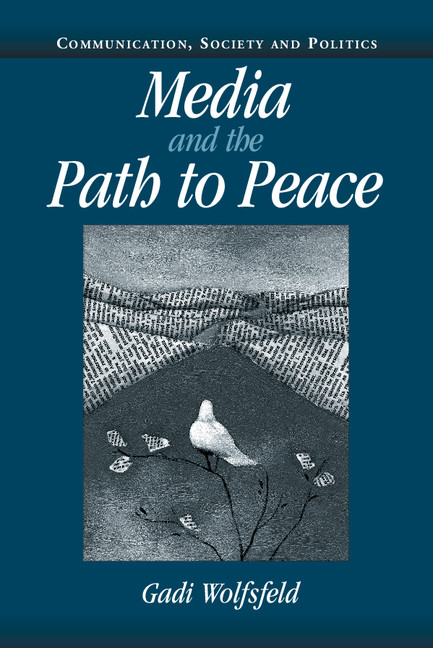
    This is the first book to examine in detail the roles that the news media can play in an ongoing peace process. Gadi Wolfsfeld explains how the press's role in such processes varies over time and political circumstance. He examines three major cases: the Oslo peace process between Israel and the Palestinians; the peace process between Israel and Jordan; and the process surrounding the Good Friday Agreement in Northern Ireland. Wolfsfeld's central argument is that there is a fundamental contradiction between news values and the nature of a peace process. This often leads the media to play a destructive role in attempts to make peace, but variations in the political and media environment affect significantly exactly how the media behave. Wolfsfeld shows how the media played a mainly destructive role in the Oslo peace process, but were more constructive during the Israel-Jordan process and in Northern Ireland.

    Reviews

    ' … thoughtful and thought-provoking …'

    Philip Seib - Marquette University

    Refine List

    Actions for selected content:

    Select all | Deselect all
    • View selected items
    • Export citations
    • Download PDF (zip)
    • Save to Kindle
    • Save to Dropbox
    • Save to Google Drive

    Save Search

    You can save your searches here and later view and run them again in "My saved searches".

    Please provide a title, maximum of 40 characters.
    ×

    Contents

    References
    Abu-Odeh, A. (1999). Jordanians, Palestinians, and the Hashemite Kingdom in the Middle East peace process. Washington DC: United States Institute of Peace
    Adam, G. F. and Thamotheram, R. (1996). The media's role in conflict: Report reviewing international experience in the use of mass-media for promoting conflict prevention, peace and reconciliation. Geneva: Media Action International
    Adoni, H. and Mane, S. (1984). Media and the social construction of reality: Toward an integration of theory and research. Communication Research 11, 323–340
    Arian, A. (1995). Security threatened: Surveying Israeli opinion on peace and war. New York: Cambridge University Press
    Arian A., Weimann, G., and Wolfsfeld, G. (1999). Balance in election coverage. In A. Arian and M. Shamir (eds.), The elections in Israel, 1996. Albany: State University of New York Press
    Arterton, C. F. (1993). Campaign '92: Strategies and tactics of the candidates. In G. M. Pomper (ed.), The election of 1992. Chatham, NJ: Chatham House
    Avraham, E., Wolfsfeld, G. and Aburaiya, I. (2000). Dynamics in the news coverage of minorities: The case of the Arab citizens of Israel. Journal of Communication Inquiry 24, 117–133
    Ayres, R. W. (1997). Mediating international conflicts: Is image change necessary ? Journal of Peace Research 34, 431–447
    Barzilai, G. (1996). Wars, internal conflicts and political order: A Jewish democracy in the Middle East. Albany, NY: State University of New York Press
    Bar-Tal, D. and Teichman, Y. (in press). Stereotypes and prejudice in conflict: The case of the perception of Arabs in Israeli society. Cambridge: Cambridge University Press
    Baumgartner, F. R. and Jones, B. D. (1993). Agendas and instability in American politics. Chicago: University of Chicago Press
    Becker, J. A. (1996). A disappearing enemy: The image of the United States in Soviet political cartoons. Journalism and Mass Communication Quarterly 73, 609–619
    Ben, A. (2001). Now everyone knows: They're guilty. Ha'aretz, July 21, p. b3 [Hebrew]
    Bennett, W. L. (1990). Toward a theory of press-state relations in the United States. Journal of Communication 40, 103–125
    Bennett, W. L. and Entman, R. M. (2001). Mediated politics: An introduction. In W. L. Bennett and R. M. Entman (eds.), Mediated politics: communication in the future of democracy. New York: Cambridge University Press
    Bennett, W. L. and D. L. Paletz (eds.) (1994). Taken by storm: The media, pubic opinion, and U.S. foreign policy in the Gulf War. Chicago: University of Chicago Press
    Blumler, J. G. and Kavanagh, D. (1999). The third age of political communication: Influences and features. Political Communication 16, 209–230
    Bowles, S. (1999). Fewer violent fatalities in schools. USA Today, April 28, p. 4A
    Brants, K. (1998). Who's afraid of infotainment?European Journal of Communication 13, 315–338
    Brants, K. and Neijens, P. (1997). The infotainment of politics. Political Communication 15, 149–164
    Brosius, H. and Eps, P. (1995). Prototyping through key events: News selection in the case of violence against aliens and asylum seekers in Germany. European Journal of Communication 10 (3), 391–412
    Bruck, P. A. (ed.) (1988). A proxy for knowledge: The news media as agents in arms control and verification. Ottawa: Carleton International Proceedings
    Bruck, P. A. (1989). Strategies for peace, strategies for news research. Journal of Communication 39, 108–129
    Bruck, P. A. and Roach, C. (1993). Dealing with reality: The news media and the promotion of peace. In C. Roach (ed.), Communication and culture in war and peace. Newbury Park: Sage
    Cappella, J. N. and Jamieson, K. H. (1997). Spiral of cyncism: The press and the public good, New York: Oxford University Press
    Caspi, D. and Limor, Y. (1999). The in/outsiders: Mass media in Israel. Cresskill, NJ: Hampton Press
    Cobb, R. and Elder, C. (1983). Participation in American politics: The dynamics of agenda-building. Baltimore, MD: Johns Hopkins University Press
    Cohen, A. and Wolfsfeld, G. (eds.) (1993). Framing the Intifada: People and media. Norwood, NJ: Ablex
    Cohen, R. (1987). Theatre of power: The art of diplomatic signalling. London: Longman, 1987
    Cohen, Y. (1986). Media diplomacy: The foreign office in the mass communications age. London: Frank Cass
    Cooke, T. (2003). Paramilitaries and the press in Northern Ireland. In P. Norris and M. Kern (eds.), Framing Terrorism. New York: Routledge
    Cottle, S. (1997). Reporting the troubles in Northern Ireland: Paradigms and media propaganda. Critical Studies in Mass Communication 14, 282–296
    Davison, P. W. (1974). Mass communication and conflict resolution. New York: Praeger
    Dearing, J. W. and Rogers, E. M. (1996). Agenda-setting. Thousand Oaks, CA: Sage
    Delli Carpini, M. and B. Williams. (2001). Let us entertain you: Politics in the new media environment. In W. L. Bennett and R. M. Entman (eds.), Mediated politics: Communication in the future of democracy. New York: Cambridge University Press
    Dorman, W. and Livingston, S. (1994). News and historical content: The establishment phase of the Persian Gulf policy debate. In W. L. Bennett and D. L. Paletz (eds.), Taken by storm: The media, public opinion, and U.S. foreign policy in the Gulf War. Chicago: University of Chicago Press
    Dorman, W., Manoff, R. K., and Weeks, J. (1988). American press coverage of U.S. -Soviet relations, the Soviet Union, nuclear weapons, arms control, and national security: A bibliography. New York: Center for War Peace and the News Media
    Eckhardt, W. (1991). Making and breaking enemy images. Bulletin of Peace Proposals 22, 87–95
    Edelman, M. (1988). Constructing the political spectacle. Chicago: University of Chicago Press
    Entman, R. (2003). Projections of power: Framing news, public opinion, and U.S. foreign policy. Chicago: University of Chicago Press
    Entman, R. (2004). Projections of power: Framing news, public opinion, and U.S. foreign policy. Chicago: University of Chicago Press
    Entman, R. and Herbst, S. (2001). Reframing public opinion as we have known it. In W. L. Bennett and R. M. Entman (eds.), Mediated politics: communication in the future of democracy
    Fawcett, L. (2002). Who's setting the postdevolution agenda in Northern Ireland ? The Harvard International Journal of Press/Politics 7, 14–33
    First, A. (1998). Who is the enemy? The portrayal of the Arabs in the Israeli TV News at the beginning of the Intifada. Gazette 60, 239–254
    First, A. (2000). Are they still the enemy? The Represenation of Arabs in the Israeli News. In P. Tudor (ed.), Mediating the other: Jews, Christians and the Media. London: The Centre of Near and Middle Eastern Studies
    Fromm, J., Gart, M., Hughes, T. L., Rodman, P., and Tanzer, L. (1992). The media impact on foreign policy. In H. Smith (ed.), The media and the Gulf War. Washington, DC: Seven Locks Press
    Galtung, J. (1998). High road, low road: Charting the course for peace journalism. Track Two 7, 7–10
    Gamson, W. A. (1992). Talking politics. New York: Cambridge University Press
    Gamson, W. A., Croteau, D., Hoynes, W., and Sasson, T. (1992). Media images and the social construction of reality. Annual Review of Sociology 18, 373–393
    Gamson, W. A. and Modigliani, A. (1987). The changing culture of affirmative action. In R. G. Braungart and M. M. Braungard (eds.), Frontiers in social movement theory. New Haven, CT: Yale University Press
    Gamson, W. A. and Modigliani, A. (1989). Media discourse and public opinion on nuclear power: A constructionist approach. American Journal of Sociology 95, 1–37
    Gamson, W. A. and Stuart, D. (1992). Media discourse as a symbolic contest: The bomb in political cartoons. Sociological Forum 7, 55–86
    Gamson, W. and Wolfsfeld, G. (1993). Movements and media as interacting systems. The Annals of the American Academy of Political and Social Science 528, 114–125
    Gannett Foundation (1991). The media at war: The press and the Persian Gulf conflict. New York: Gannett Foundation Media Center, Columbia University
    Gilboa, E. (1998). Media diplomacy: Conceptual divergence and applications. Harvard International Journal of Press/Politics 3, 56–75
    Gitlin, T. (1980). The whole world is watching. Berkeley: University of California Press
    Glasgow University Media Group (1985). War and peace news. Philadelphia: Open University Press
    Gowing, N. (1996). Media coverage: Help or hindrance in conflict prevention? Unpublished paper. New York: Carnegie Commission on Preventing Deadly Conflicts
    Graber, D. (1994). The infotainment quotient in routine television-news – A director's perspective. Discourse and Society 1994, 483–508
    Griffen, E. (1996). A first look at communication theory. New York: McGraw Hill
    Hass, A. (2001). Once again Israel is operating according to a concept. Ha'aretz, July 29, P. B1
    Hackett, R. (1991). News and dissent: The press and politics of peace in Canada, Norwood, NJ: Ablex Publishing Co.
    Hallin, D. C. (1994). We keep America on top of the world. London: Routledge
    Hallin, D. (1986). The uncensored war. New York: Oxford University Press
    Henderson, G. (ed.) (1973). Public diplomacy and political change: Four case studies, Okinawa, Peru, Czechoslovakia, Guinea. New York: Praeger
    Himmelfarb, S. (1998). Impact is the mantra: The ‘common ground’ approach to the media. Track Two 7, 38–40
    Horowitz, D. and Lissak, M. (1990). Trouble in utopia: The overburdened polity of Israel. Albany: State University of New York Press
    Hroub, K. (2000). Hamas: Political thought and practice. Beirut: Institute for Palestinian Studies
    Ito, Y. (1990). Mass communication theories from a Japanese perspective. Media, Culture and Society 12, 423–464
    Ito, Y. (2002). Climate of opinion, kuuki, and democracy, In W. Gudykunst (ed.), Communication yearbook. Mahwah, NJ: Lawrence Erlbaum
    Just, M. J., Crigler, A. N., Alger, D. E., Cook, T. E., Kern, M., and West, J. (1996). Crosstalk: Citizens, candidates, and the media in a presidential campaign, Chicago: University of Chicago Press
    Kellner, D. (1991). The Persian Gulf TV war. Boulder, CO: Westview Press
    Kepplinger, H. M. and Habermeir, J. (1995). The impact of key events on the presentation of reality. European Journal of Communication 10 (3), 371–390
    Kershner, I. (1999). The rise and rise of Colonel Dahalan. Jerusalem Report, February 1, pp. 22–24
    Kimmerling, B. (1993). Militarism in Israeli society. Theory and Criticism 4, 123–140 [Hebrew]
    Kingdon, J. (1995). Agendas, alternatives, and public policies. 2nd edn. New York: Longman
    Lawrence, R. G. (2000). The politics of force: Media and the construction of police brutality. Berkeley: University of California Press
    Lawrence, R. G. and Bennett, W. L. (2000). Civic engagement in the era of big stories. Political Communication 17, 377–382
    Liebes, T. (1997). Reporting the Arab Israeli conflict: How hegemony works. London: Routledge
    Liebes, T. (1998). Television disaster marathons: A danger for the democratic process. In T. Leibes and J. Curran (eds.), Media, Culture, and Identity. London: Routledge
    Liebes, T. and Curran, J. (eds.) (1998). Media, ritual, and identity. London: Routledge
    Livingston, S. (1997). Clarifying the CNN effect: An examination of media effects according to the type of military intervention. Research Paper R-18. Cambridge, MA: The Joan Shorenstein Center on the Press, Politics, and Public Policy, Kennedy School of Government, Harvard University
    Livingston, S. and Eachus, S. (1995). Humanitarian crises and US foreign-policy – Somalia and the CNN effect reconsidered. Political Communication 12, 413–429
    Lynch, J. (1998). Findings of the Conflict and Peace Journalism Forum. Unpublished manuscript. Tablow Court, Talow, Buckinghamshire, England
    Manheim, J. B. (1991). All of the people, all the time: Strategic communication and American politics. Armonk, NY: M. E. Sharpe
    Manheim, J. B. (1994a). Strategic public diplomacy and American foreign policy: The evolution of influences. New York: Oxford University Press
    Manheim, J. B. (1994b). Managing Kuwait's image during the Gulf conflict. In W. L. Bennett and D. L. Paletz (eds.), Taken by storm: The media, public opinion, and U.S. foreign policy in the Gulf War. Chicago: University of Chicago Press
    Manheim, J. B. (1998). The news shapers: Strategic communication as a third force in news making. In D. Graber, D. McQuail, and P. Norris (eds.), The politics of news, the news of politics. Washington, DC: CQ Press
    Manoff, R. (1996). The mass media and social violence: Is there a role for the media in preventing and moderating ethnic, national, and religious conflict? Unpublished paper. New York: Center for War, Peace, and the News Media, New York University
    Manoff, R. (1997). The media's role in preventing and moderating conflict. Crossroads Global Report (March/April), 24–27
    Manoff, R. (1998). Role plays: potential media roles in conflict prevention and management. Track Two 7, 11–16
    McQuail, Denis and S. Windahl (1993). Communication models for the study of mass communication. London: Longman
    Makovsky, D. (2001). A voice from the heavens: Al-Jazeera's satellite news broadcasts inflame emotions across the Arab world.usnews.com, May 14
    Mermin, J. (1999). Debating war and peace. Princeton, NJ: Princeton University Press
    Mishal, S. and Sela, A. (2000). The Palestinian. Hamas: Vision, violence and coexistence. New York: Columbia University Press
    Mitchell, G. J. (1999). Making peace. New York: Alfred A. Knopf
    Mowlana, H., Gerbner, G., and Schiller, H. I. (1992). Triumph of the image: The media's war in the Persian Gulf – A global perspective. Boulder, CO: Westview Press
    Mutz, D. and Reeves, B. (2001). Exposure to mediated political conflict: Effects of civility of interaction on public opinion. Paper presented at the Annual Meeting of the American Political Science Association, San Francisco, California
    Naveh, C. (2001). The role of the media in shaping Israeli public opinion in the peace process (1992–1996). In S. Sofer (ed.), Peacemaking in a divided society. London: Frank Cass
    Newton, K. (1999). Mass media effects: Mobilization or media malaise ? British Journal of Political Science 29, 577–599
    O'Heffernan, P. (1993). Mass media and U.S. foreign policy: A mutual exploitation model of media influence in U.S. foreign policy. In R. J. Spitzer (ed.), Media and public policy. Westport, CT: Praeger
    Ottosen, R. (1995). Enemy images and the journalistic process. Journal of Peace Research 32, 97–112
    Owen, D. (2000). Popular politics and the Clinton/Lewinsky affair: The implications for leadership. Political Psychology 21, 161–177
    Patterson, T. (1993). Out of order. New York: Alfred A. Knopf
    Peri, Y. (1983). Between battles and ballots: Israeli military in politics. Cambridge: Cambridge University Press
    Peri, Y. (2000). Introduction: The writing was on the wall. In Y. Peri (ed.), The assassination of Yitzhak Rabin. Stanford, CA: Stanford University Press
    Peri, Y. (2004). Telepopulism: Media and politics in Israel, Stanford, CA: Stanford University Press
    Pundak, R. (2001). From Oslo to Taba: What went wrong? Unpublished Paper
    Rabin, Y. (1996). The promise and problems of the Israeli press. The Harvard International Journal of Press/Politics 1, 106–112
    Reese, S. D. and Gandy, O. (eds.) (2001). Framing in the new media landscape. Mahwah, NJ: Lawrence Erlbaum Associates
    Reese, S., Grant, A., and Danielian, L. (1994). The structure of news sources on television: A network analysis of “CBS News,” “Nightline,” “MacNeil/Lehrer,” and “This Week with David Brinkley.”Jounal of Communication 44, 84–107
    Roach, C. (1993). Information and culture in war and peace: Overview. In Roach (ed.) Communication and culture in war and peace. Newbury Park: Sage
    Robinson, P. (2002). The CNN effect: The myth of news, foreign policy and intervention. London: Routledge
    Rolston, B. and Miller, D. (eds.) (1996). War and words: The Northern Ireland media reader. Belfast: Beyond the Pale Publications
    Roy S. (2001). The Gaza Strip: The political economy of de-development. 2nd edn. Washington, DC: Institute for Palestine Studies
    Rubinstein, D. (2001). Who needs politics when there is Al-Jazeera ? Ha'aretz, October 30, p. B3
    Ryan, C. (1991). Prime time activism: Media strategies for grassroots organizing. Boston, MA: South End Press
    Sabato, L. J. (2000). Feeding frenzy: Attack journalism and American politics. Baltimore, MD: Lanahan
    Scheufele, D. A. (1999). Framing as a theory of media effects. Journal of Communication 49, 103–122
    Schiff, Z. and Ya'ari, E. (1990). Intifada: The Palestinian uprising – Israel's third front. New York: Simon and Schuster
    Schudson, M. (1996). The Power of News. Cambridge, MA: Harvard University Press
    Serfaty, S. (ed.) (1991). The mass media and foreign Policy. New York: St. Martin's Press
    Shamir, J. and Shamir, M. (2000). The anatomy of public opinion. Ann Arbor, MI: University of Michigan Press
    Shinar, D. (2000). Media diplomacy and ‘peace talk’: The Middle East and Northern Ireland. Gazette 62, 83–97
    Shoemaker, P. (1996). Hardwired for news: Using biological and cultural evolution to explain the surveillance function. Journal of Communication 47, 32–47
    Shoemaker, P. and Eicholz, M. (2000). Good news vs. bad news: News valence as a theoretical construct. Paper presented at the Annual Conference of the International Association for Mass Communication Research in Singapore
    Simon, A. and Xenos, M. (2000). Media framing and effective public deliberation. Political Communication 17, 363–376
    Small, M. (1987). Influencing the decision-makers: The Vietnam experience. Journal of Peace Research 24, 185–198
    Sparks, C. (1992). Popular journalism: Theories and practice. In P. Dahlgren and C. Sparks (eds.), Journalism and popular culture. London: Sage
    Sprinzak, E. (2000). Israel's radical right and the countdown to the Rabin assassination. In Y. Peri (ed.), The assassination of Yitzak Rabin. Stanford, CA: Stanford University Press
    Strobel, W. P. (1997). Late breaking foreign policy: The news media's influence on peace operations. Washington, DC: The United States Institute of Peace
    Swanson, D. L. (in press). Political news in the changing environment of political journalism. In P. Maarek and G. Wolfsfeld (eds.), Political communication in a new era: A cross-national perspective. London: Routledge
    Tami Steinmetz Center for Peace Research (1996). The Peace Index Project: Findings from June, 1994 to May, 1996. Tel Aviv: University of Tel Aviv [Hebrew]
    Underwood, D. (2001). Reporting and the push for market-oriented journalism: Media organizations as businesses. In L. Bennett and R. Entman (eds.), Mediated politics: Communication in the future of democracy. New York: Cambridge University Press
    Valentino, N. A., Beckmann, M. W., and Buhr, T. A. (2001). A spiral of cynicism for some: The contingent effects of campaign news frames on participation and confidence in government. Political Communication 18, 347–367
    Van Dijk, T. A. (1996). Power and the news media. In D. Paletz (ed.) Political communication in action. Cresskill, NJ: Hampton Press, Inc
    Vedel, T. (in press). Public policies for digital democracy in the European Union and the US. In P. Maarek and G. Wolfsfeld (eds.), Political communication in a new era. London: Routledge
    Weimann, G. (1994). Can the media mediate? Mass mediated diplomacy in the Middle East. In G. Ben Dor and D. Dewitt (eds.), Confidence building measures in the Middle East. New York: Westview
    Weimann, G. (2000). Modern media and the reconstruction of reality. Thousand Oaks, CA: Sage
    Weimann, G. and Wolfsfeld, G. (2002). The struggle over the media agenda in the 1996 and 1999 elections. In A. Arian and M. Shamir (eds.), Election in Israel 1999. Albany, NY: State University of New York Press
    Weymouth, L. (2001). Barak: Die or separate. Newsweek, July 23, pp. 28–29
    Wolfsfeld, G. (1997a). Media and political conflict: News from the Middle East. Cambridge: Cambridge University Press
    Wolfsfeld, G. (1997b). Fair weather friends: The varying role of the news media in the Arab–Israeli peace process. Political Communication 14, 29–48
    Wolfsfeld, G. (1997c). Promoting peace through the news media: Some initial lessons from the peace process. Harvard International Journal of Press/Politics 2, 52–70
    Wolfsfeld, G. (2000). Political waves and democratic discourse: Terrorism waves during the Oslo peace process. In W. L. Bennett and R. Entman (eds.), Mediated politics: Communication in the future of democracy. New York: Cambridge University Press
    Wolfsfeld, G. (2001a). The news media and peace: From the Middle East to Northern Ireland. Peace Works, No. 37. Washington DC: United States Institute of Peace
    Wolfsfeld, G. (2001b). The news media and the Second Intifada: Some initial lessons. Harvard Journal of Press/Politics 6, 113–118
    Wolfsfeld, G. (2003). The role of the news media in peace negotiations: Variations over time and circumstance. In J. Darby and R. MacGinty (eds.), Contemporary peace making: Conflict, violence and peace processes, New York: Palgrave-Macmillan
    Wolfsfeld, G., Avraham, E., and Aburaiya, I. (2000). When prophesy always fails: Israeli press coverage of the Arab minority's land day protests. Political Communication 17, 115–131
    Wolfsfeld, G. and Rabihiya, Y. (1988). Communication and control in times of crisis: Israeli censorship in the occupied territories. Canadian Journal of Communication, special Issue, December, 96–101

    Metrics

    Altmetric attention score

    Full text views

    Total number of HTML views: 0
    Total number of PDF views: 0 *
    Loading metrics...

    Book summary page views

    Total views: 0 *
    Loading metrics...

    * Views captured on Cambridge Core between #date#. This data will be updated every 24 hours.

    Usage data cannot currently be displayed.

    Accessibility standard: Unknown

    Why this information is here

    This section outlines the accessibility features of this content - including support for screen readers, full keyboard navigation and high-contrast display options. This may not be relevant for you.

    Accessibility Information

    Accessibility compliance for the PDF of this book is currently unknown and may be updated in the future.
