
Skip to main content Accessibility help
×
  • Cited by 33
    • Show more authors
    • You may already have access via personal or institutional login
    • Select format
    • Publisher:
      Cambridge University Press
      Publication date:
      10 August 2009
      04 October 2007
      ISBN:
      9780511496998
      9780521876230
      9780521182256
      Dimensions:
      (228 x 152 mm)
      Weight & Pages:
      0.576kg, 282 Pages
      Dimensions:
      (229 x 152 mm)
      Weight & Pages:
      0.38kg, 282 Pages
    You may already have access via personal or institutional login
  • Selected: Digital
    Add to cart View cart Buy from Cambridge.org

    Book description

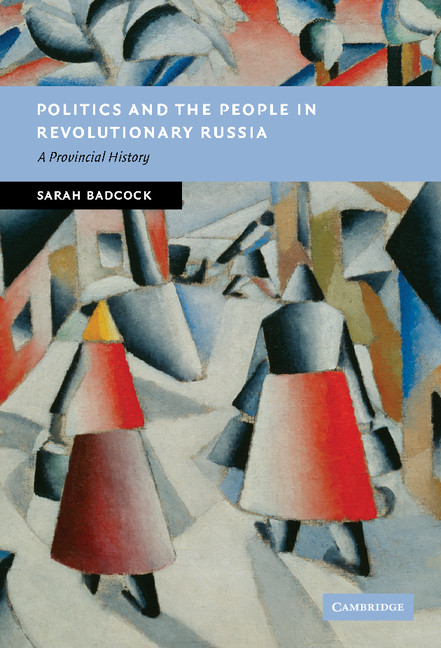
    After the collapse of the Romanov dynasty in February 1917, Russia was subject to an eight month experiment in democracy. Sarah Badcock studies its failure through an exploration of the experiences and motivations of ordinary men and women, urban and rural, military and civilian. Using previously neglected documents from regional archives, this text offers a history of the revolution as experienced in the two Volga provinces of Nizhegorod and Kazan. Badcock exposes the confusions and contradictions between political elites and ordinary people and emphasises the role of the latter as political actors. By looking beyond Petersburg and Moscow, she shows how local concerns, conditions and interests were foremost in shaping how the revolution was received and understood. She also reveals the ways in which the small group of intellectuals who dominated the high political scene of 1917 had their political alternatives circumscribed by the desires and demands of ordinary people.

    Reviews

    'This is a significant contribution …'

    Brian Bonhomme Source: The American Historical Review

    ‘[Badcock] succeeds wonderfully in showing us the power of locality in the Revolution and making us appreciate why local interests so quickly overwhelmed the stillborn national agendas of the political elite. To her great credit, she has a light touch with her sources. She lets 'ordinary people' speak through their letters and petitions so that we can begin to see what they would have seen - the chaos, the indeterminacy, and the vulnerability as well as the hope and expectation.’

    Willard Sunderland Source: The Journal of Modern History

    'Sarah Badcock's new and exciting book is a major contribution to the historiography of 1917 … It will be read with great interest by historians of the Revolution and scholars of modern Russia more broadly … a fine addition to graduate-level seminars in Russian history.'

    Robert H. Greene Source: Canadian Journal of History

    'Sarah Badcock's study of the Revolution offers a detailed and absorbing analysis of political power in the revolutionary setting of 1917.'

    Lutz Haefner Source: H-HistGeog

    'Badcock's book is a welcome addition to the still relatively small number of studies that have focused on the Russian Revolution outside St Petersburg and Moscow. It also effectively challenges students to rethink the interpretations based on the views of the political elites. It is essential reading for all specialists on the Revolution.'

    Richard D. King Source: The Historian

    'Taking part in a burgeoning trend on regional history, Sarah Badcock proposes a new history of the Revolution as experienced in the two Volga provinces of Nizhni Novgorod and Kazan. The failure of the eight months of Russia's experiment of democracy is studied in a well informed narrative based on local newspapers and archive materials.'

    Source: Central Eurasian Reader

    '… [Badcock] extensively discusses the way that citizens and local politicians are forced to react to the new conjunctures of power that are present when democratizing reforms are launched in conditions of state failure. She explains very clearly why elections, political parties, local councils, and other key democratic institutions do not fulfill either democratic objectives or meet the needs of broad political communities when political and social life is in drastic turmoil. These are important points, ones of interest well beyond the field of historians of the Russian revolution. I hope that readers interested in these or similar themes will examine this work closely.'

    Joshua Sanborn Source: Journal of World History

    ‘Badcock reinforces the prevailing wisdom that the revolutionary process of 1917 led to unbridgeable gulfs between those with power and those without it. Her important contribution is to demonstrate how this process worked from the perspective of the latter group, which had its own logical agendas. Badcock is careful not to stray beyond her carefully assembled evidence. Nonetheless, her book suggests certain interesting continuities with Soviet-era policies that are usually blamed on the Bolsheviks but seem to have grown out of the larger political and social conflict begun in 1917: a hostility to the market but also to forced grain requisitions; an antipathy toward the richer peasants (labeled by Badcock as 'separators' rather than 'kulaks'); popular indifference to democratic institutions and processes; the marginalization of women from the class of political actors; and, finally, the ungovernability of vast stretches of the Russian lands.’

    Diane P. Koenker Source: The Journal of Interdisciplinary History

    The volume's greatest contribution is its author's fearless willingness to step outside prevailing narratives to identify some of the principal underlying elements of Russia's political experience during 1917. In a sense, it outlines Russia's political culture without, remarkably, resorting to customary invidious characterizations. It can serve as a guideline for new ways of examining the revolutionary experience. Still it cannot supplant historical narrative. After all, it chooses the year 1917 for its explorations because that year experienced vast historical events. Without the broader narrative, what would it be about? Dig deeper, she seems to say, and perhaps we will better understand and even alter the narrative.’

    Michael Melancon Source: Slavic Review

    Refine List

    Actions for selected content:

    Select all | Deselect all
    • View selected items
    • Export citations
    • Download PDF (zip)
    • Save to Kindle
    • Save to Dropbox
    • Save to Google Drive

    Save Search

    You can save your searches here and later view and run them again in "My saved searches".

    Please provide a title, maximum of 40 characters.
    ×

    Contents

    Metrics

    Altmetric attention score

    Full text views

    Total number of HTML views: 0
    Total number of PDF views: 0 *
    Loading metrics...

    Book summary page views

    Total views: 0 *
    Loading metrics...

    * Views captured on Cambridge Core between #date#. This data will be updated every 24 hours.

    Usage data cannot currently be displayed.

    Accessibility standard: Unknown

    Why this information is here

    This section outlines the accessibility features of this content - including support for screen readers, full keyboard navigation and high-contrast display options. This may not be relevant for you.

    Accessibility Information

    Accessibility compliance for the PDF of this book is currently unknown and may be updated in the future.
