
Skip to main content Accessibility help
×
  • Cited by 29
    • Show more authors
    • You may already have access via personal or institutional login
    • Select format
    • Publisher:
      Cambridge University Press
      Publication date:
      02 September 2009
      16 January 2006
      ISBN:
      9780511510748
      9780521858557
      9780521394086
      Dimensions:
      (228 x 152 mm)
      Weight & Pages:
      0.618kg, 368 Pages
      Dimensions:
      (229 x 152 mm)
      Weight & Pages:
      0.49kg, 368 Pages
    You may already have access via personal or institutional login
  • Selected: Digital
    Add to cart View cart Buy from Cambridge.org

    Book description

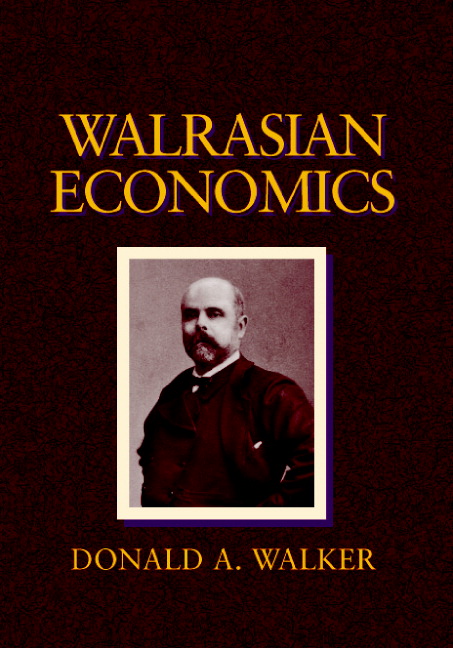
    In order to understand the various strands of general equilibrium theory, why it has taken the forms that it has since the time of Léon Walras, and to appreciate fully a view of the state of general equilibrium theorising, it is essential to understand Walras's work and examine its influence. The first section of this book accordingly examines the foundations of Walras's work. These include his philosophical and methodological approach to economic modelling, his views on human nature, and the basic components of his general equilibrium models. The second section examines how the influence of his ideas has been manifested in the theorising of his successors, surveying the models of theorists such as H. L. Moore, Vilfredo Pareto, Knut Wicksell, Gustav Cassel, Abraham Wald, John von Neumann, J. R. Hicks, Kenneth Arrow, and Gerard Debreu. The treatment also examines models of many types in which Walras's influence is explicitly acknowledged.

    Refine List

    Actions for selected content:

    Select all | Deselect all
    • View selected items
    • Export citations
    • Download PDF (zip)
    • Save to Kindle
    • Save to Dropbox
    • Save to Google Drive

    Save Search

    You can save your searches here and later view and run them again in "My saved searches".

    Please provide a title, maximum of 40 characters.
    ×

    Contents

    References
    References and Bibliography for Chapter 11
    Allais, Maurice (1968), “Vilfredo Pareto, Contributions to Economics,” in International Encyclopedia of the Social Sciences, New York: Macmillan Co. and the Free Press, 2, 399–411
    Amoroso, Luigi (1909), “La teoria dell'equilibrio economico secondo il Prof. Vilfredo Pareto,” Giornale degli Economisti, series 2, 39, October, 353–67
    Amoroso, Luigi (1921), Lezioni di economia mathematica, Bologna: N. Zanichelli
    Antonelli, Etienne (1914), Principes d'économie pure, Paris: Librairie des sciences politiques et sociales
    Antonelli, Etienne (1939), L'Economie pure du capitalisme, Paris: Guillaumin et Cie
    Antonucci, Antonio (ed.) (1938), Alcune lettere di Vilfredo Pareto pubblicate e commentate da A. Antonucci, Rome: Prof. P. Maglione-Editore; Socc. di Loescher & C.; reprinted in Busino 1973 without Antonucci's comments
    Arena, Richard and Ragni, Ludovic (1994), “Libre concurrence et méthodologie walrasienne: une tentative de mise en relation,” Economies et Sociétés, Série Œconomia, Histoire de la Pensée économique, P. E. no. 20–21, 10–11, 161–82
    Arrow, Kenneth (1959), “Towards a Theory of Price Adjustment,” in Abramovitz, Moses. (eds.), The Allocation of Economic Resources: Essays in Honor of Bernard Francis Haley, Stanford: Stanford University Press, 41–51
    Arrow, Kenneth (1968), “Economic Equilibrium,” in Sills, David L. (ed.), International Encyclopedia of the Social Sciences, 4, no place: Macmillan Company and the Free Press, 376–86
    Arrow, Kenneth J. and Debreu, Gérard (1954), “Existence of an Equilibrium for a Competitive Economy,” Econometrica, 22, July, 265–90
    Arrow, Kenneth J. and Debreu, Gérard (eds.) (2001), Landmark Papers in General Equilibrium Theory, Social Choice and Welfare, in Foundations of Twentieth Century Economics, 3, Cheltenham, U.K. and Northampton, MA. : Elgar Publishing Limited
    Arrow, Kenneth J. and Hahn, F. H. (1971), General Competitive Analysis, San Francisco: Holden-Day; Edinburgh: Oliver and Boyd
    Arrow, Kenneth J. and Hurwicz, Leonid (1958), “On the Stability of Competitive Equilibrium I,” Econometrica, 26, 522–52
    Aupetit, Albert (1901), Essai sur la théorie générale de la monnaie, Paris: Guillaumin et Cie
    Aupetit, Albert (1914), Principes d'économie pure, Paris: Guillaumin et Cie
    Barone, Enrico (1895), “Sopra un recente libro del Wicksteed,” unpublished lost mss.; translated into French by Léon Walras as “Sur un livre récent de Wicksteed,” in 239, 1895, 2, 644–48; translated into English by Donald A. Walker, in Jaffé 1983, 182–86
    Barone, Enrico (1896), “Studi sulla distribuzione,” Giornale degli Economisti, series 2, 12, February, 107–152
    Barone, Enrico (1908), “Il Ministro della produzione nello stato collettivista,” Giornale degli Economisti, series 2, 37, September, 267–93; October, 391–414
    Baumol, William J. and Goldfeld, Stephen M. (eds.) (1968), Precursors in Mathematical Economics, LSE Series of reprints of scarce works on political economy, no. 19, London: London School of Economics
    Belloc, Bernard and Michel Moreaux (1987), “Allais, Maurice,” in Eatwell et al. 1987, 1, 78–80
    Bidard, Christian and Franke, Reiner (1987), “On Walras' Model of General Equilibrium: A Simpler Way to Demonstrate Existence,” Zeitschrift für Nationalökonomie, 47 (3), 315–19
    Bini, Piero and Bruni, Luigino (1998), “Intervista a Gérard Debreu,” Storia del pensiero economico, 35, 3–29
    Blaug, Mark (ed.) (1992a), Leon Walras (1834–1910), an Elgar Reference Collection, in Pioneers in Economics, 25, Aldershot, UK and Brookfield, VT: Edward Elgar Publishing
    Blaug, Mark (1992b), The Methodology of Economics or How Economists Explain, 2nd ed., Cambridge: Cambridge University Press
    Blaug, Mark (1997), “Competition as an End-State and Competition as a Process,” in Eaton, B. Curtis and Harris, Richard G. (eds.), Trade, Technology and Economics: Essays in Honour of Richard G. Lipsey, Cheltenham, UK and Brookfield, VT: Edward Elgar Publishing, 241–62; and in Not Only an Economist, Recent Essays, Cheltenham, UK: Edward Elgar Publishing, 66–86; and in Walker 2000a, 1, 272–93
    Bliss, Christopher (1987), “Hicks, John Richard (born 1904),” in Eatwell et al., 2, 641–46
    Bompaire, François (1931), Du principe de liberté économique dans l'œuvre de Cournot et dans celle de l'école de Lausanne (Walras, Pareto), Paris: Recueil Sirey
    Bousquet, Georges-Henri (1927), Essai sur l'évolution de la pensée économique, Paris: M. Giard
    Bousquet, Georges-Henri (1928a), Cours d'économie pure, Paris: Librairie des sciences politiques et sociales
    Bousquet, Georges-Henri (1928b), Vilfredo Pareto. Sa vie et son œuvre, Paris: Payot
    Bousquet, Georges-Henri (1960), Pareto (1848–1923). Le savant et l'homme, Lausanne: Payot
    Bousquet, Georges-Henri (1964), “Introduction” to Pareto 1896/1897, new edition, Geneva: Librarie Droz, IX–XVII
    Bousquet, Georges-Henri (1971), “Quelques remarques sur Pareto et certains défauts de son œuvre,” Revue Européenne des Sciences Sociales et Cahiers Vilfredo Pareto, 9 (25), 11–27
    Bouvier, Emile (1901), “L'économie politique mathématique, quelques mots à propos du traité de M. Léon Walras,” Revue Critique de Législation et de Jurisprudence, 30 (12), December, 623–29
    Boven, Pierre (1923), “Vilfredo Pareto II. L'œuvre et les théories,” Journal de Genève, 94th year, no. 229, August 22, 1–2
    Bowley, Arthur L. (1924), The Mathematical Groundwork of Economics: An Introductory Treatise, Oxford: The Clarendon Press
    Brems, Hans (1986), Pioneering Economic Theory, 1630–1980. A Mathematical Restatement, Baltimore and London: The Johns Hopkins University Press
    Brems, Hans (1987), “Zeuthen, Frederik Ludvig Bang (1888–1959),” in Eatwell et al. 1987, 4, pp. 944–45
    Bridel, Pascal (1990), “Equilibre, statique comparée et analyse dynamique chez Vilfredo Pareto: remarques sur la contribution de Siro Lombardini,” Revue européenne des sciences sociales, 27 (88), 183–191
    Bridel, Pascal (1997), Money and General Equilibrium Theory; From Walras to Pareto (1870–1923), Cheltenham, UK and Lyme, CT: Edward Elgar Publishing Limited
    Bridel, Pascal (1998), Review of “Walras's market models. By Donald A. Walker. Cambridge; New York and Melbourne: Cambridge University Press, 1996,” Journal of Economic Literature, 36 (1), 231–33
    Bridel, Pascal and Huck, Elisabeth (2002), “Yet another look at Walras's theory of tâtonnement,” European Journal of the History of Economic Thought, 9, Winter, 513–40
    Bruni, Luigino (2002), Vilfredo Pareto and the birth of modern microeconomics, Cheltenham, U.K. and Northampton, MA: Elgar Publishing Limited
    Buckle, Henry Thomas (1872), The miscellaneous and posthumous works of Henry Thomas Buckle, edited by Taylor, Helen, London: Longmans, Green and Co
    Burgenmeier, B. (1994), “The Misperception of Walras,” American Economic Review, 84 (1), March, 342–52
    Busetto, Francesca (1995), “Why the Non-Tâtonnement Line of Reasearch Died Out,” Economic Notes, 24 (1), 89–113
    Busino, Giovanni (ed.) (1973), Vilfredo Pareto: Epistolario, 1890–1923, 2 vols., Rome: Accademia Nazionale dei Lincei
    Busino, Giovanni (1987), “Pareto, Vilfredo,” in Eatwell et. al. 1987, 3, 799–804
    Cassel, Karl Gustav (1899), “Grundriss einer elementaren Preislehre,” Zeitschrift für die gesamte Staatswissenschaf, 55 (3), 395–458
    Cassel, Karl Gustav (1900), “Grundsätze für die Bildung der Personentarife auf den Eisenbahnen,” Archiv für Eisenbahnwesen, 23, 116–46; translated as “The Principles of Railway Rates for Passengers,” International Economic Papers, 6, 1956
    Cassel, Karl Gustav (1903), The Nature and Necessity of Interest, London and New York: Macmillan
    Cassel, Karl Gustav (1918), Theoretische Sozialökonomie, Leipzig: C. F. Winter; 4th ed., revised, Leipzig: A. Deichertsche Verlasbuchhandlung Dr. Werner Scholl, 1927
    Cassel, Karl Gustav (1921), The World's Monetary Problems, Two memoranda presented to the International Financial Conference of the League of Nations in Brussels in 1920 and to the Financial Committee of the League of Nations in September 1921, London: Constable
    Cassel, Karl Gustav (1923), The Theory of Social Economy, translated by Joseph McCabe from the enlarged German 2nd ed., London: T. F. Unwin
    Cassel, Karl Gustav (1928), “The Rate of Interest, the Bank Rate, and the Stabilization of Prices,” Quarterly Journal of Economics, 42 (August), 511–29
    Cassel, Karl Gustav (1932), The Theory of Social Economy, translated by Samuel L. Barron from the 5th German edition, London: E. Benn; reprint, New York: Augustus M. Kelley, 1967
    Cassel, Karl Gustav (1935), On Quantitative Thinking in Economics, Oxford: Clarendon Press
    Cassel, Karl Gustav (1937), “Keynes' General Theory,” International Labour Review, 36, 437–45
    Clarke, Desmond M. (1991), “Descartes's Use of ‘Demonstration’ and ‘Deduction,’” in Moyal, Georges J. D., (ed.), (1991), René Descartes: Critical Assessments, 4 vols., London: Routledge
    Clower, Robert W. (1965), “The Keynesian Counter-Revolution: A Theoretical Appraisal,” in Hahn, F. H. and Brechling, F. P. R., (eds.), The Theory of Interest Rates, London: Macmillan, 103–25
    Collins Robert Unabridged French-English, English-French Dictionary (2002), 6th ed., Glasgow: HarperCollins Publishers
    Cournot, Antoine-Auguste (1838), Recherches sur les principes mathématiques de la théorie des richesses, Paris: Hachette
    Cournot, Antoine-Auguste (1863), Principes de la théorie des richesses, Paris: Hachette
    Creedy, John (1999), “The Rise and Fall of Walras's Demand and Supply Curves,” Manchester School, 67 (2), March, 192–202
    Currie, Martin and Steedman, Ian (1990), Wrestling with Time: Problems in Economic Theory, Manchester: Manchester University Press
    D'Agata, Antonio (2001), “Yet Another Proof of the Existence of a Competitive Equilibrium,” Revista de Analisis Economico, 16 (2), December, 155–58
    Davis, John B., Hands, D. Wade, and Mäki, Uskali (1998), The Handbook of Economic Methodology, Cheltenham, UK and Northampton, MA: Edward Elgar Publishing Limited
    Debreu, Gérard (1952), “A Social Equilibrium Existence Theorem,” Proceedings of the National Academy of Sciences, 38, 886–93
    Debreu, Gérard (1959), Theory of Value; An Axiomatic Analysis of Economic Equilibrium, New York: John Wiley and Sons
    Debreu, Gérard (ed.) (1996), General Equilibrium Theory, 2 vols., an Elgar Reference Collection, in The International Library of Critical Writings in Economics, general editor Mark Blaug, Cheltenham, UK and Brookfield, VT: Edward Elgar Publishing Limited
    Debs, Alexandre (2004), “‘To Be’ or ‘Ought To Be’: The Questions of Empirical Content and Normative Bias in Léon Walras's Methodology,” Journal of the History of Economic Thought, 26, December, 479–92
    Vroey, Michel (1987), “La possibilité d'une économie décentralisée,” Revue Economique, 38 (4), 773–805
    Vroey, Michel (1999), “Transforming Walras into a Marshallian Economist: A Critical Review of Donald Walker's Walras's Market Models,” Journal of the History of Economic Thought, 21 (4), December, 413–35
    Diemer, Arnaud (2002), “Economie Pure, Economie Appliquée, Economie Sociale, Un point de vue critique sur l'œuvre de Léon Walras?,” IIIe Colloque de l'Association Internationale Walras, Lyon, September 20, in Les Cahiers du CERAS, hors série no. 3, May, 2004, 235–53, with the title “Economie Pure et Economie Appliquée. Retour sur les origines de l'œuvre de Léon Walras.”
    Diemer, Arnaud and Jérôme Lallement (2004), “De Auguste à Léon Walras: retour sur les origines du marché et de la concurrence walrassiennes,” preliminary version, IVeColloque de l'Association Internationale Walras, Nice, September 23–24
    Divisia, François (1928), Economique rationelle, Paris: G. Doin
    Dockès, Pierre (1994), “≪La société n'est pas un pique-nique≫: le socialisme appliqué de Léon Walras,” Economies et Sociétés, Série Œconomia, Histoire de la Pensée économique, P. E. no. 20–21, 10–11, 270–325
    Dockès, Pierre (1996), La société n'est pas un pique-nique: Léon Walras et l'économie sociale, Paris: Economica
    Dockès, Pierre (1999), “Ce qui est, ce qui devrait être, ce qui sera: Walras's economics as he saw it,” Revue Européenne des Sciences Sociales, 37 (116), 13–36
    Dockès, Pierre, Frobert, Ludovic, Klotz, Gérard, Potier, Jean-Pierre, and Tiran, André, (eds.), (2000), Les traditions économiques françaises 1848–1939, Paris: CNRS ÉDITIONS
    Dockès, Pierre and Potier, Jean-Pierre (2001), La Vie et l'œuvre économique de Léon Walras, Paris: Economica; an extract from 249.V, IX–ⅬXXVIII
    Dorfman, Robert, Samuelson, Paul A., and Solow, Robert M. (1958), Linear Programming and Economic Analysis, New York, Toronto, London: McGraw-Hill Book Company
    Eatwell, John, Milgate, Murray, and Newman, Peter (eds.), The New Palgrave: A Dictionary of Economics, 4 vols., London: Macmillan Press; New York: Stockton Press; Tokyo: Maruzen Company
    Edgeworth, Francis Y. (1881), Mathematical Psychics: An Essay on the Application of Mathematics to the Moral Sciences, London: C. Kegan Paul; reprint, New York: Augustus M. Kelley, 1961
    Edgeworth, Francis Y. (1889), “The Mathematical Theory of Political Economy. Eléments d'économie politique pure. By Léon Walras,” Nature, 40, September, 434–36
    Einaudi, Manon Michels (1935), “Pareto as I Knew Him,” Atlantic Monthly, 156, September, 336–46
    Fisher, Irving (1892), “Mathematical Investigations in the Theory of Value and Prices,” in Transactions of the Connecticut Academy, 9, July, 3–126; reprint, New York: Augustus M. Kelley, 1965
    Fisher, Irving (1896), Appreciation and Interest, publications of the American Economic Association, 3rd series, 11 (4), August, New York: Macmillan Company
    Fisher, Irving (1892), Mathematical Investigations in the Theory of Value and Prices, in Transactions of the Connecticut Academy, 9, July, 3–126; reprint, New York: Augustus M. Kelley, 1965
    Fontaine, Phillippe (1998), “Menger, Jevons, and Walras Un-homogenized, De-homogenized, and Homogenized: A Comment on Peart,” American Journal of Economics and Sociology, 57 (3), July, 333–40
    Gewirtz, Alan (1941), “Experience and the Non-Mathematical in the Cartesian Method,” Journal of the History of Ideas, 2 (2), April, 183–210
    Giddings, Franklin H. (1896), The Principles of Sociology, New York: Macmillan Company
    Gijsel, Peter de (1989), “On the Role of General Equilibrium Theory in Walras's Theory of a Just Society,” in Walker, Donald A. (ed.), Classical and Neoclassical Economic Thought: Selected Papers from the History of Economics Society Conference 1987, Perspectives on the History of Economic Thought, 1, Aldershot, UK: Edward Elgar for the History of Economics Society, 133–44
    Gustafsson, Bo (1987), “Cassel, Gustav,” in Eatwell et al. 1987, 1, 375–77
    Hahn, Frank (1981), review: “M. Beenstock, A Neoclassical Analysis of Macroeconomic Policy, Cambridge Universtiy Press, 1980,” Economic Journal, 91 (364), December, 1036–39
    Hands, D. Wade (1998), “Positivism,” in Davis et al. 1998, 374–78
    Hauenschild, Nils and Stahlecker, Peter (2002), “A Simple Proof for the Existence of Walrasian Equilibrium under Monotone Preferences,” Economics Bulletin, 4 (4), 1–8
    Hayek, Friedrich August (1934), “Carl Menger,” Economica, n.s., 1, November, 393–420
    Herland, Michel (1996), “Three French Socialist Economists: Leroux, Proudhon, Walras,” Journal of the History of Economic Thought, 18 (1), Spring, 133–53
    Herschel, John F. W. (1831 [1830]), A Preliminary Discourse on the Study of Natural Philosophy, London: Longman, Rees, Orme, Browne and Greene
    Hicks, J. R. (1934), “Léon Walras,” Econometrica, 2, October, 338–48
    Hicks, J. R. (1939), Value and Capital; 2nd ed., 1946, Oxford: Clarendon Press
    Hicks, J. R. (1965), Capital and Growth, New York and Oxford: Oxford University Press
    Hildenbrand, W. and Kirman, A. P. (1988), Equilibrium analysis: Variations on Themes by Edgeworth and Walras, in Advanced Textbooks in Economics, 28, Amsterdam, New York, Oxford, Tokyo: North-Holland
    Hilton, H. C. (1995), “Léon Walras on Money and Banking,” History of Economics Review, 24, Summer, 72–78
    Hollander, Samuel and Peart, Sandra (1999), “John Stuart Mill's Method in Principle and Practice: A Review of the Evidence,” Journal of the History of Economic Thought, 21 (4), December, 369–97
    Hotelling, Harold (1929), “Stability in Competition,” Economic Journal, 39, March, 41–57
    Howitt, P. W. (1973), “Walras and Monetary Theory,” Western Economic Journal, 11 (4), December, 487–99
    Huck, Elizabeth (2001), “La neutralité du tâtonnement au regard de la répartition des richesses dans la théorie de la production de Léon Walras. Le cas du tâtonnement sans bons des trois premières éditions des Eléments d'économie politique pure,” Revue économique, 52 (3), May, 729–38
    Hume, David (1777), Enquiries concerning Human Understanding and concerning the Principles of Morals, 3rd edition; reprint, edited by L. A. Selby Bigge, Oxford: Clarendon Press, 1975
    Hutchison, T. W. (1953), A Review of Economic Doctrines 1870–1929, London: Oxford University Press
    Iimura, Takuya (2003), “A Discrete Fixed Point Theorem and Its Applications,” Journal of Mathematical Economics, 39 (7), September, 725–42
    Ingrao, Bruna and Israel, Giorgio (1990), The Invisible Hand: Economic Equilibrium in the History of Science, translated by Ian McGilvray, Cambridge, MA: MIT Press
    Jaffé, William (1935), “Unpublished Papers and Letters of Léon Walras,” Journal of Political Economy, 43, April, 187–207. All articles of Jaffé's that are listed in these references are reprinted in Jaffé 1983, except Jaffé 1978 and 1984
    Jaffé, William (1967), “Walras's Theory of Tâtonnement: A Critique of Recent Interpretations,” Journal of Political Economy, 75, February, 1–19
    Jaffé, William (1969), “A. N. Isnard, Progenitor of the Walrasian General Equilibrium Model,” History of Political Economy, 1, Spring, 19–43
    Jaffé, William (1971), “Reflections on the Importance of Léon Walras,” in Schaarste en Welvaart, P. Hennipman Festschrift, edited by Arnold Heertje et al., Amsterdam: Stenfert Kroese, 87–107
    Jaffé, William (1976), “Menger, Jevons and Walras De-homogenized,” Economic Inquiry, 14, December, 511–24
    Jaffé, William (1977), “The Normative Bias of the Walrasian Model: Walras versus Gossen,” Quarterly Journal of Economics, 91, August, 371–87
    Jaffé, William (1978), Review of “Walras' Economics: A Pure Theory of Capital and Money, by Michio Morishima,” Economic Journal, 88, September, 574–617
    Jaffé, William (1980), “Walras's Economics as Others See It,” Journal of Economic Literature, 18, June, 528–49
    Jaffé, William (1981), “Another Look at Léon Walras's Theory of Tâtonnement,” History of Political Economy, 13, Summer, 313–36
    Jaffé, William (1983), William Jaffé's Essays on Walras, edited by Walker, Donald A., Cambridge, New York, Melbourne: Cambridge University Press
    Jaffé, William (1984), “The Antecedents and Early Life of Léon Walras,” edited by Donald A. Walker, History of Political Economy, 16 (1), Spring, 1–57
    Jolink, Albert (1993), “‘Procrustean Beds and All That’: The Irrelevance of Walras for a Mirowski Thesis,” History of Political Economy, 25, Supplement, 159–74
    Keynes, John Maynard (1925/1930), “F. P. Ramsey 1903–1930,” in Essays and Sketches in Biography, New York: Median Books, 1956. 114–24
    Keynes, John Maynard (1936), “William Stanley Jevons 1835–1882,” in Essays and Sketches in Biography, New York: Median Books, 1956, 125–60
    Keynes, John Maynard (1936), The General Theory of Employment, Interest and Money, New York: Harcourt, Brace and Company
    Kirman, Alan P. (1987), “Pareto as an Economist,” in Eatwell et al. 1987, 3, 804–9
    Kirman, Alan P. (1999), “The Future of Economic Theory,” in Kirman, Alan P. and Gérard-Varet, L.-A. (eds.), Economics Beyond the Millenium, Oxford: Oxford University Press, 8–22
    Klotz, Gérard (1994), “Achylle Nicolas Isnard, précurseur de Léon Walras?,” Economies et Sociétés, Série Œconomia, Histoire de la Pensée économique, P.E. nos. 20–21, 28 (10–11), 29–52
    Koopmans, Tjalling (1964), “Economic Growth at a Maximal Rate,” Quarterly Journal of Economics, 78, August, 355–94
    Koppl, Roger (1992), “Price Theory as Physics: The Cartesian Influence in Walras,” Methodus, 4 (2), December, 17–28; and in Walker 2001, 1, 199–210
    Koppl, Roger (1995), “The Walras Paradox,” Eastern Economic Journal, 21 (1), 43–55; and in Walker 2001a, 2, 268–80
    Kowalik, Tadeusz (1987), “Lange, Oskar Ryszard (1904–1965),” in Eatwell et al. 1987, 3, 123–29
    Kuenne, Robert E. (1961), “The Walrasian Theory of Money: An Interpretation and a Reconstruction,” Metroeconomica, 13, August, 94–105
    Kurz, Heinz and Neri Salvadori (2000), “Walras and Ricardo,” in Dockès et al. 2000, 967–85
    Kurz, Heinz and Salvadori, Neri (2004), “Von Neumann, the Classical Economists and Arrow-Debreu: Some Notes,” Acta Œconomica, 54 (1), 39–62
    Volpe, Giulio (1936), Studi Sulla Teoria Dell' Equilibrio Economico Dinamico Generale, Naples: Jovene; translated by Helen Ampt as Studies on the Theory of General Dynamic Economic Equilibrium, Basingstoke and London: Macmillan, 1993
    Lange, Oskar R. (1936), “On the Economic Theory of Socialism, Part I,” Review of Economic Studies, 4 (1), October, 53–71
    Lange, Oskar R. (1937), “On the Economic Theory of Socialism, Part II,” Review of Economic Studies, 4 (2), February, 123–42
    Lange, Oskar R. (1944), Price Flexibility and Employment, Bloomington: Principia Press
    Laurent, Hermann (1902), Petit traité d'économie politique mathématique, rédigé conformément aux préceptes de l' école de Lausanne, Paris: C. Schmid
    Lendjel, Emeric (1997), “Le ≪biais empiriste≫ dans l'interprétation de Walker du tâtonnement walrassien,” Economies et Sociétés, Œconomia, Histoire de la pensée économique, Série P.E., no. 26, 31 (10), 47–84
    Lendjel, Emeric (1999), “Tâtonnement walrassien et marchandage parétien: Une approche comparative,” Revue européenne des sciences sociales, 37 (116), 295–314
    Lengwiler, Yvan (1998), “Endogenous Endowments and Equilibrium Starvation in a Walrasian Economy,” Journal of Mathematical Economics, 30 (1), August, 37–58
    Lexis, William (1881), “Zur mathematisch-ökonomischen Literatur,” Jahrbücher für Nationalökonomie und Statistik, new series, 3, 427–34
    Locke, John (1954), Essays on the Law of Nature, edited by Leyden, W., Oxford: Oxford University Press
    Mantel, R. (1974), “On the Characterisation of Aggregate Excess Demand,” Journal of Economic Theory, 7, 348–53
    Marchionatti, Roberto and Gambino, Enrico (1997), “Pareto and Political Economy as a Science: Methodological Revolution and Analytical Advances in Economic Theory in the 1890s,” Journal of Political Economy, 105 (6), December, 1322–48
    Marchionatti, Roberto and Mornati, Fiorenzo (2003), “Pareto et l'économie Mathématique au Début des Années 1890. Quelques Réflexions à Propos des ≪Considerazioni sui Principii Fondamentali Dell'economia Politica Pura≫,” in Histoire et Théorie des Sciences Sociales. Mélanges en l'honneur de Giovanni Busino, Geneva: Droz, 3, 51–84
    Marget, Arthur W. (1931), “Léon Walras and the ‘Cash-Balance Approach’ to the Problem of the Value of Money,” Journal of Political Economy, 39 (5), October, 569–600
    Marget, Arthur W. (1935), “The Monetary Aspects of the Walrasian System,” Journal of Political Economy, 43, April, 145–86
    Marinitsch, O. (1892), La Bourse, théorique et pratique, Paris: Paul Ollendorff
    Marx, Karl (1858), “Introduction” to Contribution to the Critique of Political Economy, reprinted in David Horowitz, Marx and Modern Economics, New York: Monthly Review Press, 1968
    Marx, Karl (1867), Capital, 1, Harmondsworth: Penguins Books, 1976
    McKenzie, Lionel W. (1954), “On Equilibrium in Graham's Model of World Trade and Other Competitive Systems,” Econometrica, 22, April, 147–61
    Ménard, Claude (1990), “The Lausanne Tradition: Walras and Pareto,” and “Commentary” by Donald A. Walker, in Hennings, Klaus and Samuels, Warren J. (eds), Neoclassical Economic Theory: 1870 to 1930, Dordrecht: Kluwer Academici Publishers, 95–136, 137–50
    Menger, Karl (1973), “Austrian Marginalism and Mathematical Economics,” in Carl Menger and the Austrian school of economics, edited by Hicks, John R. and Weber, W., Oxford: Oxford University Press, 38–60
    Mill, John Stuart (1836), “On the definition of Political Economy; and on the Method of Philosophical Investigation Proper to It,” London and Westminster Review, October; in Essays on Some Unsettled Questions of Political Economy, London: John W. Parker, 1844, 120–64; and in Collected Works of John Stuart Mill, 22, Toronto: University of Toronto Press, 1967, 309–39
    Mill, John Stuart (1981–1991), Collected Works of John Stuart Mill, 33 vols., Toronto: Toronto University Press
    Mirowski, Philip (1989), More heat than light. Economics as social physics: Physics as nature's economics, Cambridge: Cambridge University Press
    Moore, Henry Ludwell (1929), Synthetic Economics, New York: Macmillan
    Moret, Jacques (1915), L'Emploi des mathématiques en économie poltitque, Paris: M. Giard et E. Brière
    Morishima, Michio (1977), Walras' Economics; A Pure Theory of Capital and Money, Cambridge: Cambridge University Press
    Morishima, Michio (1996), “Morishima on Ricardo: Two Replies,” Cambridge Journal of Economics, 20 (1), January, 91–109; in Walker 2001, 1, 278–96
    Mosak, Jacob L. (1987), “Schultz, Henry (1893–1938),” in Eatwell et al. 1987, 4, 261–62
    Mouchot, Claude (2000), “De quelques problèmes relatifs à l'entrepreneur walrassien,” Les Cahiers du CERAS, Actes du Colloque de l'Association Internationale Walras, hors série no1, juin, 49–57
    Murray, Roberto A. (1920), Leçons d'économie politique suivant la doctrine de l'école de Lausanne, Paris: Payot et Cie
    Myrdal, Gunnar (1945), “Gustav Cassel in Memoriam,” Ekonomisk revy, 2, 3–13
    Nash, John F. (1950), “The Bargaining Problem,” Econometrica, 18, 155–62
    Nash, John F. (1951), “Non-cooperative Games,” Annals of Mathematics, 54, 286–95
    Negishi, Takashi (1989), History of Economic Theory, Amsterdam: North-Holland
    Neisser, Hans Philipp (1932), “Lohnhöhe und Beschäftigungsgrad im Marktgleichgewicht,” Weltwirtschaftliches Archiv, 36 (2), October, 415–55
    Neumann, John von (1937), “Über ein Ökonomisches Gleichungssystem und eine Verallgemeinerung des Brouwerschen Fixpunktsatzes,” Ergebnisse eines Mathematischen Kolloquiums, Heft 8, 1935–1936 [sic]; edited by Karl Menger, Leipzig and Wien: Franz Deuticke, 1938, 73–83; translated by George Morgenstern as “A Model of General Economic Equilibrium,” Review of Economic Studies, 13, 1945–1946, 1–9
    Neumann, John and Morgenstern, Oskar (1944), Theory of Games and Economic Behavior, Princeton: Princeton University Press
    Niiniluoto, Ilkka (1998), “Induction,” in Davis et al. 1998, 246–49
    Osorio, Antonio (1913), Théorie mathématique de l'échange, Paris: M. Giard et E. Brière
    Pantaleoni, Maffeo (1889), Principii di economia pura, Florence: Barbera
    Pareto, Vilfredo (1893a), “Lettre d'Italie,” Le Monde Economique, July 8, 35–36
    Pareto, Vilfredo (1893b), “Considerazioni sui principii fondamentali dell'economia politica pura,” Giornale degli Economisti, series 2, 7, October, 279–321
    Pareto, Vilfredo (1896/1897), Cours d'économie politique, 2 vols., Lausanne: F. Rouge; reprint, edited by Bousquet, G.-H. and Busino, G., Geneva: Librairie Droz, 1964
    Pareto, Vilfredo (1897), “The New Theories of Economics,” Journal of Political Economy, 5 (4), 485–502
    Pareto, Vilfredo (1898a), “Protezionismo italiano,” Critica Sociale, Rivista Quindicinale de Socialismo, 7, February 16, 49–50
    Pareto, Vilfredo (1898b), “De l'économie mathématique,” Zeitschrift für Sozialwissenschaft, 1, 320–21
    Pareto, Vilfredo (1899), “Liberali e Socialisti,” Critica Sociale, Rivista quindicinale de Socialismo, 8, September 1, 215–16
    Pareto, Vilfredo (1902–1903), Les systèmes socialistes, 2 vols., Paris: V. Giard & E. Brière
    Pareto, Vilfredo (1909), Manuel d'économie politique; translated by Alfred Bonnet from the Italian Manuale d'economia politica, Milan: Società Editrice Libraria, 1906; translation reviewed and corrected by the author, Paris: V. Giard & E. Brière. The Italian version translated by Ann S. Schwier as Manual of Political Economy, New York: Augustus M. Kelley, 1971
    Pareto, Vilfredo (1911b), “Economie Mathématique,” in Encyclopédie des sciences mathématiques, 1, Paris: Teubner, Gauthier, Villars
    Pareto, Vilfredo (1912a), “Economia Dimessa,” La Libertà Economica, Rassegna settimanale, 10 (17–18), 285–90
    Pareto, Vilfredo (1912b), Review of “La Teoria della Rendita. By Prof. Guido Sensini. (Rome: Loescher. 1912.),” Economic Journal, 22 (3), September, 467–69
    Pareto, Vilfredo (1916), Trattato di sociologia generale, 4 vols., Florence: Barbera; translated by Andrew Bongiorno and Arthur Livingston as The Mind and Society; A Treatise on General Sociology, New York: Dover Publications, 1963
    Pareto, Vilfredo (1948), Corrispondenza di V. Pareto, edited by Sensini, Guido, Padua: Cedam (Casa editrice Dr. Antonio Milani)
    Pareto, Vilfredo (1960), Lettere a Maffeo Pantaleoni, 1890–1923, edited by Sensini, Guido, 3 vols., Rome: Banca Nazionale del Lavoro
    Pareto, Vilfredo (1963–2001), Œuvres complètes de Vilfredo Pareto, 31 vols., prepared under the direction of Giovanni Busino, Geneva: Droz
    Patinkin, Don (1956), Money, Interest, and Prices: An Integration of Monetary and Value Theory, Evanston, IL: Row, Peterson; 2nd ed., New York: Harper and Row, 1965
    Patinkin, Don (1987), “Walras's Law,” in Eatwell et al. 1987, 3, 863–68
    Petri, Fabio (2004), General Equilibrium, Capital and Macroeconomics; A Key to Recent Controversies in Equilibrium Theory, Cheltenham, UK, and Northhampton, MA: Edward Elgar Publishing
    Pietri-Tonelli, Alfonso (1924), “Le equazioni generali dell'equilibrio economico di Vilfredo Pareto,” Giornale degli Economisti, series 4, 65, 55–61
    Pietri-Tonelli, Alfonso (1927), Traité d'économie rationnelle, 3rd ed, Paris: M. Giard
    Pirou, Gaëtan (1925), Les doctrines economiques en France depuis 1870, Paris: A. Colin
    Pirou, Gaëtan (1934), Les théories de l'équilibre économique: L. Walras et V. Pareto, Paris: Les Editions Domat-Montchrestien
    Poinsoit, Louis (1803), Elements de statique; 8th edition, Paris: Bachelier, 1842
    Pokorny, D. (1978), “Smith and Walras: Two theories of science,” Canadian Journal of Economics and Political Science, 11 (3), 387–403
    Potier, Jean-Pierre (1994), “Classification des sciences et divisions de l'≪économie politique et sociale≫ dans l'œuvre de Léon Walras: une tentative de reconstruction,” Economies et Sociétés, Série Œconomia, Histoire de la Pensée économique, P.E. no. 20–21, 28 (10–11), 223–77
    Potier, Jean-Pierre (1998), “Léon Walras and Applied Science: The Significance of the Free Competition Principle,” in Faccarello, Gilbert (ed.), Studies in the History of French Political Economy: From Bodin to Walras, London and New York: Routledge, 369–403
    Potier, Jean-Pierre and Walker, Donald (eds.) (2004), La correspondance entre Aline Walras et William Jaffé et autres documents, Paris: Economica
    Rebeyrol, Antoine (1998), “The Development of Walras' Monetary Theory,” in Faccarello, Gilbert (ed.), Studies in the History of French Political Economy: From Bodin to Walras, London and New York: Routledge, 319–68
    Rebeyrol, Antoine (1999), La pensée économique de Walras, Paris: Dunod
    Rebeyrol, Antoine (2002), “‘Yet Another Look’? A Comment,” European Journal of the History of Economic Thought, 9 (4), winter, 541–49
    Redman, Deborah (1997), The Rise of Political Economy as a Science; Methodology and the Classical Economists, Cambridge, MA, and London: MIT Press
    Ricci, Umberto (1924), “Pareto e l'economia pura,” Giornale degli Economisti, series 4, 65, 27–44; translated as “Pareto and Pure Economics,” Review of Economic Studies, 1 (1–3), 1933–1934, 3–21
    Rizvi, S. Abu Turab (2003), “Postwar Neoclassical Microeconomics,” in A Companion to the History of Economic Thought, edited by Samuels, Warren J., Biddle, Jeff E., and Davis, John B., Malden, MA, Oxford, UK, Melbourne, Berlin: Blackwell Publishing Ltd., 377–94
    Robert, Paul. (eds.) (2002), “Expérimental,” Le nouveau petit Robert, Paris: Dictionnaires Le Robert, 1001
    Samuelson, Paul A. (1941a), “The Stability of Equilibrium: Comparative Statics and Dynamics,” Econometrica, 9 (2), April, 97–120
    Samuelson, Paul A. (1941b), “The Stability of Equilibrium: Linear and Nonlinear Systems,” Econometrica, 9, April, 97–120
    Samuelson, Paul A. (1947), Foundations of Economic Analysis, Cambridge: Harvard University Press
    Samuelson, Paul A. (1993), “Gustav Cassel's Scientific Innovations: Claims and Realities,” History of Political Economy, 25 (3), 515–27
    Samuelson, Paul A. (1998), “Samuelson, Paul Anthony, as an Interpreter of the Classical Economists,” in Kurz, Heinz D. and Salvadori, Neri, eds., The Elgar Companion to Classical Economics, 2, Cheltenham, U.K.: Edward Elgar Publishing Limited, 329–333
    Schlesinger, Karl (1914), Theorie der Geld-und Kreditwirtschaft, Munich/ Leipzig: Dunker und Humblot
    Schlesinger, Karl (1933–1934), “Über die produktionsgleichungen der ökonomischen Wertlehre,” Ergebnisse eines mathematischen Kolloquiums, Heft 6, edited by Karl Menger, Leipzig and Wien: Franz Deuticke, 1935, 10–11; translated by William J. Baumol as “On the Production Equations of Economic Value Theory,” in Baumol and Goldfeld 1968, 278–80
    Schultz, Henry (1929), “Marginal Productivity and the General Pricing Process,” Journal of Political Economy, 37, October, 505–51
    Schultz, Henry (1932), “Marginal Productivity and the Lausanne School,” Economica, 12, August, 285–96
    Schultz, Henry (1933), “Interrelations of Demand,” Journal of Political Economy, 41, August, 468–512
    Schultz, Henry (1935), “Interrelations of Demand, Price, and Income,” Journal of Political Economy, 43, August, 433–81
    Schultz, Henry (1938), The Theory and Measurement of Demand, Chicago: University of Chicago Press
    Schumpeter, Joseph A. (1910), “Marie Esprit Léon Walras,” Zeitschrift für Volksvirtschaft, 19, 397–402; English translation in Schumpeter 1951, 74–79
    Schumpeter, Joseph A. (1911/1926), The Theory of Economic Development; An Inquiry into Profits, Capital, Credit, Interest, and the Business Cycle; translated by Redvers Opie, New York: Oxford University Press, 1961
    Schumpeter, Joseph A. (1925), “Schumpeter on Böhm-Bawerk,” in Spiegel, Henry W. (ed.), The Development of Economic Thought; Great Economists in Perspective, abridged edition, New York, Science Editions, John Wiley & Sons, 1964, 370–80
    Schumpeter, Joseph A. (1949), “Vilfredo Pareto,” Quarterly Journal of Economics, 63, May, 345–59; and in Schumpeter 1951
    Schumpeter, Joseph A. (1951), Ten Great Economists from Marx to Keynes, New York: Oxford University Press
    Schumpeter, Joseph A. (1954), History of Economic Analysis, New York: Oxford University Press
    Schwartz, P. (1972), The New Political Economy of J. S. Mill, London: London School of Economics
    Sensini, Guido (1929), “Vilfredo Pareto e la teoria della moneta,” Il Giornale Economico, September–October; reprinted in Guido Sensini, Studi di scienze sociali, 1, Rome: Casa Libraria Editrice Italiana, 1932
    Sonnenschein, Hugo F. (1972), “Market Excess Demand Functions,” Econometrica, 40, 549–63
    Sonnenschein, Hugo F. (1973), “Utility Hypothesis and Market Demand Theory,” Western Economic Journal, 11, 404–10
    Slutsky, Eugen (1915), “Sulla teoria del bilancio del consomatore,” Giornale degli Economisti e Rivista di Statistica, 51, July, 1–26
    Stackelberg, Heinrich (1933), “Zwei Kritische Bemerkungen zur Preistheorie Gustav Cassels,” Zeitschrift für Nationalökonomie, 4, June, 456–72
    Staley, Charles E. (1989), A History of Economic Thought. From Aristotle to Arrow, Cambridge, MA: Basil Blackwell
    Steiner, Philippe (1999), “L'entrepreneur parétien et la théorie de l'action,” Revue européenne des sciences sociales, 37 (116), 103–118
    Stigler, George (1941), Production and Distribution Theories; The Formative Period, New York: Macmillan Company
    Syll, Lars Pålsson (1993), “Wicksell on Harmony Economics: The Lausanne School vs. Wicksell,” Scandinavian Economic History Review, 41 (2), Winter, 172–88
    Tatti, Elena (2000), “Âtre et devoir âtre chez Léon Walras,” in Dockès et al. 2000, 417–28
    Vacherot, Etienne (1858), La métaphysique et la science ou principes de métaphysique positive; 2nd ed., 1863, 3 vols., Paris: Librairie de F. Chamerot
    Daal, Jan and Walker, Donald A. (1990), “The Problem of Aggregation in Walras's General Equilibrium Theory,” History of Political Economy, 22 (3), Fall, 489–505; and in Walker 2001a, 2, 341–57
    Daal, Jan and Jolink, Albert (1989), “Léon Walras's Mathematical Economics and the Mechanical Analogies,” History of Economics Society Bulletin, 11 (1), Spring, 25–32; and in Walker 2001a, 1, 93–100
    van Daal, Jan and Albert Jolink (1993), “Walras's ‘General’ General-Equilibrium Model,” in Hébert, Robert F. (ed.), Themes on Economic Discourse, Method, Money and Trade: Selected Papers from the History of Economics Conference 1991, Perspectives on the History of Economic Thought, 9, Aldershot: Edward Elgar for the History of Economics Society, 121–36
    Wald, Abraham (1934–1935), “Über die Produktionsgleichungen der ökonomischen Wertlehre (II),” Ergebnisse eines mathematischen Kolloquiums, Heft 7; Leipzig and Wein: Frank Deuticke, 1936, 1–6; translated by William J. Baumol as “On the Production Equations of Economic Value Theory, Part 2,” in Baumol and Goldfeld 1968, 289–93
    Wald, Abraham (1936), “Über einige Gleichungssysteme der mathematischen Ökonomie,” Zeitschrift für Nationalökonomie, 7 (5), 637–70; translated by Otto Eckstein as “On Some Systems of Equations of Mathematical Economics,” Econometrica, 19, October, 1951, 368–403
    Walker, Donald A. (1970), “Léon Walras in the Light of His Correspondence and Related Papers,” Journal of Political Economy, 78 (4), July-August, 685–701
    Walker, Donald A. (1971a), “The Static Analysis of Disequilibrium Transactions Markets,” Indian Economic Journal, 18 (3), January-March, 305–327
    Walker, Donald A. (1971b), “The Determinateness of Equilibrium in Isolated Competitive Markets,” International Review of Economics and Business, 18 (12), December, 1158–1179
    Walker, Donald A. (1983), “William Jaffé, Officier de liaison intellectuel,” in The Craft of the Historian of Economic Thought, vol. 1 of Research in the History of Economic Thought and Methodology, edited by Samuels, Warren J., Greenwich, CT: JAI Press, 19–39
    Walker, Donald A. (1984), “Is Walras's Theory of General Equilibrium a Normative Scheme?History of Political Economy, 16 (3), Fall, 445–69
    Walker, Donald A. (1987a) “Walras's Theories of Tatonnement,” Journal of Political Economy, 95(4), 758–74
    Walker, Donald A. (1987b), “Walras, Léon (1934–1910),” in Eatwell et al., 4, 852–63
    Walker, Donald A. (1987c), “Bibliography of the Writings of Léon Walras,” 1st ed., History of Political Economy, 19 (4), 667–702
    Walker, Donald A. (1989), “A Primer on Walrasian Theories of Economic Behavior,” History of Economics Society Bulletin, 11, Spring, 1–23; reprinted in Blaug 1992, 214–36
    Walker, Donald A. (1990), “Commentary by Donald A. Walker” on “The Lausanne Tradition: Walras and Pareto,” by Claude Ménard, in Neoclassical Economic Theory, 1870 to 1930, edited by Hennings, Klaus and Samuels, Warren J., Boston, Dordrecht, London: Kluwer Academic Publishers, 137–50
    Walker, Donald A. (1991), Review of “The Invisible Hand: Economic Equilibrium in the History of Science, by Bruna Ingrao and Giorgio Israel,” 1990, History of Political Economy, 23, no. 3, Fall, 560–65
    Walker, Donald A. (1996), Walras's Market Models, Cambridge, New York, and Melbourne: Cambridge University Press
    Walker, Donald A. (1997a), “The School of Lausanne,” in Encyclopedia of Keynesian Economics, edited by Cate, Thomas, with associate editors Colander, David and Harcourt, Geoffrey, Cheltenham, UK, and Brookfield, VT: Edward Elgar Publishing Limited, 361–65
    Walker, Donald A. (1997b), Advances in General Equilibrium Theory, Cheltenham, UK, Lyme, CT: Edward Elgar Publishing Limited; in French, translated by the author: La théorie de l'équilibre général: De nouveaux éclairages, Paris: Economica, 1999
    Walker, Donald A. (1998), “Léon Walras,” in The Handbook of Economic Methodology, edited by Davis, John B., Hands, D. Wade, and Maki, Uskali, Cheltenham, UK, Northampton, MA: Edward Elgar Publishing Limited, 541–45
    Walker, Donald A. (ed.) (2000a), Equilibrium, 3 vols., in Hoover, Kevin D. and Blaug, Mark (general eds.), Critical Ideas in Economics, no. 2, Cheltenham, UK, and Northampton, MA: Edward Elgar Publishing Limited
    Walker, Donald A. (2000b), “La relation entre la Bourse au ⅪXe siècle et le modèle de Léon Walras d'un marché organisé,” in Dockès et al. 2000, 443–57
    Walker, Donald A. (ed.) (2001a), The Legacy of Léon Walras, 2 vols., in Medema, Steven G., (series ed.), Intellectual Legacies in Modern Economics, Cheltenham, UK, and Northampton, MA: Edward Elgar Publishing Limited
    Walker, Donald A. (2001b), “A factual account of the functioning of the nineteenth-century Paris Bourse,” European Journal of the History of Economic Thought, 8 (2), 186–207
    Walker, Donald A. (2003), “Early General Equilibrium Economics: Walras, Pareto, and Cassel,” in A Companion to the History of Economic Thought, edited by Samuels, Warren J., Biddle, Jeff E., and Davis, John B., Malden, MA, Oxford, UK, Melbourne, Berlin: Blackwell Publishing Ltd., ch. 18, 278–93
    Walras, Auguste (1831), De la nature de la richesse et de l'origine de la valeur, Paris: Alexandre Johanneau
    Weintraub, E. Roy (1983), “On the Existence of a Competitive Equilibrium: 1930–1954,” Journal of Economic Literature, 21 (1), 1–39
    Wicksell, Knut (1893), Über Wert, Kapital und Rente, nach den neueren nationalökonomischen Theorien, Jena: G. Fisher
    Wicksell, Knut (1898), Geldzins und Güterpreise bestimmenden Ursachen, Jena: G. Fischer; translated by R. F. Kahn as Interest and Prices; A Study of the Causes Regulating the Value of Money, London: Macmillan, 1936
    Wicksell, Knut (1901, 1906), Vorlesungen über Nationalökonomie; 2nd ed. 1911, translated by E. Classen as Lectures on Political Economy, 2 vols., London: Routledge & Kegan Paul, 1934
    Wicksell, Knut (1919), “Professor Cassel's System of Economics,” in Wicksell 1934, appendix 1, 219–57
    Wicksell, Knut (1934), Lectures on Political Economy, vol. 1, General Theory, translated from the Swedish by E. Classen, London: Routledge and Kegan Paul
    Witteloostuijn, A. and Maks, J. A. H. (1988), “Walras: A Hicksian avant la lettre,” Economie Appliquée, 41 (3), 595–608
    Wieser, Friedrich (1891), “The Austrian School and the Theory of Value,” Economic Journal, 1, March, 108–21
    Witteloostuijn, A. and Maks, J. A. H. (1990), “Walras on Temporary Equilibrium and Dynamics,” History of Political Economy, 22 (2), 223–37
    Wood, John C. (ed.) (1993), Léon Walras: Critical Assessments, 3 vols., London: Routledge
    Zatarin, Joseph (1972), “La théorie des tâtonnements chez Walras,” Revue d'Economie Politique, 82 (6), 1222–28
    Zawadzki, Wńadyslaw (1914), Les mathématiques appliquées à l'économie politique, Paris: M. Rivière
    Zeuthen, Frederik L. B. (1928), Den konomiske Fordeling, Copenhagen: Busck
    Zeuthen, Frederik L. B. (1933), “Das Princip der Knappheit, Technische Kominatin und Ökonomische Qualität,” Zeitschrift für Nationalökonomie, 4, 1–24
    Zylberberg, André (1988), “L'économie mathématique chez les actuaires français au temps de Walras (1820–1914),” Oeconomia, 9, 35–64
    Zylberberg, André (1990), L'économie mathématique en France 1870–1914, Paris: Economica
    Non-Virtual Walrasian models
    Exchange models
    Bottazzi, J.-M. (1994), “Accessibility of Pareto Optima by Walrasian Exchange Processes,” Journal of Mathematical Economics, 23(6), November, 585–603
    Bronfman, Corinne (2000), “An Experimental Examination of the Walrasian Tatonnement Mechanism,” Bargaining and market behavior: Essays in experimental economics, Cambridge, New York, and Melbourne: Cambridge University Press, 381–406
    Cordoba, Jose M. and Hammond, Peter J. (1998), “Asymptotically Strategy-Proof Walrasian Exchange,” Mathematical Social Sciences, 36(3), December, 185–212
    Grandmont, Jean-Michel (1992), “Transformations of the Commodity Space, Behavioral Heterogeneity, and the Aggregation Problem,” Journal of Economic Theory, 57(1), June, 1–35
    Grodal, Birgit and Karl Vind (2000), “Walras Equilibrium with Coordination,” Institute of Economics Working paper, University of Copenhagen
    Guesnerie, Roger (2002), “Equilibre général, coordination et multiplicité sur les marches au comptant,” Revue d'Economie Politique, 112(5), September–October, 671–92
    Herings, Jean-Jacques (1997), “Equilibrium Adjustment of Disequilibrium Prices,” Journal of Mathematical Economics, 27(1), February, 53–77
    Ma, Jinpeng and Nie, Fusheng (2003), “Walrasian Equilibrium in an Exchange Economy with Indivisibilities,” Mathematical Social Sciences, 46(2), October, 159–92
    Majumdar, Mukul and Rotar, Vladimir (2000), “Equilibrium Prices in a Random Exchange Economy with Dependent Agents,” Economic Theory, 15(3), May, 531–50
    Negishi, T. (1961), “On the Formation of Prices,” International Economic Review, 2, 122–26
    Peters, Michael (1997), “On the Equivalence of Walrasian and Non-Walrasian Equilibria in Contract Markets: The Case of Complete Contracts,” Review of Economic Studies, 64(2), April, 241–64
    Uzawa, Hirofumi (1962), “A Walrasian Approach to Bargaining Games,” International Economic Review, 3, 218–32
    Some structural characteristics of non-virtual exchange or production models
    Fraja, Gianni and Sakovics, Jozsef (2001), “Walras Retrouvé: Decentralized Trading Mechanisms and the Competitive Price,” Journal of Political Economy, 109(4), August, 842–63
    Kandel, Eugene and Simhon, Avi (2002), “Between Search and Walras,” Journal of Labor Economics, 20(1), January, 59–85
    Koutsougeras, Leonidas C. (2003), “Non-Walrasian Equilibria and the Law of One Price,” Journal of Economic Theory, 108(1), January, 169–75
    Sertel, Murat R. and Yildiz, Muhamet (1999), “Double-Edged Population Monotonicity of Walrasian Equilibrium – A Note on the Nature of Competition,” Mathematical Social Sciences, 37(3), May, 235–51
    Starr, Ross M. and Maxwell B. Stinchcombe (1993), “Exchange in a Network of Trading Posts,” University of California, San Diego Department of Economics Working Paper, 93–13, April, 1–14
    Non-virtual models in which there is production
    Baigent, G. Glenn (2003), “Competitive Markets and Aggregate Information,” Eastern Economic Journal, 29(4), 593–606
    Benetti, Carlo (2002), “Le problème de la variation de prix: Les limites de la théorie walrassienne,” Revue Economique, 53(5), September, 917–31
    Bennardo, Alberto and Chiappori, Pierre Andre (2003), “Bertrand and Walras Equilibria under Moral Hazard,” Journal of Political Economy, 111(4), August, 785–817
    Berliant, Marcus and Dakhlia, Sami (2002), “Sensitivity Analysis for Applied General Equilibrium Models in the Presence of Multiple Walrasian Equilibria,” Economic Theory, 19(3), April, 459–76
    Borissov, Kirill (2004), “An Intertemporal General Equilibrium Model with Given Real Wage Rates,” Structural Change and Economic Dynamics, 15(2), June, 207–33
    Brown, Donald J. and Shannon, Chris (2000), “Uniqueness, Stability, and Comparative Statics in Rationalizable Walrasian Markets,” Econometrica, 68(6), November, 1529–39
    Dore, Mohammed H. I. (1998), “Walrasian General Equilibrium and Nonlinear Dynamics,” Nonlinear Dynamics, Psychology, and Life Sciences, 2(1), January, 59–72
    Fisher, Franklin M. (1983), Disequilibrium Foundations of Equilibrium Economics, Cambridge: Cambridge University Press
    Flaschel, Peter (1991), “Stability – Independent of Economic Structure? A Prototype Analysis,” Structural Change and Economic Dynamics, 2(1), 9–35
    Funk, Peter (1995), “Bertrand and Walras Equilibria in Large Economies,” Journal of Economic Theory, 67(2), December, 436–66
    Gul, Faruk and Stacchetti, Ennio (1999), “Walrasian Equilibrium with Gross Substitutes,” Journal of Economic Theory, 87(1), July, 95–124
    Hahn, Frank H. (1962), “On the Stability of Pure Exchange Equilibrium,” International Economic Review, 3, 206–13
    Hens, Thorsten (1997), “Stability of Tatonnement Processes of Short Period Equilibria with Rational Expectations,” Journal of Mathematical Economics, 28(1), August, 41–67
    Herings, Jean-Jacques (1997), “A Globally and Universally Stable Price Adjustment Process,” Journal of Mathematical Economics, 27(2), March, 163–93
    Horiba, Yutaka (1998), “Gross Substitutability and the Laws of Comparative Statics: A Simultaneous Demand Shift,” Keio Economic Studies, 35(2), 1–7
    Jensen, Bjarne S. (2003), “Walrasian General Equilibrium Allocations and Dynamics in Two-Sector Growth Models,” German Economic Review, 4(1), February, 53–87
    Katzner, Donald W. (1999), “Methodological Individualism and the Walrasian Tatonnement,” Journal of Economic and Social Research, 1(1), 5–33
    Majumdar, Mukul and Tapan Mitra (1997), “Complexities of Concrete Walrasian Systems,” Issues in economic theory and public policy: Essays in honour of Professor Tapas Majumdar, 41–63, Oxford and New York: Oxford University Press, Delhi
    Podczeck, Konrad (2003), “Core and Walrasian Equilibria When Agents' Characteristics Are Extremely Dispersed,” Economic Theory, 22(4), November, 699–725
    Rao, J. Mohan (1998), “A Leibenstein-Hobbes-Walras Model of Sharecropping,” Metroeconomica, 49(1), February, 62–96
    Serrano, Roberto and Volij, Oscar (1998), “Axiomatizations of Neoclassical Concepts for Economies,” Journal of Mathematical Economics, 30(1), August, 87–108
    Uses and developments of special ideas of Walras's
    Walras's law
    Aiyagari, S. Rao (1992), “Walras' Law and Nonoptimal Equilibria in Overlapping Generations Models,” Journal of Mathematical Economics, 21(4), 343–61
    Balasko, Yves (2004), “The Equilibrium Manifold Keeps the Memory of Individual Demand Functions,” Economic Theory, 24(3), October, 493–501
    Bidard, Christian (1989), “Equilibrium with a Qualitative Walras' Law,” Journal of Economic Theory, 47(1), February, 203–05
    Habibagahi, H. and J. Quirk (1989), “Hicksian Stability and Walras' Law,” in Wood, John Cunningham and Woods, Ronald N. (eds.), Sir John R. Hicks: Critical Assessments, 2, in Critical Assessments of Contemporary Economists, London and New York: Routledge, 249–61
    Huang, Weihong (2001), “Statistical Dynamics and Walras' Law,” Journal of Economic Behavior and Organization, 46(1), September, 57–71
    Lange, Oskar R. (1942), “Say's Law: A Restatement and Criticism,” in Lange, Oscar, et al. (eds.), Studies in Mathematical Economics and Econometrics, Chicago: University of Chicago Press, 49–68
    Rhodes, James R. (1984), “Walras' Law and Clower's Inequality,” Australian Economic Papers, 23(42), June, 112–22
    Yeager, Leland B. and Rabin, Alan A. (1997), “Monetary Aspects of Walras's Law and the Stock-Flow Problem,” Atlantic Economic Journal, 25(1), March, 18–36
    Walras allocations
    Armstrong, Thomas E. and Richter, Marcel K. (1984), “The Core-Walras Equivalence,” Journal of Economic Theory, 33(1), June, 116–51
    Armstrong, Thomas E. and Richter, Marcel K. (1986), “Existence of Nonatomic Core-Walras Allocations,” Journal of Economic Theory, 38(1), February, 137–59
    Herves-Beloso, Carlos and Moreno-Garcia, Emma (2004), “El poder de veto de la gran coalición,” Investigaciónes Económicas, 28(3), September, 489–513
    Manresa, Antonio (2002), “Can We Identify Walrasian Allocations?,” Review of Economic Design, 7(1), June, 57–73
    Nagahisa, Ryo-ichi (1991), “A Local Independence Condition for Characterization of Walrasian Allocations Rule,” Journal of Economic Theory, 54(1), June, 106–23
    Nagahisa, Ryo-ichi (1992), “Walrasian Social Choice in a Large Economy,” Mathematical Social Sciences, 24(1), August, 73–78
    Nagahisa, Ryo-ichi (1994), “A Necessary and Sufficient Condition for Walrasian Social Choice,” Journal of Economic Theory, 62(1), February, 186–208
    Nagahisa, Ryo-ichi and Suh, Sang-Chul (1995), “A Characterization of the Walras Rule,” Social Choice and Welfare, 12(4), October, 335–52
    Nouweland, A., Peleg, B. and Tijs, S. (1996), “Axiomatic Characterizations of the Walras Correspondence for Generalized Economies,” Journal of Mathematical Economics, 25(3), April, 355–72
    Serrano, Roberto and Oscar Volij (1997), “Abstract Equilibria, Interactive Choice Sets and Walrasian Allocations,” Department of Economics Working Paper, April, Brown University
    Serrano, Roberto and Volij, Oscar (2000), “Walrasian Allocations without Price-Taking Behavior,” Journal of Economic Theory, 95(1), November, 79–106
    Tauman, Yair and Chen, Yan (2000), “Acceptable and Walrasian Allocations,” Journal of Mathematical Economics, 34(3), November, 415–38
    Tian, Guoqiang (2000), “Feasible and Continuous Double Implementation of Constrained Walrasian Allocations,” Annals of Economics and Finance, 1(1), May, 19–32
    Yamazaki, Akira (1984), “Walras Degrees and Probability of a Blocking Coalition at Pareto Allocations,” Journal of Mathematical Economics, 13(2), October, 105–21
    The Walras correspondence
    Balasko, Yves (1975), “The Graph of the Walras Correspondence,” Econometrica, 43(5–6), September–November, 907–12
    DeMichelis, Stefano and Germano, Fabrizio (2000), “Some Consequences of the Unknottedness of the Walras Correspondence,” Journal of Mathematical Economics, 34(4), December, 537–45
    Jouini, Elyes (1993), “The Graph of the Walras Correspondence: The Production Economies Case,” Journal of Mathematical Economics, 22(2), 139–47
    Korthues, Bernd (2000), “Characterization of an Extended Walrasian Concept for Open Economies,” Journal of Mathematical Economics, 33(4), May, 449–61
    Majumdar, Mukul and Peleg, Bezalel (1997), “An Axiomatization of the Walras Correspondence in Infinite Dimensional Spaces,” International Economic Review, 38(4), November, 853–64
    Saijo, Tatsuyoshi, Tatamitani, Yoshikatsu and Yamato, Takehiko (1999), “Characterizing Natural Implementability: The Fair and Walrasian Correspondences,” Games and Economic Behavior, 28(2), August, 271–93
    Imperfectly competitive non-virtual general equilibrium models
    Oligopoly, Cournot-Walras, and monopolistic models
    Alos-Ferrer, Carlos (2004), “Cournot versus Walras in Dynamic Oligopolies with Memory,” International Journal of Industrial Organization, 22(2), February, 193–217
    Benassy, Jean-Pascal (1976), “The Disequilibrium Approach to Monopolistic Price Setting and General Monopolistic Equilibrium,” Review of Economic Studies, 43, February, 69–81
    Gary, Bobo, Robert J. (1989), “Cournot-Walras and Locally Consistent Equilibria,” Journal of Economic Theory, 49(1), October, 10–32
    Gary, Bobo, Robert J. and Michel, Philippe (1991), “Informative Advertising and Competition: A Noncooperative Approach,” International Economic Review, 32(2), May, 321–39
    Codognato, Giulio (1994), “Cournot-Walras Equilibrium: A Reconsideration,” Economic Notes, 23(3), 388–401
    Codognato, Giulio (1995), “Cournot-Walras and Cournot Equilibria in Mixed Markets: A Comparison,” Economic Theory, 5(2), March, 361–70
    Codognato, Giulio and Gabszewicz, Jean J. (1993), “Cournot-Walras Equilibria in Markets with a Continuum of Traders,” Economic Theory, 3(3), July, 453–64
    Cordella, Tito and Datta, Manjira (2002), “Intertemporal Cournot and Walras Equilibria: An Illustration,” International Economic Review, 43(1), February, 137–53
    D'Aspremont, Claude, Ferreira, Rodolphe Dos Santos, and Gérard-Varet, Louis-André (1997), “General Equilibrium Concepts under Imperfect Competition: A Cournotian Approach,” Journal of Economic Theory, 73(1), March, 199–230
    Huang, Weihong (2003), “A Naive but Optimal Route to Walrasian Behavior in Oligopolies,” Journal of Economic Behavior and Organization, 52(4), December, 553–71
    Kaas, Leo and Paul Madden (2000), “Imperfectly Competitive Cycles with Keynesian and Walrasian Features,” Institute for Advanced Studies, Vienna, Working paper, Economics Series, no. 83
    Kaas, Leo (2001), “Cournot-Walras Equilibrium without Profit Feedback,” Economics Bulletin, 4(9), 1–8
    Morishima, Michio and Majumdar, Madhavi (1996), “The Cournot-Walras Arbitrage, Resource Consuming Exchange, and Competitive Equilibrium,” in Dynamic Economic Theory, Cambridge, New York, Melbourne: Cambridge University Press, 270–84
    Novshek, William and Hugo Sonnenschein (1978), “Cournot and Walras Equilibrium,” Journal of Economic Theory, 19(2), December, 223–66, in Andrew F. Daughety (ed.) Cournot Oligopoly: Characterization and Applications, Cambridge; New York, and Melbourne: Cambridge University Press, 271–316
    Robert, Jacques (1994), “In the Cournot-Walras General Equilibrium Model, There May Be ‘More to Gain’ by Changing the Numeraire Than by Eliminating Imperfections: A Two-Good Economy Example: Comment,” in Mercenier, Jean and Srinivasan, T. N. (eds.), Applied General Equilibrium and Economic Development: Present Achievements and Future Trends, Ann Arbor: University of Michigan Press, 225–31
    Schenk-Hoppe, Klaus Reiner (2000), “The Evolution of Walrasian Behavior in Oligopolies,” Journal of Mathematical Economics, 33(1), February, 35–55
    Siebe, Wilfrid (1990), “General Equilibrium with a Continuum of Oligopolies,” Universitat Bonn Sonderforschungsbereich 303, working paper, May, 176
    Wooders, John (1997–1998), “Equilibrium in a Market with Intermediation Is Walrasian,” Review of Economic Design, 3(1), 75–89
    Yosha, Oved (1997), “Diversification and Competition: Financial Intermediation in a Large Cournot-Walras Economy,” Journal of Economic Theory, 75(1), July, 64–88
    Nash-Walras, games and bargaining models
    Allen, Beth and Heracles Polemarchakis (1994), “From Nash to Walras Equilibrium,” in Mertens, Jean-François and Sorin, Sylvain (eds.), Game-theoretic Methods in General Equilibrium Analysis, NATO Advanced Science Institutes Series D: Behavioural and Social Sciences, 77, Dordrecht and Boston: Kluwer Academic in cooperation with NATO Scientific Affairs Division, 225–41
    Alos-Ferrer, Carlos and Ania, Ana B. (2001), “Local Equilibria in Economic Games,” Economics Letters, 70(2), February, 165–73
    Bevia, Carmen, Corchon, Luis C. and Wilkie, Simon (2003), “Implementation of the Walrasian Correspondence by Market Games,” Review of Economic Design, 7(4), February, 429–42
    Corominas-Bosch, Margarida (2004), “Bargaining in a Network of Buyers and Sellers,” Journal of Economic Theory, 115(1), March, 36–77
    Dagan, Nir, Serrano, Roberto and Volij, Oscar (1998), “Comment on McLennan and Sonnenschein ‘Sequential Bargaining as a Noncooperative Foundation for Walrasian Equilibrium,’”Econometrica, 66(5), September, 1231–33
    Dubey, Pradeep and Geanakoplos, John (2003), “From Nash to Walras via Shapley-Shubik,” Journal of Mathematical Economics, 39(5–6), July, 391–400
    Faias, Marta, Moreno-Garcia, Emma and Pascoa, Mario Rui (2002), “Non-manipulability in Walrasian Cost Games,” Review of Economic Design, 7(1), June, 93–104
    Geanakoplos, John (2003), “Nash and Walras Equilibrium via Brouwer,” Economic Theory, 21(2–3), March, 585–603
    Ghosal, S. and Polemarchakis, H. M. (1997), “Nash-Walras Equilibria,” Research in Economics, 51(1), April, 31–40
    Kunimoto, Takashi and Serrano, Roberto (2004), “Bargaining and Competition Revisited,” Journal of Economic Theory, 115(1), March, 78–88
    Minelli, Enrico and Heracles M. Polemarchakis (1999), “Nash-Walras Equilibria of a Large Economy,” Université Catholique de Louvain CORE Discussion Paper, July
    Ponsati, Clara (2004), “Search and Bargaining in Large Markets with Homogeneous Traders,” Contributions to Theoretical Economics, 4(1), 1st quarter, 1–25
    Sabourian, Hamid (1999), “Bargaining and Markets: Complexity and the Walrasian Outcome,” Yale Cowles Foundation Discussion Paper, December
    Serrano, Roberto (2002), “Decentralized Information and the Walrasian Outcome: A Pairwise Meetings Market with Private Values,” Journal of Mathematical Economics, 38(1–2), September, 65–89
    Sinha, Deepak K. (1997), “Diffusion of Innovations in Globally Stable Walrasian Equilibrium,” Journal of Economics (Zeitschrift für Nationalökonomie), 66(1), 1–22
    Sonn, Sang-Young (2001), “Bargaining and Walrasian Equilibrium in Simple Production Economies,” Seoul Journal of Economics, 14(4), Winter, 379–405
    Szymanski, Stefan (2004), “Professional Team Sports Are Only a Game: The Walrasian Fixed-Supply Conjecture Model, Contest-Nash Equilibrium, and the Invariance Principle,” Journal of Sports Economics, 5(2), May, 111–26
    Trockel, Walter (1996), “A Walrasian Approach to Bargaining Games,” Economics Letters, 51(3), 295–301
    Trockel, Walter (2000), “Implementations of the Nash Solution Based on Its Walrasian Characterization,” Economic Theory, 16(2), September, 277–94
    Wooders, John (1998), “Walrasian Equilibrium in Matching Models,” Mathematical Social Sciences, 35(3), May, 245–59
    Yildiz, Muhamet (2003), “Walrasian Bargaining,” Games and Economic Behavior, 45(2), November, 465–87
    Fix-price models
    Benassy, Jean-Pascal (2000), “Rigidités nominales dans les modèles d'équilibre général intertemporel stochastique,” L'Actualité Economique/Revue D'Analyse Economique, 78(4), December, 423–57
    Vroey, Michel (2004), “Théorie de déséquilibre et chomage involontaire: Un examen critique,” Revue Economique, 55(4), July, 647–68
    Drèze, Jacques (1975), “Existence of an Exchange Equilibrium under Price Rigidities,” International Economic Review, 16, June, 301–20
    Grandmont, Jean-Michel (1982), “Temporary General Equilibrium Theory,” in Arrow, Kenneth J. and Intriligator, Michael D. (eds.), Handbook of Mathematical Economics: Volume II, Amsterdam: North-Holland Publishing Company, 879–922
    Herings, P. Jean-Jacques, Gerard van der Laan and Dolf Talman (1998), “Price-Quantity Adjustment in a Keynesian Economy,” Tilburg Center for Economic Research Discussion Paper, November
    Herings, Jean-Jacques, Laan, Gerard and Venniker, Richard (1998), “The Transition from a Dreze Equilibrium to a Walrasian Equilibrium,” Journal of Mathematical Economics, 29(3), April, 303–30
    Kades, Eric (1985), “New Classical and New Keynesian Models of Business Cycles,” Economic Review, Federal Reserve Bank of Cleveland, Quarter IV, 20–35
    Micro- and macro-economics: blending the ideas of Walras and J. M. Keynes
    Allen, Ralph C. and Stone, Jack H. (1998), “Walrasian, Non-Walrasian and Post-Walrasian Perspectives on the ADAS Model: Theoretical and Pedagogical Implications,” Aggregate demand and supply: A critique of orthodox macroeconomic modelling, New York: St. Martin's Press; London: Macmillan Press, 67–81
    Backhouse, Roger E. (1998), “The Neo-Walrasian Research Programme in Macroeconomics,” in Explorations in economic methodology: From Lakatos to empirical philosophy of science, in Frontiers of Political Economy, 17, London and New York: Routledge, 13–38
    Benassy, Jean-Pascal (2002), The macroeconomics of imperfect competition and nonclearing markets: A dynamic general equilibrium approach, Cambridge and London: MIT Press
    Citanna, Alessandro (2001), “Continua of Underemployment Equilibria Reflecting Coordination Failures, also at Walrasian Prices,” Journal of Mathematical Economics, 36(3), December, 169–200
    Colander, David (1999), “A Post-Walrasian Explanation of Wage and Price Inflexibility and a Keynesian Unemployment Equilibrium System,” Growth, employment and inflation: Essays in honour of John Cornwall, New York: St. Martin's Press; London: Macmillan Press, 211–25
    Vroey, Michel (1999), “Keynes and the Marshall-Walras Divide,” Journal of the History of Economic Thought, 21(2), June, 117–36
    Drèze, Jacques (1997), “Walras-Keynes Equilibria Coordination and Macroeconomics,” European Economic Review, 41(9), December 1735–62
    Kaas, Leo (1998), “Stabilizing Chaos in a Dynamic Macroeconomic Model,” Journal of Economic Behavior and Organization, 33(3–4), January, 313–32
    Kaas, Leo and Paul Madden (2000), “Imperfectly Competitive Cycles with Keynesian and Walrasian Features,” Institute for Advanced Studies, Vienna, Working paper, Economics Series, no. 83
    Palley, Thomas I. (1998), “Walras' Law and Keynesian Macroeconomics,” Australian Economic Papers, 37(3), September, 330–40
    Palley, Thomas I. (1999), “General Disequilibrium Analysis with Inside Debt,” Journal of Macroeconomics, 21(4), Fall, 785–803
    Applied and computational general equilibrium models
    Brown, D. J. and Matzkin, R. L. (1996), “Testable Restrictions on the Equilibrium Manifold,” Econometrica, 64(6), November, 1249–62
    Burniaux, Jean Marc et al. (1990), “Economy-Wide Effects of Agricultural Policies in OECD Countries: A GE Approach Using the WALRAS Model,” in Goldin, Ian and Knudsen, Odin (eds.), Agricultural Trade Liberalization: Implications for Developing Countries, Paris: Organisation for Economic Co-operation and Development; Washington, D.C.: World Bank, 283–306
    Burniaux, Jean-Marc, Delormé, François, Lienert, Ian, and Martin, John P. (1990), “WALRAS – A Multi-sector, Multi-country Applied General Equilibrium Model for Quantifying the Economy-wide Effects of Agricultural Policies,” OECD Economic Studies, 13, Winter, 69–102
    Carvajal, Andres (2004), “Testable Restrictions on the Equilibrium Manifold under Random Preferences,” Journal of Mathematical Economics, 40(1–2), February, 121–43
    Chang, S.-I. (1997), “The Effects of Economic Integration between North and South Korea: A Computable General Equilibrium Analysis,” International Economic Journal, 11(4), Winter, 1–16
    Cheng, John Q. and Wellman, Michael P. (1998), “The WALRAS Algorithm: A Convergent Distributed Implementation of General Equilibrium Outcomes,” Computational Economics, 12(1), August, 1–24
    Delormé, François and Mensbrugghe, Dominique (1989), “Assessing the Role of Scale Economies and Imperfect Competition in the Context of Agricultural Trade Liberalisation: A Canadian Case Study,” OECD Economic Studies, 13, Winter, 205–36
    Dhillon, Upinder S., Lasser, Dennis J., and Watanabe, Taiji (1997), “Volatility, Information, and Double versus Walrasian Auction Pricing in US and Japanese Futures Markets,” Journal of Banking and Finance, 21(7), July, 1045–61
    Gottinger, H. W. (1998), “Greenhouse Gas Economics and Computable General Equilibrium,” Journal of Policy Modeling, 20(5), October, 537–80
    Leontief, Wassily (1941), The Structure of American Economy, 1919–1929, Cambridge, MA: Harvard University Press
    Lienert, Ian (1989), “Quantifying Agricultural Policies in the WALRAS Model,” OECD Economic Studies, 13, Winter, 103–30
    List, John A. (2004), “Testing Neoclassical Competitive Theory in Multilateral Decentralized Markets,” Journal of Political Economy, 112(5), October, 1131–56
    Martin, John P. (1989–1990), “Economy-Wide Effects of Agricultural Policies in OECD Countries: Simulation Results with WALRAS,” OECD Economic Studies, 13, Winter, 131–72
    Noland, Marcus (2000), Avoiding the Apocalypse: The Future of the Two Koreas, Washington, D.C.: Institute for International Economics
    Mensbrugghe, Dominique, Martin, John P., and Burniaux, Jean Marc (1989), “How Robust Are WALRAS Results?,” OECD Economic Studies, 13, Winter, 173–204
    Piggott, John and Whalley, John (1985), New Developments in Applied General Equilibrium Analysis, New York: Cambridge University Press
    Rao, J. Mohan (1998), “A Leibenstein-Hobbes-Walras Model of Sharecropping,” Metroeconomica, 49(1), February, 62–96
    Scarf, Herbert E. (1973), The Computation of Economic Equilibria, New Haven: Yale University Press
    Scarf, Herbert E. and Shoven, John B. (eds.) (1984), Applied General Equilibrium Analysis, New York: Cambridge University Press
    Yao, Shuntian (2002), “Walrasian Equilibrium Computation, Network Formation, and the Wen Theorem,” Review of Development Economics, 6(3), October, 415–27

    Metrics

    Altmetric attention score

    Full text views

    Total number of HTML views: 0
    Total number of PDF views: 0 *
    Loading metrics...

    Book summary page views

    Total views: 0 *
    Loading metrics...

    * Views captured on Cambridge Core between #date#. This data will be updated every 24 hours.

    Usage data cannot currently be displayed.

    Accessibility standard: Unknown

    Why this information is here

    This section outlines the accessibility features of this content - including support for screen readers, full keyboard navigation and high-contrast display options. This may not be relevant for you.

    Accessibility Information

    Accessibility compliance for the PDF of this book is currently unknown and may be updated in the future.
