
Skip to main content Accessibility help
×
  • Cited by 506
    • Show more authors
    • You may already have access via personal or institutional login
    • Select format
    • Publisher:
      Cambridge University Press
      Publication date:
      21 July 2009
      23 July 2003
      ISBN:
      9780511511189
      9780521817158
      9780521520393
      Dimensions:
      (228 x 152 mm)
      Weight & Pages:
      0.55kg, 310 Pages
      Dimensions:
      (228 x 152 mm)
      Weight & Pages:
      0.426kg, 312 Pages
    You may already have access via personal or institutional login
  • Selected: Digital
    Add to cart View cart Buy from Cambridge.org

    Book description

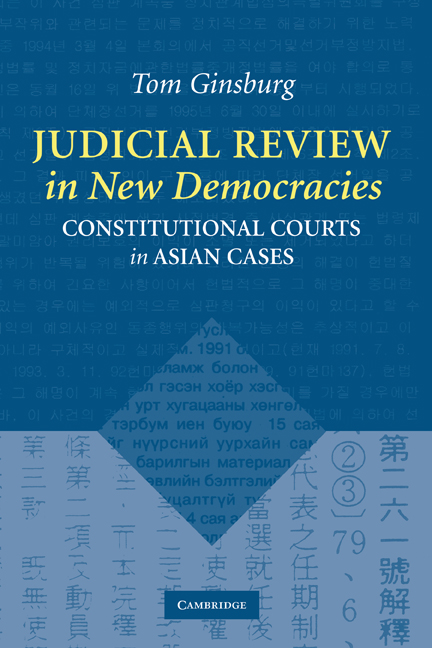
    New democracies around the world have adopted constitutional courts to oversee the operation of democratic politics. Where does judicial power come from, how does it develop in the early stages of democratic liberalization, and what political conditions support its expansion? This book answers these questions through an examination of three constitutional courts in Asia: Taiwan, Korea, and Mongolia. In a region that has traditionally viewed law as a tool of authoritarian rulers, constitutional courts in these three societies are becoming a real constraint on government. In contrast with conventional culturalist accounts, this book argues that the design and functioning of constitutional review are largely a function of politics and interests. Judicial review - the power of judges to rule an act of a legislature or national leader unconstitutional - is a solution to the problem of uncertainty in constitutional design. By providing 'insurance' to prospective electoral losers, judicial review can facilitate democracy.

    Reviews

    "Every serious scholar and student of constitutional politics and institutional design should read this book." The Law and Politics Book Review

    "Ginsburg provides compelling empirical support in his three East Asian cases that judicial power increases when political power is diffuse. Because he is interested in highlihgting the conditions under which courts can constrain other political actors, compliance is an important indicator of judicial independence." - Shannon Roesler, Law and Social Inquiry

    Refine List

    Actions for selected content:

    Select all | Deselect all
    • View selected items
    • Export citations
    • Download PDF (zip)
    • Save to Kindle
    • Save to Dropbox
    • Save to Google Drive

    Save Search

    You can save your searches here and later view and run them again in "My saved searches".

    Please provide a title, maximum of 40 characters.
    ×

    Contents

    Bibliography
    Bibliography
    Aba-Namay, Rashed. “The Recent Constitutional Reforms in Saudi Arabia.” International and Comparative Law Quarterly 42, no. 3 (1993): 295–331
    Abe, Masaki. “Internal Control of a Bureaucratic Judiciary: The Case of Japan.” International Journal of the Sociology of Law 23 (1995): 303–20
    Abel, Richard, and Philip Lewis. Lawyers in Society. 3 vols. Berkeley: University of California Press, 1988
    Ackerman, Bruce. We the People: Foundations. Cambridge, MA: Belknap, 1993
    Ackerman, Bruce. “The Rise of World Constitutionalism.” Virginia Law Review 83, no. 4 (1997): 771–97
    Ackerman, Bruce. We the People: Tranformations. Cambridge, MA: Harvard University Press, 1998
    Ahdieh, Robert. Russia's Constitutional Revolution. University Park: Pennsylvania State University Press, 1997
    Ahn, Kyong-whan. “The Growth of the Bar and the Changes in the Lawyer's Role: Korea's Dilemma.” In Law and Technology in the Pacific Community, edited by Philip S. C. Lewis, 119–34. Boulder, CO: Westview Press, 1994
    Ahn, Kyong-whan. “The Influence of American Constitutionalism on South Korea.” Southern Illinois Law Journal 27 (1998): 71
    Ainsworth, Janet E.Categories and Culture: On the ‘Rectification of Names’ in Comparative Law.” Cornell Law Review 82 (1996): 19–42
    Akande, Dapo. “The International Court of Justice and the Security Council: Is There Room for Judicial Control of Decisions of the Political Organs of the United Nations?International and Comparative Law Quarterly 46, no. 2 (1997): 309–43
    Alexander, Larry, and Schauer, Frederick. “On Extrajudicial Constitutional Interpretation.” Harvard Law Review 110, no. 7 (1997): 1359–87
    Alvarez, Jose. “Judging the Security Council.” American Journal of International Law 90 (1996): 1
    Aman, Alfred. Administrative Law in a Global Era. Ithaca, NY: Cornell University Press, 1992
    Amsden, Alice. Asia's Next Giant. Oxford: Oxford University Press, 1989
    Anand, Adarsh Sein. “Protection of Human Rights through Judicial Review in India.” In Judicial Review in International Perspective: Liber Amicorum Lord Slynn, edited by Mats Andenas, 381–93. The Hague: Kluwer Law International, 2000
    Arnold, Bruce, and Fiona May. “Social Capital, Violations of Trust and the Vulnerability of Isolates: The Social Organization of Law Practice and Professional Self-Regulation.” Paper presented at the Meetings of the Law and Society Association, Toronto, Canada, 1995
    Bailey, William Somers. “Reducing Malapportionment in Japan's Electoral Districts: The Supreme Court Must Act.” Pacific Rim Law and Policy Journal 6, no. 1 (1997): 169
    Bainbridge, Stephen M.Why a Board? Group Decisionmaking in Corporate Governance.” Vanderbilt Law Review 55 (2002): 1–34
    Batbayar, Ts. “Mongolia in 1993.” Asian Survey 34 (1994): 41–45
    Batbayar, Ts. Collected Essays. Ulaanbaatar: Mongolian Academy of Sciences, 1997
    Batchelor, Stephen. The Awakening of the West. Berkeley, CA: Parallax Press, 1994
    Bauer, Joanne R., and Daniel Bell, eds. The East Asian Challenge for Human Rights. New York: Cambridge University Press, 1999
    Baum, Julian. “Under My Thumb.” Far Eastern Economic Review (Feb. 26, 1998): 26–27
    Baum, Lawrence. The Puzzle of Judicial Behavior. Ann Arbor: University of Michigan Press, 1997
    Bawden, Charles R. A Modern History of Mongolia, 2d ed. London: Kegan Paul, 1989
    Bayar, S. “Mongolia's National Security Challenges.” San Francisco: Center for Asian Pacific Affairs, Report No. 16, Sept. 1994
    Beatty, David. Constitutional Law in Theory and in Practice. Toronto: University of Toronto Press, 1995
    Bedeski, Robert E. The Transformation of South Korea: Reform and Reconstitution in the Sixth Republic under Roh Tae Woo, 1987–1992. New York: Routledge, 1994
    Bell, Daniel. East Meets West: Human Rights and Democracy in East Asia. Princeton, NJ: Princeton University Press, 2000
    Bell, Daniel, David Brown, Kanishika Jayasuriya, and David Martin Jones. Towards Illiberal Democracy in Pacific Asia. New York: St. Martins Press, 1995
    Berman, Harold. Justice in the USSR. Cambridge, MA: Harvard University Press, 1963
    Berman, Harold. Law and Revolution. Cambridge, MA: Harvard University Press, 1985
    Bickel, Alexander. The Least Dangerous Branch: The Supreme Court at the Bar of American Politics, 2d ed. New Haven, CT: Yale University Press, 1986
    Black, Charles L. A New Birth of Freedom: Human Rights, Named and Unnamed. New York: Grosset/Putnam, 1998
    Bodde, Derk, and Clarence Morris. Law in Imperial China. Cambridge, MA: Harvard University Press, 1967
    Brzezinski, Mark. The Struggle for Constitutionalism in Poland. New York: St. Martins Press, 1998
    Buchanan, James, The Limits of Liberty. Chicago: University of Chicago Press, 1975
    Burley, Anne Marie, and Mattli, Walter. “Europe Before the Court.” International Organization 47 (1993): 41–76
    Butler, W. E. The Mongolian Legal System. Boston, MA: Kluwer, 1982
    Cappelletti, Mauro. Judicial Review in the Contemporary World. New York: Bobbs-Merrill, 1971
    Cappelletti, Mauro. The Judicial Process in Comparative Perspective. Oxford: Clarendon Press, 1989
    Carothers, Thomas. “The Rule of Law Revival.” Foreign Affairs 35 (1997): 23
    Carrasco, Enrique. “Rhetoric, Race and the Asian Crisis.” Los Angeles Times, Jan. 1, 1998
    Carrasco, Enrique. “Tough Sanctions: The Asian Crisis and the New Colonialism.” Chicago Tribune, Jan. 3, 1998
    Central News Agency. “Party Screening Committee Puts off DPP Independence Case.” Feb. 20, 1992
    Chang, Wen-chen. Transition to Democracy, Constitutionalism and Judicial Activism: Taiwan in Comparative Constitutional Perspective. Unpublished J. S. D. dissertation, Yale Law School, June 2001
    Chang, Yook-Seok. “Prosecutor's Discretionary Power in the Republic of Korea.” UNAFEI Resource Material Series 49 (1997): 69–78
    Chao, Linda, and Ramon Myers. The First Chinese Democracy: Political Life in the Republic of China on Taiwan. Baltimore, MD: Johns Hopkins University Press, 1998
    Chen, Paul Heng-cha. Chinese Legal Tradition under the Mongols. Princeton, NJ: Princeton University Press, 1979
    Cheng, Tun-jen. “Democratizing the Quasi-Leninist Regime in Taiwan.” World Politics 41 (1987): 471–99
    Cheng, Tun-jen, and Stephen Haggard, eds. Political Change in Taiwan. Boulder, CD: Lynne Reiner, 1992
    Cheng, Tun-jen, and Lao, Yi-shing. “Taiwan in 1997: An Embattled Government in Search of New Opportunities.” Asian Survey 38, no. 1 (1998): 53–63
    Chiu, Hungdah. “Constitutional Development and Reform in the Republic of China on Taiwan.” Issues and Studies 29 (1993): 1–38
    Chiu, Hungdah, and Jyh-Pin Fa. “Taiwan's Legal System and Legal Profession.” In Taiwan Trade and Investment Law, edited by Mitchell Silk, 21–42. New York: Oxford University Press, 1994
    Cho, Kuk. “Tension Between the National Security Law and Constitutionalism in South Korea: Security for What?Boston University International Law Journal 15 (1997): 125
    Choi, Dae-kwon. “Informal Ways vs. the Formal Law in Korea.” Paper presented at the Research Committee on the Sociology of Law Meeting, Tokyo, Japan, July 1995
    Choi, Sang-yong, ed. Democracy in Korea: Its Ideals and Realities. Seoul: Korean Political Science Association, 1997
    Chu, Lawrence. “Legislators Pass Amendments to Hooligan Control Act.” Central News Agency, Dec. 30, 1996
    Chu, Yun-han. “Taiwan's Unique Challenges.” Journal of Democracy 7, no. 3 (1997): 69–82
    Clark, Cal, and K. C. Roy. Comparing Development Patterns in Asia. Boulder, CO: Lynne Reiner, 1997
    Clark, Donald, ed. The Kwangju Uprising: Shadows over the Regime in South Korea. Boulder, CO: Westview Press, 1988
    Clinton, Robert Lowry. Marbury v. Madison and Judicial Review. Lawrence: University Press of Kansas, 1989
    Clinton, Robert Lowry. “Game Theory, Legal History and the Origins of Judicial Review: A Revisionist Analysis of Marbury v. Madison.” American Journal of Political Science 38, no. 2 (1994): 285–302
    Constitutional Court of Korea. Constitutional Justice in Korea. Seoul, 1993
    Constitutional Court of Korea. The Constitutional Court. Seoul, 1997
    Constitutional Court of Korea. The First Ten Years of the Korean Constitutional Court. Seoul, 2001
    Cooney, Sean. “The New Taiwan and Its Old Labour Law: Authoritarian Legislation in a Democratised Society.” Comparative Labor Law Journal 18, no. 1 (1996): 1–61
    Cooney, Sean. “Taiwan's Emerging Liberal Democracy and the New Constitutional Review.” In Asian Laws Through Australian Eyes, edited by Veronica Taylor, Sydney, 141–60. LBC Information Systems, 1997
    Cooney, Sean. “Why Taiwan Is Not Hong Kong: A Review of the PRC's ‘One Country Two Systems’ Model for Reunification with Taiwan.” Pacific Rim Law and Policy Journal 6 (1997): 497
    Cooney, Sean. “A Community Changes: Taiwan's Council of Grand Justices and Liberal Democratic Reform.” In Law, Capitalism and Power in East Asia, edited by Kanishka Jayasuriya, 253–81. New York: Routledge, 1999
    Cooter, Robert. The Strategic Constitution. Princeton, NJ: Princeton University Press, 2000
    Cooter, Robert, and Ginsburg, Tom. “Comparative Judicial Discretion – An Empirical Test of Economic Models.” International Review of Law and Economics 16 (1996): 295–313
    Dadomo, Christian, and Susan Farran. French Substantive Law. London: Sweet and Maxwell, 1997
    Dahl, Robert. “Decision-making in a Democracy: The Supreme Court as a National Policy-maker.” Journal of Public Law 6 (1957): 279
    Dahl, Robert. Democracy and Its Critics. New Haven, CT: Yale University Press, 1989
    Dahl, Robert. “Thinking About Democratic Constitutions: Conclusions from Democratic Experience.” In Nomos XXXVIII: Political Order, edited by Ian Shapiro and Russell Hardin, 175–206. New York: New York University Press, 1996
    Dashpurev, D., and S. Soni. Reign of Terror in Mongolia. Absecon Highlands, NJ: South Asian Publishers, 1992
    Davis, Michael, ed. Human Rights and Chinese Values. New York: Oxford University Press, 1995
    Davis, Michael. “Constitutionalism and Political Culture: The Debate over Human Rights and Asian Values.” Harvard Human Rights Journal 11 (1998): 109
    Davis, Michael. “The Price of Rights: Constitutionalism and East Asian Economic Development.” Human Rights Quarterly 20 (1998): 303
    De Bary, William Theodore. The Liberal Tradition in China. New York: Columbia University Press (1983)
    Bary, William Theodore. “The ‘Constitutional Tradition’ in China.” Journal of Asian Law 9, no. 1 (1995): 7–34
    De Bary, William Theodore. Asian Values and Human Rights. Cambridge: Harvard University Press, 1998
    Devins, Neal. Shaping Constitutional Values: Elected Government, the Supreme Court, and the Abortion Debate. Baltimore, MD: Johns Hopkins University Press, 1996
    Devins, Neal, and Fisher, Louis. “Judicial Exclusivity and Political Instability.” Virginia Law Review 84 (1998): 83
    Diamond, Larry. “Is the Third Wave Over?Journal of Democracy 7 (1996): 20
    Dicey, Albert V. Introduction to the Study of the Law of the Constitution, 8th ed. London: Macmillan, 1915
    Drexl, Josef. “Was Sir Francis Drake a Dutchman? – British Supremacy of Parliament after Factortame.” American Journal of Comparative Law 41 (1993): 551–71
    Dreyer, June Teufel. Testimony Before Asian Affairs Subcommittee, U.S. House of Representatives, Hearings on Taiwan, Sept. 24, 1991
    Elman, Benjamin A. “Confucianism and Modernization: A Reevaluation.” In Confucianism and Modernization: A Symposium, edited by Joseph P. L. Jiang, 1–19. Taipei: Freedom Council, 1987
    Elster, Jon. “Forces and Mechanisms in the Constitution-Making Process.” Duke Law Journal 45 (1995): 364–96
    Elster, Jon. “Limiting Majority Rule: Alternatives to Judicial Review in the Revolutionary Epoch.” In Constitutional Justice under Old Constitutions, edited by Eivind Smith, 3–22. The Hague: Kluwer Law International, 1995
    Elster, Jon. “Introduction.” In The Roundtable Talks and the Breakdown of Communism, edited by Jon Elster, 1–20. Chicago, IL: University of Chicago Press, 1996
    Elster, Jon, ed. Ulysses Unbound. New York: Cambridge University Press, 2000
    Elster, Jon, Claus Offe, and Ulrich K. Preuss. Institutional Design in Post-Communist Societies. New York: Cambridge University Press, 1998
    Ely, John Hart. Democracy and Distrust. Cambridge, MA: Harvard University Press, 1980
    Emery, C. T., and B. Smythe. Judicial Review. London: Sweet and Maxwell, 1986
    Epp, Charles R. The Rights Revolution: Lawyers, Activists and Supreme Courts in Comparative Perspective. Chicago, IL: University of Chicago Press, 1998
    Epstein, Lee, and Jack Knight. The Choices Justices Make. Washington, DC: Congressional Quarterly Press, 1998
    Eskridge, William. “The Judicial Review Game.” Northwestern University Law Review 88 (1993): 382
    Eskridge, William. Dynamic Statutory Interpretation. Cambridge, MA: Harvard University Press, 1994
    Eskridge, William, and John Ferejohn. “Politics, Interpretation, and the Rule of Law.” In Nomos XXXVI: The Rule of Law, edited by Ian Shapiro, 265–94. New York: New York University Press, 1994
    Evans, Peter. Embedded Autonomy: States and Industrial Transformation. Princeton, NJ: Princeton University Press, 1995
    Fa, Jyh-pin. A Comparative Study of Judicial Review under Nationalist Chinese and American Constitutional Law. Asian Studies Occasional Reprints Series No. 3. Baltimore: University of Maryland School of Law, 1980
    Fa, Jyh-pin. “Constitutional Developments in Taiwan: The Role of the Council of Grand Justices.” International and Comparative Law Quarterly 40 (1991): 198–209
    Faundez, Julio, ed. Good Government and Law: Legal and Institutional Reform in Developing Countries. New York: St. Martins Press, 1997
    Feldman, David. “Parliamentary Scrutiny of Legislation and Human Rights.” Public Law (summer 2002): 323–48
    Feldman, Harvey J., ed. Constitutional Reform and the Future of the Republic of China. Armonk, NY: M. E. Sharpe, 1991
    Finkel, Jodi S. “The Implementation of Judicial Reform in Peru in the 1990s.” Paper presented at the American Political Science Association Meetings, San Francisco, CA, Aug. 2001
    Fish, M. Steven. Democracy from Scratch: Opposition and Regime in the New Russian Revolution. Princeton, NJ: Princeton University Press, 1995
    Fish, M. Steven. “The Perils of Russian Superpresidentialism.” Current History 96, no. 612 (1997): 326–30
    Fisher, Louis. Constitutional Dialogues. Princeton, NJ: Princeton University Press, 1988
    Fiss, Owen. “The Right Degree of Independence.” In Transitions to Democracy in Latin America: The Role of the Judiciary, edited by Irwin P. Stotzky, 55–72. Boulder, CO: Westview Press, 1993
    Folsom, Ralph, John Minan, and Lee Ann Otto. Law and Politics in the People's Republic of China. St. Paul, MN: West Publishing, 1992
    Fox, Gregory H. and Nolte, Georg. “Intolerant Democracies.” Harvard International Law Journal 36, no. 1 (1995): 1–70
    Fox, Russell A.Confucian and Communitarian Responses to Liberal Democracy.” Review of Politics 59 (1997): 561–92
    Freedom House. Freedom in the World. Washington, DC: 1986–99
    Friedman, Barry. “Dialogue and Judicial Review.” Michigan Law Review 91 (1993): 577
    Friedman, Barry. “A History of the Countermajoritarian Difficulty, Part One: The Road to Judicial Supremacy.” N. Y. U. Law Review 73 (1998): 333
    Fuller, Lon. The Morality of Law. New Haven, CT: Yale University Press, 1964
    Gadbois, George H., Jr. “The Institutionalization of the Supreme Court of India.” In Comparative Judicial Systems: Challenging Frontiers in Conceptual and Empirical Analysis, edited by John Schmidhauser, 111–42. Boston, MA: Butterworths, 1987
    Ganzorig, Gombosurengin. “The Relationship between the Constitutional and Supreme Court of Mongolia,” Journal of East European Law 7, nos. 3–4 (2000): 667–94
    Garrett, Geoffrey. “From the Luxembourg Compromise to Codecision: Decision Making in the European Union.” Electoral Studies 14 (1995): 289–308
    Garrett, Geoffrey. “The Politics of Legal Integration in the European Union.” International Organization 49 (1995): 175–81
    Garrett, Geoffrey, and Tsebelis, George. “An Institutional Critique of Intergovernmentalism.” International Organization 50 (1996): 269–99
    Geertz, Clifford. The Interpretation of Cultures. New York: Basic Books, 1973
    Gely, Rafael, and Spiller, Pablo. “The Political Economy of Supreme Court Constitutional Decisions: The Case of Roosevelt's Court-Packing Plan.” International Review of Law and Economics 12 (1992): 45–67
    Ginsburg, Tom. “The Transformation of Legal Institutions in Mongolia, 1990–1993.” Issues and Studies 12 (1994): 77–113
    Ginsburg, Tom. “Between Russia and China: Political Reform in Mongolia.” Asian Survey 35 (1995): 459–71
    Ginsburg, Tom. “Deepening Democracy: Mongolia in 1997.” Asian Survey 38 (1998): 64–68
    Ginsburg, Tom. “Confucian Constitutionalism? The Emergence of Judicial Review in Korea and Taiwan.” Law and Social Inquiry 27 (2002): 763–99
    Ginsburg, Tom. “Economic Analysis and the Design of Constitutional Courts.” Theoretical Inquiries in Law 3 (2002): 49–85
    Ginsburg, Tom, and G. Ganzorig. “Constitutionalism and Human Rights in Mongolia.” In Mongolia in Transition, edited by Ole Bruun and Ole Odgaard, 147–64. London: Curzon Press/Nordic Institute of Asian Studies, 1996
    Ginsburgs, George. “The Constitutional Courts of Eastern Europe.” Review of Central and Eastern European Law 18 (1992): 6
    Glendon, Mary Ann. Abortion and Divorce in Western Law. Cambridge, MA: Belknap Press, 1987
    Glenn, H. Patrick. Legal Traditions of the World. New York: Oxford Univeristy Press, 2000
    Gold, Thomas. State and Society in the Taiwan Miracle. Armonk, NY: M. E. Sharpe, 1986
    Gold, Thomas. “Factors in Taiwan's Democratic Transition.” Paper presented at the conference Consolidating the Third Wave Democracies, Institute of National Policy Research, Taipei, Taiwan, Aug. 27–30, 1995
    Goldsworthy, Jeffrey. The Sovereignty of Parliament: History and Philosophy. New York: Oxford University Press, 1999
    Goodman, John B. Monetary Sovereignty: The Politics of Central Banking in Western Europe. Ithaca: Cornell University Press, 1992
    Griffin, Stephen. American Constitutionalism: From Theory to Politics. Princeton, NJ: Princeton University Press, 1996
    Gutmann, Amy, and Dennis Thompson. Democracy and Disagreement. Cambridge, MA: Belknap, 1996
    Habermas, Jurgen. Between Facts and Norms: Contributions to a Discourse Theory of Law and Democracy. Cambridge, MA: MIT Press, 1996
    Haggard, Stephen, and Robert Kaufmann. The Political Economy of Democratic Transitions. Princeton, NJ: Princeton University Press, 1995
    Hahm, Pyong-choon. The Korean Political Tradition and Law. Seoul: Royal Asiatic Society, 1987
    Hahm, Sung-deuk, and L. Christopher Plein. After Development: The Transformation of the Korean Presidency and Bureaucracy. Washington, DC: Georgetown University Press, 1997
    Halmai, Gabor, and Kim Lane Scheppele. “Living Well Is the Best Revenge: The Hungarian Approach to Judging the Past.” In Transitional Justice and the Rule of Law in New Democracies, edited by James McAdams, 155–84. Notre Dame, IN: Notre Dame University Press, 1997
    Hamilton, Gary, and Cheng-shu Kao. “Max Weber and the Analysis of the Asian Industrialization.” University of California at Davis, Research Program in East Asian Culture and Development, Working Paper No. 2, 1986
    Han, Sung-joo. “South Korea: Politics in Transition.” In Democracy in Korea: Its Ideals and Realities, edited by Sang-yong Choi, 21–47. Seoul: Korean Political Science Association, 1997
    Heaton, William. “Mongolia in 1990.” Asian Survey 31 (1991): 1
    Henderson, Gregory. Korea: Politics of the Vortex. Cambridge, MA: Harvard University Press, 1968
    Henkin, Louis. The Age of Rights. New York: Columbia University Press, 1996
    Hirschman, Albert O. Exit, Voice and Loyalty: Responses to Decline in Firms, Organizations and States. Cambridge, MA: Harvard University Press, 1972
    Hofnung, Menachem. “The Unintended Consequences of Unplanned Constitutional Reform: Constitutional Politics in Israel.” American Journal of Comparative Law 44, no. 4 (1996): 585–604
    Holland, Peter. “Towards Constitutionalism: The First Term of the Constitutional Court of South Korea.” In Asian Laws Through Australian Eyes, edited by Veronica Taylor. Sydney: LBC Information Systems, 1997
    Holmes, Stephen. “Precommitment and the Paradox of Democracy.” In Constitutionalism and Democracy, edited by Jon Elster and Rune Slagstad, 175–240. Cambridge: Cambridge University Press, 1988
    Hood, Steven J. The Kuomintang and the Democratization of Taiwan. Boulder, CO: Westview Press, 1997
    Hulan, H. “Mongolia's New Constitutional Regime: Institutional Tensions and Political Consequences.” Mongolian Journal of International Affairs 3 (1996): 42
    Huntington, Samuel. The Clash of Civilizations and the Remaking of World Order. New York: Simon & Schuster, 1996
    Huntington, Samuel. “After Twenty Years: The Future of the Third Wave.” Journal of Democracy 8, no. 4 (1997): 3–12
    Ishiyama, John, and Velten, Matthew. “Presidential Power and Democratic Development in Post-Communist Politics.” Communist and Post-Communist Studies 31 (1998): 217–34
    Jennings, Jeremy. “From ‘Imperial State to l'Etat de Droit’: Benjamin Constant, Blandine Kriegel and the Reform of the French Constitution.” In Constitutionalism in Transformation: European and Theoretical Perspectives, edited by Richard Bellamy and Dario Castiglione, 76–92. London: Blackwell, 1996
    Judicial Yuan of the Republic of China. The Grand Justices and Constitutional Court of the Republic of China. Taipei: 1995
    Kahn, Paul W. The Reign of Law: Marbury v. Madison and the Construction of America. New Haven, CT: Yale University Press, 1997
    Kelsen, Hans. “La garantie jurisdictionnel de la constitution.” Revue de droit public 44 (1928): 197–257
    Kenney, Sally J., William M. Reisinger, and John C. Reitz, eds. Constitutional Dialogues in Comparative Perspective. New York: St. Martin's Press, 1999
    King, Ambrose Y. C. “State Confucianism and Its Transformation in Taiwan.” In Confucian Traditions in East Asian Modernity: Moral Education and Economic Culture in Japan and the Four Mini-Dragons, edited by Wei-ming Tu, 228–43. Cambridge, MA: Harvard University Press, 1996
    Klarman, Michael J.How Great Were the ‘Great’ Marshall Court Decisions?Virginia Law Review 87 (2001): 1111–84
    Klingsberg, Ethan. “Judicial Review and Hungary's Transition from Communism to Democracy: The Constitutional Court, the Continuity of Law and the Redefinition of Property Rights.” B. Y. U. Law Review (1992): 41–144
    Klug, Heinz. Constituting Democracy: Law, Globalism and South Africa's Political Reconstruction. New York: Cambridge University Press, 2000
    Kodderitsch, Lorenz. “Japan's New Administrative Procedures Law: Reasons for Its Enactment and Likely Implications.” Law in Japan 24 (1994): 105
    Kommers, Donald. The Constitutional Jurisprudence of the Federal Republic of Germany, 2d ed. Durham, NC: Duke University Press, 1997
    Kommers, Donald. “Building Democracy: Judicial Review and the German Rechtstaat.” In The Postwar Transformation of Germany: Democracy, Prosperity and Nationhood, edited by John Brady, Beverly Crawford, and Sarah E. Wiliarty, 94–121. Ann Arbor: University of Michigan Press, 1999
    Koo, Hagen, ed. State and Society in Contemporary Korea. Ithaca, NY: Cornell University Press, 1993
    Koopmans, T.Comparative Law and the Courts.” American Journal of Comparative Law 45 (1996): 545–56
    Kritz, Neil, ed. Transitional Justice: How Emerging Democracies Reckon with Former Regimes, 3 vols. Washington, DC: U.S. Institute for Peace, 1995
    Krug, Peter. “Departure from the Centralized Model: The Russian Supreme Court and Constitutional Control of Legislation.” Virginia Journal of International Law 37 (1997): 725–87
    Kuo, Deborah. “Grand Justices Say Conscription Regulation Unconstitutional.” China News Agency, Dec. 26, 1997
    Kyvig, David. “The Road Not Taken.” Political Science Quarterly 104 (1989): 473
    Laakso, Markku, and Taagepera, Rein. “Effective Number of Parties: A Measure with Application to Western Europe.” Comparative Political Studies 12 (1979): 3–27
    Landes, William, and Posner, Richard. “The Independent Judiciary in an Interest-Group Perspective.” Journal of Law and Economics 18 (1975): 875
    Larkin, Christopher. “Judicial Independence and Democratization: A Theoretical and Conceptual Analysis.” American Journal of Comparative Law 44, no. 4 (1996): 605–26
    Lattimore, Owen. Nationalism and Revolution in Mongolia. New York: Oxford University Press, 1955
    Lattimore, Owen. Studies in Frontier History. New York: Oxford University Press, 1962
    Lawyers Committee for Human Rights. Halfway to Reform: The World Bank and the Venezuelan Justice System. New York: Lawyers Committee for Human Rights/Provena, 1996
    Lee, Teng-hui. “Chinese Culture and Political Renewal.” Journal of Democracy 6, no. 4 (1995): 3–8
    Leigh, Ian. “Taking Rights Proportionately: Judicial Review, the Human Rights Act and Strasbourg.” Public Law (2002): 265–87
    Lessig, Lawrence. “Introduction: Roundtable on Redesigning the Russian Court” East European Constitutional Review 3, no. 3–4 (1994): 72–74
    Li, Nigel T., and Fan, Joyce C.. “An Uncommon Case of Bigamy: An Uncommon Constitutional Interpretation.” Journal of Chinese Law 4, no. 3 (1990): 69–81
    Li, Nigel T. “The Less-Restrictive-Means Principle – A More or Less Restrictive Methodology?” Paper presented at Conference on the Evolving U.S. Constitution, 1787–1987, Institute of American Culture, Academica Sinica, Taipei, Taiwan, June 2–4, 1988
    Lijphart, Arend. Democracies: Patterns of Majoritarian and Consensus Government in Twenty-One Countries. New Haven, CT: Yale University Press, 1984
    Lim, C. W. “Student Clash with Riot Police over Kwangju Massacre.” Agence France Presse, Nov. 27, 1995
    Lim, Jibong, “The Pursuit of Happiness Clause in the Korean Constitution.” Journal of Korean Law 1 (2001): 71–103
    Linebarger, Paul. The Political Doctrines of Sun Yat-sen. Baltimore, MD: Johns Hopkins University Press, 1937
    Linz, Juan, and Alfred Stepan. Problems of Democratic Transition and Consolidation. Baltimore, MD: Johns Hopkins University Press, 1996
    Liu, Lawrence Shao-liang. “Judicial Review and the Constitution: A Tale of Two Institutions.” Paper presented at Conference on the Evolving U.S. Constitution, 1787–1987, Institute of American Culture, Academica Sinica, Taipei, Taiwan, June 2–4, 1988
    Liu, Lawrence Shao-liang. “Judicial Review and Emerging Constitutionalism: The Uneasy Case of the Republic of China on Taiwan.” American Journal of Comparative Law 39 (1991): 509
    Lubman, Stanley, ed. China's Legal Reforms. New York: Oxford University Press, 1996
    Ludwikowski, Rett R.. “Constitution Making in the Countries of Former Soviet Dominance: Current Developments.” Georgia Journal of International and Comparative Law 23 (1993): 155
    Ludwikowski, Rett R. Constitution Making in the Countries of Former Soviet Dominance. Durham, NC: Duke University Press, 1996
    Lutz, Donald. “Toward a Theory of Constitutional Amendment.” American Political Science Review 88, no. 2 (1994): 355–70
    Ma, Herbert Han-pao, “The Rule of Law in a Contemporary Confucian Society: A Reinterpretation.” Presentation to Harvard Law School, East Asian Legal Studies Program, spring 1998
    Mahbubani, Kishore. Can Asians Think? Singapore: Time Editions, 1998
    Marino-Blanco, Elena. The Spanish Legal System. London: Sweet and Maxwell, 1996
    McAdams, A. James, ed. Transitional Justice and the Rule of Law in New Democracies. Notre Dame, IN: Notre Dame University Press, 1997
    McAdams, Richard. “A Focal Point Theory of Expressive Law.” Virginia Law Review 86 (2000): 1649–1729
    McCann, Michael. Rights at Work: Pay Equity Reform and the Politics of Legal Mobilization. Chicago, IL: University of Chicago Press, 1994
    McCloskey, Robert, and Sanford Levinson. The American Supreme Court. Chicago: IL: University of Chicago Press, 1994
    Mendel, F. Fraser. “Judicial Power and Illusion: The Republic of China's Council of Grand Justices and Constitutional Interpretation.” Pacific Rim Law and Policy Journal 2, no. 1 (1993): 157–89
    Meyer, John W.. John Boli, George M. Thomas, and Francisco O. Ramirez. “World Society and the Nation State.” American Journal of Sociology 103 (1997): 144–81
    Montesquieu, Charles de Secondat. The Spirit of the Laws. Translated and edited by Anne M. Cohler, Basia Miller, and Harold Stone. New York: Cambridge University Press, 1989
    Mueller, Dennis. Constitutional Democracy. New York: Oxford University Press, 1996
    Mueller, Dennis, “Fundamental Issues in Constitutional Reform: With Special Reference to Latin America and the United States.” Constitutional Political Economy 10, no. 2 (1999): 119–48
    Mukhopadhaya, Kaushik. “Jury Size and the Free Rider Problem.” Forthcoming, Journal of Law, Economics, and Organization 19 (2003)
    Murphy, Walter. “Constitutions, Constitutionalism and Democracy.” In Constitutionalism and Democracy: Transitions in the Contemporary World, edited by Douglas Greenberg, Stanley N. Katz, Melanie Beth Oliviero, and Steven C. Wheatley, 3–25. New York: Oxford University Press, 1993
    Nathan, Andrew. Chinese Democracy. Berkeley: University of California Press, 1985
    Nino, Carlos Santos. The Constitution of Deliberative Democracy. New Haven, CT: Yale University Press, 1995
    O'Donnell, Guillermo. “Horizontal Accountability in New Democracies.” Journal of Democracy 9 (1998): 112–26
    Oh, John Kie-chang. Korean Politics. Ithaca, NY: Cornell University Press, 1999
    Park, Chan-wook. “Partisan Conflict and Immobilisme in the Korean National Assembly: Conditions, Processes, and Outcomes.” In Democracy in Korea: Its Ideals and Realities, edited by Sang-yong Choi, 295–327. Seoul: Korean Political Science Association, 1997
    Pashin, Sergy. “A Second Edition of the Constitutional Court.” East European Constitutional Review 3, nos. 3–4 (1994): 82
    Peerenboom, Randall. “Answering the Bell: Round Two of the Asian Values Debate.” Korea Journal 42, no. 2 (2002): 194–240
    Posner, Richard. Overcoming Law. Cambridge, MA: Harvard University Press, 1995
    Posner, Richard. “Is the Ninth Circuit Too Large? A Statistical Study of Judicial Quality.” Journal of Legal Studies 29 (2000): 711–18
    Post, Robert. “Theories of Constitutional Interpretation.” In Law and the Order of Culture, edited by Robert Post, 13–42. Berkeley: University of California Press, 1991
    Power, Timothy J., and Gasiorowski, Mark J.. “Institutional Design and Democratic Consolidation in the Third World.” Comparative Political Studies 30, no. 2 (1997): 123–55
    Prosser, Tony. “Understanding the British Constitution.” In Constitutionalism in Transformation: European and Theoretical Perspectives, edited by Richard Bellamy and Dario Castiglione, 61–75. London: Blackwell, 1996
    Pye, Lucien. Asian Power and Politics: The Cultural Dimensions of Authority. Cambridge, MA: Harvard University Press, 1985
    Rakove, Jack. “The Origins of Judicial Review: A Plea for New Contexts.” Stanford Law Review 49 (1997): 1031–64
    Ramseyer, J. Mark. “The Puzzling (In)Dependence of Courts: A Comparative Approach.” Journal of Legal Studies 23 (1994): 721
    Ramseyer, J. Mark, and Rasmusen, Eric B.. “Judicial Independence in a Civil Law Regime: The Evidence from Japan.” Journal of Law, Economics and Organization 13, no. 2 (1997): 259–86
    Ramseyer, J. Mark, and Eric B. Rasmusen. Measuring Judicial Independence: The Political Economy of Judging in Japan. Chicago: University of Chicago Press, 2003
    Rawls, John. A Theory of Justice. Cambridge: Harvard University Press, 1972
    Riasonovsky, V. A. Customary Law of the Mongol Tribes. Harbin, China: 1929
    Riasonovsky, V. A. Fundamental Principles of Mongol Law. Tientsin, China: 1937
    Root, Hilton. Small Countries, Big Lessons: Governance and the Rise of East Asia. New York: Oxford University Press/Asian Development Bank, 1996
    Rosenberg, Gerald N. The Hollow Hope. Chicago, IL: University of Chicago Press, 1991
    Rubenfeld, Jed. Freedom and Time: A Theory of Constitutional Self-Government. New Haven, CT: Yale University Press, 2001
    Rupen, Robert. Mongols of the Twentieth Century. Bloomington: Indiana University Press, 1964
    Sandag, Shagdariin, and Harry Kendall. The Stalin-Choibalsan Massacres in Mongolia 1921–1941: Forging the Second Communist State. Boulder, CO: Westview Press, 2000
    Sanders, Alan J. K.Mongolia's New Constitution.” Asian Survey 32, no. 6. (1992) 506–21
    Sartori, Giovanni. Comparative Constitutional Engineering: An Inquiry into Structures, Incentives and Outcomes, 2d ed. New York: New York University Press, 1996
    Schedler, Andreas, Larry Diamond, and Marc F. Plattner, eds. The Self-Restraining State: Power and Accountability in New Democracies. Boulder, CO: Lynne Reiner, 1999
    Schelling, Thomas C. The Strategy of Conflict. Cambridge: Cambridge University Press, 1960
    Schmidhauser, John R., ed. Comparative Judicial Systems: Challenging Frontiers in Conceptual and Empirical Analysis. Boston, MA: Butterworths, 1987
    Schram, Stuart, ed. Foundations and Limits of State Power in China. Hong Kong: Chinese University Press, 1987
    Schwartz, Herman. “The New Courts: An Overview.” East European Constitutional Review 2, no. 2 (1993): 28–32
    Schwartz, Warren, and Beckner, C. Frederick III. “Toward a Theory of the ‘Meritorious Case’: Legal Uncertainty as a Social Choice Problem.” George Mason Law Review 6 (1998): 801–20
    Searl, Alan. “Legislature Debates Need for Soldiers on College Campuses.” China Times, Apr. 4, 1998
    Segal, Jeffrey A., and Harold J. Spaeth. The Supreme Court and the Attitudinal Model. New York: Cambridge University Press, 1993
    Seong, C.Gweon, . “Hope I Die Before I Get Old.” Korea Herald, Sept. 24, 1997
    Shapiro, Martin. Law and Politics in the Supreme Court. New York: Free Press, 1964
    Shapiro, Martin. Courts: A Comparative and Political Analysis. Chicago, IL: University of Chicago Press, 1981
    Shapiro, Martin. “Lawyers, Corporations and Knowledge.” American Journal of Comparative Law 38 (1990): 683
    Shapiro, Martin. “Coments on the Draft Constitution of Mongolia.” Unpublished ms., San Francisco: Asia Foundation, 1991
    Shapiro, Martin. “Federalism, the Race to the Bottom, and the Regulation-Averse Entrepreneur.” In North American Federalism in Comparative Perspective, edited by Harry Scheiber, 47–56. Berkeley, CA: Institute of Governmental Studies, 1992
    Shetreet, Shimon, and Jules Deschênes. Judicial Independence: The Contemporary Debate. Boston, MA: Martinus Nijhoff, 1985
    Shih, Chih-yu. “The Style of Chinese Constitutional Development: China and Taiwan.” International Journal of the Sociology of Law 23 (1995): 371–93
    Shim, Jae-hon and Lee, Charles S.. “Test of Wills.” Far Eastern Economic Review, Jan. 23, 1997: 14–15
    Shin, Yong-bae. “Opposition Party Files Lawsuit Against Speaker.” Korea Herald, Mar. 27, 1998
    Slaughter, Anne-Marie. “The Real New World Order.” Foreign Affairs 76, no. 5 (1997): 183–97
    Slaughter, Anne-Marie, Joseph Weiler, and Alec Stone Sweet, eds. The European Court and National Courts, Doctrine and Jurisprudence: Legal Change in Its Social Context. Oxford: Hart Publishing, 1998
    Smith, Eivind, ed. Constitutional Justice under Old Constitutions. The Hague: Kluwer Law International, 1995
    Snell, James G., and Frederick Vaughan. The Supreme Court of Canada: History of the Institution. Toronto: Osgoode Society, 1985
    Sólyom, László, and Georg Brunner. Constitutional Judiciary in a New Democracy: The Hungarian Constitutional Court. Ann Arbor: University of Michigan Press, 2000
    Spitz, Richard, with Matthew Chaskalon. The Politics of Transition: A Hidden History of South Africa's Negotiated Settlement. Oxford: Hart Publishing, 2000
    Steamer, Robert J. The Supreme Court in Crisis. Amherst: University of Massachusetts Press, 1971
    Stearns, Maxwell. Constitutional Process: A Social Choice Analysis of Supreme Court Decision Making. Ann Arbor: University of Michigan Press, 2000
    Steinberg, David I. The Republic of Korea: Economic Transformation and Social Change. Boulder, CO: Westview Press, 1989
    Steinberg, David I. “The Republic of Korea: Pluralizing Politics.” In Politics in Developing Countries: Comparing Experiences with Democracy, edited by Larry Diamond, Juan J. Linz, and Seymour Martin Lipset, 369–416. Boulder, CO: Lynne Reiner, 1995
    Steinberg, David I.Korea: Triumph Amid Turmoil.” Journal of Democracy 9, no. 2 (1998): 76–90
    Sterett, Susan. Creating Constitutionalism? The Politics of Legal Expertise and Administrative Law in England and Wales. Ann Arbor: University of Michigan Press, 1997
    Stone, Alec. The Birth of Judicial Politics in France. New York: Oxford University Press, 1992
    Stone, Alec, and James Caporaso. “From Free Trade to Supranational Polity: The European Court and Integration.” Berkeley: Center for German and European Studies Working Paper, University of California, 1996
    Stotzky, Irwin P., ed. Transitions to Democracy in Latin America: The Role of the Judiciary. Boulder, CO: Westview Press, 1993
    Su, Yong-chin. “Summary of Interpretations by the Council of Grand Justices.” In Zhonghua Minguo Xing Hsien Wu Shi Nien (Fifty Years of the ROC Constitution). Taipei: National Assembly, 1997
    Sun, Yat-sen. The Teachings of Sun Yat-sen: Selections from His Writings. London: Sylvan Press, 1945
    Sunstein, Cass. Designing Democracy: What Constitutions Do. New York: Oxford University Press, 2001
    Sutil, Jorge Correa. “The Judiciary and the Political System in Chile: The Dilemmas of Judicial Independence during the Transition to Democracy.” In Transitions to Democracy in Latin America: The Role of the Judiciary, edited by Irwin P. Stotzky, 89–105. Boulder, CO: Westview Press, 1993
    Taagepera, Rein, and Matthew Soberg Shugart. Seats and Votes: The Effects and Determinants of Electoral Systems. New Haven: Yale University Press, 1989
    Tate, C. NealBook Review of Paula Newberg, Judging the State: Courts and Constitutional Politics in Pakistan.” Law and Politics Book Review 6, no. 7 (1996): 109–12
    Tate, Neal, and Thorsten Vallinder, eds. The Global Expansion of Judicial Power. New York: New York University Press, 1995
    Teik, Khoo Boo. “Between Law and Politics: The Malaysian Judiciary Since Independence.” In Law, Capitalism and Power in East Asia, edited by Kanishka Jayasuriya, 205–32. New York: Routledge, 1999
    Thurow, Lester. “Asia: The Collapse and the Cure.” New York Review of Books, Feb. 5, 1998: 22–28
    Tien, Hung-mao. The Great Transition: Political and Social Change in the Republic of China. Stanford, CA: Hoover Institution Press, 1989
    Tien, Hung-mao, ed. Taiwan's Electoral Politics and Democratic Transition: Riding the Third Wave. Armonk, NY: M. E. Sharpe, 1995
    Tollefson, Edwin. “Compliance of the Mongolian Criminal Code and Criminal Procedure Code with International Norms of Human Rights.” Ulaanbaatar: United Nations Center for Human Rights, 1996
    Tseng, Osman. “Legislature Grants No Honeymoon to President.” Business Taiwan, June 24, 1996
    Tu, Wei-ming, ed. Confucian Traditions in East Asian Modernity: Moral Education and Economic Culture in Japan and the Four Mini-Dragons. Cambridge: Harvard University Press, 1996
    U.S. Department of State. “Korea Report on Human Rights Practices.” Washington, DC: 1991–2001
    U.S. Department of State. “Mongolia Report on Human Rights Practices.” Washington, DC: 1993–2001
    U.S. Department of State. “Taiwan Report on Human Rights Practices.” Washington, DC: 1993–2001
    Unger, Roberto Mangaeira. Law in Modern Society: Toward a Criticism of Social Theory. New York: Free Press, 1976
    van Maarseven, Henc, and Ger van der Tang. Written Constitutions. Dobbs Ferry, NY: Oceana Publications, 1978
    Voigt, Stefan. “Positive Constitutional Economics: A Survey.” Public Choice 90 (1997): 11–53
    Voigt, Stefan. “Making Constitutions Work – Conditions for Maintaining the Rule of Law.” Cato Journal 18, no. 2 (1998): 275–86
    Volcansek, Mary, and Jacqueline Lucienne Lafon. Judicial Selection. New York: Greenwood Press, 1987
    Volcansek, Mary. “Political Power and Judicial Review in Italy.” Comparative Political Studies 26, no. 4 (1994): 492–509
    Waltman, Jerold L. “Judicial Activism in England.” In Judicial Activism in Comparative Perspective, edited by Kenneth Holland, 33–52. New York: St. Martin's Press, 1991
    West, James, and Yoon, Dae-kyu. “The Constitutional Court of the Republic of Korea: Transforming the Jursiprudence of the Vortex.” American Journal of Comparative Law 40 (1992): 73–119
    West, James M.Martial Lawlessness: The Legal Aftermath of Kwangju.” Pacific Rim Law and Policy Journal 6, no. 1 (1997): 85–168
    West, James M., and Baker, Edward J.The 1987 Constitutional Reforms in South Korea: Electoral Processes and Judicial Independence.” Harvard Human Rights Yearbook 1 (1988): 135–76
    White, G. Edward. “The ‘Constitutional Revolution’ as a Crisis in Adaptivity.” Hastings Law Journal 48 (1997): 867
    White, Gordon. “Civil Society, Democratization, and Development.” Democratization 1, no. 2 (1994): 379–94
    Whittington, Keith E.Legislative Sanctions and the Strategic Environment of Judicial Review.” I-CON International Journal of Constitutional Law 1 (2003)
    Winn, Jane Kaufmann, and Yeh, Tang-chi. “Advocating Democracy: The Role of Lawyers in Taiwan's Political Transformation.” Law and Social Inquiry 20, no. 2 (1995): 561
    Worden, Robert, and Andrea Marles. Mongolia: A Country Study, 2d ed. Washington, DC: Congressional Research Service, 1991
    Yamamoto, Tadashi. Emerging Civil Society in the Asia-Pacific Region. Singapore: Institute of Southeast Asian Studies, 1995
    Yang, Kun. “Judicial Review and Social Change in the Korean Democratizing Process.” American Journal of Comparative Law 41 (1993): 1–8
    Yeh, Jiunn-rong. “Changing Forces of Constitutional and Regulatory Reform in Taiwan.” Journal of Chinese Law 4 (1990): 83–100
    Yeh, Jiunn-rong. “An Analysis of Council of Grand Justices Interpretations Imposing Compliance Deadlines.” Proceedings of the National Science Council 6, no. 1 (1996): 1
    Yoon, Dae-kyu. Law and Political Authority in South Korea. Boulder, CO: Westview Press, 1990
    Yoon, Dae-kyu. “New Developments in Korean Constitutionalism: Changes and Prospects.” Pacific Rim Law and Policy Journal 4, no. 2 (1995): 395–417
    Youm, Kyu-ho. “Press Freedom and Judicial Review in South Korea.” Stanford Journal of International Law 30 (1994): 1
    Young, Michael K.. “Judicial Review of Administrative Guidance: Governmentally Encouraged Consensual Dispute Resolution in Japan.” Columbia Law Review 84 (1984): 935
    Zakaria, Fareed. “The Rise of Illiberal Democracy.” Foreign Affairs (Nov./Dec. 1997): 22–43
    Zhao, Suisheng. Power by Design: Constitution-Making in Nationalist China. Honolulu: University of Hawaii Press, 1996

    Metrics

    Altmetric attention score

    Full text views

    Total number of HTML views: 0
    Total number of PDF views: 0 *
    Loading metrics...

    Book summary page views

    Total views: 0 *
    Loading metrics...

    * Views captured on Cambridge Core between #date#. This data will be updated every 24 hours.

    Usage data cannot currently be displayed.

    Accessibility standard: Unknown

    Why this information is here

    This section outlines the accessibility features of this content - including support for screen readers, full keyboard navigation and high-contrast display options. This may not be relevant for you.

    Accessibility Information

    Accessibility compliance for the PDF of this book is currently unknown and may be updated in the future.
