
Skip to main content Accessibility help
×
  • Cited by 11
    • Show more authors
    • You may already have access via personal or institutional login
    • Select format
    • Publisher:
      Cambridge University Press
      Publication date:
      02 December 2009
      06 September 2001
      ISBN:
      9780511585944
      9780521782784
      9780521062954
      Dimensions:
      (228 x 152 mm)
      Weight & Pages:
      0.54kg, 300 Pages
      Dimensions:
      (228 x 152 mm)
      Weight & Pages:
      0.454kg, 300 Pages
    You may already have access via personal or institutional login
  • Selected: Digital
    Add to cart View cart Buy from Cambridge.org

    Book description

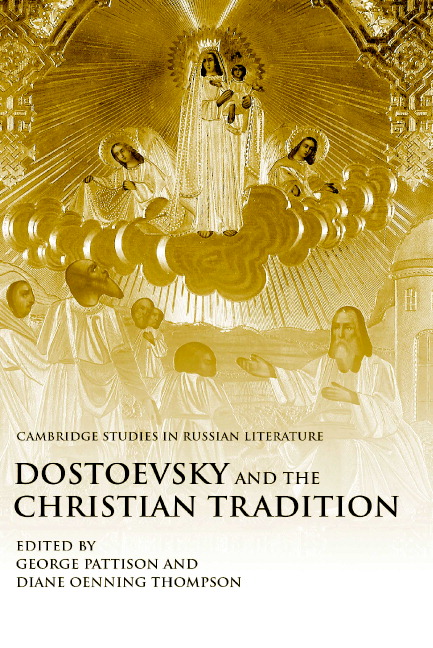
    Dostoevsky is one of Russia's greatest novelists and a major influence in modern debates about religion, both in Russia and the West. This collection brings together Western and Russian perspectives on the issues raised by the religious element in his work. The aim of this collection is not to abstract Dostoevsky's religious 'teaching' from his literary works, but to explore the interaction between his Christian faith and his writing. The essays cover such topics as temptation, grace and law, Dostoevsky's use of the gospels and hagiography, Trinitarianism, and the Russian tradition of the veneration of icons, as well as reading aloud, and dialogism. In addition to an exploration of the impact of the Christian tradition on Dostoevsky's major novels, Crime and Punishment, The Idiot and The Brothers Karamazov, there are also discussions of lesser-known works such as The Landlady and A Little Boy at Christ's Christmas Tree.

    Reviews

    Review of the hardback:‘Here is both literary criticism and theological reflection … [the authors] are to be congratulated on collecting and editing such a fine book.’

    Source: Theology

    Review of the hardback:'It goes without saying that Dostoevsky cannot occupy the central position in any appraisal of the assimilation of Christianity into Russian literature as indeed of the relevance of this phenomenon to the new Russia; in this context, then, the appearance of Dostoevsky and the Christian Tradition is timely and welcome.'

    Source: Modern Language Review

    Refine List

    Actions for selected content:

    Select all | Deselect all
    • View selected items
    • Export citations
    • Download PDF (zip)
    • Save to Kindle
    • Save to Dropbox
    • Save to Google Drive

    Save Search

    You can save your searches here and later view and run them again in "My saved searches".

    Please provide a title, maximum of 40 characters.
    ×

    Contents

    Metrics

    Altmetric attention score

    Full text views

    Total number of HTML views: 0
    Total number of PDF views: 0 *
    Loading metrics...

    Book summary page views

    Total views: 0 *
    Loading metrics...

    * Views captured on Cambridge Core between #date#. This data will be updated every 24 hours.

    Usage data cannot currently be displayed.

    Accessibility standard: Unknown

    Why this information is here

    This section outlines the accessibility features of this content - including support for screen readers, full keyboard navigation and high-contrast display options. This may not be relevant for you.

    Accessibility Information

    Accessibility compliance for the PDF of this book is currently unknown and may be updated in the future.
