
Skip to main content Accessibility help
×
  • Cited by 2
    • Show more authors
    • You may already have access via personal or institutional login
    • Select format
    • Publisher:
      Cambridge University Press
      Publication date:
      24 November 2009
      24 January 2005
      ISBN:
      9780511614347
      9780521829151
      9780521536042
      Dimensions:
      (228 x 152 mm)
      Weight & Pages:
      0.348kg, 178 Pages
      Dimensions:
      (228 x 152 mm)
      Weight & Pages:
      0.248kg, 178 Pages
    You may already have access via personal or institutional login
  • Selected: Digital
    Add to cart View cart Buy from Cambridge.org

    Book description

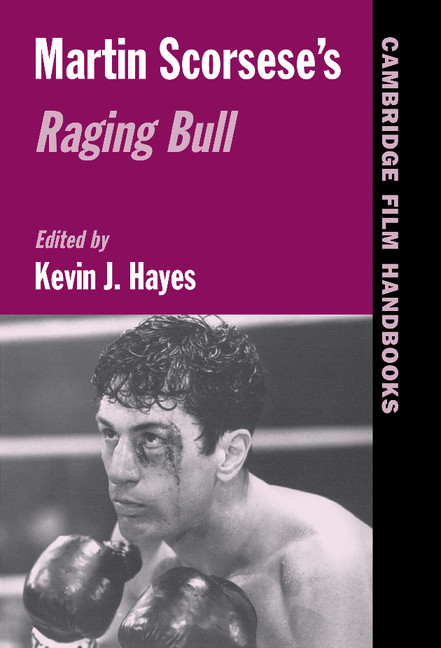
    Raging Bull (1980) represents American film making at its best. Since its initial release, the film has been called the greatest film of the 1980s, the greatest boxing film ever made, the greatest sports film ever made, and, indeed, one of the greatest films of all time. Raging Bull: A Cambridge Film Handbook presents the fullest critical appreciation of Scorsese's film available. The introduction tells the story of how the film came about, examining its inspirations and positioning Raging Bull within the history of cinema. Subsequent chapters, each written by contributors from different disciplines - film studies, literary history, theater history - discuss the film from a variety of perspectives. Though primarily directed toward undergraduate and graduate film courses, this collection should enhance appreciation of Raging Bull for all readers. Contributors to this volume have been issued a challenge: to write chapters that contain fundamental information for students, to include new information and ideas for seasoned film scholars, and to write in a jargon-free style that all readers can appreciate.

    Refine List

    Actions for selected content:

    Select all | Deselect all
    • View selected items
    • Export citations
    • Download PDF (zip)
    • Save to Kindle
    • Save to Dropbox
    • Save to Google Drive

    Save Search

    You can save your searches here and later view and run them again in "My saved searches".

    Please provide a title, maximum of 40 characters.
    ×

    Contents

    Select Bibliography
    Selected Bibliography
    Ackroyd, Peter. “All the Rage.” Spectator, 28 February 1981, 26
    Barton, Carlin A.The Scandal of the Arena.” Representations 27 (1989): 1–36
    Blake, Richard A.Redeemed in Blood: The Sacramental Universe of Martin Scorsese.” Journal of Popular Film and Television 24 (1996): 2–9
    Boyum, Joy Gould. “A Work of Power and Distinction.” Wall Street Journal, 28 November 1980, 11
    Brunette, Peter, ed. Martin Scorsese: Interviews. Jackson: University Press of Mississippi, 1999
    Coleman, John. “Box and Cocks.” New Statesman, 20 February 1981, 23
    Cook, Pam. “Masculinity in Crisis?: Pam Cook on Tragedy and Identification in Raging Bull.” Screen 23 (1982): 39–46
    Dickstein, Morris. “Self-Tormentors.” Partisan Review 64 (1994): 658–664
    Friedman, Lawrence S. The Cinema of Martin Scorsese. New York: Continuum, 1998
    Girgus, Sam B. America on Film: Modernism, Documentary, and a Changing America. New York: Cambridge University Press, 2002
    Grindon, Leger. “Body and Soul: The Structure of Meaning in the Boxing Film Genre.” Cinema Journal 35 (1996): 54–69
    Halberstam, Judith. Female Masculinity. Durham: Duke University Press, 1998
    Hemmeter, Gail Garnicelli, and Hemmeter, Thomas. “The Word Made Flesh: Language in Raging Bull.” Literature/Film Quarterly 14 (1986): 101–105
    Johnson, Carol Siri. “Constructing Machismo in Mean Streets and Raging Bull.” Perspectives on Raging Bull, ed. Steven G. Kellman. New York: G. K. Hall, 1994, 96–106
    Kael, Pauline. “Religious Pulp, or The Incredible Hulk.” New Yorker, 8 December 1980, 217–225
    Kellman, Steven G., ed. Perspectives on Raging Bull. New York: G. K. Hall, 1994
    Keyser, Lester J. Martin Scorsese. New York: Twayne, 1992
    La Motta, Jake, Joseph Carter, and Peter Savage. Raging Bull. 1970. Reprinted. New York: Bantam, 1980
    Leed, Barry H. “Scorsese vs. Mailer: Boxing as Redemption in Raging Bull and An American Dream.” Perspectives on Raging Bull, ed. Steven G. Kellman. New York: G. K. Hall, 1994, 131–135
    Librach, Ronald S.The Last Temptation in Mean Streets and Raging Bull.” Literature/Film Quarterly 20 (1992): 14–24
    Malcolm, Derek. “The Punch in Scorsese's Ring Cycle.” Guardian, 14 February 1981, 10
    Mortimer, Barbara. “Portraits of the Postmodern Person in Taxi Driver, Raging Bull, and The King of Comedy.” Journal of Film and Video 49 (1997): 28–38
    Nicholls, Mark. “Something For the Man Who Has Everything: Melancholia and the Films of Martin Scorsese.” Playing the Man: New Approaches to Masculinity, eds. Dave Trudinger, Katherine Biber, and Tom Sear. Annandale, Australia: Pluto Press, 1999, 39–51, 215–216
    Nicholls, Mark. Scorsese's Men: Melancholia and the Mob. Annandale, Australia: Pluto Press, 2004
    O'Toole, Lawrence. “Going the Distance, and Much, Much Farther.” Maclean's, 1 December 1980, p. 73
    Ringel, Eleanor. “Raging Bull Goes the Distance in Spite of Itself.” Atlanta Constitution, 20 February 1981, 3B
    Thompson, David, and Ian Christie, eds. Scorsese on Scorsese. London: Faber and Faber, 1989
    Tomasulo, Frank P. “Raging Bully: Postmodern Violence and Masculinity in Raging Bull.” Mythologies of Violence in Postmodern Media, ed. Christopher Sharrett. Detroit: Wayne State University Press, 1999, 175–197
    Westerbeck, Colin L., Jr. “Shadowboxing: A Fighter's Stance toward Life.” Commonweal, 16 January 1981, pp. 20–21
    Weiss, Marion W.Linguistic Coding in the Films of Martin Scorsese.” Semiotica 55 (1985): 185–194

    Metrics

    Altmetric attention score

    Full text views

    Total number of HTML views: 0
    Total number of PDF views: 0 *
    Loading metrics...

    Book summary page views

    Total views: 0 *
    Loading metrics...

    * Views captured on Cambridge Core between #date#. This data will be updated every 24 hours.

    Usage data cannot currently be displayed.

    Accessibility standard: Unknown

    Why this information is here

    This section outlines the accessibility features of this content - including support for screen readers, full keyboard navigation and high-contrast display options. This may not be relevant for you.

    Accessibility Information

    Accessibility compliance for the PDF of this book is currently unknown and may be updated in the future.
