
Skip to main content Accessibility help
×
  • Cited by 150
    • Show more authors
    • You may already have access via personal or institutional login
    • Select format
    • Publisher:
      Cambridge University Press
      Publication date:
      08 January 2010
      10 October 2005
      ISBN:
      9780511616013
      9780521855211
      9780521671323
      Dimensions:
      (228 x 152 mm)
      Weight & Pages:
      0.432kg, 222 Pages
      Dimensions:
      (228 x 152 mm)
      Weight & Pages:
      0.32kg, 222 Pages
    You may already have access via personal or institutional login
  • Selected: Digital
    Add to cart View cart Buy from Cambridge.org

    Book description

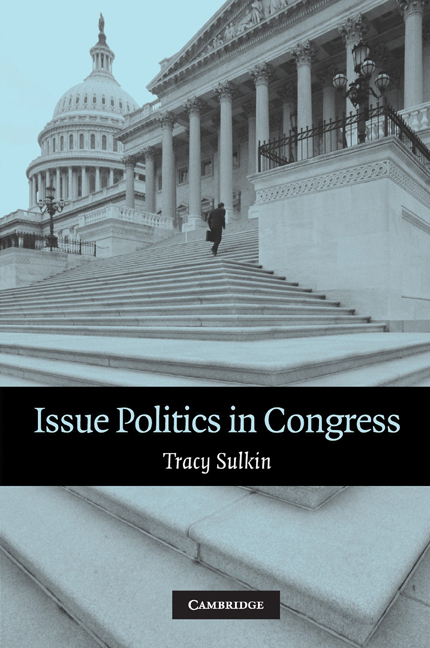
    Do representatives and senators respond to the critiques raised by their challengers? This study, one of the first to explore how legislators' experiences as candidates shape their subsequent behavior as policy makers, demonstrates that they do. Winning legislators regularly take up their challengers' priority issues from the last campaign and act on them in office, a phenomenon called 'issue uptake'. This attentiveness to their challengers' issues reflects a widespread and systematic yet largely unrecognized mode of responsiveness in the US Congress, but it is one with important benefits for the legislators who undertake it and for the health and legitimacy of the representative process. This book provides fresh insight into questions regarding the electoral connection in legislative behavior, the role of campaigns and elections, and the nature and quality of congressional representation.

    Reviews

    "This book is a major contribution to the study of Congress and, more generally, to the fields of legislative studies and American politics. It is rigorously organized, well-written, and thorough. With this book, Sulkin unifies the work on congressional elections with work on Congress as an institution, as she links the study of congressional campaigns to the study of agenda-setting and participation in Congress." Gerald Gamm, University of Rochester

    "...Tracy Sulkin's Issue Politics in Congress...is a strikingly, refreshingly original work. It's probably the best book on legislative representation in decades and one of the best books on Congress in recent memory. Sulkin identifies a feature of representation mostly missed in the voluminous literature on the subject, what she calls "issue uptake." Issue uptake occurs when, in response to the criticisms of her challenger, the reelected incumbent changes her legislative agendas in the ensuing congress. Sulkin's account of legislators' uptake level is smart, focusing on the psychology of issue attention and, more prominently, the strategic considerations of incumbents contemplating running the next time round. The empirical analysis of the book employs data on a variety of legislators' activities, including both cross-sectional and over time data, from both House and Senate. The results are rich and almost always compelling. But it's the larger implications of the book that make it exciting scholarship. It is unusual in that it connects, systematically rather than speculatively, the electoral and the legislative arenas. It shows us that campaigns matter, even if they don't actually affect who gets elected to Congress. Campaigns matter even if incumbents get reelected time after time. And challengers matter . . . Issue Politics in Congress will be an important book for a long time to come." Richard Hall, University of Michigan

    “This important study provides fresh understanding of national legislators' responsiveness to their constituents mediated through an unusual channel. A necessary read for congressional scholars. Highly recommended.”
    Choice

    "This book immediately places "issue uptake" on the list of concepts that all students of Congressional politics and electoral behavior need to know. Through sophisticated data analysis and telling examples, Sulkin explains why legislators adopt the agendas of their challengers, when they do so most vigorously, and what the payoffs are for theirs careers and for legislative representation. She adds a subtle yet critical piece to our disciplineas account of how campaigns influence policy." Thad Kousser, University of California, San Diego

    "....Tracy Sulkin examines legislators' actions on their own and on their opponents' campaign issues and in doing so provides new and important insights into the ways in which campaigns affect governing and incumbents use their opportunities in office to secure their reelection....this book is exploratory....Issue Politics in Congress will be a substantial contribution to the literature because it goes to the core of the nature of republican democracy....It is an extremely creative and meticulous empirical approach to studying representation..."
    --Eric S. Heberlig, University of North Carolina, Charlotte, Political Science Quarterly

    Refine List

    Actions for selected content:

    Select all | Deselect all
    • View selected items
    • Export citations
    • Download PDF (zip)
    • Save to Kindle
    • Save to Dropbox
    • Save to Google Drive

    Save Search

    You can save your searches here and later view and run them again in "My saved searches".

    Please provide a title, maximum of 40 characters.
    ×

    Contents

    References
    References
    Abramowitz, Alan I. 1980. “A Comparison of Voting for U.S. Senator and Representative in 1978.” American Political Science Review 74(3): 633–40
    Abramowitz, Alan I. and Segal., Jeffrey A. 1992. Senate Elections. Ann Arbor: University of Michigan Press
    Achen, Christopher H. 1977. “Measuring Representation: Perils of the Correlation Coefficient.” American Journal of Political Science 21(4): 805–15
    Achen, Christopher H. 1978. “Measuring Representation.” American Journal of Political Science 22(3): 475–510
    Ahuja, Sunil. 1994. “Electoral Status and Representation in the United States Senate.” American Politics Quarterly 22(1): 104–18
    Ainsworth, Scott H. and Thad E. Hall. 2001. “Ties That Bind: Participation and Coordination in the U.S. Congress.” Paper presented at the annual meeting of the Midwest Political Science Association, Chicago
    Ansolabehere, Stephen and Iyengar., Shanto 1995. Going Negative: How Attack Ads Shrink and Polarize the Electorate. New York: Free Press
    Arnold, R. Douglas. 1990. The Logic of Congressional Action. New Haven, CT: Yale University Press
    Arnold, R. Douglas. 2004. Congress, the Press, and Political Accountability. Princeton, NJ: Princeton University Press
    Bachrach, Peter and Baratz, Morton. 1962. “Two Faces of Power.” American Political Science Review 56(4): 947–52
    Baker, Ross K. 1989. House and Senate. New York: W. W. Norton & Company
    Bauer, Raymond, Sola Pool, Ithiel, and Dexter, Lewis Anthony. 1963. American Business and Public Policy. New York: Atherton Press
    Baumgartner, Frank R. and Jones, Bryan D.. 1993. Agendas and Instability in American Politics. Chicago: University of Chicago Press
    Baumgartner, Frank R. and Jones, Bryan D., eds. 2002. Policy Dynamics. Chicago: University of Chicago Press
    Baumgartner, Frank R., Jones, Bryan D., and MacLeod, Michael C.. 2000. “The Evolution of Bureaucratic Institutions.” Journal of Politics 62(2): 321–49
    Bendor, Jonathan and Moe, Terry M.. 1985. “An Adaptive Model of Bureaucratic Politics.” American Political Science Review 79(3): 755–74
    Benenson, Bob. 1988. “Election Guide 1988: New York Outlook.” CQ Weekly, October 15, 1988, 2926
    Benenson, Bob. 1990. “Election 1990: Kansas Outlook.” CQ Weekly, October 13, 1990, 3310
    Bernstein, Robert A. 1977. “Divisive Primaries Do Hurt: U.S. Senate Races, 1956–1972.” American Political Science Review 71(2): 540–45
    Bernstein, Robert A. 1988. “Do U.S. Senators Moderate Strategically?” American Political Science Review 82(1): 237–41
    Bernstein, Robert A. 1989. Elections, Representation, and Congressional Voting Behavior: The Myth of Constituency Control. Englewood Cliffs, NJ: Prentice Hall
    Bianco, William T. 1994. Trust: Representatives & Constituents. Ann Arbor: University of Michigan Press
    Bickers, Kenneth N. and Stein, Robert M.. 1996. “The Electoral Dynamics of the Federal Pork Barrel.” American Journal of Political Science 40(4): 1300–26
    Birkland, Thomas A. 1997. After Disaster: Agenda Setting, Public Policy, and Focusing Events. Washington, DC: Georgetown University Press
    Bohman, James. 1996. Public Deliberation: Pluralism, Complexity, and Democracy. Cambridge, MA: MIT Press
    Bond, Jon R. 1985. “Dimensions of District Attention Over Time.” American Journal of Political Science 29(2): 330–47
    Bond, Jon, Covington, Cary, and Fleisher, Richard. 1985. “Explaining Challenger Quality in Congressional Elections.” Journal of Politics 47(2): 510–29
    Born, Richard. 1981. “The Influence of House Primary Election Divisiveness on General Election Margins, 1962–76.” Journal of Politics 43(3): 640–61
    Brady, David W., Brandice Canes-Wrone, and John F. Cogan. 2000. “Differences Between Winning and Losing Incumbents.” In Change and Continuity in House Elections, ed. Brady, David W., Cogan, John F., and Fiorina, Morris. Stanford, CA: Stanford University Press
    Bragdon, Peter. 1988. “Election Guide 1988: Mississippi Outlook.” CQ Weekly, October 15, 1988, 2912–14
    Bullock, Charles S. 1973. “Committee Transfers in the United States House of Representatives.” Journal of Politics 35(1): 85–120
    Burden, Barry C. and Kimball, David C.. 2002. Why Americans Split Their Tickets: Campaigns, Competition, and Divided Government. Ann Arbor: University of Michigan Press
    Cain, Bruce, Ferejohn, John, and Fiorina, Morris. 1987. The Personal Vote: Constituency Service and Electoral Independence. Cambridge, MA: Harvard University Press
    Campbell, Angus, Converse, Philip, Miller, Warren, and Stokes, Donald. 1960. The American Voter. New York: Wiley
    Campbell, James E. 1982. “Cosponsoring Legislation in the U.S. Congress.” Legislative Studies Quarterly 7(4): 415–22
    Canes-Wrone, Brandice, Brady, David W., and Cogan, John F.. 2002. “Out of Step, Out of Office: Electoral Accountability and House Members' Voting.” American Political Science Review 96(1): 127–40
    Canon, David T. 1993. “Sacrificial Lambs or Strategic Politicians? Political Amateurs in U.S. House Elections.” American Journal of Political Science 37(4): 1119–41
    Carsey, Thomas M. 2000. Campaign Dynamics: The Race for Governor. Ann Arbor: University of Michigan Press
    Cassata, Donna. 1997. “Vocational Program Gets Panel OK.” CQ Weekly, June 14, 1997, 1378–9
    Cnudde, Charles F. and McCrone, Donald J.. 1966. “The Linkage Between Constituency Attitudes and Congressional Voting Behavior: A Causal Model.” American Political Science Review 60(1): 66–72
    Cobb, Roger W. and Elder, Charles D.. 1983. Participation in American Politics: The Dynamics of Agenda-Building. Boston: Allyn and Bacon
    Cook, Rhodes. 1990. “Election 1990: Missouri Outlook.” CQ Weekly, October 13, 1990, 3326–7
    Dahl, Robert A. 1989. Democracy and Its Critics. New Haven, CT: Yale University Press
    Davidson, Roger H. and Oleszek, Walter J.. 1996. Congress and Its Members, 5th edition. Washington, DC: CQ Press
    Deckard, Barbara Sinclair. 1976. “Electoral Marginality and Party Loyalty in House Roll Call Voting.” American Journal of Political Science 20(3): 469–81
    Delli Carpini, Michael X. and Keeter, Scott. 1996. What Americans Know about Politics and Why It Matters. New Haven, CT: Yale University Press
    Downs, Anthony. 1972. “Up and Down with Ecology: The Issue Attention Cycle.” The Public Interest 28(2): 38–50
    Duncan, Phil. 1988. “Indiana 5: Jontz vs. Williams A Standout in the Heartland.” CQ Weekly, October 29, 1988, 3102
    Duncan, Phil, ed. 1993. CQ's Politics in America. Washington, DC: Congressional Quarterly
    Elling, Richard C. 1982. “Ideological Change in the U.S. Senate: Time and Electoral Responsiveness.” Legislative Studies Quarterly 7(1): 75–92
    Erikson, Robert S. 1971. “The Electoral Impact of Congressional Roll Call Voting.” American Political Science Review 65(4): 1018–32
    Erikson, Robert S. 1978. “Constituency Opinion and Congressional Behavior: A Reexamination of the Miller–Stokes Representation Data.” American Journal of Political Science 22(3): 511–35
    Erikson, Robert S., MacKuen, Michael B., and Stimson, James A.. 2002. The Macro Polity. New York: Cambridge University Press
    Erikson, Robert S. and Gerald C. Wright. 1993. “Voters, Candidates, and Issues in Congressional Elections.” In Congress Reconsidered, 5th edition, ed. Dodd, Lawrence and Oppenheimer, Bruce. Washington, DC: CQ Press
    Eulau, Heinz and Karps, Paul D.. 1977. “The Puzzle of Representation: Specifying Components of Responsiveness.” Legislative Studies Quarterly 2(3): 233–54
    Fenno, Richard F. 1973. Congressmen in Committees. Boston: Little, Brown
    Fenno, Richard F. 1978. Home Style. Boston: Little, Brown
    Fenno, Richard F. 1989. The Making of a Senator: Dan Quayle. Washington, DC: CQ Press
    Fenno, Richard F. 1996. Senators on the Campaign Trail: The Politics of Representation. Norman: University of Oklahoma Press
    Fiorina, Morris P. 1973. “Electoral Margins, Constituency Influence, and Policy Moderation: A Critical Assessment.” American Politics Quarterly 1(4): 479–98
    Fiorina, Morris P. 1974. Representatives, Roll Calls, and Constituencies. Boston: D. C. Heath
    Fowler, Linda L., Douglass, Scott R., and Clark, Wesley D. Jr. 1980. “The Electoral Effects of House Committee Assignments.” Journal of Politics 42(1): 307–19
    Fraley, Colette. 1995. “Senate Votes to Reauthorize Ryan White AIDS Program.” CQ Weekly, July 29, 1995, 2277–8
    Franklin, Charles H. 1991. “Eschewing Obfuscation? Campaigns and the Perception of U.S. Senate Incumbents.” American Political Science Review 85(4): 1193–1214
    Freedman, Paul and Goldstein, Kenneth. 1999. “Measuring Media Exposure and the Effects of Negative Campaign Ads.” American Journal of Political Science 43(4): 1189–1208
    Greenblatt, Alan and Elving, Robert D.. 1996. “Election Preview: California.” CQ Weekly, October 19, 1996, 2974
    Gronke, Paul. 2000. The Electorate, the Campaign, and the Office: A Unified Approach to Senate and House Elections. Ann Arbor: University of Michigan Press
    Groseclose, Timothy and Krehbiel, Keith. 1994. “Golden Parachutes, Rubber Checks, and Strategic Retirements from the 102nd House.” American Journal of Political Science 38(1): 75–99
    Hale, Jon F. 1987. “The Scribes of Texas: Newspaper Coverage of the 1984 U.S. Senate Campaign.” In Campaigns in the News: Mass Media and Congressional Elections, ed. Vermeer, J. P.. New York: Greenwood Press
    Hall, Richard L. 1996. Participation in Congress. New Haven, CT: Yale University Press
    Hart, Roderick P. 2000. Campaign Talk: Why Elections Are Good for Us. Princeton, NJ: Princeton University Press
    Herrnson, Paul S. 1998. Congressional Elections, 2nd edition. Washington, DC: CQ Press
    Hershey, Marjorie Randon. 1984. Running for Office: The Political Education of Campaigners. Chatham, NJ: Chatham House Publishers
    Hill, Kim Quaile and Hurley, Patricia A.. 1999. “Dyadic Representation Reappraised.” American Journal of Political Science 43(1): 109–37
    Hinckley, Barbara. 1980. “House Re-Elections and Senate Defeats: The Role of the Challenger.” British Journal of Political Science 10(4): 441–60
    Holbrook, Thomas M. 1996. Do Campaigns Matter?Thousand Oaks, CA: Sage Publications
    Hurley, Patricia A. 1982. “Collective Representation Reappraised.” Legislative Studies Quarterly 7(1): 119–36
    Hurley, Patricia A. and Hill, Kim Quaile. 2003. “Beyond the Demand-Input Model: A Theory of Representational Linkages.” Journal of Politics 65(2): 304–26
    Idelson, Holly. 1990. “Election 1990: Washington Outlook.” CQ Weekly, October 13, 1990, 3354
    Iyengar, Shanto and Kinder, Donald R.. 1987. News That Matters. Chicago: University of Chicago Press
    Jacobs, Lawrence R. and Shapiro, Robert Y.. 2000. Politicians Don't Pander: Political Manipulation and the Loss of Democratic Responsiveness.Chicago: University of Chicago Press
    Jacobson, Gary C. 1996. “The 1994 House Elections in Perspective.” Political Science Quarterly 111(2): 203–23
    Jacobson, Gary C. 2001. The Politics of Congressional Elections, 5th edition. New York: Longman
    Jacobson, Gary C. and Dimock, Michael A.. 1994. “Checking Out: The Effects of Bank Overdrafts on the 1992 House Elections.” American Journal of Political Science 38(3): 601–24
    Jacobson, Gary C. and Kernell, Samuel. 1983. Strategy and Choice in Congressional Elections, 2nd edition. New Haven, CT: Yale University Press
    Jewell, Malcolm E. 1983. “Legislator–Constituency Relations and the Representative Process.” Legislative Studies Quarterly 8(3): 303–37
    Johannes, John R. 1984. To Serve the People: Congress and Constituency Service. Lincoln: University of Nebraska Press
    Johannes, John R. and McAdams, John C.. 1981. “The Congressional Incumbency Effect: Is It Casework, Policy Compatibility, or Something Else? An Examination of the 1978 Election.” American Journal of Political Science 25(3): 512–42
    Johnson, Charles. 2003. How Our Laws Are Made. Washington, DC: Government Printing Office
    Jones, Bryan D. 1973. “Competitiveness, Role Orientations, and Legislative Responsiveness.” Journal of Politics 35(4): 924–47
    Jones, Bryan D. 1994. Reconceiving Decision-Making in Democratic Politics. Chicago: University of Chicago Press
    Jones, Bryan D. 2001. Politics and the Architecture of Choice: Bounded Rationality and Governance. Chicago: University of Chicago Press
    Jones, Bryan D. and Baumgartner, Frank R.. 2005. The Politics of Attention: How Government Prioritizes Problems. Chicago: University of Chicago Press
    Jones, Bryan D., Baumgartner, Frank R., and Talbert, Jeffery C.. 1993. “The Destruction of Issue Monopolies in Congress.” American Political Science Review 87(3): 657–71
    Kahn, Kim Fridkin. 1991. “Senate Elections in the News: Examining Campaign Coverage.” Legislative Studies Quarterly 16(3): 349–74
    Kahn, Kim Fridkin and Kenney, Patrick J.. 1999. The Spectacle of U.S. Senate Campaigns. Princeton, NJ: Princeton University Press
    Kaplan, Dave. 1988. “Election Guide 1988: South Dakota Outlook.” CQ Weekly, October 15, 1988, 2942
    Kaplan, Dave. 1990. “Election Guide 1990: Montana Outlook.” CQ Weekly, October 13, 1990, 3327
    Katz, Jeffrey L. 1997. “GOP School Plans Get Retooling.” CQ Weekly, December 13, 1997, 3062–5
    Kenney, Patrick J. 1988. “Sorting Out the Effects of Primary Divisiveness in Congressional and Senatorial Elections.” Western Political Quarterly 41(4): 765–77
    Kessler, Daniel and Krehbiel, Keith. 1996. “Dynamics of Cosponsorship.” American Political Science Review 90(3): 555–66
    King, David C. 1997. Turf Wars: How Congressional Committees Claim Jurisdiction. Chicago: University of Chicago Press
    Kingdon, John W. 1968. Candidates for Office: Beliefs and Strategies. New York: Random House
    Kingdon, John W. 1984. Agendas, Alternatives, and Public Policies. Boston, MA: Little, Brown
    Kingdon, John W. 1989. Congressmen's Voting Decisions. New York: Harper & Row
    Krasno, Jonathan S. 1994. Challengers, Competition, and Reelection: Comparing Senate and House Elections. New Haven, CT: Yale University Press
    Krasno, Jonathan S. and Green, Donald Philip. 1988. “Preempting Quality Challengers in House Elections.” Journal of Politics 50(4): 920–36
    Krutz, Glen S. 2000. “Congressional Leaders and the Winnowing of Legislation.” Paper presented at the annual meeting of the American Political Science Association, Washington, DC
    Kuklinski, James H. 1977. “District Competitiveness and Legislative Roll-Call Behavior: A Reassessment of the Marginality Hypothesis.” American Journal of Political Science 21(3): 627–38
    Kuklinski, James H. 1978. “Representativeness and Elections: A Policy Analysis.” American Political Science Review 72(1): 165–77
    Kuklinski, James H. and Elling, Richard C.. 1977. “Representational Role, Constituency Opinion, and Legislative Roll-Call Behavior.” American Journal of Political Science 21(1): 135–47
    Lazarsfeld, Paul F., Berelson, Bernard, and Gaudet, Hazel. 1944. The People's Choice: How the Voter Makes Up His Mind in a Presidential Campaign. New York: Duell, Sloan, and Pearce
    Long, J. Scott. 1997. Regression Models for Categorical and Limited Dependent Variables.Thousand Oaks, CA: Sage Publications
    Lublin, David I. 1994. “Quality, Not Quantity: Strategic Politicians in U.S. Senate Elections, 1952–1990.” Journal of Politics 56(1): 228–41
    MacPerson, Peter. 1995. “Senate Panel OKs Ryan White Act.” CQ Weekly, April 1, 1995, 947–8
    Mann, Thomas E. 1978. Unsafe at Any Margin: Interpreting Congressional Elections. Washington, DC: American Enterprise Institute
    Mann, Thomas E. and Wolfinger, Raymond E.. 1980. “Candidates and Parties in Congressional Elections.” American Political Science Review 74(3): 617–32
    Mansbridge, Jane. 2003. “Rethinking Representation.” American Political Science Review 97(4): 515–28
    Marcus, George E. and MacKuen, Michael B.. 1993. “Anxiety, Enthusiasm, and the Vote: The Emotional Underpinnings of Learning and Involvement During Presidential Campaigns.” American Political Science Review 87(3): 672–85
    Matthews, Donald R. 1960. U.S. Senators and Their World. Chapel Hill: University of North Carolina Press
    Mayhew, David R. 1974. Congress: The Electoral Connection. New Haven, CT: Yale University Press
    Mayhew, David R. 1991. Divided We Govern: Party Control, Lawmaking, and Investigations, 1946–1990. New Haven, CT: Yale University Press
    McCombs, Maxwell E. and Shaw, Donald L.. 1972. “The Agenda-Setting Function of Mass Media.” Public Opinion Quarterly 36(2): 176–87
    McCrone, Donald J. and Kuklinski, James H.. 1979. “The Delegate Theory of Representation.” American Journal of Political Science 23(2): 278–300
    McCrone, Donald J. and Stone, Walter J.. 1986. “The Structure of Constituency Representation: On Theory and Method.” Journal of Politics 48(4): 956–75
    Miller, Warren E. and Shanks, J. Merrill. 1996. The New American Voter. Cambridge, MA: Harvard University Press
    Miller, Warren E. and Stokes, Donald E.. 1963. “Constituency Influence in Congress.” American Political Science Review 57(1): 45–56
    Moss, Bill. 1992. “He Has Drive, But No Fuel.” St. Petersburg Times, October 28, 1992, 1B
    Neuman, W. Russell. 1986. The Paradox of Mass Politics: Knowledge and Opinion in the American Electorate. Cambridge, MA: Harvard University Press
    Nie, Norman H., Verba, Sidney, and Petrocik, John R.. 1976. The Changing American Voter. Cambridge, MA: Harvard University Press
    Ornstein, Norman J., Mann, Thomas E., and Malbin, Michael J.. 1990. Vital Statistics on Congress, 1989–1990. Washington, DC: Congressional Quarterly
    Ornstein, Norman J., Mann, Thomas E., and Malbin, Michael J.. 1992. Vital Statistics on Congress, 1991–1992. Washington, DC: Congressional Quarterly
    Ornstein, Norman J., Mann, Thomas E., and Malbin, Michael J.. 1994. Vital Statistics on Congress, 1993–1994.Washington, DC: Congressional Quarterly
    Ornstein, Norman J., Mann, Thomas E., and Malbin, Michael J.. 1996. Vital Statistics on Congress, 1995–1996. Washington, DC: Congressional Quarterly
    Ornstein, Norman J., Mann, Thomas E., and Malbin, Michael J.. 1998. Vital Statistics on Congress, 1997–1998. Washington, DC: Congressional Quarterly
    Page, Benjamin I. and Shapiro, Robert Y.. 1992. The Rational Public: Fifty Years of Trends in Americans' Policy Preferences.Chicago: University of Chicago Press
    Page, Benjamin I., Shapiro, Robert Y., Gronke, Paul W., and Rosenberg, Robert M.. 1984. “Constituency, Party, and Representation in Congress.” Public Opinion Quarterly 48(4): 741–56
    Parker, Glenn R. 1980. “Sources of Change in Congressional District Attentiveness.” American Journal of Political Science 24(1): 115–24
    Patterson, Thomas. 1993. Out of Order. New York: Random House
    Pitkin, Hanna. 1967. The Concept of Representation. Berkeley, CA: University of California Press
    Polsby, Nelson W. and Schickler, Eric. 2002. “Landmarks in the Study of Congress Since 1945.” Annual Review of Political Science 5: 333–67
    Ragsdale, Lyn and Cook, Timothy E.. 1987. “Representatives' Actions and Challengers' Reactions: Limits to Candidate Connections in the House.” American Journal of Political Science 31(1): 45–81
    Riker, William H. 1986. The Art of Political Manipulation. New Haven, CT: Yale University Press
    Salisbury, Robert H. and Shepsle, Kenneth A.. 1981. “U.S. Congressman as Enterprise.” Legislative Studies Quarterly 6(4): 559–76
    Schattschneider, E. E. 1960. The Semisovereign People. New York: Holt, Rinehart and Winston
    Schiller, Wendy J. 1995. “Senators as Political Entrepreneurs: Using Bill Sponsorship to Shape Legislative Agendas.” American Journal of Political Science 39(1): 186–203
    Schiller, Wendy J. 2000. Partners and Rivals: Representation in U.S. Senate Delegations. Princeton: Princeton, NJ: University Press
    Sellers, Patrick J. 1998. “Strategy and Background in Congressional Campaigns.” American Political Science Review 92(1): 159–71
    Shapiro, Catherine R., Brady, David W., Brody, Richard, and Ferejohn, John A.. 1990. “Linking Constituency Opinion and Senate Voting Scores: A Hybrid Explanation.” Legislative Studies Quarterly 15(4): 599–622
    Shaw, Eugene F. 1977. “The Interpersonal Agenda.” In The Emergence of American Political Issues: The Agenda-Setting Function of the Press, ed. Shaw, Donald and McCombs, Maxwell. St. Paul, MN: West Publishing
    Simon, Adam F. 2002. The Winning Message: Candidate Behavior, Campaign Discourse, and Democracy. New York: Cambridge University Press
    Sinclair, Barbara. 1989. The Transformation of the U.S. Senate.Baltimore: Johns Hopkins University Press
    Spiliotes, Constantine J. and Vavreck, Lynn. 2002. “Campaign Advertising: Partisan Convergence or Divergence?” Journal of Politics 64(1): 249–61
    Squire, Peverill. 1989. “Challengers in U.S. Senate Elections.” Legislative Studies Quarterly 14(4): 531–47
    Squire, Peverill. 1992. “Challenger Quality and Voting Behavior in U.S. Senate Elections.” Legislative Studies Quarterly 17(2): 247–63
    Stimson, James A., MacKuen, Michael B., and Erikson, Robert S.. 1995. “Dynamic Representation.” American Political Science Review 89(3): 543–65
    Stone, Walter J. 1979. “Measuring Constituency–Representative Linkages: Problems and Prospects.” Legislative Studies Quarterly 4(4): 623–39
    Stone, Walter J. 1982. “Electoral Change and Policy Representation in Congress: Domestic Welfare Issues from 1956–1972.” British Journal of Political Science 12(1): 95–115
    Sullivan, John L. and Uslaner, Eric M.. 1978. “Congressional Behavior and Electoral Marginality.” American Journal of Political Science 22(3): 536–53
    Talbert, Jeffrey C., Jones, Bryan D., and Baumgartner, Frank R.. 1995. “Nonlegislative Hearings and Policy Change in Congress.” American Journal of Political Science 39(2): 383–406
    Wahlke, John C. 1971. “Policy Demands and System Support: The Role of the Represented.” British Journal of Political Science 1(3): 271–90
    Walker, Jack. 1977. “Setting the Agenda in the U.S. Senate: A Theory of Problem Selection.” British Journal of Political Science 7(4): 423–45
    Wattenberg, Martin P. and Brians, Craig Leonard. 1999. “Negative Campaign Advertising: Demobilizer or Mobilizer?” American Political Science Review 93(4): 891–99
    Wawro, Gregory. 2000. Legislative Entrepreneurship in the U.S. House of Representatives. Ann Arbor: University of Michigan Press
    Weissberg, Robert. 1978. “Collective vs. Dyadic Representation in Congress.” American Political Science Review 72(2): 535–47
    Weissberg, Robert. 1979. “Assessing Legislator–Constituency Policy Agreement.” Legislative Studies Quarterly 4(4): 605–22
    Westlye, Mark C. 1991. Senate Elections and Campaign Intensity. Baltimore: Johns Hopkins University Press
    Wilson, Rick K. and Young, Cheryl D.. 1997. “Cosponsorship in the U.S. Congress.” Legislative Studies Quarterly 22(1): 25–43
    Wright, Gerald C. and Berkman, Michael B.. 1986. “Candidates and Policy in United States Senate Elections.” American Political Science Review 80(2): 567–88
    Zaller, John R. 1992. The Nature and Origins of Mass Opinion. New York: Cambridge University Press
    Zaller, John R. 1998. “Politicians as Prize Fighters: Electoral Selection and Incumbency Advantage.” In Party Politics and Politicians, ed. Geer, John. Baltimore: Johns Hopkins University Press

    Metrics

    Altmetric attention score

    Full text views

    Total number of HTML views: 0
    Total number of PDF views: 0 *
    Loading metrics...

    Book summary page views

    Total views: 0 *
    Loading metrics...

    * Views captured on Cambridge Core between #date#. This data will be updated every 24 hours.

    Usage data cannot currently be displayed.

    Accessibility standard: Unknown

    Why this information is here

    This section outlines the accessibility features of this content - including support for screen readers, full keyboard navigation and high-contrast display options. This may not be relevant for you.

    Accessibility Information

    Accessibility compliance for the PDF of this book is currently unknown and may be updated in the future.
