
Skip to main content Accessibility help
×
  • Cited by 130
    • Show more authors
    • You may already have access via personal or institutional login
    • Select format
    • Publisher:
      Cambridge University Press
      Publication date:
      18 November 2009
      14 June 2004
      ISBN:
      9780511617140
      9780521836814
      9780521545327
      Dimensions:
      (228 x 152 mm)
      Weight & Pages:
      0.483kg, 280 Pages
      Dimensions:
      (228 x 152 mm)
      Weight & Pages:
      0.42kg, 280 Pages
    You may already have access via personal or institutional login
  • Selected: Digital
    Add to cart View cart Buy from Cambridge.org

    Book description

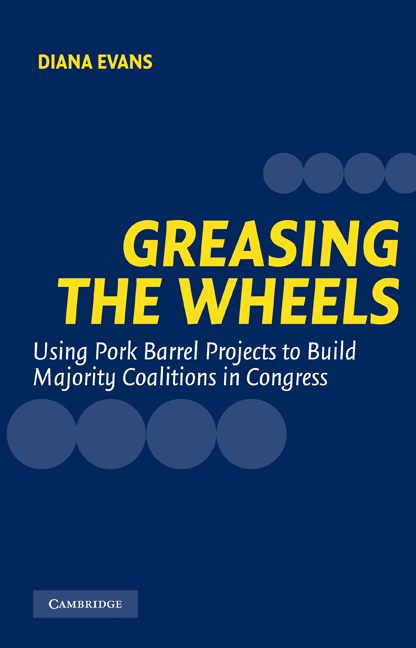
    Pork barrel projects would surely rank near the top of most observers' lists of Congress's most widely despised products. Yet, political leaders in Congress and the President often trade pork for votes to pass legislation that serves broad national purposes, giving members of Congress pork barrel projects in return for their votes on general interest legislation. It is a practice that succeeds at a cost, but it is a cost that many political leaders are willing to pay in order to enact the broader public policies that they favor. There is an irony in this: pork barrel benefits, the most reviled of Congress's legislative products, are used by policy coalition leaders to produce the type of policy that is most admired - general interest legislation. This book makes the case that buying votes with pork is one way in which Congress solves its well-known collective action problem.

    Reviews

    "...notably well written and clearheaded...Highly recommended." N.W. Polsby, University of California, Berkeley

    "This elegant book elaborates on a central insight into congressional politics: "pork barreling, despite its much maligned status, gets things done"(p.2). Evan's book thus serves as an important, balanced corrective to prevailing scholarly and journalistic views of pork barrel politics." Political Science Quarterly, Frances E. Lee, University of Maryland

    "This book is full of such keen observations and insights...it stands as an important and interesting study that adds to our understanding of Congress, policy entrepreneurs, and coalition information." Perspectives on Politics, Jeff Worsham, West Virginia University

    Refine List

    Actions for selected content:

    Select all | Deselect all
    • View selected items
    • Export citations
    • Download PDF (zip)
    • Save to Kindle
    • Save to Dropbox
    • Save to Google Drive

    Save Search

    You can save your searches here and later view and run them again in "My saved searches".

    Please provide a title, maximum of 40 characters.
    ×

    Contents

    References
    Adler, E. Scott. 2000. “Constituency Characteristics and the ‘Guardian’ Model of Appropriations Subcommittees, 1959–1998.” American Journal of Political Science 44: 104–114
    Adler, E. Scott, and Lapinski, John S.. 1997. “Demand-Side Theory and Congressional Committee Composition: A Constituency Characteristics Approach.” American Journal of Political Science 41: 895–918
    Aldrich, John H., and Cnudde, Charles F.. 1975. “Probing the Bounds of Conventional Wisdom: A Comparison of Regression, Probit, and Discriminant Analysis.” American Journal of Political Science 19: 571–608
    Aldrich, John H., and Forrest D. Nelson. 1984. Linear Probability, Logit, and Probit Models. Beverly Hills: Sage
    Aldrich, John H., and Rohde, David W.. 2000. “The Republican Revolution and the House Appropriations Committee.” Journal of Politics 62: 1–33
    Aldrich, John H., and David W. Rohde. 2001. “The Logic of Conditional Party Government: Revisiting the Electoral Connection.” In Congress Reconsidered, 7th ed., ed. Lawrence C. Dodd and Bruce I. Oppenheimer. Washington: CQ Press
    Alvarez, R. Michael, and Jason, L. Saving. 1997. “Deficits, Democrats, and Distributive Benefits: Congressional Elections and the Pork Barrel in the 1980s.” Political Research Quarterly 50: 809–831
    Alvarez, R. Michael, and Schousen, Matthew M. 1993. “Policy Moderation or Conflicting Expectations?American Politics Quarterly 21: 410–438
    Anagnoson, J. Theodore. 1982. “Federal Grant Agencies and Congressional Election Campaigns.” American Journal of Political Science 26: 547–561
    Anderson, Jack, and Michael Binstein. 1992. “Pork-Barrel Politics Teaches Hard Lesson.” Washington Post, Aug. 10
    Anderson, Sarah, and Ken, Silverstein. 1993. “Oink Oink.” The Nation 257 (Dec. 20): 752–753
    Andres, Gary J. 1995. “Pork Barrel Spending on the Wane?P.S.: Political Science and Politics 28: 207–211
    Anselmo, Joseph C., and Allison Stevens. 2003. “Regional Issues Leave Energy Bill a Hair Too Unwieldy for Senate.” CQ Weekly, Nov. 22
    Arnold, Douglas. 1979. Congress and the Bureaucracy: A Theory of Influence. New Haven, Conn.: Yale University Press
    Arnold, Douglas. 1990. The Logic of Congressional Action. New Haven: Yale University Press
    Asher, Herbert B. 1983. Causal Modeling, 2nd ed. Beverly Hills: Sage Publications
    Ashworth, William. 1981. Under the Influence: Congress, Lobbies, and the American Pork-Barrel System. New York: Hawthorn/Dutton
    Audley, John J. 1997. Green Politics and Global Trade. Washington: Georgetown University Press
    Axelrod, Robert. 1981. “The Emergence of Cooperation among Egoists.” American Political Science Review 75: 306–318
    Baker, Ross K. 1989. The New Fat Cats: Members of Congress as Political Benefactors. New York: Priority Press
    Balla, Steven J., Eric, Lawrence, Forrest, Maltzman, and Lee, Sigelman. 2002. “Partisanship, Blame Avoidance, and the Distribution of Legislative Pork.” American Journal of Political Science 46: 515–525
    Baron, David P. 1991. “Majoritarian Incentives, Pork Barrel Programs and Procedural Control.” American Journal of Political Science 35: 57–90
    Baron, David P., and John, A. Ferejohn. 1989. “Bargaining in Legislatures.” American Political Science Review 89: 1181–1206
    Barone, Michael, and Grant Ujifusa. 1992. The Almanac of American Politics. Washington, D.C.: National Journal
    Barry, Brian. 1965. Political Argument. New York: Humanities Press
    Berry, William D. 1984. Nonrecursive Causal Models. Newbury Park, Calif: Sage
    Beyond Distrust: Building Bridges between Congress and the Executive. 1992. Washington, D.C.: National Academy of Public Administration
    Bickers, Kenneth N., and Stein, Robert M.. 1996. “The Electoral Dynamics of the Federal Pork Barrel.” American Journal of Political Science 40: 1300–1326
    Bickers, Kenneth N., and Robert M. Stein. 2000. “The Changing Structure of Federal Aid and the Politics of the Electoral Connection.” Paper presented at the annual meeting of the American Political Science Association, Washington, D.C
    Birnbaum, Jeffrey H., and Alan S. Murray. 1987. Showdown at Gucci Gulch. New York: Vintage
    Bond, Jon R., and Richard Fleisher. 1990. The President in the Legislative Arena. Chicago: University of Chicago Press
    Box-Steffensmeier, Janet M., Arnold, Laura W., and Zorn, Christopher J. W.. 1997. “The Strategic Timing of Position Taking in Congress: A Study of the North American Free Trade Agreement.” American Political Science Review 91, no. 2 (June 1997): 324–338
    Bradsher, Keith. 1993. “Administration Cuts Flurry of Deals.” New York Times, Nov. 11
    Brady, David W. 1988. Critical Elections and Congressional Policy Making. Stanford, Calif.: Stanford University Press
    Brady, David W., Joseph, Cooper, and Patricia, A. Hurley. 1979. “The Decline of Party in the U.S. House of Representatives, 1887–1968.” Legislative Studies Quarterly 4: 381–407
    Brown, Kirk F. 1983. “Campaign Contributions and Congressional Voting.” Paper presented at the 1983 annual meeting of the American Political Science Association, Chicago
    Browne, William P. 1995. Cultivating Congress: Constituents, Issues and Interests in Agricultural Policymaking. Lawrence: University of Kansas
    Bryce, James. 1959. The American Commonwealth. New York: G. P. Putnam's Sons
    Buchanan, James M., and Gordon Tullock. 1962. The Calculus of Consent. Ann Arbor: University of Michigan
    Bullock, Charles S.. 1976. “Motivations for U.S. Congressional Committee Preferences: Freshmen of the 92nd Congress.” Legislative Studies Quarterly 1: 201–212
    Bullock, Charles S.. 1985. “U.S. Senate Committee Assignments: Preferences, Motivations, and Success.” American Journal of Political Science 29: 789–808
    Cain, Bruce, John Ferejohn, and Morris Fiorina. 1987. The Personal Vote. Cambridge: Harvard University Press
    Carsey, Thomas M., and Barry, Rundquist. 1999. “Party and Committee in Distributive Politics: Evidence from Defense Spending.” Journal of Politics 61: 1156–1169
    Carter, Jimmy. 1982. Keeping Faith: Memoirs of a President. New York: Bantam
    Chappell, Henry W. Jr. 1982. “Campaign Contributions and Congressional Voting: A Simultaneous Probit-Tobit Model.” Review of Economics and Statistics 64: 77–83
    Christensen, Mike. 2000. “Congress's Cornucopia: A Sampler of Spending Add-Ons.” CQ Weekly 58 (Oct. 7): 2322–2323
    Citizens against Government Waste. 2000. Pig Book. http://www/cagw.org, accessed June 29, 2000
    Cloud, David S. 1991. “Momentum Grows for Gas Tax to Pay for Highway Bill.” CQ Weekly 49 (July 13): 1881
    Cohen, Richard E. 1993a. “Clinton's NAFTA Team Battling Uphill.” National Journal 25 (November 6): 2674
    Cohen, Richard E.. 1993b. “Democratic Salvage Operation on NAFTA.” National Journal, Sept. 25, no. 38, p. 2259
    Cohn, Jonathan S. 1998. “Roll Out the Barrel.” The New Republic 218 (April 20): 19–23
    Collie, Melissa P. 1988. “The Legislature and Distributive Policy Making in Formal Perspective.” Legislative Studies Quarterly 12: 427–458
    Collie, Melissa P., and David W. Brady. 1985. “The Decline of Partisan Voting Coalitions in the House of Representatives.” In Congress Reconsidered, 3rd ed., ed. Lawrence C. Dodd and Bruce I. Oppenheimer, 272–287. Washington, D.C.: CQ Press
    “Congress OKs North American Trade Pact.” Congressional Quarterly Almanac 1993. Washington, D.C.: CQ Press
    Conway, Margaret. 1991. “PACs in the Political Process.” In Interest Group Politics, 3rd ed., ed. Allan J. Cigler and Burdett A. Loomis. Washington: CQ Press
    Cordes, Colleen, and Siobhan, Gorman. 1996. “Congress Slashes Earmarks for Academe by 50%.” Chronicle of Higher Education 43 (Sept. 13): 33–34
    Cox, Gary W., and Mathew McCubbins. 1993. Legislative Leviathan: Party Government in the House. Berkeley: University of California Press
    Dahl, David. 1993. “The NAFTA Debate; Support of Fla. House Delegation Courted.” St. Petersburg Times, Nov. 6
    Dahl, Robert A., and Charles E. Lindblom. 1953. Politics, Economics and Welfare. New York: Harper & Row
    Davis, Joseph A. 1987. “Making It Work: Robert Roe: Ardent Defender of Helping Folks at Home.” Congressional Quarterly Weekly Report 45 (October 24): 2593–2594
    Deering, Christopher J., and Steven S. Smith. 1997. Committees in Congress, 3rd ed. Washington, D.C.: CQ Press
    Denzau, Arthur T., and Robert, J. Mackay. 1983. “Gatekeeping and Monopoly Power of Committees: An Analysis of Sincere and Sophisticated Behavior.” American Journal of Political Science 27: 740–761
    Denzau, Arthur T., and Michael, C. Munger. 1986. “Legislators and Interest Groups: How Unorganized Interests Get Represented.” American Political Science Review 80: 89–106
    Devroy, Ann, and Kenneth J. Cooper. 1993. “Hopeful White House Edges Toward NAFTA Win; Lobby Effort Gains More Than a Dozen New Votes in House.” Washington Post, Nov. 17
    Dillin, John. 1993. “NAFTA Opponents Dig in Despite Lobbying Effort.” Christian Science Monitor, Oct. 12
    Dodd, Lawrence C. 1977. “Congress and the Quest for Power.” In Congress Reconsidered, ed. Lawrence C. Dodd and Bruce I. Oppenheimer, 269–307. New York: Praeger
    Duncan, Phil. 1989. Politics in America, 1990: The 101st Congress. Washington, D.C.: CQ Press
    Duncan, Philip D., and Christine C. Lawrence. 1997. Politics in America, 1998: The 105th Congress. Washington, D.C.: CQ Press
    Dutt, Jill. 1993. “White House: It's Down to a Dozen.” Newsday, Nov. 15
    Edwards, George C., III. 1980. Presidential Influence in Congress. San Francisco, Calif.: W. H. Freeman
    Edwards, George C., III 1989. At the Margins: Presidential Leadership of Congress. New Haven, Conn.: Yale University Press
    Ehrenhalt, Alan. 1987. Politics in America: The 100th Congress. Washington, D.C.: CQ Press
    Ellwood, John W., and Eric, M. Patashnik. 1993. “In Praise of Pork.” Public Interest 110: 19–33
    Elving, Ronald D. 1994. “A Chance to Transcend Parochial Concerns.” Congressional Quarterly Weekly Report 52 (March 26): 774
    Engel, Steven T., and David, J. Jackson. 1998. “Wielding the Stick Instead of the Carrot: Labor PAC Punishment of Pro-NAFTA Democrats.” Political Research Quarterly 51: 813–828
    Evans, C. Lawrence. 1991. Leadership in Committee: A Comparative Analysis of Leadership Behavior in the U.S. Senate. Ann Arbor: University of Michigan Press
    Evans Yiannakis, Diana. 1981. “The Grateful Electorate: Casework and Congressional Elections.” American Journal of Political Science 25: 568–580
    Evans, Diana. 1986. “PAC Contributions and Roll Call Voting: Conditional Power.” In Interest Group Politics, 2nd ed., ed. Allan J. Cigler and Burdett A. Loomis, 114–132. Washington, D.C.: CQ Press
    Evans, Diana. 1988. “Oil PACs and Aggressive Contribution Strategies.” Journal of Politics 50: 1047–1056
    Evans, Diana. 1994. “Reconciling Pork-Barrel Politics and National Transportation Policy: Highway Demonstration Projects.” In Who Makes Public Policy? The Struggle for Control between Congress and the Executive, ed. Robert S. Gilmour and Alexis A. Halley, 42–61. Chatham, N.J.: Chatham House
    Evans, Diana. 1996. “Before the Roll Call: Interest Group Lobbying and Public Policy Outcomes in House Committees.” Political Research Quarterly 49: 287–304
    Feldman, Paul, and James, Jondrow. 1984. “Congressional Elections and Local Federal Spending.” American Journal of Political Science 28: 147–164
    Fenno, Richard F., Jr. 1966. The Power of the Purse: Appropriations Politics in Congress. Boston: Little, Brown
    Fenno, Richard F., Jr. 1973. Congressmen in Committees. Boston: Little, Brown
    Fenno, Richard F., Jr. 1978. Home Style: House Members in Their Districts. Boston: Little, Brown
    Ferejohn, John A. 1974. Pork Barrel Politics. Stanford, Calif.: Stanford University Press
    Ferejohn, John A. 1986. “Logrolling in an Institutional Context: A Case Study of Food Stamp Legislation.” In Congress and Policy Change, eds. Gerald C. Wright, Jr., Leroy N. Rieselbach, and Lawrence C. Dodd, 223–253. New York: Agathon
    Ferejohn, John, Morris, Fiorina, and Richard, D. McKelvey. 1987. “Sophisticated Voting and Agenda Independence in the Distributive Politics Setting.” American Journal of Political Science 31: 169–193
    Fiorina, Morris P. 1974. Representatives, Roll Calls, and Constituencies. Boston: Lexington
    Fiorina, Morris P.. 1981a. “Some Problems in Studying the Effects of Resource Allocation in Congressional Elections.” American Journal of Political Science 25: 543–567
    Fiorina, Morris P. 1981b. “Universalism, Reciprocity, and Distributive Policymaking in Majority Rule Institutions.” In Research in Public Policy Analysis and Management, vol. 1, ed. John P. Crecine, 197–222. Greenwich, Conn.: JAI Press
    Fiorina, Morris P. 1989. Congress: Keystone of the Washington Establishment, 2nd ed. New Haven, Conn.: Yale University Press
    Fleisher, Richard. 1993. “PAC Contributions and Congressional Voting on National Defense.” Legislative Studies Quarterly 18: 391–409
    Frendreis, John P., and Richard, W. Waterman. 1985. “PAC Contributions and Legislative Voting Behavior: Senate Voting on Trucking Deregulation.” Social Science Quarterly 66: 401–412
    Frisch, Scott A. 1998. The Politics of Pork: A Study of Congressional Appropriation Earmarks. New York: Garland
    Gettinger, Stephen. 1999. “R.I.P. to a Conservative Force.” CQ Weekly, Jan. 9. http://cq.com, accessed May 18, 2000
    Gilligan, Thomas W., and Keith, Krehbiel. 1990. “Organization of Informative Committees by a Rational Legislature.” American Journal of Political Science 34: 531–64
    Goddard, Stephen B. 1994. Getting There: The Epic Struggle between Road and Rail in the American Century. New York: Basic
    Goldstein, Steve. 1995. “Pork Barrel Politics Continue Under GOP Control.” Sun News (Myrtle Beach, S.C.), Dec. 28
    Gopoian, David. 1984. “What Makes PACs Tick? An Analysis of the Allocation Patterns of Economic Interest Groups.” American Journal of Political Science 23: 259–281
    Goss, Carol. 1972. “Military Committee Membership and Defense Related Benefits in the House of Representatives.” Western Political Quarterly 25: 215–233
    Green, Stephen. 1995. “Packard Helps to Man the Barricades in House GOP's Revolution.” San Diego Union-Tribune, March 11
    Grenzke, Janet. 1989. “Shopping in the Congressional Supermarket: The Currency Is Complex.” American Journal of Political Science 33: 1–24
    Groseclose, Tim. 1996. “An Examination of the Market for Favors and Votes in Congress.” Economic Inquiry 34: 320–340
    Groseclose, Tim, and James, M. Snyder. 1996. “Buying Supermajorities.” American Political Science Review 90: 303–315
    Hagle, Timothy M., and Glenn, E. Mitchell. 1992. “Goodness of Fit Measures for Probit and Logit.” American Journal of Political Science 36: 762–784
    Hall, Richard L., and Bernard, Grofman. 1990. “The Committee Assignment Process and the Conditional Nature of Committee Bias.” American Political Science Review 84: 1149–1166
    Hall, Richard, and Frank, W. Wayman. 1990. “Buying Time: Rational PACs and the Mobilization of Bias in Congressional Committees.” American Political Science Review 84: 797–820
    Handler, Edward, and John R. Mulkern. 1982. Business in Politics. Lexington, Mass.: D.C. Heath
    Hausman, J. A. 1978. “Specification Tests in Econometrics.” Econometrica 46: 1251–71
    Healey, Jon. 1993. “The States' Pipeline.” Congressional Quarterly Weekly Report 51 (Dec. 11): 12–14
    Healy, Patrick. 2000. “Congressional Manna Falls on Campuses.” Boston Globe, July 23
    Herndon, James F. 1982. “Access, Record, and Competition as Influences on Interest Group Contributions to Congressional Campaigns.” Journal of Politics 44: 996–1019
    Hibbing, John R., and Elizabeth Theiss-Morse. 1995. Congress as Public Enemy: Public Attitudes toward American Political Institutions. Cambridge: Cambridge University Press
    “Highway Bill Passes over Reagan's Veto.” 1987 CQ Almanac, 331–336. Washington, D.C.: CQ Press
    “Highway Reauthorization Dies Amid Disputes.” Congressional Quarterly Almanac, 1986, 284–286. Washington, D.C.: CQ Press
    “Highways, Mass Transit Funded.” 1991 CQ Almanac, 137–151. Washington, D.C.: CQ Press
    Hinds, Michael deCourcy. 1992. “Indictment of Congressman Means Little at Home.” New York Times, May 17
    Hird, John A. 1991. “The Political Economy of Pork: Project Selection at the U.S. Army Corps of Engineers.” American Political Science Review 85: 429–456
    Hirsh, William, and Michael Isikoff. 2000. “Senator Hothead,” Newsweek, Feb. 21, p. 26
    Holden, Constance. 1985. “Science Board Takes on Pork-Barreling.” Science 227, (March 8): 1183
    Hook, Janet. 2000. “Campaign 2000: In Campaign with Few National Themes to Propel It, GOP Goes Local,” Los Angeles Times, Oct. 8, p. 1A
    Hornbeck, J. F. 1994. Highway Demonstration Projects: Background and Economic Policy Issues. Congressional Research Service. Washington: Government Printing Office
    Hosmer, David W., and Stanley Lemeshow. 1989. Applied Logistic Regression. New York: John Wiley & Sons
    Hulse, Carl. 2003. “Even with Bush's Support, Wide-ranging Legislation May have Been Sunk by Excess.” New York Times, Nov. 26
    Hurwitz, Mark S., Roger, J. Moiles, and David, W. Rohde. 2001. “Distributive and Partisan Issues in Agriculture Policy in the 104th House,” American Political Science Review 95: 911–922
    Ivins, Molly. 1995. “No More Business as Usual? Oh, Those Funny GOP Freshmen.” Hartford Courant, Oct. 29
    Jacobson, Gary C. 1990. The Electoral Origins of Divided Government. Boulder, Colo.: Westview
    Jacobson, Gary C.. 1997. The Politics of Congressional Elections, 4th ed. New York: Longman
    Johannes, John R., and John, C. McAdams. 1981. “The Congressional Incumbency Effect: Is It Casework, Policy Compatibility, or Something Else?American Journal of Political Science 25: 512–542
    Jones, Charles O. 1995. Separate but Equal Branches: Congress and the Presidency. Chatham, N. J.: Chatham House
    Jones, Rochelle, and Peter Woll. 1976. The Private World of Congress. New York: Free Press
    Jones, Woodrow, and Robert, K. Keiser. 1987. “Issue Visibility and the Effects of PAC Money.” Social Science Quarterly 68: 170–176
    Kahane, Leo H. 1996. “Congressional Voting Patterns on NAFTA: An Empirical Analysis.” American Journal of Economics and Sociology 55: 95–409
    Kau, J. B., and , P. H. Rubin. 1979. “Self-Interest, Ideology and Logrolling in Congressional Voting.” Journal of Law and Economics 22: 365–84
    Kearns, Doris. 1976. Lyndon Johnson and the American Dream. New York: Harper and Row
    Kelly, Brian. 1992. Adventures in Porkland. New York: Villard
    Kernell, Samuel. 1986. Going Public: New Strategies of Presidential Leadership. Washington, D.C.: CQ Press
    Kiewiet, D. Roderick, and Mathew D. McCubbins. 1991. The Logic of Delegation: Congressional Parties and the Appropriations Process. Chicago: University of Chicago Press
    Kingdon, John W. 1984. Agendas, Alternatives, and Public Policies. Boston: Little, Brown
    Kingdon, John W. 1989. Congressmen's Voting Decisions, 3rd ed. Ann Arbor: University of Michigan Press
    Knezo, Genevieve J., and Richard E. Rowberg. 1993. Appropriations Directed by Congress to Specific Colleges and Universities, for Research and Development and Research-Related Facilities, FY 1992. Washington: Congressional Research Service, 93–684
    Koford, Kenneth J. 1982. “Centralized Vote-Trading.” Public Choice 39: 245–268
    Komarow, Steve. 1993. “NAFTA and Politics on the Line in Debate.” USA Today, Nov. 8
    Kosova, Weston. 1994. “Where's the Pork?The New Republic 211 (Sep. 5): 10
    Krehbiel, Keith. 1987. “Why Are Congressional Committees Powerful?American Political Science Review 81: 929–35
    Krehbiel, Keith. 1990. “Are Congressional Committees Composed of Preference Outliers?American Political Science Review 84: 149–63
    Krehbiel, Keith. 1992. Information and Legislative Organization. Ann Arbor: University of Michigan Press
    Krehbiel, Keith. 1998. Pivotal Politics: A Theory of U.S. Lawmaking. Chicago: University of Chicago Press
    Langbein, Laura I. 1986. “Money and Access: Some Empirical Evidence.” Journal of Politics 48: 1052–62
    Latus, Margaret Ann. 1984. “Assessing Ideological PACs: From Outrage to Understanding.” In Money and Politics in the United States, ed. Michael J. Malbin, 142–171. Chatham, N.J.: Chatham House
    Lee, Frances. 2000. “Senate Representation and Coalition Building in Distributive Politics.” American Political Science Review 94: 50–72
    Lee, Frances. 2002. “Coalition Building in Transportation Policy: The Politics of Geography in the U.S. House of Representatives.” Presented at the annual meeting of the Midwest Political Science Association, Chicago
    Lee, Frances E., and Bruce I. Oppenheimer. 1999. Sizing Up the Senate: The Unequal Consequences of Equal Representation. Chicago: University of Chicago Press
    Lee, Jessica. 1993. “Fence-sitters Targets of NAFTA Push.” USA Today, Nov. 11
    Lee, Jessica, and Bill Nichols. 1993. “NAFTA Undecided Hold Power.” USA Today, Nov. 16
    Levitt, Steven D., and Snyder, James M. Jr.. 1995. “Political Parties and the Distribution of Federal Outlays.” American Journal of Political Science 39: 958–980
    Levitt, Steven D., and James, M. Snyder Jr.. 1997. “The Impact of Federal Spending on House Election Outcomes.” Journal of Political Economy 105, no. 1 (Feb.): 30–53
    Lewis, Charles. 1993. “The NAFTA-Math; Clinton Got His Trade Deal, but How Many Millions Did It Cost the Nation?” Washington Post, Dec. 26
    Lightman, David. 1995. “Pork Still a Staple in Diet of Congress.” Hartford Courant, Oct. 23
    Longley, Lawrence D., and Walter J. Oleszek. 1989. Bicameral Politics: Conference Committees in Congress. New Haven, Conn.: Yale University Press
    Loomis, Burdett. 1988. The New American Politician: Ambition, Entrepreneurship, and the Changing Face of Political Life. New York: Basic
    Lowi, Theodore J. 1964. “American Business, Public Policy, Case-Studies, and Political Theory.” World Politics 16: 677–715
    Maass, Arthur A. 1951. Muddy Waters: The Army Engineers and the Nation's Rivers. Cambridge: Harvard University Press
    MacDonald, John. 1996. “Pork and Scandal in a Republican Stronghold.” Hartford Courant, Feb. 24
    Manley, John. 1970. The Politics of Finance. Boston: Little, Brown
    Marshall, Bryan W., Brandon C. Prins, and David W. Rohde. 1997. “The Senate Purse: A Longitudinal Study of the Senate Appropriations Committee.” Michigan State University, typescript
    Matthews, Donald R., and James A. Stimson. 1975. Yeas and Nays: Normal Decision Making in the U.S. House of Representatives. New York: Wiley
    Mayer, Kenneth R., and David T. Canon. 1999. The Dysfunctional Congress? The Individual Roots of an Institutional Dilemma. Boulder, Colo.: Westview Press
    Mayhew, David R. 1974. Congress: The Electoral Connection. New Haven, Conn.: Yale University Press
    Mayhew, David R. 1991. Divided We Govern: Party Control, Lawmaking, and Investigations, 1946–1990. New Haven, Conn.: Yale University Press
    McCain, John. 2000. “Statement of Senator John McCain on Objectionable Provisions in S. 1233, Agriculture Appropriations for FY 2000.” http://www.senate.gov/∼mccain/, accessed June 29, 2000
    Menard, Scott. 1995. Applied Logistic Regression Analysis. Sage University Paper series on Quantitative Applications in the Social Sciences, series no. 07–106. Thousand Oaks, Calif: Sage
    Merida, Kevin, and Tom Kenworthy. 1993. “For Some, a Bitter NAFTA Taste; House Awaits Fallout from Bipartisan Vote Deal-Making.” Washington Post, Nov. 18
    Mills, Joshua. 1993. “Business Lobbying for Trade Pact Appears to Sway Few in Congress.” New York Times, Nov. 12
    Mills, Mike. 1990. “Skinner Steers Federal U-Turn as Interstate Dead Ends.” CQ Weekly Report 48 (Dec. 15): 4134–4140
    Mills, Mike 1991a. “Highway Bill Debate Becomes War between the States.” CQ Weekly Report 49 (June 8): 1487–1489
    Mills, Mike. 1991b. “Senate Panel Passes Overhaul of Federal Highway Policy.” CQ Weekly Report 49 (May 25): 1366–1368
    “Minnesota Ranks Near the Bottom of the Pork Barrel.” 200 Star Tribune (Minneapolis, Minn.), April 6. 2000
    Mintz, Bill. 1993. “You Scratch My NAFTA, I'll Scratch…, Deals Being Bade as Vote Draws Near.” Houston Chronicle, Nov. 13
    Munson, Richard. 1993. The Cardinals of Capitol Hill. New York: Grove
    Mitchell, Alison, and Matthew Wald. 2002. “Senators Declare Support for Waste Site.” New York Times, July 9
    Morgan, Dan, and Juliet Eilperin. 2003. “Rejection of Earmarks Angers Democrats; GOP Subcommitte Chairman Says He Won't Honor Party's Projects in Bill.” Washington Post, Nov. 7
    Murphy, James T. 1974. “Political Parties and the Pork Barrel: Party Conflict and Cooperation in House Public Works Committee Decision Making.” American Political Science Review 68: 169–185
    “NAFTA's Bizarre Bazaar.” December 1992. Washington, D.C.: Public Citizen
    Neil, Andrew. 1994. “America's New World Spells the End of Big Government.” Sunday Times (London), Nov. 6
    Neustadt, Richard E. 1990. Presidential Power and the Modern Presidents. New York: Free Press
    Neustadt, Richard E.. 1993. “Clinton NAFTA Deals? It's Business.” Newsday, Dec. 17
    Neustadtl, Alan. 1990. “Interest Group PACsmanship: An Analysis of Campaign Contributions, Issue Visibility, and Legislative Impact.” Social Forces 69: 549–564
    Nichols, Bill. 1993. “Just 12 Votes May Settle NAFTA's Fate.” USA Today, Nov. 15
    Nicholson, Richard S. 1991. “Pork Barrel ‘Science.’Science 254 (Dec. 6): 1433
    Niou, Emerson M. S., and Peter, C. Ordeshook. 1985. “Universalism in Congress.” American Journal of Political Science 29: 246–258
    Norman, Colin. 1986. “House Endorses Pork Barrel Funding.” Science 233: 616–617
    Norman, Colin, and Eliot, Marshall. 1986. “Over a (Pork) Barrel: The Senate Rejects Peer Review.” Science 233: 145–146
    Olson, Mancur. 1965. The Logic of Collective Action. Cambridge: Harvard University Press
    Ornstein, Norman. 2003. “Don't Take Civility Out of House Appropriations Panel.” Roll Call, Nov. 5. http://www.rollcall.com, accessed Nov. 5, 2003
    Ornstein, Norman J., Thomas E. Mann, and Michael J. Malbin. 2002. Vital Statistics on Congress. Washington, D.C.: AEI
    Owens, John R., and Larry, L. Wade. 1984. “Federal Spending in Congressional Districts.” Western Political Quarterly 37: 404–423
    Palazzolo, Daniel J., and Bill Swinford. 1994. “‘Remember in November’? Ross Perot, Presidential Power, and the NAFTA.” Paper delivered at the annual meeting of the American Political Science Association, New York, NY
    Parks, Daniel J. 1999. “Partisan Voting Holds Steady.” CQ Weekly 57 (Dec. 11): 2975
    Penny, Timothy, and Harris Fawell. 1993. “Silence of the Hams.” Wall Street Journal, Aug. 9
    Pike, Otis. 1993. “On Capitol Hill, the Undecided Can Hold Out for Highest Bid.” Chicago Sun-Times, Nov. 17
    Pincus, Walter, and Dan Morgan. 1995. “Pork Barrel Hitches Ride on Pentagon Train.” Washington Post, March 23
    Plott, Charles. 1968. “Some Organizational Influences on Urban Renewal Decisions.” American Economic Review 58: 306–311
    Poole, Keith T., and Howard Rosenthal. 1997. Congress: A Political- Economic History of Roll Call Voting. New York: Oxford
    Pound, Edward T. 1994. “How to Pull the Levers.” U.S. News and World Report 116 (Feb. 21): 46
    “President Reagan's Radio Address.” 1987. Federal News Service, March 28
    “Public Citizen Launches ‘NAFTA Pork Patrol.’” Nov. 16, 1993. Washington, D.C.: Public Citizen
    Ray, Bruce A. 1980a. “Congressional Losers in the U.S. Federal Spending Process.” Legislative Studies Quarterly 3: 359–72
    Ray, Bruce A.1980b. “Congressional Promotion of District Interests: Does Power on the Hill Really Make a Difference?” In Political Benefits, ed. Barry S. Rundquist. Lexington, Mass.: Lexington Books
    Rich, Michael J. 1989. “Distributive Politics and the Allocation of Federal Grants.” American Political Science Review 83: 193–213
    Riker, William H. 1962. The Theory of Political Coalitions. New Haven, Conn.: Yale University Press
    Riker, William H., and Peter C. Ordeshook. 1973. An Introduction to Positive Political Theory. Englewood Cliffs, N.J.: Prentice-Hall
    Ripley, Randall B., and Grace A. Franklin. 1991. Congress, the Bureaucracy, and Public Policy, 5th ed. Pacific Grove, Calif.: Brooks/Cole
    Rivers, Douglas, and Quang, H. Vuong. 1988. “Limited Information Estimators and Exogeneity Tests for Simultaneous Probit Models.” Journal of Econometrics 39: 347–366
    Roberts, Brian E. 1990. “A Dead Senator Doesn't Lie: Seniority and the Distribution of Federal Benefits.” American Journal of Political Science 34: 31–58
    Rohde, David W. 1991. Parties and Leaders in the Postreform House. Chicago: University of Chicago Press
    Rohde, David W. 1994. “Parties and Committees in the House: Member Motivations, Issues, and Institutional Arrangements.” Legislative Studies Quarterly 21: 341–359
    Roman, Sixto. 1993. “Brown Sees Gains in His Battle against Academic Earmarks.” Congressional Quarterly Weekly Report 51 (Dec. 4): 3307–3310
    Rosenbaum, David E. 1993. “Perot Debate Seen as Way to Try to Save Trade Pact.” New York Times, Nov. 5
    Rosenbaum, David E. 1994. “A Giant Void in Congress.” New York Times, June 1
    Rosenthal, A. M. 1993. “On My Mind; Defining Bill Clinton.” New York Times, Nov. 19
    Rundquist, Barry S., and John A. Ferejohn. 1975. “Observations on a Distributive Theory of Policy Making.” In Comparative Public Policy, ed. Craig Liske, William Loehr, and John McCammant. New York: John Wiley
    Rundquist, Barry S. and David, Griffith. 1976. “An Interrupted Time-Series Test of the Distributive Theory of Military Policy-Making.” Western Political Quarterly 24: 620–626
    Safire, William. 1988. Safire's New Political Dictionary: The Definitive Guide to the New Language of Politics. New York: Random House
    Saltzman, Gregory M. 1987. “Congressional Voting on Labor Issues: The Role of PACs.” Industrial and Labor Relations Review 40: 163–179
    Sandler, Todd. 1992. Collective Action: Theory and Applications. Ann Arbor: University of Michigan Press
    Savage, James D. 1991. “Saints and Cardinals in Appropriations Committee and the Fight against Distributive Politics.” Legislative Studies Quarterly 16: 329–348
    Savage, James D. 1999. Funding Science in America. New York: Cambridge University Press
    Sawyer, Jon. 1993. “Trade Accord Vote Won't Be Political, Gephardt Pledges.” St. Louis Post-Dispatch, July 29
    Schick, Allen, with the assistance of Felix LoStracco. 2000. The Federal Budget: Politics, Policy, Process. Washington, D.C.: Brookings
    Schmitt, Eric. 1994. “House Battle Threatens Big Research Universities with Loss of Millions.” New York Timesy, Aug. 17
    Schroedel, Jean Reith. 1987. “Campaign Contributions and Legislative Outcomes.” Western Political Quarterly 40: 371–389
    Sellers, Patrick J. 1997. “Fiscal Consistency and Federal District Spending.” American Journal of Political Science 41: 1024–1041
    Shanahan, Eileen. 1993. “White House Acting to Ease Floridians' Fears on NAFTA.” St. Petersburg Times, Oct. 1
    Shepsle, Kenneth A. 1974. “On the Size of Winning Coalitions.” American Political Science Review 68: 505–518
    Shepsle, Kenneth A. 1978. The Giant Jigsaw Puzzle. Chicago: University of Chicago Press
    Shepsle, Kenneth A. 1986. “Institutional Equilibrium and Equilibrium Institutions.” In Political Science: The Science of Politics, ed. Herbert Weisberg. New York: Agathon
    Shepsle, Kenneth A., and Weingast, Barry R.. 1981. “Political Preferences for the Pork Barrel.” American Journal of Political Science 25: 96–111
    Shepsle, Kenneth A., and Barry, R. Weingast. 1984. “Political Solutions to Market Problems.” American Political Science Review 78: 417–34
    Shepsle, Kenneth A., and Barry, R. Weingast. 1987a. “The Institutional Foundations of Committee Power.” American Political Science Review 81: 85–104
    Shepsle, Kenneth A., and Barry, R. Weingast. 1987b. “Why Are Congressional Committees Powerful?American Political Science Review 81: 936–45
    Shepsle, Kenneth A., and Barry, R. Weingast. 1994. “Positive Theories of Congressional Institutions.” Legislative Studies Quarterly 21: 149–179
    Sinclair, Barbara. 1978. “From Party Voting to Regional Fragmentation, 1933–1956.” American Politics Quarterly 6: 125–46
    Sinclair, Barbara. 1997. Unorthodox Lawmaking: New Legislative Processes in the U.S. Congress. Washington: CQ Press
    Smith, Steven S., and Christopher J. Deering. 1990. Committees in Congress, 2nd ed. Washington: CQ Press
    Snyder, James M. 1991. “On Buying Legislatures.” Economics and Politics 3: 93–109
    Solomon, Burt. 1987. “Staff at Work.” National Journal 19: 1174–1176
    Starobin, Paul. 1987. “Pork: A Time-Honored Tradition Lives On.” Congressional Quarterly Weekly Report 45 (Oct. 24): 2581–2594
    Stein, Robert M., and Kenneth, N. Bickers. 1994a. “Congressional Elections and the Pork Barrel.” Journal of Politics 56: 377–399
    Stein, Robert M., and Kenneth, N. Bickers. 1994b. “Response to Barry Weingast's Reflections.” Political Research Quarterly 47: 329–333
    Stein, Robert M., and Kenneth, N. Bickers. 1994c. “Universalism and the Electoral Connection: A Test and Some Doubts.” Political Research Quarterly 47: 295–318
    Stein, Robert M., and Kenneth N. Bickers. 1995. Perpetuating the Pork Barrel: Policy Subsystems and American Democracy. New York: Cambridge University Press
    Stockman, David. 1975. “The Social Pork Barrel.” Public Interest 39 (Spring): 3–30
    Stockman, David. 1986. The Triumph of Politics: Why the Reagan Revolution Failed. New York: Harper & Row
    Stokes, Bruce. 1993. “A Hard Sell.” National Journal 25 (Oct. 16): 2472–2476
    Strahan, Randall. 1989. “Members' Goals and Coalition-Building Strategies in the U.S. House: The Case of Tax Reform.” Journal of Politics 51: 373–84
    Stratmann, Thomas. 1992. “The Effects of Logrolling on Congressional Voting.” American Economic Review 82: 1162–1176
    Taylor, Andrew. 1996. “GOP Pet Projects Give Boost to Shaky Incumbents.” Congressional Quarterly Weekly Report 54 (Aug. 3): 2169–2172
    Taylor, Andrew, Alan, Greenblatt, Lori, Nitschke, Chuck, McCutcheon, and Charles, Pope. 1998. “GOP's War on Pet Projects Bogs Down in Temptation.” Congressional Quarterly Weekly Report 56 (Aug. 22): 2264–2269
    Toner, Robin. 1994. “Image of Capitol Maligned by Outsiders, and Insiders.” New York Times, Oct. 16
    Tumulty, Karen. 1994. “The Price of Pork.” Time 144 (Nov. 7): 37–39
    Tumulty, Karen. 1995. “The Freshmen Go Native.” Time 146 (Nov. 20): 70–71
    “Uncivil Society.” 2003. Washington Post, Oct. 22
    U.S. Congress. House. Committee on Public Works and Transportation. 1986. Surface Transportation and Uniform Relocation Assistance Act of 1986 (to accompany H.R. 3129) (H. Rpt. 99–665). Washington: Government Printing Office (Y1.1/8 99–665)
    U.S. Congress. Senate. Committee on Appropriations. Subcommittee on Agriculture, Rural Development, Food and Drug Administration, and Related Agencies. 1995. Agriculture, Rural Development, Food and Drug Administration, and Related Agencies Appropriation Bill, 1996. (S. Rpt. 104–142). Washington: Government Printing Office (Y1.1/5:104–142)
    Weiner, Tim. 1994. “Sending Money to Home District: Earmarking and the Pork Barrel.” New York Times, July 13
    Weingast, Barry R. 1979. “A Rational Choice Perspective on Congressional Norms.” American Journal of Political Science 23: 245–263
    Weingast, Barry R. 1994. “Reflections on Distributive Politics and Universalism.” Political Research Quarterly 47: 319–327
    Weingast, Barry R., and William, J. Marshall. 1988. “The Industrial Organization of Congress; or, Why Legislatures, like Firms, Are Not Organized as Markets.” Journal of Political Economy 96: 132–63
    Weingast, Barry R., and Mark, J. Moran. 1983. “Bureaucratic Discretion or Congressional Control? Regulatory Policymaking by the Federal Trade Commission.” Journal of Political Economy 91: 765–800
    Weingast, Barry R., Kenneth, A. Shepsle, and Christopher, Johnsen. 1981. “The Political Economy of Benefits and Costs: A Neoclassical Approach to Distributive Politics.” Journal of Political Economy 889: 642–664
    “Who Ya Gonna Call? Porkbusters!” 1997. CNN All Politics. June 9. http://europe.cnn.com/ALLPOLITICS/1997/gen/resources/pork/porkbusters, accessed Nov. 1, 2000
    Wilcox, Clyde. 1988. “Share the Wealth: Contributions by Congressional Incumbents to the Campaigns of Other Candidates.” Paper presented at the annual meeting of the American Political Science Association, Washington, D.C
    Wilhite, Allen, and John, Theilmann. 1987. “Labor PAC Contributions and Labor Legislation: A Simultaneous Logit Approach.” Public Choice 53: 267–276
    Wilson, Rick K. 1986. “An Empirical Test of Preferences for the Pork Barrel: District-Level Appropriations for Rivers and Harbors Legislation, 1889–1913.” American Journal of Political Science 30: 729–754
    Wines, Michael. 1993. “A ‘Bazaar’ Method of Dealing for Votes.” New York Times, Nov. 11
    Wines, Michael. 1994. “Bringing Home Bacon Isn't Protecting Veterans.” New York Times, Nov. 6
    Wines, Michael. 1995. “Congress Returning to Face Long List of G.O.P. Promises.” New York Times, Sept. 5
    Wink, Kenneth A., Livingston, C. Don, and James, C. Garand. 1996. “Dispositions Constituencies, and Cross-Pressures: Modeling Roll-Call Voting on the North American Free Trade Agreement in the U.S. House.” Political Research Quarterly 49: 749–70
    Wolf, Richard. 1995. “Ways of the Past Take the Edge Off GOP Revolution.” USA Today, Oct. 2
    Woodward, Bob. 1994. The Agenda: Inside the Clinton White House. New York: Simon & Schuster
    Wright, John R. 1985. “Contributions and Roll Calls: An Organizational Perspective.” American Political Science Review 79: 400–414
    Wright, John R.. 1990. “Contributions, Lobbying, and Committee Voting in the U.S. House of Representatives.” American Political Science Review 84: 417–438

    Metrics

    Altmetric attention score

    Full text views

    Total number of HTML views: 0
    Total number of PDF views: 0 *
    Loading metrics...

    Book summary page views

    Total views: 0 *
    Loading metrics...

    * Views captured on Cambridge Core between #date#. This data will be updated every 24 hours.

    Usage data cannot currently be displayed.

    Accessibility standard: Unknown

    Why this information is here

    This section outlines the accessibility features of this content - including support for screen readers, full keyboard navigation and high-contrast display options. This may not be relevant for you.

    Accessibility Information

    Accessibility compliance for the PDF of this book is currently unknown and may be updated in the future.
