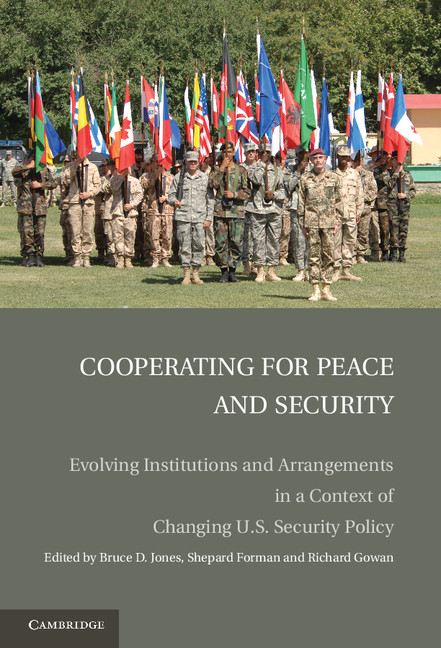

Cooperating for Peace and Security attempts to understand - more than fifteen years after the end of the Cold War, seven years after 9/11, and in the aftermath of the failure of the United Nations (UN) reform initiative - the relationship between US security interests and the factors that drove the evolution of multilateral security arrangements from 1989 to the present. Chapters cover a range of topics - including the UN, US multilateral cooperation, the North Atlantic Treaty Organization (NATO), nuclear nonproliferation, European and African security institutions, conflict mediation, counterterrorism initiatives, international justice and humanitarian cooperation - examining why certain changes have taken place and the factors that have driven them and evaluating whether they have led to a more effective international system and what this means for facing future challenges.
‘This volume provides a uniquely detailed and wide-ranging survey of international institutions and security cooperation since the end of the Cold War. It will become a standard point of reference in debates about the US and multilateralism in a changing world.'
Kemal Dervis - Vice President and Director of Global Economy and Development, The Brookings Institution and former Executive Head of UNDP
Loading metrics...
* Views captured on Cambridge Core between #date#. This data will be updated every 24 hours.
Usage data cannot currently be displayed.
This section outlines the accessibility features of this content - including support for screen readers, full keyboard navigation and high-contrast display options. This may not be relevant for you.
Accessibility compliance for the PDF of this book is currently unknown and may be updated in the future.
