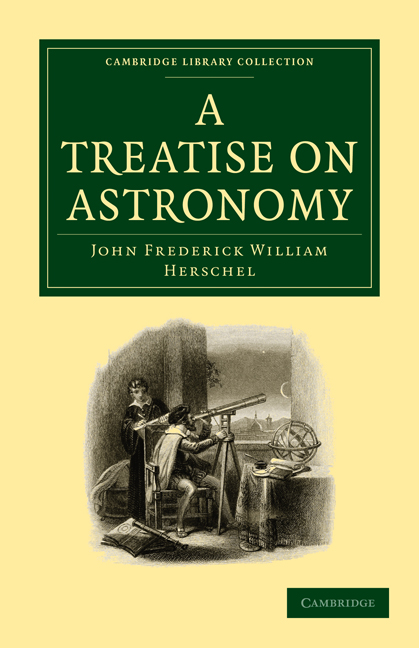

Astronomer and philosopher Sir John Herschel (1792–1871), the son of William and the nephew of Caroline, published his 1833 Treatise on Astronomy in the 'Cabinet Cyclopaedia' series of which the first volume had been his enormously successful Preliminary Discourse on the Study of Natural Philosophy. He is regarded as the founder of the philosophy of science, and made contributions in many fields including mathematics, the newly discovered process of photography, and the botany of southern Africa, which he studied while making astronomical observations of the southern hemisphere, and where he was visited by Darwin and Fitzroy on the Beagle voyage. It was however as the natural successor to his father's astronomical studies that he is best remembered, and this book, which is written for the interested lay person, places strong emphasis on the importance of accurate observation and on avoiding preconceptions or hypotheses not based on such observation.
Loading metrics...
* Views captured on Cambridge Core between #date#. This data will be updated every 24 hours.
Usage data cannot currently be displayed.
This section outlines the accessibility features of this content - including support for screen readers, full keyboard navigation and high-contrast display options. This may not be relevant for you.
Accessibility compliance for the PDF of this book is currently unknown and may be updated in the future.
