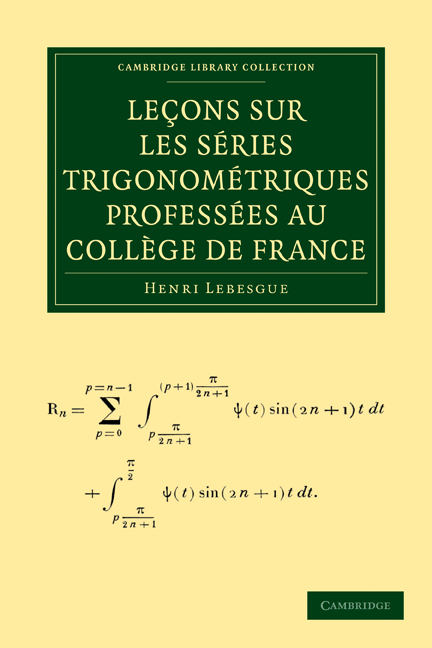

The two great works of the celebrated French mathematician Henri Lebesgue (1875–1941), Leçons sur l'intégration et la recherche des fonctions primitives professées au Collège de France (1904) and Leçons sur les séries trigonométriques professées au Collège de France (1906) arose from lecture courses he gave at the Collège de France while holding a teaching post at the University of Rennes. In 1901 Lebesgue formulated measure theory; and in 1902 his new definition of the definite integral, which generalised the Riemann integral, revolutionised integral calculus and greatly expanded the scope of Fourier analysis. The Lebesgue integral is regarded as one of the major achievements in modern real analysis, and remains central to the study of mathematics today. Both of Lebesgue's books are reissued in this series.
Loading metrics...
* Views captured on Cambridge Core between #date#. This data will be updated every 24 hours.
Usage data cannot currently be displayed.
This section outlines the accessibility features of this content - including support for screen readers, full keyboard navigation and high-contrast display options. This may not be relevant for you.
Accessibility compliance for the PDF of this book is currently unknown and may be updated in the future.
