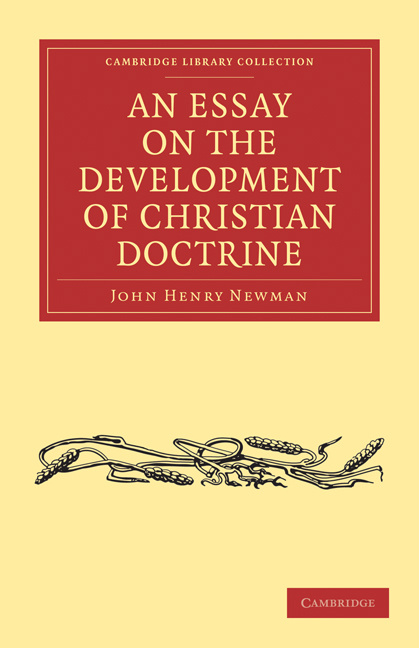

John Henry Newman (1801–1890) remains one of the best-known and influential English churchmen of the nineteenth century. Ordained as a priest in the Anglican Church in 1825, he converted to Roman Catholicism, being ordained as a priest and later appointed cardinal. His works include Grammar of Assent (1870) and Apologia Pro Vita Sua (1865–1866) as well as this Essay (1845), written in the midst of his own religious transformation. He discusses his theory of the development of Christian dogma: 'from the nature of the human mind, time is necessary for the full comprehension and perfection of great ideas … the longer time and deeper thought for their full elucidation'. By showing how fidelity to timeless truths coexisted in Christianity together with deeper and more developed understanding over time, Newman provides a helpful personal and theological apology for the teaching and practice of Catholicism against its detractors.
Loading metrics...
* Views captured on Cambridge Core between #date#. This data will be updated every 24 hours.
Usage data cannot currently be displayed.
This section outlines the accessibility features of this content - including support for screen readers, full keyboard navigation and high-contrast display options. This may not be relevant for you.
Accessibility compliance for the PDF of this book is currently unknown and may be updated in the future.
