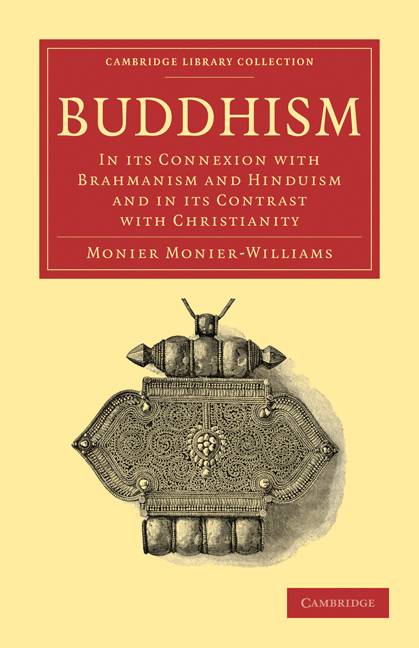

This book derives from a series of lectures given in 1888 by Monier Monier-Williams, who was Professor of Sanskrit at Oxford for over 30 years and whose work broke new ground in the Western understanding of Buddhism and other South Asian religions. This substantial historical survey of Buddhism begins with an account of the Buddha and his earliest teaching, as well as a brief description of the origin and composition of the scriptures containing the Buddha's law (Dharma). Monier-Williams explains the early constitution of the Buddha's order of monks (Sangha), and outlines the philosophical doctrines of Buddhism together with its code of morality and theory of perfection, culminating in Nirvana. He also describes formal and popular rituals and practices, and sacred places and objects. The book is an example of Victorian Orientalist scholarship which remains of interest to historians of religious studies, Orientalism, and the British Empire.
Loading metrics...
* Views captured on Cambridge Core between #date#. This data will be updated every 24 hours.
Usage data cannot currently be displayed.
This section outlines the accessibility features of this content - including support for screen readers, full keyboard navigation and high-contrast display options. This may not be relevant for you.
Accessibility compliance for the PDF of this book is currently unknown and may be updated in the future.
