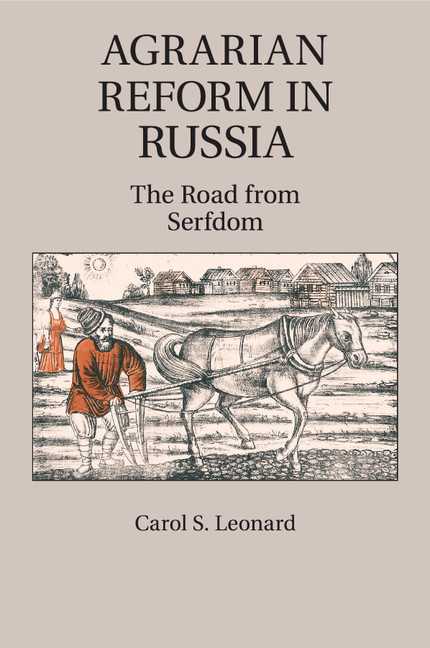

This book examines the history of reforms and major state interventions affecting Russian agriculture: the abolition of serfdom in 1861, the Stolypin reforms, the NEP, the Collectivization, Khrushchev reforms, and finally farm enterprise privatization in the early 1990s. It shows a pattern emerging from a political imperative in imperial, Soviet, and post-Soviet regimes, and it describes how these reforms were justified in the name of the national interest during severe crises - rapid inflation, military defeat, mass strikes, rural unrest, and/or political turmoil. It looks at the consequences of adversity in the economic environment for rural behavior after reform and at long-run trends. It has chapters on property rights, rural organization, and technological change. It provides a new database for measuring agricultural productivity from 1861 to 1913 and updates these estimates to the present. This book is a study of the policies aimed at reorganizing rural production and their effectiveness in transforming institutions.
‘This book is rich and informative, placing agrarian reforms in a full macroeconomic context and allowing them to be understood as part of the history of Russian transitions. This is a must-read.’
Brigitte Granville - Queen Mary, University of London
‘There isn’t another book on the market that succeeds in the ambitious goal of tying Russian agricultural reform to economic performance over more than 150 years. The conclusion that the positive effects of reform are only evident over a long period of time carries important policy implications.’
Paul R. Gregory - University of Houston
'Agrarian Reform in Russia: The Road from Serfdom is a broad-reaching, ambitious survey and analysis of agricultural change and reform in Russia from the emancipation of 1861 to the present day … Anyone interested in the fascinating debate on the rural commune’s origin, development, functioning, and legacy, and its role in maintaining tradition as well as facilitating change, will find this book an excellent starting place.'
Source: Revolutionary Russia
'An impressive book … packed with detail.'
Source: Slavonic and East European Review
'This is a richly-textured book, and it includes significant statistical evidence, especially relating to agricultural performance between 1861 and 1911. Its themes are illuminated by the author's own experience as an advisor to the Russian government on agricultural policy in the 1990s and Leonard's work is not simply a piece of historical scholarship, but offers broad observations on the nature of Agrarian policy making in Russia.'
Peter Waldron Source: European History Quarterly
Loading metrics...
* Views captured on Cambridge Core between #date#. This data will be updated every 24 hours.
Usage data cannot currently be displayed.
This section outlines the accessibility features of this content - including support for screen readers, full keyboard navigation and high-contrast display options. This may not be relevant for you.
Accessibility compliance for the PDF of this book is currently unknown and may be updated in the future.
