
Skip to main content Accessibility help
×
  • Cited by 63
    • Volume 1: Regarding Method
      Show more authors
    • You may already have access via personal or institutional login
    • Select format
    • Publisher:
      Cambridge University Press
      Publication date:
      05 September 2012
      09 September 2002
      ISBN:
      9780511790812
      9780521581059
      9780521589260
      Dimensions:
      (228 x 152 mm)
      Weight & Pages:
      0.509kg, 228 Pages
      Dimensions:
      (228 x 152 mm)
      Weight & Pages:
      0.377kg, 225 Pages
    You may already have access via personal or institutional login
  • Selected: Digital
    Add to cart View cart Buy from Cambridge.org

    Book description

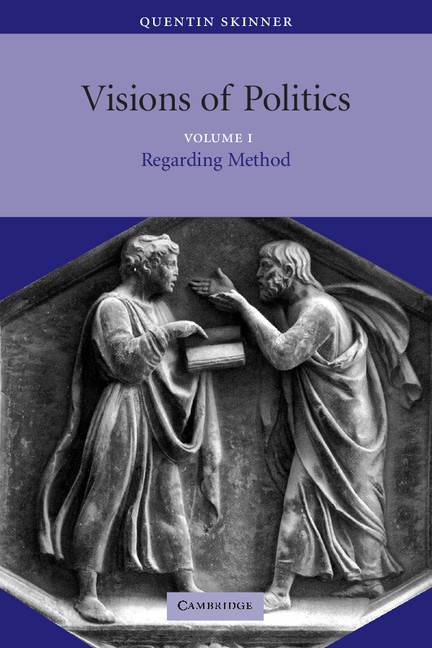
    The first of three volumes of essays by Quentin Skinner, one of the world's leading intellectual historians. This collection includes some of his most important philosophical and methodological statements written over the past four decades, each carefully revised for publication in this form. In a series of seminal essays Professor Skinner sets forth the intellectual principles that inform his work. Writing as a practising historian, he considers the theoretical difficulties inherent in the pursuit of knowledge and interpretation, and elucidates the methodology which finds its expression in his two successive volumes. All of Professor Skinner's work is characterised by philosophical power, limpid clarity, and elegance of exposition; these essays, many of which are now recognised classics, provide a fascinating and convenient digest of the development of his thought.Professor Skinner has been awarded the Balzan Prize Life Time Achievement Award for Political Thought, History and Theory. Full details of this award can be found at http://www.balzan.it/News_eng.aspx?ID=2474

    Awards

    Winner of the 2007 David Easton Award - Foundation of Political Theory Section of the American Political Science Association

    Reviews

    ‘Quentin Skinner is one of the world’s foremost historians of political thought … As a retrospective showcase of the work of a major scholar, this is impressive. Skinner’s ability to combine political and philosophical insight with minute knowledge of several centuries of political literature is awe inspiring.’

    Robert Sugden Source: The Times Higher Education Supplement

    ' … this is a deeply impressive collection which displays Skinner's exceptional range.'

    Source: The New York Review

    Refine List

    Actions for selected content:

    Select all | Deselect all
    • View selected items
    • Export citations
    • Download PDF (zip)
    • Save to Kindle
    • Save to Dropbox
    • Save to Google Drive

    Save Search

    You can save your searches here and later view and run them again in "My saved searches".

    Please provide a title, maximum of 40 characters.
    ×

    Contents

    Bibliography
    Aaron, Richard I. (1955). John Locke, 2nd edn, Oxford
    Abelson, Raziel (1965). ‘Because I Want To’, Mind 74, pp. 540–53
    Abrams, Philip (1967). Introduction to John Locke, Two Tracts on Government, ed. Philip Abrams, Cambridge, pp. 3–111
    Adkins, A. W. H. (1960). Merit and Responsibility: A Study in Greek Values, Oxford
    Adler, M. J. (1967). Foreword to Otto A. Bird, The Idea of Justice, New York
    Aiken, Henry David (1955). ‘The Aesthetic Relevance of Artists’ Intentions', Journal of Philosophy 52, pp. 742–53
    Alexander, William (Earl of Stirling) (1624). An Encouragement to Colonies, London
    Allport, Floyd H. (1955). Theories of Perception and the Concept of Structure, New York
    Ammirato, Scipio (1846–9). Istorie Fiorentine, ed. Ferdinando Ranalli, 6 vols., Florence
    Anglo, Sydney (1966). ‘The Reception of Machiavelli in Tudor England: A Reassessment’, Il Politico 31, pp. 127–38
    Anglo, Sydney (1969). Machiavelli: A Dissection, London
    Anglo, Sydney (1973). ‘Melancholia and Witchcraft: The Debate between Wier, Bodin and Scot’ in Folie et déraison à la Renaissance, ed. Alois Gerlo, Brussels, pp. 209–22
    Anscombe, G. E. M. (1957). Intention, Oxford
    Aristotle (1926). The ‘Art’ of Rhetoric, ed. and trans. J. H. Freese, London
    Armstrong, Robert L. (1965). ‘John Locke's “Doctrine of Signs”: A New Metaphysics’, Journal of the History of Ideas 26, pp. 369–82
    Arnold, Thomas Clay (1993). Thoughts and Deeds: Language and the Practice of Political Theory, New York
    Aubrey, John (1898). ‘Brief Lives’, chiefly of Contemporaries, set down by John Aubrey, between the years 1669 & 1696, ed. Andrew Clark, 2 vols., Oxford
    Austin, J. L. (1980). How To Do Things With Words, ed. J. O. Urmson and Marina Sbisà, 2nd edn with corrections, Oxford
    Avineri, Shlomo (1968). The Social and Political Thought of Karl Marx, Cambridge
    Ayer, A. J. (1967). ‘Man as a Subject for Science’ in Philosophy, Politics and Society, 3rd series, ed. Peter Laslett and W. G. Runciman, Oxford, pp. 6–24
    Ayers, Michael (1978). ‘Analytical Philosophy and the History of Philosophy’ in Philosophy and its Past, ed. Jonathan Rée, Michael Ayers and Adam Westoby, Brighton, pp. 41–66
    Bach, Kent and Harnish, Robert M. (1979). Linguistic Communication and Speech Acts, Cambridge, Mass
    Bailyn, Bernard (1967). The Ideological Origins of the American Revolution, Cambridge, Mass
    Barnard, F. M. (1965). Herder's Social and Political Thought, Oxford
    Barnes, Barry (1974). Scientific Knowledge and Sociological Theory, London
    Barnes, Barry and Bloor, David (1982). ‘Relativism, Rationalism and the Sociology of Knowledge’ in Rationality and Relativism, ed. Martin Hollis and Steven Lukes, London, pp. 21–47
    Baron, Hans (1961). ‘Machiavelli: the Republican Citizen and the Author of The Prince’, English Historical Review 76, pp. 217–53
    Bartelson, Jens (1995). A Genealogy of Sovereignty, Cambridge
    Barthes, Roland (1979). ‘From Work to Text’ in Textual Strategies, ed. Josué V. Harari, Ithaca, N.Y., pp. 73–81
    Bateson, F. W. (1953). ‘The Function of Criticism at the Present Time’, Essays in Criticism 3, pp. 1–27
    Baumgold, Deborah (1981). ‘Political Commentary on the History of Political Theory’, American Political Science Review 75, pp. 928–40
    Baxter, Andrew (1745). An Enquiry into the Nature of the Human Soul, 3rd edn, 2 vols., London
    Beardsley, Monroe C. (1958). Aesthetics, New York
    Beardsley, Monroe C. (1970). The Possibility of Criticism, Detroit, Mich
    Beardsley, Monroe C. (1992). ‘The Authority of the Text’ in Intention and Interpretation, ed. Gary Iseminger, Philadelphia, Penn., pp. 24–40
    Bevir, Mark (1994). ‘Are There any Perennial Problems in Political Theory?’Political Studies 42, pp. 662–75
    Bevir, Mark (1997). ‘Mind and Method in the History of Ideas’, History and Theory 36, pp. 167–89
    Bevir, Mark (1999). The Logic of the History of Ideas, Cambridge
    Bevir, Mark (2001). ‘Taking Holism Seriously: A Reply to Critics’, Philosophical Books 42, pp. 187–95
    Bird, Otto A. (1967). The Idea of Justice, New York
    Blackburn, Simon (1984). Spreading the Word, Oxford
    Bloom, Allan (1980). ‘The Study of Texts’ in Political Theory and Political Education, ed. Melvin Richter, Princeton, N.J., pp. 113–38
    Bloom, Allan and Jaffa, Harry C. (1964). Shakespeare's Politics, New York
    Bloor, David (1976). Knowledge and Social Imagery, London
    Bluhm, William T. (1965). Theories of the Political System, Englewood Cliffs, N.J.
    Bodin, Jean (1595). La Demonomanie des Sorciers, Paris
    Boucher, David (1985). Texts in Contexts: Revisionist Methods for Studying the History of Ideas, Dordrecht
    Bracken, Harry M. (1965). The Early Reception of Berkeley's Immaterialism, 1710–1733, The Hague
    Brailsford, H. N. (1961). The Levellers and the English Revolution, London
    Brodbeck, May (1963). ‘Meaning and Action’, Philosophy of Science 30, pp. 309–24
    Bronowski, Jacob and Mazlish, Bruce (1960). The Western Intellectual Tradition, London
    Brooke, John (1963–4). ‘Namier and Namierism’, History and Theory 3, pp. 331–47
    Burke, Peter (1995). The Fortunes of the ‘Courtier’: The European Reception of Castiglione's ‘Cortegiano’, Cambridge
    Bury, J. B. (1932). The Idea of Progress, London
    Butterfield, Herbert (1957). George III and the Historians, London
    Carr, E. H. (1961). What is History? London
    Cassirer, Ernst (1946). The Myth of the State, New Haven, Conn
    Cassirer, Ernst (1954). The Question of Jean-Jacques Rousseau, trans. Peter Gay, Bloomington, Ind
    Cassirer, Ernst (1955). The Philosophy of the Enlightenment, trans. Fritz C. A. Koelln and James P. Pettegrove, Beacon edn, Boston, Mass
    Castiglione, Baldassare (1981). Il Libro del Cortegiano [1528], ed. Nicola Longo, Milan
    Castiglione, Baldassare (1994). The Book of the Courtier [1561], trans. Thomas Hoby, ed. Virginia Cox, London
    Castoriadis, Cornelius (1987). The Imaginary Institution of Society, trans. Kathleen Blamey, Cambridge
    Catlin, G. E. G. (1950). A History of Political Philosophy, London
    Chapman, J. W. (1956). Rousseau – Totalitarian or Liberal? New York
    Cherel, Albert (1935). La Pensée de Machiavel en France, Paris
    Cicero (1942). De Partitione Oratoria, ed. and trans. H. Rackham, London
    Cioffi, Frank (1976). ‘Intention and Interpretation in Criticism’ in On Literary Intention, ed. David Newton-De Molina, Edinburgh, pp. 55–73
    Clark, Stuart (1980). ‘Inversion, Misrule and the Meaning of Witchcraft’, Past and Present 87, pp. 98–127
    Clark, Stuart (1997). Thinking with Demons: The Idea of Witchcraft in Early Modern Europe, Oxford
    Close, A. J. (1972). ‘Don Quixote and “The Intentionalist Fallacy”’, British Journal of Aesthetics 12, pp. 19–39
    Cobban, Alfred (1941). The Crisis of Civilization, London
    Cochrane, Eric W. (1961). ‘Machiavelli: 1940–1960’, Journal of Modern History 33, pp. 113–36
    Cohn, Norman (1976). Europe's Inner Demons, London
    Colish, Marcia L. (1971). ‘The Idea of Liberty in Machiavelli’, Journal of the History of Ideas 32, pp. 323–50
    Collingwood, R. G. (1939). An Autobiography, Oxford
    Collingwood, R. G. (1940). An Essay on Metaphysics, Oxford
    Collingwood, R. G. (1946). The Idea of History, Oxford
    Coltman, Irene (1962). Private Men and Public Causes: Philosophy and Politics in the English Civil War, London
    Corwin, Edward S. (1928–9). ‘The “Higher Law” Background of American Constitutional Law’, Harvard Law Review 42, pp. 149–85, 365–409
    Corwin, Edward S. (1948). Liberty against Government, Baton Rouge, La
    Cox, Richard H. (1960). Locke on War and Peace, Oxford
    Cranston, Maurice (1964). ‘Aquinas’ in Western Political Philosophers, ed. Maurice Cranston, London, pp. 29–36
    Cropsey, Joseph (1962). ‘A Reply to Rothman’, American Political Science Review 56, pp. 353–9
    Curley, E. M. (1978). Descartes Against the Skeptics, Oxford
    Dahl, Robert A. (1963). Modern Political Analysis, Englewood Cliffs, N.J.
    Danto, Arthur C. (1965). Analytical Philosophy of History, Cambridge
    Davidson, Donald (1963). ‘Action, Reason and Cause’, Journal of Philosophy 60, pp. 685–700
    Davidson, Donald (1967). ‘The Logical Form of Action Sentences’ in The Logic of Decision and Action, ed. Nicholas Rescher, Pittsburgh, Penn., pp. 81–95
    Davidson, Donald (1984). ‘On the Very Idea of a Conceptual Scheme’ in Inquiries into Truth and Interpretation, Oxford, pp. 183–98
    Davidson, Donald (1986). ‘A Coherence Theory of Truth and Knowledge’ in Truth and Interpretation, ed. Ernest LePore, Oxford, pp. 307–19
    Davies, E. T. (1964). The Political Ideas of Richard Hooker, London
    Defoe, Daniel (1965). ‘The Shortest-Way with the Dissenters’ [1702] in Daniel Defoe, ed. James T. Boulton, London, pp. 88–99
    D'Entrèves, A. P. (1939). The Medieval Contribution to Political Thought, Oxford
    Derrida, Jacques (1976).Of Grammatology, trans. Gayatri Chakravorty Spivak, Baltimore, Md
    Derrida, Jacques (1978). Writing and Difference, trans. Alan Bass, London
    Derrida, Jacques (1979). Spurs: Nietzsche's Styles, trans. Barbara Harlow, Chicago, Ill
    Dibon, Paul (1959). ‘Redécouverte de Bayle’ in Pierre Bayle: Le Philosophe de Rotterdam: Etudes et documents, ed. Paul Dibon, Amsterdam, pp. ⅶ–ⅹⅶ
    Dickens, Charles (1985). Hard Times [1854], ed. David Craig, Penguin Classics edn, London
    Donagan, Alan (1957). ‘Explanation in History’, Mind 66, pp. 145–64
    Dray, William (1957). Laws and Explanations in History, Oxford
    Dummett, Michael (1973a). Frege: Philosophy of Language, London
    Dummett, Michael (1973b). ‘The Justification of Induction’, Proceedings of the British Academy 59, pp. 201–32
    Dunn, John (1969). The Political Thought of John Locke: An Historical Account of the Argument of the ‘Two Treatises of Government’, Cambridge
    Dunn, John (1980). Political Obligation in its Historical Context: Essays in Political Theory, Cambridge
    Dunn, John (1996). The History of Political Theory and Other Essays, Cambridge
    Durkheim, Emile (1964). The Rules of Sociological Method, trans. S. A. Solovay and J. H. Mueller, New York
    Eburne, Richard (1962). A Plain Pathway to Plantations [1624] in Folger Documents of Tudor and Stuart Civilization, ed. Louis B. Wright, Ithaca, N.Y., pp. 3–154
    Edling, Max and Mörkenstam, Ulf (1995). ‘Quentin Skinner: from Historian to Political Scientist’, Scandinavian Political Studies 18, pp. 119–32
    Elster, Jon (1978). Logic and Society, New York
    Elster, Jon (1982). ‘Belief, Bias and Ideology’ in Rationality and Relativism, ed. Martin Hollis and Steven Lukes, London, pp. 123–48
    Elton, G. R. (1969a). The Practice of History, rev. edn, London
    Elton, G. R. (1969b). England 1200–1640, Cambridge
    Elton, G. R. (1970). Political History: Principles and Practice, London
    Elton, G. R. (1991). Return to Essentials, Cambridge
    Elyot, Sir Thomas (1962). The Book Named the Governor [1531], ed. S. E. Lehmberg, London
    Evans, Richard J. (1997). In Defence of History, London
    Femia, Joseph V. (1988). ‘An Historicist Critique of “Revisionist” Methods for Studying the History of Ideas’ in Meaning and Context: Quentin Skinner and his Critics, ed. James Tully, Cambridge, pp. 156–75
    Fennor, William (1965). The Counter's Commonwealth [1617] in The Elizabethan Underworld, ed. A. V. Judges, London, pp. 423–87
    Fish, Stanley (1980). Is There a Text in this Class? Cambridge, Mass
    Foord, Archibald S. (1964). His Majesty's Opposition, 1714–1830, Oxford
    Foot, Philippa (1958). ‘Moral Arguments’, Mind 67, pp. 502–13
    Forster, E. M. (1924). A Passage to India, London
    Forster, Michael N. (1998). ‘On the Very Idea of Denying the Existence of Radically Different Conceptual Schemes’, Inquiry 41, pp. 133–85
    Foucault, Michel (1979). ‘What is an Author?’ in Textual Strategies, ed. Josué V. Harari, Ithaca, N.Y., pp. 141–60
    Foucault, Michel (1980). Power/Knowledge, ed. Colin Gordon, Brighton
    Freundlieb, Dieter (1980). ‘Identification, Interpretation, and Explanation: Some Problems in the Philosophy of Literary Studies’, Poetics 9, pp. 423-40
    Friedrich, C. J. (1964). ‘On Re-reading Machiavelli and Althusius: Reason, Rationality and Religion’ in Rational Decision, ed. C. J. Friedrich, New York
    Gadamer, Hans-Georg (1960). Wahrheit und Methode, Tübingen
    Gadamer, Hans-Georg (1975). Truth and Method, London
    Gang, T. M. (1957). ‘Intention’, Essays in Criticism 7, pp. 175–86
    Gardiner, Patrick (ed.) (1959). Theories of History, New York
    Garfinkel, Alan (1981). Forms of Explanation, New Haven, Conn
    Gay, Peter (1974). Style in History, New York
    Geertz, Clifford (1980). Negara: The Theater State in Nineteenth-Century Bali, Princeton, N.J.
    Geertz, Clifford (1983). Local Knowledge, New York
    Geertz, Clifford (2000). Available Light: Anthropological Reflections on Philosophical Topics, Princeton, N.J.
    Geuss, Raymond (1981). The Idea of a Critical Theory: Habermas and the Frankfurt School, Cambridge
    Gibson, Quentin (1960). The Logic of Social Enquiry, London
    Gilbert, Felix (1977). History: Choice and Commitment, Cambridge, Mass
    Gombrich, E. H. (1962). Art and Illusion: A Study in the Psychology of Pictorial Representation, rev. edn, London
    Goodman, Nelson (1978). Ways of Worldmaking, Brighton
    Gorman, David, et al. (1987). ‘Provocation on Belief’, Social Epistemology 1, pp. 97–108
    Gough, J. W. (1950). John Locke's Political Philosophy: Eight Studies, Oxford
    Gough, J. W. (1957). The Social Contract, 2nd edn, Oxford
    Graham, Keith (1977). J. L. Austin: A Critique of Ordinary Language Philosophy, Brighton
    Graham, Keith (1980). ‘The Recovery of Illocutionary Force’, Philosophical Quarterly 30, pp. 141–8
    Graham, Keith (1981). ‘Illocution and Ideology’ in Issues in Marxist Philosophy 4, ed. John Mepham and D. H. Ruben, Brighton, pp. 153–94
    Graham, Keith (1988). ‘How Do Illocutionary Descriptions Explain?’ in Meaning and Context: Quentin Skinner and his Critics, ed. James Tully, Cambridge, pp. 147–55
    Greene, John C. (1957–8). ‘Objectives and Methods in Intellectual History’, Mississippi Valley Historical Review 44, pp. 58–74
    Greenleaf, W. H. (1972a). ‘Hobbes: The Problem of Interpretation’, in Hobbes and Rousseau, ed. Maurice Cranston and R. S. Peters, New York, pp. 5–36
    Greenleaf, W. H. (1972b). ‘Hume, Burke and the General Will’, Political Studies 20, pp. 131–40
    Grice, H. P. (1957). ‘Meaning’, Philosophical Review 66, pp. 377–88
    Grice, H. P. (1969). ‘Utterer's Meaning and Intentions’, Philosophical Review 78, pp. 147–77
    Guilhaumou, Jacques (2000). ‘De l'histoire des concepts à l'histoire linguistique des usages conceptuels’, Genèses 38, pp. 105–18
    Gunn, J. A. W. (1988–9). ‘After Sabine, After Lovejoy: The Languages of Political Thought’, Journal of History and Politics 6, pp. 1–45
    Gunnell, John G. (1979). Political Theory: Tradition and Interpretation, Cambridge, Mass
    Gunnell, John G. (1982). ‘Interpretation and the History of Political Theory: Apology and Epistemology’, American Political Science Review 76, pp. 317–27
    Gwyn, W. B. (1965). The Meaning of the Separation of Powers, New Orleans
    Hacker, Andrew (1954). ‘Capital and Carbuncles: the “Great Books” Reappraised’, American Political Science Review 48, pp. 775–86
    Hacker, Andrew (1961). Political Theory: Philosophy, Ideology, Science, New York
    Hacking, Ian (1982). ‘Language, Truth and Reason’ in Rationality and Relativism, ed. Martin Hollis and Steven Lukes, London, pp. 48–66
    Hacking, Ian (1991). ‘The Making and Molding of Child Abuse’, Critical Inquiry 17, pp. 253–88
    Hacking, Ian (1995). Rewriting the Soul: Multiple Personality and the Sciences of Memory, Princeton, N.J.
    Hampsher-Monk, Iain (1988). ‘Speech Acts, Languages or Conceptual History?’ in History of Concepts: Comparative Perspectives, ed. Iain Hampsher-Monk, Karen Tilmans and F. Van Free, Amsterdam, pp. 37–50
    Hampsher-Monk, Iain (2001). ‘The History of Political Thought and the Political History of Thought’ in The History of Political Thought in National Context, ed. Dario Castiglione and Iain Hampsher-Monk, Cambridge, pp. 159–74
    Hampshire, Stuart (1959). Thought and Action, London
    Hancher, Michael (1972). ‘Three Kinds of Intention’, Modern Language Notes 87, pp. 827–51
    Hare, R. M. (1952). The Language of Morals, Oxford
    Harlan, David (1989). ‘Intellectual History and the Return of Literature’, American Historical Review 94, pp. 581–609
    Harrison, W. (1955). ‘Texts in Political Theory’, Political Studies 3, pp. 28–44
    Hart, Jeffrey P. (1965). Viscount Bolingbroke, Tory Humanist, London
    Hawthorn, Geoffrey (1979). ‘Characterising the History of Social Theory’, Sociology 13, pp. 475–82
    Hearnshaw, F. J. C. (1928). ‘Henry St John, Viscount Bolingbroke’ in The Social & Political Ideas of Some English Thinkers of the Augustan Age A.D. 1650–1750, ed. F. J. C. Hearnshaw, London, pp. 210–47
    Hempel, Carl (1942). ‘The Function of General Laws in History’, Journal of Philosophy 39, pp. 35–48
    Hesse, Mary (1970a). ‘Hermeticism and Historiography: An Apology for the Internal History of Science’ in Minnesota Studies in the Philosophy of Science 5, ed. Roger H. Stuewer, Minneapolis, Minn., pp. 134–60
    Hesse, Mary (1970b). ‘Is There an Independent Observation Language?’ in The Nature and Function of Scientific Theories, ed. R. G. Colodny, Pittsburgh, Penn., pp. 35–77
    Hesse, Mary (1973). ‘Reasons and Evaluations in the History of Science’ in Changing Perspectives in the History of Science, ed. Mikulás Teich and Robert Young, London, pp. 127–47
    Hesse, Mary (1974). The Structure of Scientific Inference, London
    Hexter, J. H. (1964). ‘The Loom of Language and the Fabric of Imperatives: the Case of Il Principe and Utopia’, American Historical Review 69, pp. 945–68
    Hexter, J. H. (1971). The History Primer, London
    Hirsch, E. D., Jr (1967). Validity in Interpretation, New Haven, Conn
    Hirsch, E. D., Jr (1976). ‘In Defense of the Author’ in On Literary Intention, ed. David Newton-De Molina, Edinburgh, pp. 87–103
    Hobbes, Thomas (1996). Leviathan, or The Matter, Forme, & Power of a Commonwealth Ecclesiasticall and Civill [1651], ed. Richard Tuck, Cambridge
    Holdcroft, David (1978). Words and Deeds, Oxford
    Hollinger, David A. (1985). In the American Province: Studies in the History and Historiography of Ideas, Bloomington, Ind
    Hollis, Martin (1970a). ‘The Limits of Irrationality’ in Rationality, ed. Bryan R. Wilson, Oxford, pp. 214–20
    Hollis, Martin (1970b). ‘Reason and Ritual’ in Rationality, ed. Bryan R. Wilson, Oxford, pp. 221–39
    Hollis, Martin (1972). ‘Witchcraft and Winchcraft’, Philosophy of the Social Sciences 2, pp. 89–103
    Hollis, Martin (1974). ‘My Role and its Duties’ in Nature and Conduct, ed. R. S. Peters, London, pp. 180–99
    Hollis, Martin (1982). ‘The Social Destruction of Reality’ in Rationality and Relativism, ed. Martin Hollis and Steven Lukes, London, pp. 67–86
    Hollis, Martin (1988). ‘Say it with Flowers’, in Meaning and Context: Quentin Skinner and his Critics, ed. James Tully, Cambridge, pp. 135–46
    Hood, F. C. (1964). The Divine Politics of Thomas Hobbes, Oxford
    Hooker, Richard (1989). Of the Laws of Ecclesiastical Polity [1594], ed. A. S. McGrade, Cambridge
    Hough, Graham (1966). An Essay on Criticism, London
    Hough, Graham (1976). ‘An Eighth Type of Ambiguity’ in On Literary Intention, ed. David Newton-De Molina, Edinburgh, pp. 222–41
    Hoy, David (1985). ‘Jacques Derrida’ in The Return of Grand Theory in the Human Sciences, ed. Quentin Skinner, Cambridge, pp. 43–64
    Hudson, Liam (1972). The Cult of the Fact, New York
    Hume, Robert D. (1999). Reconstructing Contexts: The Aims and Principles of Archaeo-Historicism, Oxford
    Humphrey, Lawrence (1563). The Nobles, or Of Nobility, London
    Hylton, Peter (1984). ‘The Nature of the Proposition and the Revolt against Idealism’ in Philosophy in History, ed. Richard Rorty, J. B. Schneewind and Quentin Skinner, Cambridge, pp. 375–97
    Inglis, Fred (2000). Clifford Geertz: Culture, Custom and Ethics, Cambridge
    Iser, Wolfgang (1972). ‘The Reading Process: A Phenomenological Approach’, New Literary History, 3, pp. 279–99
    Jacob, James R. and Jacob, Margaret C. (1980). ‘The Anglican Origins of Modern Science: the Metaphysical Foundations of the Whig Constitution’, Isis 7, pp. 251–67
    Jacob, Margaret C. (1976). The Newtonians and the English Revolution, 1689–1720, Ithaca, N.Y.
    James, Susan (1984). The Content of Social Explanation, Cambridge
    Jarvie, I. C. (1970). ‘Understanding and Explanation in Sociology and Social Anthropology’ in Explanation in the Behavioural Sciences, ed. Robert Borger and Frank Cioffi, Cambridge, pp. 231–48
    Jarvie, I. C. and Agassi, Joseph (1970). ‘The Problem of the Rationality of Magic’ in Rationality, ed. Bryan Wilson, London, pp. 172–93
    Jaspers, Karl (1962). The Great Philosophers, vol. 1, London
    Jauss, Hans Robert (1970). ‘Literary History as a Challenge to Literary Theory’, New Literary History 2, pp. 7–37
    Jenssen, Peter L. (1985). ‘Political Thought as Traditionary Action: the Critical Response to Skinner and Pocock’, History and Theory 24, pp. 115–46
    Jones, Robert A. (1977). ‘On Understanding a Sociological Classic’, American Journal of Sociology 83, pp. 279–319
    Jones, W. T. (1947). Machiavelli to Bentham in Masters of Political Thought, ed. Edward M. Sait, 3 vols., London, vol. 2
    Joyce, James (1969). Ulysses [1922], Harmondsworth
    Juhl, P. D. (1976). ‘Can the Meaning of a Literary Work Change?’ in The Uses of Criticism, ed. A. P. Foulkes, Frankfurt, pp. 133–56
    Juhl, P. D. (1980). Interpretation, Princeton, N.J.
    Kaufman, Arnold S. (1954). ‘The Nature and Function of Political Theory’, Journal of Philosophy 51, pp. 5–22
    Keane, John (1988). ‘More Theses on the Philosophy of History’ in Meaning and Context: Quentin Skinner and his Critics, ed. James Tully, Cambridge, pp. 204–17
    Kenny, Anthony (1963). Action, Emotion and Will, London
    King, Preston (1983). ‘The Theory of Context and the Case of Hobbes’ in The History of Ideas, ed. Preston King, London, pp. 285–315
    King, Preston (1995). ‘Historical Contextualism: The New Historicism?’History of European Ideas 21, pp. 209–33
    Kiremidjian, G. D. (1969–70). ‘The Aesthetics of Parody’, Journal of Aesthetics and Art Criticism 28, pp. 231–42
    Kjellström, Peter (1995). ‘The Narrator and the Archaeologist: Modes of Meaning and Discourse in Quentin Skinner and Michel Foucault’, Statsvetenskaplig Tidskrift, 98, pp. 21–41
    Koselleck, Reinhart (1985). Futures Past: On the Semantics of Historical Time, trans. Keith Tribe, London
    Koselleck, Reinhart (1989). ‘Linguistic Change and the History of Events’, Journal of Modern History 61, pp. 649–66
    Kuhn, Thomas S. (1962). The Structure of Scientific Revolutions, Chicago, Ill
    Kuhn, Thomas S. (1977). The Essential Tension, Chicago, Ill
    Labrousse, Elisabeth (1964). Pierre Bayle, vol. 2: Hétérodoxie et rigorisme, The Hague
    LaCapra, Dominick (1980). ‘Rethinking Intellectual History and Reading Texts’, History and Theory 19, pp. 245–76
    Ladurie, E. Le Roy (1974). The Peasants of Languedoc, trans. John Day, London
    Laing, R. D. and Esterson, A. (1970). Sanity, Madness, and the Family, 2nd edn, London
    Lakatos, Imre (1978). The Methodology of Scientific Research Programmes: Philosophical Papers, vol. 1, ed. John Worrall and Gregory Currie, Cambridge
    Lakoff, Sanford A. (1964). Equality in Political Philosophy, Cambridge, Mass
    Laski, Harold J. (1961). Political Thought in England: Locke to Bentham, Oxford
    Laslett, Peter (1965). Introduction to The Library of John Locke, ed. John Harrison and Peter Laslett (Oxford Bibliographical Society Publications 13), Oxford
    Laudan, Larry (1977). Progress and its Problems, Berkeley, Calif
    Lear, Jonathan (1982). ‘Leaving the World Alone’, Journal of Philosophy 79, pp. 382–403
    Lear, Jonathan (1983). ‘Ethics, Mathematics and Relativism’, Mind 92, pp. 38–60
    Leeuwen, T. M. van (1981). The Surplus of Meaning, Amsterdam
    Lemon, M. C. (1995). The Discipline of History and the History of Thought, London
    Lerner, Max (1950). Introduction to Machiavelli, The Prince and The Discourses, New York
    Leslie, Margaret (1970). ‘In Defence of Anachronism’, Political Studies 18, pp. 433–47
    Levine, Joseph M. (1986). ‘Method in the History of Ideas: More, Machiavelli and Quentin Skinner’, Annals of Scholarship 3, pp. 37–60
    Lewis, David (1969). Convention, Cambridge, Mass
    Lewis, David (1974). ‘Radical Interpretation’, Synthèse 27, pp. 331–44
    Locke, John (1988). Two Treatises of Government [1690], ed. Peter Laslett, Cambridge
    Lockyer, Andrew (1979). ‘“Traditions” as Context in the History of Political Theory’, Political Studies 27, pp. 201–17
    Louch, A. R. (1966). Explanation and Human Action, Oxford
    Lovejoy, Arthur O. (1960). The Great Chain of Being: A Study of the History of an Idea, Torchbook edn, New York
    Lukes, Steven (1973). ‘On the Social Determination of Truth’ in Modes of Thought, ed. Robin Horton and Ruth Finnegan, London, pp. 230–48
    Lukes, Steven (1977). Essays in Social Theory, London
    Macdonald, Graham and Pettit, Philip (1981). Semantics and Social Science, London
    Machiavelli, Niccolò (1960). Il Principe e Discorsi Sopra La Prima Deca di Tito Livio, ed. Sergio Bertelli, Milan
    Machiavelli, Niccolò (1962). Istorie Fiorentine [1525], ed. Franco Gaeta, Milan
    MacIntyre, Alasdair (1962). ‘A Mistake about Causality in Social Science’ in Philosophy, Politics and Society, 2nd series, ed. Peter Laslett and W. G. Runciman, Oxford, pp. 48–70
    MacIntyre, Alasdair (1966). A Short History of Ethics, London
    MacIntyre, Alasdair (1971). Against the Self-Images of the Age, London
    Macpherson, C. B. (1962). The Political Theory of Possessive Individualism: Hobbes to Locke, Oxford
    Makkreel, Rudolf A. (1990). ‘Traditional Historicism, Contemporary Interpretations of Historicity and the History of Philosophy’, New Literary History 21, pp. 977–91
    Mandelbaum, Maurice (1965). ‘The History of Ideas, Intellectual History, and the History of Philosophy’, History and Theory 5, pp. 33–66
    Mandelbaum, Maurice (1967). ‘A Note on History as Narrative’, History and Theory 6, pp. 413–19
    Mandell, David Paul (2000). ‘The History of Political Thought as a “Vocation”: A Pragmatist Defense’ in Vocations of Political Theory, ed. Jason A. Frank and John Tambornino, Minneapolis, Minn., pp. 118–42
    Mansfield, Harvey (1965). Statesmanship and Party Government: A Study of Burke and Bolingbroke, Chicago, Ill
    Marsilius of Padua (1951–6). The Defender of Peace [Defensor Pacis 1324], 2 vols., ed. and trans. Alan Gewirth, New York
    Martin, Kingsley (1962). French Liberal Thought in the Eighteenth Century, London
    Martinich, A. P. (1992). The Two Gods of Leviathan: Thomas Hobbes on Religion and Politics, Cambridge
    McCloskey, Robert G. (1957). ‘American Political Thought and the Study of Politics’, American Political Science Review 51, pp. 115–29
    McCoy, Charles R. N. (1963). The Structure of Political Thought, New York
    McCullagh, C. Behan (1984). ‘The Intelligibility of Cognitive Relativism’, Monist 67, pp. 327–40
    McCullagh, C. Behan (1998). The Truth of History, London
    McCulloch, J. R. (1952). Preface to Early English Tracts on Commerce, ed. J. R. McCulloch, Cambridge, pp. ⅲ–ⅹⅴ
    McGinn, Colin (1977). ‘Charity, Interpretation, and Belief’, Journal of Philosophy 74, pp. 521–35
    McGrade, Arthur S. (1963). ‘The Coherence of Hooker's Polity: the Books on Power’, Journal of the History of Ideas 24, pp. 163–82
    Melden, A. I. (1961). Free Action, London
    Merkl, Peter H. (1967). Political Continuity and Change, New York
    Mew, Peter (1971). ‘Conventions on Thin Ice’, Philosophical Quarterly 21, pp. 352–6
    Mintz, Samuel I. (1962). The Hunting of Leviathan, Cambridge
    Monter, E. William (1969). ‘Inflation and Witchcraft: the Case of Jean Bodin’ in Action and Conviction in Early Modern Europe, ed. Theodore K. Rabb and Jerrold Seigel, Princeton, N.J., pp. 371–89
    Morgenbesser, Sidney (1966). ‘Is it a Science?’Social Research 33, pp. 255–71
    Morgenthau, Hans J. (1958). Dilemmas of Politics, Chicago, Ill
    Morris, Christopher (1953). Political Thought in England: Tyndale to Hooker, Oxford
    Morris, Christopher (1966). ‘Montesquieu and the Varieties of Political Experience’ in Political Ideas, ed. David Thomson, London, pp. 79–94
    Morris, Jones, Huw, (1964). ‘The Relevance of the Artist's Intentions’, British Journal of Aesthetics 4, pp. 138–45
    Mortimore, G. W. and Maund, J. B. (1976). ‘Rationality in Belief’ in Rationality and the Social Sciences, ed. S. I. Benn and G. W. Mortimore, London, pp. 11–33
    Mulligan, Lotte, Richards, Judith and Graham, John (1979). ‘Intentions and Conventions: A Critique of Quentin Skinner's Method for the Study of the History of Ideas’, Political Studies 27, pp. 84–98
    [Mun, Thomas] (1952). A Discourse of Trade from England unto the East Indies [1621] in Early English Tracts on Commerce, ed. J. R. McCulloch, Cambridge, pp. 1–47
    Murdoch, Iris (1970). The Sovereignty of Good, London
    Murphy, N. R. (1951). The Interpretation of Plato's Republic, Oxford
    Namier, L. B. (1930). England in the Age of the American Revolution, London
    Namier, L. B. (1957). The Structure of Politics at the Accession of George III, 2nd edn, London
    Nehamas, Alexander (1985). Nietzsche: Life as Literature, Cambridge, Mass
    Nelson, Leonard (1962). ‘What is the History of Philosophy?’Ratio 4, pp. 122–35
    Newton-Smith, W. H. (1981). The Rationality of Science, London
    Nietzsche, Friedrich (1994). On the Genealogy of Morality [1887], ed. Keith Ansell-Pearson, trans. Carol Diethe, Cambridge
    Norval, Aletta J. (2000). ‘The Things We Do with Words – Contemporary Approaches to the Analysis of Ideology’, British Journal of Political Science 30, pp. 313–46
    Novick, Peter (1988). That Noble Dream: The ‘Objectivity Question’ and the American Historical Profession, Cambridge
    Oakley, Francis (1984). Omnipotence, Covenant, and Order: An Excursion in the History of Ideas from Abelard to Leibniz, Ithaca, N.Y.
    Oakley, Francis (1999). Politics and Eternity: Studies in the History of Medieval and Early-Modern Political Thought, Leiden
    Owen, David (1999). ‘Political Philosophy in a Post-imperial Voice’, Economy and Society 28, pp. 520–49
    Palonen, Kari (1997). ‘Quentin Skinner's Rhetoric of Conceptual Change’, History of the Human Sciences 10, pp. 61–80
    Palonen, Kari (1999). ‘Rhetorical and Temporal Perspectives on Conceptual Change’, Finnish Yearbook of Political Thought 3, pp. 41–59
    Papineau, David (1978). For Science in the Social Sciences, London
    Parekh, B. and Berki, R. N. (1973). ‘The History of Political Ideas: A Critique of Q. Skinner's Methodology’, Journal of the History of Ideas 34, pp. 163-84
    Parkin, Charles (1956). The Moral Basis of Burke's Political Thought, Cambridge
    Petrey, Sandy (1990). Speech Acts and Literary Theory, London
    Plamenatz, John (1963). Man and Society, 2 vols., London
    Plucknett, Theodore F. T. (1926–7). ‘Bonham's Case and Judicial Review’, Harvard Law Review 40, pp. 30–70
    Pocock, J. G. A. (1962). ‘The History of Political Thought: A Methodological Enquiry’ in Philosophy, Politics and Society, 2nd series, ed. Peter Laslett and W. G. Runciman, Oxford, pp. 183–202
    Pocock, J. G. A. (1965). ‘Machiavelli, Harrington, and English Political Ideologies in the Eighteenth Century’, William and Mary Quarterly 22, pp. 549–83
    Pocock, J. G. A. (1973). ‘Verbalizing a Political Act: Towards a Politics of Speech’, Political Theory 1, pp. 27–45
    Pocock, J. G. A. (1980). ‘Political Ideas as Historical Events: Political Philosophers as Historical Actors’ in Political Theory and Political Education, ed. Melvin Richter, Princeton, N.J., pp. 139–58
    Pocock, J. G. A. (1985). Virtue, Commerce, and History: Essays on Political Thought and History, Chiefly in the Eighteenth Century, Cambridge
    Pocock, J. G. A. (1987). The Ancient Constitution and the Feudal Law: A Study of English Historical Thought in the Seventeenth Century: A Reissue with a Retrospect, Cambridge
    Popkin, Richard H. (1953). ‘Joseph Glanvill: A Precursor of David Hume’, Journal of the History of Ideas 14, pp. 292–303
    Popkin, Richard H. (1969). ‘The Sceptical Origins of the Modern Problem of Knowledge’ in Perception and Personal Identity, ed. Norman S. Care and Robert H. Grimm, Cleveland, Ohio, pp. 3–24
    Popkin, Richard H. (1979). The History of Scepticism from Erasmus to Spinoza, Berkeley, Cal
    Popper, K. R. (1962). The Open Society and Its Enemies, 4th edn, 2 vols., London
    Pratt, Mary Louise (1977). Toward a Speech Act Theory of Literary Discourse, Bloomington, Ind
    Prezzolini, Giuseppe (1968). Machiavelli, trans. G. Savini, London
    Price, Russell (1973). ‘The Senses of Virtù in Machiavelli’, European Studies Review 3, pp. 315–45
    Prudovsky, Gad (1997). ‘Can We Ascribe to Past Thinkers Concepts They Had No Linguistic Means to Express?’History and Theory 36, pp. 15–31
    Putnam, Hilary (1975). Mind, Language and Reality, Cambridge
    Putnam, Hilary (1981). Reason, Truth and History, Cambridge
    Quine, W. V. O. (1960). Word and Object, New York
    Quine, W. V. O. (1961). From a Logical Point of View, rev. edn, Cambridge, Mass
    Quintilian (1920–2). Institutio Oratoria, ed. and trans. H. E. Butler, 4 vols., London
    Raab, Felix (1964). The English Face of Machiavelli: A Changing Interpretation 1500–1700, London
    Rée, Jonathan (1991). ‘The Vanity of Historicism’, New Literary History 22, pp. 961–83
    Reid, Thomas (1941). Essays on the Intellectual Powers of Man, ed. A. D. Woozley, London
    Richards, I. A. (1929). Practical Criticism, London
    Richter, Melvin (1986). ‘Conceptual History (Begriffsgeschichte) and Political Theory’, Political Theory 14, pp. 604–37
    Richter, Melvin (1987). ‘Begriffsgeschichte and the History of Ideas’, Journal of the History of Ideas 48, pp. 247–63
    Richter, Melvin (1995). The History of Social and Political Concepts: A Critical Introduction, Oxford
    Rickman, H. P. (1967). Understanding and the Human Studies, London
    Ricoeur, Paul (1973). ‘The Model of the Text: Meaningful Action Considered as a Text’, New Literary History 5, pp. 91–117
    Ricoeur, Paul (1981). Hermeneutics and the Human Sciences, ed. and trans. John B. Thompson, Cambridge
    Roberts, Geoffrey (1996). ‘Narrative History as a Way of Life’, Journal of Contemporary History 31, pp. 221–8
    Roberts, Lewes (1952). The Treasure of Traffike or a Discourse of Forraigne Trade[1641] in Early English Tracts on Commerce, ed. J. R. McCulloch, Cambridge, pp. 49–113
    Robinson, Howard (1931). Bayle the Sceptic, New York
    Rorty, Richard (1972). ‘The World Well Lost’, Journal of Philosophy 69, pp. 649–65
    Rorty, Richard (1979). Philosophy and the Mirror of Nature, Princeton, N.J.
    Rorty, Richard (1983). ‘Postmodernist Bourgeois Liberalism’, Journal of Philosophy 80, pp. 583–9
    Rorty, Richard (1985). ‘Solidarity or Objectivity’ in Post-Analytic Philosophy, ed. John Rajchman and Cornel West, New York, pp. 3–19
    Rosebury, Brian (1997). ‘Irrecoverable Intentions and Literary Interpretation’, British Journal of Aesthetics 37, pp. 15–27
    Russell, Bertrand (1946). History of Western Philosophy, New York
    Ryan, Alan (1965). ‘John Locke and the Dictatorship of the Bourgeoisie’, Political Studies 13, pp. 219–30
    Sabine, George H. (1951). A History of Political Theory, 3rd edn, London
    Saccone, Eduardo (1983). ‘Grazia, Sprezzatura, Affettazione in the Courtier’ in Castiglione: The Ideal and the Real in Renaissance Culture, ed. Robert W. Hanning and David Rosand, London, pp. 45–67
    Sampson, R. V. (1956). Progress in the Age of Reason, Cambridge, Mass
    Schiffer, Stephen R. (1972). Meaning, Oxford
    Schmidt, James (1999). ‘How Historical is Begriffsgeschichte?’History of European Ideas 25, pp. 9–14
    Schochet, Gordon (1974). ‘Quentin Skinner's Method’, Political Theory 2, pp. 261–76
    Schutz, Alfred (1960). ‘The Social World and the Theory of Social Action’, Social Research 27, pp. 203–21
    Searle, John R. (1962). ‘Meaning and Speech Acts’, Philosophical Review 71, pp. 423–32
    Searle, John R. (1969). Speech Acts, Cambridge
    Seidman, Steven (1983). ‘Beyond Presentism and Historicism: Understanding the History of Social Science’, Sociological Inquiry 53, pp. 79–94
    Seliger, Martin (1968). The Liberal Politics of John Locke, London
    Shakespeare, William (1988). The Complete Works, ed. Stanley Wells and Gary Taylor, Oxford
    Shapiro, Ian (1982). ‘Realism in the Study of the History of Ideas’, History of Political Thought 3, pp. 535–78
    Shirley, F. J. (1949). Richard Hooker and Contemporary Political Ideas, London
    Sibley, Mulford Q. (1958). ‘The Place of Classical Theory in the Study of Politics’ in Approaches to the Study of Politics, ed. Roland Young, Chicago, Ill
    Skinner, Quentin (1966). ‘The Limits of Historical Explanations’, Philosophy 41, pp. 199–215
    Skinner, Quentin (1970). ‘Conventions and the Understanding of Speech-acts’, Philosophical Quarterly 20, pp. 118–38
    Skinner, Quentin (1971). ‘On Performing and Explaining Linguistic Actions’, Philosophical Quarterly 21, pp. 1–21
    Skinner, Quentin (1974) ‘Some Problems in the Analysis of Political Thought and Action’, Political Theory 23, pp. 277–303
    Skinner, Quentin (1975). ‘Hermeneutics and the Role of History’, New Literary History 7, pp. 209–32
    Skinner, Quentin (1978a). ‘Action and Context’, Proceedings of the Aristotelian Society, supp. vol. 52, pp. 57–69
    Skinner, Quentin (1978b). The Foundations of Modern Political Thought, vol. 1: The Renaissance, Cambridge
    Skinner, Quentin (1996). ‘From Hume's Intentions to Deconstruction and Back’, Journal of Political Philosophy 4, pp. 142–54
    Skinner, Quentin (1998). Liberty Before Liberalism, Cambridge
    Skorupski, John (1976). Symbol and Theory, Cambridge
    Skorupski, John (1978). ‘The Meaning of Another Culture's Beliefs’ in Action and Interpretation, ed. Christopher Hookway and Philip Pettit, Cambridge, pp. 83–106
    Smith, R. Jack (1948). ‘Intention in an Organic Theory of Poetry’, Sewanee Review 56, pp. 625–33
    Spitz, J. F. (1989). ‘Comment lire les textes politiques du passé? Le Programme méthodologique de Quentin Skinner’, Droits 10, pp. 133–45
    Stark, Werner (1960). Montesquieu: Pioneer of the Sociology of Knowledge, London
    Stern, Laurent (1980). ‘On Interpreting’, Journal of Aesthetics and Art Criticism 39, pp. 119–29
    Stevenson, C. L. (1963). Facts and Values, New Haven, Conn
    Stewart, John B. (1963). The Moral and Political Philosophy of David Hume, New York
    Stout, Jeffrey (1981). The Flight from Authority, Notre Dame
    Stove, D. C. (1982). Popper and After, Oxford
    Strauss, Leo (1952). Persecution and the Art of Writing, Glencoe, Ill
    Strauss, Leo (1953). Natural Right and History, Chicago, Ill
    Strauss, Leo (1957). What is Political Philosophy? Glencoe, Ill
    Strauss, Leo (1958). Thoughts on Machiavelli, Glencoe, Ill
    Strauss, Leo and Cropsey, Joseph (1963). The History of Political Philosophy, Chicago, Ill
    Strawson, P. F. (1971). Logico-Linguistic Papers, London
    Strout, Cushing (1992). ‘Border Crossings: History, Fiction, and Dead Certainties’, History and Theory 31, pp. 153–62
    Supple, B. E. (1959). Commercial Crisis and Change in England 1600–1642: A Study in the Instability of a Mercantile Economy, Cambridge
    Talmon, J. L. (1952). The Origins of Totalitarian Democracy, London
    Tarlton, Charles D. (1973). ‘Historicity, Meaning and Revisionism in the Study of Political Thought’, History and Theory 12, pp. 307–28
    Tawney, R. H. (1938). Religion and the Rise of Capitalism, Pelican Books edn, Harmondsworth
    Taylor, A. E. (1938). ‘The Ethical Doctrine of Hobbes’, Philosophy 13, pp. 406–24
    Taylor, Charles (1964). The Explanation of Behaviour, London
    Taylor, Charles (1971). ‘Interpretation and the Sciences of Man’, Review of Metaphysics 25, pp. 3–51
    Taylor, Charles (1981). ‘Understanding and Explanation in the Geisteswissenschaften’ in Wittgenstein: To Follow a Rule, ed. Steven Holtzman and Christopher Leich, London, pp. 191–210
    Taylor, Charles (1982). ‘Rationality’ in Rationality and Relativism, ed. Martin Hollis and Steven Lukes, London, pp. 87–105
    Taylor, Charles (1988). ‘The Hermeneutics of Conflict’ in Meaning and Context: Quentin Skinner and his Critics, ed. James Tully, Cambridge, pp. 218–28
    Thomas, Keith (1971). Religion and the Decline of Magic, London
    Thompson, Martyn P. (1993). ‘Reception Theory and the Interpretation of Historical Meaning’, History and Theory 32, pp. 248–72
    Thorne, S. E. (1938). ‘Dr Bonham's Case’, Law Quarterly Review 54, pp. 543–52
    Travis, Charles (1975). Saying and Understanding, Oxford
    Trevor-Roper, H. R. (1967). Religion, the Reformation and Social Change, London
    Tuck, Richard (1993). ‘The Contribution of History’ in A Companion to Contemporary Political Philosophy, ed. Robert E. Goodin and Philip Pettit, Oxford, pp. 72–89
    Tucker, Robert C. (1961). Philosophy and Myth in Karl Marx, Cambridge
    Tully, James (1988). ‘The Pen is a Mighty Sword: Quentin Skinner's Analysis of Politics’ in Meaning and Context: Quentin Skinner and his Critics, ed. James Tully, Cambridge, pp. 7–25
    Tully, James (1993). An Approach to Political Philosophy: Locke in Contexts, Cambridge
    Tully, James (1995). Strange Multiplicity: Constitutionalism in an Age of Diversity, Cambridge
    Turner, Stephen (1983). ‘“Contextualism” and the Interpretation of the Classical Sociological Texts’, Knowledge and Society 4, pp. 273–91
    Urmson, J. O. (1968). The Emotive Theory of Ethics, London
    Vanderveken, Daniel (1990). Meaning and Speech Acts, 2 vols., Cambridge
    Vile, M. J. C. (1967). Constitutionalism and the Separation of Powers, Oxford
    Villari, Pasquale (1892). The Life and Times of Niccolò Machiavelli, trans. Linda Villari, new edn, 2 vols., London
    Viroli, Maurizio (1987). ‘“Revisionisti” e “Ortodossi” Nella Storia delle Idee Politiche’, Rivista di Filosofia 78, pp. 121–36
    Vossenkuhl, Wilhelm (1982). ‘Rationalität und historisches Verstehen. Quentin Skinner's Rekonstruktion der politischen Theorie’, Conceptus 16, pp. 27-43
    Warrender, Howard (1957). The Political Philosophy of Hobbes: His Theory of Obligation, Oxford
    Warrender, Howard (1979). ‘Political Theory and Historiography’, The Historical Journal 22, pp. 931–40
    Watkins, J. W. N. (1965). Hobbes's System of Ideas, London
    Weber, Max (1930). The Protestant Ethic and the Spirit of Capitalism, trans. Talcott Parsons, London
    Weber, Max (1968). Economy and Society: An Outline of Interpretive Sociology, ed. Guenther Roth and Claus Wittich, 3 vols., New York
    Weldon, T. D. (1946). States and Morals, London
    Weldon, T. D. (1953). The Vocabulary of Politics, Harmondsworth
    Weston, Corinne Comstock (1965). English Constitutional Theory and the House of Lords, London
    Wheeler, John (1931). A Treatise of Commerce[1601], ed. G. B. Hotchkiss, New York
    Whitfield, J. H. (1947). Machiavelli, Oxford
    Williams, Raymond (1976). Keywords: A Vocabulary of Culture and Society, London
    Williams, Raymond (1983). Keywords: A Vocabulary of Culture and Society, rev. and expanded, London
    Wimsatt, K. C. (1954). The Verbal Icon, Lexington, Ky
    Wimsatt, W. K. and Beardsley, Monroe C. (1976). ‘The Intentional Fallacy’ in On Literary Intention, ed. David Newton-De Molina, Edinburgh, pp. 1–13
    Winch, Peter (1958). The Idea of a Social Science, London
    Winch, Peter (1964). ‘Mr Louch's Idea of a Social Science’, Inquiry 7, pp. 202–8
    Winch, Peter (1970). ‘Understanding a Primitive Society’ in Rationality, ed. Bryan R. Wilson, Oxford, pp. 78–110
    Winiarski, Warren (1963). ‘Niccolo Machiavelli’ in History of Political Philosophy, ed. Leo Strauss and Joseph Cropsey, Chicago, Ill., pp. 247–76
    Wittgenstein, Ludwig (1958). Philosophical Investigations, trans. G. E. M. Anscombe, 2nd edn, Oxford
    Wokler, Robert (2001). ‘The Professoriate of Political Thought in England since 1914: A Tale of Three Chairs’ in The History of Political Thought in National Context, ed. Dario Castiglione and Iain Hampsher-Monk, Cambridge, pp. 134–58
    Wolin, Sheldon S. (1961). Politics and Vision, Boston, Mass
    Woodhouse, A. S. P. (1938). Puritanism and Liberty, London
    Wootton, David (1986). Preface and Introduction to Divine Right and Democracy, Harmondsworth, pp. 9–19, 22–86
    Yolton, John W. (1975). ‘Textual vs Conceptual Analysis in the History of Philosophy’, Journal of the History of Philosophy 13, pp. 505–12
    Zuckert, Michael P. (1985). ‘Appropriation and Understanding in the History of Political Philosophy: On Quentin Skinner's Method’, Interpretation 13, pp. 403–24

    Metrics

    Altmetric attention score

    Full text views

    Total number of HTML views: 0
    Total number of PDF views: 0 *
    Loading metrics...

    Book summary page views

    Total views: 0 *
    Loading metrics...

    * Views captured on Cambridge Core between #date#. This data will be updated every 24 hours.

    Usage data cannot currently be displayed.

    Accessibility standard: Unknown

    Why this information is here

    This section outlines the accessibility features of this content - including support for screen readers, full keyboard navigation and high-contrast display options. This may not be relevant for you.

    Accessibility Information

    Accessibility compliance for the PDF of this book is currently unknown and may be updated in the future.
