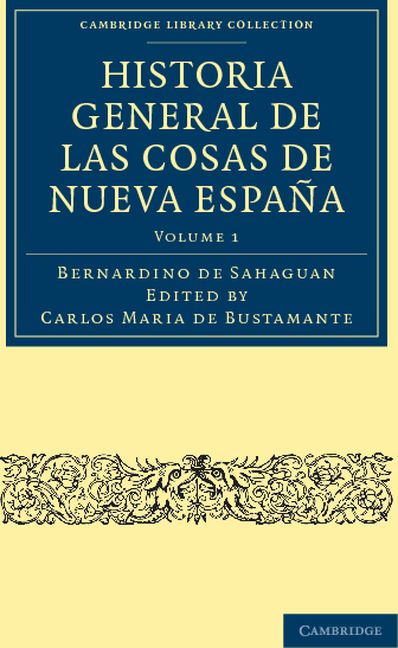
Historia General de las Cosas de Nueva España

-
Select format
-
- Publisher:
- Cambridge University Press
- Publication date:
- 05 March 2012
- 27 January 2011
- ISBN:
- 9780511792878
- 9781108025836
- Dimensions:
- Weight & Pages:
- Dimensions:
- (216 x 140 mm)
- Weight & Pages:
- 0.53kg, 420 Pages
You may already have access via personal or institutional login
Volume 1
Show more authors 
You may already have access via personal or institutional login
Book description
Friar Bernardino Sahagûn was in 1529 one of the first Catholic missionaries to the Aztecs. During his sojourn in Mexico he came to speak Nahuatl (the native language) fluently and to understand the Aztec culture, customs, religion and infrastructure intimately. He compiled the largest and most richly detailed record of the Aztecs and their history before the civilisation was wiped out by the Spanish conquest, and Sahagûn is sometimes considered 'the father of ethnology', as his study was the first to derive from the subjects' own point of view, through using native informants in his research. The work, written in 1540, was originally an illustrated manuscript of twelve books in a combination of Nahuatl and Spanish; this version, in Spanish only, was first published in 1829. Volume 1 covers the gods, their origins, the calendar of festivals and sacrificial events, and art and astrology relating to the Aztec religion.
Contents
Contents
Metrics
Altmetric attention score
Full text views
Full text views helpTotal number of HTML views: 0
Total number of PDF views: 0 *
 Loading metrics...
* Views captured on Cambridge Core between #date#. This data will be updated every 24 hours.
Usage data cannot currently be displayed.
Accessibility standard: Unknown
Why this information is here
This section outlines the accessibility features of this content - including support for screen readers, full keyboard navigation and high-contrast display options. This may not be relevant for you.
Accessibility Information
Accessibility compliance for the PDF of this book is currently unknown and may be updated in the future.