

5.1 Introduction
The research findings presented in the last two chapters have been primarily quantitative in nature, describing the extent to which academic research writing employs phrasal grammatical devices, in contrast to the grammatical discourse styles of other registers. In Chapter 3, we began with the fundamental opposition between clausal discourse styles and phrasal discourse styles, showing that conversational discourse relies mostly on clausal grammatical features (including a dense use of dependent clause features), while academic writing relies primarily on phrasal grammatical features (especially those functioning as noun phrase modifiers). This opposition is best described in terms of a continuum of use influenced by three major situational factors: production in the spoken versus written mode, communicative purpose (especially personal/interpersonal versus informational), and the extent to which discourse is written by specialists and addressed to other specialists. The registers that are the most marked situationally are also the most distinctive in their linguistic discourse styles. Thus, conversation is produced in the spoken mode; it has personal/interpersonal communicative purposes; and it is a register that all speakers of a language participate in. Linguistically, conversation is distinctive in its frequent use of ‘colloquial’ features (e.g., contractions, pronouns, discourse markers) and also in its frequent use of finite dependent clauses functioning as clause constituents. At the other extreme, academic research writing is produced in the written mode; it has informational communicative purposes; and it is a register written by specialists and intended for other specialists. Linguistically, academic prose has the opposite characteristics from conversation: very few ‘colloquial’ features, and few finite dependent clauses (especially those functioning as clause constituents), but a frequent use of phrasal features functioning as noun phrase modifiers. There is a large set of related phrasal devices that pattern in this way, including nouns as nominal pre-modifiers, attributive adjectives, noun–participle compounds as nominal pre-modifiers, prepositional phrases as nominal post-modifiers, and appositive noun phrases as nominal post-modifiers.
Chapter 4 added further information about these register differences, showing that the phrasal grammatical style typical of present-day academic research writing is actually a recent innovation. In fact, this grammatical style is not attested in any register in the eighteenth and even early nineteenth centuries, and thus it represents one of the most important grammatical changes in English of the last four centuries. However, conforming to the perspective described by Fennell (Reference Fennell2001) and Denison (Reference Denison and Romaine1998), the historical changes documented in Chapter 4 are quantitative/statistical trends rather than completely new grammatical innovations. That is, those historical developments involve structures that have become ‘more or less common generally or in particular registers’ (Denison Reference Denison and Romaine1998: 93). Thus, phrasal devices functioning as noun phrase modifiers were well-attested in the seventeenth and eighteenth centuries, but they were generally rare at that time in all registers. Over the following centuries, they have gradually increased in use in informational written registers, while their frequency of use remained virtually unchanged in other registers. Then, in the twentieth century, we witnessed a dramatic increase in use, restricted primarily to informational written registers.
It is clear from the quantitative findings presented in Chapters 3 and 4 that these grammatical trends have resulted in a new discourse style not attested in earlier historical periods. This grammatical style is innovative in the ways in which it packages information in discourse: (1) presenting information in noun phrases rather than in clauses, and (2) presenting information in phrasal modifiers rather than in clausal modifiers.
Most registers in English employ clausal discourse styles, and historically, clausal discourse styles have been the norm. In fact, some kinds of academic prose continue to employ clausal styles even up to the present time. For example, humanities research writing, with its narrative and descriptive communicative purposes, makes extensive use of a discourse style with many clausal modifiers that function as adverbials or objects of verbs. Finite relative clauses are also extremely frequent in this sub-register; these are often non-restrictive, providing extra information rather than identifying the reference of the head noun. The following example sentences from history research writing illustrate this type of complex academic prose with multiple levels of embedded dependent clauses:
The French tended [ to trap and trade for furs ], but the British settlers, [ who were starting [ to survey land in [ what is now Tennessee and Kentucky ] ], looked like incipient farmers.
[ As Washington noted in his journal ], the French army officers, [ after they had “dosed themselves pretty plentifully with wine,” [ which “gave a License to their Tongues [ to reveal their Sentiments more freely,” ] ] ] told Washington: [ “It was their absolute Design [ to take possession of the Ohio ], & by G– they would do it.” ]
In contrast, science (and social science) research writing tends to employ phrases rather than clauses, with information packaged as noun modifiers rather than as clause constituents. The following sentence from a psychology research article is typical:
This may indeed be part of the reason for the statistical link between schizophrenia and membership in the lower socioeconomic classes.
The clausal syntactic structure of this sentence is extremely simple, with only one main verb phrase:
- X may be Y
(This may be part)
Instead of embedded clauses, all of the information is packaged as phrasal modifiers embedded in noun phrases:
This may indeed be part [ of the reason [ for the statistical link [ between schizophrenia and membership [ in the lower socioeconomic classes ] ] ] ].
Our discussion up to this point has described the historical development of this new grammatical discourse style from a quantitative perspective. In the present chapter, we take the analysis of these features one step further, showing that these changes represent more than just a shift in preferred discourse style. That is, contrary to the expectations raised by Fennell (Reference Fennell2001) and Denison (Reference Denison and Romaine1998), we argue here that these historical developments are not merely quantitative/stylistic trends. Rather, there have been important extensions to the grammatical/discourse functions of these devices accompanying the increases in frequency of use. These functional extensions can be documented for each of the individual grammatical devices described in the preceding chapters. In Section 5.2, we explore the use of phrasal grammatical devices that function as nominal pre-modifiers, and then in Section 5.3, we turn to a detailed consideration of devices functioning as nominal post-modifiers.
5.2 Phrasal features functioning as pre-modifiers of a head noun
5.2.1 Nouns as nominal pre-modifiers
The shift towards the present-day reliance on nouns as nominal pre-modifiers in academic written prose is perhaps the most dramatic quantitative–historical change in English witnessed in the last three centuries. As Figures 4.5 and 4.16 showed, pre-modifying nouns were rare in the seventeenth, eighteenth, and even nineteenth centuries, but then they rapidly increased in use over the course of the twentieth century, to the extent that they are now ubiquitous in modern written academic texts.
This change is not merely a quantitative shift in stylistic preference. From a discourse perspective, texts are now constructed in fundamentally different ways from earlier centuries, relying to a large extent on phrasal devices rather than dependent clause structures. But deeper consideration reveals linguistic change at a more fundamental level, involving a steady expansion of meaning and function. In the present section, we describe five factorsFootnote 1 related to the functional extension of pre-modifying nouns:
A) pre-modifying nouns used as an alternative to ’s-genitive and of-genitive phrases
B) semantic classes of the nouns used as pre-modifiers
D) sequences of multiple pre-modifying nouns
E) the meaning relationships between nouns
To investigate these factors, we undertook detailed qualitative analyses of noun–noun sequences in science prose, medical prose, and newspaper articles from the ARCHER Corpus.
A) Pre-modifying nouns used as an alternative to ’s-genitive and of-genitive phrases
One major reflection of the functional extension of pre-modifying nouns is that they are now commonly used to express genitive meanings, replacing the functional domain of ’s-genitive and of-genitive phrases. Thus, consider the following example from a newspaper article:
… the Pope met […] the Communist Party chief…
The final noun phrase in this example expresses a genitive relationship that could be paraphrased with either of the other two genitive variants:
- noun-’s + head noun:
the Communist Party’s chief
- head noun + of-phrase:
the chief of the Communist Party
These previous studies have been restricted to only two linguistic variants: ’s-genitives versus of-genitives. However, when pre-modifying nouns are considered as a third genitive option, a different picture emerges (see Biber et al. Reference Biber, Egbert, Gray, Oppliger, Szmrecsanyi, Kyto and Paivi2016; Szmrecsanyi et al. Reference Szmrecsanyi, Biber, Egbert and Franco2015), with pre-modifying nouns becoming the preferred option for expressing genitive relationships.
The findings presented in Chapters 3 and 4 are based on the textual rates of occurrence for grammatical features (i.e., rather than the percentage use of a variant as a proportion of interchangeable occurrences). This type of research design has been called a ‘text-linguistic’ perspective on linguistic variation, because it tells us how often we will encounter a linguistic feature in texts (see Biber Reference Biber2012; Biber et al. Reference Biber, Egbert, Gray, Oppliger, Szmrecsanyi, Kyto and Paivi2016). Text-linguistic findings regarding post-nominal of-phrases show that this feature has declined in use in fiction and newspaper prose (see Table 4.3). Although the historical change for of-phrases is less strong in the sub-registers of academic prose, there has been a consistent historical decline in those registers as well, with the strongest declines seen in science and social science research articles (see Figures 4.8 and 4.15). In contrast, pre-modifying nouns have increased dramatically in use from a text-linguistic perspective, and that increase has been strongest in science research articles (see Table 4.3; Figures 4.5, 4.16). The text-linguistic rates of occurrence for ’s-genitives are not reported in Chapters 3 and 4, because they are quite rare in academic writing (only c. 2.5 per 1,000 words in present-day academic prose; see Biber et al. Reference Biber, Johansson, Leech, Conrad and Finegan1999: 302).
The text-linguistic perspective can be contrasted with a variationist perspective, based on analysis of linguistic tokens that are interchangeable with other structural options (see discussion in Biber et al. Reference Biber, Egbert, Gray, Oppliger, Szmrecsanyi, Kyto and Paivi2016; Szmrecsanyi et al. Reference Szmrecsanyi, Biber, Egbert and Franco2015). Variationist research designs are based on analyses of each token of a linguistic feature, identifying the particular linguistic variant used in that occurrence, and predicting the use of linguistic variants by reference to other contextual factors. The results in such analyses are proportional, comparing the percentages of a particular variant out of all interchangeable constructions.
From a variationist perspective, ’s-genitives are expanding in use relative to of-genitives (see earlier discussion). However, when we include pre-modifying nouns as a third variant, it turns out that this newer structural variant is expanding in use relative to both ’s-genitives and of-genitives.
Thus, Figure 5.1 plots the proportional use of interchangeable nouns as pre-modifiers (versus ’s-genitives). In most cases, these two construction types are in general not interchangeable. As a result, the proportions shown in Figure 5.1 are based on very small samples, causing some fluctuations in the historical trends. For example, the nineteenth-century proportions of 55% pre-modifying nouns (versus 45% s-genitives) in science prose is based on a sample of only forty tokens that occurred in the ARCHER Corpus (22 noun pre-modifiers that are interchangeable with s-genitives, and 18 s-genitives that are interchangeable with noun-pre-modifiers). However, despite the relatively small sample sizes, the overall historical trends are consistent across registers, with a notable increase in the proportional use of noun pre-modifiers (and thus a corresponding decline in the proportional use of ’s-genitives) across the centuries. Science prose shows the strongest increase, with noun pre-modifiers being used over 95% of the time in interchangeable constructions in the twentieth century.

Figure 5.1 Historical change in the proportional use of pre-modifying noun genitives (versus 's-genitives)
The sample of interchangeable occurrences in ARCHER for the of-genitive versus noun pre-modifier alternation is much larger (see Biber et al. Reference Biber, Egbert, Gray, Oppliger, Szmrecsanyi, Kyto and Paivi2016; tables 2 and 3), and correspondingly, the historical trends shown in Figure 5.2 are much more consistent across centuries. For all three registers, there is a strong increase in the proportional use of noun pre-modifiers at the expense of of-genitives. Letters and newspaper reportage take the lead in this change during the nineteenth century, while science prose shifted strongly towards increased noun pre-modifier variants during the twentieth century.

Figure 5.2 Historical change in the proportional use of pre-modifying noun genitives (versus of-genitives)
These findings provide strong evidence for the functional expansion of pre-modifying nouns, related specifically to the increasing use of these features to express genitive meanings. In Chapter 4, we discussed the increased use of ‘other’ prepositional phrases as nominal post-modifiers (e.g., in, on, for, with), and compared that trend to the overall decline in frequency of of-phrases as nominal post-modifiers (see detailed discussion in Section 5.3.1). In the present section, we have shown that this decline in use is also related to the historical increase of nouns used as pre-modifiers, related in part to the functional extension of these structures to express the same kinds of genitive meanings that have traditionally been expressed by of-phrases (and the ’s-genitive). We return to this wider perspective (i.e., considering both pre-modifying and post-modifying structures) in Section 5.4.
B) Semantic classes of the nouns used as pre-modifiers
In the sixteenth century, the functions of pre-modifying nouns were extremely restricted, with most occurrences referring to titles such as King, Master, or Doctor (see Raumolin-Brunberg’s Reference Raumolin-Brunberg1991 analysis of noun phrase structures in Sir Thomas More's writings). In the seventeenth and eighteenth centuries, pre-modifying nouns came to be used for an expanded set of functions, but they were still quite restricted in use, expressing meanings related to three general semantic categories: title nouns, place/location nouns, and concrete/tangible nouns. Following are typical examples from seventeenth and eighteenth century written informational prose.
Title nouns:
King, Doctor, Duke, Captain, Lord, and so on
Place nouns:
Specific places:
Hampton Court, Dumbarton Castle, India Company, Greenwich Park, Boston papers, London gazette
General locations:
country habitations, farm houses, field marshall, frontier garrisons, ground floors, home affairs, town wall
Concrete/tangible nouns:
cannon ball, castle hill, chamomile tea, coffee house, copper mill,corn field, foot soldiers, flannel roller, fountain water, goose eggs, gun ship, hen eggs, iron chain/particles/tools, linen handkerchief, milk diet, mineral taste/spring(s)/poisons, sand bank, sea captains, spring water, tea commissioners
By the late-1800s, when the overall frequency of noun–noun sequences began to increase, there was also a marked expansion in the range of meanings expressed by pre-modifying nouns. Thus, in addition to the categories described earlier, we find pre-modifying nouns commonly used to refer to institutions, states or conditions, and other intangibles.
Institutions:
family history, school proposal, state convention, union member
States or conditions (often diseases in medical prose):
cancer cells, croup cases, diphtheria results, health department, maternity hospitals, smallpox eruption
Other intangibles:
class examinations, currency troubles, credit foncier, heat apoplexy,
weather bureau, temperature chart, quarantine restrictions
This expansion in the kinds of meanings expressed by pre-modifying nouns continued over recent decades, so that by the end of the twentieth century, almost any noun could be used freely as a pre-modifier of another head noun. These include a wide range of abstract nouns with intangible meanings, such as:
age group, casualty department, emergency powers, income tax, monopoly act, news agency, peace conference, press conference, price commission, sector strike, sex differences, television interview, time interval, wage increases, weight loss
C) Nominalizations as pre-modifiers
A related historical change – beginning in the middle of the nineteenth century – involves the use of nominalizations in noun–noun sequences, both as the head noun (e.g., school proposal, class examinations, quarantine restrictions) and as the pre-modifying noun. For the most part, pre-modifying nominalizations refer to processes or activities; they are derived from verbs, either through morphological derivation or through conversion. This expansion in use continued throughout the twentieth century, with a much greater range of nominalized and converted forms derived from verbs being used as noun pre-modifiers. Consider the following examples.
Twentieth century nominalizations and noun conversions as NP pre-modifier, referring to processes or activities:
extradition treaty, government officials, inoculation experiments, insurance companies, investigation department, publication house, service reform, taxation prospects, correlation coefficients, population base, regression analysis, reprisal raids, terrorism centre awards bureau, murder trials, research fund, trade agreement, transport unions, study period Nouns morphologically derived from verbs:
Verb to noun conversion:
In addition, nominalized forms derived from nouns or adjectives also came to be commonly used as noun pre-modifiers in the twentieth century. These nominalizations typically refer to abstract attributes or qualities rather than processes. For example, consider the following:
Nominalizations referring to abstract attributes or qualities:
freedom movement, intelligence agencies, majority group, memorial service, mortality rate, safety officials, security interests
D) Sequences of multiple pre-modifying nouns
A fourth type of functional extension is the increased use of noun phrases with multiple pre-modifying nouns, as in justice department official. The only occurrences of this type found in our corpus before 1800 were proper names with multiple titles, as in Minister Count Kinski, Lieutenant Colonel Longueville, Madame Countess d'Etrees. NNN sequences begin to appear in common noun phrases in the late nineteenth and early twentieth centuries, but they are still relatively rare; examples in the ARCHER Corpus include: army reorganization scheme, cancer research associations/fund, Dublin hospital reports, home rule bill, interest charge amounts, river colony politics, trade union leader.
The dramatic change in the use of these structures occurred in the second half of the twentieth century, when NNN sequences become relatively common, and even NNNN sequences are not unusual. Consider the following examples:
1950–1990 Newspaper prose:
Three-noun sequences:
air force machines, aviation security committee, fighter pilot training, health department clinics, house personnel office, justice department intervention, justice department official, justice department spokesman, news agency correspondent/reports, oil tanker drivers, police motorcycle outriders, polio vaccination situation, road haulage association/drivers/industry, settlements tax increases, task force officers, trade boycott campaign, transport labour unions
Four-noun sequences:
emergency cabinet committee meetings, peace treaties enforcement action
1950–1990 Medical prose:
acid phosphatase activity/levels/test/units/values, air flow limitations, artery blood flow, assay dilution factor, blood glucose level, blood pressure clinic, body surface area, chromosome gene product, daytime serum concentrations, granulocyte adhesion functions, granulocyte surface membrane, haemoglobin digestion method, hazards regression analyses, hepatitis surface antigen, hill committee report, hill report recommendations, hospital record departments, infarction blood pressure, insulin infusion tests, life insurance tables, (early) morning urine specimens, mouse ascites fluid, nitrogen excretion supply, peak plasma concentrations/levels, Pearson correlation coefficients, plasma concentration curve, plasma glucose levels/profile/value, rabbit immunoglobulin fractions, (high) resolution image intensifier, sinus node dysfunction life table survival curves, peak mean plasma concentration, mean plasma glucose value, plasma concentration time curve Three-noun sequences:
Four-noun sequences:
Even longer NN sequences are attested in recent decades, including the following sequence of six pre-modifying nouns from the headline of a recent science news article published in the Guardian (November 14, 2014):
Philae comet lander alien ‘cover-up’ conspiracy theories emerge
E) The meaning relationships between the pre-modifying noun and the head noun
Finally, there has been historical extension in the meaning relationships that hold between a pre-modifying noun and the head noun (see Feist Reference Feist2012 for a detailed discussion of the order of constituents used as NP pre-modifiers). The title nouns and place nouns found as pre-modifiers in the seventeenth and eighteenth centuries are straightforward in this regard. For example, Captain Smith is a person named Smith who is a captain; Greenwich Park is a park located in Greenwich; frontier garrisons are garrisons located at the frontier.
The other classes of pre-modifying nouns, though, do not consistently express a single meaning relationship to the head noun. This is true even for the concrete/tangible nouns found as pre-modifiers in the eighteenth century. For example:
| NN sequence | Meaning paraphrase |
| iron chain/tools, linen handkerchief milk diet, chamomile tea, flannel roller, mineral spring(s)/ poisons | an N2 that is composed of N1 |
| hen eggs, goose eggs, fountain water, spring water | an N2 that comes from N1 |
| coffee house, copper mill, corn field, gun ship, sand bank | an N2 where one can find N1 |
| sea captains, sea commissioners | an N2 specializing in N1 |
| cannon ball, farm house, town wall | an N2 used for/with an N1 |
The set of possible meaning relationships expands greatly in the late nineteenth century and throughout the twentieth century, associated with the wider range of pre-modifying nouns. Following is a sample of the additional meaning relationships commonly expressed by NN sequences in the late twentieth century:
| NN sequence | Meaning paraphrase |
| government official, union member | a person (N2) belonging to the institution identified by N1 |
| state convention, union assets | an inanimate entity (N2) associated with the institution identifed by N1 |
| family history, algebra textbook, sports magazine, psychology lecture | a text (N2) about the topic identified in N1 |
| awards bureau, investigation department, price commission, safety officials | a person or institution (N2) that regulates or administers N1 |
| casualty department, intelligence agencies, news agency, terrorism centre | an institution (N2) that tries to obtain information about N1 |
| extradition treaty, monopoly act, research fund | an inanimate entity (N2) that regulates or administers N1 |
The grammatical use of nominalizations or nominal conversions as head nouns in these complex noun phrases results in additional meaning relationships. In many cases, the pre-modifying noun is the semantic patient or theme of the process described by the nominalized head noun. Many of these head nouns are derived from intransitive verbs; in those cases, the pre-modifying noun corresponds to the logical subject but the semantic patient. Thus, compare:
Noun phrase: wage increases
Clause with intransitive verb: wages increased
Clause with transitive verb: something increased wages
Other head nouns are clearly derived from transitive verbs; in those cases, the pre-modifying noun corresponds to the logical direct object, expressing the semantic patient. Thus, compare:
Noun phrase: waste disposal
Clause with transitive verb: someone disposed of the waste
In other cases, the pre-modifying noun identifies the purpose or topical domain of the process described by the nominalized or noun-converted head noun (e.g., peace conference). For example:
| wage increases, child development, justice department intervention, eye movement | N1 is a patient or theme affected by the process described by N2; syntactically, N1 is the logical subject of N2 |
| weight loss, waste disposal, income tax, taxi driver, trade legislation | N1 is a patient or theme affected by the process described by N2; syntactically, N1 is the logical direct object of N2 |
| trade agreement, reprisal raids, freedom movement, peace conference | N1 identifies the purpose or topical domain of the process described by N2 |
In some of these cases, both nouns are nominalized processes. For example, a regression analysis refers to ‘someone analyzing the way in which variable X regresses with variable Y’.
In addition, there are many more specific meanings for particular NN sequences. For example:
| NN sequence | Meaning relationship |
| age group | a group consisting of people with a particular age |
| correlation coefficients | coefficents that report correlations |
| emergency powers | powers that can be used in an emergency |
| inoculation experiments | experiments that test the effectiveness of inoculation |
| retail outlet | an outlet that sells retail merchandise |
| pressure hose | a hose able to withstand pressure |
| pressure ratio | a ratio measuring pressure |
| NNN sequence | Meaning relationship |
| oil tanker drivers | people who drive tankers that contain oil |
| trade boycott campaign | a campaign to encourage people to boycott trade |
| NNNN sequence | Meaning relationship |
| emergency cabinet committee meetings | meetings of a committee associated with a cabinet, called in an emergency |
| peace treaties enforcement action | activities carried out to enforce treaties intended to result in peace |
Summary: Pre-modifying nouns in written discourse
These functional extensions in the use of nouns as NP pre-modifiers are further illustrated by considering academic texts from the nineteenth versus late twentieth century. For example, Text Sample 5.1 is from multi-disciplinary science writing (from the Philosophical Transactions) in the mid-nineteenth century, illustrating the types of clausal elaboration that were common in earlier centuries (including finite adverbial clauses, complement clauses, and relative clauses). Of-genitive constructions and nominalizations (division, operation, tenacity, explanation, alterations, comparison) are also common in this text; however, there are no instances of nouns as noun pre-modifiers.
Text Sample 5.1 Nineteenth century multi-disciplinary science
Finite relative clauses are underlined; of-genitives are shown in ITALIC CAPS.
That division OF these nerves produces some serious lesion is proved by the death OF the animal, which generally takes place a few days after the operation. Considering the well-known tenacity OF life possessed by these animals this was quite an unexpected result, for which I am unable at present to afford any satisfactory reason.…Whatever may be the true explanation, it is impossible not to regard this result with surprise, when we consider the serious lesions which this animal is capable of undergoing at other points OF the frame without loss OF life. The usual time which it survives is variable, and depends greatly on the season OF the year.…For the purpose OF avoiding this loss OF life, I adopt the plan OF dividing the glossopharyngeal on one side only OF the tongue, and I find that it has the desired effect OF preserving the life OF the animal, while we can observe the same alterations on the corresponding side, as well as when both nerves are divided. Another advantage found in the division OF a single nerve is, that on the uninjured side we have constantly at hand a means OF comparison by which we can judge with certainty respecting any alterations that may be produced in the divided nerve.
Present-day multi‐disciplinary science writing can sometimes be similar in grammatical style to nineteenth century science articles. For example, Text Sample 5.2 illustrates a modern PT text with extensive clausal elaboration (finite relative clauses are underlined) and frequent use of the of-genitive (shown in ITALIC CAPS). However, this text also illustrates the recent shift towards increasing use of phrasal modification, with a much greater reliance on nouns as noun pre-modifiers (shown in bold italics).
Text Sample 5.2 Twentieth century multi-disciplinary science
From Darwin derives not only the explicit assumption OF animal-human continuity, but also the implicit assumption that behaviour patterns, from which intelligence must be inferred, are proper candidates for evolutionary selection, a tenet that became the foundation stone OF ethology and was also seminal for many branches OF psychobiology. In one OF his notebooks Darwin wrote that ‘he who understands baboon would do more towards metaphysics than Locke' (Notebook M, p. 84, 16 August 1838; cf. Gruber (1974) pp. 317–318). Darwin himself, however, is relatively silent, even impotent, when it comes to those behavioural descriptions that might lead to a deep or systematic understanding OF the cognitive capacities OF animals, let alone metaphysics, and his most concentrated treatment OF reasoning, for example, in the Descent OF man is little more than scattered anecdotes OF doubtful value.
Most present-day multi-disciplinary science articles employ much less clausal elaboration, coupled with an extremely dense use of phrasal modifiers, as Text Sample 5.3 illustrates:
Text Sample 5.3 Twentieth century multi-disciplinary science
Tide gauge measurements suggest that global average sea-levels rose by between 1 and 2 mmyr-1 during the twentieth century (Church et al. 2001). Between 1993 and 2000, satellite altimetry indicated that the rate OF rise was approximately 2.5 mmyr-1 (Cabanes et al. 2001), which may indicate a recent acceleration OF the long-term trend or it could be the result OF interdecadal variability. In the future, global average sea-level is expected to increase more rapidly as a result OF anthropogenic climate change. The Third Assessment Report OF the Intergovernmental Panel on Climate Change concluded that between 1990 and 2100, the global average sea-level rise is likely to be between 9 and 88 cm (Church et al. 2001). While this century-scale rise in sea-level will threaten many low-lying unprotected coastal areas, it is the extremes OF sea-level associated with storm surges that will cause much OF the damage (for instance McCarthy et al. 2001). Extreme water levels will also increase as time-average sea-levels rise. In addition, changes in the number, path and strength OF atmospheric cyclonic storms may alter the formation and evolution OF storm surges. However, because individual surge events depend on the driving meteorology, we cannot predict individual surges more than, at most, a few days ahead.
This grammatical style is even more prevalent in recent specialist science research articles, exhibiting an even more extreme reliance on nouns used as noun pre-modifiers, coupled with even less frequent use of dependent clauses. For example:
Text Sample 5.4 Twentieth century specialist science
Population growth rate is a particularly powerful index for evaluating harvest effects because it measures the ability OF a population to increase when subjected to any specified level OF exploitation.…Selectivity OF the harvest on Putauhinu Island translates into large differences in harvest rates among weight classes.…The population effects OF removing an individual depends on quality (i.e. future contributions to reproduction) and on the contribution OF its stage to demography. The effect of quality differences among chick classes in our model is small because chicks move among classes during the nanao and rama (Table 1). The contribution OF chick survival to population growth is small, and regardless of initial weight all chicks become identical pre-breeders at the end OF the first year (Fig. 1).…There is evidence for such links between characteristics OF young individuals and life history traits OF adults in many taxanomies…
One interesting characteristic of the pre-modifying nouns found in modern specialist science writing is that they are often not technical terms. Of course, we can find counter-examples which fit the stereotype of jargon-heavy scientific academese, as in:
The Peutz-Jegher syndrome tumor-suppressor gene encodes a protein-threonine kinase.
However, the more common pattern is to modify a non-technical head noun with another non-technical pre-modifying noun. Specialist background knowledge is required to understand the meaning relationship between the two nouns, but the nouns themselves typically have transparent, everyday meanings. Many of these could be paraphrased with an of-genitive as nominal post-modifier:
- sea level
level OF the sea
- water level
level OF the water
- life history
history OF a life
- life history traits
traits OF a history OF a life
- quality differences
differences in quality
- century-scale rise
a rise on the scale of a century
- population effects
the effects on the population
| tide gauge measurements | measurements made by a gauge that calculates the level of the tide |
| long-term trend | a trend that lasts for the long term |
| time-average sea-levels | the level of the sea averaged across different time periods |
| storm surge | a surge in the sea level, associated with a storm |
| surge events | events that involve a surge in the sea level, associated with a storm |
| harvest rates | differences in the magnitude of a harvest |
| harvest effects | the extent to which the magnitude of a harvest varies |
| chick survival | the extent to which chicks survive |
As shown from these examples, the individual nouns employed in noun–noun sequences are often not technical, but the meaning relationships underlying those sequences are technical and require specialist background knowledge for understanding. Thus, the historical shift towards an increasing reliance on such forms has resulted in a surprising loss of explicitness in specifying the intended meaning. We return to this rhetorical/pragmatic change in Chapter 6.
In sum, the dramatic increase in the use of nouns as nominal pre-modifiers represents much more than a mere quantitative shift in stylistic preference. In particular, the present section has shown that there has been a major expansion in the types of nouns that can occur as nominal pre-modifiers, as well as a major expansion in the range of meaning relationships and grammatical functions underlying noun–noun sequences.
5.2.2 Attributive adjectives as nominal pre-modifiers
Attributive adjectives differ from most other types of phrasal noun modifiers in their historical development. As we showed in Chapter 4 (see especially Table 4.4 and Figure 4.5), attributive adjectives were already well established and frequent in use in the seventeenth century (in popular registers as well as informational registers), and their rate of occurrence has changed little over the subsequent centuries. However, this stability in quantitative patterns masks historical linguistic change in the use of this linguistic feature.
As described in Biber et al. (Reference Biber, Johansson, Leech, Conrad and Finegan1999: 508ff ), attributive adjectives can be grouped into two major semantic categories: ‘descriptors’ and ‘classifiers’ (cf. Feist Reference Feist2012: 9–10). Descriptors are prototypical adjectives describing attributes of the head noun, including physical characteristics, evaluations, and emotional states. They are used to describe a wide range of physical characteristics, such as color or physical appearance (e.g., red, pale), size or weight (e.g., large, thin, heavy), age and frequency (e.g., old, new, daily, recent). Descriptors are also used to denote a wide range of evaluations or emotional states (e.g., bad, nice, beautiful, appropriate, strange, happy, sad).
In contrast, adjectives functioning as classifiers delimit or restrict the reference of the head noun, identifying the category of the noun (e.g., final, previous, German, chemical, legal). Classifiers are usually not gradable, while descriptors usually are (compare very large versus *very chemical). There are two major subcategories of classifiers: relational/classificational adjectives, which serve to delimit the referent of a noun in relation to other referents (e.g., additional, average, different, general), and topical/affiliative adjectives, which identify the type or subject area of a noun, or designate the group that a referent belongs to (e.g., commercial, human, official, social, Chinese, European).
There are major differences across present-day registers in the reliance on descriptor versus classifier adjectives: conversation (and fiction) tend to use descriptors to a much greater extent than classifiers, while newspaper prose and academic prose tend to use classifiers to a much greater extent than descriptors (see Tables 7.2 and 7.3 in Biber et al. Reference Biber, Johansson, Leech, Conrad and Finegan1999: 511–513). However, in the seventeenth and eighteenth centuries, academic prose was similar to popular registers (e.g., fiction and letters) in that it mostly utilized descriptor adjectives.
To further investigate the extension of attributive adjective functions in academic prose, we coded the functions of attributive adjectives in science research articles from two historical periods: seventeenth/eighteenth century versus twentieth century. One difference that quickly became apparent was the range of different adjectives (‘adjective types’) used in these two historical periods. That is, although the overall rate of occurrence for attributive adjectives is similar for eigtheenth versus twentieth century research writing (see Figure 4.5 in Chapter 4), the number of different adjective types used in these periods is dramatically different, with nearly four times more adjective types in the most recent period. That is, eighteenth century science writing tended to rely on the frequent use of relatively few different adjectives, whereas modern science writing employs a much larger inventory of different adjectives.
Figure 5.3 shows that the typical functions of attributive adjectives in science writing have similarly shifted over time. This figure is based on a categorization of the one hundred most frequent adjectives in eighteenth century versus twentieth century science articles, distinguishing descriptive versus classifying functions. In the eighteenth century, descriptive functions (physical and evaluative) were the most prevalent for this set of adjectives (c. 65% of the top 100 adjectives), while that preference was reversed in the twentieth century (with c. 75% of the top 100 adjectives serving classifier functions). In both historical periods, descriptive adjectives that identify physical attributes (e.g., great, large, high) are almost twice as common as descriptive evaluative adjectives (e.g., good, important, special), although physical descriptors are often used for evaluative functions in academic writing (a large difference, a small effect, high ability). Within the classifier category, relational adjectives (e.g., same, different, general, major) are more common than topical/affiliative adjectives (e.g., social, political, public), and this relationship also holds for both historical periods.

Figure 5.3 The 100 most frequent adjective types, categorized for descriptive versus classifier functions
When we consider adjective types that occur with lower frequencies in academic science writing, we see that topical/affiliative adjectives dominate these lists, especially in the twentieth century. For example, in a sample of less common attributive adjectives (occurring c. one time per million words), 50% served topical functions (e.g., perimental, cultural, ellipsoidal, coniferous), compared with c. 25% with relational functions (e.g., middle, eligible, existent, contrary). Surprisingly, descriptive-evaluative functions are much more important among these lower frequency adjectives than descriptive-physical functions: 20% of these adjectives serve descriptive-evaluative functions (e.g., famous, urgent, erroneous), compared with only 5% with descriptive-physical functions.
In sum, while there has been little historical change in the overall frequencies for attributive adjectives, there have been important changes in the diversity of adjective types, and in the typical functions of those forms. In particular, present-day science writing employs a much wider set of different adjectives than in previous centuries, with most of those new adjectives serving classifying-topical functions.
5.2.3 Noun–participle compounds as nominal pre-modifiers
Noun–participle compounds (e.g., correlation-based category) are another phrasal feature associated with present-day academic writing. As noted in Chapter 4, noun–participle compounds were rarely used in eighteenth century academic writing. While they are still not especially frequent in absolute terms, they have increased in use by a factor of ten during the last half century (see Figure 4.6). This increase has been especially noteworthy for N + -ed compounds (e.g., cue-focused processes, mood-induced states, stress-induced anisotropy).
Similar to the grammatical features described in the preceding sections, noun–participle compounds were comparatively restricted in function in earlier historical periods (in addition to being infrequent). By the mid-nineteenth century, several relatively lexicalized compounded forms were already in use, such as home-made, self-made, star-spangled, frost-bitten, heart-broken, lion-hearted, fun-loving, blood-curdling, and awe-inspiring. Certain words were repeatedly incorporated into these compounds. For example, numerous compounds were formed with the prefixed nouns self and heart (e.g., self-made men, self-imposed discipline, self-taught artist, self-organized vigilance, self-destroying evils, self-denying Jesuit, self-relying men, self-sacrificing traits; heart-broken Incas, heart-rending cry, heart-cheering salute, heart-chilling scenes, heart-sickening scene). Similarly, the participles shaped (e.g., heart-shaped muscle, spindle-shaped globules, spoon-shaped extremities) and colored (e.g., saffron-colored powder, coffee-colored discharge) were used to form multiple compounds in texts from this period.
Beyond those relatively fixed forms, nineteenth century authors used noun–participle compounds to express a range of relatively concrete meanings, combining nouns that refer to physical entities with participles expressing tangible actions. These included both compounds formed with –ed participles (e.g., the surf-beaten shore, blood-drenched plains, storm-beaten trees, ivy-covered towers, the ice-choked Delaware River) as well as compounds formed with –ing participles (e.g., flesh-eating barbarians; money-squandering community; nostril-dilating power; fur-bearing animals; a health-seeking, pleasure-loving man; ship-building operations; salt-producing carbonate; air-breathing reptile).
Many of these noun–participle compounds that were used in eighteenth and nineteenth century academic writing have now become relatively informal, being used regularly in modern popular spoken and written texts (e.g., fictional novels and even conversation regularly use forms like home-made, self-made, heart-broken, fun-loving, awe-inspiring). However, innovative uses of this grammatical construction in present-day English are restricted primarily to informational academic prose, and in that register, the lexical associations of this feature have been extended greatly from the nineteenth century.
In modern science and social science research articles, the two most common participial forms incorporated into noun–participle compounds are based and related. Interestingly, these are both abstract and relational in meaning, in contrast to the tangible actions/events described by the compounded participial forms in the nineteenth century. In addition, most of the nouns incorporated into these structures are abstract in meaning, in contrast to the nouns referring to physical entities in the seventeenth and eighteenth centuries. Examples include:
space-based observations
matrix-based analysis
XML-based modelling
GT2-based services
grid-based mechanisms
performance-based measures
object-based competition
standards-based tests
age-related increases
health-related problems
education-related income disparities
science-related skills
accountability-related pressures
time-related covariates
instruction-related activities
the PTdins(3,5)P2-related fission cascade
three Rb-related genes
systemic sclerosis-related symptoms
Beyond the participial forms based and related, there is an extremely diverse set of nouns and participles incorporated into noun–participle compounds in present-day science and social science research writing. As observed earlier, most of these involve abstract nouns combined with process, stative, or relational participles. For example:
service-oriented architecture
disease-associated Prpres
GPI-linked proteins
protein-lined canaliculus
stress-induced anisotropy
HPC-enabled simulations
climate-driven changes
atom-resolved evidence
scrapie-infected mice
fluorescence-activated cell
river-supplied sediment
basin-distributed temperature
HIV-infected individuals
placebo-controlled design
investigator-designed questionnaires
teacher-reported behavior problems
life-threatening conditions
number-crunching simulations
light-scattering measurements
voltage-sensing apparatus
ligand-binding domains
protein-signaling networks
population-averaging effects
sediment-gauging activities
mountain-draining rivers
colony-forming units
answer-changing behavior
Thus, noun–participle compounds have undergone an extension in functionality similar to that of the other devices used for the pre-modification of nouns in academic written English. Most obviously, that extension has involved a large increase in the inventory of words used to form these compounds. However, this extension also entails a shift in the kinds of nouns and participles that can be combined to form a compound. In the eighteenth and nineteenth centuries, these words were restricted primarily to concrete physical objects (expressed by the nouns) and concrete actions/events (expressed by the participles). In contrast, the noun–participle compounds found in present-day academic writing usually consist of abstract nouns combined with an abstract process/relational participle.
5.3 Phrasal features functioning as post-modifiers of a head noun
5.3.1 Prepositional phrases as nominal post-modifiers
In Chapter 4, we described the strong decline in frequency for finite relative clauses and of-genitive phrases in academic prose over the last century. At the same time, though, ‘other’ prepositional phrases (e.g., phrases headed by in, on, for) functioning as noun modifiers strongly increased in frequency. Specifically, Figure 4.8 showed that ‘other’ prepositional phrases functioning as noun modifiers nearly doubled in frequency in academic prose from 1850 to 2005. Post-nominal prepositional phrases headed by two specific prepositions have been especially important in this historical change: in and for (see Figure 4.9). Post-nominal phrases headed by in are especially prevalent in science research writing, while post-nominal phrases headed by for are more common in the social sciences. For example:
The presence of ingested particles IN the multivesicular bodies IN the relatively early stage confirms the findings of Farquhar et al… [Science writing]
Whenever reference to the city as eternal was made it was associated with a concept FOR the need FOR Roman social and military unity. [Social science writing]
However, this grammatical change extends well beyond the increased use of those two prepositions. In fact, the most notable finding here is the large number of different prepositions that function as the head of prepositional phrases modifying nouns, reflecting the extent to which this structural device has been generalized in modern academic writing. Six other prepositions (in addition to in and for) occur with moderately high frequencies heading post-nominal phrases in modern academic prose: about, between, from, on, to, and with:
Coders were unaware in regard to other information ABOUT the families.
We examine the relationships BETWEEN class and country…
Items FROM the Home Inventory were used to construct two composite measures…
The literature ON cultural congruence has focused primarily on the interactional and discursive aspects of teaching.
Immediately after exposure TO wasps, pupae were weighed…
Nop7p has been implicated in the control of ribosome biogenesis via its interaction WITH origin recognition complex proteins…
In addition, a wide range of other prepositions are used at lower frequency levels for this function in modern academic writing, including across, after, against, along, among(st), around, as, at, before, behind, by, into, like, near, over, toward(s), under, upon, within, and without:
This cooperation ACROSS the aisle was sparked by FDR’s controversial “court-packing” scheme.
In late 1939, a few weeks AFTER the outbreak of the war, a group of scientists persuaded the financier Alexander Sachs to convey to Roosevelt a letter…
Settlement expansion also took place … at other sites AROUND Jerusalem.
Puerto Rico's status AS a commonwealth of the United States creates a unique set of Conditions…
We used corrected-item-mean imputation to handle missing data AT the item level…
Closer teacher-child relationships predicted higher standardized test scores in language and math and higher ratings BY teachers…
Until shortly before his entry INTO politics, Barak had been a military man…
Monuments occasioned a struggle OVER meaning AMONG social groups…
[moderation could be achieved] by taming the radical forces WITHIN the Nazi Party…
Thus, this structural feature (prepositional phrases as nominal post-modifiers) is currently in advanced stages of being generalized to the full set of prepositions, rather than being restricted to only a small subset of specialized prepositions.
Academic research writing often incorporates sequences of these prepositional phrases as noun modifiers, creating dense information structures with few verbs. In the following example, four of the noun phrases in the sentence contain prepositional phrases as noun post-modifiers, including multiple modifiers for a single head noun, and prepositional phrase modifiers embedded in other modifiers. For example:
Here we will use translocation OF muskox Ovibos moschatus FROM eastern Greenland TO the mountain range Dovre IN Central Norway to parameterize a simple population model WITHOUT density regulation that can be used to improve our ability to predict future fluctuations OF small populations.
Thus, at one level, modern academic prose is similar to eighteenth century science writing in employing extensive structural embedding. The main difference, though, is that the embedding in modern texts is phrasal, while the embedding in eighteenth century texts is clausal.
Similar to the historical changes for nominal pre-modifiers, the increased frequency of prepositional phrases as nominal post-modifiers has been accompanied by a large expansion in function and meaning. The most obvious indication of this expansion is the increase in the range of meaning relations that can be signaled by prepositional phrase (PP) noun modifiers. For example, in present-day academic prose, the prepositions in and on can express both concrete locative meanings (blood flow in skin and in skeletal muscle; many places on the slopes below) and abstract meanings (evolution in Roosevelt's imperialist thought; the influence of evolutionary ideas on his public policies). However, the use of these prepositions to express abstract meanings is a relatively recent development restricted primarily to writing. Thus, in conversation, over 90% of these PPs as noun modifiers express concrete/locative meanings, as in:
somebody in the neighborhood
a vault in his house
those kids in California
stuff on the dash
that thing on the roof
did you read that dedication on the first page
This is similar to the typical uses of these prepositions in written texts from the sixteenth to the seventeenth centuries, where they normally expressed concrete/locative meanings even in academic written prose. Consider the following examples.
Concrete meanings expressed by noun-modifying PPs with in; seventeenth century medical prose:
| N + PP sequence | Meaning |
| a wynde in the heed, ache in the backye, pain in his knee | location inside a body part |
| the oil in the thermometer, kernels in your meat, quantity of opium in it | location inside an object or substance |
| our apothecaries in England, John Bissite in St. Peters Parish | geographic location |
| the foregoing chapters in the first part, his judgement and candor in his writings | textual location |
Concrete meanings expressed by noun-modifying PPs with on; seventeenth century medical prose:
| N + PP sequence | Meaning |
| a postume on the longes, blisters and hackes on the lips, two on each side | location on the surface of an object |
As Figures 5.4 and 5.5 show, these concrete meanings were dominant for in/on noun-modifying PPs in the sixteenth and seventeenth centuries. In contrast, abstract meanings were uncommon. Abstract meanings with on were especially rare, restricted to an identification of ‘topic’, as in:
a poem on the virtue of a laurel leaf
some remarks on the late debate about X
occasional notes on Dr. George Thompsons
a learned author on this subject
PPs with in had a similar abstract use in the seventeenth century, identifying a general research domain:
my studie in ciuile and humane learnynge
that Axiome in philosophie
his learning in all sciences
our work in the Astrological or chymical way of physic
new discoveries in medicine
my sentiments in these matters
Figures 5.4 and 5.5 show that the functions of both in PPs and on PPs as noun modifiers in academic writing has changed dramatically from the seventeenth century to the present day: in present-day academic prose, c. 60% of these constructions are used to express abstract meanings rather than concrete/locative meanings. Those abstract uses include the identification of topical domain, as in seventeenth century medical prose. However, there are other abstract uses that were only beginning to emerge in the seventeenth and eighteenth centuries. Three of these abstract functions are especially important in modern academic science writing:
1. nominalization + on PP, corresponding to a nominalized equivalent of a prepositional verb construction; for example:
abiological dependence on physical conditions
[compare: it depends on physical conditions]
his reliance on the evolutionary thesis
[compare: he relied on the evolutionary thesis]
a focus on measures of student outcomes
[compare: someone focused on measures of student outcomes]
2. process noun + on PP, corresponding to a transitive verb with a direct object that is the ‘patient’ of the verb; for example:
a profound influence on student responses
[compare: something profoundly influenced student responses]
A significant impact on sea-bird numbers
[compare: something impacted sea-bird numbers]
a much greater effect on the attitudes of other students
[compare: something affected students’ attitudes]
3. constructions with an ing non-finite clause following the preposition on; for example:
an effect on determining choice
emphasis on providing support
any restriction on publishing it
research on promoting science learning
Prepositional phrases with in have also developed two especially common abstract uses in modern academic writing:
1. process noun + in PP, corresponding to an intransitive verb with a subject that is the ‘patient’ of the verb; for example:
a decline in mean IQ
[compare: mean IQ declined]
a sudden increase in metabolic rate
[compare: metabolic rate suddenly increased]
a change in the food supply
[compare: the food supply changed]
2. constructions with an ing non-finite clause following the preposition in; for example:
invaluable assistance in recording electrocardiographs from canaries
difficulty in separating the sarcoplasmic proteins from the myofibrils errors in rounding the total score
One of the more interesting aspects of these historical changes with in and on PPs is that each of these prepositions has developed a specialized abstract function that marks the modifying noun as the semantic ‘patient’ of the process described by the head noun. For example:
an increase in efficiency
[compare: something increased efficiency, or efficiency increased]
influence on dropout rates
[compare: something influenced dropout rates]
For PPs with in, these head nouns usually correspond to intransitive verbs:
Subject NP (‘patient’) + Intransitive V > Head noun (identifying a process) + IN + NP (‘patient’)
the chief reason for Britain’s decline in exports
[compare: Britain’s exports declined]
a rapid increase in the size of the egg
[compare: the size of the egg increased]
variation in frequency
[compare: the frequency varied]
For PPs with on, these head nouns correspond to transitive verbs. Many of these are simple transitive verbs, as in:
Transitive V+ Object NP (‘patient’) > Head noun (identifying a process) + ON + NP (‘patient’)
a significant influence on the tragic developments that followed
[compare: something influenced the tragic developments]
two factors have the greatest impact on college grades
[compare: two factors impact college grades]
a greater emphasis on intellectual behaviors
[compare: someone emphasises intellectual behaviors]
Other head nouns taking on-PPs correspond to prepositional verbs, although the object of the verb still serves the same semantic role of ‘patient’:
Transitive prepositional V +on + Object NP (‘patient’) > Head noun (identifying a process) +ON + NP (‘patient’)
a biological dependence on physical conditions
[compare: it depends on physical conditions]
his reliance on the evolutionary thesis
[compare: he relied on the evolutionary thesis]
a focus on measures of student outcomes
[compare: someone focused on measures of student outcomes]
In present-day informational writing, there are numerous head nouns that can take these patterns. Seven head nouns are especially frequent with prepositional phrases with in followed by an NP (‘patient’): change, decrease, difference, fall, increase, rise, and variation. (Other head nouns that occur with this pattern include: advances, breakdown, decline, development, evolution, growth, improvement, reduction, and shift.) Similarly, there are numerous head nouns that take on plus an NP (‘patient’): effect and emphasis are especially frequent with this pattern, but other nouns include attack, constraint, debate, decision, discussion, impact, influence, limit, limitation, restriction. There are fewer prepositional verbs that have been nominalized to occur as head nouns in this pattern, but examples include bearing on, dependence on, focus on, insistence on, and reliance on.
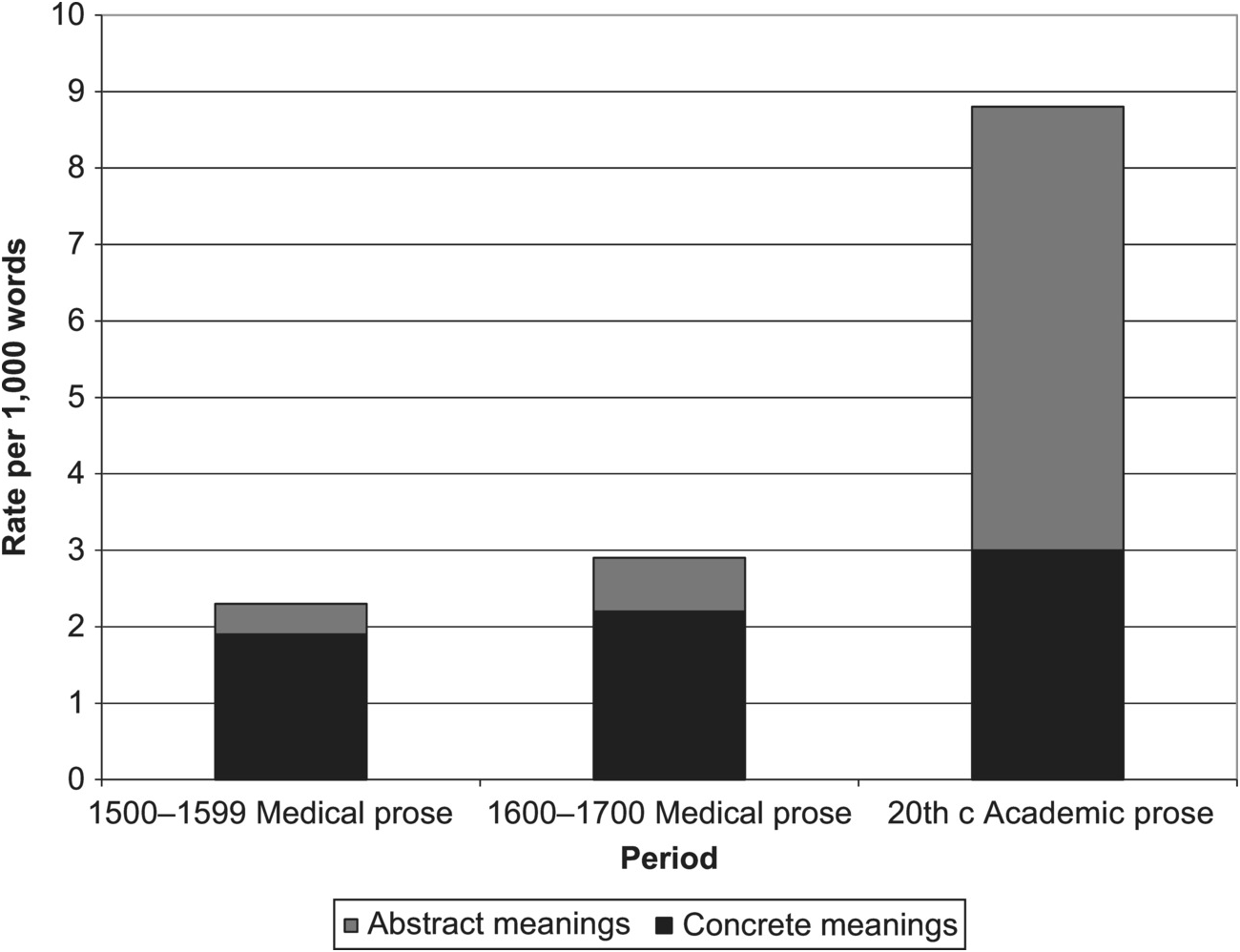
Figure 5.4 IN as noun modifier: concrete versus abstract meanings
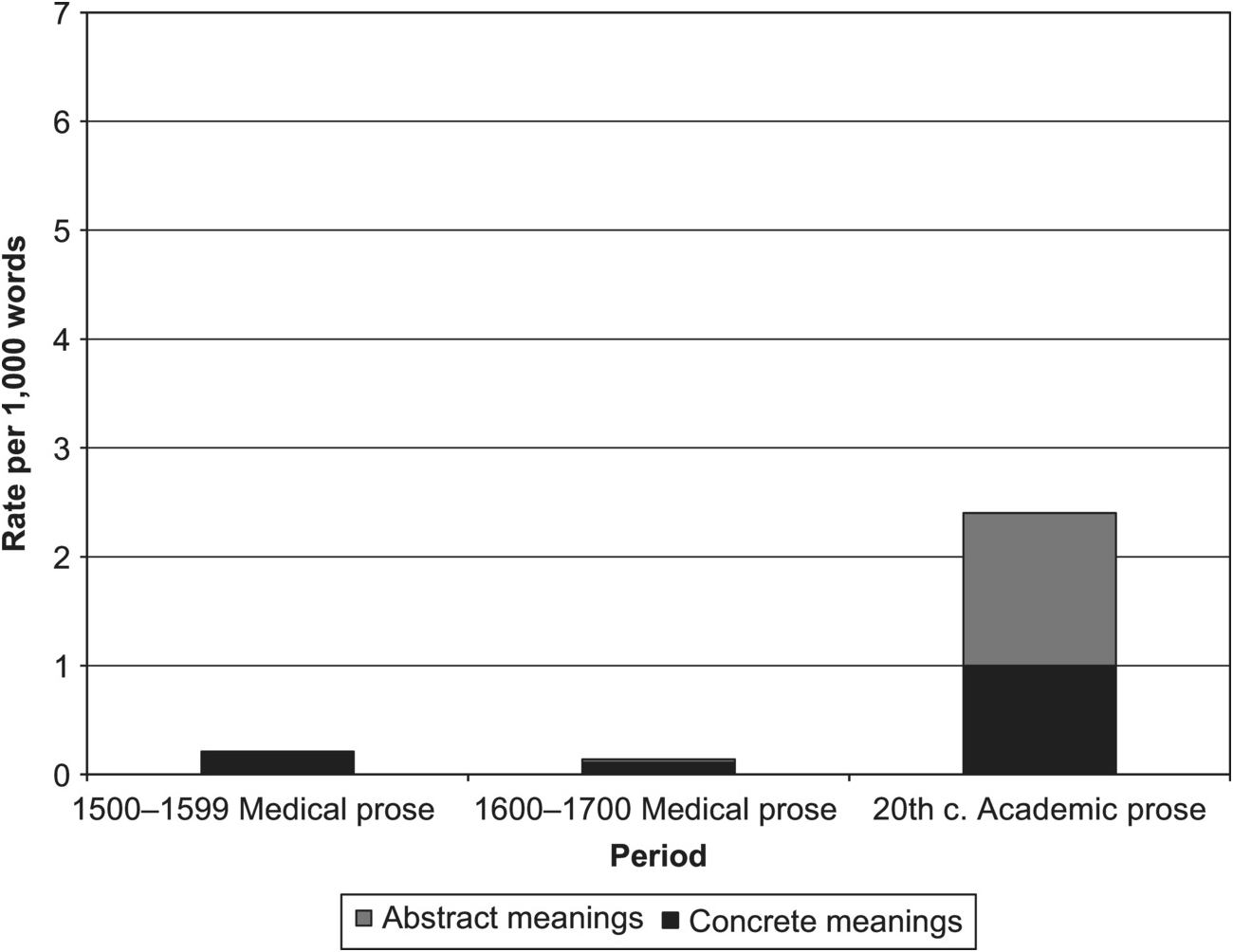
Figure 5.5 ON as noun modifier: concrete versus abstract meanings
These specialized grammatical uses have been introduced gradually over the past four centuries in informational written texts. The semantic ‘patient’ pattern with the preposition in historically precedes the ‘patient’ pattern with on, corresponding to the more general development of in and on PPs as nominal modifiers (see Figure 4.9). In PPs with this meaning seem to have first occurred in the sixteenth century with the head nouns difference and change, and this pattern then gradually spread to other process nouns during the following four centuries. We list here the first attested examples for selected process nouns + in + NP (‘patient’) from the OED:
1530 no difference in sounde
1585 to attempt alteration and change in the church of God
1627 one inch of decrease in the growth of men
1760 improvement in the art of … defending strong places
1804 a fall in the price of the article
1806 great variation in its composition
1817 a small rise in the annual payment
1823 a sudden increase in the circulating medium
1869 quick growth in intellectual and moral force
As noted earlier, the development of on-PPs as abstract noun modifiers lagged behind in-PPs. The phrase dependence on (derived from the prepositional verb depend on) occurs at a relatively early stage, but nominalized equivalents of other prepositional verbs with on appear considerably later. We list here the first attested examples of these combinations from the OED:
1605 dependence on the Latin
1754 reliance on the promises of God
1798 insistance on tradition
1908 a focus on passing pedestrians
Simple process nouns that take on + patient NP (i.e., nouns that are not derived from prepositional verbs) lagged behind these other structures by about a century; for example:
1696 Absence, Madam, has had the same effect on my Passion
1869 their impact on the atoms
1899 their emphasis on the partial nature of all physiological analysis.
Another major reflection of functional expansion is the increasing ability of all prepositions to occur as a nominal post-modifier with an -ing clause as complement. In essence, these structures function to express a process in a nominal structure, while at the same time retaining clausal constituents in the ing-clause, such as objects and adverbials. For example:
the first step in seeking quicker treatment
difficulty in separating the sarcoplasmic proteins from the myofibrils
errors in rounding the total score
the value of full doses in treating cancer
a book on managing large organizations
a critical study on reducing hardware development time
emphasis on providing support
motives for committing a violent crime
plans for creating a UFO
procedures for selecting cluster structure
Early occurrences of this structural pattern are attested from Middle English and Early Modern English; the following examples are from seventeenth century medical prose:
the vertues and worth of this Medicine in helping and curing many diseases
pains in making water
the difficulty in searching out the causes of them
the truth of the marchaunt in transporting the same
As shown in Figure 5.6, this structure was rarely used during the seventeenth to nineteenth centuries, but it has increased in use over the course of the twentieth century. Prepositional phrases with in and for take the lead here, while phrases with on + -ing clause are expanding in use more slowly.

It is possible to track the historical progression of this structure to an increasing number of different controlling nouns. In many cases, these structures have an earlier historical counterpart with a prepositional verb + -ing clause. The prepositional verb later becomes nominalized (or converted to a noun), but the structure retains the co-occurrence with an ing-clause as complement. Thus, compare the following examples from the OED, showing the first attestation of a verb + in + -ing clause versus the corresponding noun + in + -ing clause:
VERB: 1572 such as men use in searching ore
versus
NOUN: 1620 it hath special use in illustrating [something]
VERB: 1647 assist in procuring [something]
versus
NOUN: 1742 assistance in apprehending [something]
VERB: 1730 succeed in forcing [something]
versus
NOUN: 1820 success in capturing [something]
VERB: 1606 persist in doing wrong
versus
NOUN: 1874 persistency in seeking a pacific settlement
VERB: 1940 [they] specialize in hunting big game
versus
NOUN: 1970 specialisations in printing [something]
Interestingly, only abstract meanings occur with post-modifying in followed by an –ing clause. This is in part due to the non-finite verb phrase coming after the preposition, as it represents a process rather than a concrete entity. However, this is also due to the abstract nature of all head nouns that occur with this pattern (e.g., accuracy, difference, effect, degree, value, confidence, error, and diligence). As the following examples illustrate, many of these nouns are nominalizations, and the meaning relationship between the head noun and the process represented in the prepositional phrase + –ing clause is one of simultaneous time or place. That is, the abstract state (usually expressing a stance or evaluation) referred to by the head noun exists at the same time and/or place as the process in the verb phrase.Footnote 2 For example:
Boldness in foretelling the Emperors death (1702)
the greater ease and convenience in solving all the necessary geographical and nautical problems (1777)
his diligence and exactness in making observations for a long series of years (1786)
difficulty in conceiving how this is possible (1811)
difficulty in expanding his religious conceptions (1858)
In post-modifying –ing structures with the preposition for, two major types of meaning are expressed. In the first, for + –ing clause modifies head nouns like equation, machine, or formula – nouns that are somewhat more concrete and tangible in meaning than cognitive abstract nouns like idea, reason, or caution. These for-phrases function to identify the purpose of the entity referred to by the head noun, and they can usually be paraphrased with a relative clause like ‘which function(s) to’ or ‘which serve the purpose of ’. For example:
the Rules for directing Ships into Ports through the vast ocean (1715)
[compare: rules that direct ships]
equations for reducing the mean Place of the 4th Satellite (1749)
[compare: equations which function to reduce]
a machine for subdiving the arc of this quadrant (1790)
[compare: a machine for the purpose of subdiving]
a formula for finding the dominical letter in any century (1822)
[compare: a formula which functions to find the dominical letter]
the data for computing the distance of the heavenly bodies (1860)
[compare: data for the purpose of computing the distance]
operations for determining the figure of the earth (1893)
[compare: operations for the purpose of determining the figure of the earth]
A second less common meaning expressed by N + for + -ing clause is more abstract: the head noun refers to the evidentiary basis of an argument, and the for-phrase presents the argument (or conclusion, hypothesis, etc.) itself:
good reasons for thinking that the adjustment may be performed (1790)
[compare: reasons to think that the adjustment may be performed]
good grounds for concluding that such was the case (1889)
[compare: grounds to conclude that such was the case]
The functional extension of noun-modifying PPs headed by ‘other’ prepositions could be described in much more detail. We have focused here primarily on the development of in/on/for as noun-modifying PPs, but similar extensions in function have occurred for many of the other prepositions that head post-nominal PPs. The descriptions in this section have documented linguistic innovation and change at multiple levels: in the overall extent to which a structure is used; in the particular structural variants that occur; and in the meaning relationships expressed by the structure.
5.3.2 Appositive noun phrases as nominal post-modifiers
Chapters 3 and 4 show that appositive noun phrases are common in informational writing but extremely rare in conversation. Examples like the following are commonplace in present-day newspaper prose (head noun phrase bolded, appositive noun phrase underlined):
“A lot of companies are looking to get out of these plans anyway,” says Dan Mcginn, a pension consultant in Anaheim, Calif.
The only comparable feature that occurs in conversational discourse is a sequence of a noun with vague reference followed by a more precise noun phrase, as in:
You can turn on the thing, the Tony awards.
These ‘prefaces’ and ‘tags’ in conversation are used by speakers to clarify the meaning of noun phrases. They are attached to the beginning or end of a clause, rather than modifying a noun phrase within a clause (see Biber et al. Reference Biber, Johansson, Leech, Conrad and Finegan1999: 1072ff); for example:
That little shop – it’s great.
He’s had a blind put up – a special blind that leads straight across the
fanlight.
In contrast, appositive noun phrases modify a head noun, and the entire complex noun phrase structure is embedded in a clause. For example:
Last month the nine pages at issue were leaked, apparently by someone within the military, since the Pentagon memo, an internal document, was attached.
As Figure 4.10 (in Chapter 4) showed, it is only in recent decades that appositive noun phrases have become common, even in informational written discourse. These structures were attested but rare in the eighteenth century, but they have increased in use considerably over the past one hundred years.
A more detailed consideration of these structures shows that they have also expanded greatly in function, similar to the patterns of use seen for NN sequences and PPs as noun modifiers. In the eighteenth century, most appositive noun phrases were used to identify the title or position of a person, as in the following examples.
Newspaper:
1773: On Friday last arrived here from London, via New-York, Mr. William Young, Botanist to their Britannick Majesties
1785: The church of Seaham having some time ago been broke into, and robbed of the communion plate, Mrs. Robinson, relict of the late Rector of that place, has generously repaired the loss by a handsome set, of the value of 50l.
1819: The King on Thursday granted an audience of leave to M. de NESSELRODE, the Russian Minister for Foreign Affairs who had been for some time at Paris, though his name has not till now been once mentioned in the Journals since his arrival there.
Science prose:
1775: The bounty of his Majesty, our Patron, happily removed this difficulty.
1825: At the period of my transmitting my former paper to the Society, I was not aware that any English author had written upon the same subject; but was afterwards much surprised on learning that a Gentleman of Edinburgh, Mr. DALYELL, had published an account of these animals in 1814,…
This function continues to be one of the most common uses of appositive noun phrases in modern newspaper writing, as in:
James Klein, president of the American Benefits Council
Dallas Salisbury, CEO of the Employee Benefit Research Institute
However, additional functions began to develop in academic research writing in the nineteenth century. First, appositive noun phrases began to be used to provide additional descriptive information about the head noun. In many examples, the first NP is a common noun referring to a person, and the second NP gives descriptive characteristics of that person. The following examples are all from mid-nineteenth century science/medical writing:
their daughter, a young servant girl in the seventh month of pregnancy
the mother of the girl, a strong healthy woman, aet. 45, and nearly at the full period of pregnancy
a previously healthy girl of five years, a patient of Dr Menzies
the patient, a young girl about 13 years of age
This pattern of use was further extended in the nineteenth century to provide descriptive information about inanimate head nouns, as in:
The first case of erysipelas, the one from which all the other seizures start, occurred at Corfu…
It is the American or green helebore, and is found from Canada to Georgia. The root, the only efficient part, is perennial, bulbous, stout, premorse, and dark.
A specialized function introduced around this time is to explain a technical term with an appositive noun phrase, providing a common‐place description of the term:
or still more strictly in relation to Favus, a disease dependent on the existence of a plant or vegetable like parasite-phyticides
a parasitic affection frequently styled ringworm of the body,- to distinguish it from Tinca (Herpes) Tonsurans, ringworm of the scalp
In addition, a structural/textual innovation was introduced in the nineteenth century: the use of parentheses to mark the appositive noun phrase, rather than separating the two by commas. For example:
In about two months after it had acquired this additional head, a fragment separated from the tail (the most usual place of separation) and was in progress towards its entire reproduction when it was accidently lost…
the former is composed of sporules, empty tubes (the mycelium), and tubes filled with sporules
Despite this variation in form and meaning, appositive noun phrases throughout the nineteenth century retained the primary meaning relationship of being directly co-referential with the head noun. Thus, in the examples mentioned earlier, Mr. William Young is Botanist to their Britannick Majesties; the patient was a young girl about 13 years of age; the root is the only efficient part; tinca (herpes) tonsurans is ringworm of the scalp, and so on.
This directly co-referential meaning relationship continues to be the primary one expressed by appositive noun phrases in present-day newspaper prose. However, in twentieth century academic research writing, appositive noun phrases began to be used to express information having a wider range of implicit meaning relationships to the head noun. These noun phrases can be quite long and complex, and so they are usually contained in parentheses, rather than separated by commas.
Often, an appositive noun phrase is used to introduce an acronym, or to itemize the members of a group, as in:
We present the results of the International Meta-analysis of Mortality Impact of Systemic Sclerosis (IMMISS)…
In four cohorts (Athens, Keio, Mayo, and Florence), investigators stated that…
However, in many other cases, the meaning relationship is more specialized in academic research writing. For example, consider the following sentence, where the appositive noun phrase is not strictly co-referential with the head noun:
Comparison of these scores to the studies in our meta-analysis reveals that they are all of moderate quality (scores of 2 to 4 on a scale of 0 to 5).
In this sentence, the head noun gives the author’s interpretation of the findings (‘moderate quality’), while the appositive noun phrase provides the actual results.
Many other instances of appositive noun phrases in academic writing illustrate even more distant relationships. Thus consider:
Numerous variables were measured, including case status, sex, race, date of enrollment (date of first visit to the cohort with the pertinent diagnosis), age at first visit, …
In this example, the head noun identifies a variable that was used in a study, and the appositive noun phrase is used to specify methodological information, documenting how that variable (‘date of enrollment’) was measured in the study. The meaning could have been made more explicit through the use of clausal structures, something like:
*For the purposes of this study, we operationally defined the variable ‘date of enrollment’ as the date when the subject made the first visit to the cohort with the pertinent diagnosis.
Appositive noun phrases are commonly used for such functions in modern scientific writing. The following example illustrates the dense use of appositive noun phrases in a science research article, often with appositives embedded in other appositives:
Timing of peak growth coincides with the observed peak growth of our wild parr; a period when their growth effectiveness (assimilation minus BMR) was high (fig. 1d) and the period when their natural food was particularly abundant.
The highest level appositive in this example expresses the classical co-referential meaning: the observed peak growth of our wild parr is a period when their growth effectiveness was high. However, the embedded appositive noun phrase (assimilation minus BMR) has a more specialized meaning that provides details about the methodology, specifying that ‘growth effectiveness’ was calculated by subtracting the BMR measure from the assimilation measure.
Appositive noun phrases with complex meaning relationships are common in modern science research articles. In all cases of apposition, there are no grammatical markers used to make the meaning relationship explicit. Thus, consider the following examples:
Analyses that included all cases in each center (n = 3311; total follow-up: 19,990 person-years) yielded largely similar results.
Our Girnock analysis (fig. 2a) shows that late autumn and winter (day 240 onwards) was the only period when…
In multivariate analyses that adjusted for age and sex, renal involvement (hazard ratio [HR] = 1.9; 95% confidence interval [CI]: 1.4 to 2.5), cardiac involvement (HR = 2.8; 95% CI: 2.1 to 3.8), pulmonary involvement (HR = 1.6; 95% CI: 1.3 to 2.2), and anti-topoisomerase I antibodies (HR = 1.3; 95% CI: 1.0 to 1.6) increased mortality risk.
As these examples show, it is not at all unusual to have multiple appositive noun phrases in the same clause, often modifying a single head noun, and often embedded hierarchically. For example, ‘HR’ and ‘CI’ are embedded appositive noun phrases providing acronyms for ‘hazard ratio’ and ‘confidence interval’. These appositive noun phrases all provide additional descriptive information about the head noun, but many of them do not express a simple co-referential relationship. From a discourse perspective, these devices provide a way for authors to condense information into few words. We turn to this more general functional priority in the following section.
5.4 The systemic ‘drift’ towards structural compression, motivated by economy of expression
The grammatical developments documented in the last two chapters represent a fundamental shift in the discourse style of academic writing, resulting in grammatical patterns of use that are unlike those found in any register in earlier historical periods. In the present chapter, we have shown how these changes entail more than just stylistic shifts in the density of nominal/phrasal features; rather, these grammatical features have also undergone important extensions in their uses and functions.
The underlying functional motivation shared by these historical changes is the drive towards economy of expression, resulting in structural compression to convey the maximum amount of information in the fewest words possible. From a cultural perspective, these linguistic developments have occurred alongside the proliferation of academic sub-disciplines, which have become increasingly specialized in both topic and readership, resulting in the ‘information explosion’ and the need to present more information in an efficient and concise way.
When considered from this general functional perspective, the grammatical features discussed in preceding sections can be treated as a cline rather than as a simple dichotomy between clausal versus phrasal devices. At the most general level, all phrasal devices are more structurally compressed than clausal devices. However, there is also variation within these two major categories. For example, within the general category of clausal modifiers, non-finite clauses are more compressed than finite clauses. Similarly, within the general category of phrasal modifiers, NP pre-modifying phrases are more compressed than NP post-modifying phrases.
Thus, the structural devices used for noun phrase modification can be ranked along a cline of compression as follows:
| Least compressed | |
 | Noun phrases modified by finite relative clauses |
| Noun phrases modified by non-finite relative clauses | |
| Noun phrases modified by post-modifier phrases (PPs, appositive NPs) | |
| Noun phrases modified by pre-modifier phrases (attributive adjectives, pre-modifying nouns) | |
| Most compressed | |
Up to this point in our discussion, we have for the most part treated these as independent structures, describing the functions of each grammatical device separately from the others. However, in many cases, these devices are interchangeable, and thus they can be regarded as structural alternatives for expressing essentially the same information. Thus, consider the following sentence from an eighteenth century science article, focusing on the underlined noun phrases:
And if his Computation, which was made for Greenwich, had been reduced to the Meridian of London, the Difference would have been still less.
This same information could easily be expressed with a non-finite relative clause rather than a full finite relative clause:
And if his Computation made for Greenwich had been reduced to the Meridian of London, the Difference would have been still less.
However, this structure can be further compressed to a simple prepositional phrase as post-modifier, as in:
And if his Computation for Greenwich had been reduced to the Meridian of London, the Difference would have been still less.
And finally, the two noun phrases with PP post-modifiers could be further reduced to structures with a noun as pre-modifier, as in:
And if his Greenwich Computation had been reduced to the London Meridian, the Difference would have been still less.
This cline of compression provides a framework for considering the entire system of grammatical complexity, and historical trends within that system. When all of these grammatical features are considered together, they show that the system of grammatical complexity has been undergoing a ‘drift’ towards greater structural compression, with phrasal pre-modifiers of nouns representing the most extreme endpoint of that trend.
Biber and Finegan (Reference Biber and Finegan1989a) document the historical trend towards ‘oral’ discourse styles in popular written registers (letters, fiction, essays), associated with the increasing use of a suite of colloquial grammatical features. That study employed the concept of historical ‘drift’ to describe ‘a cumulative series of gradual linguistic developments in a consistent direction’ (Biber and Finegan Reference Biber and Finegan1989a: 489). Sapir (Reference Sapir1921: 155) introduced this concept as follows: ‘The drift of a language is constituted by the unconscious selection on the part of its speakers of those individual variations that are cumulative in some special direction’. In the 1989 Biber and Finegan study, and in other studies of ‘informalization’ (Fairclough Reference Fairclough1992) or ‘colloquialization’ (Hundt and Mair Reference Hundt and Mair1999; Mair Reference Mair2006; Leech et al. Reference Leech, Hundt, Mair and Smith2009), that ‘drift’ relates to the use of a wide range of conversational grammatical features, which have steadily increased in frequency in popular written registers during the twentieth century.
The grammatical changes described in the present book are equally systematic, and they similarly involve an entire system of grammatical features moving in ‘a special direction’. However, this historical ‘drift’ is exactly the opposite from the one described in previous research: towards increased structural compression associated with a distinctive ‘literate’ discourse style (rather than change towards increased use of colloquial features).
Thus, Figure 4.7 traced the dramatic decline in the frequency of finite relative clauses in academic prose over the last 300 years, and Figure 4.8 traced the similar decline in the use of prepositional phrases as adverbials and the decline in the use of of-genitives. In contrast, Figure 4.5 showed the dramatic increase in the use of nouns as NP pre-modifiers, especially in the last century. Likewise, Figure 4.6 showed the recent increase in the use of noun–participle compounds as NP pre-modifiers; Figures 4.8 and 4.9 plot the increase in use for ‘other’ prepositional phrases as NP post-modifiers; and Figure 4.10 showed the strong increase in the use of appositive noun phrases as NP post-modifiers. Taken together, these plots document the overall systemic change in the use of grammatical complexity features in academic written registers: the drift towards a structurally compressed discourse style.
Similar to the example sentence discussed earlier, it is possible to treat these changes for individual grammatical features as structural alternatives, exploring how similar kinds of content can be expressed through increasingly compressed structural devices. As a case study, consider the use of finite relative clauses that have a simple predicative function, with a subject gap and the main verb be, as in:
I took away the glass with the water, which was quite limpid
Figure 5.7 plots the historical use of such relative clauses, showing a historical trend similar to that for finite relative clauses overall (compare Figure 4.7 in Chapter 4) – except that the decrease in frequency for predicative relative clauses is even greater than for relative clauses generally.

Figure 5.7 Historical change in the use of predicative relative clauses in science research articles
Consideration of specific examples from the eighteenth century shows that most predicative relative clauses could be easily rephrased in modern prose with phrasal noun modifiers. Consider the following examples:
Predicative relative clauses that could be replaced with attributive adjectives:
A body that is light will swim
[compare: a light body]
I took away the glass with the water, which was quite limpid
[compare: the quite limpid water]
The most powerful diuretics and hydragogue purgatives were given by another physician and me in vain, the bulk of her belly, which was very great when I saw her first, rather increasing
[compare: the bulk of her great belly]
I cut a little of the upper end of the branch which was very tender
[compare: the very tender branch]
Predicative relative clauses that could be replaced with a post-modifying prepositional phrase:
It was their custom to name these climates from some considerable place that was at or near the middle.
[compare: some considerable place at or near the middle]
Its motion represents the apparent diurnal motion of the heavens, which is from east to west
[compare: the apparent diurnal motion of the heavens, from east to west]
The water which is in E B, is by the Forcer D C forced up, whereby the Air, that is between A and E, is compressed…
[compare: the water in E B]
[compare: the Air between A and E]
A Gentleman in the Country, sitting by his Fire-side in the Winter, was swelled for several Days with the Smoak or Flame of some Poyson-Wood that was in the Fire.
[compare: some Poyson-Wood in the Fire]
Predicative relative clauses that could be replaced with a post-modifying appositive noun phrase:
This species of air (which is a kind of acid) is a modification of the nitrous acid…
[compare: This species of air (a kind of acid)]
He supposeth therefore that Sirius, which is the brightest of all the Fixed Stars, may be equal to the Sun
[compare: Sirius, the brightest of all the Fixed Stars]
I passed into the little hole a sprig of a known Plant, which was Baulme…
[compare: a known Plant (Baulme)]
If the short line VA be imagined perpendicular to the plane of the ecliptic, and to pass through the planet at [A], the angle VTA, is the latitude of the planet, which is called the geocentric latitude
[compare: the latitude of the planet (the ‘geocentric latitude’)]
As noted above, phrasal modifiers can be ranked among themselves for the extent to which they are structurally compressed, with NP pre-modifiers being more compressed than post-modifiers. Interestingly, there is some evidence that the overall historical drift towards more compressed structures in academic prose extends to even this level, with phrasal post-modifiers recently being replaced by phrasal pre-modifiers.
For example, in Section 5.2.1, we discussed how pre-modifying nouns can be considered as a structural alternative to post-modifying of-phrases. It turns out that many of the head nouns that permit this choice can also occur with ‘other’ prepositional phrases as post-nominal modifiers (see Section 5.3.1). By focusing specifically on the use of those head nouns, it is possible to track more general historical change in the preferred structure used in cases when a range of variants is possible.
For example, several head nouns commonly occur with on prepositional phrases, including: effect, emphasis, attack, constraint, debate, decision, discussion, impact, influence, limit, limitation, and restriction (see Section 5.3.1). Most of these same head nouns can occur with an of-genitive, although the specific meaning usually differs: the noun following of identifies the semantic agent of the activity described by the head noun, while the noun following on identifies the semantic patient of the activity described by the head noun. The two prepositions often occur together in the same sentence with these meanings, as in:
His surprize will give place to concern and regret, when he observes […] the pernicious influence of uncleanliness and foul air on the duration of life
[compare: uncleanliness influences the duration of life]
[This…] visibly explains the effect of a severe colic on the intestine
[compare: a severe colic affects the intestine]
Pre-modifying nouns can also modify these same head nouns, often with an agentive meaning; they thus often serve as direct structural alternatives to of-genitives with these head nouns. For example:
Observational learning may produce the declarative knowledge influence on social decision making.
[compare: the influence of declarative knowledge on social decision making; i.e., declarative knowledge influences social decision making]
Because of the CES emphasis on local interpretations […], the larger research project focused on two questions …
[compare: the emphasis of the CES on local interpretations; i.e., the CES emphasizes local interpretations]
Figure 5.8 plots the historical development of all three grammatical devices controlled by this set of head nouns (based on analysis of the Corpus of Historical American English – COHA; see Davies Reference Davies2012). The two features that can be regarded as direct structural alternatives – of-genitives and pre-modifying nouns – are almost mirror images of each other, with pre-modifying nouns increasing in use over the decades at about the same rate as the decrease in use of of-genitives. The third structural option – on post-modifying phrases – follows an increasing trajectory that parallels pre-modifying nouns. That grammatical feature represents the emergence of a new grammatical/pragmatic function: the noun phrase following on identifies the semantic patient of the process referred to by the head noun. Thus, we see two quite different patterns of historical change here: of-genitives are being replaced by pre-modifying nouns (a more compressed structure) that serve a similar function, while post-modifier on-phrases are independently increasing in use because they serve a function not attested in earlier periods.

Figure 5.8 Historical change (in COHA) of three grammatical variants:
A similar kind of analysis can be carried out for the head nouns that commonly control in-phrases, including: change, decrease, difference, fall, increase, rise, variation, advances, breakdown, decline, development, evolution, growth, improvement, reduction, and shift. These head nouns also regularly occur with both of-genitives and pre-modifying nouns. However, in this case all three structural variants usually have equivalent meanings. Thus, consider the following sentences from eighteenth century science articles, compared with the rephrased expressions that would be more typical in present-day prose:
A change of velocity will not alter the elongations
[compare:
A change in velocity will not alter the elongations
A velocity change will not alter the elongations]
The duration is calculated in proportion, allowing for the difference of refraction in reference to the different state of the atmosphere at different seasons.
[compare:
difference in refraction
refraction difference]
Figure 5.9 plots the historical change in the use of these three grammatical devices controlled by a set of head nouns expressing ‘change’ meanings (based on analysis of COHA; see Davies Reference Davies2012). Similar to Figure 5.8, we see a steady decline in the frequency of of-genitives controlled by these nouns. In-phrases were already established with this function in 1820, and they steadily increased in use during the following decades. By the mid-twentieth century, in-phrases have overtaken of-genitives controlled by these head nouns. However, we then see a surprising development in the latter half of the twentieth century: in-phrases decline in use, actually paralleling the declining trajectory of of-phrases.

Figure 5.9 Historical change (in COHA) of three grammatical variants:
We believe that this reversal in the trajectory of in-phrases can be explained by the historical development of pre-modifying nouns with these head nouns. Figure 5.9 shows that noun + noun sequences occurred with low frequency throughout the nineteenth century, but then steadily increased in use over the decades of the twentieth century. In the 1980s, pre-modifying nouns with these ‘change’ head nouns overtook of-genitives in frequency, and then in the 1990s, this structure overtook in-phrases in frequency. Thus, it appears that the maximially compressed structural alternative – pre-modifying nouns – has become the preferred variant by the end of the twentieth century.
To further confirm this development, we undertook the same analyses in the Corpus of Contemporary American English (COCA; see Davies Reference Davies2010), allowing a more detailed consideration of recent change during the years between 1990 and 2012. Figure 5.10 confirms the cross-over between pre-modifying nouns and in-phrases in the 1990s, and further shows that this trend is still in progress up to the present day.Footnote 3

In fact, the most dramatic increase in frequency for pre-modifying nouns has occurred in the last five years. As a result, pre-modifying structures like the following are common in present-day academic prose:
Nouns that commonly pre-modify ‘change’ head nouns in 2005 science and social science articles:
- NOUN + growth:
ability, achievement, adolescent, body, cell, individual, juvenile, plant, population
- NOUN + change:
attitude, behavior, individual, mood, weight
- NOUN + difference:
ability, age, gender, mean, standard deviation, (raw) score, test
- NOUN + variation:
individual, group, size, weight
- NOUN + reduction:
weight, (class) size
- NOUN + development:
adolescent, adult, attitude, cancer, career, child, community, competence, concept, curriculum, language, literacy, materials, memory, personality, program, self, staff, teacher, test, vocabulary
We have noted repeatedly how this pattern of inter-related structural changes has resulted in a discourse style unattested in earlier historical periods. In contrast to common stereotypes about academic writing, this dominant discourse style of science research writing is not verbose and needlessly elaborated. In fact, it is maximally compressed in structure.
It further turns out that the grammatical style of science research writing directly contradicts preconceived notions about the communication of information in academic prose. That is, instead of being maximally explicit in the ways in which it conveys meaning, the compressed grammatical features typical of science prose result in a discourse style that is highly inexplicit in meaning. We turn to those considerations in the following chapter.


