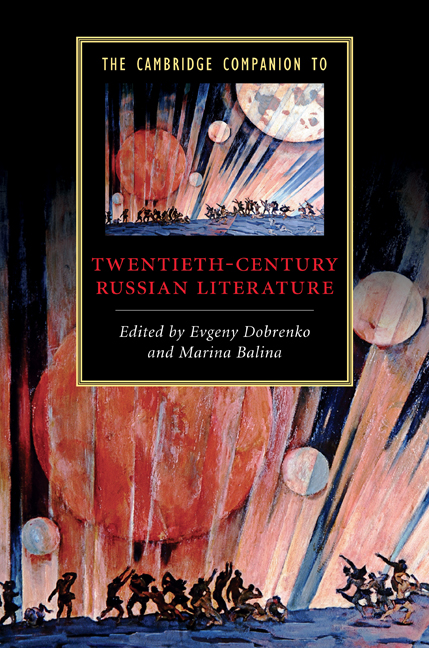

In Russian history, the twentieth century was an era of unprecedented, radical transformations - changes in social systems, political regimes, and economic structures. A number of distinctive literary schools emerged, each with their own voice, specific artistic character, and ideological background. As a single-volume compendium, the Companion provides a new perspective on Russian literary and cultural development, as it unifies both émigré literature and literature written in Russia. This volume concentrates on broad, complex, and diverse sources - from symbolism and revolutionary avant-garde writings to Stalinist, post-Stalinist, and post-Soviet prose, poetry, drama, and émigré literature, with forays into film, theatre, and literary policies, institutions and theories. The contributors present recent scholarship on historical and cultural contexts of twentieth-century literary development, and situate the most influential individual authors within these contexts, including Boris Pasternak, Alexander Solzhenitsyn, Joseph Brodsky, Osip Mandelstam, Mikhail Bulgakov and Anna Akhmatova.
'This Cambridge Companion features a stellar line-up of senior scholars surveying subfields that they not only have led, but sometimes also invented … All fifteen chapters are well-written, informative and authoritative.'
Robert Bird Source: Slavonic and East European Review
Loading metrics...
* Views captured on Cambridge Core between #date#. This data will be updated every 24 hours.
Usage data cannot currently be displayed.
This section outlines the accessibility features of this content - including support for screen readers, full keyboard navigation and high-contrast display options. This may not be relevant for you.
Accessibility compliance for the PDF of this book is currently unknown and may be updated in the future.
