Gender, Honor, and Charity in Late Renaissance Florence

-
Select format
-
- Publisher:
- Cambridge University Press
- Publication date:
- 07 September 2011
- 22 August 2011
- ISBN:
- 9780511976797
- 9781107002944
- 9781107690875
- Dimensions:
- (228 x 152 mm)
- Weight & Pages:
- 0.52kg, 290 Pages
- Dimensions:
- (229 x 152 mm)
- Weight & Pages:
- 0.43kg, 292 Pages
- Subjects:
- Area Studies, European History after 1450, History, European Studies
You may already have access via personal or institutional login- Subjects:
- Area Studies, European History after 1450, History, European Studies
Show more authors 
You may already have access via personal or institutional login
Book description
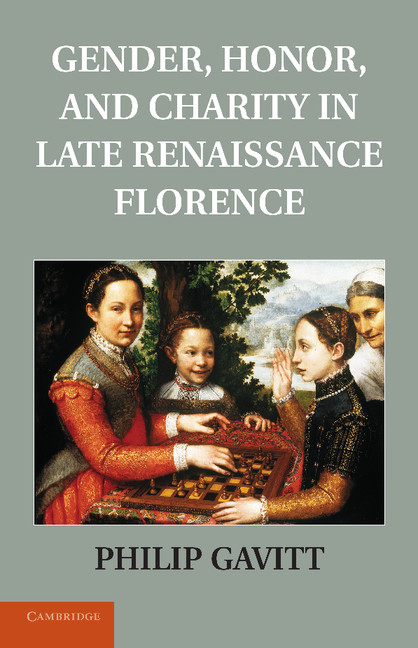
This book examines the important social role of charitable institutions for women and children in late Renaissance Florence. Wars, social unrest, disease and growing economic inequality on the Italian peninsula displaced hundreds of thousands of families during this period. In order to handle the social crises generated by war, competition for social position and the abandonment of children, a series of private and public initiatives expanded existing charitable institutions and founded new ones. Philip Gavitt's research reveals the important role played by lineage ideology among Florence's elites in the use and manipulation of these charitable institutions in the often futile pursuit of economic and social stability. Considering families of all social levels, he argues that the pursuit of family wealth and prestige often worked at cross-purposes with the survival of the very families it was supposed to preserve.
Reviews
'Gavitt has ably demonstrated that charitable and other conventual institutions were an important part of state-building strategies in Florence and an intrinsic part of Florentine life and culture. His book provides an important window into key aspects of Florentine gender and family history.'
Source: Parergon
'This book is and will long be an important contribution to a lively and growing area of research interest - the inheritance practices of early modern Italian societies.'
Source: Continuity and Change
'Gavitt provides stimulating insight into crucial issues that although long debated in the historiography of Renaissance Florence have been only sporadically addressed for the history of the city in the sixteenth century.'
Source: The American Historical Review
Contents
Contents
Metrics
Altmetric attention score
Full text views
Full text views helpTotal number of HTML views: 0
Total number of PDF views: 0 *
 Loading metrics...
* Views captured on Cambridge Core between #date#. This data will be updated every 24 hours.
Usage data cannot currently be displayed.
Accessibility standard: Unknown
Why this information is here
This section outlines the accessibility features of this content - including support for screen readers, full keyboard navigation and high-contrast display options. This may not be relevant for you.
Accessibility Information
Accessibility compliance for the PDF of this book is currently unknown and may be updated in the future.