
Skip to main content Accessibility help
×
  • Cited by 6
    • Show more authors
    • You may already have access via personal or institutional login
    • Select format
    • Publisher:
      Cambridge University Press
      Publication date:
      05 June 2012
      15 September 2011
      ISBN:
      9780511984570
      9781107011465
      9781107648876
      Dimensions:
      (246 x 189 mm)
      Weight & Pages:
      0.99kg, 394 Pages
      Dimensions:
      (246 x 189 mm)
      Weight & Pages:
      0.83kg, 394 Pages
    You may already have access via personal or institutional login
  • Selected: Digital
    Add to cart View cart Buy from Cambridge.org

    Book description

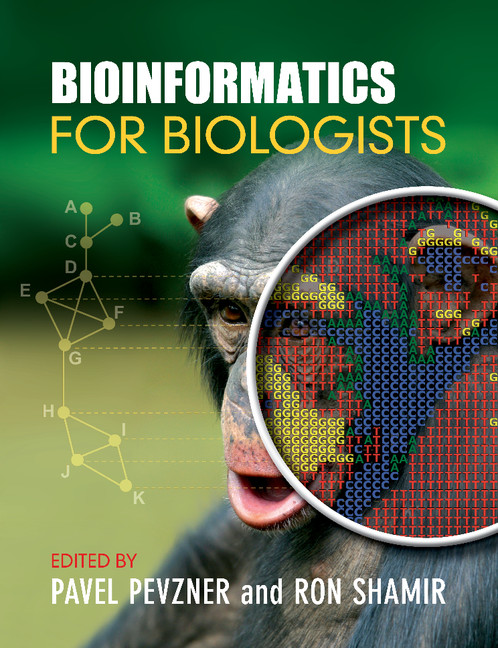
    The computational education of biologists is changing to prepare students for facing the complex datasets of today's life science research. In this concise textbook, the authors' fresh pedagogical approaches lead biology students from first principles towards computational thinking. A team of renowned bioinformaticians take innovative routes to introduce computational ideas in the context of real biological problems. Intuitive explanations promote deep understanding, using little mathematical formalism. Self-contained chapters show how computational procedures are developed and applied to central topics in bioinformatics and genomics, such as the genetic basis of disease, genome evolution or the tree of life concept. Using bioinformatic resources requires a basic understanding of what bioinformatics is and what it can do. Rather than just presenting tools, the authors - each a leading scientist - engage the students' problem-solving skills, preparing them to meet the computational challenges of their life science careers.

    Reviews

    'This volume contains a remarkable collection of individually-authored chapters cutting a wide swathe across the field as it is currently constituted. What is noteworthy, aside from the wide angle of the snapshot of today's bioinformatics, something the editors promise to update in future editions, is the innovative and effective pedagogical emphasis apparent throughout … The editors set out to provide a resource for teaching bioinformatics to life science undergraduates, and this is reflected in the language, organization and mathematical restraint of the different chapters … It is highly suitable as a text or reference for bioinformatics courses at the graduate level, for biologists, medical students and computer scientists. Biological naïveté in thinking and writing plagues bioinformatics, and Pevzner and Shamir's Bioinformatics for Biologists offers a wonderful therapy for that condition as well as an effective palliative for life science students' math phobias.'

    Professor David Sankoff - University of Ottawa

    'A serious and valuable effort to bring essential and much-needed training in the computational sciences to students of modern biology.'

    Michael Waterman - University of Southern California

    'This volume represents an excellent [effort] towards creating an interesting and useful introductory bioinformatics text. In its current form it may benefit computational scientists more than biologists, but has the potential to evolve into an invaluable resource for all bioinformaticists, independent of their primary field of study.'

    Dimitris Papamichail Source: SIGACT News

    Refine List

    Actions for selected content:

    Select all | Deselect all
    • View selected items
    • Export citations
    • Download PDF (zip)
    • Save to Kindle
    • Save to Dropbox
    • Save to Google Drive

    Save Search

    You can save your searches here and later view and run them again in "My saved searches".

    Please provide a title, maximum of 40 characters.
    ×

    Contents


    Page 1 of 2


    Page 1 of 2


    REFERENCES
    References
    [1] N., Guelzim, S., Bottani, P., Bourgine, and F., Képès. Topological and causal structure of the yeast transcriptional regulatory network. Nature Genet., 31:60–63, 2002.
    [2] National Human Genome Research Institute. Image provided for free public use through the US National Institutes of Health Image Bank as NHGRI press gallery photo 20018.
    [3] M. B., Eisen, P. T., Spellman, P. O., Brown, and D., Botstein. Cluster analysis and display of genome-wide expression patterns. Proc. Natl. Acad. Sci. U S A, 95:14, 863–14, 868, 1998.
    [4] N., Metropolis, A. W., Rosenbluth, M. N., Rosenbluth, A. H., Teller, and E., Teller. Equation of state calculation by fast computing machines. J. Chem. Phys., 21:1087–1092, 1953.
    [5] S., Geman and D., Geman. Stochastic relaxation, Gibbs distributions, and the Bayesian restoration of images. IEEE Trans. Pattern Anal. and Machine Intell., 6:721–741, 1984.
    [6] G. E., Schwarz. Estimating the dimension of a model. Ann. Stat., 6:461–464, 1978.
    [7] H., Causton, J., Quackenbush, and A., Brazma. Microarray Gene Expression Data Analysis: A Beginner's Guide. Blackwell Science, Malden, MA, 2003.
    [8] A., Zhang. Advanced Analysis of Gene Expression Microarray Data. World Scientific Publishing, Toh Tuck Link, Singapore, 2006.
    [9] L., Wasserman. All of Statistics. Springer, New York, 2004.
    [10] L., Wasserman. All of Non-Parametric Statistics. Springer, New York, 2006.
    [11] T. M., Mitchell. Machine Learning. WCB/McGraw-Hill, Boston, MA, 1997.
    [12] T., Hastie, R., Tibshirani, and J., Friedman. The Elements of Statistical Learning: Data Mining, Inference, and Prediction. Springer-Verlag, New York, 2001.
    [13] P., Congdon. Applied Bayesian Modelling. John Wiley and Sons, Chichester, 2003.
    [14] A., Gelman, J. B., Carlin, H. S., Stern, and D. B., Rubin. Bayesian Data Analysis. CRC Press, Boca Raton, FL, 2004.
    [15] R. E., Neapolitan. Learning Bayesian Networks. Pearson Prentice Hall, Upper Saddle River, NJ, 2004.
    [16] W. R., Gilks, S., Richardson, and D. J., Spiegelhalter. Markov Chain Monte Carlo in Practice. Chapman and Hall/CRC, Boca Raton, FL, 1996.
    [17] A., Ruszczyński. Nonlinear Optimization. Princeton University Press, Princeton, NJ, 2006.
    [18] S., Boyd and L., Vandenberghe. Convex Optimization. Cambridge University Press, New York, 2004.
    [19] P., Dhaseleer, S., Liang, and R., Somogyi. Genetic network inference: From co-expression clustering to reverse engineering. Bioinformatics, 16:707–726, 2000.
    [20] N., Friedman, M., Linial, I., Nachman, and D., Pe'er. Using Bayesian networks to analyze expression data. J. Comp. Biol., 7:601–620, 2000.

    Metrics

    Altmetric attention score

    Full text views

    Total number of HTML views: 0
    Total number of PDF views: 0 *
    Loading metrics...

    Book summary page views

    Total views: 0 *
    Loading metrics...

    * Views captured on Cambridge Core between #date#. This data will be updated every 24 hours.

    Usage data cannot currently be displayed.

    Accessibility standard: Unknown

    Why this information is here

    This section outlines the accessibility features of this content - including support for screen readers, full keyboard navigation and high-contrast display options. This may not be relevant for you.

    Accessibility Information

    Accessibility compliance for the PDF of this book is currently unknown and may be updated in the future.
