
Skip to main content Accessibility help
×
  • Cited by 104
    • Show more authors
    • You may already have access via personal or institutional login
    • Select format
    • Publisher:
      Cambridge University Press
      Publication date:
      07 October 2011
      29 September 2011
      ISBN:
      9780511997990
      9781107012233
      9781107632905
      Dimensions:
      (228 x 152 mm)
      Weight & Pages:
      0.5kg, 244 Pages
      Dimensions:
      (229 x 152 mm)
      Weight & Pages:
      0.33kg, 244 Pages
    You may already have access via personal or institutional login
  • Selected: Digital
    Add to cart View cart Buy from Cambridge.org

    Book description

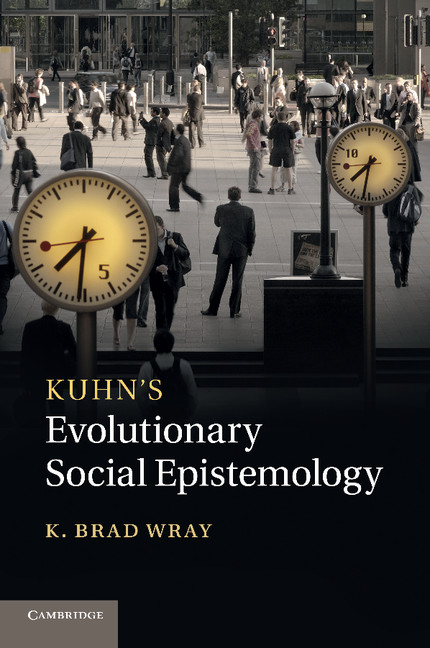
    Kuhn's Structure of Scientific Revolutions (1962) has been enduringly influential in philosophy of science, challenging many common presuppositions about the nature of science and the growth of scientific knowledge. However, philosophers have misunderstood Kuhn's view, treating him as a relativist or social constructionist. In this book, Brad Wray argues that Kuhn provides a useful framework for developing an epistemology of science that takes account of the constructive role that social factors play in scientific inquiry. He examines the core concepts of Structure and explains the main characteristics of both Kuhn's evolutionary epistemology and his social epistemology, relating Structure to Kuhn's developed view presented in his later writings. The discussion includes analyses of the Copernican revolution in astronomy and the plate tectonics revolution in geology. The book will be useful for scholars working in science studies, sociologists and historians of science as well as philosophers of science.

    Reviews

    'K. Brad Wray admirably succeeds in explaining in a coherent way Thomas Kuhn’s view of scientific development. He shows us how a sympathetic dispute with the sociology of science paves the way for a social epistemology that deserves its name. He also shows us clearly how a theory of scientific development that features revolutions is nevertheless evolutionary. A splendid book!'

    Professor Dr Paul Hoyningen-Huene - Leibniz Universität Hannover

    'Wray’s monograph fills an important gap in the literature on Kuhn by clarifying and defending Kuhn’s epistemology of science as it was developed in his later work, and by showing how it relates to recent work in sociology of science and science studies. Wray offers many important insights drawn from his re-examination of Kuhn’s social epistemology while at the same time pointing to new areas of research that philosophers need to pursue.'

    Hanne Andersen - Aarhus University, Denmark

    'Excellent book … a rich and stimulating guide, one that caused me to rethink my own take on Kuhn and the issues that his work has raised for us. Both science studies professionals and more general readers will find much of value here.'

    Source: Metascience

    '… a constructive and insightful framework for developing an epistemology of science … Well written, clear, and carefully argued, Kuhn’s Evolutionary Social Epistemology will be most useful and insightful …'

    Stefano Gattei Source: Isis

    '… of interest to philosophers, sociologists, scientists, historians of science, and scholars working in science studies … Wray has the ability to write in a clear and accessible way … could be used as a textbook on Kuhn’s epistemology of science … a splendid book … I am convinced it will inspire many scholars and students in years to come.'

    Barbara G. Benzi Source: International Studies in the Philosophy of Science

    '… highly recommended … The book provides concrete points of cooperative and collaborative studies of the science of sociological and philosophical perspective …'

    Markus Seidel Source: Rezensionen: Zeitschrift für Theoretische Soziologie

    Refine List

    Actions for selected content:

    Select all | Deselect all
    • View selected items
    • Export citations
    • Download PDF (zip)
    • Save to Kindle
    • Save to Dropbox
    • Save to Google Drive

    Save Search

    You can save your searches here and later view and run them again in "My saved searches".

    Please provide a title, maximum of 40 characters.
    ×

    Contents

    Bibliography
    Abbott, A. 2001 Chaos of DisciplinesUniversity of Chicago Press
    Achinstein, P. 2001 “Subjective Views of Kuhn,”Perspectives on Science 9 423
    Andersen, H. 2001 On KuhnBelmont, CAWadsworth/Thomson Learning
    Andersen, H. 2001 Kuhn, Conant and Everything: A Full or A Fuller AccountPhilosophy of Science 68 258
    Andersen, H.Barker, P.Chen, X. 2006 The Cognitive Structure of Scientific RevolutionsCambridge University Press
    Armitage, A. 1957 Copernicus and Modern AstronomyMineola, NYDover Publications
    Baigrie, B. 1988 “Why Evolutionary Epistemology Is an Endangered Theory,”Social Epistemology 2 357
    Barker, P. 2002 “Constructing Copernicus,”Perspectives on Science 10 208
    Barker, P. 2001 Kuhn, Incommensurability, and Cognitive SciencePerspectives on Science 9 433
    Barker, P. 2001
    Barker, P. 1999 Copernicus and the Critics of PtolemyJournal for the History of Astronomy 30 343
    Barker, P.Chen, X.Andersen, H. 2003 Nickles, T.Thomas KuhnCambridge University Press
    Barnes, B. 2003 Nickles, T.Thomas KuhnCambridge University Press
    Barnes, B. 1982 T. S. Kuhn and Social ScienceNew YorkColumbia University Press
    Barnes, B.Bloor, D. 1982 Hollis, M.Lukes, S.Rationality and RelativismCambridge, MAMIT Press
    Barnes, B.Bloor, D.Henry, J. 1996 Scientific Knowledge: A Sociological AnalysisUniversity of Chicago Press
    Bayer, A. E.Dutton, J. E. 1977 “Career Age and Research-Professional Activities of Academic Scientists: Test of Alternative Nonlinear Models and Some Implications for Higher Education Faculty Policies,”Journal of Higher Education 48 259
    Becher, T.Trowler, P. R. 2001 Academic Tribes and TerritoriesBuckinghamSociety for Research into Higher Education and Open University Press
    Ben-David, J.Collins, R. 1966 Scientific Growth: Essays on the Social Organization and Ethos of ScienceFreudental, G.Berkeley and Los AngelesUniversity of California Press
    Berlin, I. 2002 LibertyHardy, H.Oxford University Press
    Biagioli, M. 1993 Galileo Courtier: The Practice of Science in the Culture of AbsolutismUniversity of Chicago Press
    Biagioli, M. 1990 The Anthropology of IncommensurabilityStudies in History and Philosophy of Science 21 183
    Bird, A. 2003 “Kuhn, Nominalism, and Empiricism,”Philosophy of Science 70 690
    Bird, A. 2000 Thomas KuhnPrinceton University Press
    Boghossian, P. 2006 Fear of Knowledge: Against Relativism and ConstructivismOxford University Press
    Bradie, M. 1986 “Assessing Evolutionary Epistemology,”Biology and Philosophy 1 401
    Brannigan, A. 1981 The Social Basis of Scientific DiscoveryCambridge University Press
    Brown, H. 2005 “Incommensurability Reconsidered,”Studies in History and Philosophy of Science 36 149
    Brown, H. I. 1983 “Incommensurability,”Inquiry 26 3
    Brown, J. R. 1989 The Rational and the SocialLondonRoutledge
    Bruner, J. 1983 In Search of Mind: Essays in AutobiographyNew YorkHarper and Row
    Bruner, J. S.Postman, L. 1949 “On the Perception of Incongruity: A Paradigm,”Journal of Personality 18 206
    Buchwald, J. Z.Smith, G. E. 2001 “Incommensurability and the Discontinuity of Evidence,”Perspectives on Science 9 463
    Budd, J. M.Sievert, M.Schultz, T. R. 1998 “Reasons for Retraction and Citations to the Publications,”Journal of the American Medical Association 280 296
    Burian, R. M. 2001 “The Dilemma of Case Studies Resolved: The Virtues of Using Case Studies in the History and Philosophy of Science,”Perspectives on Science 9 383
    Butterfield, H. 1957 The Origins of Modern ScienceNew YorkFree Press
    Butts, R. E. 2000 Witches, Scientists, Philosophers: Essays and LecturesSolomon, G.DordrechtKluwer
    Campbell, D. T. 1974 Schilpp, P. A.The Philosophy of Karl PopperLa SalleOpen Court
    Carnap, R. 1950 “Empiricism, Semantics, and Ontology,”Revue Internationale de Philosophie 4 20
    Cartwright, N. 1994 Papineau, D.The Philosophy of ScienceOxford University Press
    Cedarbaum, D. G. 1983 “Paradigms,”Studies in History and Philosophy of Science 14 173
    Chen, X. 1990 “Local Incommensurability and Communicability,”PSA: Proceedings of the Biennial Meeting of the Philosophy of Science Association 1 67
    Chen, X.Barker, P. 2000 Continuity through Revolutions: A Frame-Based Account of Conceptual Change during RevolutionsPhilosophy of Science 67 S208
    Chubin, D. E. 1976 “The Conceptualization of Scientific Specialties,”Sociological Quarterly 17 448
    Cohen, I. B. 1985 Revolution in ScienceCambridge, MAHarvard University Press
    Cohen, I. B. 1974 Suppe, F.The Structure of Scientific TheoriesUrbana and ChicagoUniversity of Illinois Press
    Cohen, L. J. 1973 “Is the Progress of Science Evolutionary?,”British Journal for the Philosophy of Science 24 41
    Cole, J. R. 1979 Fair Science: Women in the Scientific CommunityNew YorkFree Press
    Cole, J. R.Zuckerman, H. 1975 Coser, L. A.The Idea of Social Structure: Papers in Honor of Robert K. MertonNew York: Harcourt Brace Jovanovich
    Cole, S. 2004 “Merton’s Contribution to the Sociology of Science,”Social Studies of Science 34 829
    Cole, S. 1992 Making Science: Between Nature and SocietyCambridge, MAHarvard University Press
    Cole, S. 1979 Age and Scientific PerformanceAmerican Journal of Sociology 84 958
    Cole, S. 1975 Coser, L. A.The Idea of Social Structure: Papers in Honor of Robert K. MertonNew YorkHarcourt Brace Jovanovich
    Collier, J. 1984 “Pragmatic Incommensurability,”PSA: Proceedings of the Biennial Meeting of the Philosophy of Science Association 1 146
    Conant, J. B. 1950 Conant, J. B.Robert Boyle’s Experiments in PneumaticsCambridge, MAHarvard University Press
    Conant, J.Haugeland, J. 2000
    Copernicus, N. 1543 On the Revolutions of Heavenly SpheresWallis, C. G.Amherst, NYPrometheus Books
    Crane, D. 1972 Invisible Colleges: Diffusion of Knowledge in Scientific CommunitiesUniversity of Chicago Press
    Darwin, C. 1878 On the Origin of the Species by Means of Natural SelectionCarroll, J.Peterborough, ONBroadview Press
    Daston, L. 2008 “On Scientific Observation,”Isis 99 97
    Davies, J. C. 1962 “Toward a Theory of Revolution,”American Sociological Review 21 5
    Dear, P. 2001 Revolutionizing the Sciences: European Knowledge and Its Ambitions, 1500–1700Princeton University Press
    Demir, I. 2008 “Incommensurabilities in the Work of Thomas Kuhn,”Studies in History and Philosophy of Science 39 133
    Dennis, W. 1966 “Creative Productivity between the Ages of 20 and 80 Years,”Journal of Gerontology 21 1
    Dennis, W. 1956 Age and Productivity among ScientistsScience 123 724
    Diamond, A. M. 1980 “Age and Acceptance of Cliometrics,”Journal of Economic History 40 838
    Dibner, B. 1980 Heralds of Science: As Represented by Two Hundred Epochal Books and Pamphlets in the Dibner Library, Smithsonian InstitutionWashington, DCBurndy Library and Smithsonian Institution
    Dobbs, B. J. T. 2000 Osler, M.Rethinking the Scientific RevolutionCambridge University Press
    Donovan, A.Laudan, L.Laudan, R. 1988 Scrutinizing Science: Empirical Studies of Scientific ChangeDordrechtKluwer
    Doppelt, G. 2001
    Doppelt, G. 1978 Kuhn’s Epistemological Relativism: An Interpretation and DefenseInquiry 21 1
    Downes, S. M. 2000 “Truth, Selection and Scientific Inquiry,”Biology and Philosophy 15 425
    Drake, S. 1970 Galileo Studies: Personality, Tradition, and RevolutionAnn ArborUniversity of Michigan Press
    Dreyer, J. L. E. 1963 Tycho Brahe: A Picture of Scientific Life and Work in the Sixteenth CenturyNew YorkDover Publications
    Duhem, P. 1917 Essays in the History and Philosophy of ScienceAriew, R.Barker, P.IndianapolisHackett Publishing Company
    Durkheim, E. 1897 Suicide: A Study in SociologySpaulding, J. A.Simpson, G.New YorkFree Press
    Edge, D. O.Mulkay, M. J. 1976 Astronomy Transformed: The Emergence of Radio Astronomy in BritainNew YorkJohn Wiley and Sons
    Ennis, J. G. 1992 “The Social Organization of Sociological Knowledge: Modeling the Intersection of Specialties,”American Sociological Review 57 259
    Ereshefsky, M. 1998 “Species Pluralism and Anti-Realism,”Philosophy of Science 65 103
    Ereshefsky, M. 1992 Eliminative PluralismPhilosophy of Science 59 671
    Fagan, B. M.
    Farley, J.Geison, G. L. 1974 “Science, Politics and Spontaneous Generation in Nineteenth-Century France: The Pasteur–Pouchet Debate,”Bulletin of the History of Medicine 48 161
    Feldman, R. 1988 “Rationality, Reliability, and Natural Selection,”Philosophy of Science 55 218
    Feyerabend, P. K. 1970 Lakatos, I.Musgrave, A.Criticism and the Growth of Knowledge: Proceedings of the International Colloquium in the Philosophy of Science, London 1965Cambridge University Press197
    Fleck, L. 1935 Genesis and Development of a Scientific FactTrenn, T. J.Merton, R. K.University of Chicago Press
    Frank, P. 1949 Modern Science and Its PhilosophyCambridge, MAHarvard University Press
    Frankel, H. 1982 “The Development, Reception, and Acceptance of the Vine-Matthews-Morley Hypothesis,”Historical Studies in the Physical Sciences 13 1
    Friedman, M. 2003 Nickles, T.Thomas KuhnCambridge University Press
    Friedman, M. 2001 Dynamics of Reason: The 1999 Kant Lectures at Stanford UniversityStanford, CACSLI Publications
    Friedman, M. 2000 Kant, Kuhn, and the Rationality of SciencePhilosophy of Science 69 171
    Friedman, M. 1998 On the Sociology of Scientific Knowledge and Its Philosophical AgendaStudies in History and Philosophy of Science 29 239
    Friedman, M. 1974 Explanation and Scientific UnderstandingJournal of Philosophy 71 5
    Fuller, S. 2004 Kuhn vs. Popper: The Struggle for the Soul of ScienceNew YorkColumbia University Press
    Fuller, S. 2000 Thomas Kuhn: A Philosophical History for Our TimesUniversity of Chicago Press
    Fuller, S. 1999 The Governance of Science: Ideology and the Future of the Open SocietyBuckinghamOpen University Press
    Galilei, G. 1612 Discourse on Bodies in WaterFinocchiaro, M. A.IndianapolisHackett Publishing Company
    Galilei, G. 1612 Discourse on Bodies in WaterSalusbury, T.UrbanaUniversity of Illinois Press
    Galison, P. 1997 Image and Logic: A Material Culture of MicrophysicsUniversity of Chicago Press
    Garber, D. 2001 Descartes and the Scientific Revolution: Some Kuhnian ReflectionsPerspectives on Science 9 405
    Garfield, E. 1980 Gieryn, T.Science and Social Structure: A Festschrift for Robert K. MertonNew York
    Garvey, W. D.Tomita, K. 1972 “Continuity of Productivity by Scientists in the Years 1968–71,”Science Studies 2 379
    Gascoigne, R. M. 1987 A Chronology of the History of Science: 1450–1900New YorkGarland Publishing
    Gattei, S. 2008 Thomas Kuhn’s “Linguistic Turn” and the Legacy of Logical Empiricism: Incommensurability, Rationality and the Search for TruthAldershotAshgate Publishing
    Giere, R. N. 1999 Science without LawsUniversity of Chicago Press
    Giere, R. N. 1988 Explaining Science: A Cognitive ApproachUniversity of Chicago Press
    Giere, R. N. 1973 History and Philosophy of Science: Intimate Relationship or Marriage of Convenience?British Journal for the Philosophy of Science 24 282
    Gilbert, M. 2000 Sociality and Responsibility: New Essays in Plural Subject TheoryLanhamRowman and Littlefield
    Gillispie, C. G. 1970 Dictionary of Scientific BiographyNew YorkCharles Scribner’s Sons
    Gingerich, O. 1975 “‘Crisis’ versus Aesthetic in the Copernican Revolution,”Vistas in Astronomy 17 85
    Gingerich, O. 1973 The Role of Erasmus Reinhold and the Prutenic Tables in the Dissemination of Copernican TheoryStudia Copernicana 6 43
    Gingerich, O. 1971 Actes du xii Congrès International d’Histoire des Sciences: Paris, 1968ParisBlanchard
    Glen, W. 1982 The Road to Jaramillo: Critical Years of the Revolution in Earth ScienceStanford University Press
    Goldman, A. 1986 Epistemology and CognitionCambridge, MAHarvard University Press
    Goldman, A. 1999 Knowledge in a Social WorldOxfordClarendon Press
    Goldstone, J. A. 2003 Mahoney, J.Rueschemeyer, D.Comparative Historical Analysis in the Social SciencesCambridge University Press
    Goldstone, J. A. 1991 Revolution and Rebellion in the Early Modern WorldBerkeley and Los AngelesUniversity of California Press
    Golinski, J. 1998 Making Natural Knowledge: Constructivism and the History of ScienceUniversity of Chicago Press
    Grantham, T. 1994 “Does Science Have a ‘Global Goal?’: A Critique of Hull’s View of Conceptual Progress,”Biology and Philosophy 9 93
    Greene, J. C. 1971 Roller, D. H. D.Perspectives in the History of Science and TechnologyNormanUniversity of Oklahoma Press
    Gregory, R. A. 1977 Hodgkin, Alan L.The Pursuit of Nature: Informal Essays on the History of PhysiologyCambridge University Press
    Gurr, T. R. 1970 Why Men RebelPrinceton University Press
    Hacking, I. 1999 The Social Construction of What?Cambridge, MAHarvard University Press
    Hacking, I. 1993 Horwich, P.World Changes: Thomas Kuhn and the Nature of ScienceCambridge, MAMIT Press
    Hacking, I. 1983 Representing and Intervening: Introductory Topics in the Philosophy of Natural ScienceCambridge University Press
    Hanson, N. R. 1958 Patterns of DiscoveryCambridge University Press
    Hanson, N. R. 1961 The Copernican Disturbance and the Keplerian RevolutionJournal of the History of Ideas 22 169
    Harding, S. 1991 Whose Science? Whose Knowledge?: Thinking from Women’s LivesIthaca, NYCornell University Press
    Harding, S. 1986 The Science Question in FeminismIthaca, NYCornell University Press
    Hardwig, J. 1991 “The Role of Trust in Knowledge,”Journal of Philosophy 88 693
    Hayek, F. A. 1960 The Constitution of LibertyUniversity of Chicago Press
    Heidelberger, M. 1976 Gutting, G.Paradigms and Revolutions: Applications and Appraisals of Thomas Kuhn’s Philosophy of ScienceUniversity of Notre Dame Press
    Helmreich, R. L.Spence, J. T.Thorbecke, W. L. 1981 “On the Stability of Productivity and Recognition,”Personality and Social Psychology Bulletin 7 516
    Henry, J. 2008 The Scientific Revolution and the Origins of Modern ScienceHoundmillsPalgrave Macmillan
    Hesse, M. 1976 “Truth and the Growth of Scientific Knowledge,”PSA: Proceedings of the Biennial Meeting of the Philosophy of Science Association 2 261
    Horner, K.Rushton, J. P.Vernon, P. A. 1986 “The Relation between Aging and Research Productivity of Academic Psychologists,”Psychology of Aging 1 319
    Hoskin, M. 1997 Hoskin, M.The Cambridge Illustrated History of AstronomyCambridge University Press
    Hoyningen-Huene, P. 2008 “Thomas Kuhn and the Chemical Revolution,”Foundations of Chemistry 10 101
    Hoyningen-Huene, P. 1992 The Interrelations between Philosophy, History and Sociology of Science in Thomas Kuhn’s Theory of Scientific DevelopmentBritish Journal for the Philosophy of Science 43 487
    Hoyningen-Huene, P. 1989 Reconstructing Scientific Revolutions: Thomas S. Kuhn’s Philosophy of ScienceLevine, A. T.University of Chicago Press
    Hoyningen-Huene, P.Oberheim, E.Andersen, H. 1996 “Essay Review: On Incommensurability,”Studies in History and Philosophy of Science 27 131
    Hoyningen-Huene, P.Sankey, H. 2001 Incommensurability and Related MattersDordrechtSpringer
    Hughes, S. S. 1977 The Virus: A History of the ConceptNew YorkScience History Publications
    Hull, D. L. 2001 Science and SelectionCambridge University Press
    Hull, D. L. 1988 Science as a Process: An Evolutionary Account of the Social and Conceptual Developments of ScienceUniversity of Chicago Press
    Hull, D. L. 1974 “Are the ‘Members’ of Biological Species ‘Similar’ to Each Other?,”British Journal for the Philosophy of Science 25 332
    Hull, D. L.Tessner, P. D.Diamond, A. M. 1978 “Planck’s Principle,”Science 202 717
    Kanazawa, S. 2003 “Why Productivity Fades with Age: The Crime–Genius Connection,”Journal of Research in Personality 37 257
    Kincaid, H. 1996 Philosophical Foundations of the Social Sciences: Analyzing Controversies in Social ResearchCambridge University Press
    Kindi, V. 2005 The Relation of History of Science to Philosophy of Science in and Kuhn’s Later Philosophical WorkPerspectives on Science 13 495
    Kitcher, P. 1993 The Advancement of Science: Science without Legend, Objectivity without IllusionOxford University Press
    Knorr Cetina, K. 1999 Epistemic Cultures: How the Sciences Make KnowledgeCambridge, MAHarvard University Press
    Koestler, A. 1959 The Sleepwalkers: A History of Man’s Changing Vision of the UniverseLondonPenguin Books
    Kraminick, I. 1972 Reflections on Revolution: Definition and Explanation in Recent ScholarshipHistory and Theory 11 26
    Kuhn, T. S. 2000 The Road since Structure: Philosophical Essays, 1970–1993, with an Autobiographical InterviewConant, J.Haugeland, J.University of Chicago Press
    Kuhn, T. S. 2000
    Kuhn, T. S. 1993
    Kuhn, T. S. 1992
    Kuhn, T. S. 1991
    Kuhn, T. S. 1991
    Kuhn, T. S. 1989
    Kuhn, T. S. 1987
    Kuhn, T. S. 1983
    Kuhn, T. S. 1980 The Halt and the Blind: Philosophy and History of ScienceBritish Journal for the Philosophy of Science 31 181
    Kuhn, T. S. 1979
    Kuhn, T. S. 1979
    Kuhn, T. S. 1977 The Essential Tension: Selected Studies in Scientific Tradition and ChangeUniversity of Chicago Press
    Kuhn, T. S. 1977
    Kuhn, T. S. 1977
    Kuhn, T. S. 1976
    Kuhn, T. S. 1974
    Kuhn, T. S. 1970
    Kuhn, T. S. 1970
    Kuhn, T. S. 1969
    Kuhn, T. S. 1968
    Kuhn, T. S. 1963 Crombie, A. C.Scientific Change: Historical Studies in the Intellectual, Social and Technical Conditions for Scientific Discovery and Technical Invention, from Antiquity to the PresentNew YorkBasic Books
    Kuhn, T. S. 1962 The Structure of Scientific RevolutionsUniversity of Chicago Press
    Kuhn, T. S. 1962
    Kuhn, T. S. 1961
    Kuhn, T. S. 1959
    Kuhn, T. S. 1957 The Copernican Revolution: Planetary Astronomy in the Development of Western ThoughtCambridge, MAHarvard University Press
    Kuukkanen, J.-M. 2007 “Kuhn, the Correspondence Theory of Truth, and Coherentist Epistemology,”Studies in History and Philosophy of Science 38 555
    Lakatos, I. 1970 Lakatos, I.Musgrave, A.Criticism and the Growth of Knowledge: Proceedings of the International Colloquium in the Philosophy of Science, London 1965Cambridge University Press
    Latour, B. 1987 Science in Action: How to Follow Scientists and Engineers through SocietyCambridge, MAHarvard University Press
    Latour, B. 1983 Knorr-Cetina, K. D.Mulkay, M.Science Observed: Perspectives on the Social Study of ScienceLondonSage
    Latour, B.Woolgar, S. 1986 Laboratory Life: The Construction of Scientific FactsPrinceton University Press
    Laudan, L. 1984 Science and Values: The Aims of Science and Their Role in Scientific DebateBerkeley and Los AngelesUniversity of California Press
    Laudan, L. 1977 Progress and Its Problems: Toward a Theory of Scientific GrowthBerkeley and Los AngelesUniversity of California Press
    Laudan, R.Laudan, L.Donovan, A. 1988
    Law, J. 1976
    Le Grand, H. E. 1988 Drifting Continents and Shifting Theories: The Modern Revolution in Geology and Scientific ChangeCambridge University Press
    Lehman, H. C. 1953 Age and AchievementPrinceton University Press
    Lemaine, G.MacLeod, R.Mulkay, M.Weingart, P. 1976
    Lemaine, G.MacLeod, R.Mulkay, M.Weingart, P. 1976 Perspectives on the Emergence of Scientific DisciplinesChicagoAldine
    Levine, A. 2010 “Thomas Kuhn’s Cottage,”Perspectives on Science: Historical, Philosophical, Social 18 369
    Longino, H. E. 2002 The Fate of KnowledgePrinceton University Press
    Longino, H. E. 1990 Science as Social Knowledge: Values and Objectivity in Scientific InquiryPrinceton University Press
    McArthur, R. P.Pestana, H. R. 1975 Proceedings No. 3: XIVth International Congress of the History of ScienceTokyo and KyotoScience Council of Japan
    McCann, H. G. 1978 Chemistry Transformed: The Paradigmatic Shift from Phlogiston to OxygenNorwood, NJAblex
    McClellan, J. E.Dorn, H. 1999 Science and Technology in World History: An IntroductionBaltimoreJohns Hopkins University Press
    McMullin, E. 1993 Horwich, P.World Changes: Thomas Kuhn and the Nature of ScienceCambridge, MAMIT Press
    Mach, E. 1896 Principles of the Theory of Heat: Historically and Critically ElucidatedB. McGuinnessDordrechtD. Reidel
    MacIntyre, A. 1981 After Virtue: A Study in Moral TheoryUniversity of Notre Dame Press
    MacIntyre, A. 1984 Brown, J. R.Scientific Rationality: The Sociological TurnDordrechtD. Reidel
    Marshak, S. 2008 Earth: Portrait of a PlanetNew YorkW. W. Norton and Company
    Marx, W.Bornmann, L. 2010 “How Accurately Does Thomas Kuhn’s Model of Paradigm Change Describe the Transition from the Static View of the Universe to the Big Bang Theory in Cosmology?,”Scientometrics 84 441
    Masterman, M. 1970 Lakatos, I.Musgrave, A.Criticism and the Growth of Knowledge: Proceedings of the International Colloquium in the Philosophy of Science, London, 1965Cambridge University Press
    Mayr, E. 2004 What Makes Biology Unique? Considerations on the Autonomy of a Scientific DisciplineCambridge University Press
    Menard, H. W. 1986 The Ocean of Truth: A Personal History of Global TectonicsPrinceton University Press
    Menard, H. W. 1971 Science: Growth and ChangeCambridge, MAHarvard University Press
    Merton, R. K. 2004 Merton, R. K.Barber, E.The Travels and Adventures of SerendipityPrinceton University Press
    Merton, R. K. 1996 On Social Structure and ScienceSztompka, P.University of Chicago Press
    Merton, R. K. 1995 The Thomas Theorem and the Matthew EffectSocial Forces 74 379
    Merton, R. K. 1977 Merton, R. K.Gaston, J.The Sociology of Science in EuropeCarbondale and EdwardsvilleSouthern Illinois University Press
    Merton, R. K. 1973 The Sociology of Science: Theoretical and Empirical InvestigationsStorer, N. W.University of Chicago Press
    Merton, R. K. 1972
    Merton, R. K. 1963
    Merton, R. K. 1961
    Merton, R. K. 1959 Priorities in Scientific Discovery: A Chapter in the Sociology of ScienceAmerican Sociological Review 22 635
    Merton, R. K. 1949 Merton, R. K.Social Theory and Social StructureNew YorkFree Press
    Merton, R. K. 1945 Sociological TheoryAmerican Journal of Sociology 50 462
    Merton, R. K. 1945 Gurvitch, G.Moore, W. E.Twentieth-Century SociologyNew YorkPhilosophical Library
    Merton, R. K. 1941 Review of by Florian ZnanieckiAmerican Sociological Review 6 111
    Merton, R. K.Garfield, E. 1986
    Messeri, P. 1988 “Age Differences in the Reception of New Scientific Theories: The Case of Plate Tectonics Theory,”Social Studies of Science 18 91
    Mladenović, B. 2007 ‘Muckraking in History’: The Role of the History of Science in Kuhn’s PhilosophyPerspectives on Science 15 261
    Molnar, P. 2001 Oreskes, N.Plate Tectonics: An Insider’s History of the Modern Theory of the EarthBoulderWestview Press
    Mulkay, M. J. 1975 Three Models of Scientific DevelopmentSociological Review 23 509
    Mulkay, M. J.Edge, D. O. 1976
    Mullins, N. C. 1972 “The Development of a Scientific Specialty: The Phage Group and the Origins of Molecular Biology,”Minerva: Review of Science, Learning and Policy 10 51
    Musgrave, A. E. 1971 Gutting, G.Paradigms and Revolutions: Applications and Appraisals of Thomas Kuhn’s Philosophy of ScienceUniversity of Notre Dame Press
    Myers, G. 1990 Writing Biology: Texts in the Social Construction of Scientific KnowledgeMadisonUniversity of Wisconsin Press
    Nersessian, N. J. 2003 Nickles, T.Thomas KuhnCambridge University Press
    Newton, I. 1726 The Principia: Mathematical Principles in Natural PhilosophyCohen, I. B.Whitman, A.Budenz, J.Berkeley and Los AngelesUniversity of California Press
    Newton-Smith, W. H. 2000 A Companion to the Philosophy of ScienceOxfordBlackwell Publishers
    Nickles, T. 1997 “The Multi-Pass Conception of Scientific Inquiry,”Danish Yearbook of Philosophy 32 11
    Nitecki, M. H.Lemke, J. L.Pullman, H. W.Johnson, M. E. 1978 “Acceptance of Plate Tectonic Theory by Geologists,”Geology 6 661
    Oberheim, E. 2005 “On the Historical Origins of the Contemporary Notion of Incommensurability: Paul Feyerabend’s Assault on Conceptual Conservativism,”Studies in History and Philosophy of Science 36 363
    Oreskes, N. 2008 “The Devil Is in the (Historical) Details: Continental Drift as a Case of Normatively Appropriate Consensus?,”Perspectives on Science 16 253
    Over, R. 1982 “Is Age a Good Predictor of Research Productivity?,”Australian Psychologist 17 129
    Papineau, D. 1996 Papineau, D.The Philosophy of ScienceOxford University Press
    Pedersen, O. 1980 “Tycho Brahe and the Rebirth of Astronomy,”Physica Scripta 21 693
    Pickering, A. 1984 Constructing Quarks: A Sociological History of Particle PhysicsEdinburgh University Press
    Pinch, T. J. 1982 “Kuhn – The Conservative and Radical Interpretations: Are Some Mertonians ‘Kuhnians’ and Some Kuhnians ‘Mertonians’?,”Social Studies of Science 27 465
    Pinch, T. J. 1979 “Paradigm Lost?: A Review Symposium,”Isis 70 437
    Pinch, T. J.Bijker, W. E. 1984 “The Social Construction of Facts and Artefacts: Or How the Sociology of Science and the Sociology of Technology Might Benefit Each Other,”Social Studies of Science 14 399
    Pitt, J. 2001 “The Dilemma of Case Studies: Toward a Heraclitian Philosophy of Science,”Perspectives on Science 9 373
    Planck, M. 1949 Scientific Autobiography and Other Papers: With a Memorial Address on Max Planck by Max von LaueGaynor, F.New YorkPhilosophical Library
    Popper, K. R. 1975 Hacking, I.Scientific RevolutionsOxford University Press
    Popper, K. R. 1972 Objective Knowledge: An Evolutionary ApproachOxford University Press
    Popper, K. R. 1970 Lakatos, I.Musgrave, A.Criticism and the Growth of Knowledge: Proceedings of the International Colloquium in the Philosophy of Science, London 1965Cambridge University Press
    Popper, K. R. 1963 Conjectures and Refutations: The Growth of Scientific KnowledgeNew YorkHarper and Row
    Popper, K. R. 1959 The Logic of Scientific DiscoveryNew YorkBasic Books
    Popper, K. R. 1946 The Open Society and Its EnemiesPrinceton University Press
    Price, D. de Solla 1963 Little Science, Big Science … and BeyondMerton, R. K.Garfield, E.New YorkColumbia University Press
    Quine, W. V. 1969 Ontological Relativity and Other EssaysNew YorkColumbia University Press
    Rand, D. G.Dreber, A.Ellingsen, T.Fudenberg, D.Nowak, M. A. 2009 “Positive Interactions Promote Public Cooperation,”Science 325 1272
    Rappa, M.DeBackere, K. 1993 “Youth and Scientific Innovation: The Role of Young Scientists in the Development of a New Field,”Minerva: A Review of Science, Learning and Policy 31 1
    Reichenbach, H. 1938 Experience and Prediction: An Analysis of the Foundations and the Structure of KnowledgeUniversity of Notre Dame Press
    Reisch, G. A. 1991 “Did Kuhn Kill Logical Empiricism?,”Philosophy of Science 58 2
    Renzi, B. G. 2009 Kuhn’s Evolutionary Epistemology and Its Being Undermined by Inadequate Biological ConceptsPhilosophy of Science 76 143
    Rescher, N. 1978 Scientific Progress: A Philosophical Essay on the Economics of Research in Natural ScienceUniversity of Pittsburgh Press
    Reydon, T. A. C.Hoyningen-Huene, P. 2010 Discussion: Kuhn’s Evolutionary Analogy in and ‘The Road since Structure’Philosophy of Science 77 468
    Richardson, A. 2007 Richardson, A.Uebel, T.The Cambridge Companion to Logical EmpiricismCambridge University Press
    Rolin, K. 2008 “Science as Collective Knowledge,”Cognitive Systems Research 9 1
    Rouse, J. 1987 Knowledge and Power: Toward a Political Philosophy of ScienceIthaca, NYCornell University Press
    Rouse, J. 2003 Nickles, T.Thomas KuhnCambridge University Press
    Sankey, H. 1994 The Incommensurability ThesisAldershotAshgate
    Sankey, H. 1993 Kuhn’s Changing Conception of IncommensurabilityBritish Journal for the Philosophy of Science 44 7
    Sankey, H. 1991 Incommensurability, Translation, and UnderstandingPhilosophical Quarterly 41 414
    Sankey, H.Hoyningen-Huene, P. 2001
    Schaffer, S. 1989 Gooding, D.Pinch, T.Schaffer, S.The Uses of Experiment: Studies in the Natural SciencesCambridge University Press
    Scheffler, I. 1967 Science and SubjectivityIndianapolisBobbs-Merrill
    Schenkman, L. 2010 “Random Samples: Who’s Bigger?,”Science 330 301
    Schmaus, W. 2008 “A New Way of Thinking about Social Location in Science,”Science & Education 17 1127
    Schmitt, F. F. 1994 Schmitt, F. F.Socializing Epistemology: The Social Dimensions of KnowledgeLanhamRowman and Littlefield
    Shapere, D. 1966 Hacking, I.Scientific RevolutionsOxford University Press
    Shapere, D. 1964 Paradigms and Revolutions: Applications and Appraisals of Thomas Kuhn’s Philosophy of ScienceUniversity of Notre Dame Press
    Shapin, S. 1996 The Scientific RevolutionUniversity of Chicago Press
    Shapin, S. 1994 A Social History of Truth: Civility and Science in Seventeenth-Century EnglandUniversity of Chicago Press
    Shapin, S. 1992 “Discipline and Bounding: The History and Sociology of Science as Seen Though the Externalism–Internalism Debate,”History of Science 30 333
    Shapin, S. 1975 “Phrenological Knowledge and the Social Structure of Early Nineteenth-Century Edinburgh,”Annals of Science 32 219
    Shapin, S.Schaffer, S. 1985 Leviathan and the Air-Pump: Hobbes, Boyle, and the Experimental LifePrinceton University Press
    Shapiro, A. E. 1996 The Gradual Acceptance of Newton’s Theory of Light and Color, 1672–1727Perspectives on Science 4 59
    Sharrock, W.Read, R. 2002 Kuhn: Philosopher of Scientific RevolutionCambridgePolity Press
    Simonton, D. K. 2004 Creativity in Science: Chance, Logic, Genius, and ZeitgeistCambridge University Press
    Simonton, D. K. 1997 Creative Productivity: A Predictive and Explanatory Model of Career Trajectories and LandmarksPsychological Review 104 66
    Simonton, D. K. 1992 Social Context of Career Success and Course for 2,026 Scientists and InventorsPersonality and Social Psychology Bulletin 18 452
    Simonton, D. K. 1992 Leaders of American Psychology, 1879–1967: Career Development, Creative Output, and Professional AchievementJournal of Personality and Social Psychology 62 5
    Simonton, D. K. 1989 Age and Creativity: Nonlinear Estimation of an Information Processing ModelInternational Journal of Aging and Human Development 29 23
    Simonton, D. K. 1984 Creative Productivity and Age: A Mathematical Model Based on a Two-Step Cognitive ProcessDevelopmental Review 4 97
    Sismondo, S. 1996 Science without Myth: On Constructions, Reality, and Social KnowledgeAlbanyState University of New York Press
    Skocpol, T. 1979 States and Social Revolutions: A Comparative Analysis of France, Russia, and ChinaCambridge University Press
    Solar, L.Sankey, H.Hoyningen-Huene, P. 2008 Rethinking Scientific Change and Theory ComparisonDordrechtSpringer
    Solomon, M. 2001 Social EmpiricismCambridge MAMIT Press
    Stadler, F. 2007 Richardson, A.Uebel, T.The Cambridge Companion to Logical EmpiricismCambridge University Press
    Stanford, P. K. 2006 Exceeding Our Grasp: Science, History, and the Problem of Unconceived AlternativesOxford University Press
    Stern, N. 1978 Age and Achievement in Mathematics: A Case-Study in the Sociology of ScienceSocial Studies of Science 8 127
    Stewart, J. A. 1986 Drifting Continents and Colliding Interests: A Quantitative Application of the Interests PerspectiveSocial Studies of Science 16 261
    Stich, S. 1990 Fragmentation of ReasonCambridge, MAMIT Press
    Sulloway, F. J. 1996 Born to Rebel: Birth Order, Family Dynamics, and Creative LivesNew YorkPantheon Books
    Swanson, D. R.Smalheiser, N. R. 1997 “An Interactive System for Finding Complementary Literatures: A Stimulus to Scientific Discovery,”Artificial Intelligence 91 183
    Taylor, C. 1985 Philosophy and the Human Sciences: Philosophical Papers 2Cambridge University Press
    Thagard, P. 2010 “Explaining Economic Crises: Are There Collective Representations?,”Episteme 7 266
    Thagard, P. 1999 How Scientists Explain DiseasePrinceton University Press
    Thagard, P. 1992 Conceptual RevolutionsPrinceton University Press
    Thagard, P. 1988 Computational Philosophy of ScienceCambridge, MAMIT Press
    Thagard, P. 1980 Against Evolutionary EpistemologyPSA: Proceedings of the Biennial Meeting of the Philosophy of Science Association 1 187
    Thoren, V. E. 1967 An Early Instance of Deductive Discovery: Tycho Brahe’s Lunar TheoryIsis 58 19
    Tilly, C.Tilly, L.Tilly, R. 1975 The Rebellious Century: 1830–1930Cambridge, MAHarvard University Press
    Topál, J.Gergely, G.A Erdöhegyi, Csibra, G.Miklósi, A. 2009 Differential Sensitivity to Human Communication in Dogs, Wolves, and Human InfantsScience 325 1269
    Toulmin, S. 1972 Human UnderstandingPrinceton University Press
    Toulmin, S. 1970 Lakatos, I.Musgrave, A.Criticism and the Growth of Knowledge: Proceedings of the International Colloquium in the Philosophy of Science, London 1965Cambridge University Press
    Toulmin, S. 1961 Foresight and Understanding: An Enquiry into the Aims of ScienceNew YorkHarper Torchbooks
    Uebel, T. 2008 Psillos, S.Curd, M.The Routledge Companion to Philosophy of ScienceLondonRoutledge
    van Fraassen, B. C. 2002 The Empirical StanceNew HavenYale University Press
    van Fraassen, B. C. 1989 Laws and SymmetryOxfordClarendon Press
    van Fraassen, B. C. 1980 Scientific ImageOxford University Press
    van Helvoort, T. 1994 History of Virus Research in the Twentieth Century: The Problem of Conceptual ContinuityHistory of Science 32 185
    Waterson, A. P.Wilkinson, L. 1978 An Introduction to the History of VirologyCambridge University Press
    Watkins, J. 1970 Lakatos, I.Musgrave, A.Criticism and the Growth of Knowledge: Proceedings of the International Colloquium in the Philosophy of Science, London 1965Cambridge University Press
    Watson, J. D. 1968 The Double Helix: Being a Personal Account of the Discovery of the Structure of DNA, a Major Scientific Advance which Led to the Award of a Nobel PrizeNew YorkAtheneum
    Weinberg, S. 1998 “The Revolution That Didn’t Happen,”New York Review of Books 45 15
    Westfall, R. S. 2000 Osler, M.Rethinking the Scientific RevolutionCambridge University Press
    Westman, R. S. 1994 Two Cultures or One? A Second Look at Kuhn’s Isis 89 79
    Westman, R. S. 1975 The Melanchthon Circle, Rheticus, and the Wittenberg Interpretation of the Copernican TheoryIsis 66 164
    White, H. D.Wellman, B.Nazer, N. 2004 Does Citation Reflect Social Structure: Longitudinal Evidence from the ‘Globenet’ Interdisciplinary Research GroupJournal of the American Society for Information Science and Technology 55 111
    Williams, L. P. 1970 Lakatos, I.Musgrave, A.Criticism and the Growth of Knowledge: Proceedings of the International Colloquium in the Philosophy of Science, London 1965Cambridge University Press
    Wilson, J. T. 1965 A New Class of Faults and Their Bearing on Continental DriftNature 207 343
    Worboys, M. 1976
    Worrall, J. 2003 Nickles, T.Thomas KuhnCambridge University Press
    Worrall, J. 1989 Structural Realism: The Best of Both Worlds?Dialectica 43 1
    Wray, K. B. 2010 Rethinking the Size of Scientific Specialties: Correcting Price’s EstimateScientometrics 83 471
    Wray, K. B. 2009 Did Professionalization Afford Better Opportunities for Young Scientists?Scientometrics 81 757
    Wray, K. B. 2007 The Cognitive Dimension of Theory Change in Kuhn’s Philosophy of ScienceStudies in History and Philosophy of Science 8 610
    Wray, K. B. 2007 Who Has Scientific Knowledge?Social Epistemology: A Journal of Knowledge, Culture and Policy 21 337
    Wray, K. B. 2005 Does Science Have a Moving Target?American Philosophical Quarterly 42 47
    Wray, K. B. 2004 An Examination of the Contributions of Young Scientists in New FieldsScientometrics 61 117
    Wray, K. B. 2003 Is Science a Young Man’s Game?Social Studies of Science: An International Review of Research in the Social Dimensions of Science and Technology 33 137
    Wray, K. B. 2002 The Epistemic Significance of Collaborative ResearchPhilosophy of Science 69 150
    Zagorin, P. 1973 Theories of Revolution in Contemporary HistoriographyPolitical Science Quarterly 88 23
    Zollman, K. J. S. 2007 The Communication Structure of Epistemic CommunitiesPhilosophy of Science 74
    Zuckerman, H. 1996 Scientific Elite: Nobel Laureates in the United StatesNew BrunswickTransaction
    Zuckerman, H. 1988 Smelser, N. J.The Handbook of SociologyLondonSage
    Zuckerman, H.Merton, R. K. 1973

    Metrics

    Full text views

    Total number of HTML views: 0
    Total number of PDF views: 0 *
    Loading metrics...

    Book summary page views

    Total views: 0 *
    Loading metrics...

    * Views captured on Cambridge Core between #date#. This data will be updated every 24 hours.

    Usage data cannot currently be displayed.

    Accessibility standard: Unknown

    Why this information is here

    This section outlines the accessibility features of this content - including support for screen readers, full keyboard navigation and high-contrast display options. This may not be relevant for you.

    Accessibility Information

    Accessibility compliance for the PDF of this book is currently unknown and may be updated in the future.
