


7.1 Can Plants Tell Stories?
This is the question Darwin set out to answer in his final book, The Power of Movement in Plants (Reference Darwin and DarwinDarwin and Darwin 1880), published shortly before he died. This idiosyncratic question summed up Darwin’s life-long attempt to understand the common history of all life, and to devise strategies for telling it. Using a variety of innovative techniques, Darwin eventually figured out how to record what he termed ‘the life-history of the plant’, putting special emphasis on the way plants interacted with the world around them, sensing changes in environment, reacting to stimuli, deciding their fate (Reference Darwin and DarwinDarwin and Darwin 1880: 548). Darwin’s argument for the ability of plants to feel and react, even to think, was controversial in his time, but opened up entirely new avenues of research into plant physiology, from plant signalling (the relay of information), to chemotaxis and tropism (respectively, movement and growth in response to stimuli). Today, research into these phenomena is commonplace. But I wish to take up perhaps the most radical implication of Darwin’s plant studies: plants do have stories to tell, and if we listen closely, they can tell them to us.
These stories bear little comparison to a Jane Austen novel; in the stories Darwin recorded, we do not find plant-based Elizabeth Bennets, waiting to see whether Mr. Darcy will deign to join the dance. But these narratives do catch a perhaps more delicate interaction in which, as literary historian Gillian Beer has put it, ‘observer and observed are in a dance of accord’ (Reference Beer and FaflakBeer 2017: 31). Drawing on the history and philosophy of science, performance studies and narrative theory, I will explore the implications of Darwin’s plant studies for the place of narrative in science.
It is generally recognized that Darwin’s scientific accounts were organized by narratives – various stories that attempted to explain how specific relationships, structures and behaviours evolved in the past (Reference LevineLevine 1988; Reference BeerBeer 2000). The key role that narratives play in Darwin’s accounts underlines the importance of narratives to science in general, but also the importance of considering how scientific narratives are structured by wider practices of storytelling. In my earlier studies of Darwin’s science, I have emphasized the necessarily fictive quality of the stories produced by Darwin’s studies, insofar as they retroject a persuasive narrative on the basis of incomplete evidence (Reference GriffithsGriffiths 2016). As Greg Priest points out, these ‘conjectural historical narratives’ were sometimes organized by Darwin into diagrams, as in the famous tree of life from the Origin (Reference PriestPriest 2018). Darwin described the stories he imagined as ‘castles in the air’, retrospective fictions tethered to empirical grounds through the meticulous but necessarily partial assembly of historical data and present observations. In this way, we might take Darwin’s castles as proof of the claim that new scientific narratives, and new scientific theories in general, are produced by the scientific imagination; they are, as Alistair Crombie put this, ‘designed in the mind’ (Reference CrombieCrombie 1988). Similarly, Erin James has suggested that narratives about plants tend to stage a kind of ventriloquist act, in which plants serve as a vehicle for the expression of human opinions and perspectives (Reference James, Gagliano, Ryan and VieiraJames 2017).
The present chapter departs from this line of human-centred thinking, by asking: to what degree were Darwin’s narratives recordings of narratives from nature itself? And how did the objects of Darwin’s studies intervene in telling their own stories? Darwin’s narratives often operate on at least two levels. On the one hand, he hypothesized long-term stories of adaptive evolution to bridge the evidentiary gaps in the distribution of traits within current and past species, explaining how complex behaviours and traits might evolve from simpler precursors. But in his later works he also placed increasingly heavy emphasis on the contingent and idiosyncratic way that specific traits were adapted to new purposes. And he sought to document this contingency, which operated at the level of species history, through smaller-scale narratives that described the lives of individual specimens, in detailed micro-histories of their growth and contingent change. Darwin’s last major work, The Power of Movement in Plants, marks the culmination of these efforts. In allowing plants to draw their contingent behaviour on the page, he enlisted them in his efforts to narrate (from the perspective of individual plants) how they grow, subsequently articulating these accounts to reconstruct (from the perspective of the species) how they once evolved.
Central to that approach was a set of techniques that allowed plants to inscribe their growth on various media, writing their lives into Darwin’s science. Figure 7.1 is a late example – a graphic reproduction of the trail a plant root left on a glass slide as it grew. What would it mean to read these graphic traces as scientific narratives? Narrative theorist Mieke Bal defines narrative as ‘a text in which an agent relates (“tells”) a story in a particular medium’. Bal further defines ‘story’ as a set of ‘chronologically related events that are caused or experienced by actors’, emphasizing that agents are ‘not necessarily human’ and that the ‘medium’ may be visual as much as textual (Reference BalBal 1997: 4). Darwin’s plant illustrations certainly seem to meet a minimal description of narrative as a linear account of events experienced by some agent. Here, we see in the various squiggles, and in the alteration of thicker and thinner strokes, the varying pressure and direction of the root of a plant as it senses and attempts to grow around the slide. And yet, to take these illustrations seriously as narratives, as pieces of the ‘life-history of the plant’, we must rethink our basic intuitions about where scientific narratives come from. More than the narratives about science that Robert Meunier discusses (Chapter 12), or the ‘narratives of nature’ that John Huss studies (Chapter 3), they are narratives from nature. Such scientific narratives are not simply produced by the scientists and projected on the world, but rather are generated through interaction with that world, elaborated through what Andrew Pickering has termed a ‘dance of agencies’ – both natural and human (Reference PickeringPickering 1995).
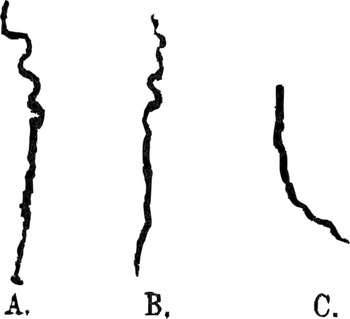
Figure 7.1 Phaseolus multiflorus
‘Tracks left on inclined smoked glass-plates by tips of radicles in growing downwards. A and C, plates inclined at 60°, B inclined at 68° with the horizon’.
The following chapter has two movements. In the first, I’ll explore the methods of Darwin’s plant science, attending to the performative intricacy of scientific experimentation as a collaborative dance that highlights the contingent, narrative aspects of plant development – akin to the ‘reticulate approach’ identified by Elizabeth Haines (Chapter 9). In the section that follows, I’ll examine how these contingent histories, co-elaborated by Darwin and his plant subjects, are articulated together at the close of the work as a ‘life-history’ – in effect, a Bildungsroman that reconfigures individual events in relation to an overarching evolutionary thesis. On the basis of this account, I propose a way of understanding scientific narratives as moving between entanglement with the world and reconceptualization, and between the narration of contingent events and their reconfiguration into higher-order narrative genres, by means of a process that draws multiple actors, human and non-human, into alignment, cultivating multi-level, multiply-scaled stories about how the world works.
7.2 Plant Narrative and the ‘Dance of Agencies’
At the core of Darwin’s botanical research program was the question of how plants and other forms of life interact. Over the course of several decades, especially after his move to Down House, some fifteen miles from London, Darwin let his imagination run riot, exploring an astonishing range of methods to entice plants into cooperating with his studies. He tickled them with horse hair and pencil; he gave them a spin in rotating boxes; he played them music; he fed them sweetmeats, and sometimes, just meat. These experiments, simple, elegant, intimate, produced results that often astonished the botanical world, and the greenhouse at Down became an object of fascination for visitors. The results were published in a series of pathbreaking works of botany (Reference DarwinDarwin 1862b; Reference 162Darwin1865; Reference Darwin1875a; Reference Darwin1875b; Reference Darwin1876; Reference Darwin1877; Reference Darwin and DarwinDarwin and Darwin 1880).
All of Darwin’s plant studies demonstrate a fascination with the relation between plant and animal life, and Darwin’s insistent assertions that plants possessed sensitivity, an ability to move, digest and even think, much like animals. Darwin’s grandfather, Erasmus Darwin, was famous for drawing analogies between plant and animal life, between their modes of reproduction and growth, and was eventually notorious for insisting that these analogies indicated a common nature and a more basic, shared history of evolution (Reference PriestmanPriestman 2000). In adopting his grandfather’s commitment to the shared nature of plant and animal life, Charles took an unusual perspective on the possibilities of plant agency, and a unique interest in documenting their sensitive and responsive engagement with the world – sensing and capturing insects for nourishment, grasping and then climbing neighbouring trees and structures.
As Darwin exposed increasingly complex plant behaviours and adaptations, others argued that these elaborate behaviours defied explanation by the gradual means of natural selection. In 1871, St. George Jackson Mivart summed up these objections, arguing that, even if natural selection might operate on such adaptations after they evolved, it could not explain how they first developed. The elaborate adaptive structures of orchids, and the power of twining plants to climb trees, illustrated the ‘incompetency of “natural selection” to account for the incipient stages of useful structures’ (Reference MivartMivart 1871: 35).Footnote 1 It was the most succinct statement of what Stephen Jay Gould would later term the ‘5 percent of a wing principle’: variations in the wing structure of flying birds might experience selective pressure, but an incipient wing would seem to be useless for flight and therefore non-adaptive (Reference GouldGould 2002: 1220).
Darwin recognized this as a serious challenge to the comprehensiveness of the theory of natural selection and immediately set out to answer it. The following year, he added an entirely new chapter to the sixth edition of On the Origin of Species, responding at length to Mivart’s critiques. In the only new chapter ever added to that work, Darwin placed heavy emphasis on the sensitive actions of plants as examples in which the ‘incipient stages of useful structures’ might have developed ‘incidentally’ from other adaptive traits (Reference DarwinDarwin 1872: 198). All plants, he noted, seemed to have some capacity to move, and this movement is often coordinated with a basic sensitivity to specific influences, like sunlight and gravity. This innate sensitivity gave them an ‘incidental’ sensitivity to touch, much as ‘the nerves and muscles of an animal are excited by galvanism’ or electrical stimulus, despite such sensitivity being non-adaptive (Reference DarwinDarwin 1872: 198). These incidental abilities, Darwin argued, could be the building blocks of much more complex adaptive behaviours, like the behaviour of climbing and insect-eating plants.
As Gould explains, this marked a significant shift in the emphasis Darwin placed on such ‘exaptations’ – a term coined by Gould and Elisabeth S. Vrba to describe cases of functional repurposing (Reference Gould and VrbaGould and Vrba 1982). As Gould later explained, Darwin gave exaptation a ‘vital role in establishing the contingency and unpredictability of evolutionary change’, with the consequence that ‘historical [i.e., narrative] explanation’ became central to his evolutionary histories (Reference GouldGould 2002: 1224–1225). Exaptations effectively differentiate the historical origin of a trait and its current function, locating the contingency of evolutionary development in selective events that repurpose a given trait. Mivart’s critique helped Darwin recognize the importance of such examples of exaptation both as a way to explain ‘incipient’ adaptive structures and as a way to underline the essential contingency of natural selection. In light of Mivart’s critique, the exaptive development of plant behaviour took on a further significance, not recognized in Gould’s analysis. If exaptation allowed plants to develop animal-like behaviour, moving as well as reacting to their environment, this showed that complex behaviours could emerge contingently by repurposing traits to serve new functions. Yet the convergence of plant and animal behaviour also demonstrated that complex adaptations could be achieved by radically different exaptive pathways. Darwin’s long-standing interest in the analogy between plant and animal life took on enhanced importance in demonstrating the unexceptional as well as contingent evolution of animal behaviour. Demonstrating the agency of plant life was the linchpin of this analysis because it drew attention to both the complexity of plant behaviour and its analogy with animal action. For the rest of his career, Charles Darwin would doggedly pursue this strategy, working to prove, first, that plants exhibited forms of agency, second, that these behaviours could be explained as the exaptation of traits that did not originally serve their present purpose, and, finally, that these mechanisms were distinct from the (equally contingent) adaptations undergirding animal behaviour.
After making these revisions to On the Origin of Species, Charles launched a series of studies to solidify his argument that plants not only moved, but that this movement was a purposeful behaviour exapted from previously existing traits. This required the development of a variety of new experimental techniques for registering both the contingency of plant behaviour and the contingency of their evolutionary history. Working with his children, Francis, George and Horace, he produced a considerably revised, second edition of Climbing Plants that nearly doubled its length (Reference DarwinDarwin 1875b) as well as an in-depth study of the carnivorous behaviours of Insectivorous Plants (Reference Darwin1875a). These works stunned botanists by showing that virtually all plants exhibited some movement, not just growth, in response to their environment. One outcome of his study of insectivorous plants demonstrated, via various chemical and electrical experiments, that plants possess what he termed ‘nervous matter’, distinct from the nerve tissue of animals (Reference DarwinDarwin 1862a).
At the time, studies of plant physiology were growing considerably more sophisticated. In part, this was due to rigorous new techniques developed by Julius Sachs in his lab at the University of Würzburg. Sachs’s ‘auxanometer’, which mechanically registered plant growth, is one example (Figure 7.2a). Although the auxanometer provided a precise way to study plant growth, it did so with a significant limitation: it could only register growth monotonically along one dimension. Sachs believed that all of the processes that controlled plant movement and growth were rooted in the direct impact of external factors like light, humidity and temperature on the physics and chemistry of growth. This ‘mechanics of growth’, he argued, would eventually explain apparently ‘discontinuous variations of growth’ as the interaction between different continuous processes (Reference SachsSachs 1887: 552). The auxanometer expresses this understanding of plant growth, carefully measuring the vertical growth, normalized as monotonic movement along a single axis, in order to disentangle the influence of various factors. When plotted alongside controlled changes in temperature, humidity or illumination, Sachs believed that the auxanometer would reveal that apparent changes of behaviour were not contingent, irregular events, but rather the unfolding of basic physio-chemical processes.
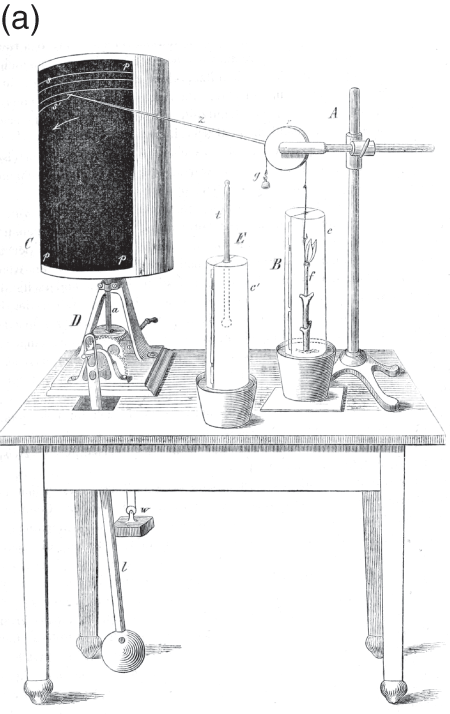
Figure 7.2a Auxanometer.
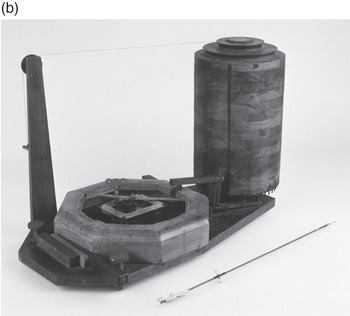
Figure 7.2b Horace Darwin’s self-recording auxanometer.
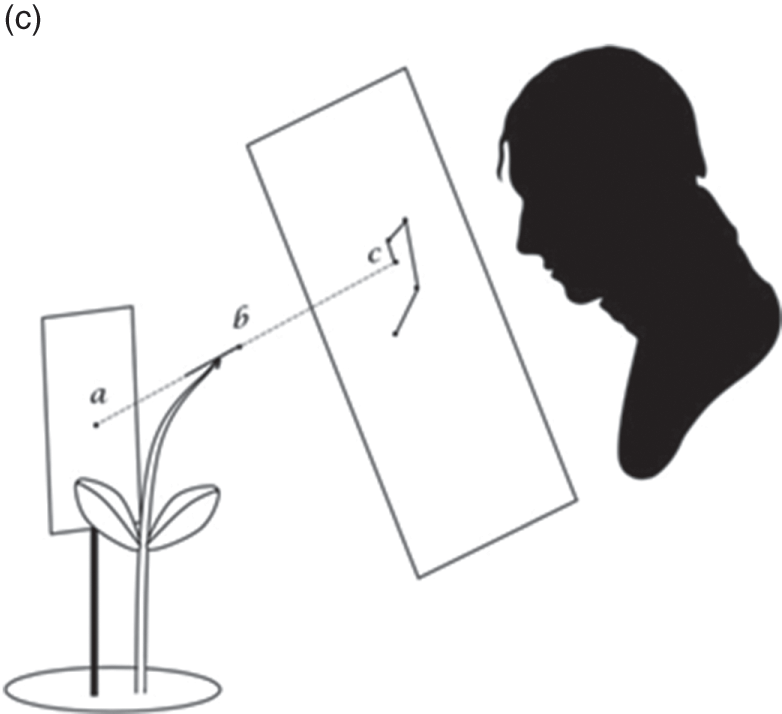
Figure 7.2c Experimental design for Charles Darwin and Francis Darwin’s plant nutation observations
Walter Bryce Gallie and various literary theorists have argued that events are significant to a narrative if they are both non-deterministic and have consequences for later events, affecting the outcome of the narrative (Reference GallieGallie 1964; Reference BarthesBarthes 1975; Reference ChatmanChatman 1978). As Beatty summarizes the distinction, meaningful narratives have ‘turning points’ that are defined both by their temporal and causal relation to later events (the way later events are contingent upon their outcome) and because turning points are contingent per se (they are not necessary, and might have gone some other way) (Reference BeattyBeatty 2016: 36–37). In such cases, as Mary S. Morgan explains, time serves as a ‘material in which we see the dependency of relations or the unfolding of events’ (Reference MorganMorgan 2017: 87). Insisting, by contrast, that plants react in a strictly deterministic fashion, Sachs insisted that plant movement was not contingent per se. As a parallel example of a non-eventful, and so non-narrative, sequence of events, Reference MorsonGary Saul Morson (2003: 61) imagines a description of the movements of Mars that records only where the planet was in each subsequent month, ad infinitum. Such accounts, as Morgan points out, are merely ‘chronicles’: they ‘order events through time’, but do not seek to explain ‘the relations between them’ (Reference Morgan2017: 86). In a similar fashion, Sachs’s interpretation of plant recordings translated the seeming eventfulness of plant growth into the continuous action of physical processes, demoting the narrative of plant behaviour into a chronicle of plant response not essentially different, if seemingly more complicated, from the way planets respond to the interplay of gravitational forces.
Darwin’s studies of exaptation were designed to underline the narrative rather than simply chronological character of evolutionary explanations by making room for the agency of the plants – helping them to function as narrators of their own story by allowing them to record their active response to their surroundings. Impressed with Sachs’s technique, Charles initially asked his son Horace to make a replica of Sachs’s instrument (Figure 7.2b; Horace was an accomplished instrument-maker), and he helped his son Francis secure an invitation to study with Sachs in his lab. Yet they soon abandoned the auxanometer, developing alternative techniques that gave the plants greater freedom of movement. Charles had first begun to try and record their movements in ‘On the Movements and Habits of Climbing Plants’ (Reference 162DarwinDarwin 1865). Placing a hemispherical glass over the tendril and plotting its revolving movement over the course of one workday using a pencil, he confirmed Henri Dutrochet’s earlier studies of the ‘circumnutation’, or revolving movement, of pea tendrils and demonstrated that this rotation sometimes reversed (Reference 162DarwinDarwin 1865: 65). But he lamented that he could not affix the pencil to the plant itself, allowing it to draw its own movement more accurately. Fifteen years later, Charles and Francis announced a breakthrough: they finally devised a scheme to get plants to draw. After smoking glass plates to deposit a layer of carbon, they suspended them at an oblique angle beneath germinated seeds, allowing the small root stems or ‘radicles’ to trace a pattern as they moved across the plate, seeking soil (Figure 7.1).
Taking the pencil out of their own hands and so allowing the plants to trace their own course permitted the Darwins graphically to capture not only the waving path of the roots but variations in force as the tips bent towards and away from the inclined plates. The varying thickness of the line traced by the root tips marks fully contingent narrative events in which the actor (here, the root tips), confronted by an obstacle (the slide), attempts to overcome it. The eventful and non-monotonic nature of each track is underlined by an accompanying textual narrative, which emphasized that ‘Their serpentine courses show that the tips moved regularly from side to side; they also pressed alternately with greater or less force on the plates, sometimes rising up and leaving them altogether for a very short distance’ (Reference BurkhardtBurkhardt et al. 2019: 29). As Francis privately noted, the fact that the tips of the plant roots only lightly touched the plates, rather than ‘pressing hard’ on them, suggested that plants sensed the obstacles and tried to move around them, like hands feeling in the dark (Reference BurkhardtBurkhardt et al. 2019: 27). This thoroughly contingent action is what discriminates these root tracings from mindlessly deterministic behaviour, distinguishing the former as micro-narratives that, per Bal’s definition, describe a series of ‘related events that are [both] caused [and] experienced by actors’.
The various experiments performed by the Darwins on root tips showed a complex form of agency that actively responds to and discriminates between various kinds of stimulus, including light, moisture, physical pressure and the pull of gravity, in order to decide the course pursued by the plant ‘in penetrating the ground’ (Reference Darwin and DarwinDarwin and Darwin 1880: 573). In translating these graphic narratives into text, the Darwins rearticulated the sinuous narrative inscribed by the root tips upon the glass plates, characterizing them as a sequence of turning points, significant events in which the root tip, acted on ‘simultaneously’ by ‘two, or perhaps more, of the exciting causes’, effectively changed its mind, pursuing one course rather than another (Reference Darwin and DarwinDarwin and Darwin 1880: 574). For this reason, the radicle provided the primary evidence that plant behaviour was contingent per se. They concluded that such tracks demonstrate the agency of the plant root:
It is hardly an exaggeration to say that the tip of the radicle thus endowed, and having the power of directing the movements of the adjoining parts, acts like the brain of one of the lower animals; the brain being seated within the anterior end of the body, receiving impressions from the sense-organs, and directing the several movements.
Sachs forcefully rejected the analogy between plant and animal cognition, complaining that ‘Charles Darwin and his son Francis […] on the basis of experiments which were unskilfully [‘ungeschicht’, or clumsily] made and improperly explained, came to the conclusion, as wonderful as it was sensational, that the growing point of the root, like the brain of an animal, dominates the various movements in the root’ (Reference SachsSachs 1882: 843; Reference Sachs1887: 689). The debate between Sachs and the Darwins over the status of plant behaviour – whether plants have the capacity to ‘direct’ their movements – turned on this question: do plants have the capacity to make meaningful changes in the course of their lives; in other words, are they narrative agents? Sach’s auxanometer provides a signal example of the nineteenth-century turn towards ‘mechanical objectivity’, which asserted that increasingly sophisticated instrumental recordings would allow nature to speak for itself (Reference Daston and GalisonDaston and Galison 2007). And yet, any scientific apparatus makes assumptions about a phenomenon under study. Even as such self-recording instruments were designed to produce a neutral or ‘universal’ language of nature, as Soraya de Chadarevian explains, ‘they exerted a normative power on “nature” itself […] forc[ing] the phenomena to inscribe their movements on paper’ in the restricted terms furnished by the apparatus (Reference de Chadareviande Chadarevian 1993: 290). Conversely, the relative looseness of the Darwins’ unmechanized experimental set-up is precisely what allowed plants to demonstrate their wider degree of agency, narrating their own stories.
If Sachs wanted his plants to behave, marching with regular, lawlike action, Darwin wanted his plants to dance to their own tune. Insisting on the analogy between plant and animal agency, the Darwins narrowed the distance between the agency of the scientists and the agency of their object of study. Their smoked glass experiments provide a robust example of the methodological adjustments that Pickering has described as a dance of agencies, in which the human agency of the scientists continually adapts the experimental protocol in order effectively to frame the ‘material agency’ of the phenomena being studied (Reference PickeringPickering 1995: 103). As used by Pickering, ‘dance’ furnishes a metaphor that captures how scientists observe and then actively adjust the experimental protocol when physical phenomena fail to behave in the expected manner (the scientist leads).
The Power of Movement in Plants is striking, in part, because it insists that plants have agency, too – that within the dance of agencies, plants can lead the scientist. This dance is evident in its teeming illustrations of plant movement. The movement of really large plant structures had long been clear. But the movement of tiny shoots, stems and roots was generally so minute it had gone unnoticed. The problem was to connect the human scale to the plant scale. While they remained ignorant of the mechanisms underpinning plant sensation, the Darwins had considerable success recording the mechanisms that underpinned the various forms of plant movement itself. To each structure of interest, they glued a small glass filament, with a bead of wax at the end. Behind the filament, they staked a card with a black dot as an index. And on the other side, they placed a pane of glass perpendicular to the filament, measuring the distance between all three. As the filament moved, they used ink to trace the alignment between bead and index on the pane of glass, taking note of the time (Figure 7.2c). The whole movement was magnified up to thirty times by the differential ratio between bead, index and pane of glass (AB, AC). The result was nearly two hundred illustrations of plant movement that ranged across the gamut of vegetal life.Footnote 2 Take the illustration given in Figure 7.3a, an observation of a fava bean leaf, which captures two days in the life of this plant in the Darwin household. To make each observation, the Darwins had to move with the plant; aligning plant structure, environmental index, glass, pencil, hand and body, at specific moments in time. Individual dots mark observations, moments at which one of the Darwins hovered in alignment with the filament and index card, and marked their line on the glass. Solid lines connect sequential observations; dotted lines indicate periods overnight when the Darwins slept.
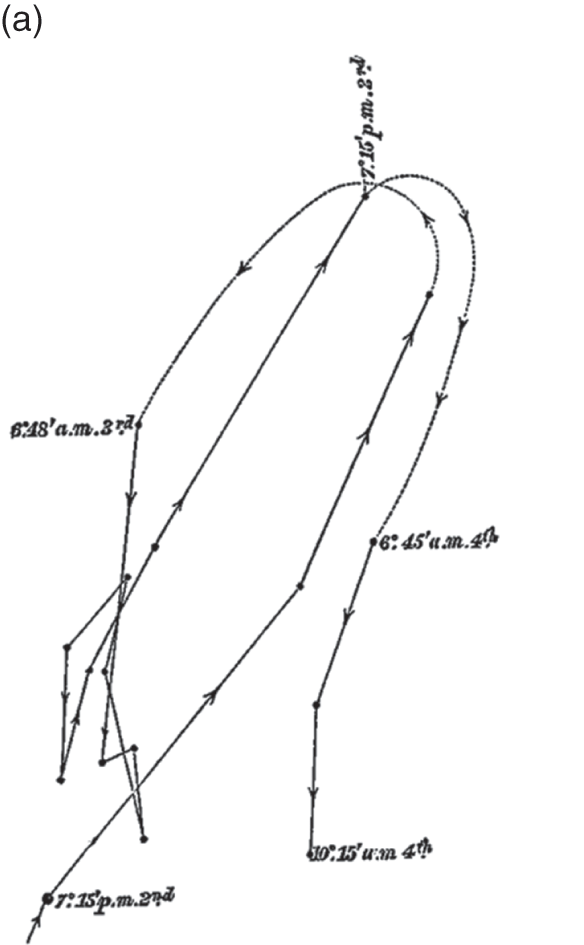
Figure 7.3a Vicia faba
‘Circumnutation of leaf, traced from 7.15 p.m. July 2nd to 10.15 a.m. 4th’ (woodcut).
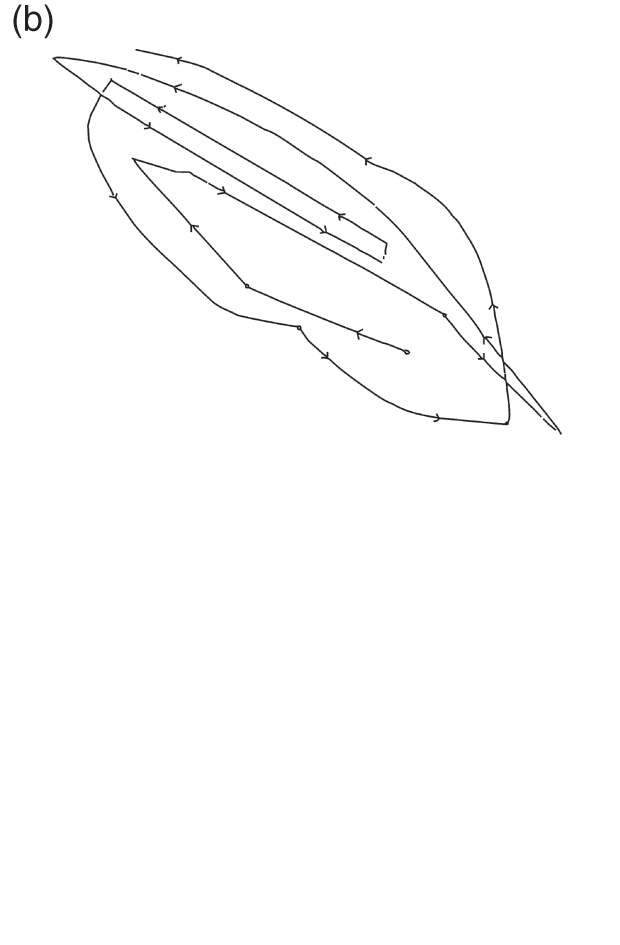
Figure 7.3b Brassica oleracea
‘Conjoint circumnutation of the hypocotyl and cotyledons during 10 hours 45 minutes’ (woodcut).
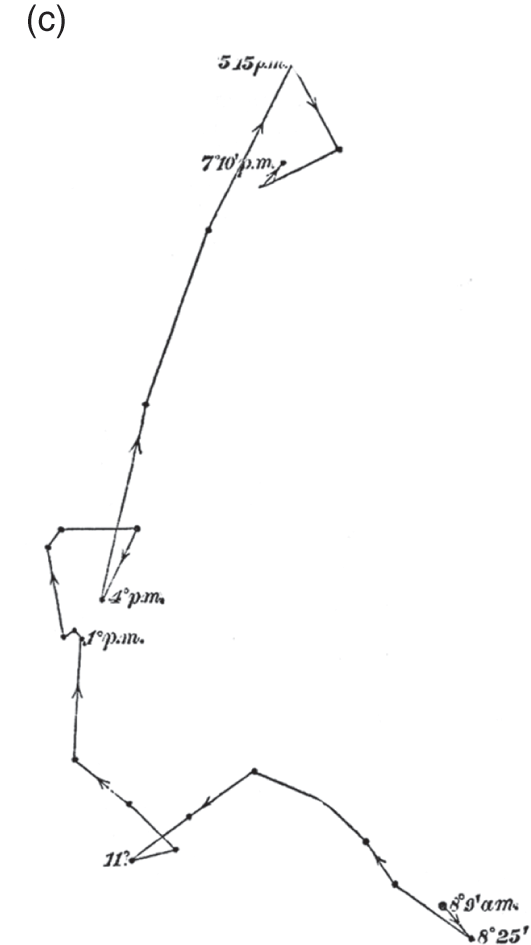
Figure 7.3c Brassica oleracea
‘Heliotropic movement and circumnutation of a hypocotyl towards a very dim lateral light, traced during 11 hours, on a horizontal glass in the morning, and on a vertical glass in the evening’ (woodcut).
In attending to the embodied situation of these experimental events, I take a note from the field of performance studies, which, as Barbara Kirshenblatt-Gimblett explains, emphasizes ‘practice and event [as] a recurring point of reference’, focusing attention on questions of ‘presence, liveliness, agency, [and] embodiment’.Footnote 3 Performance studies furnishes a strategy for reading experimental histories, in the spirit of John Dupré and Daniel H. Nicholson’s ‘Manifesto for a Processual Philosophy of Biology’, as embodied engagements with nature and its ‘hierarchy of processes, stabilized and actively maintained at different timescales’ (Reference Nicholson, Dupré, Nicholson and DupréNicholson and Dupré 2018: 3). Note the synchronies of the interaction between the Darwins and their plants. To make this alignment work, a series of different temporalities have to come into each other’s sway; from stable processes of the physical apparatus (the relative stability of the environment, index card and glass slide, the quick-drying varnish that secured the filament to leaf, the mutability of ink); to the different rhythms of the living agents drawn together by that apparatus. Each slide traces this drama of bodies in motion. Far from clumsy, each mark, each plate, captures another step in an extended attempt – stretching over multiple decades – to learn how to dance with plant life, how to follow its lead.
7.3 Genre and the Reconfiguration of Narrative Levels
The simplicity and sensitivity of the experimental design proved to be its virtue, allowing the Darwins to show that virtually all plant structures moved, and allowing plants to expose their quivering, wakeful life to human view. The Power of Movement in Plants demonstrated the near universality of circumnutation (circular plant movement) across plant species, and across the parts of the plant, from roots and shoots, to leaves and petals, to branches and trunks. Using careful microscopic work, the Darwins also verified that plant movement was produced by the combined action of two traits – variations in the growth of cells on opposite sides of the supporting structure, and more specialized plant structures called ‘pulvini’, in which cells on one side or the other could periodically expand or contract (Reference Darwin and DarwinDarwin and Darwin 1880: 113–116). This, in turn, allowed them to track how circumnutation had been exapted to serve various new functions. They traced myriad examples of heliotropism and apheliotropism (bending towards or away from light sources), geotropism (growing towards the earth) and reactions to temperature and other stimuli.
An important example of this strategy is given in their exploration of Brassica oleracea, or cabbage plant. When we first encounter cabbages in The Power of Movement in Plants, the Darwins document how the seedling, despite lacking a pulvinus, rotates clearly from its base early in its growth, providing a fine example of circumnutation (Figure 7.3b). Later in the study, they return to these seedlings to demonstrate how that behaviour is bent towards different purposes. Moving a similar cabbage seedling near a partially veiled window in the morning they observe how its rotation is deflected and elongated in the direction of the light, only returning to its more circulate rotational behaviour after sunset, at 5.15 p.m. (Figure 7.3c). The strong linear movement from the bottom right to upper left corner of the pane in Figure 7.3c provides a ‘striking’ contrast, they note, to the orderly rotation of Figure 7.3b. Various comparisons like these demonstrate how circumnutation has been adapted to serve a variety of functions, moving towards and away from light, towards and away from gravity, and responding to touch.
In this way, each vacillation in plant movement is tied to a swerve in that plant’s evolutionary history. The extraordinary number of illustrations – five times as many illustrations in a single volume than included in any of Darwin’s other works – demonstrate the variety of events that constitute a plant’s life, and the variety of ways different plants might respond to them. In each, the periodicity of circumnutation provides a background pattern, an elliptical expectation of behaviour that casts any deviation into sharp relief. The Darwins chart deviations in the size, direction and periodicity of these ellipses through the study – the term ‘ellipse’ is itself used nearly two hundred times. Against this elliptical expectation, any sharp deviation of plant movement stands out as a clear fork in the road, the marked reaction of the plant to some stimulus. To put this differently, the ellipse functions in these images as a kind of narrative scaffold, a generic pattern that highlights concrete and consequential events in the narrative.Footnote 4
In essence, each illustration, with its swerves and turns, magnifies a micro-narrative, or better, a micro-history, co-written by the Darwins and their plant subjects. Yet these events do not only mark consequential happenings in the life of the plant; they also index turning points in the evolution of plant life, past moments when circumnutation was exapted to serve a new function. The larger argument set out in The Power of Movement in Plants depends on a multipart analogy between these micro-histories of individual plants, detailed through both their self-inscription and accompanying textual account, and the evolutionary narratives of species history, an analogy that reads differences in the behaviour of individual species as distinct histories of exaptation and adaptive refinement.
For most of the study, over the hundreds of accounts of the growth and movement of individual plants, this analogy is implicit; the authors generally seem to rely on their audience’s knowledge of the wider evolutionary argument of all of Charles Darwin’s studies. This coy positioning of evolutionary argument is abandoned in the conclusion, which gathers all of the observations into a single, unified story. In the final chapter, the study’s scientific narrator draws the various plant micro-histories together, asking that ‘we will in imagination take a germinating seed, and consider the part which the various movements play in the life-history of the plant’ (Reference Darwin and DarwinDarwin and Darwin 1880: 548). The speculation that follows traces a generic seedling from germination, through various events, to its ultimate flowering as a tree – summing up the life events typical for plants in general. The result is a 27-page novella (or mini-novel) that gathers the various experiments explored over the course of the study and organizes them into a unitary narrative that strings together various ‘adaptive movements’ (Reference Darwin and DarwinDarwin and Darwin 1880: 551). Throughout the passage, this narrator slips into present-tense, active formulations that emphasize the plant’s agency, as when ‘our seedling now throws up a stem bearing leaves’ (Reference Darwin and DarwinDarwin and Darwin 1880: 558). When we look at a tree, we see a solid object tossed by the wind, but, in fact, ‘each petiole, sub-petiole, and leaflet’ quivers with activity, activity that marks its continuous reaction to the light, moisture, gravity and other stimuli of its surroundings. Reviewing all the actions that constitute a tree’s life, the narrator comments, ‘All this astonishing amount of movement has been going on year after year since the time when, as a seedling, the tree first emerged from the ground’ (Reference Darwin and DarwinDarwin and Darwin 1880: 558). All of the illustrations of the book, from the elaborate dance steps of the inked filament tracks to the tracings of rootlets on smoked glass, are organized through this single tree’s story, which takes seed and blooms in the mind’s eye.
The ‘life-history’ serves a key function in mediating between the micro-histories of individual plant growth and evolutionary history – a relation set out in Table 7.1. Like David Copperfield or Great Expectations, the ‘life-history of a plant’ gathers various micro-histories and observations into an unfolding story within which an individual actor confronts various challenges and successfully overcomes them. In essence, the Darwins repurpose the Bildungsroman (the contemporary ‘novel of development’ that dominated early to mid-nineteenth-century fiction) as a scaffold capable of interpolating these micro-histories into a single compelling narrative. The accession of this new generic model is marked by specific shifts of narrative point of view (or ‘focalization’), as well as tense, character of action and agent.Footnote 5 All underline a shift from contemporary conventions of scientific monographs. Over the last several centuries, scientific prose has come to rely on passive constructions that minimize the focalization of the scientist–narrator.Footnote 6 And for much of The Power of Movement in Plants, the Darwins similarly deploy passive constructions that describe the experimental design paired with simple-past descriptions of what the plants did. By contrast, the first-person plural ‘we’ that narrates the ‘life-history’ ripples with personality, even as it draws the reader into the act of imaginative engagement. It also facilitates a periodic shift into possessive constructions within the recounting of the ‘life-history’ (including ‘our seedling’), which suffuse the narrative with a sense of familiar responsibility maintained between the narrator’s description, the reader’s implication and the seedling itself, who is now recognized not as an individual scientific specimen but as a more charismatic agent – effectively, our hero. A shift in tense, from the past-tense constructions of the micro-histories to a present-tense unfolding of life events similarly marks a shift in temporal relations and in the character of the events narrated. As many narrative theorists have pointed out, the time of telling and the original timing of the events described in a narrative can never precisely align in either speed or duration (Reference Wittenberg and GarrettWittenberg 2018: 14–15). The ‘life-history’ exacerbates this contrast to powerful effect, dramatizing the distillation of entire life cycles, abstracted across various species, into a handful of crisply plotted pages. The accession of the Bildungsroman structures this turn towards holist integration, centring the account on a unitary actor, sequence and perspective, reconfiguring the events studied throughout the treatise as a series of developing chapters in the life of an individual plant.
Table 7.1 Narrative levels in Charles Darwin and Francis Darwin, The Power of Movement in Plants (Reference Darwin and Darwin1880)
The ‘life-history’ dramatizes the status of plants as active agents within their own narratives. This dramatization, in turn, calls attention to the links between the demonstrated actions of plants, with their various powers, and the antecedent action of natural selection, through which adaptations (especially exaptations) shaped these behaviours and the development of each species. The intermediate status of the ‘life-history’, as the middle stratum of three narrative levels, is made explicit at its close, which situates its story between the micro-histories traced by individual plants and an overarching narrative of species evolution. Listing the various forms of movement studied over the course of the preceding pages, the Darwins assert that ‘it has now been shown’ that these ‘important classes of movement all arise from modified circumnutation’, and they finally, and explicitly, identify the power which has given this plant its various abilities: these uses of the ‘power to bend […] might gradually be acquired through natural selection’ (Reference Darwin and DarwinDarwin and Darwin 1880: 569–570).
If, as Ian Duncan argues (Reference Duncan2019), the Bildungsroman emerged alongside the birth of modern anthropology as a formal model through which an individual life could register the larger story of the human species, the narrator of The Power of Movement in Plants uses their own ‘life-history’ to set out an analogous story about the longer evolution of all plant species. Morgan describes narrative ‘configuration’ as a process that ‘make[s] things cohere – a process of […] making an account that is consistent with all the evidence, that offers a coherency within that account, and that has some explanatory credibility’ (Morgan, Reference Morgan2017: 93). Narrative genres like the Bildungsroman are powerful aids, as they can provide shared standards for the consistency, coherence and credibility of an account. But the ‘life-history’ also demonstrates the role that genres play in reconfiguring previous narratives. Mediating the plant’s relation to evolutionary time, the ‘life-history’ reshapes the micro-histories it draws upon. It is worth thinking more about the role literary genres play in structuring scientific narratives, insofar as they provide such patterns of structure, and establish a ‘horizon of expectations’, that, in Hans Robert Jauss’s influential account, conditions how readers interpret narratives (Reference JaussJauss 1970). Reviewed with the evolutionary implications of the ‘life-history’ in mind, and so, tacitly reconfigured and placed in relation to a wider story, each individual illustration does not simply present the tale of a few hours in the life of an individual plant, but also a concretized retelling of a longer evolutionary history. In light of Darwin’s science, each trait, each action, is pregnant with a history of evolutionary change.
7.4 Conclusion
The dynamic, interactive narratives of The Power of Movement in Plants suggest that we should pay less attention to discrete narratives than to the relation that obtains between various narratives and their world and especially to narration as a process that mediates between a description of events and events in a world, setting them into relation. If narrative, including graphic narratives, do not simply capture, but coordinate events, this means their effect depends on the specific way they coordinate wider patterns, as well as the various purposes to which they are later applied. Perhaps most scientific narratives work this way. Certainly, narratives help scientists to identify and respond to – to sync up with – temporal patterns in the world, and so to coordinate their inscription into the scientific record. Narratives have a peculiarly powerful ability to draw us into an alignment with the world, to train our attention on patterns of action and exceptional events. If we usually think of scientific narratives as perspicuous fictions, ‘designed in the mind’ to model aspects of the world, the unusually active role that plants play in telling their stories within The Power of Movement in Plants suggests that scientific narratives are in part produced by, rather than simply applied to, the world they describe – that the dance of agencies is also a dance of authorships.
Richard Bellon has recently observed the profound influence that Darwin’s plant narratives had on a generation of plant ecologists to come, encouraging them to attend to the sociability of plants and their intertwined evolutionary histories (Reference BellonBellon 2009). Michael Marder, taking stock of the wealth of recent studies that have built on the pioneering work of the Darwins to explore the ability of plants to interact with their environment, and even communicate with each other, underlines their core implication: we need to understand plants as ‘not only a what but also a who, an agent in its milieu’ (Reference Marder and MarderMarder 2016: 42). Plant narratives mediate, pulling our attention, entraining our thoughts, bringing us into contact with nature. In this way, Darwin’s studies, which draw naturalist, specimen and world into a delicate movement, continue to test the conformations of interspecies relations, the anthropology of the inhuman.Footnote 7
8.1 Introduction
The English language does not contain a native word to express the more violent forms of wind. We have borrowed a great many since we became the great merchants of the East, but hurricane and tornado are Spanish, typhoon, we believe, Chinese, though dictionaries derive it from the Greek, simoom Arabic, and cyclone pure Greek, with a conventional meaning imposed upon it by science. […] Storm is the only native word of any force, and an Englishman’s idea of a storm does not tempt him to sympathize greatly with the sufferers from its violence. Accustomed only to the winds of the north, which bring catarrh and consumption, but leave wooden houses standing for years, which seldom last many hours, and are never destructive except at sea, his power of imagining wind is limited, and he reads a story like that of the catastrophe at Calcutta with a feeling of pity in which there is just a trace of something like contempt. People out there must be very weak or arrangements very bad for a mere wind to work all that destruction, throw ‘Lloyds into a panic, and impede the systole diastole of Her Majesty’s foreign mails.’
On 5 October 1864, as the monsoon winds were retreating from the littorals of the Bay of Bengal, a devastating cyclone struck, killing 80,000 people, drowning the city of Calcutta and washing away large swathes of coastal villages. Thirty-six ships were lost in the storm, and of the 195 ships docked at Calcutta point, 182 were damaged, with an estimated combined loss of approximately 1 million pounds sterling (Reference Gastrell and BlanfordGastrell and Blanford 1866: 145). While the loss of life, cattle and property were staggering, the coasts of the Bay of Bengal were no stranger to the cyclonic battering. Moreover, meteorology as a public science had also gained a solid footing in England and its colonies (Reference GolinskiGolinski 2007; Reference AndersonAnderson 2010; Reference CarsonCarson 2019). Yet, surprisingly, The Spectator wrote that the English language did not have the capacity to narrate what happened on that fateful October day. How do we then understand and historicize the semiotic confusion expressed in the opening epigraph by the anonymous writer of The Spectator? The focus of the question should not be the English language, but perhaps the narrative and representational possibilities and crisis produced by the storm under consideration itself.Footnote 1 While one may ascribe some of the writer’s confusion to the ‘blinkered’ vision of colonial writings about colonized environments and climate, a deeper engagement with the writer’s lament that science has merely imposed a ‘conventional meaning’ upon the fury of the wind is necessary.Footnote 2
By the sixteenth century, we can witness the emergence of a scientific curiosity about storms by Iberian theologians and lawyers investigating hurricanes in the Caribbean. One of the most noteworthy among them was López Medel, who was a high court judge and served in the appellate courts in Santo Domingo, Guatemala and New Granada from 1540 to 1550, overseeing shipping and trading disputes (Reference SchwartzSchwartz 2015: 17). He wrote about buracanes, which he defined as a ‘meeting and dispute of varied and contrary winds’, later recognized as circular winds and defined as cyclones by the president of the Marine Court of Enquiry in Calcutta, Henry Piddington (1797–1858), almost three centuries later. What kinds of science did these men of law in the colonies produce? How did the legal search for plausible narratives influence a particular narrative science of storm forecasting?
Tropical storms in the Bay of Bengal emerged as a problem of knowledge as the East India Company was expanding its trade in Britain’s eastern colonies. Turning to Piddington’s cyclone research allows us to historicize his new science of ‘cyclonology’, which was a product of Victorian science, but also of the colonial legal and trading world in which he found himself. This science, as he wrote, was not meant to be conducted ‘in the state room of science, but in the cabin-table’ of ships and docks (Reference PiddingtonPiddington 1848: xiv). In the process, he narrativized historical storms in his works. This chapter argues that through his storm narratives and the accompanying visualization of the storm card, he shaped the very object – the cyclone – as a scientific category of investigation. His science used conversational language to conceptualize, for the sailors, the phenomenal world of the storms as wind movement in which one can discern patterns and tendencies through rigorous training of the eye and use of the storm card itself.Footnote 3 He began writing storm memoirs in 1839 and continued to write them until he died in 1858. His storm writings were geared towards achieving a discernible order in the stormy skies with the purpose of predicting the direction of the storm and plot its track. This was meant to help both mariners and jurors. In Mary Morgan’s definition, what Piddington’s narratives did, was ‘create a productive order amongst materials with the purpose to answer why and how questions’ (Reference MorganMorgan 2017: 86).Footnote 4 By organizing the patterns of historical cyclones from ships’ logs, reports and court depositions, he wanted to understand why and how cyclones formed. A narrative science of cyclones, replete with storm memoirs and a diagrammatic representation in the storm card, ordered the interpretation of winds to make cyclones both trackable and predictable in the service of the marine insurance market. Storms became a problem of knowledge precisely because these ‘violent forms of winds’ created panic among underwriters in the colony and metropole, and as the epigraph wonderfully captures, they ‘impede[d] the systole diastole of Her Majesty’s foreign mails’. If fire, capture and piracy were known risks associated with maritime routes, tropical storms became the ‘unknowns’ of the expanding insurance markets.Footnote 5 As we saw, the 1864 cyclone devastated the very sinews of global trade and credit that, by the nineteenth century, tightly stitched together far-flung geographies from the Caribbean, Coromandel, Malacca and Bengal to the ports of England.Footnote 6
Through the eighteenth century, the process of interpreting the skies and understanding the causes of storms navigated a terrain between providential design, folk traditions and emerging science about geological, chemical and meteorological phenomena. Scholars have documented this as a historical transition from Aristotelian astrometeorology, through the ascendance of Renaissance observational sciences and what was known as ‘rustic’ weather knowledge, to nineteenth-century dynamic climatology (Reference GolinskiGolinski 2007; Reference AndersonAnderson 2010; Reference CoenCoen 2018). Yet there was a parallel tradition of knowledge production that sometimes intersected with Victorian science, and other times remained firmly locked within the worlds of trade, insurance and legal spheres. Oftentimes this parallel world could be found along the ports, docks and observatories spread across the globe: Barbados, Mauritius, Bengal, Madras and Manila. Indeed, it was narrative storm memoirs written by colonists engaged in a range of professions from planters to shipmasters or legal actors who would shape both the form and content of weather science as well as frame the diagrammatic representation of the storm as a circular image. This parallel body of knowledge followed the routes of imperial capital and was sustained by a nautical marketplace.
The search for scientific cyclone forecasting emerged from narratively ordering accounts of historical storms, which were converted into a diagrammatic tool to depict, plot and track tropical winds. This, in turn, created laws of predictable wind patterns, which would allow one to read cyclonic motions that deviated from wind tracks. Indeed, for Britain’s expanding empire in the east, the problem of estimating risks of trade and administering compensation following shipwrecks created Piddington’s new science of cyclonology. Faced with the exigencies of global trade, the Bay of Bengal became a laboratory for nineteenth-century weather science. Turning to Piddington’s writing and the curious scientific tool – the storm card – allows us to document how a narrative science of cyclone forecasting emerged from the interstices of imperial trade. It shows how in the process of narrativizing memories of tropical storms, the cyclone as an object of knowledge came into being in the texts and the diagrams. The meaning-making and meaning-conveying process of narrating the science of storms was shaped by the traffic in language, imaging and metaphors between weather observers and shipmasters’ logbooks as they brushed with the colonial marine and admiralty courts through the nineteenth century.
8.2 The Nautical Marketplace
Piddington’s legal and scientific world was embedded in the nautical marketplace. Throughout the eighteenth century, the East India Company lost nearly one-quarter of its ships sent to Asia.Footnote 7 For instance, between 1760 and 1796, it lost 20 per cent of its ships to shipwreck on their way to Asia (Reference Bowen, McAleer and BlythBowen, McAleer and Blyth 2011: 118). A Select Committee on Shipwrecks reported to the House of Commons in 1836 that England was losing nearly 3 million pounds sterling per annum (£ 2,836,666) and had lost 894 lives to shipwrecks.Footnote 8 This report was prepared with the help of the accounting books of Lloyds and so only reflects cases of ships insured by Lloyds. The report gives details of the reasons the ships were wrecked or floundered and crew drowned. Among the many causes for wrecks, two bore the highest responsibility. First, the committee wrote that often instruments of navigation (namely depth recorders, barometers and chronometers) were either faulty or absent, or the crew was not sufficiently trained to use them (Reference JenningsJennings 1843). Second, they pointed out that the widespread use of premium-based marine insurance might mean that shipmasters and merchants were indulging in risky voyages in stormy seas, and as a result there was a higher incidence of shipwrecks. While there is no existing data that links the use of premium-based marine insurance to increased numbers of shipwrecks, the report indexes some of the assumptions prevalent within the expanding nautical marketplace of the early nineteenth century. The specific concern for this Committee, widely reflected in the world of nautical writing too, was that the expansion of marine insurance had allowed shipmasters to transfer the risk of shipwreck to the underwriters, which ultimately transferred the risk to the British public (Nautical Magazine (1836): 593). The result was fierce battles in the imperial admiralty courts adjudicating liability over wrecked ships and ultimately flinging blame for the wrecks onto ‘the plainest sailor’, to use one of Piddington’s oft-used descriptors, who routinely failed to navigate the cyclonic and turbulent waters of the Indian Ocean.
The British Indian Navy and their hydrographers had been charting the oceanic currents and coastal tides in the Indian Ocean since the 1760s. In order to make long-distance shipping safer, Piddington furthered the project by developing a usable science of storm forecasting for sailors. Piddington, who grew up in south-east England, worked his way up to command ships to India. He settled in Bengal in 1824 and remained there till his death, serving as the foreign secretary to the Agricultural Society of India, a secretary to the Asiatic Society of Bengal, curator to the Museum of Economic Geology (a first of its kind in the world) and, more importantly for this chapter, as the president of the Marine Court of Enquiry in Calcutta from 1830 to 1858. Following his death, he became famous for his meteorological pursuits and was known for coining the term ‘cyclone’. He described the storms which he saw in the Bay of Bengal as ‘coiled snakes’, for their circular motions, and came up with the name cyclone to distinguish them from trade winds, which blew in straight lines (Reference MarkhamMarkham 2015: 35–37).
Piddington’s scientific pursuits into storms emerged out of his life as a shipmaster, but the scaffold of his storm narratives was shaped by his work in the Marine Court. In the 1830s, the Marine Court was a simple affair. The Calcutta court was housed in a small room that served as a court once a week or less, depending on the availability of a mariner’s jury (which, prior to the coming of steam, depended on the monsoon winds), and this same room served as the meeting room or exchequer on other days. It was only in 1836 that a special court of enquiry was set up in England and its imperial ports, dedicated to establishing the ‘fact of the wreck’ and to creating mechanisms to ‘censure owners or commanders of vessels’ or acquit them honourably from charges of having caused the wreck. It was also tasked with suspension of certificates or licences should shipmasters be found to be incompetent. These courts were to be funded from the ship registration fees (Nautical Magazine 1836: 596–597). Piddington’s presidency over the Marine Court of Enquiry in Calcutta was during this moment of transition, when government oversight was increasing and standardization of practices and the pedagogy of mariners were being discussed within both the East India Company in India and the House of Commons in London.Footnote 9 He was familiar with the legal arguments and counter arguments made to establish the fact and narrative of the wreck during the onset of a cyclone. He not only heard mariners, pilots and witnesses narrate the sighting of storms, but he collected their barometric readings and read their logs documenting disputes about how to steer the ship in a cyclone. Apart from this, he was simultaneously poring over the archive of prior cases as he sought to lend structure to the procedure of settling disputes. What emerges is the way he used these multiple different narrative accounts in order to distinguish the contingent wind patterns from their predictable movements, thereby developing scientific taxonomies of various kinds of winds and a law of storms in the Indian Ocean.
Michael Reidy’s work on the development of British marine science has already documented how the imperial imperatives to sail unencumbered and safely through the littorals of England drove tidal science in the nineteenth century. The Admiralty, he shows, turned to science to advance its overseas empire (Reference ReidyReidy 2008: 5–7). Along with the Royal Navy, the rise of marine insurance conglomerates like Lloyds of London from the latter half of the eighteenth century was coterminous with British imperial expansion in the east and the rise of scientific storm forecasting. That some colonial legal actors, who were busy adjudicating on trading issues, were also obsessed with reading patterns in storms should elicit further investigation. Storms were documented and narratively ordered in ships’ logs and shipmasters’ diaries. The physical sites that enabled such documentation – often understood as the field and laboratory of weather science – have been documented by historians of science as floating observatories (ships) and weather stations spread across the empire (Reference ReidyReidy 2008; Reference NaylorNaylor 2015). If ships were floating observatories, they were also carrying bundles of letters, queries and texts across the empire, which were exchanging, plotting and tracking information about the very winds that carried them on the vast oceanic expanse. Knowledge of the atmospheric world was stabilized at multiple sites and through various genres – memoirs, barometric tables, diagrams, legal writings. Along with the scientific work from ships and observatories, a curious scribal culture emerged from the late eighteenth century in the British Empire, similar to the epidemiological narrative cultures documented by Engelmann in this volume (Chapter 14). This curious narrative outpouring saw planters and lawyers write storm narratives and cyclone memoirs. Apart from navigators who needed to understand the wind infrastructure that fuelled their trade, underwriters, lawyers and financiers took an active interest in those elemental phenomena that had the ability to disrupt the imperial financial machinery. The amateur scientific writings about storms and legal petitions and court decisions about wrecks formed a polyphonous world that laid the groundwork for nineteenth-century storm science.
Many of the wrecks occurred in the Bay of Bengal, especially in the last stretch of the journey as the ships navigated from the tip of the Bay to the port in Calcutta, the then capital of the British India. It was a rain-fed, tidal and changeable landscape. Mariners’ and hydrographers’ early attempts at control began with sketching the coasts of the Bay of Bengal.Footnote 10 From 1753, the East India Company began employing an official hydrographer, Alexander Dalrymple. Under Dalrymple’s oversight the official process of systematizing coastal charts began. Navigating into the port of Calcutta, which was situated almost 100 miles from the Sagar Islands in the Bay of Bengal, was difficult as the ships would have to sail through a network of mangrove islands, tidal sand flats and seasonal salt marshes, which annually changed shape, disappeared or sometimes suddenly reappeared especially during the summer months of tropical cyclones. Logs of ships warned that when storms and ‘hurricanes’ occurred at the mouth of the river Hooghly (or Hughli), sailing can become disastrous because the sea inundates the low-lying alluvial lands and ships often founder (Reference ReidReid 1838: 284). Rudyard Kipling, who considered this stretch among the most dangerous as far as navigability was concerned, wrote about the River Hughli thus: ‘Men have fought the Hugli for two hundred years, till now the river owns a huge building, with drawing, survey, and telegraph departments, devoted to its private service, as well as a body of wardens, who are called the Port Commissioners’ (Reference KiplingKipling 1923: 28).
8.3 Storm Science in the Courts
Two representative shipwreck cases debated in the Marine Court in Calcutta reveal how the legal ‘fact of wreck’ was established and show the legal imperatives that drove Piddington’s science. The first case was debated following the founding of the Marine Court and almost half a century prior to Piddington’s term. A sloop, Betsey Galley, wrecked at the mouth of Bay of Bengal as it was reaching the port of Calcutta on a stormy evening on 25 April 1778. The Betsey was wrecked upon the Long Sand in the Bay of Bengal at the mouth of the delta, with 13 members and its cargoes going under water before reaching the port of Calcutta.Footnote 11 Betsey’s wreck was fiercely debated in the Marine Court in Calcutta over four months. The petitioners were Capt. John Raitt and Mr. Weller (the merchant invested in the sloop), who claimed to the Court that Thomas Broad, the master attendant in charge of the pilot schooner to the Betsey Galley, did not offer any assistance and must be held responsible for the wreck. The Committee of Insurance deposed in the Marine Court and supported the claim against Thomas Broad, deeming him the negligent master of the pilot schooner, responsible for the wreck and seeking to debar him from future navigational duties. As the petitioners pointed out, it was a dark summer’s night and the ship was sailing fast through the waters of the Hughli, and Broad’s pilot boat failed to keep ahead of the Betsey Galley.Footnote 12 Moreover, Broad also rendered no assistance after the wreck, although it was no more than a few leagues ahead. However, the one-sided incriminations of a shipmaster against his attendant should hardly surprise anyone or be enough to establish the reason for the wreck.
Broad’s deposition, on the other hand, pointed out that the storm during the months of April can wreak havoc in these areas. April is the nor’wester season and is marked by sudden storms and coastal surges which can make riverine travel and navigation tricky in the Bengal delta. Caught in the turbulent waters of the Hughli, Broad pointed out that he steered the boat based on the direction of the incoming gales, which he had successfully done many times, yet the winds changed course and Betsey foundered before Broad could do anything. Following the adversarial interrogation of the admiralty courts, Broad was called for questioning, which consisted of questions about the usual role of the pilot schooner during storms and about whether he felt that he performed his duties. Like a well-honed defendant, he answered questions about the usual duties and responsibilities mostly thus: ‘It is sometimes usual and sometimes not’. And for questions where they tried to assess his opinion, he offered stock answers. For instance, to the question: ‘How come the ship [was] lost?’ Broad’s answer was: ‘If you put any particular questions to me I shall answer them’. Thereafter he demurred and the interrogation remained inconclusive.
Yet, the mariner’s jury and the judge concluded that Broad’s ‘obstinacy and misconduct’ were to blame. How did they reach this conclusion? The Committee of Insurance and the merchant’s jury turned to another source to ascertain the truth about the wreck, namely Broad’s prior mistakes of navigation. The committee in whose interest it was to locate blame on the negligence of the master attendant or the pilot navigator offered depositions in the court documenting prior instances when Thomas Broad failed in his duties while attending other ships.Footnote 13 Turning to precedence made the wreck appear to be caused not by the cyclone, but instead due to Broad’s habitual navigational misconduct. As legal historians have pointed out, reputation and credibility were deeply entangled in courtroom decisions through the eighteenth and nineteenth centuries, especially prior to the arrival of expert evidence and forensic criminology (Reference GolanGolan 2009: 5–51). Even then, and to an extent now, credibility performs a critical role in establishing the plausibility of the narratives offered.
Upon hearing all the testimonies, the judge decided that the total loss of the vessel was owing to an error in judgement on Broad’s part, and was not due to the nor’wester that suddenly set in. Such legal decisions were often based not on the availability of the evidence such as the ships’ logs, charts of depth sounding and barometric pressure, a studied understanding of wind direction or testimonies about the unnavigability of the channel, but rather character assessments of those steering the ship or pilot boats. Indeed, in multiple cases, the moment of wreck is often reconstructed by turning to other instances of failure of the shipmaster’s or pilot’s duty, including character assessments – such as ‘wanting in attention’ or ‘given to liquor’.Footnote 14 These character deficits also defined the ability to develop a studied understanding of the laws of storms. What bothered Piddington’s scientific temper was the excessive role the personal character, social standing, or networks of credibility, and the ability of the defendant to draw upon powerful witnesses, played in establishing the depth and nature of human error. Within the space of the Marine Court, trying to separate human miscalculation from unavoidable natural disaster was complicated.
By the time Piddington began presiding over the Marine Court, the ability to forecast natural disaster remained mostly poor and the nature of adjudication of wrecks navigated a terrain not very different from the one we witnessed in the case of the Betsey Galley. The Barge Amherst was partially wrecked in October 1838, mid-way on its voyage from Myanmar (Burma) to Calcutta.Footnote 15 Dalrymple’s work as the Company’s official hydrographer had transformed the landscape of navigation prints, with official charts in circulation by the last decade of the eighteenth century. He was followed soon after by James Horsburgh, who served the Company from 1810 to 1836, keeping extensive records of the tides of the Bay of Bengal coasts. Horsburgh also introduced the need to take extensive depth soundings to detect shoals and shifts in the coastline, while regularly updating those surveys.Footnote 16 By 1832, the Royal Navy recognized that the tidal charts for India were more complete and detailed than the ones pertaining to the English coasts.Footnote 17 The arrival of Horsburgh and his diligent publication of official nautical charts introduced a new standard of judgement. In cases of accidents, ships which were found to be in possession of non-official charts could be penalized. However, given that the route from Burma to Calcutta was so treacherous, Horsburgh’s directions were considered insufficient. A mariner under the pseudonym ‘Nautics’ suggested that ‘Should ships frequenting Rangoon, attend only to Mr. Horsburgh’s directions, without waiting for a pilot (which at times they may be compelled to do from stress of weather) they will surely run aground and suffer considerable damages’ (Reference PhippsPhipps: 1832: 145).
The Amherst was supposed to set sail from Kyaukphu one early October morning in 1838. However, the ship was delayed due to low winds. When the ship finally set sail, it reached a rock face then known to sailors as the Terribles. Unable to stay on course, the Amherst hit those rocks on the night of 22 October and was damaged, but managed to reach Calcutta, half-damaged, with its logbooks intact. In this instance, the logbook, the detailed notes of arguments and conversations kept by both Captain Bedford and attendant Captain Jump, would have allowed the Marine Court to establish that the swinging barometric pressure and winds veered the ship off its course. The notes, the witness depositions and the log show that Jump disagreed with Capt. Bedford’s directions, who insisted that the ship should have continued to sail in the direction it was headed. Had he followed Jump’s chart, the ship might have been saved from hitting the rocks.
There is a twist in this case. The day after Amherst dropped anchor in Calcutta following this fateful journey, Capt. Jump deposited his papers with the port authorities as Piddington had required all sailors to do. Thereafter, Jump quietly slipped out of Calcutta that very afternoon, boarding a ship to Bombay and then London and in the process forfeiting part of his pay. The court spent a considerable time deciphering Jump’s sudden disappearance and gathering evidence of his prior conduct in their attempt to piece together his character. The court ultimately decided his fate in absentia. It ruled that Jump could not man another Company ship or ship in his Majesty’s service as he was deemed too incompetent. His incompetence, the court declared, was not his ability to decipher winds, but in his inability to be judicious enough, first, to disregard his master’s misreading and veer the ship in the right direction, and, second, not to stay back in Calcutta to offer witness in the court of law. The archival trail breaks off here, and we do not know if, along with barring Jump from Company duty, the merchants invested in Amherst were duly compensated for their partial loss.
What these court minutes reveal is how the multiple iterations and reconstructions of the wreck in the courtroom were embedded within the socio-political hierarchies of the world outside. According to the court’s decisions, ships sank or foundered more often because of human error stemming from altercations between master and pilot, inexperienced pilots or drinking and ‘rottenness of native crafts’ than because of the turbulence of the seaboard. Legal decisions, as we know, are a product of ‘social, political, epistemic struggle’, and these struggles set the background for discerning the nature of wind patterns and the causes of wrecks (Reference Raman, Balachandran and PantRaman, Balachandran and Pant 2018: 2). This narrative reconstruction of the moment of wreck, which made human character central, was crucial to adjudicating damage claims throughout the first half of the nineteenth century. These resources left Piddington, with a vast set of storm narratives, to construct his science in the service of the mariners. He wanted his science to act as a protection not just from cyclones but also wanted to protect sailors and pilots like Broad and Jump, who were being fleeced by the insurance agents and the mariner’s jury who shifted the liability for wrecks during cyclones onto them.
The legal disputes in the Marine Court were geared towards the search for plausible narratives about a shipwreck. One may divide Piddington’s legal archive into two sets of evidence: one was recalling the memory of the onset of the storms and the other was an observational set of evidence. The testimonies of shipmasters, pilots and sailors constituted the memory evidence, which would often include not just notes about the storm but also character judgements about the people involved. Observational evidence comprised that which was written down in the ships’ logs, like wind direction, daily logs, temperature and barometric pressure charts. They were descriptions of observed phenomena rather than recalled memory and were either verbal testimony or written petitions. Court decisions often emerged by pitting various storm and character narratives against one another to arrive at a plausible description of the facts of the wreck. If the legal enquiry was geared towards establishing a plausible argument about shipwrecks in order to locate the liabilities incurred in the damages, Piddington’s cyclonology attempted to standardize the narratives of storms through his scientific writings and the storm card.
8.4 From Memories to Prediction: The Making of the Storm Card
In the twenty odd years following his entry into the Marine Court in Calcutta, Piddington consulted on multiple cases and analysed 250 ships’ logs from mariners plying in the Bay of Bengal and collected storm observations from port masters in various ports in India. In 1839, Piddington published his first storm observations in the Journal of the Asiatic Society of Bengal. Between 1839 and 1851, he published 23 memoirs of cyclones, each one taking up between 11 and 100 pages. These memoirs were like working notes, where he collated logs from ships that were caught in the gales, along with observatory notes, reports in newspapers and notes from port masters to plot the movements of cyclones in the Bay of Bengal and to develop his hypothesis. Following the publication of his first cyclone memoir in 1839, he began to receive multiple logs and extracts that were then preserved at India House (which furnished him with accounts of storms from 1780 to 1841) and built his own ‘storm library’ (Reference PiddingtonPiddington 1848: 7). The accumulation of storm writings in the form of logs, observations, reports and his own collection of memoirs comprised his attempt to understand how winds in their interaction with the world around them – reacting to atmospheric heat, thermodynamics, oceanic currents – developed into cyclones. In his writings, storms, much like a narrative plot, had a beginning, a middle and an end. Akin to Darwin’s plants’ ‘life-histories’, which are considered by Devin Griffiths elsewhere in this volume (Chapter 7), the cyclone emerges as a scientific object through a ‘two-way traffic’ between representation and scientific discovery.
Unlike Darwin’s visual narratives, Piddington’s were primarily textual and tabular, tracing the transformation of regular winds into circular storms. This allowed him, among other things, to complete the puzzle that Medel ascribed to the indistinctive directions of the buracanes winds, laying the groundwork for the development of a rotational theory of winds.Footnote 18 He standardized the definition of a cyclone – which was far from the scientific imposition of a conventional meaning upon a strong gust of wind, as The Spectator claimed. In order to come up with a name for this wind, Piddington moved away from terminology expressing strength to those expressing direction. He clarified that ‘cycloidal’ was a known word expressing ‘a relation to a defined geometrical curve, and one not sufficiently approaching our usual views, which are those of something nearly though not perfectly circular’. He then proposed to use a single word ‘cyclone’, which would be used to express ‘the same thing in all cases; and this without any relation to the strength of the wind’ (Reference PiddingtonPiddington 1848: 11). This laid the foundation for his practical new science of cyclonology, which he developed over three books: The Horn-Book of Storms for the India and China Seas (Reference Piddington1844), an expanded version, published as The Sailor’s Horn-Book for the Law of Storms (Reference Piddington1848) and a textbook entitled Conversations about Hurricanes: For the Use of Plain Sailors (Reference Piddington1852).
His science was geared ‘to enable the plainest ship master, then, clearly to comprehend this science in all its bearings and uses’ (Reference PiddingtonPiddington 1848: i). Piddington’s goal was to ease adjudication and at the same time to instruct the seamen by developing a science of storms through his ‘thick narratives’ (Paskins, Chapter 13). Piddington wanted storm science to act as a form of insurance and protection against wreckage. If mariners were preparing their logs with an eye towards the centrality of the logbook in documenting navigational knowledge and for adjudicating potential settlement cases, then Piddington was prospectively archiving the same logs with an eye towards creating a database from which to develop a systematic way to discern the law of storms.
His practices for assembling an archive for the law of storms involved a process of acquiring and retrieving material, reconfiguring that material and then transcribing this body of information into a narrative interpretive framework. For Piddington’s new science of cyclonology it was the process of reconfiguration that drove the interpretive framework. Each storm that Piddington adjudicated upon, observed in situ, read about in logbooks and heard during deposition was situated in deep historicity.Footnote 19 The monsoon, the capability of the navigator, the observer, the reputability of the pilot all shaped his archive of storm writing. Piddington’s life narratives of winds with the storm as denouement can be understood as exemplifying colligation (Reference MorganMorgan 2017). Piddington wanted to produce ‘law like knowledge’ of storms that was based on cases but utilizing modes of inquiry and methods of organizing vast amounts of data that would be systematic enough to mimic the natural world and thereby produce knowledge that could become universal (Reference Creager, Lunbeck and Norton WiseCreager, Lunbeck and Wise 2007). Such a method would result in producing usable evidence within both the scientific and legal domains. In his attempt scientifically to order the storm he devised the storm card, a tool that would make storm tracks discernible and protect mariners against wrecks with the hope that it would also help in the adjudication of cases.
Piddington first introduced his storm card in the Sailor’s Horn-Book. It was meant to serve as a card of practical utility that he produced for the use of ‘plain sailors’. The storm cards were developed as a diagrammatic representation of wind pattern and direction during a storm that was circular, with the basic assumption that there were certain laws that governed the wind movement within this circularity. Thus, they were highly schematic visualizations of wind movements, which taught: ‘how to avoid Storms; how best to manage in Storms when they cannot be avoided; and how to profit by Storms!’ (Reference PiddingtonPiddington 1848: xiii). As can be seen in Figure 8.1, Piddington’s storm cards were translucent sheets which the sailor would place upon a map to understand the track of the storm and determine the direction to steer the ship. There were two separate cards for the two hemispheres, with the eye of the cyclone visualized vis-à-vis the wind direction. The sailor could plot the eye on the map and avoid it. The storm card was a perfect representation of the wind directions as the cyclone gathers strength, , and as such it sought to highlight the ‘sensory character of much natural language’ (Wise, Chapter 22).
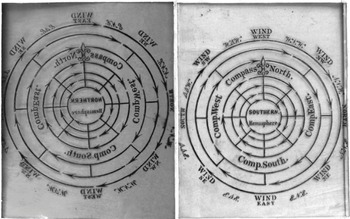
Figure 8.1 Piddington’s storm card, Reference Piddington1848
Through his work in the courts Piddington had deduced that there were three kinds of dangers to a vessel in a cyclone: ‘the veering of the wind; the excessive violence of it near the centre; and the sudden calms and shifts and awful sea at the centre’ (Reference PiddingtonPiddington 1848: 103). The biggest challenge was that while most seamen knew not to be in the centre of what mariners often called the ‘waterspouts’, there was no scientific ordering of their tacit knowledge. The lack of any science to govern their observations had to do with the fact that seamen were ‘not accustomed to consider the winds as tangent lines to a circle, and the bearing of the centre perpendicular to them, the consideration of “how the centre bears,” even with the aid of the Storm Card, may hence sometimes be found puzzling’ (Reference PiddingtonPiddington 1848: 105). Piddington’s storms cards were accompanied by a tabulated explanation of the wind depicted in the cards. Moreover, directions for using the storm cards – i.e., avoiding the centre, heaving with the direction of the wind, or profiting from it – were illustrated by ships’ logs elucidating how other ships managed or failed in cases of storms in the multiple oceans and coasts. His reasoning was that a sailor had more felicity with reading tables and logs than diagrams, and the accompanying narratives and tables will teach them how to use the storm card more successfully. Moreover, juxtaposing the logs which he had accumulated with the storm cards allowed him to reconstruct possible cyclone scenarios and devise ways to improve upon managing in these cyclones. The storm cards were widely used and reprinted in many sailing manuals and laid the groundwork for a prescriptive science of storms. Figure 8.2 shows a further development of Piddington’s storm cards, reproduced in a textbook for sailing, in 1891. The narrative directions on how to manage in a storm have been condensed and moved into the centre of the card. This recipe-narrative condenses the various scenarios for managing in cyclones. As these directives became part of the storm visualization, the storm card is transformed from a navigational into a pedagogical tool.
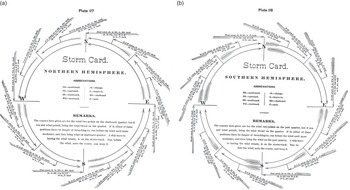
Figure 8.2 S. B. Luce’s recreation of the storm card, from The Textbook of Seamanship (1891)
Such a schematic visualization of the storm in advance of aerial and satellite photography should not be taken as a given.Footnote 20 For Piddington to plot this diagram of the storm, the science of cyclones had to move away from an understanding of storms as a meeting of disputed and contrary winds. This was no mean feat given that eighteenth- and nineteenth-century storm observers would have seen a storm from a single vantage point (for Piddington, who had worked as a sailor, this would have been the deck of a ship), so that tornadoes, waterspouts, hurricanes and tropical storms were often strong winds that violently changed directions and were accompanied by thick clouds (Reference WalkerWalker 1989: 483). A particular kind of ‘epistemic switch’ (Brian Hurwitz, Chapter 17) was necessary to move from visualizing and narrating tropical storms as contrary wind patterns to the bird’s-eye view of this neat and cycloidal representation.
Piddington’s work built upon accounts of hurricanes in the Caribbean Seas, ships’ logs and court cases involving coastal landfalls of cyclones in the Indian ocean. Gilbert Blane’s account of the 1780 hurricane that struck Barbados had confirmed for Piddington that there was a need for developing terminological specificity to distinguish between straight and rotatory winds, and that with some observation, tracking wind direction and training one’s eyes, one would be able to discern patterns in these rotatory winds well enough to predict the direction of the tropical cyclone. Apart from Blane, Piddington had access to accounts of storms in the Coromandel from the south-eastern coasts of the Indian peninsula given to him by the Master Attendant of Madras Port, Capt. Christopher Biden. He was simultaneously reading American meteorologist William Charles Redfield’s work, which had already described the storms of the north Atlantic Ocean as ‘progressive whirlwinds’, i.e., that they were always rotatory and that they moved in a plottable track (Reference PiddingtonPiddington 1848: 4). In 1838, William Reid, who was stationed as the governor of the Bermudas, published An Attempt to Develop the Law of Storms by Means of Facts, where he documented that the storms that struck the Caribbean coasts were storms that rotated clockwise in the southern hemisphere and anticlockwise in the northern (Reference PiddingtonPiddington 1848: 5).
Following on from these writings, Piddington announced both the reason for developing a law of storms and the two principles that made storms discernible and plottable. He declared that storms would gradually become understood as a trackable wind movement, which any good sailor could navigate in. The first principle laid down the wind motion and direction, and Piddington showed that winds circulate in two motions on two sides of the equator and that it was both a straight and a curved motion, which made the winds systems circulate as they were ‘rolling forward at the same time’ (Reference PiddingtonPiddington 1848: 8). The second principle proved that in the northern hemisphere wind moved from east to west, ‘or contrary to the hands of a watch’, while in the southern hemisphere the wind motion lay with the hands of the watch. These two central principles of Piddington’s ‘new science of cyclonology’ rendered the sky with discernible wind patterns. His storm science, visualized through the card, would allow sailors to train their eye to recognize deviations from the pattern and therefore cyclonology would ultimately act as a form of insurance and protection against wreckage: ‘to enable the plainest ship master, then, clearly to comprehend this science in all its bearings and use’ (Reference PiddingtonPiddington 1848: i). As someone presiding over the Marine Court in Calcutta, he worked with a very specific definition of law:
Theory and Law. The seaman may best understand these two words by his quadrant. As long as people who paid attention to these things supposed that light when reflected from a mirror was always so at a certain angle depending somehow on the direction in which the original light fell upon it, this was a theory. When it was proved by experiment that the angle of reflection was equal to the angle of incidence this became the Law of reflection, and when Hadley applied it to obtain correct altitudes, and to double the angle by the two reflections of the quadrant, he used it for a nautical object of the first importance and of daily practical utility. These are the three great steps of human knowledge and progress. The theory, or supposition that a thing always occurs according to certain rules, the proof or Law that it does and will always so occur, and the application of that Law to the business of common life.
For Piddington, the storm card is a distilled version of the law of nature applied to the business of common life – his science that should be conducted in the cabin tables of a ship. Piddington’s storm science was geared towards teaching sailors to recognize the centre of the cyclone and to devise methods to avoid it. According to him, the safest way of managing a vessel in a storm is by following the wind direction and sailing on its rotatory or circular course rather than straight through it. In order to do that a sailor had to see a particular kind of storm – not one where strong winds blew in multiple directions, but one where there was a circular pattern to it with a centre that one must, at all cost, avoid. However, he was quick to point out that what the sailor is discerning with the storm card are not tracks of storms, but the ‘tendency of the paths of the usual Cyclones’ (Reference PiddingtonPiddington 1848: 42). For this reason, his directives to use the storm cards were accompanied by excerpts of shipmasters’ logs which he meticulously collected from ships that docked at Calcutta and Madras.
Storm cards not only order the moments before the storm, but also make historical wind movements legible and transform them into a set of universal signs to be read and deciphered in order to avert a wreck. And given his role in the Marine Court, he also hoped that they would ease adjudication about wrecks. The storm card was a technical tool that helped the shipmaster verify the wind direction. By standardizing storm science, Piddington had also hoped to develop plausible narratives about the moment of the wreck were they to occur, and plot when and where mistakes were made. He was also fully aware of the difficulties of rendering the volatile tropical skies into a set of laws and diagrams. Therefore, Piddington recommended that mariners follow the storm card, but cautioned against ‘the mischievous and ignorant notion that there is any fixed law for the tracks of these terrific meteors, especially in narrow seas with volcanic islands or continents within, or near to, or limiting them’ (Reference PiddingtonPiddington 1848: 62). Moreover, Piddington saw his storm card as an evolving tool and he requested the sailors to offer feedback for improving upon the tool. Indeed, the storm card made the sailor’s tacit knowledge into a discernible evidence of his ability to read wind direction reflecting his capability as an experienced sailor. Thus, the storm card performed two functions: it was a critical tool of pedagogy for sailors and it sought to standardize the narrative science of cyclones.
8.5 Conclusion: Narrating Imperial Cyclonology
In the Bay of Bengal, the line between what was knowable in the ‘blooming, buzzing’ (Reference DastonDaston 2016: 60) world of storms and gales shaped the material practices of rowing, towing and navigating the seaboard and in the process was translated into empirical knowledge through storm narratives. As mentioned above, Piddington was not the first weather observer, nor was he the first to write about winds and hurricanes. What makes Piddington’s work stand out is the legal and imperial imperatives that drove his cyclonology. He was driven by a desire to bring order to the process of administering justice, protecting the plainest shipmaster against storms and equally from the wreckages of the inequitable justice system of the Marine and Admiralty courts.Footnote 21 Piddington’s cyclonology emerged out of what Morgan and Wise called a backward understanding of the event, whose narratological cognition and reconstruction happens after the fact, i.e., after he had listened to multiple accounts of the storm that wrecked ships. In that, he was very much the ‘confused and reflective participant’ who, ‘when confusion is resolved, [becomes] the narrator throwing explanatory light on the situation’ (Reference MorganMorgan and Wise 2017). For example, in Conversations about Hurricanes (Reference PiddingtonPiddington 1852), meant to be a book of dialogic pedagogy between three sailors, Capt. Wrongham, one of the fictive sailors, tries to understand if the storm card is a form of ‘prognostication’. He comments, ‘our knowledge then would all be fore-knowledge, both as to what happened and what in all probability was going to happen’ (Reference PiddingtonPiddington 1852: 93). With this form of foreknowledge acting as insurance against wreckage, the jury’s ability to judge and place liability for the storm would be resolved efficiently. The storm card, a product of his new science of cyclonology, was also a product born of an encounter with the legal world of the Marine Court.Footnote 22
9.1 Introduction
This chapter explores connections between the intellectual work done by Hugh Hamshaw Thomas (1885–1962) in two separate domains: first, as an academic palaeobotanist; and second, as a military intelligence officer during the First and Second World Wars. In both domains, Thomas relied on the use of fragmentary visual evidence (and photography in particular) to attempt to understand landscapes. In his palaeontological work he was looking at fossil plants and past environments; in his military work he was piecing together landscapes of enemy activity. Rather than considering the visual fragments as elements in a process of ‘mapping’ those landscapes, I emphasize the way in which, in both domains, they were part of narratives.
In what follows, I review the wide range of material and intellectual resources drawn upon by Thomas to undertake this narrative work under the umbrella of what I call a ‘narrative practice’. I argue that this ‘narrative practice’ included particular techniques for handling and analysing visual material, the accretion of visual evidence into archival architectures and the inculcation of epistemic virtues, with and alongside the construction of conjectural accounts about historical processes. In other words, the nature and the usefulness of the archive was predicated on narrative techniques and outcomes. An exploration of the figurative terms used by Thomas’s peers to characterize the kind of work he was engaged in allows us to see ‘narrative practice’ as a unified whole.
Thomas pursued his career in palaeobotany almost exclusively at the University of Cambridge, where he was Fellow at Downing College, and later university lecturer in Botany. He was awarded the prestigious Darwin Centenary medal in 1958 (Reference HarrisHarris 1963). That academic career was punctuated by war and work with aerial photointerpretation. In the First World War, he was Photographic Officer for the 5th Wing of the Royal Flying Corps. It has been claimed that the success of the British campaign in Palestine and Egypt (in which T. E. Lawrence famously also played a part) was to a great extent attributable to Thomas’s contribution. In the Second World War, Thomas was responsible for producing the Manual of Photointerpretation used by the Allied Central Interpretation Unit, and, as Chief of Third Phase Interpretation, initiated the allied investigation into rocket development at Peenemunde (Reference SmithSmith 1985: 189).
Both of Thomas’s domains of work relied heavily on visual records. Figure 9.1 is an image from a First World War manual on the use of aerial photography: ‘The Interpretation of Aeroplane Photographs in Mesopotamia’.Footnote 1 It is one of a series of sample images that offered military officers an introduction to the different physical and social features of the terrain as viewed from the sky. ‘The study of photographs’, the manual explains, ‘is only of value in so far as the results may be turned to practical account, either in the way of assisting tactical operations, or of obtaining information regarding the Enemy’s intentions and dispositions’.Footnote 2 In other words, the photographs were to be used to generate narrative conjectures about what the enemy would do next.

Figure 9.2 is visual evidence from Thomas’s most important paper, published in 1925. It depicts a fossil that he had collected in Yorkshire. In the paper in which the figure was published, Thomas was presenting a new fossil species that he had named ‘the Caytoniales’. Thomas was proposing that the Caytoniales were an entirely new order of plants that corrected a ‘missing’ link between ferns and flowering plants. He was offering an important narrative conjecture about the evolution of plant life.
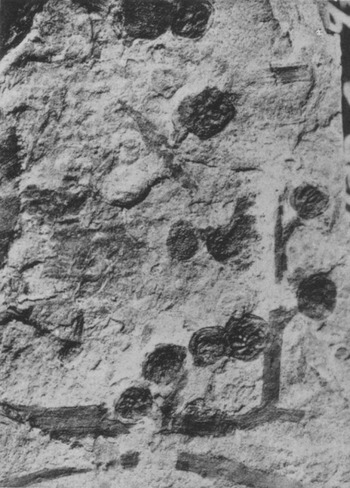
Figure 9.2 Photograph of a fossil collected by Thomas in Yorkshire
‘Part of an infructescence showing its attachment to a larger branch, also isolated fruits in which the outlines of seeds can be made out. No perianth scars can be found on the axis or on the branch’ (original caption).
Each of these forms of visual evidence was being woven into narrative conjectures in a similar way. To explore the connections between his use of images in each context I make two propositions. First, that we should frame Figures 9.1 and 9.2 as constitutive of a ‘narrative practice’ that Thomas deployed in each domain.Footnote 3 Second, that we should understand that practice as a hybrid association of multiple forms of activity.
Historical studies of the different activities that I consider to lie within Thomas’s narrative practice have often been pursued in separate fields. From the historical epistemology of early twentieth-century photography we know that the status of each of these photographic reproductions as evidence was, as John Tagg puts it, a ‘complex historical outcome […] [of] certain institutional practices and historical relations’ (Reference TaggTagg 1988: 4–5). Both the aerial photograph and the depicted fossil fell within institutional practices and historical relations that could be described as ‘a colonial habitus’ (Reference PinneyPinney 2008). Both items were implicated within British efforts to know in order to dominate, motivations that through the nineteenth century had prioritized data collection on a massive scale in attempts to map physical, biological and social processes of increasing scale and complexity (Reference DriverDriver 2000; Reference CoenCoen 2018). That effort included innovation in modes of producing, refining, labelling and categorizing visual evidence within archives (Reference RudwickRudwick 1976; Reference KelseyKelsey 2007; Reference TuckerTucker 2013). This scholarship provides us with a strong basis from which to consider how the role of visual evidence in each of Thomas’s domains was being developed and negotiated.
We can also draw on a rich and flourishing scholarship on the relationship between evidence and causal explanations in the historical sciences, particularly biology, palaeontology and archaeology. A scholarly resurgence of interest in this field has offered several further important strategies for thinking about Thomas’s narrative practice, particularly with respect to visual evidential materials, many of which are discussed in this volume.Footnote 4 Such scholarship has emphasized that narrating the past can entail a variety of epistemic techniques for drawing together and assessing evidential elements (Reference Richards, Nitecki and NiteckiRichards 1992; Reference TurnerTurner 2000; Reference MorganMorgan 2017). Scholars, in particular Alison Wylie, have shown that these approaches require certain epistemic skills that might include opportunism, flexibility, a respect for ambiguity and epistemic humility (Reference Chapman and WylieChapman and Wylie 2016), and that those modes offer different scopes for developing and extending historical claims (Reference ClelandCleland 2011). Adrian Currie’s Rock, Bone, and Ruin (Reference Currie2018) situates many of these alongside each other.
This chapter connects and extends these two largely separate discussions in several ways. First, it situates narrative as the central and unifying principle of an epistemic practice that encompassed multiple simultaneous activities, in which neither evidence collection nor explanatory accounts were prior. Second, this chapter contextualizes that practice within early twentieth-century figures of speech: working ‘like Sherlock Holmes’, ‘reading the book of nature’, and thought as being ‘like a river’. The interplay of these figurative terms allows us to characterize the unifying narrative practice as reticulate (networked), multi-scalar and dynamic; qualities that have resonance with more recent descriptions of explanatory practices in the historical sciences. This characterization is reinforced when we follow the translation of Thomas’s narrative practice in palaeobotany into the arena of military intelligence.
9.2 A Narrative Practice? Finding Traces?
9.2.1 Fossils
To begin, we need to ask how the items in Figures 9.1 and 9.2 were being used as evidence. The dark spots on the surface of the rock fragment depicted in Figure 9.2 were identified by Thomas in his Reference 205Thomas1925 paper as seeds from a newly identified prehistoric plant species. However, at the moment he was formulating that proposition, the function of the plant organ he had identified, the nature of the organism it came from and the nature of the prehistoric environment which hosted the plant were all unknown. For Thomas to arrive at his conclusion, several different and interlinked questions need to be resolved simultaneously.
How might I recognize or define a prehistoric plant organ?
How is this organ related, developmentally, to others, such as leaves, in an individual plant? Does its tissue share common properties with other organs?
What is the role of this structure in the development of a species or evolutionary branch? Is this an early flowering plant (angiosperm)?
What does the presence of a fossil with these characteristics tell us about the environment? For example, how was pollen transmitted?
What inadvertent effects might have been produced in the preservation and preparation of the fossil that falsely suggest botanical features?
In Reference 205ThomasThomas’s (1925) paper we can follow how he asked and answered these parallel questions of the fossil (Figure 9.2). He observes to the reader that some of the seed-membranes were not cleanly extracted and therefore appear ‘broken up’ (Reference 205ThomasThomas 1925: 359). They could nonetheless be interpreted. The proto carpel and fruit-bearing structures appeared to share some characteristics with their equivalents in modern flowering plants: they had a foliar-type tissue, i.e., shared some qualities with leaf tissue (Reference 205ThomasThomas 1925: 306). They didn’t have the scars that would indicate they were originally part of hermaphrodite flowers (Reference 205ThomasThomas 1925: 315). Crucially, however, for Thomas, the structure depicted in Figure 9.2 seemed to function more like carpel than the reproductive organs of a seed-bearing fern. The important difference being whether the ovule was open to the air (ferns) or closed with a stigma and pollen-tube leading to it (flowering plants) (Reference 205ThomasThomas 1925: 325). Thomas made the assertion that he could identify a proto stigma.
In Thomas’s account, all these questions are deeply interrelated. For example, in recounting the difficulty that he had in extracting the remains of seeds and seed membranes from the rock matrix Thomas offers some insight into the potential for representational artefacts to weaken his interpretation – that the effects of his process might misguide our ‘reading’. However, that account also informed his suggestion that the seeds were stuck in a fleshy fruit, adding weight to an account of the plant as a proto angiosperm (flowering plant) rather than a seed-bearing fern. We see how interconnected questions, therefore produced interconnected narratives (of the process of extraction and of the function of the plant organ) from which Thomas arrived at an overarching narrative in which the fossil represented a transitional stage between a fern and the first flowering plants.Footnote 5
9.2.2 Aerial Photographs
In considering how the aerial photograph in Figure 9.1 was interpreted, the guide from which it was drawn identifies a similar set of interconnected questions. The overarching question addressed to the image in Figure 9.1 would be: what can we understand about enemy strategy from this landscape feature? Here, as with the fossil fragments, there was a scarcity of material to interpret, and multiple unknowns. The network of questions would include:
How can a particular track in use by the enemy be identified?
What is the role of the track in relation to other elements in the image? (How is it networked with other resources?)
What is the role of this track in the context of an immediate goal of the enemy?
What does the nature of the track tell us about the broader capabilities and intentions of the enemy?
The section in the guide on interpreting tracks is particularly revealing.
They disclose dumps; battery positions; headquarters; wire which is otherwise invisible, and gaps through it; patrol paths; observation posts; in villages, those houses which are important centres; advanced listening posts […] the evidence of numerous tracks and shortcuts leading across irrigated and cultivated fields may be taken to denote the presence in the neighbourhood of bodies of troops. The local population would not make sufficient use of these foot-paths to cause destruction to growing crops.Footnote 6
As with the fossil evidence, a set of interconnected questions at different scales were all being developed as the basis for narratives that functioned in dialogue with each other. We see much more than a mapping of landscape features. Each question tested an emergent overarching narrative that would be a conjectural account of the enemy’s activities. Importantly, however, some of these questions were not all posed or answered once the photograph was in hand. Some were determined in advance, some emerged as by-products of the processing or preparation of the photographs (gridding, annotating), while others emerged from direct analysis of a single image. To understand the resulting narratives requires expanding our field of analysis to a narrative practice that encompasses all of these stages. Figurative descriptions of this kind of work that were contemporary to Thomas offer us ways to take such a holistic approach.
9.2.3 From Questions to Narratives?
Sherlock Holmes made his first public appearance just two years after Thomas’s birth and within a short space of time, was being used as a methodological role model in a variety of contexts (see ‘New Habits of Media Use’, section 9.4.1, below).Footnote 7 Carlo Ginzburg has placed Holmes in a late nineteenth-century zeitgeist that connected the modus operandi of the consulting detective with an emergent episteme that touched art history, psychology, and medicine (Reference GinzburgGinzburg 1989). Picking up Ginzburg’s perspective, it is sensible to propose that to think ‘like Sherlock Holmes’ meant to formulate whodunnit and howdunnit narratives using a network of traces of an event. We could take, for example, an episode from Holmes’s debut in A Study in Scarlet in which he lends his attention to minute aspects of the appearance of a watch. After an examination of a series of scratches and pawnbrokers’ marks, Holmes connects them into a conjectured biography of the watch which is intertwined with a conjectural biography of its former owner.
The second trope that was applied to visual practices such as Thomas’s by his contemporaries was that of reading evidence ‘like a book’. Critical histories of the use of aerial photography in the social sciences such as Reference HauserHauser (2007) and Reference HaffnerHaffner (2013) have drawn attention to early twentieth-century use of the ‘book’ trope to describe the interpretation of aerial views. In one of Haffner’s examples, an early advocate of the value of the aerial view in human geography argued that air photographs let you ‘read the land as one reads a great open book’ (Reference HaffnerHaffner 2013: 27).Footnote 8 The study by Lorraine Daston and Peter Galison of visual epistemic authority (Reference Daston and Galison2007) has drawn attention to the use of this expression in other modes of scientific practice as indicative of authority through ‘trained judgement’.
The act of interpretation is characterized slightly differently in these two cases. Haffner suggests in The View from Above that reading a landscape process from an aerial view ‘was simply a matter of noting what had existed before versus what had appeared’ (Reference HaffnerHaffner 2013: 13). In Hauser’s account, the longer (past) human histories that are evidenced by aerial views are described as being stored below the ground, a history simply waiting to be revealed by new angles of flight and light (Reference HauserHauser 2007). Daston and Galison go somewhat further in describing what visual interpretation requires. They cite examples of introductory texts in early twentieth-century scientific atlases that exhorted their readers to consider image interpretation as the ‘skills required to read a new language using an unfamiliar alphabet and a different script’ (Reference Daston and GalisonDaston and Galison 2007: 328). A common trope for this mode of analysing of visual evidence, Daston and Galison argue, was the intuitive scanning of facial physiognomy – the rapid and possibly subconscious recognition and comparison of complex and minute differences within facial appearances. Attention to those differences could be learned.
Yet both of the above retrospective accounts using the figure of the book have flattened the role of narrative that it implies. We can reinvigorate the narrative component of the book trope if we reconnect it to Holmes tracing the contours of a human life from the incidental features of a watch. Conan Doyle’s emphasis on the unique possession of these skills in the consulting detective, encourages us to put aside the idea that the interpretation of the phenomena under scrutiny is determined by the phenomena itself (is read). Instead, we can investigate how interpretations were ‘written’ or constructed.
A third figurative expression, which sheds further light on the first two, is provided by the philosophical writing of Agnes Arber, one of Thomas’s botanist colleagues at Cambridge.Footnote 9 For our purposes, her most useful expression was one in which she compared biological thought to a river. Through this expression, Arber was rejecting the idea that thought was strictly linear and proposing that it was better imagined as a reticulum (a network) moving through three dimensions in one direction. She saw the flow of thought that would eventually produce a narrative account as including eddies and currents, and therefore, by consequence, as dynamic. In Arber’s words (drawing from yet another three-dimensional analogy), a biological explanation does not ‘grow by accretion of ready-made parts, as a building’, but rather ‘in passing from phase to phase […] suffers transformation from within’ (Reference ArberArber 1954: 69).
Bringing these three expressions together, we have: (i) the gathering of evidence to narrate a crime as offered by the figure of the consulting detective; (ii) attention to the relationship of phenomena within and across images as offered by the analogies to learning to read; (iii) the conceptualization of biographical thought as a river, encompassing data collection, analysis and the production of an explanatory narrative. All these reinforce the value of exploring a narrative practice that encompasses multiple modes of work. Understanding how a practitioner might seek to develop such a practice is best understood by returning to the context in which Thomas received his botanical training and then to the reworking of that practice in a military context.
9.3 Linking Vision and Narrative in Thomas’s Scientific Work
9.3.1 Botanical Visual Cultures
Scholars have demonstrated that training in botany and biology in the late nineteenth century had a very strong emphasis on the visual. Botanical and biological knowledge were primarily transmitted as a visual practice. Posters, chalkboard drawings and field outings were the primary access to understanding plant life in schoolchildren. However, they remained the key tools for teaching at undergraduate level, as Thomas’s own mentor, Albert Charles Seward, testified in a paper for the New Phytologist (Reference SewardSeward 1902). By the turn of the century, British botanists had become actively interested in the possibilities that were offered by photographs as a research resource. In 1901, the British Association for the Advancement of Science (BAAS), Section K (Botany), joined other BAAS groups who had begun their own systematic image collections.
Kelley Reference WilderWilder (2008) and others have identified the changing uses of photography in science in this period as a tool for both classification and measurement. Scholars have also explored how image technologies and analytical techniques were co-developed (Reference HentschelHentschel 2002; Reference KelseyKelsey 2007). Photography operated with and alongside gridding, labelling and diagramming practices that highlighted or abstracted particular aspects of a phenomenon, as well as indexing practices, which placed each image within ordered and signifying relationships to places, people, specimens and to other images. The epistemic architectures for botanical photography calibrated scientific visions of the vegetative world and formed the basis of a disciplinary visual practice (Reference HughesHughes 2016). In other words, visual record systems were set up that would allow comparisons between photographs as epistemic objects and identify particularity within individual visual records (Reference RheinbergerRheinberger 2015). They trained a botanical or palaeobotanical observer’s attention to groupings of related features within a visual record, allowed them to find new or unknown features to explore, and cultivated in them an ‘exceptionally seeing eye’ (Reference Meinig and MeinigMeinig 1979: 199).Footnote 10
There is more at work here than what has been called expert training in ‘pattern recognition’ (Reference Daston and GalisonDaston and Galison 2007: 329). The background to the publication of Figure 9.2 offers excellent insight into how several layers of material and epistemic work built the photograph into a disciplinary visual archive through reticulate narratives. The fossils that came to be known as Caytoniales were found in Cayton Bay in Yorkshire. Their geographical origin was recorded in their new names, in the archival records alongside the original specimens in the Sedgwick Museum, Cambridge, and noted in the scientific paper in which they were presented (Reference 205ThomasThomas 1925: 302). Figure 9.2 shows a rock from Cayton Bay, on the surface of which the fruits of Caytonia Sewardii are identified (magnified to 2.5 × their original size) to allow inspection of the form of the plant organs at the relevant level of visual detail. Once logged, such rocks were then subject to extensive further preparation including boiling for several weeks in specific chemicals, passing through alcohols and slicing with a microtome. This process revealed the chemical composition of different parts of the fossilized plant matter creating further sets of microscopic images at a cellular level that were identified as different plant organs.
We start to see how these processes created epistemic objects that had a networked relationship to each other, crossing multiple scales of place (from the cliff-face to the laboratory) and of plant function (from prehistoric landscape ecologies to organ to cell). These relational features of the image are accounted for through questions that produced various smaller narratives, smaller narratives which are held in unity by the overarching narrative of Caytoniales as a missing link between ferns and flowering plants. That overarching narrative includes the relationships between site, process, archive and conjecture, linking place and plant function in a reticulate and partly predetermined and partly emergent manner.
9.3.2 Writing Botanical Relationships
The role of narrative in the use of visual archives has received less critical attention than the social and political processes that shape those archives’ production. Yet the narrative techniques involved were just as much subject to culturally specific processes, to disciplining and to epistemic virtues. Here, I propose an analysis of two particular narrative ‘challenges’ that demonstrate this. The first of these challenges was the deceptively simple task of translating the profoundly visual experiences of research of plant lifeforms into verbal accounts.Footnote 11 Another was the entanglement of botany within arguments about the nature and destiny of life forms.
The relationship between categorizing and narrating plant physiology is revealed by a banal but profoundly perplexing problem that was offered to readers of the New Phytologist by the botanist Leonard Alfred Boodle in 1903. Boodle’s worries about botanical accounts of the vascular structure in leaves give us an insight into the connection between botanical visual and narrative practices. He argued that an individual vascular structure needed to be traced from the stem towards the leaf in order to observe the increasing complexity of the structure. Boodle is specifically arguing against a proposition by Reference BaryHeinrich Anton de Bary (1884) that the course of vascular structures could be most easily understood by tracing them down from the base of the leaf into the stem. Important to both Boodle and Bary was that the order in which you approached the description might unwittingly commit you to a different perspective on the evolutionary or developmental precedence in the plant’s physiological features. A narrative artefact might impede your interpretation.
As Boodle pointed out, ‘In many cases according as one describes the vascular and other tissues as traced upwards or downwards, one is easily led to use phrases which commit one to a different opinion as to their morphological nature in the two cases’ (Reference BoodleBoodle 1903: 108). While you could choose a direction for descriptive purposes, ‘the topographical statement must be reworded according to the view arrived at of the first origin of these tissues’ (Reference BoodleBoodle 1903: 109). We see a focusing of attention on the epistemic pitfalls that could occur as a result of clumsy expression. One might suggest that Boodle is simply arguing for a clarity of thought that distinguishes between the spatial relation and physiological origin of an organ in a scientific description. However, the case material itself (the relationship between the leaf and the stem) demonstrates that he is also arguing for a particular kind of ‘openness’ required to solve problems in a field of knowledge with so few parameters. To return to the terms set up in this chapter, he is arguing for a dynamic narrative practice.
A second challenge in constructing botanical narratives lay in the question not just of process but of the destiny of plant forms, a question that interested Thomas himself. This was the question of emergent differences in plant tissue (stem, leaf, bud) and whether there was an essential or original nature of plant tissue. This question had been under debate for decades and was the focus of Goethe’s essay ‘On the Metamorphosis of Plants’ (Reference Goethe1790) that had been seminal in the discipline. Although Thomas rejected the thesis that Goethe put forward in that essay (that the leaf was the urform of plant matter), he celebrated the epistemic openness of Goethe’s investigation. In a manifesto for plant morphology from 1933, Thomas directly quoted Goethe to underline a point on epistemic method: ‘The thing now to be aimed at is to keep habitually in view the two contrary directions in which variations are developed’ (Reference ThomasThomas 1933: 47). For Thomas, narratives about process and progress had to be dynamic, open to radical reshaping.
In Thomas’s case, as those of many of his colleagues, that openness included scepticism about oversimplifying evolutionary processes. In his advocacy for a ‘new morphology’, in 1933 Thomas affirmed the value of using the forms of both living and fossilized plants to construct narratives about evolutionary history. However, Thomas argued, these narratives should be assembled with caution. In particular, he emphasized, one should not rely on the stability of concepts such as the leaf, petal or stamen (Reference ThomasThomas 1933: 48; Reference Thomas1934). One might also be cautious about over-reliance on simplistic models for the mechanisms of inheritance when similar characteristics might emerge across different, and widely separated, groups (Reference ThomasThomas 1934: 176; Reference WinsorWinsor 1995).
Thomas’s manifesto bears the echoes of one made by his predecessors as President of Section K (Botany) of the BAAS, William Henry Lang. Lang had also argued for the value of morphological study some years earlier, in 1915, suggesting that it offered the means to untangle an interrelationship of plant species that looked ‘more like a bundle of sticks than a tree’ (Reference LangLang 1915: 242). When we understand the opacity of the biological mechanisms at the heart of Thomas’s narrative accounts of plant life, it becomes clear why it was important to hold so many questions open simultaneously. We can see why the narratives about fossil plants needed to be dynamic. Thomas was bringing together multiple narratives that were all under formulation at the same time, and which, borrowing Arber’s expression, when passing from ‘phase to phase’ suffered ‘transformation from within’ (Reference ArberArber 1954: 69).Footnote 12
Casting our minds back to the analogy of the ‘book of nature’, the relationship of narrative to traces evidenced in plant tissue reveals how much more like writing than reading this process was. We see that the archive was bound into narrative relations and we see the vital importance of narrative skills in Thomas’s work as a palaeobotanist. That training included attention to narrative artefacts that might inadvertently be introduced into verbal description. It included the measured use of existing explanatory mechanisms. It also included the capacity simultaneously to explore multiple networks of significance at multiple scales in order to produce a reticulate, multi-scalar architecture of narratives that constrained and supported each other and that were flexible enough to accommodate instability in the identity of the narrated objects. Leaves, stems or proto stamens might be called upon to play entirely new roles in narratives that shifted with and around them.
9.4 Thomas’s Narrative Practice and Military Intelligence: The ‘New Morphology’ of War
9.4.1 New Habits of Media Use
If Thomas’s narrative practice was a valued technique for botanical enquiry, the capacity to narrate enemy behaviour might seem an even more obvious and essential part of warfare. Retrospectively, it also seems common sense that the military would use aerial photography to construct such narratives. The scholarship of military historians has often suggested a continuous enthusiasm for photographic and aerial surveillance technologies since the mid-nineteenth century. Yet in fact there was dissent and difficulties in their uptake into intelligence practices.
It is often stated that the use of photography by British soldiers and military engineers was already widespread in the nineteenth century, particularly in imperial endeavours (Reference Mattison and HannavyMattison 2008). The Royal Engineers School at Chatham began to teach photography in 1856. Photography was in use in reconnaissance during the 1867–68 campaign in Abyssinia. The Royal Engineers also began to develop balloon technology to generate photography from the air during the nineteenth century. By 1878, there were four balloon sections with men also trained in photography (Reference MeadMead 1983: 19). Balloons and unmanned kites were used for reconnaissance by the British in the South African conflicts, particularly from 1898 to 1902 (Reference MeadMead 1983: 25). In this reading, nineteenth-century institutional uptake paved the way for a spectacular deployment of photography in the First World War, when millions of photographs were produced, and the merits of the aerial view were proven.
These accounts of the use of remote sensing in war overplay its roots. In fact, to paraphrase Elizabeth Edwards, while photographs offered the armed forces ‘a whole new different class of knowledge’, it had to be ‘recognized, contained and utilized within […] existing habits of media use’ in the early twentieth century (Reference EdwardsEdwards 2014: 175).Footnote 13 That process was not a straightforward one. In the early twentieth century, the British armed forces’ habits of use for photography were not analytically oriented. While in previous decades botanists, archaeologist and geologists had enthusiastically begun to assemble visual records for analytical purposes, in military contexts, photography appears to have been used largely to other ends. In the late nineteenth century, the British military’s primary official use of photography was in fact as ‘the readiest and most accurate mode of copying’ officers’ hand sketches of the terrain, maps and charts (Reference Holland and HozierHolland and Hozier 1870: 360). Where original images were being made in an official capacity, they were not being used for field intelligence, but rather to document scenes ‘after the fact’. Some images were made of peoples and places in an ethnographic vein. Some images were made of military manoeuvres in progress or completed military engineering projects. Some images were made to document the effects of bombardment or sieges (Reference BollochBolloch 2004; Reference Sampson and HannavySampson 2008). In sum, photography was being used to record seen events rather than to make conjectural narratives about unseen events. Even the military value of the panoptic view from the air was not a given. The potential of balloons and kites for military reconnaissance was tested in South Africa; however, this had been due to strong advocacy by enthusiasts, and in the face of some reluctance by officials.
During this period of prevarication about photography, the whole field of military intelligence was, however, in flux. At the end of the nineteenth century, concerns about the nature of combat in any future European wars were prompting institutional change. It was recognized that British field intelligence expertise was minimal and ill-adapted either to fighting across large fronts in wars that involved civilians, industry and distributed resources or to meeting ‘guerrilla’ forces in relatively unknown terrain. Previously, field intelligence activities had been mustered in response to each crisis; there was no ongoing training. Nonetheless, British failures in South Africa had caused some anxiety, and in 1907 the first attempts were made to provide a permanent core of experts in the form of a field-intelligence training course (Reference Siegel, Jackson and SiegelSiegel 2005). The impact of this course was doomed to be limited, as there were only around eight attendees each year. Its content was also not very rigorous. Attendees were given little instruction in observation; instead, it was recommended that they closely examine ‘the adventures and methodology of Sherlock Holmes’ (Reference Siegel, Jackson and SiegelSiegel 2005: 136).
Within the first year of combat in the First World War, attitudes to photography began to change. In February 1915, the Royal Flying Corps began to innovate cameras for use from aeroplanes, and the aerial photographs that were produced were taken up eagerly in the field. The technologies and techniques for photographic capture, organization and analysis were innovated rapidly. British military success in Palestine and Sinai was attributed to aerial photography (and, Air Chief Marshall Salmond said, to Thomas’s work in particular, as Photographic Officer, RFC 5th Wing) (Reference HarrisHarris 1963).
In both the Western and the Eastern conflicts in the First World War, aerial photography was eventually integrated into forms of hybrid media produced from cartography, photography, annotation and diagramming. However, the narrative power of the visual material in each arena was not the same. Contemporaries who observed the enthusiastic uptake of aerial photography in the East attributed it, at least in part, to the difference in the amount of pre-existing knowledge that the British had about the environment and societies in that region (Reference DowsonDowson 1921). Although the changing scale and pattern of warfare was devastating and unprecedented in the West, the campaigns in France and Belgium were being fought in terrains that had familiar social and physical geographies, and of which the British had detailed topographical maps. It was relatively easy to identify changes in the landscape that were due to enemy action. In the East, the aerial photographs that were taken carried the additional epistemic burden of providing more general understandings of the physical terrain, as well as the socio-cultural habits and material dispositions of enemy forces.Footnote 14 Narrative conjectures about the enemy were riskier, and there was a greater need to link questions and visual evidence in a reticulate, dynamic, multi-scalar fashion.
Despite the importance of this work during the First World War, in the years that followed the conflict the British armed forces did not continue to develop further techniques to analyse aerial photographs. The military seemed relatively indifferent to the powerful potential of photointerpretation for intelligence purposes, despite some effort by Thomas and other veterans from the war in Palestine and Mesopotamia, including T. E. Lawrence.Footnote 15 When the British entered into conflict in 1939, that lack was fairly rapidly felt, and Thomas himself, along with other photo-interpretation veterans, were re-recruited in military intelligence.
When Thomas was transferred back to strategic photointerpretation work his first role was to review the RAF manual of photointerpretation. He subsequently became leader of the ‘third phase’ of the Joint Forces photointerpretation work, in which specialist groups produced long-term studies of changes on the ground (Reference Rose, Rose, Ehlen and LawrenceRose 2019). His interests led to the founding of two new photointerpretation sections in the third phase dedicated to topography and to industry. Thomas eventually led his section in one of the most celebrated moments in the history of military intelligence, the identification and destruction of German V-2 rocket capabilities at Peenemünde.
9.4.2 A Military Narrative Practice
The epistemology of military photointerpretation has been subjected to far less academic analysis than the epistemological role of photography in academic science. However, we know that it was not only the 1908 British military intelligence officers who invoked Sherlock Holmes for methodological instruction. As Paul K. Saint-Amour notes, instruction manuals for photointerpretation regularly called on Holmes as a role model (Reference Saint-AmourSaint-Amour 2003: 359). We are learning from our association of Holmes, books and rivers in Thomas’s botanical narrative practice that the apparently simple evocation of ‘Holmesian’ practice conceals a highly complex process.
First, we see the emergence of visual infrastructures in military intelligence that were intended to produce ‘exceptionally seeing eyes’. Very early use of photography in First World War military intelligence often involved unwieldy photomontage panoramas of enemy encampments. These were not easy to circulate or report upon. One of Thomas’s key contributions in the East was organizing systematic, gridded, aerial photography of the unknown landscapes in which war was unfolding. That photography was abstracted to produce topographic maps of the terrain, from which significant changes could be more easily observed and upon which they could be more easily notated. We see the first steps in practice similar to the organizing principle for visual materials in botany, creating systems from which similarity and difference across sets of features could be discerned (Reference RheinbergerRheinberger 2015).Footnote 16 That systematizing of photography also allowed the production of ‘atlas-like’ documents such as the one from which Figure 9.1 is drawn: ‘The Interpretation of Aeroplane Photographs in Mesopotamia (Part 2)’. These guides taught observers how to find visual indicators of enemy activity in and against non-signifying landscape features.
Ultimately, such documents allowed for reticulate and multi-scalar narrative accounts of enemy activity. We see this in the gradual extension of the role of aerial photography in the East during the years of the First World War. Initially it was used for identifying targets and calculating the effect of bombing campaigns. Later it was deployed to more obviously narrative ends: creating track maps that showed human movement in the landscape or estimating troop deployments based on types of tents and shelters (Reference SheffySheffy 2014: 189). During the Second World War, the value of narrative practices such as Thomas’s for that photo-interpretative work was more substantially recognized. Via his scientific networks, Thomas was responsible for the recruitment of ‘many men and women accustomed in their professional lives to examining subjects in depth’, recognizing potentially signifying features of an image, ‘and pursuing a “lead” until its nature and purpose were established’ (Reference HalsallHalsall 2005).
As this new military narrative practice emerged, we see that an emphasis was placed on working in a dynamic way. In the context of rapidly and regularly providing reports, the need to keep an open mind, as a technique for disciplining the imagination, was highly valued. André-H. Carlier (a French photo-interpretation expert from the First World War) noted the activity required someone who would, ‘not give in to his imagination, and be willing to surround himself with all sources of information, ignoring none’ (quoted in Reference HaffnerHaffner 2013: 13). Art historian Ernst Gombrich recounted the story of a photographic interpreter who had been crucial to the success at Peenemünde whose imagination was later insufficiently disciplined. In looking at a photographic trace, Gombrich warns:
There can be no professional stocking of minds with an infinite variety of possibilities. All the professional should learn, and obviously never learns, is the possibility of being mistaken. Without this awareness, without this flexibility, interpretation will easily get stuck on the wrong track.
Here we have advocacy for flexibility in the construction of narratives that is similar to that which we encountered in the context of studying plants. We see that the objects whose traces were being both sought in and narrated from the aerial photographs had conjectural definitions that might be highly unstable. Was this site an ordinary factory, or a laboratory for a secret Nazi weapon? Dynamism in narrative accounts, while managing the possibility of being mistaken, were qualities common to each of Thomas’s domains.
Overall in military narrative practice based on aerial photography we can identify epistemic techniques similar to those deployed in palaeobotany. We see the collection and organization of fragments of traces into visual evidence, into archives and atlases. We see the need to find ways to train attention on small details of landscape change, of similarity and of difference that would be accounted for by mini narratives that would provide ‘leads’. We then see those accumulate in overarching narratives. We see the need to work flexibly, considering multiple narratives simultaneously and at multiple scales so that parallel accounts of visual traces might test each other’s coherence. We can see that this emergent military narrative practice paralleled skills that Thomas had honed in his scientific work.
9.5 Conclusion
Bringing together the two domains of Thomas’s work offers us a clearer view of each. Existing scholarship on the architectures of visual knowledge in botany and ecology allow us to identify the emergence of similar practices when the armed forces developed new habits of media use around aerial photography. Juxtaposing Thomas’s two domains serves to reinforce that such narratives were not read from the visual record but mutually developed with the accretion of visual evidence. The co-construction of archival architectures with narrative required working in a way that was reticulate (networked), multi-scalar and dynamic, characteristics that are reflected in the various figurative expressions used by Thomas’s peers. We can recognize this practice as particularly well adapted to investigating complex processes for which evidence was scarce. In addition to its contributions to understanding the role of narrative in scientific practice, this chapter provides new perspectives on the visual cultures of twentieth-century biology, and on the legacy of military aerial photography in civilian spatial sciences.Footnote 17
10.1 Introduction
Phylogenetic trees are predominantly bifurcating tree diagrams that biologists use to represent evolutionary trajectories and patterns of shared ancestry. In the past two decades, phylogenetic trees have become more flashy, colourful and visually sophisticated compared with tree diagrams of the 1980s and 1990s. In addition to the basic structure of connected lines with taxa names, these filigreed trees contain other graphic and textual elements like images of animals or plants, coloured areas or lines and symbols. Several authors have discussed phylogenies from the perspectives of narrative science and historical explanation (e.g., Reference ClelandCleland 2011; Reference GriesemerGriesemer 1996; Reference O’HaraO’Hara 1988; Reference O’Hara1992). It has been argued that phylogenies are somewhat prior to evolutionary histories in the sense that they are more descriptive and therefore more objective or that they provide a scaffold for evolutionary histories. My chapter will show that, even if this is the case in some respects, phylogenetic trees are all the more interesting for it.
Robert Reference O’HaraO’Hara (1988), for example, claims that the relationship of phylogeny to evolutionary history is a relationship of chronicle to history.Footnote 1 According to him, a chronicle is a ‘description of a series of events, arranged in chronological order but not accompanied by any causal statements, explanations, or interpretations’ (Reference O’HaraO’Hara 1988: 144; emphasis original). Following Arthur Danto, he argues that histories, on the other hand, contain ‘a class of statements called narrative sentences’ (Reference O’HaraO’Hara 1988: 144; emphasis original). In addition to his view of phylogenies as chronicles, O’Hara advocates a scaffold viewFootnote 2 of phylogeny, meaning that he understands phylogenies as the basis for evolutionary histories. James Reference GriesemerGriesemer (1996) disagrees with O’Hara with respect to his view of phylogenies as interpretation-free chronicles. He argues that phylogenies are the result of several methodological decisions (e.g., the choice of phylogeny construction method, choice of outgroup) and claims that phylogenetic analysis ‘produces something more theoretically charged than chronicle’ (Reference GriesemerGriesemer 1996: 67). However, like O’Hara, Griesemer subscribes to the chronicle–history dichotomy and to the scaffold view of phylogeny and evolutionary history. He writes: ‘I agree that cladistic analysis aims at something prior to evolutionary narrative in the way that chronicle precedes history’ (Reference GriesemerGriesemer 1996: 67). Neither O’Hara nor Griesemer seems to believe that phylogenies do much, if any, explanatory work.
My discussion of a study conducted by Maria Nilsson and her collaborators (Reference Nilsson, Churakov, Sommer and Van Tran2010) shows that phylogenies and phylogenetic trees are much more interesting than interpretation-free chronicles. In fact, the phylogeny construction process requires several decisions (e.g., which taxa to include, which characters to use) that potentially affect the outcome of the analysis and is based on fundamental assumptions about molecular evolution. I show that the chronicle–history dichotomy is misleading in the case of phylogenetic trees and evolutionary histories because tree diagrams as the central and only comprehensive representation of phylogenies are read as evolutionary narratives, provided that the reader is familiar with the specialist conventions.Footnote 3 I argue that all phylogenetic trees, even plain ones, represent narrative explanations, and the informed reader can derive narrative sentences from them. My discussion of the filigreed marsupial tree constructed by Reference Nilsson, Churakov, Sommer and Van TranNilsson et al. (2010), and other examples of filigreed phylogenetic trees, shows that, by adding graphic and textual elements to the basic tree structure, narratives can extend beyond phylogenetic narratives of origin and divergence, including narratives of species migration and political and pedagogical narratives. I conclude that filigreed phylogenetic trees are used to represent integrated narratives, and so contain more epistemic features than have been recognized thus far.
10.2 Phylogenetic Analysis: Reconstructing the Past
As a historical science, evolutionary biology shares characteristics with other natural sciences, such as physics and chemistry, as well as other historical sciences, such as anthropology and archaeology (Reference Harrison and HeskethHarrison and Hesketh 2016; Reference Kaiser, Plenge, Kaiser, Scholz, Plenge and HüttemannKaiser and Plenge 2014; Reference Tucker, Kaiser, Scholz, Plenge and HüttemannTucker 2014). Just like human historians who study the origin and trajectory of events (e.g., wars, revolutions), evolutionary biologists are, among other things, concerned with accounting for unique, localized events that happened in the past – for example, the origin and evolutionary trajectory of species (see Beatty, Chapter 20; Reference CurrieCurrie 2014). Since the events of interest are not directly accessible or observable, both human historians and evolutionary biologists need to find other ways to gain knowledge of the past.
One way of reconstructing the past is to look for tracesFootnote 4 (Reference ClelandCleland 2002) or clues (Reference GardinerGardiner 1961: 74; Reference GinzburgGinzburg 1979) and infer past events from this evidence. This type of trace-based reasoning is frequently compared to detective work where the investigator tries to reconstruct the crime based on clues that they find at the crime scene (Reference ClelandCleland 2002: 490; Reference GinzburgGinzburg 1979: 276; see also Haines, Chapter 9). The investigation usually starts with the discovery of a puzzling phenomenon and the question of how, when or why it came to be as it is (Reference RothRoth 2017: 44). While historians visit archives to find records that can be used as clues, in molecular phylogenetics the traces are part of the organism itself, namely its genome which is seen as an archive containing the historical record of its lineage (Reference BromhamBromham 2016: 329). Since methods of phylogenetic analysis are comparative, scientists also need molecular data of closely related taxa to construct a phylogenetic tree. The main assumption is that the more similar the genomes of two populations are, the closer they are related to each other. If genomes of two populations are very similar to each other, researchers assume that they have diverged rather recently. In the following section, I will give a more detailed account of the different steps of a phylogenetic analysis by using Nilsson and her collaborators’ (Reference Nilsson, Churakov, Sommer and Van Tran2010) study as an exemplary case.
10.2.1 Constructing the Marsupial Tree
One of the first steps to construct any phylogenetic tree is to choose which organisms should be included in the analysis. In this case, Nilsson and her collaborators (Reference Nilsson, Churakov, Sommer and Van Tran2010) decided to include representative species of all seven marsupial orders. In total, the researchers ran their analysis with representative specimens of twenty species plus one outgroup (a reference species that is only distantly related with the group of interest). Another important step that needs to be made in the beginning of a phylogenetic analysis is the choice of characters, the traits or features of organisms taken to matter. While morphological characters are still used by some researchers, most phylogenetic trees that have been published in the last two decades are at least partially based on molecular characters (e.g., DNA or rRNA sequences). As phylogenetic markers, Reference Nilsson, Churakov, Sommer and Van TranNilsson et al. (2010) used retroposons, also called jumping genes, because these DNA fragments are transcribed into RNA, then ‘jump’ to a different place in the genome where they are inserted through reverse transcription. Once a retroposon has been inserted in the ancestral germline, it can become fixated in the ancestral population and is inherited by all descents. One can thus conclude that if a certain number of retroposons is present in two or more marsupial species, they are more closely related to each other than to species that do not share these retroposons. According to the researchers, retroposons exhibit low insertion site preferences, which makes it highly unlikely that the same retroposon was inserted twice in the same place in the genome of two different species (Reference Nilsson, Churakov, Sommer and Van TranNilsson et al. 2010). The scientists thus assume that when two marsupial species share a retroposon at a certain place in the genome, it was inherited from a common ancestor. On these grounds, they claim that ‘the shared presence of retroposed elements at identical orthologous genomic locations of different species, families, or orders is a virtually homoplasy-free indication of their relatedness’ (Reference Nilsson, Churakov, Sommer and Van TranNilsson et al. 2010).
The researchers used sequence data from databases but also received marsupial DNA samples from collaborators in Australia. The data were then used to preselect potential phylogenetically informative retroposon loci. Altogether, the group found 53 phylogenetically informative markers (Reference Nilsson, Churakov, Sommer and Van TranNilsson et al. 2010). These 53 characters were plotted in a presence–absence table, and analysed. Nilsson and her collaborators used parsimony analysis to find the most parsimonious tree (of all possible tree patterns, the tree diagram that minimizes the total number of character state changes is to be preferred). They used a program referred to as ‘PAUP* (Phylogenetic Analysis Using Parsimony *and other methods)’ to analyse the data and generate the tree topology. The procedure shows that phylogenetic analysis is a comparative approach, with similarity as the ordering principle. These similarities, however, were inherited from a common ancestor and can thus be used to reconstruct phylogenetic relationships.
10.2.2 Reading Tree Diagrams as Visual Narratives
If the researchers had decided to publish their results in a systematics journal that is devoted to phylogenetic theory and practice, they could have stopped here and published the plain tree diagram as a depiction of the phylogenetic narrative (Figure 10.1). But since the scientists published the article in PLoS Biology, they integrated the phylogenetic narrative with narratives from other fields to create an appealing story that is more likely to get published in journals with a broader thematic scope. To depict the integrated narrative, the researchers turned the plain tree that consists of connected horizontal lines and species names into an attractive image that contains additional visual elements (Figure 10.2). I use the labels basic structure or plain tree to refer to phylogenetic trees that only consist of connected lines and names of biological taxa, and filigreed tree to refer to tree diagrams that include the basic structure and additional visual and textual elements. While this is a type of scaffolding where the plain tree is used as the basis for the filigreed tree, I do not use the labels plain and filigreed to distinguish between chronicles and histories or to imply that phylogenies are prior to evolutionary histories. Instead, I argue that both plain and filigreed trees are read as narratives and depict evolutionary histories.
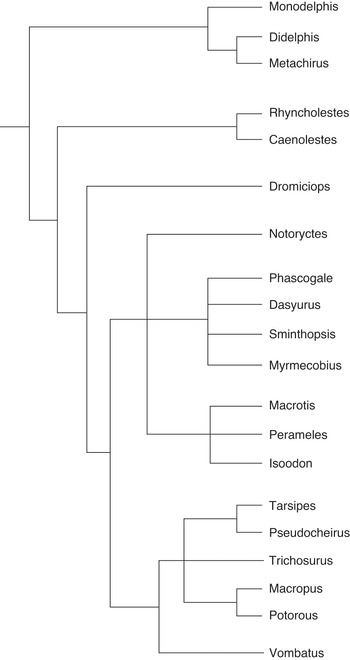
Figure 10.1 Plain marsupial tree
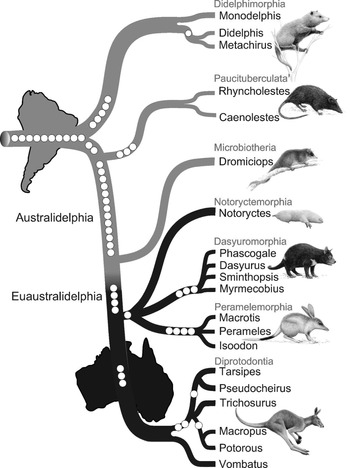
Figure 10.2 Filigreed marsupial tree
The original caption for Figure 10.2 is: ‘Phylogenetic tree of marsupials derived from retroposon data. The tree topology is based on a presence/absence retroposon matrix (Table 1 https://journals.plos.org/plosbiology/article/figure/image?download&size=original&id=info:doi/10.1371/journal.pbio.1000436.t001) implemented in a heuristic parsimony analysis (Figure S3 https://doi.org/10.1371/journal.pbio.1000436.s007). The names of the seven marsupial orders are shown in red, and the icons are representative of each of the orders: Didelphimorphia, Virginia opossum; Paucituberculata, shrew opossum; Microbiotheria, monito del monte; Notoryctemorphia, marsupial mole; Dasyuromorphia, Tasmanian devil; Peramelemorphia, bilby; Diprotodontia, kangaroo. Phylogenetically informative retroposon insertions are shown as circles. Gray lines denote South American species distribution, and black lines Australasian marsupials. The cohort Australidelphia is indicated as well as the new name proposed for the four ‘true’ Australasian orders (Euaustralidelphia)’ (Reference Nilsson, Churakov, Sommer and Van TranNilsson et al. 2010: 4).
The plain tree (Figure 10.1) is not part of the main paper by Reference Nilsson, Churakov, Sommer and Van TranNilsson et al. (2010) but can be found in the supplementary material. Given that phylogenetic trees are used within the framework of evolutionary science, the temporal aspect of these diagrams seems obvious. However, there are several misunderstandings about how to interpret the internal nodes, the relationship among taxa and the time axis (Reference GregoryGregory 2008). In the mid-twentieth century, most phylogenetic trees contained actual ancestors and depicted ancestor-descendant relationships (of extant or extinct species).Footnote 5 Today, however, phylogenetic analysis is focused on sister group relationships and it is assumed that contemporary species cannot be each other’s ancestors. Although the branching diagrams that do not contain any specified ancestors could be interpreted as cladograms that merely depict patterns of character distribution (Reference WileyWiley 1981: 98; Reference Eldredge and CracraftEldredge and Cracraft 1980: 10), most contemporary scientists who practise phylogenetic analysis understand the branching diagrams that they produce as phylogenetic trees, implying a process of change over time, and commonly refer to them as phylogenies. The internal and unnamed nodes of phylogenetic trees are interpreted as actual (but unknown) or hypothetical common ancestors. However, they also represent speciation events (the divergence of one cohesive population into two descendent populations), and/or the emergence of unique characters (Reference GregoryGregory 2008).Footnote 6 In any case, the internal nodes represent an event (speciation event) or species (extinct ancestor) that happened or existed at an earlier point in time. The tips of the branches represent the present and the rest of the tree represents the past. Regardless of the interpretation of the internal nodes, the connected lines of the tree diagram represent the pathways that eventually led to the currently existing species. In a phylogenetic tree that represents all living beings, one could trace all lines back to the so-called last universal common ancestor (LUCA). Since the root of the plain tree is on the left and the tips of the branches on the right, its timeline runs from left to right.Footnote 7
The basic structure of the marsupial tree (Figure 10.1) depicts the following phylogenetic narrative of origin and divergence that is similar for all phylogenetic trees: the marsupial clade originated, and over time the ancestral population underwent character changes. Then, the ancestral population diverged into separate populations that again underwent character changes. One of these populations eventually evolved into Didelphimorphia, with three extant species, and the other population underwent further speciation events. Further character changes and the next speciation event occurred and separated the population that eventually evolved into Paucituberculata, from the population that evolved into Microbiotheria and the Euaustralidelphian orders.Footnote 8
The filigreed tree (Figure 10.2) is the central element of the paper by Reference Nilsson, Churakov, Sommer and Van TranNilsson et al. (2010) and was created by Jürgen Schmitz, the project’s principal investigator. To create the filigreed tree, he added images of seven marsupials as representatives of each of the orders to the basic structure (e.g., the order Diprotodontia is represented by a kangaroo). The names of the marsupial orders were added in grey (red in the original figure); the phylogenetically informative retroposon insertions are shown as white dots and different shading was used for the South American and Australasian lineages. The grey lines represent South American and the black lines represent Australasian marsupial lineages, which is made clear by additional images of the continents South America and Australia. The names Australidelphia and Euastralidelphia were also added to the plain tree.Footnote 9
With the main narrative and target audience in mind, Schmitz first created the diagram and then constructed the text to provide more detailed information and explanation (Schmitz, personal communication, 11 April 2018). While the main function of the diagram is to depict a ‘narrative of nature’ (the evolution and spread of the marsupial clade), some visual elements have a dual function and also represent the researchers’ narrative of science (what the scientists did to get the results).Footnote 10 Representations of the retroposons, for example, show how many retroposons are shared by members of a clade but also tell the reader that retroposons were used as characters for the phylogenetic analysis. Some of the visual elements were added to make the diagram look more appealing and raise the readers’ interest. For this purpose, Schmitz hired a professional artist to draw pictures of marsupials. The main function of the additional elements, however, is to create an image that ‘speaks for itself’, meaning that the informed reader understands the central argument of the paper just by looking at the diagram (Schmitz, personal communication, 11 April 2018).Footnote 11
Schmitz created a diagram that emphasizes the most important findings of the analysis, namely that there is a clear divergence between Australasian and South American marsupials, that Microbiotheria is more closely related to South American marsupials than to Australasian marsupials and that the four Australasian orders share a single origin with Microbiotheria suggesting one single migration event from South America to Australia (Reference Nilsson, Churakov, Sommer and Van TranNilsson et al. 2010). Nilsson et al. take the finding that all Australasian marsupials share four retroposons that are not present in Dromiciops gliroides (the only extant species of Microbiotheria) as evidence that Microbiotheria is more closely related to South American marsupials than to Australasian marsupials. In the filigreed tree, these retroposons are represented as four white dots located at the transition area from grey to black. Schmitz emphasized the divergence between Australasian and South American marsupials by using grey lines for South American lineages and black lines for Australasian lineages. The analysis by Nilsson et al. suggests that the species Dromiciops gliroides, the only survivor of the order Microbiotheria, is not nested within the Australasian orders. Based on these findings, the researchers suggest nomenclatural changes and ‘propose the new name Euaustralidelphia (“true Australidelphia”) for the monophyletic grouping of the four Australasian orders Notoryctemorphia, Dasyuromorphia, Peramelemorphia and Diprotodontia’ (Reference Nilsson, Churakov, Sommer and Van TranNilsson et al. 2010: 4–5). The way the tree diagram was arranged horizontally instead of vertically, with South America to the left of Australia, visually represents the migration event from South America to Australia. Since the filigreed tree (Figure 10.2) represents both time and geographical information, it is read from top-left to bottom-right. Interestingly, the continents are represented in their current state as separate land masses, although the migration event supposedly occurred when South America, Antarctica and Australia were still connected by land bridges (Reference SchmitzSchmitz 2010).
By analysing the text of Reference Nilsson, Churakov, Sommer and Van TranNilsson et al. (2010), it becomes clear that the migration narrative is not only created on the basis of the phylogeny but through integration with narratives from other fields such as palaeontology and geology. The following excerpt illustrates that the group incorporated the fossil record and biogeographical evidence into the phylogenetic narrative.
The fossil Australian marsupial Djarthia murgonensis is the oldest, well-accepted member of Australidelphia. Thus, combined with the lack of old Australidelphian fossils from South America, the most parsimonious explanation of the biogeography of Australidelphia is of an Australian origin. However, the poor fossil record from South America, Antarctica, and Australia does not exclude that Djarthia, like Dromiciops, could be of South American origin and had a pan-Gondwanan distribution.
An integration of the phylogenetic narrative with narratives from other historical sciences like palaeontology and geology is facilitated by similar narrative conventions of a central subject (protagonist) that changes over time (Hopkins, Chapter 4; Huss, Chapter 3; see also section 10.3, below). The fact that researchers in other fields follow the same narrative conventions makes it easy to integrate heterogenous elements to form one coherent narrative. Broadening a narrative by integrating it with narratives from other fields is one way of creating a thicker scientific narrative (see Paskins, Chapter 13).
The integrated narrative that is represented by the filigreed marsupial tree can be phrased like this: the marsupial clade originated and over time the ancestral population underwent character changes. Then, the ancestral population diverged into separate populations that again underwent character changes. One of these populations eventually evolved into Didelphimorphia, with three extant species, and the other population underwent further speciation events. Further character changes and the next speciation event occurred and separated the population that eventually evolved into Paucituberculata from the other population, that again underwent character changes over time. Then the next speciation event occurred and one of the descendent populations eventually evolved into Microbiotheria. Members of the other descendent population migrated from South America to Australia, which constituted the origin of the superorder Euaustralidelphia.Footnote 13
While specialists can read these narratives directly off the diagrams, the untrained reader needs additional information to understand the trees’ narratives. To be sure, the filigreed tree’s caption provides information on how to interpret the added visual elements, but the authors assume that the reader understands the basic structure without further information. To be able to read the diagram as a narrative, the reader thus relies on background knowledge and needs to be familiar with the specialist conventions (see Andersen, Chapter 19; Merz 2011; Reference Vorms, Humphreys and ImbertVorms 2011). The resemblance of the basic structure of phylogenetic trees with human family pedigrees and the cultural practice of representing kinship and genealogy with tree images and branching diagrams might facilitate the understanding of phylogenetic trees as representations of shared ancestry (Reference GregoryGregory 2008; Reference HellströmHellström 2011; Reference RussellRussell 1979). However, there are common misunderstandings in the interpretation of phylogenetic trees that show how difficult it is for non-specialists properly to understand phylogenetic trees (Reference Meir, Perry, Herron and KingsolverMeir et al. 2007).Footnote 14
10.3 How Phylogenetic Trees Represent Narrative Explanations
So far, I have established that specialists read plain and filigreed phylogenetic trees as narratives. In this section, I argue that the informed reader can also derive narrative explanations from them. Or, from the perspective of the author, phylogenetic trees are used to represent narrative explanations.
Arguably, not every narrative is explanatory. However, when they offer solutions to puzzles, narratives qualify as explanations (Reference MorganMorgan 2017; Reference RothRoth 1989). As Mary Morgan puts it, ‘what narratives do above all else is create a productive order amongst materials with the purpose to answer why and how questions’ (Reference Morgan2017: 86). In the case of the phylogenetic analysis of marsupials, the material at hand (molecular sequences) was ordered in terms of similarity to answer the question of how the seven marsupial orders are related to each other (Reference Nilsson, Churakov, Sommer and Van TranNilsson et al. 2010). The phylogenetic tree of the marsupial clade represents an answer to this question. The scientists were particularly interested in the phylogenetic position of Microbiotheria. This relationship, however, is only one of the many evolutionary relationships that are represented in the tree diagram. In this sense, the diagram stands for itself because it is more detailed than the text and includes relationships that are not mentioned in the text. Thus, the visual narrative is more comprehensive than the written one that focuses only on the most disputed phylogenetic relationships.
In addition to being answers to puzzles, narrative explanations show ‘what happened at a particular time and place and in what particular circumstances’ (Reference GardinerGardiner 1961: 82). Thus, they are mostly concerned with token events – for example, a particular war or revolution – not with finding regularities of how wars or revolutions come about. They don’t merely explain an occurrence but show how things came to be as they are by referring to events that happened at an earlier point in time (Beatty, Chapter 20).Footnote 15 To be sure, the marsupial tree represents the origin and evolution of a particular clade and its exact branching pattern is probably unique to the marsupial clade. However, the tree diagram also represents type phenomena like speciation and emergence of traits. Moreover, it is ‘exemplary as a concrete problem solution that can be extended to give an explanation to similar phenomena elsewhere’ (Reference MorganMorgan 2017: 94). Phylogenetic trees not only represent explanations of the origin and evolution of biological taxa but are also used in other disciplines such as linguistics to represent the origin and diversification of languages (Reference Atkinson and GrayAtkinson and Gray 2005).
The events that are included in a narrative explanation are events that made a difference to the outcome (Reference BeattyBeatty 2016; Reference Beatty2017). In the temporal series, the outcome B is contingent upon at least one previous event A in the sense that B could not have happened if A had not happened in the past (Reference BeattyBeatty 2016). To be more precise, B is contingent upon the pathway that connects B with previous events (Reference DesjardinsDesjardins 2011). In the tree diagram, the difference-making events are represented as a temporal series of internal nodes (speciation events) and lines that connect the nodes (emergence of traits). The tree diagram by Reference Nilsson, Churakov, Sommer and Van TranNilsson et al. (2010) thus represents an explanation of how recent marsupial species came to be as they are by referring to speciation events and divergence that happened earlier in time. The existence of recent marsupial species is contingent upon the existence of their ancestors and the evolutionary pathway that eventually led to their occurrence. However, the tree diagram is rather thin on detail because it contains no exact information on ancestors or difference-making events such as speciation events (except for the migration event from South America to Australia) and loss or acquisition of traits.
Narrative explanations also include narrative sentences that ‘give descriptions of events under which the events could not have been witnessed, since they make essential reference to events later in time than the events they are about’ (Reference DantoDanto 1985: xii; see also Reference RothRoth 2017). An example is: ‘The Thirty Years War began in 1618’ (Reference DantoDanto 1985: xii). Thus, only in hindsight, when we know how the narrative ends, are we able to identify its beginning and unfolding (Reference MartinMartin 1986: 74). Narrative sentences can be derived directly from the tree diagram by Reference Nilsson, Churakov, Sommer and Van TranNilsson et al. (2010), and phylogenetic trees in general. For example, ‘Microbiotheria originated before Notoryctemorphia, Dasyuromorphia and Peramelemorphia’ or ‘The first divergence within the marsupial clade gave rise to Didelphimorphia’.
Narrative explanations are characterized as ‘connected account[s] of [an] entity’s development in time’ (Reference White and HookWhite 1963: 4), or, as Roth puts it (Reference Roth2017: 45), a narrative is ‘unified by showing the development of a subject over time’. These statements express a notion of coherence that is captured by the concept of central subject (Reference White and HookWhite 1963; Reference HullHull 1975; Reference Ereshefsky and TurnerEreshefsky and Turner 2020) and corresponds to the concept of protagonist in narratology (see Hajek, Chapter 2). The role of central subjects is ‘to form the main strand around which the historical narrative is woven’ (Reference HullHull 1975: 255). Examples for central subjects are Napoleon (Reference HullHull 1975: 262) and the Hawaiian Island archipelago (Reference Ereshefsky and TurnerEreshefsky and Turner 2020). The central subject in Reference Nilsson, Churakov, Sommer and Van TranNilsson et al.’s (2010) narrative is the marsupial clade because this entity forms the main strand of the evolutionary narrative. The migration event from South America to Australia is singled out as a particularly important event in the life of the clade because it led to the formation of a new superorder.
To be sure, the scientists present their explanation of the origin and evolution of marsupial orders in the text of the research paper; however, narrative explanations are also represented by phylogenetic trees in a more immediate manner. I have shown that they represent answers to a puzzle, temporal series with difference-making events, token phenomena, and revolve around a central subject. I have also argued that an informed reader can derive narrative sentences directly from the diagram. The basic structure depicts all elements of a narrative explanation discussed in this section and thus already represents a narrative explanation (phylogenetic narrative). The filigreed tree with additional elements (e.g., images of continents), however, represents a broader narrative explanation about migration. In the following section, I discuss examples that show further ways of modifying phylogenetic trees to represent narrative explanations.
10.4 Use of Phylogenetic Trees in Different Contexts
The use of phylogenetic trees extends beyond biological systematics. In this section I will give two examples of the use of phylogenetic trees in other fields to show their functions in different contexts. Like the marsupial tree (Figure 10.2), the diagrams discussed here are filigreed trees that include different types of additional textual and graphic elements. These examples illustrate two things. First, phylogenetic narratives are not always represented in the same form. Even though the diagrams discussed in this section are based on a branching structure, they are arranged and read in different ways, particularly with respect to the time axis. Second, filigreed trees are modified to represent narratives that extend beyond evolutionary histories or common ancestry and differ in terms of narrative content.
10.4.1 Phylogenetic Trees in Museums
Phylogenetic trees can be found in many museums, science centres, zoos, aquariums and botanical gardens. The phylogenetic tree entitled ‘vertebrate diversity’ (Figure 10.3) is part of a permanent exhibit at the University of Kansas Natural History Museum. The diagram contains a vertical tree diagram (root at the bottom), with schematic images of species at the eight tips (extant and extinct species represented by different shades).Footnote 16 The tips represent fishes, birds plus reptiles (in one group), mammals and amphibians. Unlike phylogenetic trees in scientific papers, this tree diagram includes an arrow indicating temporal directionality from bottom to top. The top of the diagram shows an extended mammal branch with seventeen tips. The tree designers included both common and scientific names of species. In addition to the legend with the two colours that represent living and extinct species, the diagram also contains a short explanatory text.

One of the functions of Figure 10.3 is to communicate scientific research to a broad audience. The tree diagram depicts phylogenetic relationships in accordance with scientific findings, and the explanation, that the branching pattern represents evolutionary relationships, enables people who are completely unfamiliar with phylogenetic trees to get a basic understanding of the diagram. The explanatory text states that some of the phylogenetic relationships are unresolved: ‘When three or more lineages come from the same point, this indicates that scientists are uncertain about which of those lineages are more closely related’ (Figure 10.3). This either means that scientists disagree about the respective phylogenetic relationships or that phylogenetic analyses produced inconclusive results. The authors also mention that new evidence can lead to revisions of phylogenetic relationships (Figure 10.3, bottom). These additional remarks help the audience understand what the diagram represents, but also informs about the character of scientific research and its results. The schematic images of vertebrates can easily be understood by a broad audience including young children. Another important function of the vertebrate tree is to teach ‘phylogenetic literacy’ (Reference GregoryGregory 2008) to a broad audience. Studies have shown that there are misconceptions about the representation of time in phylogenetic trees (Reference GregoryGregory 2008; Reference Meir, Perry, Herron and KingsolverMeir et al. 2007; Reference Omland, Cook and CrispOmland, Cook and Crisp 2008). Instead of reading the time axis from the root of the tree to the tips, many students believe that the location of the tips is a representation of temporality and read time from left to right, assuming older species are on the left and younger species on the right (Reference GregoryGregory 2008: 134; Reference Meir, Perry, Herron and KingsolverMeir et al. 2007: 72). To avoid misinterpretations, the authors of the vertebrate tree thus added an arrow labelled ‘time’ that indicates the time axis from bottom to top.
Another function of phylogenetic trees in museums is ‘to make links between specific exhibits and the broader tree of life’ (Reference MacDonaldMacDonald 2014). When scientists refer to the tree of life, they usually mean a phylogeny of all living beings, but also the concepts of common ancestry and biodiversity (Reference MacDonald and WileyMacDonald and Wiley 2012: 14). The bottom part of the vertebrate tree does not contain any details like species names because its main function is to show that all vertebrates are related to each other. The schematic images of different vertebrates depict the diversity within this group. Like many other phylogenetic trees in museums, the extended mammal branch of the vertebrate tree also includes humans. In contrast to other phylogenetic trees in museums or zoos, however, the human branch is not emphasized in any way and does not have a central position (see Reference MacDonald and WileyMacDonald and Wiley 2012 for examples). This way of representing humans in a phylogenetic tree allows visitors to see who our closest relatives are and at the same time communicates that humans are one species among many with no special position on the tree of life. In general, the arrangement of the branches might help to correct the common misconception of ‘ladder thinking’ with higher and lower species (Reference GregoryGregory 2008: 127–128; Reference Kummer, Clinton and JensenKummer, Clinton and Jensen 2016: 393; Reference O’HaraO’Hara 1992).
Compared to the marsupial trees (section 10.2), the vertebrate tree shows an alternative way of representing phylogenetic narratives. The trees differ with respect to the direction of time and the taxonomic level of the central subject. The marsupial trees are arranged horizontally, with the root on the left, but the vertebrate tree’s branching structure is arranged vertically, with the root at the bottom. Thus, time on the vertebrate tree is not read from (top-)left to (bottom-)right, but from bottom to top. While the marsupial trees show the evolutionary history of marsupial orders, the vertebrate tree represents the evolutionary history of four groups of vertebrates and a more fine-grained evolutionary history of mammals. This shows that phylogenetic narratives can be developed on different taxonomic levels. The trees also differ with respect to narrative content. The filigreed marsupial tree emphasizes an important turning point in the evolutionary history of the marsupial cade (migration event), but the vertebrate tree’s narrative was developed to include a narrative of connectedness thorough common ancestry. Thus, the vertebrate tree is read both as a narrative of evolutionary history (emphasis on time) and as an ancestor narrative (emphasis on shared ancestry). Elements of self-reference in the diagram (arrow, explanatory text) enable readers to interpret and understand not only this particular phylogenetic tree but phylogenetic trees in general.
10.4.2 Phylogenetic Trees in Animal Rights Debates
In a flyer entitled ‘Brother Chimp, Sister Bonobo: Rights for Great Apes!’ published by the Giordano Bruno Foundation, the authors included a phylogenetic tree of great apes (Giordano Bruno Foundation 2011: 5; Figure 10.4). In contrast to most phylogenetic trees in scientific papers the tree in the flyer contains information on taxonomic ranks (e.g., superfamily, family, genus/species) at the nodes. The prevailing phylogenetic classification identifies chimpanzees (Pan troglodytes) and bonobos (Pan paniscus) as the closest extant relatives of humans (Homo sapiens), with chimpanzees and bonobos as members of the genus Pan and humans as members of the genus Homo. Given the close phylogenetic relatedness of humans, chimpanzees and bonobos, the authors argue that the latter two should be placed into the genus Homo and renamed Homo troglodytes and Homo paniscus, respectively (Giordano Bruno Foundation 2011: 4–5). Interestingly, this demand is already implemented in their great ape tree. The ultimate demand of the Giordano Bruno Foundation, however, is not the renaming of chimpanzees and bonobos, but the recognition of fundamental rights for great apes (Giordano Bruno Foundation 2011: 6). According to the authors their updated classification ‘would not only be scientifically consistent, it would also have psychological knock-on effects – as it would deflate our exaggerated sense of importance and motivate us to grant our closest relatives the respect they deserve’ (Giordano Bruno Foundation 2011: 5).
Figure 10.4 Great ape tree
Like the vertebrate tree (section 10.4.1), the great ape tree is arranged vertically, but with the root at the top. Similar to the marsupial trees (section 10.2), the vertebrate tree is also a phylogeny of a mammalian clade, but it is not used to represent a narrative of the origin and evolution of great apes. Instead, the great ape tree is read as a narrative of common ancestry of humans, chimpanzees and bonobos. Thus, the emphasis of the great ape narrative is not on the temporal aspect of evolution but on the genealogyFootnote 17 of great apes. Like phylogenetic trees in scientific papers, the great ape tree does not include ancestors, but the placement of taxonomic ranks at the nodes makes the diagram look more like a human family pedigree that includes ancestor names at the nodes. The narrative of common ancestry of humans, chimpanzees and bonobos is also expressed in the title of the flyer that refers to chimpanzees and bonobos as our brothers and sisters, implying that we share the same ‘parents’. The authors also refer to common ancestry when they argue that humans, chimpanzees and bonobos should be placed in the same genus: ‘Today it is an undisputed fact that humans are the closest living relatives of chimpanzees and bonobos. The genome of these three species differs only by a fraction – between 6.4 per cent and 0.6 per cent, depending on the methods of measurement. Some scientists would therefore like to unite them in a single genus, Homo’ (Giordano Bruno Foundation 2011: 5).
The phylogenetic tree represents the scientifically recognized phylogenetic relationships (chimpanzees and bonobos as the sister species of humans) but not the prevailing scientific nomenclature. The renaming of chimpanzees and bonobos places them in the same genus as humans (Homo), thereby distorting the prevailing scientific classification that places chimpanzees and bonobos in the genus Pan. The tree diagram represents an explanation of why chimpanzees and bonobos should be renamed (Giordano Bruno Foundation 2011: 4–5). However, the main purpose of including the great ape tree in the flyer is not to represent scientific findings, but first and foremost to represent a political narrative that explains why fundamental human rights (e.g., the right to life, the right to individual liberty) should be extended to other great apes. The example of the great ape tree thus shows how political and scientific narratives are woven together and represented in a visual representation. To be sure, the common ancestry of humans, chimpanzees and bonobos is only part of the narrative that explains why the ‘community of equals’ should be extended beyond humans,Footnote 18 but the flyer discussed here focuses on this particular aspect of the argument (Giordano Bruno Foundation 2011: 6).
10.5 Filigreed Trees and Integrated Narratives
The construction process of the marsupial tree clearly shows that phylogenies are not descriptive chronicles. In fact, there are many decisions that potentially affect the outcome of the analysis such as the choice of characters, species, outgroup and method of data analysis. There are also fundamental assumptions about molecular evolution (e.g., retroposon insertions) that form the basis of phylogenetic analysis and the interpretation of the tree diagram. I have argued that a specialist audience reads phylogenetic trees, even plain ones, as evolutionary histories and that all phylogenetic trees represent narrative explanations. The scaffold view of phylogeny and evolutionary history as advocated by O’Hara and Griesemer is thus misleading because it implies that phylogeny is something prior to or separate from evolutionary histories. It is true that plain trees are scaffolds for more filigreed versions of trees, but not in the sense that filigreed trees depict evolutionary histories while plain trees depict something prior to evolutionary histories. I have shown that the filigreed marsupial tree is read as a narrative that includes geographical aspects of the evolution of the marsupial clade, namely the divergence of South American and Australasian marsupials after a migration event. It is thus used to represent a coherent narrative that resulted from integration of a phylogenetic narrative with narratives from geology and palaeontology. The examples of the use of filigreed trees outside of academic evolutionary biology show that they are also used to represent narratives that extend beyond evolutionary histories of clades. These narratives are formed through integration of an ancestor narrative with political demands or integration of a phylogenetic narrative with a pedagogical narrative. All diagrams discussed in this chapter contain the basic branching structure of a phylogenetic tree but differ in narrative content and reading of the diagrams.Footnote 19


 Open access