

In October 1972, Amílcar Cabral was in New York again. The bespectacled revolutionary was the leader of the Partido Africano da Independência da Guiné e Cabo Verde (African Party for the Independence of Guiné and Cabo Verde, or PAIGC). Since 1963 he had overseen an armed struggle for independence in the Portuguese colony of Guiné (Guinea-Bissau).Footnote 1 Cabral spent much of his time abroad, traveling the world in search of monetary and material support to oppose the better equipped military of the Portuguese empire. Most of this assistance came from Africa and Eastern Europe, where Cabral adopted the iconic Czech zmijovka hat that often covered his receding hairline. Nonetheless, Cabral continued to court Western populations. The countries of the North Atlantic Treaty Organization (NATO) supplied their Portuguese ally with weapons the dictatorship used to wage its colonial wars. But Cabral believed many US citizens sympathized with his party’s push for self-determination and more could be won over.
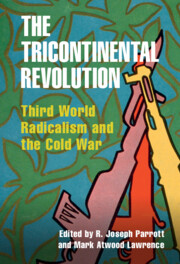
Taking time from his latest trip to the United Nations, Cabral found himself in a small room packed with African American activists. Over the previous years, the PAIGC had become a model of self-determination for Black Americans and anti-imperial organizing for Western radicals (Figure 9.1), his writings part of a global canon of Third World leftists. For many in the room that day, Cabral stood out within this network of revolutionaries like Che Guevara and Mao Zedong because of his race. His identity as a “brother” created a Pan-African linkage, which made his words especially powerful for African-descended peoples. Yet as Cabral answered questions from his audience, he offered a political challenge. “Naturally if you ask me between brother and comrades what I prefer,” he explained, “if we are brothers it is not our fault or our responsibility. But if we are comrades, it is a political engagement. Naturally we like our brothers, but in our conception it is better to be a brother and a comrade.”Footnote 2

Figure 9.1 Westerners adapted and contributed to Tricontinental iconography while organizing solidarity movements. This American poster used the trope of broken chains to highlight the individual elements of imperialism and racism that Tricontinentalism challenged. It also reflects the cooperative diplomacy adopted by leftist liberation movements, especially in Africa, that encouraged Western activists to treat national revolutions as interconnected. Liberation Support Movement, Artist Unknown, 1972. Offset, 36x25 cm.
This concise statement captured Cabral’s vision of solidarity but also some of its tensions. His nuanced, practical vision of anti-imperialism made him an icon in the 1970s and recently led to a resurgence of interest in his philosophy.Footnote 3 Yet how best to understand that philosophy remains open to debate. Many have seen Cabral as a Marxist who rarely quoted Marx and softened the edges of abstract dogmatism with a focus on concrete African realities.Footnote 4 Others have placed him in the Pan-African pantheon alongside Frantz Fanon and Kwame Nkrumah, men who drew upon African strands of radical politics.Footnote 5 A few scholars – notably Patrick Chabal and Mustafah Dhada – view Cabral as a pragmatic nationalist whose ideas developed primarily from the struggle in Guiné even as he drew elements from external sources.Footnote 6 These debates continue because Cabral never wrote a singular theoretical work laying out a cohesive set of ideas. He expressed his philosophy piecemeal in speeches and party documents, in which he revisited and refined concepts in response to domestic and international events. The result is an overarching intellectual trajectory complicated by a series of competing emphases and audiences, which has led to diverse interpretations.
This chapter contends that Cabral’s ideas were centered on the practical needs of the Guinean struggle, but they aligned with a militant brand of anti-imperialism that emerged in the 1960s. Cabral was part of a generation of Third World leftists who believed coordinated, parallel national revolutions would erase inequalities between Global North and South, advancing the long fight against empire to a more aggressive phase. A dedicated nationalist, he viewed socialism as a toolkit for evaluating the international system and organizing an independent country. Change would come not via class struggle but rather through adoption of a common culture that provided the foundations for cross-class political action against foreign domination. This Third World revolution moved beyond European communism in hopes of finally erasing the manufactured economic inequalities and racism that marginalized the Global South.
As the PAIGC became enmeshed in the diverse solidarity networks that sustained its war for independence, Cabral refined his synthetic ideology to better explain his party’s position at the intersection of Third World anti-imperial traditions, international socialism, and Pan-Africanism. Indeed, Cabral argued a month before the armed revolt began that the PAIGC “had lost its strictly national character and has moved onto an international level.”Footnote 7 From its earliest stages, the PAIGC sought support from an array of international alliances, building connections as decolonization and shifting politics opened new avenues for solidarity. These networks not only funded the liberation struggle but also helped legitimize the party against competitors during its many years in exile. Tensions existed – racial solidarity versus ideological cohesion, philosophical purity versus practical compromise – yet Cabral managed them by focusing on the common imperial enemy, which he understood in both its colonial and neocolonial guises. The persistence of these frictions occasionally hampered the movement, especially at the granular level of interpersonal interactions, but PAIGC philosophy legitimized the creation of an inclusive revolutionary coalition and proved effective at building solidarity in both North and South. As a result, Cabral became, according to historian Jock McCulloch, “the leading political theorist of the second phase of the independence era,” or what this volume argues might be better described as Tricontinentalism.Footnote 8
The Ideology of Nationalist Revolution
Central to PAIGC philosophy was the search for unity amidst the social divisions created by Europe’s oldest empire. Colonialism provided Portugal with power and prestige beyond its impoverished status, and Antonio Salazar made empire the centerpiece of his fascist Estado Novo from the 1930s onward. Extractive industries in the major colonies of Angola and Mozambique led to an expansion of the colonial state, but settlement remained light into the twentieth century, especially in the hinterlands of Guiné and Cabo Verde. In mainland Guiné, the Portuguese presence did not stretch far beyond administrative centers like the port capital of Bissau. Lisbon managed the colony by manipulating and reinforcing ethnic and social divisions, which included using Cabo Verdeans to fill minor bureaucratic positions. The Cabo Verde islands featured a creole mestiço population produced by centuries of intermingling between Portuguese administrators, sailors, and descendants of enslaved Africans. Creolized Cabo Verdeans, along with a small minority of “assimilated” mainland Africans hailing mostly from urban areas, had access to education and civil employment after modest colonial reforms in the early twentieth century. These advantages made them ideal middlemen in the empire, especially in Guiné, where islanders became symbols of empire.Footnote 9
Cabral and the PAIGC leadership emerged from this context. Most were Cabo Verdeans by birth or lineage with ties to Guiné. Cabral was born to Cabo Verdean parents on the mainland, where his father served as a teacher. He attended island schools and witnessed the periodic starvation that Portugal allowed to occur in its drought-prone colony. Upon gaining admittance to university in Lisbon, Cabral diverged from the path of colonial administrator and embraced a distinctly African identity. He joined a community of young nationalists associated with the Casa dos Estudantes do Império (House for Colonial Students) that included Angolans Mário Pinto de Andrade and Agostinho Neto, as well as Mozambican Marcelino Dos Santos. This cadre – effectively a revolutionary salon in the metropolitan capital – explored foreign ideas suppressed by the dictatorship including Marxism, African nationalism, and the Harlem Renaissance’s search for Black identity.Footnote 10 They also began organizing against Portugal’s fascist empire.
At the center of this nascent ideology was a conscious identification as Africans. The well-educated students were partially assimilated into the nominally race-blind culture of the Lusophone empire but found little sense of belonging in Portugal. Cabral later implied they were Europeanized “petite bourgeois” alienated from peasants at home (there being little to no colonial working class) but marginalized within the empire. Lacking a firm identity, they found a solution in the “re-Africanisation of our minds.”Footnote 11 This process was the origin of Cabral’s famous dictum that revolutionaries must “return to the source,” rejecting the allure of European superiority to align with the “native masses.” Yet Cabral believed this conversion took on historic importance only if resistance to cultural domination laid the groundwork for political solidarity that challenged “foreign domination as a whole.”Footnote 12
The middling classes therefore had a choice. They could enjoy their small privileges or commit class suicide by adopting a revolutionary consciousness that identified fully with the culture and goals of the majority in their homelands.Footnote 13 While Cabral referenced Marxist ideas, he did not desire class conflict but the creation of national unity across classes. This unity provided the foundation for a revolution forged around a shared African personality. Cabral carried this nascent ideology with him when he left Lisbon to serve as a colonial agronomist, using a surveying project to analyze Guiné’s diverse communities. In 1956, party histories claim, Cabral founded the PAIGC alongside a core of Cabo Verdeans in Bissau. Later that year he was reportedly present at the formation of the Movimento Popular de Libertação de Angola (Popular Movement for the Liberation of Angola, or MPLA) in Luanda. The PAIGC organized clandestinely in Bissau, with some success among the city’s dockworkers.Footnote 14
Importantly, this “return to the source” did not mean adopting one dominant cultural tradition or ethnic identity but rather creating a new national consciousness. For the educated Africans of the Lisbon salon, returning wholesale to village traditions meant rejecting the useful elements that came with empire: advanced technology, industry, modern social relationships, and the nation-state. This last point was especially important in Guiné, which featured nearly a dozen ethnic groups with distinct traditions and languages. Cabral believed this was the result of Portuguese imperialism “halt[ing] our history,” exaggerating and formalizing antiquated social formations or forging new ones to undermine a united resistance.Footnote 15 Europe developed nations and bureaucracies to manage modern economic and societal relations while keeping Guineans “prisoners of the medieval mentality of their political formulations.”Footnote 16
The process through which educated revolutionaries joined with the peasant majority offered a solution. It linked the nascent, authentic power of a mass movement with the knowledge and critical self-awareness of educated individuals like Cabral. For the PAIGC, the struggle against empire also offered Cabo Verdeans the opportunity for a renewed African identity as part of the formation of a modern Pan-African nation. Chabal argues that the party adapted sociopolitical structures from the large Balante ethnic group that provided many early recruits and which Cabral claimed was egalitarian and anti-colonial. Yet the party did not promote Balante nationalism.Footnote 17 Convinced that ethnocentric localism was anathema to revolution and unity amidst the diversity of Guiné, Cabral sought to forge a new identity.Footnote 18 With his party acting as a gatekeeper, Cabral envisioned a movement that promoted “positive cultural values” derived from shared African traditions while discarding inherited practices that hindered solidarity such as sexism, sectarianism, and racism.Footnote 19 Cabral contended that a successful movement could not simply displace colonialism with old ideas; it needed to create a nation that represented all citizens.
Therefore, Cabral and the PAIGC built their party at the intersection of two political avenues: an aspirational form of African identity politics and a practical socialism that provided concrete material benefits. Both were vital to party ideology but sometimes caused tension within the movement.Footnote 20 Regarding the former, the PAIGC’s desire to forge a common identity using positive aspects of an idealized African culture meant it consciously rejected unity based on anti-imperial racism. The party’s official position was that it opposed Portugal, not its people.Footnote 21 Yet this nuance faded at the operational level when PAIGC operatives used emotional appeals to mobilize disaffected Africans. “The BLACK MAN lives in misery because the WHITE MAN exploits him,” wrote PAIGC President Rafael Barbosa, who recruited in Bissau until his arrest in 1962. “[I]n Africa as a whole,” added Barbosa, “we are driving the Whites out because they treat us poorly.”Footnote 22 Cabral himself occasionally blurred the lines connecting whites to empire when addressing PAIGC cadres, but the party generally avoided such rhetoric.Footnote 23 Cabral repeatedly expressed his strong opposition to organizing around race, arguing “we can not answer racism with racism.”Footnote 24 Yet tension remained, since such appeals were powerfully convincing to many Guineans whose experiences of empire were visibly tied to white Europeans.
Indeed, competing parties saw value in adopting racial appeals. By the late 1950s, an array of nationalists competed with the PAIGC to win followers. Prominent among them was François Mendy, a Senegalese soldier of Guinean descent that historian Mustafah Dhada describes as “rabidly racist.”Footnote 25 In 1960, he founded the Senegal-based Movimento de Libertação da Guiné (MLG), which became a primary alternative to the PAIGC.Footnote 26 Despite living most of his life in French territory, Mendy argued the PAIGC’s Cabo Verdean leadership were interlopers. He built his party using black racial appeals that attacked both imperial Portugal and creole islanders, arguing PAIGC leaders were using the Guinean people to free their island home and replace Portuguese domination with “Cabo Verdean neocolonialism.”Footnote 27 In response to these attacks, the PAIGC denounced “intransigent enemies who, guided by an opportunistic and selfish spirit, try to confuse our people” by dividing Guineans and Cabo Verdeans in ways that served Portuguese goals.Footnote 28 Linking African identity with anti-imperialism downplayed the racial and xenophobic rhetoric that had the potential to rebound on the Cabo Verdean-dominated PAIGC. For Cabral, “African” necessarily denoted an evolving political nationalism that contrasted with the exclusionary identarian politics proposed by the Dakar-based MLG.
This less racialized idea of African identity worked hand in glove with Cabral’s reading of socialism, which sought rapid modernization while complementing the oft-cited idea of African communalism. As with much of Cabral’s philosophy, the origins of his socialist thought dated to his time in Lisbon, where collaborators – notably Agostinho Neto – had ties to Portuguese communists. Cabral was attracted to the socialist worldview and Lenin’s definition of empire as the highest form of monopoly capitalism. But rather than adopting the one-world socialism of Portuguese communists, who were equivocal about the national question and initially hoped Africans would act as extensions of the metropolitan party, Cabral aimed for the revival of African polities capable of self-determination.Footnote 29 As Cabral explained later, African revolutions needed to gain control of the “mode of production” – and by extension, political institutions – to create “new prospects for the cultural development of the society … by returning to that society all its capacity to create progress.”Footnote 30 The Marxist worldview helped identify strategies for reestablishing control of their own history. The PAIGC defined itself from the beginning as a “workers’ political organization” (uma organizaçao politica da classes trabalhadores) and focused on urban organizing, but Cabral avoided the communist label.Footnote 31 Rather, he used the theoretical tools socialism provided to unite disparate African peoples against imperial domination.
Cabral’s socialist worldview led him to define self-determination broadly, reaching beyond political or flag independence to embrace national control of economics and culture. “Independence,” he argued in 1961, was “just one indispensable step to attaining this objective [of national progress].”Footnote 32 Other European states were allowing political independence while retaining effective economic and diplomatic control of former colonies. Cabral assumed (correctly) that allies like the United States were encouraging Salazar to embrace this approach as a way of retaining influence and pro-Western stability in Africa.Footnote 33 Cabral feared “attempts by imperialists and colonialists to re-establish themselves, in new forms,” specifically warning of business penetration.Footnote 34 This broad idea of imperialism encompassing both formal colonialism and socioeconomic neocolonialism became central to Cabral’s ideology.
The conceptualization of empire had two effects. The first was to expand beyond Portugal to criticize Western countries that supported Lisbon, notably the economic powerhouses of the United States and Germany. This allowed the PAIGC to find allies opposed to common foes, ranging from Vietnamese communists to the British working class. Second, it highlighted the threat of “African traitors,” whom Cabral described as the “self-styled heads of state” and unprincipled nationalists willing to accommodate foreign economic or political domination in exchange for personal power.Footnote 35 Effectively, the PAIGC dismissed opponents not just as rivals but also as agents of empire. In 1962, Cabral warned, “We must strengthen our vigilance against the attempts to install a new form of colonialism among us, against the opportunists, the ambitious, and all the enemies of the unity of freedom and progress of our peoples.”Footnote 36 As a result, dueling accusations of neocolonialism became an inescapable part of nationalist politics.
The PAIGC promised a modern, united socialist state in direct opposition to the history of imperial division. In Guiné, where ethnicity and race were contested topics, a shared future and the struggle to achieve it provided the foundation for solidarity. In early 1962, the party laid out its program for achieving independence and building a Pan-African polity. Plans included a government based on “democratic centralism,” the development of “modern industry and commerce” through state intervention, compulsory public education, religious freedom, and the “elimination of man’s exploitation of man” responsible for poverty, ignorance, sexism, and a host of other social maladies.Footnote 37 After the armed revolt began in 1963, the creation of schools, hospitals, and “people’s stores” became major components of party policy – and propaganda – in newly liberated territory. These services grew from one of Cabral’s key insights: “the people are not fighting for ideas, for things in anyone’s head. They are fighting to win material benefits, to live better and in peace … to guarantee the future of their children.”Footnote 38 Rather than building the nation solely on racial or ethnic identity, the PAIGC claimed legitimacy by promising material benefits.
As a result, visible and sustained action was a necessary component of selling this political movement. Early efforts focused on labor organizing in Bissau, mirroring the ways unions mobilized against empire in British and French territories. Yet Portugal would not abandon its empire. In 1959, a strike by workers at Bissau’s Pidjiguiti Docks invited a deadly crackdown that forced the party into exile.Footnote 39 Denied the ability to pursue non-violent political action, Cabral gravitated toward models offered by militant Afro-Asian liberation movements.
This shift marked the final element establishing the direction of the PAIGC. Cabral was not opposed to armed conflict, but neither did he seek it. In statements preceding and following Pidjiguiti, Cabral stressed his willingness to negotiate with Portugal for independence.Footnote 40 Though these appeals came as the PAIGC prepared for war, there is reason to take Cabral at his word. As late as 1972, he stated he was “not a great defender of the armed fight” even though it was necessary in Guiné.Footnote 41 Cabral did not fetishize violence but embraced fighting as the necessary response to Portugal’s stubborn use of force to sustain its empire. In justifying this idea, he looked abroad to the “lesson” offered by “the case of Algeria” – that “armed struggle is the necessary corollary to the impossibility of resolving this conflict through the ballot [voix politique].”Footnote 42 Additional models from China and Cuba encountered after Pidjiguiti bolstered the Algerian model.Footnote 43 Progress was necessary to build a movement, and with no other avenues, only armed conflict could achieve concrete victories. With it came an opportunity to unite the nation’s disparate peoples through the crucible of war.Footnote 44
After recruiting and training small cadres, the PAIGC invaded Guiné from neighboring Guinea in January 1963. The invasion revealed one final element of Cabral’s ideology drawn from the Algerian example. The National Liberation Front’s (FLN) successful diplomacy revealed that “the strengthening of real and active solidarity of oppressed peoples is an indispensable condition for the common struggle against imperialism and colonialism.”Footnote 45 By linking material and political solidarity with local anti-colonialism, the exiled PAIGC found the power to challenge Portugal’s empire and build its socialist, African nation. With domestic organizing impossible, Cabral understood that the international dimension became “the most important point of our struggle. Without resolute and frank support from the Afro-Asian nations, nothing can be done.”Footnote 46
A Transnational African Struggle
International support was vital for the PAIGC for two main reasons. It legitimized the PAIGC against competing parties and provided material aid for the guerrilla war and reconstruction of occupied territories. Cabral identified potential allies by drawing on the ideas that informed internal PAIGC solidarity: shared ideological goals and an identity based on common histories, values, and ambitions. He believed concentric circles of collaboration formed beginning with Lusophone liberation groups and then extending progressively to “solidarity on the African, Afro-Asian and international levels.”Footnote 47 Cabral tapped into the currents of the global process of decolonization and developed increasingly broad networks of support as the party’s ambitions expanded.
Because Guiné and Cabo Verde were hinterlands even within Portugal’s empire, the PAIGC used ties to important colonies such as Angola to bolster its position. Cabral achieved this goal by institutionalizing the personal contacts and ideological affinities of the Lisbon salon.Footnote 48 In 1958, he spearheaded the formation of the Movimento AntiColonialista with MPLA leaders, which evolved into the Conferência das Organizações Nacionalistas das Colónias Portuguesas (Conference of Nationalist Organizations of the Portuguese Colonies, or CONCP) three years later. This latter group united all the major socialist-inclined nationalist parties in the Lusophone world, including the MPLA, activists from Portugal’s Indian enclave of Goa, and the Frente de Libertação de Moçambique (Mozambique Liberation Front, or FRELIMO) after its formation in 1962. These organizations amplified the power of the individual parties by loosely linking the political and military challenges to Portugal. Among its first actions, the CONCP used the international attention focused on the Angolan rebellion to press its broader case against Portuguese imperialism. Later, the existence of three distinct military fronts – Angola from 1961, Guiné after 1963, and Mozambique after 1964 – prevented Portugal from concentrating its forces in any one country (Map 9.1).Footnote 49

Map 9.1 Africa, leftist liberation, and Cuban intervention, 1960–1980
Note: Cabo Verde (1975) – not pictured – sits roughly 600 kilometers West of Cap-Vert, Senegal. South Africa became a sovereign state in 1934, declared itself a republic independent from the British monarchy in 1961, and ended apartheid with free elections in 1994. Rhodesia unilaterally declared independence as a white republic in 1965; an international agreement recognized Zimbabwe in 1980.
Yet the CONCP parties lacked military materiel, international prestige, and refuge from Portuguese crackdowns, meaning they needed allies among newly independent states. Cabral actively cultivated such support from the PAIGC’s founding, attending the All-African People’s Conference and other gatherings, but decolonization was vital. The PAIGC needed a safe haven from repressive Portuguese authorities. When Sékou Touré led neighboring Guinea to independence in 1958 (a year before Pidjiguiti forced the PAIGC into exile), Cabral reportedly exclaimed, “That’s it! Now I have my country.”Footnote 50 An ardent nationalist and champion of Pan-Africanism, Touré embraced a leftist vision of state development that gave him access to Eastern European largesse. Touré was wary of provoking Portugal, but he opposed colonialism and saw the PAIGC as the best prospect for achieving decolonization. He allowed the PAIGC to establish their headquarters in his country in May 1960.Footnote 51
This transnational solidarity was vital for the party in the years before it was capable of waging revolution, enhancing PAIGC legitimacy as it competed with other nationalist groups. The party’s emphasis on material progress and the promise of a new nation required action to legitimize its claims, whereas groups like Mendy’s MLG could fall back on static identarian politics. Such problems were not uncommon. In Angola, the Congo-based, Bakongo-dominated Frente Nacional de Libertação de Angola (National Liberation Front of Angola, or FNLA) attacked the socialist MPLA as mestiços and over-educated cosmopolitans disconnected from the African masses.Footnote 52 These challenges likely informed the formation of the CONCP, since recognition by other socialists lent credibility and provided political momentum before a successful armed revolt could legitimize the individual parties. Later, such connections offered a sense of progress in the up-and-down war against Portugal so long as one CONCP member was making military gains.
The support of independent countries, however, was more concrete: they empowered individual movements through direct political and material aid. This reality was apparent in the period before the armed revolt began in 1963. After failing to establish a broad front, the PAIGC competed with Mendy’s MLG to be the voice of Guinean nationalism. From different exile capitals – Mendy in Dakar and the PAIGC in Conakry – each sought to win the contest by assembling international support. The PAIGC focused first on Touré in what became known as the “Battle of Conakry.”Footnote 53 Unable to fully resolve the mainland-islander divide, they sought assistance to limit the influence of local MLG proponents by asking the government to admit only party approved Guineans. They warned officials of a “small group of would-be Africans … [who] fostered the politics of racism in the native races and exploited some resentment existing with other Africans, for example Cabo Verdeans.”Footnote 54 Cabral’s able diplomacy and successful navigation of domestic politics gradually won over Touré. He permitted the PAIGC to open training facilities, and Conakry became the conduit for shipments of goods and arms from North African states and Eastern Europe. Cabral achieved less success in Senegal due to Mendy’s ties to President Leopold Senghor. Still, MLG efforts to have Senegal champion its position among African states reaped few rewards, so the PAIGC outpaced its rival as Cabral cultivated new alliances, notably with Kwame Nkrumah in Ghana.Footnote 55
The expanding list of allies gave the PAIGC momentum, but it needed a successful military campaign to demonstrate progress. The outbreak of armed hostilities in Angola in 1961 put Portugal on the defensive, but Cabral concluded a second front was necessary to “divide the forces of our common enemy.”Footnote 56 The PAIGC concentrated on achieving long-term results rather than short-term political impact, patiently infiltrating small cadres across the border to observe conditions, cultivate relationships with village leaders, and prepare for a sustained war. In January 1963, the armed campaign began in the densely forested southern portion of the territory. The PAIGC expanded its influence in rural areas over the next decade. Lisbon maintained control of Bissau thanks to a military advantage largely supplied by NATO countries, both bilaterally and through illegal Portuguese transfers of material meant for Western defense.
The armed revolt opened what Julião Soares Sousa has argued was the second phase of Cabral’s foreign policy.Footnote 57 The PAIGC used its newfound legitimacy to expand its web of support to become the leading party in Guiné and, after the collapse of the revolt in Angola, the Lusophone movement. Arms and money came from several African states, notably Algeria and Egypt.Footnote 58 After its founding in 1963, the Organization of African Unity (OAU) further enhanced the PAIGC’s profile. Its Liberation Committee sought to organize continental support for decolonization by identifying and aiding nationalist parties capable of waging active liberation campaigns. In the Portuguese colonies, the OAU chose the PAIGC and fellow CONCP member FRELIMO. It initially favored the more active FNLA, which launched the 1961 revolt, but it split its support after 1965 between that party and the MPLA once the latter became the preferred partner of the wider Afro-Asian movement.Footnote 59 The messy Angola situation aside, the OAU decision affirmed the PAIGC’s position as the preeminent nationalist party for Guiné. Even Senegal gradually warmed to the party, admitting in 1964 (according to PAIGC propaganda) that it was “the most serious” movement.Footnote 60
Pan-African solidarity solidified the PAIGC’s position and allowed it to launch the revolution. The party hoped that the OAU promise to coordinate aid would counter the assistance Portugal received from the West. Yet the reality was that OAU recognition was primarily a diplomatic victory. The Liberation Committee had difficulty securing meaningful commitments from donors and was slow to distribute supplies, most of which came from states like Algeria that already championed liberation. The reality was that as the PAIGC transitioned from a revolt into a full-scale war of independence, it needed more extensive aid than its postcolonial allies could provide.
Bridging Third World Revolution and Communism
Given the limitations of postcolonial Africa, the PAIGC relied heavily on communist states. The Eastern bloc provided the weaponry and services needed to confront the power of Euro-American imperialism, but the PAIGC was more ideologically aligned with Tricontinental anti-imperialists such as Vietnam and Cuba. Cabral viewed Marxism, in Patrick Chabal’s pithy phrasing, as “a methodology rather than an ideology.”Footnote 61 It explained the basic realities motivating empire, but the PAIGC’s main goals – national independence, antiracism, democratization under party guidance, and economic progress to provide social welfare – only partially aligned with the hierarchical, proletariat-driven universalism of the Soviet Union. The PAIGC’s most natural allies were Third World leftists, who had experienced colonialism and were in some cases transforming their societies through militant struggles for independence. Cabral found early lessons in Algeria and Patrice Lumumba’s Congo and drew parallels further afield to Vietnam and Palestine as his party grew in stature. There was informal collaboration with North Vietnam and short-lived assistance from China, but most states had too few resources and too many local demands to send much aid.Footnote 62
Alone among non-African Third World countries, Cuba provided substantial support. Cooperation began in earnest after the PAIGC impressed Che Guevara during his unsuccessful Congo campaign. The PAIGC received shipments of food, arms, and medicine from 1965 onward. Cuba offered training and sent advisors that numbered between 50 and 60 in any given year.Footnote 63 Cabral gladly accepted this assistance, but on terms that reveal his understanding of solidarity. First, he kept tight reins on the struggle and did not replicate Cuban models. There was danger in “blindly applying the experience of others.” Referencing Che’s statements about the value of mountains for guerrillas, Cabral explained, “[Guiné] has no mountains … We had to convert our people themselves into the mountain.”Footnote 64 Cabral looked abroad for ideas, but the PAIGC had to wage its own revolution and articulate its own philosophies in response to local conditions.Footnote 65 Second, it had to do so with its own people. Cabral welcomed Cuban expertise, but he turned down offers of large Cuban deployments: “A basic principle of our struggle is counting on our own forces, our own sacrifices, our own efforts.”Footnote 66 Since the struggle itself would give shape to the aspirational nation, combatants had to be locals. Aid in the form of material and expertise addressed the “disparity of means” between empire and colonized, empowering Guineans and Cabo Verdeans to free their country.Footnote 67
In addressing this disparity, one of the key accomplishments of the Third World network was raising the PAIGC’s profile and giving it an international voice. Cuba invited the party to the 1966 Tricontinental Conference alongside a select group of leftist revolutionaries from Southern Africa that included fellow CONCP members, the African National Congress (ANC), and the Zimbabwe African People’s Union (ZAPU). Cabral’s rousing “Weapon of Theory” speech in Havana introduced the nascent West African revolution to the world and sketched a roadmap for Third World socialist revolution. Cabral argued peasant countries needed a vanguard party like the PAIGC, in which an educated elite (identifying with the masses) parsed the difference between a “fictitious political independence” and true self-determination.Footnote 68 The party led a revolution that transformed economic, political, and cultural relationships in order to displace an empire that maintained its power by operating at all three levels.Footnote 69 Though these goals were not military in nature, events in Algeria, Vietnam, and Lusophone Africa demonstrated that militancy was needed to combat determined imperialism. The “criminal violence” that sustained colonialism and empire, Cabral argued, required “liberating violence” in response.Footnote 70 Given status alongside representatives of the USSR, China, Cuba, and North Vietnam, the nationalist leader from a small West African colony asserted his place at the forefront of the growing Tricontinental movement.Footnote 71
Cabral’s critique of the international system drew from the experiences of the Global South to contend the world’s major problem was not class division but the inequality imperialism created between nations. He believed the postwar welfare state blunted the hard edges of capitalism in the North, where technological progress and an emphasis on consumption “enabled vast strata of the population to rise.” But the imperial structures that enriched European nations did so at the expense of the colonized, directing investments narrowly and creating extractive relationships in colonies that “instigated, fomented, inflamed or resolved social contradictions and conflicts.”Footnote 72 Western capitalism was problematic, but imperialism separated the rising living standards of the Global North from the stubborn poverty and war typical in the South.
This worldview aligned the PAIGC with radical Third World nationalists, but its concept of revolution also provided the foundations for relations with the wealthier Eastern bloc. Cabral saw the nascent Tricontinental movement as the successor to international communism, now centered on the needs of the long-marginalized Third World. Cabral praised the October Revolution as “the first major blow to imperialism,” though the Soviet model no longer represented the vanguard. In 1961, Cabral cast the Tricontinental idea as the “final phase of the elimination of imperialism”:
even more than class struggle in the capitalist countries and the antagonism between these countries and the socialist world, the liberation struggle of the colonial peoples is the essential characteristic, and we would say the prime motive force, of the advance of history in our times; and it is to this struggle, to this conflict on three continents that our national liberation struggle against Portuguese colonialism is linked.Footnote 73
The PAIGC needed the wealth and arms of the East, but the radicals of the Global South had to guide this generation’s revolution. Cabral borrowed principles from Marxism – the distribution of international power, confidence in the masses, and egalitarian justice – and deployed them within the colonial context to create a cohesive ideology. “We changed the names,” Cabral told a Soviet audience, “and adapted the discourse to the essential reality of the history of our day: the struggle for life against imperialism.”Footnote 74 The Soviet Union set the stage for contemporary movements by shifting the balance of power in the world toward revolution.Footnote 75 Its primary role in the 1960s was to be banker and armorer of Third World struggles led by Vietnam, Cuba, and now the PAIGC.
Nonetheless, the Soviet Union was cautious when Cabral first requested assistance in 1961, likely wary to back armed revolt during a tense period with the United States. It did not, however, object to its allies working with liberation parties. The first linkage was with Czechoslovakia, whose shipments of arms in 1961 helped make the war possible. Philip Muehlenbeck and Natalia Telepneva argue this relationship emerged from ideological solidarity and a consensus among Eastern satellites that the PAIGC was a “serious movement” with prospects for rolling back colonialism.Footnote 76 The party built relationships with Romania, East Germany, and Yugoslavia, which supplied materiel, medical assistance, and other goods for liberated territories in Guiné.
Early interactions with socialist states paved the way for expanded ties to the Soviet Union as the PAIGC’s status rose. The relationship began with professional training and scholarships requested by the PAIGC and MPLA, which Eastern states hoped would guide socialist economies after independence.Footnote 77 A year after launching the revolt, Cabral sought to expand these ties, requesting grants in medicine, food, and arms from Nikita Khrushchev.Footnote 78 The Soviets became more responsive as the armed struggle proved durable.Footnote 79 Cabral benefited from Khrushchev’s promotion of “different roads to socialism” as a way of combating Chinese influence in the Third World. Telepneva argues that the Soviets, having had uneasy relationships with both Nkrumah and Touré, also appreciated that Cabral distanced himself from “African socialism.”Footnote 80 Cabral had strong relationships with both leaders and was no strict communist, but he did stand out among African radicals. His “scientific socialism” clearly drew from Marxism and, as historian Jock McCulloch notes, more actively embraced modernization, technology, and solidarity with Northern working classes than either Fanon or Nkrumah.Footnote 81
These tendencies and Cabral’s active pursuit of Eastern bloc aid proved attractive to Soviet officials.Footnote 82 Other chapters in this volume detail how the Soviet Union’s competition with China pushed it in more anti-colonial directions in the 1960s, but Portugal’s pariah status and the PAIGC’s growing international reputation made the alliance palatable. Rather than fomenting a revolution, the USSR was aiding one. Mustafah Dhada notes that from 1964 onward, the Soviet Union provided military training and an estimated 30–40 percent of light and heavy arms, or what one party document called “articles of primary necessity” for the war.Footnote 83 As early as 1965, Cabral – after lamenting the “very inadequate” assistance from well-intentioned African governments – stated that “we rely mainly on the help of our friends, the socialist countries,” specifically referencing the USSR.Footnote 84 These weapons, including anti-aircraft guns delivered in the early 1970s, allowed the PAIGC to counter the Portuguese military advantage and occupy the majority of the country by 1973.
As with the Lusophone and Tricontinental networks, the alliance helped legitimize both sides. This fact became apparent at the International Conference of Solidarity with the Peoples of Southern Africa and the Portuguese Colonies held in Khartoum in 1969. With the Soviet-supported Afro-Asian Peoples Solidarity Organization, the USSR sponsored the event to burnish its revolutionary credentials after its controversial intervention in Czechoslovakia the year prior. The conference highlighted its aid to African independence movements by mobilizing international support behind what it called the “sole official and legitimate authorities of the respective countries.” These parties – the leftist nationalists of the CONCP, the ANC, and ZAPU – included all those invited to the Havana Conference three years earlier.Footnote 85 More overtly ideological than the OAU’s preferred list, the conference established a clearly delineated set of “authentic movements” worthy of global support, with Cabral and his party heralded as the most successful examples.
Cabral joined individuals such as Che Guevara in providing an intellectual bridge between Global South anti-imperialism and Marxism, ably managing tensions as Tricontinentalism diverged from Soviet bloc communism. Cabral tacked left, but the PAIGC celebrated non-alignment and carefully guarded its sovereignty even as it sought foreign aid.Footnote 86 The Soviets and their Eastern allies accepted this ideological independence, since an international coalition of anti-imperial governments served their purposes almost as well as a cohesive communist international. The result was an alliance that, according to one East German official, represented “the cohesion of the three great revolutionary currents of our times … world socialism, the movement for national liberation, and the people’s struggle for peace, security, national independence, and social progress.”Footnote 87
Western Solidarity and the Problem of Race
Cabral’s integration of Third World nationalism with Marxism worked well internationally, but tensions remained at the granular level, particularly where theoretical concepts informed localized action. These tensions were particularly visible in Cabral’s attempts to build a broad, multiracial solidarity network in the West. Both race and ideology were contentious matters in Guiné, but they faded at the international level. Militant Afro-Asian leaders shared a vaguely racialized anti-colonial identity while Soviets elided it by focusing on class and empire; all shared ideological proclivities. Yet both issues were front and center in the Western experience of the 1960s, and Cabral clarified the relationships between identity, culture, ideology, and revolution as he pursued a flexible non-alignment that courted support in Europe and the United States.
That Cabral bothered appealing to Western activists at all reflected his concept of imperialism. He believed the global system of exploitation and dehumanization included marginalized European and North American populations alongside the colonies. Portugal itself was ripe for revolution since Salazar’s fascist state preserved order and stability at the expense of living standards. Militarily and economically dependent on NATO allies, Lisbon was effectively “employed by world imperialism,” argued Cabral.Footnote 88 Revolutions were necessary in both colonies and metropole, though these would be parallel movements because they operated in unique contexts and articulated distinct if overlapping goals.Footnote 89 This idea became the basis for the PAIGC’s effort to mobilize “all the progressive forces” in support of the anti-colonial struggle.Footnote 90 Westerners could identify with the political programs of African revolutions, even if they could not become part of the armed revolt or African culture. The PAIGC welcomed government support as it did in the East, but Cold War fears of instability and Soviet involvement led most Western states to ally with Portugal. However, there were hints that civil society groups might be receptive as decolonization and the Vietnam War fueled social disruption.
After all, many Westerners were coming to believe they too suffered under empire. As part of the attempt to “rationaliz[e] imperialism” after World War II, Cabral contended, capitalists created a “false bourgeoisie to put a brake on the revolution” in the colonies and took similar action in metropoles through the creation of the postwar welfare state. The hope was that slight material progress would weaken demands for economic and social justice.Footnote 91 Cabral rejected this temptation during his time in Lisbon, and he saw Westerners grappling with similar calculations during the 1960s. Youth raised amidst the dissonance of material luxury, racial inequality, and the threat of nuclear destruction rejected the status quo. Many embraced instead a program for reform of social and economic relations associated with the New Left. Their models came not from classical labor philosophers but from Tricontinental revolutionaries such as Fanon who focused on the problems of the day: empire, social inequality, self-determination, and the spiritual malaise of the middle class.
The PAIGC actively cultivated support from this movement. Efforts began in neutral Sweden as early as 1965, where Cabral found a warm reception from Social Democrats under Olof Palme, who approved humanitarian support to PAIGC projects after he became prime minister in 1969. But the rise of New Left activism promised possibilities in the heart of NATO. In 1970, Cabral built on the Soviet-backed Khartoum meeting by spearheading the Rome Conference, a three-day gathering aimed at coordinating nonstate aid to the PAIGC and its leftist CONCP allies.Footnote 92 The goal was broad solidarity uniting “effective people of all the tendencies” from across the political spectrum.Footnote 93 Because Western support for an armed revolt against Portugal was unlikely, Cabral encouraged aid to rebuild occupied territory. He also asked allies to mobilize political pressure to isolate Portugal and legitimize the PAIGC enough to avoid post-independence interventions. The goal, Cabral told a group of Italian communists, was not armed European resistance but allies who could “find the best means and the best forms of fighting against our common enemy.”Footnote 94 Dozens of organizations responded, ranging from German Marxists to British churches.
Support for the PAIGC was especially strong from two sources: radical youth and the Black diaspora. Regarding the former, activist students gravitated to the PAIGC’s social reconstruction of liberated territories and practical ideas for self-determination that included local control of education and healthcare, economic reform, and gender equality. Cabral’s advice “to tell no lies … claim no easy victories” became a popular dictum reminding activists to keep their actions constant and grounded in reality.Footnote 95 Cabral promoted these aspects of the struggle through extensive travel and publications. Collections of writings and speeches began appearing in 1969, a few years after he became a subject for magazines such as Tricontinental and The Black Panther. The PAIGC also invited Westerners to visit Guiné to see the revolution in action. Films and books, such as Stephanie Urdang’s Fighting Two Colonialisms about women in the struggle, highlighted the most progressive elements of Cabral’s philosophy and connected them to Western debates over changing social relationships.Footnote 96 Judy Tzu-Chun Wu has described this phenomenon of idealization and application as “radical orientalism,” but the PAIGC encouraged these glosses and lionized Cabral to promote solidarity.Footnote 97 While activists supported the MPLA and FRELIMO, Cabral emerged as the face of Lusophone revolution and, according to Swedish writer Per Wästberg, “an idol to many.”Footnote 98
Cabral’s status peaked among the Black diaspora in Europe and North America. Especially in the United States, Cabral was a true African revolutionary with whom many identified. His experience of alienation and rediscovery of African identity spoke to the Black Power Movement, while his theorization of “class suicide” legitimized its many middle-class activists. Militants lauded the success of the PAIGC’s armed campaign, and Cabral’s warning that revolutions were “not exportable commodities” allowed more moderate Black nationalists to argue for assertive but peaceful political organizing.Footnote 99 The key for Cabral was using the analytical toolbox provided by Third World socialism to mount a cultural and political response to empire based on local “geographical, historical, economic, and social conditions.”Footnote 100 In articulating this concept of flexible transnational revolution based on local conditions, Cabral necessarily waded into issues of race, which haunted Western politics during this period.
Cabral’s view of race was complex, and he used the term sparingly. He understood identity primarily through the lens of culture. Culture reflected the interaction of genetic, historical, political, economic, and geographic factors, and Cabral believed that “the sociological factors are more determining than the biological.”Footnote 101 As a result, identity was always in flux as social conditions and material realities changed, and the African continent included a multitude of identities that could be described as forming “several Africas.”Footnote 102 Racial conceptualization essentialized these complex identities, and Cabral implied it was a byproduct of imperial strategies promoting disunity. Indeed, when the PAIGC leader used racial terms, it was generally while attacking practices of imperialism, apartheid, and segregation. His concept of an African people, which he referenced often, did not automatically designate blackness but rather a combination of geographically defined linkages, historical experiences, and common values or traditions that existed across cultures and provided opportunity for collaboration. Indeed, Cabral dismissed the common delineation between the light-skinned Islamic north and darker sub-Saharan Africa when it was made by one African American interlocuter.Footnote 103
This distinction between fluid cultural conceptions of identity and more static racial categorization is vital for understanding Cabral’s Pan-African appeal in the West. Cabral understood Pan-Africanism as a sociopolitical project more than a strictly racial one, which did not automatically exist but was built on the common experiences and aspirations of anti-imperial African peoples. In this way, it fit with his humanist concept of a gradual evolution of societies toward larger and more effective party, national, and ultimately transnational groupings.Footnote 104 It was practical and political in nature rather than exclusive and ancestral. This idea sometimes caused confusion in the diaspora, especially among Black Americans, because strictly enforced racial borders promoted a race-based theory of Pan-Africanism in which membership was intrinsic and action should occur immediately at the transnational level.Footnote 105 Cabral’s concept of Pan-African revolution reflected two key components of Tricontinentalism – socio-historical commonalities and ideological solidarity, the brotherhood and comradeship referenced above. He recognized the powerful emotional appeal of the former but emphasized the necessity of political action embedded in the latter.
By conceptualizing Pan-Africanism as a sociopolitical project rather than merely an ethnic brotherhood, Cabral reaffirmed the necessity of cooperative, multiracial solidarity organized at both the international and local levels. During one British tour, Cabral explained that “racism is always opportunism,” and he urged Black audiences to embrace political action alongside white activists.Footnote 106 In response, many Black Power nationalists softened their stance on race in ways that mirrored PAIGC practice, retaining assertive calls for local self-determination and racially exclusive leaderships but cooperating with reformist whites. This process is most apparent in the experience of the African Liberation Support Committee (ALSC), which sponsored nationwide African Liberation Day celebrations in the United States beginning in 1972. Partially under Cabral’s influence, the nationalist ALSC drifted left, adopting a platform in 1973 that emphasized socialism and opened avenues for multiracial coordination. This decision reflected nationwide political shifts, dramatized by the conversion of the Newark-based cultural theorist Amiri Baraka into a Third World Marxist willing to use democratic structures to take control of local government.Footnote 107 This transition from brothers into comrades in a multiracial revolution linking North and South expanded the scope of solidarity organizing in the early 1970s. Successful multiracial campaigns targeting Portugal’s colonial economy included the Dutch Coffee Boycott and the Gulf Oil Boycott in the United States.Footnote 108
Political organizing in the West produced inconsistent but valuable results for the PAIGC. A year after Sweden became the first Western state to provide medical and educational aid, the World Council of Churches launched its Program to Combat Racism with grants going to each of the CONCP parties. Groups such as the American Committee on Africa and the Dutch Angola Comité sent smaller shipments of clothes, medicine, vehicles, and other supplies for social projects in the liberated territories. Popular organizing also changed official policies. In 1970, the Dutch government began donating to African liberation groups, and the minority UK Labour Party passed a resolution favoring moral and material support.Footnote 109 The PAIGC slowly gained acceptance, highlighted by the 1972 visit to the liberated territories by a UN panel consisting of representatives from Ecuador, Sweden, and Tunisia. Its report noted the “marked progress achieved” in liberating territory and building up local services, recommending support for the PAIGC and “concerted action by the international community to exercise pressure on the Government of Portugal.”Footnote 110 While this declaration did not end the Portuguese war, it affirmed the PAIGC’s status as a government-in-waiting and provided the party with highly effective propaganda when it unilaterally declared independence in September 1973.
The growth of Western solidarity alongside earlier Third World and Eastern support reveals that the PAIGC crafted an effective strategy at the international level. Cabral defined a socialist theory of anti-imperialism that traversed both North-South and East-West political divides. Yet at the grassroots level, this inclusive revolution continued to face challenges from ideological, racial, and ethnic divisions. These contradictions appeared clearly in the Western context, where divergent identarian and political motivations for anti-imperialism hampered organizing. The Tricontinental tendency toward localized political analysis and varied modes of revolution fueled sometimes rancorous debates, especially where no dominant party existed to guide discussions. In one European example, hardcore Marxists unwilling to compromise with capitalists criticized the coalition of humanitarians, liberal reformers, and pragmatic radicals, who favored peaceful campaigns on “easily understandable” issues like forced labor on coffee plantations.Footnote 111 The CONCP parties desired mass movements that could achieve tangible results, but – focused on their own armed struggles – their irregular interventions did not stop the internecine conflicts that weakened anti-imperial organizing in key countries like Germany.
So too did the embrace of Cabral’s theories reveal the uneasy balance between exclusive Third World identities and universal leftist ideologies that defined the Tricontinental movement. Tension between diasporic visions of Cabral as an African revolutionary fighting white racism and his leftist philosophy reinforced the bitter divide between race-conscious nationalists and the growing socialist wing of Black Power. In the United States, this view manifested dramatically in the division of the ALSC in 1974. One witness to the debate noted that Cabral represented the “major theoretical author … popular with all tendencies in the black movement for their own reasons.”Footnote 112 For leftists, Cabral was an accessible voice of anti-imperialism and self-determination, promoting practical methods to empower Black leaders within the heart of global capitalism. By contrast, racial nationalists deeply skeptical of multiracial alliances situated Cabral’s writings on culture within a Pan-African pantheon of leaders stretching from Marcus Garvey through Nkrumah. They rejected broader ideas of Tricontinentalism, with the influential poet Haki Madhubuti dismissing PAIGC allies Castro and Guevara (along with Lenin) as “another sect of white people … using their special system of control, both steeped in and based on white supremacy.”Footnote 113 Continued unity between these trends proved impossible, and the bifurcation of the ALSC undermined one of the largest Black anti-imperial organizations in the West.
The development of the Western solidarity movement thus represented both the ambition and the limitations of PAIGC philosophy. In September 1973, the PAIGC unilaterally declared independence after a decade of war, seven months before the Carnation Revolution toppled the Lisbon regime. Nearly sixty countries recognized the declaration, but all were from the Global South or Communist East. Even those Western states providing aid did not officially recognize free Guiné until the new Portuguese government accepted decolonization in 1974. Still, Cabral had praised the Western assistance that filled stores in liberated territories and isolated Lisbon. These partial victories implied a de facto acceptance of PAIGC governance that smoothed the transition after Portugal’s collapse and had great symbolic value. As Tanzanian Ambassador Salim Salim told Swedish Premier Olof Palme, in the “context of the North-South divide,” aid to the PAIGC demonstrated that many Westerners supported “the struggle against colonialism and racialism.”Footnote 114
Coda
Cabral did not live to see independence, partly because of the identarian conflicts that his philosophy never fully overcame. In January 1973, a former party officer assassinated him in Conakry. Though debate continues over circumstances surrounding the event, the officer was a Guiné mainlander who, among other issues, resented the party’s majority Cabo Verdean leadership. Yet Cabral had fashioned a movement bigger than himself. Portugal recognized the PAIGC’s claim to Guinean independence in 1974, only months after young military officers disillusioned by their time fighting in Guiné toppled the Lisbon regime. In July 1975, Cabo Verde received independence. The two shared the ruling PAIGC, a flag, and an anthem, with constitutions that established national unity as their end goal. Without the charismatic Cabral and the cohesion demanded by the military campaign, however, the PAIGC could not make the Pan-African project last. Difficulty transitioning the colonial system to the socialist state and poor economic conditions inspired criticism of the PAIGC in Guiné, and intraparty tensions focused on outsider “mestiços” dominating leadership. In November 1980, a military coup ousted Cabral’s half-brother, Luís, and ended plans for union.Footnote 115 Amílcar Cabral and the PAIGC liberated both Guiné and Cabo Verde, but they remained separate nations.
These events do not negate Cabral’s ideology, but they reveal the challenges faced by, and inherent in, Tricontinentalism. Third World radicalism did not fit the boundaries established by colonialism or the international system. Cabral and the PAIGC merged ideology and identity in the hopes of forging a unity between traditionally distinct but interrelated colonies in Guiné and Cabo Verde. They situated the revolution within overlapping ideological currents, adapting foreign ideas to define the movement and using international aid to enable the struggle against Portugal. More difficult was using these same relationships to overcome the economic and cultural legacies of imperialism without the powerful solidarity provided by war. Though ultimately unsuccessful and perhaps overly optimistic, this was not quixotic utopianism. It was an attempt to restore the sense of agency that imperialism denied colonial subjects while working within inherited social and diplomatic realities. This project was common to postcolonial nations, and it proved difficult because the fight for political self-determination was just one step in a larger project seeking the more diffuse goals of economic and cultural liberation.
Few of Cabral’s ideas related to revolution were wholly unique, but his ability to unite different strands into a cohesive global vision made him a leading figure in the Tricontinental movement. His socialist-inspired nationalism coincided or preceded similar programs pursued by others such as Nelson Mandela. Still, Cabral’s emphasis on national unity and the power of culture as the foundation for political action spoke eloquently to the context and desires of the Third World. Few individuals more clearly conceptualized these relationships and explained them, especially in the Pan-African context. Part of this had to do with the fact that he led a revolutionary movement in the Tricontinental era, which provided the PAIGC access to alliances in and beyond Africa denied to those who came before and after. The popularity of his philosophy encouraged him to enact and refine specific intellectual ideas because global revolution seemed possible and doing so expanded potential networks of support. Cabral balanced competing tensions by harnessing hope for the future and legitimizing political organizing through the material benefits it promised ordinary people. Cabral’s premature death preserved for many around the world the unrealized potential of this ambitious vision of global revolution, even as his assassination and the fate of the Guiné-Cabo Verde union highlight the barriers that obstructed Tricontinentalism.
Our every action is a battle cry against imperialism, and a battle hymn for the people’s unity against the great enemy of mankind: the United States of America.Footnote 1
Ernesto “Che” Guevara’s message to the Havana meeting of the Organization of Solidarity with the Peoples of Africa, Asia, and Latin America (OSPAAAL) – also known as the Tricontinental Conference – was the clearest elucidation of his Tricontinental vision of revolutionary warfare. The speech lauded the Vietnamese people for their courageous struggle against US imperialism and called for the creation of many other Vietnams. Guevara’s conviction that the international proletariat shared a common enemy led him to promote a strategy for guerrilla warfare on the continents of what is now widely referred to as the “Global South.” Though the nomenclature took a while to catch up, this shift in the conceptual construct of the developing countries, from the “Third World” to the “Global South” tracked an evolving understanding of the ways in which the world was divided. Guevara, among others (Figure 10.1), came to believe that the most salient divisions were not between the capitalist and communist blocs, but between the Global North – the industrialized economic powers, including the Soviet Union and other highly developed economies of the Eastern bloc – and the Global South. The latter term was understood as including not only the peoples of Africa, Asia, and Latin America – in other words, the decolonizing world – but also the subject peoples within the industrialized countries, particularly African Americans in the United States.Footnote 2
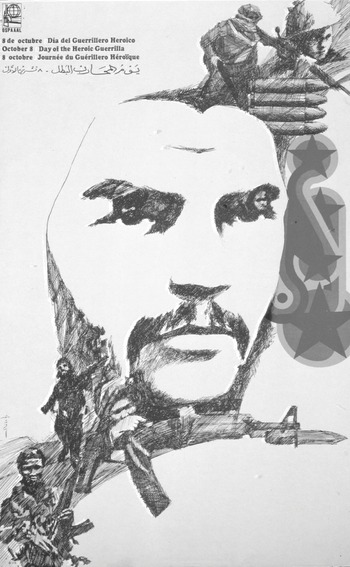
Figure 10.1 Che Guevara’s death in 1967 affirmed his position as a global revolutionary icon. He became the most familiar face in a pantheon of Tricontinental martyrs that included Patrice Lumumba, Mehdi Ben Barka, and Amílcar Cabral. OSPAAAL posters memorialized these contemporaries while also drawing linkages to older revolutions with celebrations of Cuba’s José Martí and the Nicaraguan Augusto Sandino. OSPAAAL, Olivio Martinez, 1971. Offset, 54x33 cm.
Guevara’s views on this subject put him at odds with revolutionary Cuba’s superpower ally, the Soviet Union. Cuban leaders, particularly Fidel Castro, found themselves caught between conflicting strategies: to cultivate the solidarity of the developing world, with Cuba playing a leading role, and to develop an alliance with the Soviet Union as the only great power capable of protecting the Cuban Revolution against US aggression. While Castro struggled to balance on this tightrope of competing imperatives, over time Guevara became more outspoken in his criticism of the Soviet Union. This tendency is ironic in light of his earlier self-identification as a communist and the role he played in radicalizing the Cuban Revolution beyond the more moderate visions of noncommunist and anti-communist members of the 26th of July Movement.
This chapter traces the development of Guevara’s beliefs, ideas, and actions, particularly as they evolved within three unfolding and interrelated historical contexts: the shifting Cuban-Soviet alliance, the deterioration of relations with the United States as the Cuban Revolution confronted the realities and legacies of US imperialism, and the deepening yet ultimately quixotic quest for Third World solidarity. Guevara both embodied and foreshadowed a pattern that would play out elsewhere in the developing world – admiration and emulation of the Soviet Union, followed by disillusionment with the model on offer in Moscow and a shift toward emphasizing the commonalities and solidarities of the Third World. His internationalism, idealism, and optimism ultimately contributed to the failure of his Tricontinental revolutionary vision, as they led him to seriously underestimate the heightened appeal of nationalism among the peoples of the newly decolonizing states.
Becoming “el Che”
Born in 1928 in Argentina to a downwardly mobile family of aristocratic background, Ernesto Guevara de la Serna was raised in an atmosphere of intellectual and political debate. As a medical student at the University of Buenos Aires, he came into contact with militant communists and accompanied them to at least one communist youth meeting, where he witnessed the destructive sectarianism of Argentina’s radical left. These experiences compounded his innate skepticism and distrust of established authority, while inculcating disdain for the factionalism of Latin America’s communist parties. Though sympathetic to communism, he never became a formal member of the Argentine communist party or any other political party. Moreover, he criticized Latin America’s reformist left-wing parties for their anti-communism and amenability to cooperating with the United States. Guevara’s extensive travels around Latin America brought him face to face with the dreadful living conditions of poor peasants and urban workers in the countries he visited. He came to believe that the revolutionary struggle of “Nuestra América” was a shared one against US imperialism. Only by breaking Latin American dependence on the United States could the region truly decolonize and fulfill the promise of genuine freedom. Even at this early stage, Guevara’s outlook was international. He would repeatedly be frustrated by what he viewed as the parochial nationalism of many Latin American regimes and political parties.
In assessing the prospects for revolution in Latin America, Guevara was most impressed by Guatemala under Colonel Jacobo Arbenz Guzmán. The second democratically elected president in Guatemalan history, Arbenz came to power in 1951 and began to enact reforms that alienated powerful US interests and threatened the prerogatives of key sectors of Guatemalan society. Arbenz drew resentment not only from US business interests and domestic stakeholders but also from regional strongmen. The struggle between dictators and democrats in Central America and the Caribbean had been underway since before the end of World War II, with tyrants like Trujillo in the Dominican Republic and Somoza in Nicaragua conspiring to topple democratic reformers like Arbenz and his predecessor, Juan José Arévalo.Footnote 3 Guevara became steeped in the Guatemalan revolutionary milieu, embarking upon an intellectual journey into Marxism-Leninism with his soon-to-be wife Hilda Gadea, a Peruvian and member of the American Popular Revolutionary Alliance and the Alliance of Democratic Youth, the mass organization of the Guatemalan communist party, the Partido Guatemalteco del Trabajo (PGT).Footnote 4 Arbenz had recently legalized the party, and Guevara applauded Arbenz’s willingness to cooperate with communist leaders.Footnote 5 For Guevara, it was Arbenz’s willingness to work with the communists that distinguished him from other Latin American leaders who were leftist and reformist yet still anti-communist. Through the PGT, Guevara came into contact with exiled Cubans who were plotting a return to their home island to overthrow the increasingly tyrannical regime of Fulgencio Batista. Guevara was in Guatemala City when a ragtag band of exiles led by Colonel Castillo Armas and backed by the CIA, which coordinated a devastatingly effective psychological warfare campaign against Arbenz, launched a coup. The CIA’s propaganda, especially radio broadcasts, convinced Arbenz that a much larger army, including US troops, was on its way. He capitulated without firing a shot and fled to Mexico City.Footnote 6 This was a profound moment for Guevara, one that would shape his later attitudes and experiences. He had been fully prepared to fight on behalf of the Arbenz government, expecting the regime to arm the peasants and workers. Guevara was crushed when he found out that Arbenz had failed even to put up a fight.Footnote 7
Guevara’s assessment of the events in Guatemala tracked closely with that of the Guatemalan communists and Soviet officials. Nikolai Leonov, a KGB officer whose later career would include multiple stints in various Latin American countries and who served as an information officer at the Soviet embassy in Mexico City in the early 1950s, observed that across Latin America, opposition to authoritarian regimes was increasing. He predicted that because of US support for regional dictators, this opposition could potentially spill over into a general protest against the “imperialistic policies” of the United States.Footnote 8 Arbenz himself had sent an urgent plea to Moscow for help in rebuffing US imperialist pretensions. In a communiqué that was circulated in the International Department of the Soviet Communist Party (CPSU) Central Committee, Arbenz claimed that his economic policies, particularly agrarian reform, had threatened “such powerful monopolies as United Fruit,” which had then petitioned the Eisenhower administration to lend “moral and material” support to their invasion plans. The United States was waging a campaign of slander and lies, tarnishing Guatemala as a “threat to the security of the American continent” and a “bridgehead of international communism” in order to create a pretext for “open intervention” in Guatemala’s internal affairs, with the ulterior motive of depriving the country of its sovereignty and independence.Footnote 9
Though many Soviet officials and representatives of trade unions and other party organizations sympathized with Arbenz, the highest-ranking leadership in the CPSU still adhered to a more dogmatic view of revolution that characterized Guatemala under Arbenz as “bourgeois-democratic” because it was not led directly by the Guatemalan communist party. This rigid ideological orthodoxy undermined Soviet influence on Latin America’s radical left and pointed to a critical divergence from the views of Guevara, who understood that Arbenz’s attempts to cultivate a measure of independence by allowing the Guatemalan communist party to operate legally represented a clear break from US-imposed definitions of “hemispheric solidarity.” Soviet propagandists, based on information supplied by the communist parties and trade unions, assumed that the US intervention was designed to protect the monopoly status of United Fruit, and they discerned no difference between the interests of the Eisenhower administration and those of the company.Footnote 10 Guevara’s analysis of the Guatemalan coup was similar to that of Soviet officials, even though he had greater faith in Arbenz’s reforms. He believed that the US State Department and the United Fruit Company were virtually indistinguishable. The coup had proven that victory could only be gained through “blood and fire” and that the “total extermination” of the reactionaries was the only way to achieve justice in America.Footnote 11 This oversimplified view of US-Latin American relations would later contribute to Guevara’s unraveling in Bolivia.
Guevara’s experience in Guatemala shaped the development of his revolutionary strategy. Specifically, he learned three key lessons from the Guatemalan coup. First, given that factions of the armed forces had turned against Arbenz, it seemed obvious that for a revolution to consolidate its gains in the face of US imperialism and its local lackeys, the army needed to be purged and created anew. A revolutionary regime had no reason to expect the support of the existing armed forces. Second, the leaders of the revolution must arm the populace in order to defend the revolution. Guevara sincerely believed that if only Arbenz had provided weapons to his supporters in the labor unions and the peasantry, he could have vanquished Castillo Armas even without the help of the regularly constituted armed forces. Finally, the experience of Arbenz even more firmly convinced Guevara that US imperialism could only be defeated via armed violence.Footnote 12
After fleeing Guatemala, Guevara traveled to Mexico City, where he linked up with Fidel Castro and the Cuban exiles. They received training from Alberto Bayo, a Cuban-born Spanish military officer who had conducted guerrilla operations with the Republican forces in the Spanish Civil War. Bayo, whom Guevara later described as the only real teacher he ever had, counted among his influences Augusto César Sandino, who led the insurgency against the US occupation of Nicaragua from 1927 to 1933.Footnote 13 Sandino’s guerrilla strategy attacked the morale of US combat forces as well as the American public’s will to fight. From his mountain outposts, he spread the struggle into the cities, protracting the conflict and refusing to engage US troops head on.Footnote 14 Bayo also borrowed heavily from the consummate theorist of guerrilla warfare, Mao Zedong, though there were profound differences between the two. Mao’s strategy was aimed at a foreign aggressor; Bayo’s aimed instead at a domestic authoritarian regime. Mao’s strategy combined conventional with irregular warfare, whereas Bayo advocated an entirely guerrilla campaign on the Sandino model. The two agreed on the crucial importance of cultivating the active support of the local peasantry. For Bayo, success in guerrilla warfare could be achieved only when “a people suffer, whether from foreign invasion, the imposition of a dictatorship, the existence of a government which is an enemy to the people, an oligarchic regime, etc.” If such conditions were lacking, Bayo asserted, “the guerrilla war will always be defeated.”Footnote 15 Holding the United States responsible for installing and supporting regimes that caused so much suffering in Latin America, Guevara left Mexico dedicated to applying Bayo’s strategies to the “armed struggle against Yankee imperialism” in Cuba.Footnote 16
The Vanguard of the Latin American Revolution
Though the voyage and landing of the Granma was an utter disaster, the Castro brothers, Guevara, and several others survived and escaped into the Sierra Maestra mountains, where they waged guerrilla warfare against Batista’s forces for almost three years. Relations between the leaders of the urban underground and the leaders of the rural insurgency were tense at best, especially as Castro moved to consolidate his control over revolutionary strategy and tactics. Perhaps in large part due to the dispute between the urban and rural revolutionaries, Guevara assigned insufficient importance to the urban struggle in his theoretical writings on guerrilla warfare. The foco theory attributed to Guevara was popularized by Regis Debray, who oversimplified much of Guevara’s writings on revolutionary warfare.Footnote 17
Almost immediately upon consolidating power in Cuba, the revolutionaries of Castro’s 26th of July Movement began to look outward. Guevara, as one of the movement’s most committed internationalists, played a key role in planning for the earliest expeditions to spread the revolution to Cuba’s neighbors, especially those governed by brutal dictators like Somoza in Nicaragua and Trujillo in the Dominican Republic. These expeditions were motivated by ideological revolutionary romanticism as well as pragmatic security concerns. The Cubans sought not only to liberate their neighbors suffering under the tyranny of dictatorships but also to create a regional environment conducive to the consolidation of their own revolution.Footnote 18 Though all expeditions were either aborted or ended in spectacular failure, they demonstrated the regional outlook of the Cuban Revolution.
In June 1959, Guevara was dispatched on a tour of African and Asian states, many of which had been represented at the first Afro-Asian conference in Bandung in 1955. He also spent a week in Yugoslavia, his first visit to a socialist country. Although he found his trip fascinating, he was skeptical of the regime’s commitment to communism and frustrated by its refusal to grant a Cuban request for an arms deal.Footnote 19 Though raising some doubts about the socialist world, his travels solidified an ambition to unite the struggles of the peoples of all three continents – Asia, Africa, and Latin America. Che sensed that he was living at a crucial juncture in world history, when “the liberated people are becoming conscious of the great deceit they have been subjected to, the so-called racial inferiority.” Cuba’s identification with the Third World and integration into what would become known as the Non-Aligned Movement was, for Che, “the result of the historic convergence of all oppressed peoples.” The Cuban Revolution could be a catalyst for this convergence. Upon returning to Cuba from his travels around Africa and Asia, Che declared that “our continents will unite and destroy, once and for all, the anachronistic presence of colonialism.”Footnote 20
Guevara believed this global revolution would be summoned through armed violence and would result in a structural economic reordering in favor of small, postcolonial states, with Cuba serving as a model for both. In extrapolating the experience of the Cuban Revolution outward, Che acknowledged the existence of very few “exceptional” factors in the success of the revolution. The most important was that “North American imperialism was disoriented and unable to measure the true depth of the Cuban Revolution.” Future insurrections would not be able to count on such disorientation because “imperialism … learns from its mistakes.”Footnote 21 Yet Guevara remained confident of the hemisphere’s revolutionary prospects, because there existed, as Bayo had argued, common plights motivating the “colonial, semicolonial, or dependent” countries toward revolution. The “underdeveloped” world suffered from “distorted development” due to imperialist policies that encouraged raw material production and monocultural economies. Dependence on a single product, with a single market, was the result of “imperialist economic domination.”Footnote 22 In Cuba, the most basic fact of the economy was that it “was developed as a sugar factory of the United States.”Footnote 23 The revolution had been waged not merely to topple Batista but to reorder such unequal economic relations.
As head of the Department of Industrialization within the National Institute of Agrarian Reform (INRA) and then as president of the National Bank, Guevara further developed his ideas about economic planning. Although his thinking was deeply influenced by Marxism-Leninism, he ultimately came to reject the economic prescriptions of the Soviet Union and other socialist states in Eastern Europe. He believed that the Soviet system had failed to advance the consciousness of the workers that was a prerequisite for the construction of genuine socialism.Footnote 24 Even before visiting the Soviet Union, he had read Soviet industrial manuals that referred to the law of value, which for Marx was at the center of the capitalist mode of production. The Soviet Union, in attempting to build communism from a pre-capitalist level of development, relied on the law of value, and hence the profit motive, to achieve efficiencies and thereby accelerate the development of productive forces. Guevara rejected this Soviet solution to the dilemma of industrialization, which he argued merely adopted the tools of capitalism but without the efficiency of the “free market.”Footnote 25 He further argued that the law of value should never operate in trade between the countries of the socialist bloc.Footnote 26 Specifically, he objected to the use of material incentives for production, maintaining that they must be replaced by moral incentives in order to undermine the law of value and achieve a truly socialist consciousness.Footnote 27 This idea would form one of the main planks in his critique of Soviet economic policy toward the developing world.
In August 1961, a special meeting of the Inter-American Economic and Social Council of the Organization of American States in Punta del Este, Uruguay, provided an ideal venue for Che to expound upon his economic ideas. First of all, he argued that economic planning was not possible until political power was in “the hands of the working class.” Second, the “imperialistic monopolies” must be “completely eliminated.” Finally, the “basic activities of production” must be “controlled by the state.” Only if those three preconditions held could real economic planning for development begin.Footnote 28 Che’s policies stood in stark contrast to the terms of the Alliance for Progress as presented by Kennedy administration officials at Punta del Este. Whereas the Alliance for Progress apportioned financial aid in the hopes of spurring moderate political and economic reforms, Che envisioned a revolutionary restructuring of the historically unequal economic relations across the Americas. He believed that it was necessary to protect Latin American businesses from foreign monopolies and that the United States must reduce tariffs on the industrial products of Latin American states. Furthermore, any foreign investment should be indirect and not subject to political conditions that discriminated against state enterprises. The interest rates on development loans should not exceed 3 percent, and the amortization period should be no less than ten years, with the possibility of extension in the case of balance of payments issues. Che also called for reforms to lighten the tax burden on the working class.Footnote 29 Additionally, he urged the US delegation to cease pressuring OAS member states not to trade with the socialist bloc.Footnote 30 As head of the Cuban delegation to the meeting, Guevara refused to sign onto the Alliance for Progress, arguing that it completely neglected the fundamental economic problems facing Latin America.Footnote 31
At the United Nations Conference on Trade and Development (UNCTAD) in Geneva in 1964, Che continued to develop his economic platform. He declared that the “only solution” to the problems of humanity was to bring an end to the “exploitation of the dependent countries by the developed capitalist countries.”Footnote 32 Noting that the “socialist camp” had “developed uninterruptedly” at rates of growth much higher than its capitalist counterpart, he lamented the “total stagnation” of the underdeveloped world.Footnote 33 In Guevara’s view, this stagnation was a direct legacy of colonialism, and the decisive defeat of the imperialists was a necessary precondition for economic development.Footnote 34 Though the vast majority of his ire was reserved for the United States, by placing the socialist bloc within the developed world and counterposing the developed world with the decolonizing countries, Guevara gestured toward a different understanding of economic exploitation from the one offered by the Soviet Union. Guevara’s views on this issue were more closely aligned with those of the Chinese communists in positioning anti-imperialism – as opposed to class conflict – at the center of the struggle for economic liberation.
Between the Third World and the Soviet Union
From the outset, Cuban leaders positioned the revolution between the Third World and the Soviet Union. A combination of ideological convictions, geopolitical realities, and domestic political pressures conditioned early Cuban foreign policy. Castro sought to consolidate power in his hands domestically, using the Cuban communist party’s ties to Moscow to court the Soviet Union while simultaneously seeking to export the revolution to Cuba’s authoritarian neighbors in a bid to shore up regional security. In the looming confrontation with the United States, it was critical that Cuba’s neighbors not become a convenient launching point for a US invasion. Yet these oft-conflicting imperatives required a careful balancing act. Castro could announce his intentions to establish an alliance with the Soviets only once the more moderate factions of the revolutionary movement had been sidelined or eliminated. At the same time, the Cubans had to send reassuring signals to Moscow regarding the strictly tactical nature of their temporary compromises with the national bourgeoisie.Footnote 35
Castro repeatedly urged greater unity and emphasized the power of Cuba’s revolutionary example for the rest of Latin America.Footnote 36 In a speech at the UN, Castro declared that the “case of Cuba” is the “case of all underdeveloped, colonialized countries.”Footnote 37 At the same time, the Cubans were embarking upon what would ultimately become a highly contentious relationship with the Soviet Union. In March and April 1959, Cuban emissaries began making overtures; one emissary told the Soviet ambassador to Mexico that the Castro regime was striving to emulate the accomplishments of the Soviets and that the restoration of formal diplomatic relations between the two countries was “only a matter of time.”Footnote 38 It was not long, however, before Cuba’s efforts to export the revolution created tensions between the Soviet Union and countries in Latin America. Mexican officials expressed their disapproval of Cuban expeditions in the Caribbean to the Soviet ambassador in Mexico City in August 1959. The Mexican government had detained and deported three separate groups of Cubans who had been captured in Mexican territorial waters.Footnote 39 The Soviets had no interest in destabilizing the Mexican government, but they approached the Cuban Revolution with cautious optimism. The visit of Anastas Mikoyan to Havana in February 1960 to open the Soviet cultural and technical exhibit presented an opportunity for Moscow to evaluate the “character and path” of the Cuban Revolution and the possibilities for further Soviet-Cuban cooperation.Footnote 40
In October 1960, Che headed the first official Cuban delegation to the Soviet Union. His travels around the socialist bloc left his admiration for the Bolshevik revolution intact, but he also witnessed a clash between Soviet plans and Cuban revolutionary ambitions. According to Anatoly Dobrynin, Che requested Soviet assistance in constructing a steel mill and an automobile factory in Cuba in order to spur the industrialization of the economy. He was informed that what the Cuban economy really needed was hard currency and that the best way to obtain it was through continued sales of sugar.Footnote 41 Due in part to the continued operation of the law of value in intra-socialist bloc trade relations, as well as the Soviet prioritization of raw material imports over industrialization in its economic relations with Cuba, Che ultimately came to believe that the Soviet Union was complicit in the continued exploitation of decolonizing states.Footnote 42
Yet the Cubans needed the support of a great power patron like the Soviet Union in their confrontation with US imperialism. The case of Arbenz’s Guatemala seemingly proved that this confrontation would inevitably involve violence. Cuban leaders therefore sought to safeguard the security of the revolution by strengthening ties with the socialist bloc and the non-aligned world. Though Cuban ambitions most closely paralleled those of Third World radicals, only the Soviets and their Eastern European allies had the financial, industrial, and military resources that Cuba needed. This balancing act created tensions with Soviet leaders, who occasionally chastised the Cubans for their “revolutionary adventurism,” while some members of the Non-Aligned Movement viewed the Cubans as aligned with the communist bloc.Footnote 43 After the Bay of Pigs debacle of April 1961, which confirmed for the Soviets the fundamental inability of the United States to coexist peacefully with the Cuban Revolution, Havana amplified its requests for Soviet military assistance.Footnote 44
Fortunately for Castro, Cuban requests came at a time when Khrushchev was pursuing a more active approach to spreading Soviet influence in the decolonizing world. At the 22nd CPSU Congress in October 1961, Khrushchev lauded the “revolutionary struggle” of the peoples of Asia, Africa, and Latin America, expressing his conviction that “the 1960s will go down in history as the years of the complete disintegration of the colonial system.” Yet “remnants” of the colonial system remained; Khrushchev singled out “the Guantanamo military base on Cuban soil,” occupied by the imperialists “against the will of the Cuban people.” The Soviet Union was “unswervingly fulfilling its internationalist duty.”Footnote 45 Khrushchev backed up this rhetoric with the provision of military aid to Cuba, including medium-range ballistic missiles capable of reaching targets in the United States and in some Latin American capitals.
These missiles would open a divide between the Soviets and their revolutionary clients during the October Crisis, more familiar as the Cuban Missile Crisis in Washington and the Caribbean Crisis in Moscow.Footnote 46 The idea of installing missiles in Cuba originated with Khrushchev, and some Soviet officials were skeptical that Castro would accept the deal, as it contradicted his identification of Cuba with the non-aligned world. The Cubans believed that the Soviet provision of nuclear weapons could protect the revolution from US aggression while enhancing the strategic position of the entire socialist bloc. Yet during the crisis itself, when Castro urged Khrushchev to consider launching the weapons in the event of a direct US invasion of Cuba, the Soviet premier balked. Khrushchev’s failure even to consult the Cubans regarding negotiations with the Kennedy administration infuriated Havana and ushered in a chilly period of Soviet-Cuban relations.Footnote 47 Mao was quick to capitalize on Khrushchev’s “great power chauvinism,” accusing the Soviets of kowtowing to the imperialists and selling out the Cuban Revolution.Footnote 48 After blinking into the nuclear abyss, the Soviets actively sought to reduce tensions with the United States, and Chinese hostility escalated to the point of considering Soviet influence as akin to a second form of imperialism.Footnote 49
Despite the greater ideological affinity of the Cubans with the Chinese, Havana was still dependent on Soviet aid, requiring Cuban leaders to continue their balancing act. The November 1964 conference of Latin American communist parties hosted in Havana illustrated one such compromise with Moscow. Although Beijing-oriented regional communist parties were excluded from the gathering, the delegates proclaimed support for the armed struggle in several Latin American countries – Colombia, Guatemala, Haiti, Honduras, Panama, Paraguay, and Venezuela – while continuing to pursue the peaceful path to power in the rest of the region.Footnote 50 Mao was reportedly furious about the conference; he railed against the “three demons” of “imperialism, the atomic bomb, and revisionism,” with the Soviet Union epitomizing the last of these.Footnote 51 The goal was clearly to discredit the predominantly white, industrially advanced Soviet Union in the eyes of the Third World, but Guevara seemed to reject the political implications of this “theory of the two imperialisms.” The Soviet Union was reliably anti-imperialist and played an invaluable role in sustaining Cuba in a hostile region, he believed, even if Cuban and Soviet priorities did not fully align in terms of economics, the transition to socialism, and support for armed revolutionary movements.
Though Cuba did not abandon its Soviet patron, Guevara critiqued the communist superpower for what he saw as its divergence from the revolutionary path. While celebrating the anniversary of the Russian Revolution in Moscow in November 1964, he criticized the Soviet model of industrial success before a crowd of local students, suggesting that the “Soviet Man” was not so very different from, for instance, a Yankee. This assertion reflected his belief that the continued operation of the law of value would perpetuate a capitalist consciousness and thereby prevent the emergence of a fundamentally new socialist outlook. The students, recognizing this opinion as an attack from the left, accused him of “Trotskyism.” Che rejected the epithet.Footnote 52 But upon his return to Cuba, he indulged in a lengthy attack on the notion of “goulash communism,” arguing that the reason the socialist bloc was falling behind the West was not because it was following the tenets of Marxism-Leninism but because it had abandoned them. The Soviets had succumbed to the law of value and adopted all manner of capitalist methods.Footnote 53 Many in the Cuban leadership, however, did not share Guevara’s views and sometimes criticized his extreme ideological purity.
The following month, Guevara departed for a three-month tour of several African countries and China, where he continued this line of attack. At the second economic seminar of Afro-Asian Solidarity, held in Algiers in February 1965, Che criticized the Soviets as “accomplices” of the West in the exploitation of the underdeveloped world, and he asserted that the socialist countries had a “moral duty to liquidate their tacit complicity with the exploiting countries of the West.” He urged the socialist bloc to use its power to transform international economic relations.Footnote 54 At the heart of the matter was Che’s belief that ongoing, global revolution was necessary if small states like Cuba were ever to attain true political and economic independence. Though less racialized, this theory of Third World revolution aligned with much of China’s rhetoric and created tensions with the countries of the socialist bloc. Raul Castro, in an effort to patch things up, privately suggested to at least one Eastern European diplomat that Che’s proposals were “too extreme.”Footnote 55 Nevertheless, Guevara would soon avail himself of the opportunity to back up his rhetorical exhortations to tricontinental solidarity with meaningful action, as he turned his sights to the ongoing struggle in Africa for liberation from European colonialism.
The Cuban Vision of Global Revolution
Guevara believed that a global revolution was necessary to achieve a socialist transformation of the international system. Obtaining power via armed force was an essential prerequisite for eliminating the continuing vestiges of imperialism and transforming global economic relations. The spread of armed revolts would inevitably weaken the United States as it aided reactionary governments and became directly involved in counterinsurgency. Though the Cubans came to power with ambitions of fomenting revolution in the Americas, Africa seemed more fertile ground after a wave of decolonization swept the continent in the early 1960s. While Che’s erstwhile adventures in the Congo proved frustrating, the 1966 Tricontinental Conference helped establish a shared Third World vision of socialist revolution that would provide the impetus for new insurgencies in Latin America.
The Cuban revolutionaries exhibited an early and intense interest in the African liberation movements, particularly in the struggle of the Algerian National Liberation Front (FLN) against French colonialism. As Piero Gleijeses has shown, “Algeria was Cuba’s first love in Africa,” and exchanges of weapons and medical assistance began as early as December 1961.Footnote 56 These exchanges demonstrated just how quickly the Cuban regime acted upon its vision of global revolution. Connections between Cuba and Africa stretched beyond material interests. Intellectually, the Cuban leadership – particularly Che – was profoundly influenced by Frantz Fanon, the radical psychologist and FLN member of French West Indian descent, whose philosophical writings continue to inform postcolonial studies. One can note striking similarities in the views of the two revolutionary thinkers. They both viewed the world in Manichean terms and disdained the national bourgeoisie that served as handmaidens to Western imperialism. Neither saw the possibility or even desirability of rapprochement with the capitalist world. Perhaps most importantly, both men were humanists; they emphasized the commonalities linking oppressed peoples everywhere and sought to build solidarity by transcending the class, racial, ethnic, religious, and sectarian divides that have long plagued humankind.Footnote 57 They believed this could happen only if a people’s national consciousness evolved to a higher level – that of “a common cause, of a national destiny, and of a collective history.”Footnote 58 They shared an emphasis on the tricontinental nature of the revolutionary struggle, and both believed that in order to build a new society, the structures of the colonial system must be destroyed and a new consciousness created.
As for how the countries of the Third World should conduct themselves in an international system divided between capitalism and socialism, Fanon and Guevara agreed: “The Third World ought not to be content to define itself in the terms of values which have preceded it. On the contrary, the underdeveloped countries ought to do their utmost to find their own particular values and methods and a style which shall be peculiar to them.”Footnote 59 Che held a deeper respect for communism than did Fanon, but he agreed that the Soviet model did not fit seamlessly with the conditions of Latin America and Africa. For him, it was impossible “to realize socialism with the aid of the worn-out weapons left by capitalism” because the “economic base has undermined the development of consciousness.” In order “to construct communism simultaneously with the material base of our society, we must create a new man.” Che sought a merger of socialism and Third World internationalism, wherein the mobilization of the masses would be achieved by moral rather than material incentives.Footnote 60 Indeed, for Che, the “ultimate and most important revolutionary ambition” was “to see man liberated from his alienation,” a theme common to Third World theorists.Footnote 61 Both Fanon and Che argued that their parties would be the vanguard. They rejected the necessity of waiting for the “objective conditions” of a revolution to ripen and argued that such conditions could be created by revolutionary movements. “Africa will not be free through the mechanical development of material forces,” Fanon wrote in 1960, “but it is the hand of the African and his brain that will set into motion and implement the dialectics of the liberation of the continent.”Footnote 62
If Algeria offered the first concrete example of solidarity, then the Congo became the prime illustration of why such cooperation was needed, especially after the 1961 assassination of Patrice Lumumba. Many progressives and socialists around the world viewed Lumumba as a symbol of the anti-imperialist struggle, and many Cubans interpreted his assassination as evidence that the forces of imperialism would not relinquish power without a fight. Though Che blamed Lumumba’s murder on the “imperialists,” he acknowledged that the Congolese prime minister had made some mistakes. He put too much trust in the United Nations and international law and failed to understand that the imperialists could be defeated only via force of arms.Footnote 63 Guevara would go on to lead an advisory mission to the Congo in support of Congolese revolutionary Laurent Kabila. In order to blend in with the Africans, the mission was composed overwhelmingly of Afro-Cubans, including Che’s second-in-command, Víctor Dreke.Footnote 64
Guevara’s dream of a Cuban-aided African revolution would not be realized until after his death. Although the Cubans were successful in infiltrating 150 men into eastern Congo in early 1965, they found Kabila’s forces undisciplined, surprisingly small in number, and divided along ethnic and political lines. There was little sense of shared struggle or will to coordinate forces. Though Che tried to instill the lessons of the Cuban guerrilla experience, he found students inattentive and overly attached to superstitions he perceived as limiting their interest in training.Footnote 65 With more Cuban instructors than recruits, Che left the Congo before the year was out.Footnote 66 The only bright spot in this “history of a failure” was that Che made contact with Agostinho Neto, leader of the People’s Movement for the Liberation of Angola (MPLA).Footnote 67 Neto requested instructors, weapons, and equipment to train and arm MPLA cadres and showed interest in fighting alongside experienced Cuban guerrillas.Footnote 68 In agreeing to these requests, Guevara unknowingly laid the groundwork for the later Cuban military intervention in the Angolan Civil War, which pitted the MPLA against US-backed anti-communist forces after the country’s independence in 1975. At the height of Cuban involvement in sub-Saharan Africa in the 1980s, nearly 40,000 Cuban combat troops actively protected the MPLA from both domestic foes and the neighboring South African military. The psychological and material costs of this war contributed to the ultimate collapse of apartheid.Footnote 69
Guevara’s failure in the Congo did not blunt the Cuban commitment to revolution. Though Che was the most vocal proponent of guerrilla tactics, much of the Cuban leadership shared his belief that only revolution on a global scale would transform the international system and that Cuba functioned as the vanguard for this global revolution. This was the motivation for the Castro regime to work together with Algeria’s Ahmed Ben Bella (until his ousting in mid-1965) to organize the first Tricontinental Conference, convened in Havana in January 1966. The conference sought to define and organize a tricontinental revolution by integrating the “two great contemporary currents of the World Revolution” – the Soviet-led socialist revolution and the “parallel current of the revolution for national liberation.”Footnote 70 The goal, then, was to bridge the ideological differences that fueled the Sino-Soviet split, replacing it with revolutionary unity on the Cuban model. Accordingly, Castro openly criticized the Chinese leadership in his remarks, even as the general commitment to armed struggle adopted elements of the more aggressive Maoist approach to revolution that made the Soviets uneasy.Footnote 71 The peoples of Asia, Africa, and Latin America, the conference collectively concluded, “must answer imperialist violence with revolutionary violence.”Footnote 72 This was the type of revolutionary syncretism, drawing on a wide base of support from the Second and Third Worlds, that informed the Cuban model of revolution, which Che was attempting to export.
Still abroad weighing his next move after the Congo debacle, Guevara’s absence was notable, but the message he sent epitomized his vision of Tricontinental unity. Disunity hobbled Kabila’s Congolese revolution, and it had undermined the prospects for global revolution. As the Soviet Union, China, and the nations of the Third World squabbled in the years preceding the Tricontinental Conference, the United States deployed troops in the Dominican Republic and South Vietnam. Would-be revolutionaries had to recognize that “Yankee imperialism” – the “fortress of colonialism and neocolonialism” as the Cubans described it – represented the “greatest enemy of world peace” and constituted “public enemy number one of all the peoples of the world.”Footnote 73 Che argued that resistance to the United States was the locus of unity for the struggles of the world’s downcast. Those on the frontlines of the struggle required the support of both the Third World and the socialist countries – what he and others referred to as the “progressive forces of the world.” Specifically, he lamented the “sad reality” that Vietnam “is tragically alone,” putting most of the blame for the plight of the Vietnamese people on the shoulders of US imperialism but also condemning those “who hesitated to make Vietnam an inviolable part of the socialist world.” The Tricontinental strategy aimed at the complete destruction of imperialism and the creation of truly independent nations, but to achieve this goal, progressive governments had to encourage and support those actively fighting against the United States and its capitalist allies; there had to be “two, three … many Vietnams.”Footnote 74
The conference established the Latin American Solidarity Organization (OLAS), which was to be permanently headquartered in Havana. Castro used the August 1967 OLAS conference to snub the Soviets, ensuring that most delegations were headed by noncommunist revolutionary leaders and issuing provocative statements that were clearly aimed at Moscow. In his closing speech, Castro criticized those who suggested the possibility of a peaceful transition to socialism and asserted that armed violence was the irrevocable course of the revolution in Latin America.Footnote 75
The Ill-Fated Bolivian Adventure
Guevara chose Bolivia to launch the continental campaign because he viewed it as ripe for revolution. In 1964, General René Barrientos had staged a coup against President Víctor Paz Estenssoro of the leftist Movimiento Nacionalista Revolucionario (MNR). Víctor Paz had come to power in 1952 after an insurrection of armed tin miners, Indian peasants, and labor unionists forced a reluctant military to honor his democratic election two years prior. Guevara, who had visited the country in 1953, believed that the MNR was insufficiently radical, even though Víctor Paz had enacted meaningful agrarian reform, nationalized the tin mining companies, and granted universal suffrage.Footnote 76 After the coup, Barrientos pledged to continue these reforms but kept the peace through increasingly repressive measures, alienating key rural constituencies from the government in La Paz.
Rising political frustration combined with several other factors to make revolution seem feasible. First, Guevara believed that the Bolivian army and security forces were too small and weak to effectively confront a guerrilla challenge. Second, he believed that the United States would be slow to react to an insurgency there, despite evidence of intense US interest in Bolivia in the framework of the Alliance for Progress.Footnote 77 Guevara seemed to hope that that the foco would inspire others throughout South America, so that if the United States did intervene, it would sink into a quagmire. Third, the geographical location of the country in the heart of South America was seen as a strategic center from which the revolution could spread. Fourth, Mario Monje, General Secretary of the Bolivian Communist Party, agreed to provide logistical support, contacts, and cadres to the effort.Footnote 78 Finally, the political circumstances of Bolivia’s neighbors were not viewed as favorable. Though Che initially hoped to launch a foco in his homeland under the command of his friend and fellow Argentine Jorge Masetti, the column was destroyed by the harsh climate of northern Argentina, its inability to attract local support, and ruthless Argentine security forces. Neighboring Peru, meanwhile, boasted a popularly elected civilian government that was embarking upon a program of moderately progressive reforms and an army that had effectively suppressed several guerrilla insurgencies in the two years before Che set out for Bolivia.Footnote 79
From the outset, though, Che found the conditions for revolution had been greatly exaggerated. At the Tricontinental Conference, Monje, as head of the Bolivian delegation, deceived the Cubans about the revolutionary potential of Bolivia and about the Bolivian Communist Party’s own intentions to launch a guerrilla foco. Bolivia’s communist left had split into two factions, with Monje’s Bolivian Communist Party remaining loyal to Moscow and the New Bolivian Communist Party aligning with Beijing. Moreover, the majority of Bolivian Marxists identified with neither of these parties, but instead belonged to an array of other groups – most of them more powerful than the two communist parties – ranging from the Trotskyite Workers’ Revolutionary Party to the governing MNR. The rigidly orthodox Monje added to Guevara’s frustrations, insisting that any revolution must be party led. He refused to recognize the authority of a commander who was not a card-carrying communist and prevented the Bolivian communists who trained in Cuba from joining Che’s group. The communists promised aid and support that they never had any intention of delivering, and they may have even provided the Bolivian authorities with information regarding Che’s whereabouts.Footnote 80
Ultimately, the Bolivian disaster demonstrated that Che’s model of guerrilla warfare, based on a selective reading of the Cuban experience, was not readily generalizable and that he neglected the unique aspects of the Cuban Revolution to his own peril.Footnote 81 In addition to discounting the key role urban revolutionaries played in the 26th of July Movement, Guevara’s overweening dedication to militant confrontation led him to eschew the sort of tactical compromises that Castro had pursued in order to broaden cooperation among the various anti-Batista elements. Most importantly, Guevara overestimated Bolivian popular revolutionary sentiment and ultimately failed to gain local support. Even though Barrientos had seized power via a military coup, he was then popularly elected in 1966 (albeit facing little opposition). He traveled extensively through Bolivia, giving speeches to the Indians in Aymara and Quechua and promising further economic and social programs. Che viewed these and earlier reforms as insufficiently radical, but many Bolivian workers and peasants disagreed. Most remained invested in their society and felt they had already experienced their revolution for national liberation under Víctor Paz. Ultimately, perhaps the fundamental ingredient missing from Che’s foco was that its cause was not viewed as just by the majority of Bolivians.
Furthermore, the response of the Barrientos regime to the presence of the guerrillas was highly effective. The Bolivian president requested the assistance of the CIA in the counterinsurgency campaign to eradicate Che’s foco but was still able to portray the campaign in a nationalist light because most members of Guevara’s group were Cuban and not Bolivian. He repeatedly drew attention to the foreign nature of the guerrilla movement and portrayed himself as a staunch defender of Bolivian law and order. In a deft move to appeal to Bolivia’s radical left, Barrientos even appointed four Marxists to his cabinet during the period of Che’s guerrilla activity in the country. Though he faced criticism from right-wing circles, he explained that he was not opposed to Marxists so long as they worked within the democratic process. With limited popular support, Guevara’s early success in battles against the Bolivian security forces gave way to months of frustration. On October 9, 1967, he was captured and executed by a Bolivian Ranger unit that had received counterinsurgency training from US Army Special Forces.Footnote 82
Aftermath and Legacies
Though there was a tremendous outpouring of grief among Latin America’s radical left, Che’s capture and execution were virtually ignored in Moscow. A brief Pravda obituary praised his “deep devotion to the cause of the revolutionary liberation of the peoples and great personal courage and fearlessness,” but the only public commemoration of Che’s life was a rally held by a small group of Latin American students from Moscow’s Patrice Lumumba People’s Friendship University.Footnote 83 Soviet news media continued to disparage the brand of revolutionary “adventurism” that Che exemplified, and a month after his execution, Brezhnev gave a speech in which he declared that socialist revolutions should only be launched in countries where the necessary objective conditions for revolution had already been fulfilled. The message was a clear reference to Che’s failure in Bolivia. Orthodox communist parties in Latin America followed suit, issuing denunciations of armed struggle and declaring their loyalty to the CPSU line.
The death of Che and the obliteration of the nascent Bolivian foco he had nurtured, combined with guerrilla defeats in Guatemala, Colombia, and Venezuela, contributed to an improvement in Cuba’s relations with the USSR. Though Castro continued to aid revolutionary movements, he was more selective in determining which ones to support. He continued to advocate the armed struggle but softened his rhetoric about the inevitability of violence.Footnote 84 By refusing to condemn the 1968 Soviet invasion of Czechoslovakia, Castro signaled his support for Moscow’s foreign policy. Though his speech about the episode contained several veiled criticisms of the Soviets, it marked a turning point after which Soviet-Cuban relations were closer and less contentious. In 1972, Cuba became a member of the Council for Mutual Economic Assistance (CMEA), the Soviet-led economic assistance organization comprising the socialist bloc countries. Later in the year, a series of bilateral trade, economic, and financial agreements reshaped the Cuban economy along Soviet lines, eventually making the island’s economic dependence on Moscow almost total. Cuban officials now loyally defended Soviet policy positions in international organizations, especially the Non-Aligned Movement and the United Nations, but so too did the USSR become a key backer of Cuban support for Third World nationalism, actively aiding Castro’s support for communist governments in Angola and Ethiopia in the 1970s and 1980s.
Che’s radicalism and his fierce devotion to spreading the revolution would continue to inspire armed revolutionaries in Latin America, even after the fall of the Berlin Wall and the complete collapse of Soviet-style communism in Europe. Yet Che’s ideals and actions had exacerbated tensions in the Cuban-Soviet alliance and provoked the wrath of Washington. The ideological and theoretical hair-splitting that distinguished the Fidelistas from the Maoists from the pro-Soviet factions undermined the unity and cooperation necessary for effective action. The United States, unwilling to tolerate the rise of any leftist regime, happily took advantage of divisions by consolidating alliances with a range of Latin American dictatorships. The Pentagon designed and disseminated counterinsurgency tactics to stamp out the spreading influence of Fidelista and other Marxist-inspired guerrilla groups. The Vietnams that Che sought to inspire in South America failed as US counterinsurgency doctrine and training spread across the continent, culminating in Operation Condor, a transnational network of right-wing violence and oppression of the Marxist left.Footnote 85 In the United States, though some radical groups answered Che’s call (perhaps most infamously, the Weathermen), ultimately US society managed to cleave together in the maintenance of the status quo.Footnote 86
Nevertheless, the internationalism and solidarity that Che epitomized continue to animate Cuban foreign policy into the twenty-first century. Cuba provides humanitarian aid to dozens of countries in Africa, Asia, the Middle East, and Europe alongside emergency support, especially medical and health workers, to countries suffering from natural disasters. Thousands of students from all over the world received free medical education at the Latin American School of Medicine in Havana. Cuba even provided health care to children affected by the 1986 nuclear accident in Chernobyl.Footnote 87 Moreover, Che distinguished himself as an economic philosopher whose ideas shaped the Cuban economy and continue to inspire progressives worldwide. Many of the items on his agenda would appear in the 1970s in the guise of the New International Economic Order (NIEO), a political project aimed at enshrining the economic sovereignty of the postcolonial states. The major proponents of the program advocated a complete restructuring of global economic relations along lines similar to those Che sketched out at the 1961 Punta del Este conference.Footnote 88 The NIEO ultimately suffered the same fate as Che’s Tricontinental revolutionary vision. Both fell victim not only to the dominance of the industrialized capitalist world, headed by the United States, but also to the continuing appeal of nationalism and the enduring primacy of national interests.
Marx discovered and history has confirmed that the capitalist and the worker are the principal opposed personages of our time, and the mercenary and the internationalist fighter embody the same irreconcilable opposition.
In some ways, the year 1976 represented the peak of Tricontinental solidarity. Cuban soldiers operating halfway around the world in the former Portuguese colony of Angola helped consolidate power for the leftist Movimento Popular de Libertação de Angola (People’s Movement for the Liberation of Angola, or MPLA) in the face of concerted opposition. They repelled a coalition of local nationalist parties, South African soldiers, and covert Western assistance that sought to deny the MPLA its claim to authority in the months after independence. By the time Fidel Castro visited Guinea in June 1976, much of the world recognized the MPLA as the legitimate government of Angola, and the trial of thirteen mercenaries in Luanda revealed the extent of intervention. In Conakry, Castro hailed the victory as a blow to global imperialism with a distinct regional importance (Figure 11.1). “In Angola,” he claimed, “the white mercenaries were destroyed along with their myth and so was the myth of the invincibility of the South African racists.”Footnote 2
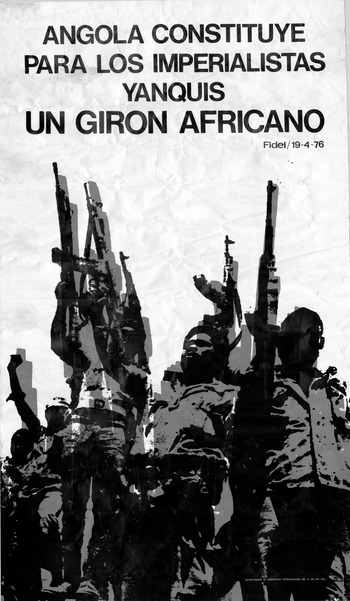
Figure 11.1 “Angola is for the US imperialists an African Giron,” asserts this poster. Both Cuba and Angola viewed the MPLA’s victory over US-backed forces as a black eye for Washington, and many in the United States agreed. Southern Africa was the major arena for Cuban foreign policy for the next decade, and Southern African revolutionaries praised Cuban efforts opposing apartheid. Departamento de Orientación Revolucionaria, 1976.
During the prior decade, mercenaries emerged as one of the most persistent challenges to socialist revolution in Africa. In the Congo, white soldiers of fortune hailing from South Africa, Rhodesia, and former metropoles subdued rebellions and led the armies of Western-aligned governments. A myth of invincibility grew up around these forces as they won major victories with small numbers. When Cuba first began to envision a global revolutionary solidarity, it consciously sought to combat this mercenary challenge, which Castro described in his speech closing the 1966 Havana Conference as “one of the most subtle and perfidious stratagems of Yankee imperialism.”Footnote 3 Yet the reference was not merely to soldiers of fortune or mercenary companies like the one Mike Hoare assembled in the Congo. Rather, Castro targeted a range of figures working on behalf of Euro-American interests, including the forces of South Vietnam in 1966 and the failed exile invasion of Cuba at Playa Girón in 1961.
For Cuba, mercenarism represented the violent edge of neocolonialism: the coalition of Western advisors, local allies, covertly funded exiles, and soldiers-for-hire that limited the expansion of revolution through force. As the Cuban official Raul Valdez Vivo explained, “as long as there is imperialism, there will be mercenaries.”Footnote 4 This expansive definition never became widely adopted, but it reflected an inescapable reality. The wealthy United States and its powerful allies had a spectrum of options to respond to revolution. They used different forces in order to balance strategic necessity, material cost, and the effects on US prestige. Soldiers-for-hire offered Western governments ways to augment local forces while maintaining “plausible deniability,” but so did the use of covert forces and to some extent the arming of client states.Footnote 5
The Cuban concept of mercenarism sought to capture the calculations behind these options and was central to the militant Tricontinental worldview. Opposite mercenaries were revolutionary internationalist fighters, embodied in the figure of Che Guevara. Both these opposing forces consisted of foreign militants fighting alongside rebels or for governments, but they had different motivations and relationships to allied movements or states. Cuban leaders believed there was a distinctly unequal power relationship between mercenaries and their employers. Wealthy Western governments – or sometimes companies – retained anti-revolutionary agents to protect their interests either by direct payments (traditional mercenaries) or indirect benefits provided to local clients or client states, which included assurances of power, weapons, or other forms of aid. These local clients were motivated by self-aggrandizement, individual gain, or class promotion. By contrast, revolutionary solidarity drove the internationalist fighter, who sought to support the global struggle against empire and capitalism. Internationalist fighters operated not independently but rather as representatives of formerly colonized states or liberation movements (considered postcolonial governments in waiting). As Cuba’s internationalist fighters confronted mercenaries in Africa, the nation’s leaders emphasized identarian politics to further reinforce the distinction between Global North and South. Thus, by the 1970s, the internationalist fighter became a politicized symbol of cross-racial solidarity in the struggle against the necessarily interlinked “white mercenary,” imperialism, and neocolonialism.
Scholars have paid little attention to the ideologies that animate opposition to mercenaries and mercenarism. Yet thinking about the Castro government’s conceptualization of these phenomena and Cuba’s actions in Africa (see Map 9.1) reveal important elements about how a key branch of Tricontinentalism understood neocolonialism, internationalism, and the distinct power dynamics that damned the former while legitimating the latter. This chapter will consider this concept through four lenses: the Cuban response to the Playa Girón invasion, the extended challenge of mercenaries in the Congo, the Cuban intervention in Angola, and finally efforts to establish a body of law to control the use of mercenary force.Footnote 6 Taken together, these events reveal that, despite setbacks, Cuba’s internationalist fighters scored significant victories against mercenaries, particularly in Angola. But Cuba’s articulation of this spectrum of neocolonial violence, in which mercenarism was a key strategic part, struggled to gain support beyond Castro’s immediate allies. As events in the Congo and Angola raised global concern about freelance soldiers, states responded by drafting international laws that ignored Cuba’s expansive view and ultimately failed to resolve the challenge of mercenary force. Nevertheless, this Cuban conceptualization of mercenarism provides a window into Tricontinentalism: its global vision, concrete solidarity, and ultimate inability to change the structure of the international system.
Mercenaries and Tricontinental Solidarity
The shifting role of mercenaries in the modern world has been well documented by scholars.Footnote 7 The once common practice of hiring soldiers from elsewhere became controversial amidst the nationalist revolutions of the nineteenth century. Yet soldiers-for-hire did not wholly disappear, and mercenaries thrived as instruments of neocolonialism in Latin America.Footnote 8 They served as security for US companies – effectively extralegal armies – protecting and promoting national interests in between regular invasions and occupations by marines. In effect, Latin America anticipated the reality many postcolonial nations in Asia and Africa confronted during the Cold War. The Cuban concept of mercenarism evolved from this context, linking Cold War interventions to this longer history of foreign adventurism, filibustering, and economic domination.
The US-supported invasion at Playa Girón, known in English as the Bay of Pigs, led the Castro government to begin articulating its Tricontinental definition of mercenarism. On April 17, 1961, about 1,500 CIA-trained, anti-Castro exiles – the military wing of the Frente Revolucionario Democrático (FRD), self-styled as Brigade 2506 – landed at Bahía de Cochinos. When internal uprisings failed to materialize and President John Kennedy declined to provide US naval and air support, the Castro government overpowered the invasion force and captured about 1,200 members of Brigade 2506. Cuba subsequently tried and convicted the exiles for treason. Though many returned to the United States in exchange for prisoners and medicine in late 1962, a handful were executed.Footnote 9 The members of Brigade 2506 viewed themselves as representatives of a legitimate anti-Castro political movement – “freedom loving, Cuban patriots from all walks of life” – but Cuba labeled them mercenaries.Footnote 10 Though mercenaries remained undefined in international law, the Castro government used the term to delegitimize political opposition by linking it to outside meddling.
At the center of the issue was the question whether the members of Brigade 2506 acted on their own or on behalf of the United States. The Castro government believed the latter, laying out its logic in a collection of documents published in Havana as Historia De Una Agresión: El Juicio a Los Mercenarios De Playa Girón. The March 1962 indictment stated that the “mercenary brigade” was “trained, armed, directed, and paid by the imperialist Government of the United States of America.”Footnote 11 In fact, the CIA spent a year and $4.4 million molding disparate exile groups into a cohesive opposition.Footnote 12 Historia De Una Agresión took pride in uncovering the agency’s central role, detailing secret meetings from Havana to New York and a string of Caribbean training camps from Puerto Rico through Louisiana to Guatemala.Footnote 13 Collaboration with the imperial power immediately called into question the legitimacy and authenticity of the nationalism claimed by Brigade 2506, with the Cuban government arguing its members represented foreign interests. It noted that many members of the brigade planned to recover nationalized property. For Cubans, these counterrevolutionary goals meant that the invaders’ motives were “purely economic, purely at the service of a foreign country.”Footnote 14 For Castro, who warned of “mercenary armies” as early as 1960, these actions confirmed that opponents of the revolution had become paid agents of the United States determined to undermine Cuban sovereignty.Footnote 15
Cuba argued that the mercenary was a vital component of the neocolonial variety of imperialism practiced by the United States. The use of mercenary force allowed the United States and allied capitalist states to intervene against revolution with limited responsibility or liability.Footnote 16 Long familiar to Latin America, this practice became common across the 1960s Third World as decolonization ended European political control without dissolving the strong economic ties of empire. The first flashpoint in this new reality was the former Belgian Congo. When the country gained independence in June 1960 under the leadership of the outspoken Prime Minister Patrice Lumumba, the powerful Anglo-Belgian mining company Union Minière du Haut-Katanga encouraged the secession of the mineral-rich southeastern province of Katanga under the businessman Moïse Tshombe. Tshombe accused Lumumba of communist sympathies and built a local gendarme under the leadership of Belgian officers, many of whom remained as mercenaries when colonial troops withdrew after independence. Worried Lumumba might lean toward the Soviet Union, Belgium and the United States quietly supported the assassination of the independent-minded nationalist by Katangan authorities in January 1961. Lumumba’s death caused international outrage, and fellow African leaders criticized Tshombe for seceding with the aid of white mercenaries, implying a betrayal of carefully intertwined racial and anti-imperial solidarities that helped bind together postcolonial states. On February 21, 1961, less than two months before the invasion of Cuba, the UN Security Council sought to calm tensions by urging foreign forces, including “mercenaries,” to withdraw from the Congo.Footnote 17
Cubans understood the regime’s victory at Playa Girón in this broader context. As the United States and its Western allies turned to mercenary force to police imperial boundaries where they had no direct control, the small Caribbean island fought back and won. Though isolated within its own hemisphere, where the Organization of American States (OAS) suspended the country because its “Marxist–Leninist government” was “incompatible with the principles and objectives of the inter-American system,” Cuba found new allies.Footnote 18 First among these was the Soviet Union, which aided the island and adopted some of its ideological language in order to needle the United States. In a March 1962 Security Council meeting, the Soviet ambassador claimed that the United States was “preparing within its own armed forces units of mercenaries to engage in a new intervention against Cuba.”Footnote 19 So too did Africans, Asians, and even North Americans see in small, embattled Cuba an example of resistance to Euro-American empire.Footnote 20 After Playa Girón, the Cuban regime posited that the nation had become “a symbol, an emblem of the anti-imperialist struggle.”Footnote 21
Isolated as it was, Cuba looked to this new international status to safeguard its revolution. The Soviet Union’s decision to deploy nuclear missiles on the island was, according to Che Guevara, linked to the insecurity created by “the mercenary attack at Playa Girón.”Footnote 22 Yet while the resolution of the Cuban Missile Crisis included a modicum of protection from US invasion, the revolutionary government envisioned a global movement of small states that could take the offensive against the United States in a way the Soviets were not willing to undertake. Detailed in other chapters within this volume, notably those by Hernandez and Hosek, Byrne, and Friedman, this struggle took Cuba into the orbit of the Afro-Asian People’s Solidarity Organization (AAPSO) and eventually led to the Tricontinental meeting in Havana of 1966. Key postcolonial leaders viewed European attempts to preserve economic and political power in their former colonies as analogous to the Latin American context, so they looked to Cuba as a model for reinforcing independence. The Moroccan leftist Mehdi Ben Barka predicted it would require either “Castroism” (revolution) or progressive political alliance to assure Africa would not become a neocolonial outpost for the Western powers.Footnote 23 In many ways, Cuba anticipated the problems its African allies would face. As a result, many states gradually adopted Castro’s conception of neocolonial force as Africa became the center of mercenarism.
The Mercenary and the Internationalist Fighter in the Congo
For Cuba, mercenary force was part of a larger problem: wealthy Western countries feared socialist revolutions in the Third World and could choose from a range of options to undermine them. In terms of military responses, mercenaries involved minimal commitment but transgressed international norms, which inspired Cuba’s liberal use of the term to denigrate US actions. Their sudden appearance in the Congo spoke directly to the Western decision to intervene in the Third World to protect economic and strategic interests. Postcolonial nations, long subsumed within Euro-American empires and lacking the resources to protect state sovereignty, struggled to respond to mercenary force. “Only the protégés of Yankee millionaires, representatives of slavery and wealth, representatives of fortune and privilege,” Castro said, “can obtain the support of a navy or an army.”Footnote 24 Even Soviet support failed to address this power imbalance, especially after the Cuban Missile Crisis illustrated the limits of Moscow’s commitment to confronting the United States. Cuban leaders therefore concluded that Third World states had to unite to confront this capitalist imperial challenge. They would organize within the Non-Aligned Movement and United Nations to draft new legal frameworks for the international system, but there was a need for active defense in the short-term. The result was what became known as the internationalist fighter.
Two main characteristics distinguished the internationalist fighter from the mercenary, as these terms were understood in radical Third World circles. First, the internationalist fighter was a socialist.Footnote 25 Mercenaries were motivated by greed and personal gain. Cubans believed anti-communism was generally either ideological window dressing for or intertwined with these base motives. Internationalist fighters, by contrast, were selfless. They fought to defend a global revolution waged by Third World socialists for national self-determination and the transformation of the international system. This “new revolutionary subject,” as Anne Garland Mahler describes it, was a direct refutation of the degradations of empire, including colonialism and neocolonialism.Footnote 26 “If the Yankee imperialist[s] feel free to bomb anywhere they please and send their mercenary troops to put down the revolutionary movement anywhere in the world,” Castro explained at the Havana Conference, “then the revolutionary peoples feel they have the right, even with their physical presence, to help the peoples who are fighting the Yankee imperialists.” He went on to pledge “our revolutionary militants, our fighters, are prepared to fight the imperialists in any part of the world.”Footnote 27
Second, as the quote above shows, the internationalist fighter operated in solidarity with the world’s oppressed people, not as a tool of domination. Governments employed mercenaries when they lacked legitimacy and sufficient support from local peoples to field a national force. Therefore, mercenaries fought against the best interests of the people (as revolutionaries saw it) on behalf of the Western powers, who either controlled client governments or undermined the independence of revolutionary states. In either case, mercenaries became agents of foreign domination. By contrast, the internationalist fighter fought alongside nationalist movements and governments in a bid to protect their rights to political and economic self-determination. At least in the ideal, this was a relationship of equals. Solidarity sought to bolster the nascent power of postcolonial governments.
The Congo became the first test of the worldview pitting the internationalist fighter against the neocolonial mercenary. Following the formation of the Democratic Republic of the Congo in 1964, the former head of secessionist Katanga, Moïse Tshombe, became prime minister. Faced with a rebellion by leftist supporters of the assassinated Lumumba, Tshombe turned to the West, specifically the United States, for aid. Fearing a “Commie field day in the Congo” but hesitant to intervene directly, Washington acted covertly.Footnote 28 It cajoled Belgium and employed mercenaries, repackaged as “military technicians” and volunteers, to prop up the weak government and defeat the Simba rebellion.Footnote 29 Recruited heavily from South Africa and Rhodesia (modern Zimbabwe) despite US preference for more Belgians and other Europeans, the mercenaries served as officers for the poorly trained Congolese army. They also formed the “cutting edge” of the government’s military response as part of the all-white 5th Commando unit under Colonel “Mad” Mike Hoare, an Indian-born Irish veteran of the British army who settled in South Africa and worked for Tshombe during the Katanga secession.Footnote 30 Though meant to operate quietly, the mercenaries gained notoriety in 1965 working alongside Belgian paratroopers to retake Stanleyville (Kisangani), where rebels held hundreds of European nationals hostage. The United States was essential in these efforts, providing funds, planning operations, and supplying transport for mercenaries and Belgian troops.Footnote 31 The CIA also arranged for air support and maritime interdiction of rebel aid, hiring Cuban exiles as contractors in order to limit US personnel to mostly advisory and technical roles.Footnote 32
Castro’s government believed the Congo confirmed its critique of US policy, including the mercenary nature of Cuban exiles, and provided an opportunity for the internationalist fighter. African governments were concerned about events in sub-Saharan Africa’s largest country, and aid from radical states like Algeria increased after white mercenaries became involved. The Tshombe government appeared weak. “Northeast Congo,” one US official noted in early 1965, “is really being held by only 110 mercenaries, supported by a peanut airforce.”Footnote 33 Washington officials worried a small band of “well-trained ‘enemy’ mercenaries could conceivably take it all back again.”Footnote 34 That such a small band was able to secure the large territory owed more to the exaggerated reputation the mercenaries acquired fighting poorly trained rebels over the past months than their actual military might. Believing the African continent ripe for revolution, Castro sent Che Guevara to organize a more effective rebellion.
Guevara found mostly frustration. With Cubans in the Congo at the joint request of the rebels and neighboring Tanzania, notes historian Piero Gleijeses, Guevara was constrained by respect for his hosts and the Congolese fear that public knowledge of the revolutionary icon’s presence might draw a forceful Western response. And Guevara found that Cuba had overestimated the potential of the rebellion. He complained of poorly organized troops, questionable leadership, and little fighting spirit. Finally, African countries proved willing to accept the Western-backed government in the Congo. When President Joseph Kasa-Vubu dismissed the controversial Tshombe and pledged to send all the “white mercenaries” home, the Organization of African Unity (OAU) withdrew aid from the Simba rebels. Tanzania, which served as Cuba’s forward operating base, made peace with Congo in order to focus its support for the anti-colonial revolution in southern neighbor Mozambique. It requested Cuba end its operations in the Congo, and Havana agreed.Footnote 35
Guevara’s Congo venture did not go as planned, but there are two points worth noting. First, it illustrated a distinct contrast between Cuba’s militant internationalism and Western intervention. Cuba’s internationalist fighters were there as allies in solidarity with the leftist rebellion opposing the Tshombe regime, which many Africans viewed with suspicion due to its political and economic ties to Europe. While Che’s reputation and Havana’s assistance provided Cuba with influence, it generally deferred to the desires of its African allies even when these desires clashed with Cuban priorities. This approach contrasted with US involvement, wherein Washington knew the “kind of leverage we have” over the Congolese government and was not above threatening to “cut aid or pull out some planes.”Footnote 36 While the United States did not always get its way, it achieved most of its goals in the Congo, in part by cajoling a reluctant Belgium to deploy troops and using powerful diplomatic tools to keep critical African governments at bay.
Second, Cuba did find partners in Africa, particularly among Lusophone revolutionaries. The strongest relationship developed with Amílcar Cabral and his successful Partido Africano da Independência da Guiné e Cabo Verde (PAIGC). Castro provided the party with important military and technical aid over the next decade, which likely encouraged Cabral to adopt Castro’s concept of mercenaries. By 1970, he identified “mercenaries of various nationalities” as responsible for training counterrevolutionary forces in the Republic of Guinea and criticized the “African mercenaries” who supported the Portuguese attack on the PAIGC’s exile home in Conakry.Footnote 37 Yet Cabral, though grateful for Cuban support, rejected Castro’s offers for larger numbers of troops even as Portugal turned to mercenaries. His emphasis on the role revolution played in the construction of the new nation precluded the involvement of foreign soldiers, as R. Joseph Parrott notes in Chapter 9. Castro accepted this logic, adapting the idea of the internationalist fighter to the needs of the ally in question. Thus, the many doctors and technicians sent to train PAIGC operatives would be the most important contribution Cuban internationalists would make to an African revolution before the 1970s.Footnote 38
A 1974 military coup that ended Portuguese colonialism created a new opportunity for Cuba. Castro had ties to the PAIGC’s ally, the MPLA, the most avowedly socialist but least successful of the major leftist parties fighting Portuguese rule.Footnote 39 Over the next year, the MPLA vied militarily for control of Angola with two opposing parties linked to the West. The Cuban government agreed to provide aid to the Forças Armadas Populares de Libertação de Angola (FAPLA), the party’s armed wing, when competition turned increasingly toward military confrontation. As the November transfer of power neared, it became clear that the MPLA’s enemies were slowly uniting into a coalition supported by the Congo, South African troops, US weapons, and hired soldiers. Militant Tricontinentalism and the internationalist fighter finally had the chance to confront a Western intervention.
Angola and the Defeat of the “White Mercenary”
The sudden end of Portugal’s empire presented a number of geopolitical challenges. Scholars often explain US involvement, which aided the Frente Nacional de Libertação de Angola (FNLA) and the União Nacional para a Independência Total de Angola (UNITA), as a response to the arrival of Cuban forces in the country. But as Piero Gleijeses’s exhaustive research shows, the CIA and South Africans were active in Angola before Cuba deployed its internationalist brigades in November 1975. President Ford authorized a covert war against the MPLA on July 18, 1975, beginning with a CIA investment worth $24.7 million.Footnote 40 Wary of deploying troops following the Vietnam War, US strategy again looked to allies and proxies, including mercenaries recruited to fight in northern Angola. Once it became clear that the United States and South Africa were in the process of intervening in Angolan affairs, MPLA head Agostinho Neto requested Castro’s assistance. Cuba responded with what historian Jonathan Brown describes as “religious fervor.”Footnote 41
Cuban aid proved invaluable in helping the MPLA establish control of Angola. The few dozen advisors present in August 1975 grew to 500 officers and instructors by October. They brought with them rifles, trucks, and pilots to fly the MPLA’s small air force. Supported by this Cuban assistance, the MPLA won some early victories, but the South African intervention aiding UNITA in the south and FNLA forces backed by the CIA and Portuguese mercenaries in the north pressed toward Luanda. In response, Cuba sent two planeloads of troops to fight alongside the MPLA.Footnote 42 With Soviet aid, Cuban troops helped the MPLA hold the capital of Luanda until independence on November 11. They pushed back two more offensives over the following months as the number of Cuban troops swelled past 15,000. Increased military success, combined with a strong global reaction to South African intervention, turned the tide in favor of the MPLA, which gained widespread recognition as Angola’s ruling party by February 1976.
Cuban solidarity played a vital role in reinforcing MPLA sovereignty in the face of foreign intervention. The presence of internationalist fighters was no secret; news reports and sympathetic Westerners remarked on their presence, the latter differentiating them from mercenaries by referring to “Cuban volunteers.”Footnote 43 The key difference was their identification with the MPLA and its cause. Neto argued they were “comrades who have felt the problems of our revolution, of our struggle, the problems of our people.”Footnote 44 American officials also noted the foreign fighters’ impact. CIA Director William Colby remarked cynically that Cuban soldiers had become the “mercenaries of the Communist world.” Yet even Washington officials recognized that the motivation, organization, and public avowal of the Cuban deployment set them apart. “These are not mercenaries,” the CIA’s Africa chief reminded Colby, “they are regular Cuban troops.” All admitted they had a powerful impact on events in Angola.Footnote 45
By contrast, the American-backed intervention proved a disaster. The covert aid provided by the United States became a global spectacle after South Africa intervened. The alliance between Angolans and the apartheid state elicited immediate regional condemnation. The sudden appearance (and capture) of white mercenaries, whom one MPLA official noted were “frequently” encountered in battle, caused additional consternation.Footnote 46 A US Congress still smarting from the Vietnam War moved to constrain a policy that lacked legitimacy, passing the Clark Amendment that barred covert activities in Angola without prior legislative approval. South Africa soon withdrew its troops, though it continued to support UNITA’s guerrilla war for over a decade. The MPLA held a trial in Luanda for thirteen captured mercenaries, including three Americans, that heightened Western embarrassment by publishing details of the failed intervention.
Cuba embraced events in Angola as not just a blow to US empire but also as a defeat of mercenary force, dramatized by the Luanda Trial. Cuba’s global vision of mercenarism and the internationalist response found its clearest explanation in the publication Angola: Fin Del Mito de Los Mercenarios (1976), a sustained analysis of the Western intervention written by Raul Valdes Vivo, the head of the General Department of Foreign Relations of the Cuban Central Committee of the Communist Party.Footnote 47 Taking an expansive view, Vivo identified a spectrum of US agents: Israel, “traitorous Arab rulers,” South Vietnam, and UNITA’s Joseph Savimbi. But he argued that Angola represented a new stage in US policy after its inglorious defeat in Vietnam. Washington resorted to mercenaries, asserted Vivo, “so as to avoid the need for a full frontal attack by imperialism.”Footnote 48
While Vivo simplified the Angolan situation, he was accurate in many respects. White mercenaries were just one component meant to strengthen the resolve and ability of the FNLA and UNITA alongside assistance from the CIA, Zaire (formerly Congo), and South Africa. US policymakers were more reluctant to use soldiers-for-hire than they had been a decade prior, but the shadow of Vietnam pushed them in that direction. When one military official recommended increasing CIA operatives to help reinforce anti-MPLA forces, he was quieted with the rhetorical “General, did you ever hear of Laos?” Strategy immediately shifted to mercenaries. Much like earlier in the Congo, the United States sought to shape events with minimal involvement, including reaching out to former Portuguese colonials who “have a heart for Angola and want to help out.”Footnote 49 Portugal proved reluctant to assist these efforts, and Brazil flatly refused, leaving the United States to depend on local proxies and South Africa. The United States funded some mercenaries alongside France, though both operated more subtly than they had in the Congo.Footnote 50
As a result, the mercenary network that cohered in Angola was more diffuse and less professional than a decade prior. Klaas Voß argues that Angola was the beginning of a shift in American recruitment strategies, from the organized method that partially reproduced colonial relationships to a “laissez-faire approach” that depended on “recruitment agencies and mercenary networks.”Footnote 51 One (in)famous node in this network was Soldier of Fortune. Founded in 1975 after former army officer Robert K. Brown visited Rhodesia, the magazine became a clearinghouse for information about mercenaries in Southern Africa, including recruitment notices.Footnote 52 Vivo interviewed the captured US mercenary Gary Acker, who found his way to Angola through his own ad in the magazine. A Vietnam veteran with anti-communist views, he gravitated to the mercenary life after failing to find a peacetime job. While such economic motivations were real, historian Gerald Horne contends that many veterans like Acker also saw Angola as an opportunity to flip the script from Vietnam. They welcomed the chance to fight against real communists after Cuban participation became public.Footnote 53 This anti-communist connection led Vivo to suspect CIA connections to Soldier of Fortune and the recruiting offices that appeared in Western nations.Footnote 54 While the United States certainly funded mercenaries in Angola, the government apparently did opt for the “laissez-faire” approach. Records show less of the recruitment, coordination, and transportation that typified the Bay of Pigs invasion or the Congo episode.Footnote 55
While reinforcing some Cuban arguments about mercenarism, the Angola conflict also promoted a subtle change in the Cuban approach to the topic. Castro’s claim that Angola had witnessed the destructions of “the white mercenaries … along with their myth” implied a new emphasis on race in Cuban ideas of Tricontinental solidarity.Footnote 56 This shift in Cuban rhetoric directly reflected an increased involvement in Africa. Events in the Congo during the previous decade created an aura of invulnerability around the white soldiers drawn heavily from minority-ruled Southern African states. It began with the Katanga secession but transformed into myth when the mercenaries, rarely numbering more than 1,000, defeated the Simba rebellion.Footnote 57 African concern with white mercenaries served two conflicting purposes. On the one hand, it linked small bands of unaffiliated soldiers with institutional power associated with the colonial system, subconsciously attaching the mercenary to a long history of martial success. Simultaneously, this rhetoric united a diverse set of majority-black African states behind an anti-imperial cause. It also enabled them to argue that mercenaries exacerbated racial strife, which Westerners feared would harm their standing on the continent.Footnote 58 The myth provided white mercenaries with exaggerated power in the 1960s, but their defeat in Angola provided a rallying cry for anti-imperial solidarity.
Cuba’s rhetorical shift is important because the Castro government had previously resisted making race central to Tricontinentalism or its concept of mercenarism. Not only were light-skinned Cuban leaders, including Argentinian Che Guevara, sensitive about race, but this formulation excluded local collaborators like Tshombe and the FNLA. In the Congo, Guevara criticized the rebels for blaming their losses on white mercenaries rather than fellow Africans. Mercenaries from Belgium and Southern Africa trained and led the army, but much of the fighting was undertaken by formidable Congolese soldiers in the employ of a black-led government.Footnote 59 When the Cubans finally withdrew, Che worried less about the challenge posed by the handful of whites than the fact that the rebels would have to confront “mercenary” Africans acting as agents of imperialism and neocolonialism.Footnote 60
Still, Cuba knew race had the power to promote solidarity, especially at the interpersonal level. Victor Dreke, Guevara’s Afro-Cuban second-in-command in the Congo tasked with recruiting Cuban volunteers, recalls being told “the compañeros were to be black – ‘very black’.”Footnote 61 As Dreke’s comment implies, the increased emphasis on the racial elements of solidarity emerged as Cuban collaboration with Africans increased. Allies like Cabral sought to balance race and ideology in conceptualizing revolution, and his statement that Cubans were “a people that we consider African” likely encouraged the shift.Footnote 62 Moreover, African opposition to minority rule provided a ready source of solidarity partially defined along racial lines. It had been the public revelations about the South African intervention, after all, that undermined UNITA and the FNLA while forcing African states to overwhelmingly condemn the intervention.
Invoking this racialized specter aligned Cuba with African allies and further differentiated its soldiers from mercenaries. Vivo’s Fin Del Mito de Los Mercenarios emphasized this new racial frame. He dismissed Soldier of Fortune as bigoted, one node in the network connecting Washington and its “mercenary thugs” to the hated minority states of the continent.Footnote 63 The magazine adopted a rhetoric of nominal racial equality, but its fawning coverage of Rhodesian and South African soldiers reinforced the mythic power of armed whites, which Vivo compared to depictions of Tarzan in “US racist literature.”Footnote 64 Destroying this threat struck a blow against empire and white dominance. “The 30 year-long myth of the white mercenaries, arriving by the legion or emerging suddenly from nowhere as vast armies,” Vivo declared, “was destroyed in a matter of three weeks, and neocolonialism lost one of its sharp fangs.”Footnote 65 Castro declared Angola no less than the Playa Girón of Africa; there was now proof that “white mercenaries” were subject to defeat and that the mighty South African government was vulnerable.Footnote 66
Wedding aspects of black self-determination to the socialist revolution served one final purpose. Race had long been a mark of status in Cuba, but officials downplayed domestic divisions by promoting a “Marxist exceptionalism” that claimed racism to be impossible in the socialist state.Footnote 67 This rhetoric did not erase inequalities. Nor did it fit comfortably with the mindset of African and Asian leaders, whose non-white identities became increasingly central to their national oppositions to empire. Aligning itself with African states against white invaders encouraged the Castro government to embrace an Afro-Cuban identity. Vivo captured the idea in striking prose:
In Angolan soil, the soil of many of their ancestors, remain the bodies of the internationalist fighters killed in combat, followers of Che Guevara, eternal heroes of two homelands, giving new life to the Latin-African roots of which Fidel spoke.Footnote 68
As Mark Sawyer observes, “involvement in Angola opened the issue of race.”Footnote 69 The embrace of this Afro-Cuban identity further tied the nation to the global anti-imperial movement while realizing – abroad if not always at home – the power of a multi-ethnic state.Footnote 70 Whereas mercenaries were outsiders intent on prolonging foreign domination, Cuba claimed a diasporic solidarity opposed to alien white empires and racism writ large. This formulation of mercenarism addressed foreign and domestic priorities of the Cuban state but ultimately limited its ability to shape wider global norms.
Mercenary Force and International Law
If Angola in 1976 was a prime example of Tricontinental solidarity and the evolution of the Cuban concept of mercenarism, its aftermath demonstrated the limitations of the philosophy, namely its inability to win sufficient support to transform the international system. Cuba and the MPLA sought to use the Luanda Trial to legitimize its power and set legal precedent against foreign intervention and the use of mercenaries. With support from African governments, the MPLA’s Ministry of Justice invited approximately fifty-one individuals from thirty-seven countries to make up the International Commission of Enquiry on Mercenaries. Headed by André Mouélé of the Congo-Brazzaville, the commission included among its members three Cubans including Vivo, two Soviets, and three Americans from the National Conference of Black Lawyers. The MPLA charged the commission with drafting a statement on the legal status of mercenaries and monitoring the trial, which most analysts deemed politicized but procedurally fair. More troubling, perhaps, these observers concluded that “being a mercenary” was not a legally recognizable crime. They agreed that the international community should intervene to solve this problem.Footnote 71
International law had indeed been slow to tackle the problem of mercenaries. Though they fell out of favor during the 1800s when nationalism became the preferred tool for recruiting armies, mercenaries remained valuable contributors to small, distant wars and found new state imprimaturs under guises like the French Foreign Legion. Few legal documents mentioned mercenaries. The 1907 Hague and 1949 Geneva Conventions assumed such soldiers – without using the term precisely – to be lawful combatants and privy to the same humane treatment as other prisoners of war.Footnote 72
After Playa Girón in 1961, Cuba intermittently sought to institutionalize the vague distaste for mercenaries into international law, ultimately hoping to declare foreign intervention by mercenaries illegal. Attorney General Jose Santiago Cuba Fernández cited elements of the 1928 Havana convention, the 1936 Inter-American Peace Conference, and the charters of the UN and OAS to claim the United States violated international law. These documents discouraged indirect intervention in the affairs of sovereign states. Fernández’s choice of the emotionally powerful term mercenaries dramatized the extent to which the United States had funded and guided the exile invasion.Footnote 73 Cuba ultimately convicted the exiles of treason, but they structured the colorful hearings around mercenarism in an attempt to try the United States in “the Court of the Peoples of the world.”Footnote 74
Castro argued in 1962 that the lack of international law regulating mercenarism allowed the use of mercenaries to continue.Footnote 75 Thus, Cuban rhetoric and the multilingual publication of documents like Historia De Una Agresión and Vivo’s Fin Del Mito de Los Mercenarios sought not just to win propaganda victories but also to influence international law. In this respect, these publications and gatherings like the Havana Conference were part of the larger anti-imperial project that sought to forge solidarity in order to integrate concerns of the Global South into an international system built on European and North American priorities and precedents. As Vijay Prashad notes, the Tricontinental “rehearsed the major arguments – so that they could take them in a concerted way to the main stage, the United Nations.”Footnote 76 Cuba wanted to put neocolonial intervention on the docket in New York. Yet by defining mercenaries as products of specific ideological and (later) racial contexts, Cuba delimited the legal value of the concept it sought to universalize.
Rather, it was African states that led the push to revise international law to discourage the use of mercenaries. Events in the Congo unnerved many of these young nations, especially after the munity of white mercenaries in 1966 threatened regional stability. The next year at Kinshasa, the OAU passed a resolution demanding the withdrawal of mercenaries from the Congo.Footnote 77 Events such as the Biafran secession from Nigeria, which led to a civil war in which mercenaries played a small role, reinforced the need for change as governments on both the left and right felt threatened. As a result, the OAU, meeting in Addis Ababa in 1971, drafted a convention against mercenaries that was finalized six years later.Footnote 78 It declared that mercenarism was a crime that could be “committed by the individual, group or association, representative of a State and the State itself who with the aim of opposing by armed violence a process of self-determination stability or the territorial integrity of another State” engage in a number of different actions.Footnote 79 The convention did not use the politicized language of intervention favored by Cuba, but the OAU went beyond merely defining the mercenary as an individual and articulated a definition of a crime for which states might be guilty. It further demanded that states prohibit within their territories “any activities by persons or organisations who use mercenaries against … the people of Africa in their struggle for liberation.”Footnote 80 This formulation directly responded to the implicitly racialized use of mercenaries by and from the white minority regimes that aimed to frustrate self-determination of postcolonial states. These OAU efforts were a catalyst for international action before the Luanda Trial.
The UN responded to OAU efforts by formulating the first truly intercontinental definition of a mercenary. Begun in 1974 and adopted in 1977, Article 47 of the Additional Protocols to the 1949 Geneva Convention stripped these figures of the legal protections extended to legal combatants and prisoners of war.Footnote 81 But it lacked much of the language of the OAU convention, specifically the attempt to hold states accountable for employing mercenaries. These more radical elements present in the OAU text fell victim to UN deliberations, where the need for majority approval empowered moderate states and allowed powerful Western countries to promote acceptably banal language. Blessing Akporode Clark, Nigeria’s Permanent Representative to the UN, described Article 47 as a “compromise text” that owed much to the US delegation, “who had conducted the negotiations leading to the adoption of the new article.”Footnote 82 International law finally ruled on mercenaries, but it did so in a way that failed to address the inequalities of power that led to their use. Cuba was deeply disappointed. As Minister of Foreign Affairs Juana Silvera explained, his country favored “an exact definition and prohibition that would clearly reflect the truth of mercenary activities, the aims of which are to hamper and thwart the struggle of peoples to free themselves. These aims,” Silvera continued, “reflect political interests of the imperialist countries and their lackeys, which have … ignored this truth, thus helping to build up the mercenary system.”Footnote 83 Such an overtly political definition of mercenary activity was unlikely to gain traction, but the reality was the OAU conventions fared only marginally better because they targeted practices used by both the Western powers and their Third World allies.
Agitation against mercenary force became an ongoing theme at the UN as the practice grew increasingly common. Ten years after passage of the UN convention, the Red Cross lamented, “there has scarcely been any conflict involving military operations in which the presence of mercenaries has not played a part in one way or another.”Footnote 84 As a result, efforts increased to address the recruitment, use, and financing of mercenaries. African states again took the lead. In December 1979, Nigeria pushed successfully for a new convention against the recruitment, use, financing, and training of mercenaries. Likely referencing the Western obsession with the violent international struggle of the Palestinian Liberation Organization, Clark explained that “efforts by the international community to reduce the problem of international terrorism cannot be said to be complete without focusing attention on the menace these soldiers of fortune bring to many nations in Africa.”Footnote 85 A month later, at the start of its new session, the General Assembly formed a committee to draft the new convention, with nine of the thirty-five members coming from African nations. Cuba was not initially selected as a member of the committee by the Latin American group of nations. But just a few days after the committee was announced, Panama, under the control of the socialist-leaning Democratic Revolutionary Party, withdrew in favor of Cuba.Footnote 86
Cuba seemed to have finally gained the international standing to promote its theory. The successful defense of the MPLA in Angola affirmed Cuba’s claim to be a revolutionary state with global aspirations. Its troops remained in Angola while doctors and technicians streamed in to help build the infrastructure of the state. In late 1977, Cuban troops again deployed to the African continent, this time to protect the communist Derg in Ethiopia from a Somali invasion.Footnote 87 As Paul Thomas Chamberlin shows in Chapter 3, this was the apex of Tricontinental solidarity. Cuba parlayed its standing among leftist Third World governments to finally take the chairmanship of the Non-Aligned Movement beginning in 1979 with hopes of moving the loosely organized conference in more radical directions. With nominal leadership of the UN’s largest voting bloc, Cuba seemed poised to shape the conversation on mercenarism. Yet Cuba was ultimately frustrated. This history illustrates the extent to which Cuba’s expansive view of mercenarism – and Tricontinentalism itself – struggled to gain and maintain widespread support.
Cuba had lost its position as head of the NAM by the time the two working groups of the drafting committee consolidated their efforts in 1984. Cuba struggled to steer the loose conference, stymied on various occasions by conservative oil states in the Gulf region, moderates like Nigeria, and even by allies like Vietnam whose zeal for revolution took a backseat to its interest in managing regional and global politics. Cuba’s UN vote against censuring the Soviet Union for its invasion of Afghanistan further eroded its standing. Yet the country remained committed to Tricontinentalism, and the Cuban delegation contributed a proposed draft convention to the committee that situated the problem of mercenary force squarely within this context. The preamble identified mercenaries as antagonists of liberation and decolonization, citing earlier efforts by the OAU and NAM to promote “progressive development of international law towards regarding mercenarism as international crime.” Cuba’s expansive definition of mercenarism provided an alternative to the individual-focused UN Additional Protocols of 1977, declaring that states, along with their representatives and agents, were culpable for the crime of mercenarism if they organized, financed, supplied, equipped, trained, promoted, or employed forces that oppose national liberation, independence, or self-determination movements.Footnote 88 This language drew on and expanded the 1977 OAU convention, but Cuba’s draft garnered sparse support. As deliberations stretched on, the financial crisis of the 1980s led to the decline of G-77 power and forced many UN-member states to court donations from Washington and the international financial institutions it controlled. There was little appetite for a radical challenge to international norms, even when the subject was mercenaries.
The committee’s final draft neglected most of the Cuban language. The focus was on mercenaries as individuals and the goal of maintaining “friendly relations” between states, rather than protecting liberation movements. The Convention against the Recruitment, Use, Financing and Training of Mercenaries adopted in 1989 did update the Additional Protocols of 1977 by adding a second definition of mercenaries that recognized them as a threat to the constitutional order and territorial integrity of a state. Still, the UN maintained a narrow vision of who constituted a mercenary: an outsider “neither a national or resident of the State” in which they were operating, who acted outside official state forces.Footnote 89 The Cuban definition of both exile invasions and foreign-backed proxy governments as examples of a broader, neocolonial concept of mercenarism had no support from international law. The convention discouraged states from recruiting, using, financing, or training mercenaries, but all the offences specified in the convention were acts committed by persons.
Ironically, even this watered-down convention failed to win much support. After nearly three decades, only thirty-six states had ratified it by 2021. The United States, France, and Britain – major purveyors of mercenary force from the Cold War to the present – are not among them. Neither is Angola, which signed the convention in 1990 but never ratified it. Three years later, the country became a launching point for a generation of soldiers-for-hire. Still involved with its prolonged civil war with UNITA, the MPLA government – without Cuban troops thanks to the end of the Cold War – employed the private, South Africa-based military company Executive Outcomes (EO) to help it defend major assets, including oil infrastructure operated by multinationals like Gulf Oil.Footnote 90 Cuba’s Tricontinental vision of international fighters opposing capitalist mercenaries was lost. In the following decades, employment of these corporate security contractors became common as states like Angola chose to defend elite political and economic interests rather than continue down the path of Tricontinental revolution.
The private contractors employed by EO and similar companies, which some observers see as modern mercenaries, fit well with the competitive neoliberalism of the 1990s.Footnote 91 The delimited, much ignored anti-mercenary laws formulated after the Luanda Trial did little to slow the growth of these companies, and prosecutions of all but their worst excesses remain rare.Footnote 92 In the twenty-first century, the United States used dozens of private firms such as Blackwater to provide security, training, and operations support during its extended wars in Afghanistan and Iraq.Footnote 93 Though the underlying logic had changed from anti-communism to anti-terrorism, essential calculations about cost and culpability remained constant in producing these new coalitions between Western forces, local allies, and soldiers-for-hire. So too did this coalition both respond to and encourage networks of opposing transnational fighters, though the identarian fundamentalism of groupings like the Islamic State contrasted sharply with the Tricontinentalism of the Cold War era.
Conclusion
As a radical, revolutionary nation, Cuba conceptualized mercenarism – understood to be an explicit form of imperialism – to help organize and assist Third World peoples to challenge colonial and neocolonial domination. As a consequence of what Mahler calls “the totalizing perspective,” anyone acting against Cuba or its Tricontinental partners was a mercenary.Footnote 94 Dreke summed up this global contest in 2017: it was as simple as capitalists versus socialists.Footnote 95 Emergent formulations of international law viewed mercenaries more simply, as individual legal violations rather than components of a larger system aimed at policing the edges of North-South power disparities. Cuba’s broad formulation of mercenarism and inherently ideological motivations proved controversial even at the time. This contention prevented the adoption of these ideas even as a majority of African states sought to rein in this destructive and unpredictable practice. Tricontinental thought was too radical to achieve a consensus among Third World states, let alone to reshape the rules of international law. With no sufficient legal apparatus limiting the use of mercenaries or intervention in the Global South, Tricontinental advocates – and subsequent generations of anti-imperialists – responded to force with force.
This does not mean that Cuban soldiers became mercenaries for the left. Christine Hatzky, among others, argues that the Cuban government profited from its deployment of military and civil forces in Angola, making them mercenary in nature.Footnote 96 Hatzky is correct that Angola paid for decades of Cuban assistance, and internationalist deployments became a point of national pride for Castro’s government, almost mythic in nature. However, these payments were considered parts of Tricontinental solidarity, in which marginalized states pooled their limited resources to fight a common revolution. Cuba lent military and civil assistance to Angola, but it required payments to subsidize these deployments. Two points argue against understanding this as a mercenary relationship. First, Hatzky herself admits that most Cubans were motivated by solidarity and commitment to the revolution, not by the possibility of individual gain.Footnote 97 Exchanges occurred between governments as part of international diplomacy. Second, understanding Cuban concepts of mercenarism reveals that the limited inequalities of power between the parties prevented the creation of such a dynamic. Cuba and Angola negotiated their relationship in ways that allowed each country to benefit.Footnote 98 Cuba could not bankroll its foreign mission, but neither could it dictate terms. This arrangement contrasts with both traditional mercenary relationships wherein money buys loyalty and the expansive definition that Cuba applied to the United States, whose wealth allowed it to provide generous aid but wielded this power to control clients such as Congo and South Vietnam.
This is not to say that Tricontinental solidarity was wholly superior to mercenary force. Internationalist fighters thrived in the postcolonial era because of their role within the militant ideological conflict of the Cold War. When the conflict ended, the internationalist fighter became untenable even as US empire remained. Cuba began reducing its Angolan deployment after the MPLA claimed victory over South African troops at Cuito Cuanavale, but it is no coincidence that the final withdrawal occurred between 1989 and 1991. Moreover, the departure of Cuban and other foreign troops did not resolve the factors that led to internal unrest and the use of mercenaries; indeed, decades of Cold War conflict exacerbated it. Especially in Africa, leaders such as Angola’s José Eduardo Dos Santos grew dependent on foreign soldiers – be they politically inclined or paid – to prop up governments whose legitimacy was limited by political, regional, and historical divisions. Like mercenaries, internationalist fighters provided weak governments with an effective fighting force whose allegiance was only tangentially related to domestic competence and whose foreign makeup militated against the creation of competing domestic power blocs. It is this reality that helps explain Angola’s shift toward corporate mercenaries after the Cold War ended. As a result, Che and his fellow internationalist fighters have become largely symbolic, while mercenaries soldier on.


 Open access