
Skip to main content Accessibility help
×
  • Cited by 2
    • Show more authors
    • You may already have access via personal or institutional login
    • Select format
    • Publisher:
      Cambridge University Press
      Publication date:
      24 September 2021
      14 October 2021
      ISBN:
      9781009008853
      9781316518427
      Dimensions:
      (228 x 152 mm)
      Weight & Pages:
      0.83kg, 300 Pages
      Dimensions:
      Weight & Pages:
    You may already have access via personal or institutional login
  • Selected: Digital
    Add to cart View cart Buy from Cambridge.org

    Book description

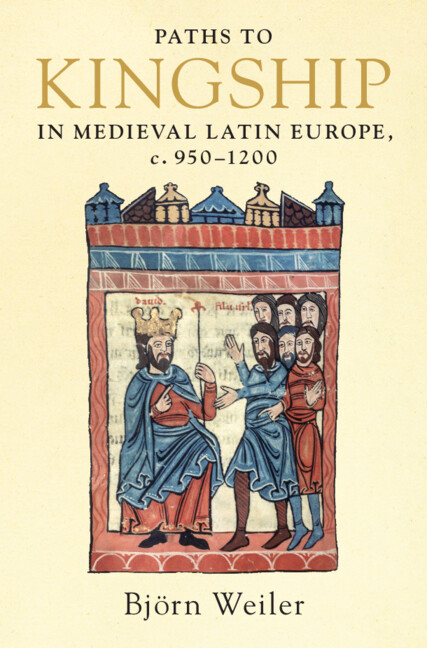
    Medieval Europe was a world of kings, but what did this mean to those who did not themselves wear a crown? How could they prevent corrupt and evil men from seizing the throne? How could they ensure that rulers would not turn into tyrants? Drawing on a rich array of remarkable sources, this engaging study explores how the fears and hopes of a ruler's subjects shaped both the idea and the practice of power. It traces the inherent uncertainty of royal rule from the creation of kingship and the recurring crises of royal successions, through the education of heirs and the intrigue of medieval elections, to the splendour of a king's coronation, and the pivotal early years of his reign. Monks, crusaders, knights, kings (and those who wanted to be kings) are among a rich cast of characters who sought to make sense of and benefit from an institution that was an object of both desire and fear.

    Reviews

    ‘From the different strategies for designating royal heirs, to the behind-the-scenes preparations for coronations, to the contested idea of sacral kingship, Weiler leaves no stone unturned in examining the process of becoming king during the central middle ages. This is an extraordinary transeuropean history on an impressive scale.’

    Jonathan Lyon - University of Chicago

    ‘Weiler gives us a strikingly innovative comparative history of medieval kingship. The work spans all of medieval (Latin) Europe, with meticulously uniform attention to the acquisition, contestation, and retention of royal office - in the context of political communities, and the nexus of norm and practice. An instantly indispensable, magnificent achievement.’

    Piotr Górecki - University of California, Riverside

    'W. B.'s challenge was to explain the secular society of the early Middle Ages using forms. This bet has been fully won, thanks to a careful reading of these documents, informed by a completely up-to-date international bibliography.'

    Simon MacLean Source: Francia recensio

    ‘Weiler’s thought-provoking work is rich in detail and will be a staple text for all those wishing to further their understanding of the nature of medieval kingship.’

    Stephen Donnachie Source: Royal Studies Journals

    Refine List

    Actions for selected content:

    Select all | Deselect all
    • View selected items
    • Export citations
    • Download PDF (zip)
    • Save to Kindle
    • Save to Dropbox
    • Save to Google Drive

    Save Search

    You can save your searches here and later view and run them again in "My saved searches".

    Please provide a title, maximum of 40 characters.
    ×

    Contents

    Metrics

    Altmetric attention score

    Full text views

    Total number of HTML views: 0
    Total number of PDF views: 0 *
    Loading metrics...

    Book summary page views

    Total views: 0 *
    Loading metrics...

    * Views captured on Cambridge Core between #date#. This data will be updated every 24 hours.

    Usage data cannot currently be displayed.

    Accessibility standard: Unknown

    Why this information is here

    This section outlines the accessibility features of this content - including support for screen readers, full keyboard navigation and high-contrast display options. This may not be relevant for you.

    Accessibility Information

    Accessibility compliance for the HTML of this book is currently unknown and may be updated in the future.
