

… a very steady hiss type of static, the origin of which is not yet known.2
Karl Guthe Jansky was the first person to look at the Universe from outside the traditional visible light window. His presentation, with the innocuous title “A Note on Hiss Type Atmospheric Noise,” stunned the small group of radio scientists who heard his talk at the 27 April 1933 Washington meeting of the US National Committee of the International Union of Radio Science (URSI). Although cautioned by his employer, Bell Laboratories, to avoid any sensationalism, following several years of meticulous research aimed at improving the reliability of the AT&T long distance telephone circuits, Jansky announced that he had detected radio noise from the Milky Way Galaxy. Subsequently, the effect of the US economic depression followed by Jansky’s increasing defense-related responsibilities limited any further work at Bell Labs on what Jansky called his “Star Noise.” However, starting in 1937, Grote Reber, a young radio amateur and recent engineering graduate, working alone with a homebuilt antenna, followed up Jansky’s pioneering work and made the remarkable discovery that Jansky’s “Star Noise,” unlike the light from the Milky Way, did not come from any normal thermal processes that dominate the light from the planets, stars, galaxies, and other celestial objects. Reber made the first maps of this new nonthermal radio emission from the Milky Way that was later understood to be synchrotron radiation from ultra-relativistic electrons moving in weak cosmic magnetic fields.
The serendipitous detection of nonthermal radio emission from the Milky Way by Karl Jansky, followed by the theoretical interpretation by Soviet astrophysicists, set the stage for the plethora of later – also serendipitous – discoveries of the powerful nonthermal radio emission from radio galaxies, quasars, pulsars, cosmic masers, and other cosmic radio sources that would be discovered by radio astronomers over the next half century and which are described in later chapters.
Star Noise
In 1933, the world was in the midst of the Great Depression. One quarter of Americans were out of work. Two months before Franklin Roosevelt became the 32nd president of the United States on 4 March 1933, Adolph Hitler rose to power in Germany, and two days later he dissolved the German Parliament, beginning the path to global turmoil and destruction. But the turmoil and destruction of the Second World War also led to unprecedented advances in radio technology that would make possible the new science of radio astronomy.
In 1933, the United States passed the 21st amendment to the Constitution repealing prohibition; Wiley Post became the first person to fly solo around the world; Albert Einstein emigrated to the United States; based on James Chadwick’s discovery of the neutron a year earlier, Leó Szilárd conceived the idea of a nuclear chain reaction; the movie King Kong premiered in New York City; the United States went off the gold standard; the legendary gangster John Dillinger robbed his first bank; Paul Dirac and Erwin Schrödinger shared the Nobel Physics Prize; Babe Ruth hit a home run at the first major league All-Star baseball game; and Edwin Armstrong obtained a patent for the invention of FM radio. A gallon of gas cost 10 cents, a loaf of bread 7 cents, but a 3 minute transatlantic phone call using shortwave radio cost $75 and was plagued by noise and fading.
By 1915, using cables and regularly spaced vacuum tube repeaters, AT&T had extended telephone service to reach across the North American continent, but transatlantic service presented more of a challenge. Following experimental systems built in 1923, AT&T started the first commercial transatlantic telephone communication between New York and London in 1927, using very long wavelength 5 km (60 kc) radio transmissions from a 200 kilowatt water-cooled transmitter located in Maine.3 Two operators were required at each end, one “to make contact with the telephone network in her country” while the “other operator directs her attention to the transatlantic link.” But the system was unreliable due to the effects of varying propagation and static, especially during the summer months. Also, at 60 kc, the available bandwidth was limited and there was persistent interference from powerful telegraph transmitters.
In 1925, AT&T created the Bell Telephone Laboratory as its research arm to complement Western Electric, which manufactured the telephone equipment used by AT&T. Three years later, AT&T introduced a new shortwave telephone service between the United States and England and later South America. But the shortwaves brought a new set of difficulties related to the uncertain propagation connected with the time of day, the seasons, and solar activity. Static, especially over the tropical path to South America, and locally generated noise from thunderstorms, electrical equipment, and automobile ignition were all problems.4 Bell Labs engineers were aware that even in the absence of locally generated noise, the noise level was greater when an antenna was connected to a shortwave receiver than when the antenna was replaced by a resistor.5 When Karl Jansky arrived at the Bell Telephone Laboratories on 20 July 1928 at the age of 22, he was assigned the task of understanding the propagation of shortwave radio signals and studying the noise that was limiting the effectiveness of long distance telephone calls, both for the existing long wave operations and the newly inaugurated short wavelength service.
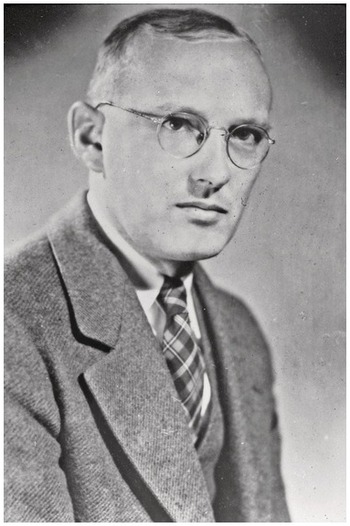
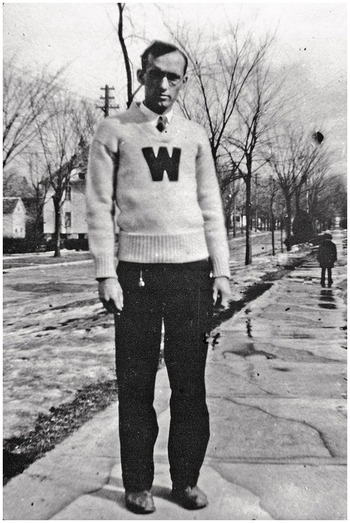
Karl Guthe Jansky (Figure 1.1) was born in the Oklahoma Territory on 22 October 1905, where his father, Cyril, was Dean of the College of Engineering at the University of Oklahoma, and he grew up in Madison, Wisconsin, after his father became a Professor of Electrical Engineering at the University of Wisconsin. Karl was an outstanding student at the University of Wisconsin where he studied physics, and he excelled at sports. During his student years, he starred at right wing for the Wisconsin Badgers ice hockey team (Figure 1.2) and graduated Phi Beta Kappa in 1927. Starting in his college years, Karl first began to suffer from high blood pressure and the chronic kidney disease that would ultimately take his life. After a year in graduate school, Jansky applied for a job at the AT&T Bell Telephone Laboratories but, due to his questionable health, he was turned down. Fortunately, Karl’s older brother, Moreau, who had previously worked at Bell Labs, pulled some strings and convinced AT&T to take a chance and hire Karl. Due to concerns about the possible effect of city pollution on his health, AT&T management sent Jansky to live and work at the Bell Labs’ Cliffwood Beach site in rural New Jersey, instead of at the AT&T Wall Street office in New York City. As it fortuitously turned out, not only was the air quality in New Jersey better than in New York City, but the reduced radio noise from automobiles and industry would facilitate Jansky’s research that resulted in his remarkable serendipitous discovery of radio noise from the Milky Way.6
Karl Jansky.
1928 photograph of Karl Jansky as a University of Wisconsin ice hockey player.
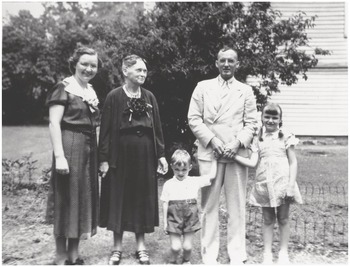
While working at Bell Labs, Karl played tennis and golf and had the highest batting average on the Laboratory softball team. He was the table tennis champion of Monmouth County, New Jersey, and enjoyed bowling, skiing, tennis, and playing chess. Jansky was also a passionate bridge player and avid Brooklyn Dodger baseball fan and was described by his colleagues as very competitive in sports and bridge but friendly, modest, and easy to get along with.7 In 1929, after a year at Bell Labs, Karl married Alice Larue Knapp. Karl and Alice had two children, Anne Moreau and David, and, in spite of the economic uncertainties of the depression, Karl and Alice enjoyed an active social life with fellow Laboratory staff (Figure 1.3).
1938 photograph of the Jansky family. Left to right: Karl’s wife Alice, family friend, son David, Karl, daughter Anne Moreau.
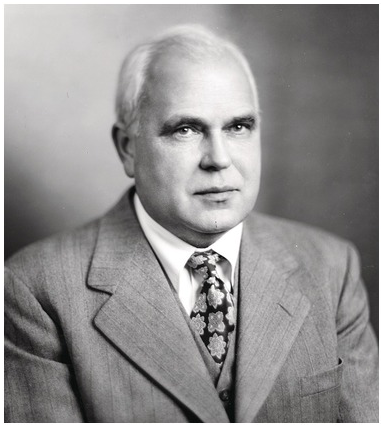
During his entire career at Bell Labs, Karl’s boss was Harald Friis, a well-known Danish engineer who had immigrated to the United States (Figure 1.4). Although Friis and his wife Inge became close personal friends of Karl and Alice and were the godparents to their daughter Anne Moreau, Karl developed a strained relationship with Friis over his work assignments. Fortunately, Jansky’s historic accomplishment is chronicled through the entries in his laboratory notebooks and monthly work reports, both of which have been partially preserved at the Bell Labs Archives, as well as a series of detailed letters that he and Alice regularly wrote to his parents and younger siblings back home in Wisconsin. In particular, in writing to his father, who understood and appreciated the significance of Karl’s work, Karl was able to go into significant technical detail and at the same time discuss the personal challenges of living and working under the prevailing economic constraints.8
Harald Friis, Karl Jansky’s long time supervisor at Bell Laboratories.
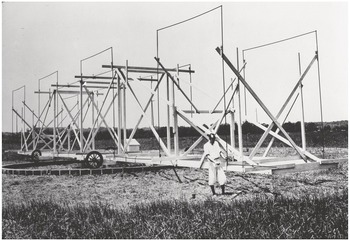
For his long wavelength (near 4,000 m) investigations that partly occupied his first few years at Bell Labs, Jansky adopted the instrumentation and techniques previously developed by Friis.9 However, the short wavelength study was new territory, and he had to design both his antenna and receiver. Since he had studied physics at Wisconsin, Jansky was unfamiliar with radio and electronic terminology, and reflected to his father, “that is what I get for not taking engineering.”10 In order to locate the source of radio noise affecting the shortwave telephone communications, Karl needed a directional antenna, which he based on a design developed by his Bell Labs colleague, Edmund Bruce. The laboratory shops constructed the radiating element from standard 12 foot sections of ⅞ inch diameter brass plumbing pipe as the ¼ wavelength vertical elements of a Bruce Array. A second set of elements acted as a reflector giving Karl a directional antenna having more than a factor of 300 front-to-back ratio (25 db). As shown in Figure 1.5, the whole arrangement was mounted on a turntable using tires from a Ford Model T automobile, and was driven by a motor to make a complete rotation every 20 minutes. Karl’s children, David and Ann Moreau, enjoyed playing on their father’s “merry-go-round.”
Karl Jansky and his Bruce Array at Holmdel, NJ, used for the first detection of cosmic radio emission.
Jansky initially decided to work at a frequency of 20,689.7 kc (14.5 m) which he found was relatively free of radio signals. While continuing his analysis of long wavelength noise, as well as developing a system designed to study ultra-short waves (3 to 6 m), he designed and built the instrumentation needed to study the source of 14.5 m noise, putting particular emphasis on minimizing the noise contribution from his receiver and reducing instabilities and spurious oscillations. He used a bandwidth of 26 kHz, much greater than the 3 to 6 kHz normally used for voice communication, and he averaged the output of his receiver over a period of about 10 seconds to minimize the noise fluctuations. Although his work suffered a setback with the move of the Bell Labs site to a new location near Holmdel, New Jersey, that offered space to accommodate the growing Bell Laboratories staff, there was less local radio noise at the new site, which turned out to significantly benefit his research.
By mid-1930, Karl’s rotating array had been relocated to a new circular track that was constructed at the Holmdel site, and he was able to begin work. He quickly located radio transmissions originating in England and South America. By November, he had located a source of noise toward the southwest. As he wrote to his parents on 5 December, although he was plagued by static or noise from local thunderstorms, he was aware of static that appeared to come from a direction unrelated to any known weather disturbance.11
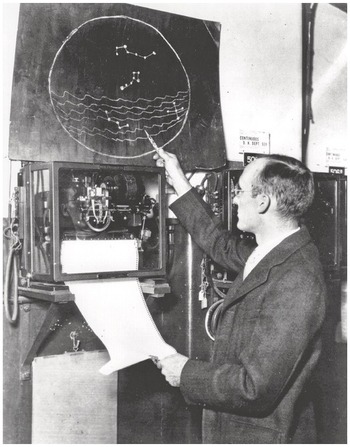
During the first half of 1931, Jansky upgraded his receiving system and obtained more systematic records of his data by attaching a moving chart recorder to the output of his receiver (Figure 1.6). By this time, he realized that he was detecting static unrelated to weather activity over a range of directions from the southeast to the southwest. Following the summer thunderstorm activity, during the 1931/1932 winter, Jansky realized that the noise came from a direction that appeared to change with the time of the day. Although distracted by other Laboratory responsibilities, Jansky recognized that in the morning the noise appeared to come from the east, moved toward the south around noon, and then came from the west in the late afternoon, suggesting an origin associated with the Sun. Around this time, Jansky recognized that his noise, that he called a “hiss,” was not characteristic of the kind of static normally associated with electrical noise or thunderstorm activity. After the birth of his daughter and proudly telling his parents that Anne Moreau “is the best natural baby I have seen in a long time,” Karl excitedly wrote,12
I have been receiving a very weak and very steady static lately that is so very steady that it could be easily mistaken for a signal but which I can definitely show is not a signal. The peculiar thing about the static is that the direction from which it comes changes gradually and what is most interesting always comes from a direction that is the same or very nearly the same as the direction the sun is from the antenna. I have not had much time to put on this problem but as soon as I get two more reports written am going to concentrate on it alone and see what I can find. Sounds interesting doesn’t it.
And in his January 1932 Work Report Karl wrote,
Thunderstorm static was almost completely absent, but there was, and still is, present a very steady continuous interference; the term static doesn’t quite fit it, that changes direction continuously throughout the day going completely around the compass in 24 hours. During the month of December this varying direction of arrival followed the sun almost exactly making it appear that perhaps the sun causes this interference or at least has something to do with it.
Karl Jansky in 1933 at the chart recorder output of his 21 MHz radiometer.
Having no background in astronomy, Jansky did not yet appreciate that, during his winter observations, the Sun was coincidently in the same direction as the Milky Way. Although he continued to spend time with his ultra-short wave system, in preparing for a demonstration to AT&T executives, and in preparing an introductory speech for Friis to give at an URSI Symposium on Static, during early 1932 Jansky recognized that the hiss came earlier each day and was no longer associated with the direction of the Sun. In his April 1932 presentation to the US National Committee for the International Union of Radio Science (URSI)13 and in the first of his three famous papers published in the Proceedings of the Institute of Radio Engineers (Proc. IRE), Jansky described the following three distinct types of static:14
The first group is composed of the static received from local thunderstorms and storm centers. Static in this group is almost always of the crash type. It is very intermittent … The second group is composed of very steady weak static coming probably from [ionospheric] refractions from thunderstorms some distance away. The third group is composed of a very steady hiss type static the origin of which is not yet known.
Apparently, he had not recognized the third group of static until January 1932, but, after going back to examine his earlier data, he reported that:
The static of the third group is also very weak. It is, however, very steady, causing a hiss in the phones that can hardly be distinguished from the hiss caused by [receiver] noise, [and] the direction of arrival of this static coincided with … the direction of the sun. However, during January and February, the direction has gradually shifted so that now [March 1] it precedes in time the direction of the sun by as much as an hour.
Jansky was puzzled as he tried to reconcile the apparent shift of the direction of the static with the lengthening of the day and he eagerly awaited the summer solstice when he expected the direction of the hiss to reverse direction. Throughout this period, Jansky’s monthly work reports showed that he was still spending more time on monitoring the long wavelength recorder than studying the mysterious shortwave hiss. He also spent time each month instructing technical assistants on mathematics, attending committee meetings, and in other assigned Laboratory duties. Due to mechanical breakdowns or overhauls of the rotating array, or to circuit revisions characteristic of his technical background, during the summer and autumn months, the shortwave rotating array was apparently used only over weekends. Only in September did he shut down the long wavelength recording system, “to allow more time to be spent on more pressing problems.”15
After 21 June, when the Sun reached its most northerly declination, instead of reversing as expected, the direction of the static continued to fall behind the Sun at a rate of two hours per month. Now, even further mystified, Jansky consulted his boss, Harald Friis, and other Bell Labs colleagues, who were equally perplexed.16 The breakthrough came from Karl’s close friend, Melvin [Mel] Skellett, a graduate student at Princeton University working for a PhD in astronomy, who recognized the sidereal nature of Jansky’s data. With the help of Skellett, and after consulting several astronomy text books, Jansky finally understood the implications of what he had found and, on 21 December 1932, he wrote to his father,17
I have taken more data which indicates definitely that the stuff, whatever it is, comes from something not only extraterrestrial but from outside the solar system. It comes from a direction that is fixed in space … I’ve got to get busy and write another paper right away before someone else interprets the results in my other paper in the same way and steals my thunder from my own data.
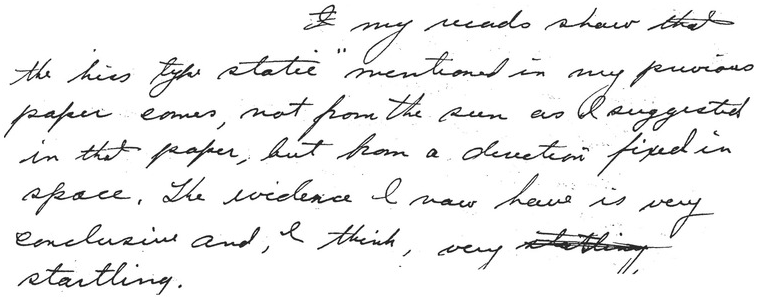
In February, he wrote again (Figure 1.7), “My records show that the ‘hiss type static’ mentioned in my previous paper comes, not from the sun as I suggested in that paper, but from a direction fixed in space. The evidence I now have is very conclusive and, I think, very startling.”18
Excerpt from Jansky’s February 1933 letter to his parents where he writes “my records show that the ‘hiss type static’ mentioned in my previous paper comes, not from the sun as I suggested in that paper, but from a direction fixed in space. The evidence I now have is very conclusive and, I think, very startling.”
Excited about his finding, Karl approached Friis about presenting his work at the June 1933 meeting of the Institute of Radio Engineers (IRE). The meeting was to be held in Chicago and would give him an opportunity to visit his family in Wisconsin. Instead, Friis told Jansky to give his talk at the April meeting of the US National Committee for URSI in Washington, which was closer to Bell Labs, and he cautioned Jansky not to generate undo attention. But, as Karl later wrote to his father,19
I have not the slightest doubt that the original source of these waves whatever it is or wherever it is, is fixed in space. My data proves that, conclusively as far as I am concerned. Yet Friis will not let me make a definite statement to that effect but says I must use the expression ‘apparently fixed in space’ or ‘seems to come from a fixed direction’ etc. etc. … But I suppose it is safer to do what he says.
Following Friis’ strict instruction, Karl simply titled his short 12 minute talk on 27 April 1933, “A Note on Hiss Type Atmospheric Noise,” that, as he complained to his father, “meant nothing to anybody but a few who were familiar with my work.” He was disappointed in the lack of any reaction to his talk and described URSI to his family as “an almost defunct organization … attended by a mere handful of old college professors and a few Bureau of Standards engineers.”20
Karl’s older brother, Moreau, who recognized the significance of Karl’s discovery, was an influential leader of the US National Committee for URSI and stepped in to get Karl some recognition. Through his former contacts at Bell Labs, Moreau arranged for AT&T to issue a press release that drew widespread attention throughout the national and international news media. The 5 May 1933 edition of The New York Times featured a front page “above the fold” article titled, “New Radio Waves Traced to the Centre of the Milky Way.” The next day, the Times “Week in Science” section and the 15 May edition of Time Magazine carried their own stories of Karl’s discovery, and on the evening of 6 May, radio station WJZ in New York and the NBC Blue Network carried a live broadcast of Jansky’s star noise received at Holmdel and sent over the AT&T Long Lines to the studio in New York City.21 In describing his star noise during his radio interview, Jansky explained,
The observations show definitely that the maximum of hiss comes from somewhere on the celestial meridian designated by astronomers as “18 hours right ascension” … But my measurements further show that the radio hiss comes from a point on that 18-hour meridian somewhat south of the equator, that is at about minus 10 degrees in declination … that seems to confirm Dr. Shapley’s calculation that the radio waves seem to come from the center of gravity of our galaxy.
Encouraged by the favorable attention received by Karl’s work, his brother, Moreau, used his influence to get Karl invited to the June IRE meeting that Friis had earlier rejected.22 But now, with the encouragement of more senior Bell Labs management, Karl ignored Friis’ reservations and, as he told his father, he decided to change his title “to suit myself.”23 His IRE talk was published in the Proceedings of the IRE as his now classic paper on “Electrical Disturbances Apparently of Extraterrestrial Origin.”24 In this paper, Jansky reported “that the direction of arrival of these waves is fixed in space, i.e., that the waves come from some source outside the solar system,” and he gives this direction as the “center of the huge galaxy of stars and nebulae of which the sun is a member.”
Aware that his first Proc. IRE paper published the previous year had suggested that the hiss type noise originated in the Sun,25 Jansky also published a short note in Nature, with the title, “Radio Waves from Outside the Solar System.” In this paper, he explained that “the direction of arrival of this disturbance remains fixed in space, that is to say the source of this noise is located in some region that is stationary with respect to the stars,” and gave the direction of the radio noise as “right ascension of 18 hours and declination of ‒10 degrees,” although, as he pointed out, the declination “might be in error by as much as ±30°.”26 Later, in an effort to reach a broader audience, he published an article in Popular Astronomy with a similar title, “Electrical Phenomena that Apparently Are of Interstellar Origin.”27 In these two later papers, we note an increased use of astronomical terminology which Jansky had now mastered. Then, in October, Karl was invited to lecture at the American Museum of Natural History in New York where he boldly used the provocative title, “Hearing Radio from the Stars” and proudly played his “hiss” noise sent over the AT&T lines from Holmdel to New York.
Although Jansky spent most of the next few years working on other problems, including the direction of arrival of ultra-short wave radio transmissions, he did find time to further analyze his star noise data. In July 1935, he traveled to Detroit, Michigan, where he presented his new analysis at the annual IRE meeting. His talk was one of the last in the late afternoon and only a few dozen people stayed at the end of a hot summer day to hear him explain that the radio noise came from throughout the Galactic Plane and that there is an important contrast between the visual and radio sky.28 In the published version of his Detroit talk, “A Note on the Source of Interstellar Interference,” Jansky referred to his 16 September 1932 data as a “typical day’s record” that showed “Beside varying gradually in height throughout the day, the peaks obtained for each revolution of the antenna also change decidedly in shape” (Figure 1.8). In this, the third of his Proc. IRE publications, Jansky concisely summarized the known characteristics of his star noise:29
(a) The radio noise is distributed throughout the galactic plane with the strongest emission coming from the center of the galaxy.
(b) The characteristics of star noise are very similar to the noise generated by vacuum tube circuits suggesting that “it is produced by the thermal agitation of electrical particles.”
(c) Visually the Sun appears brighter than the radiation from all the stars combined, but the reverse is true at radio wavelengths.
Reproduction of Jansky’s 16 September 1932 chart recorder output showing the radio emission from the Milky Way in a 12 hour period as his antenna beam swept across the Galaxy three times an hour. The different response profiles reflect the varying angle of Jansky’s fan beam alignment with the plane of the Milky Way. The lettering at the top of each plot indicates the direction of the antenna beam at that time.
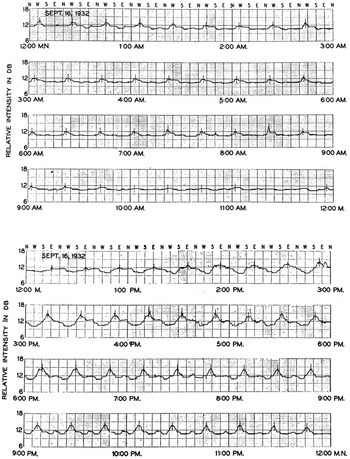
Later, radio astronomy historian Woodruff Sullivan III reanalyzed Jansky’s data taken on 16 September 1932 and, as shown in Figure 1.9, displayed his analysis in the form of a radio intensity image.30
Contour map plotted in galactic coordinates showing the distribution of radio intensity over the sky, constructed by Woodruff T. Sullivan III from Jansky’s 16 September 1932 data.

Around this time, according to Grote Reber, Jansky proposed building a 100 foot diameter transit dish to continue his investigation of star noise at 60 MHz (5 m). However, as Jansky explained to Reber, he was told, “that the proposal was outside the realm of company business.”31
Bell Labs was proud to share in the publicity surrounding Karl Jansky’s unexpected discovery of cosmic radio noise, but it didn’t really contribute to making telephones work better. For a period, Jansky’s “merry-go-round” was used by others for testing antennas, but it ultimately fell into disrepair and the remnants were destroyed. In 1964, a replica of Karl’s antenna was erected at the entrance of the NRAO Green Bank Observatory. Years later, former Bell Labs scientists J. Anthony (Tony) Tyson and Robert (Bob) Wilson located the site of the antenna at Holmdel and, on 8 June 1998, Bell Labs dedicated a memorial model antenna on the site of Jansky’s merry-go-round (Figure 1.10).
Grote Reber (left) and Jesse Greenstein meet again at the 1998 Bell Labs dedication of a memorial monument marking the original location of Jansky’s antenna.

Jansky did return briefly to a measurement of his star noise, using a variety of different antennas to measure its frequency dependence between 5 MHz (60 m) and 23 MHz (13 m). Although he commented on a marginally greater noise at 16.7 m wavelength compared to 14 m, due to interference from diathermy machines and the effects of ionospheric absorption associated with increasing sunspot activity, Jansky’s measurements of the frequency dependence of galactic radio noise were inconclusive. About the same time, Friis and C. B. Feldman, using Friis’s Multiple Unit Steerable Antenna (MUSA), reported the detection of what they referred to as “star static,” with up to a factor of six above receiver noise over a wide range of frequencies down to 10 MHz.32 However, since they were apparently interested in testing MUSA, not in investigating the properties of star static, they did not report any quantitative dependence of how the star noise varied with frequency.
Karl Jansky spent most of the remainder of his career at Bell Labs continuing his research on shortwave radio propagation, as well as investigating the sources of noise that limited radio communication. As was later recognized by Second World War radar operators, Jansky showed that, in the absence of man-made interference, the sensitivity of shortwave radio systems was often limited by cosmic noise, and not by receiver circuit noise.33 In the 1940s, he helped to develop the first microwave repeater systems used by AT&T to carry television signals from New York to Boston.
Increasingly toward the end of the decade, Jansky was called on to work on classified defense-related programs. He was recognized by an Army–Navy citation for his development techniques for the electronic detection of submarines. After the Bell Labs invention of the transistor in 1947, Jansky was one of the first to use transistors to build low noise preamplifiers and received several patents on a radio direction finder or sextant based on the radio emission from the Sun, that was later developed by the Collins Radio Co. for the Naval Research Laboratory. However, his deteriorating health limited his activities and, after a series of strokes, on 14 February 1950, Karl Jansky succumbed to his long illness and died at the young age of 44, before the impact of his discovery of cosmic radio noise was fully appreciated by the astronomical community.
The early 1930s coincided with the 11 year minimum in the level of sunspot activity and a correspondingly low level of ultraviolet radiation that ionizes the upper regions of the earth’s atmosphere, known as the ionosphere. When heavily ionized during periods of enhanced solar activity, the ionosphere reflects radio waves, permitting global shortwave radio communication when radio waves can bounce off the ionosphere and return to the Earth thousands of miles away, well beyond the direct line of sight distance. Similarly, near sunspot maximum cosmic radio waves are reflected back into space, so only near sunspot minima can shortwave cosmic radio emission reach the Earth. The reflectivity of the ionosphere depends not only on solar activity but on the radio frequency (wavelength) as well.34 Above some critical frequency that depends on solar activity the ionosphere is transparent. Radio waves much below the critical frequency are absorbed by the ionosphere.
Jansky was fortunate that he started his experiments just near the beginning of an extended period of low solar activity when the ionosphere was transparent to the incoming galactic radio emission. Had he worked five years earlier or five years later, near periods of enhanced sunspot activity, he likely would not have been able to detect cosmic radio emission. He was also fortunate in choosing to work at a wavelength near 15 m. Had he chosen to work at a longer wavelength, the ionosphere would have appeared opaque even at sunspot minimum; had he worked at shorter wavelengths, the incoming cosmic radio waves would have been too weak for Jansky to detect with the equipment then available to him.
Jansky’s most productive period, in the early 1930s, coincided with the depths of the economic depression with many people out of work. In May 1932, Bell Labs, “discharged” some staff and cut the remaining staff to a four day work week with a corresponding cut in pay, although Jansky and others continued to work five and even six days a week while getting paid for four. He borrowed money from his father, which he paid back in installments, to help buy their new house, and was concerned throughout his career about his medical expenses. Looking for opportunities to continue his star noise research, Jansky wondered about a university position but, aware of his chronic illness and growing family responsibilities, he could not relinquish his relatively secure position at Bell Labs. However, by 1944, to meet the demands of the defense effort, Jansky was working overtime and was thankful for the extra pay he needed to meet the increasing cost of medical care.
Historians, along with Karl’s colleagues and family members, have asked whether or not he was restricted by Friis from continuing his star noise research. In his 1956 book, The Changing Universe: The Story of the New Astronomy, author John Pfeiffer provocatively wrote that, “Rarely in the history of science has a pioneer stopped his work completely, at the very point where it was beginning to get exciting. Yet Jansky did just that … He did all he could to convince his associates and superiors that the work was worth pursuing for practical reasons. But his arguments failed to produce results.”35 In a review of Pfeiffer’s book in Science, Frank Edmondson, from the National Science Foundation, further stirred the pot and suggested that “Jansky’s failure to secure support for continued pure research at Bell Laboratories” may have led the United States to be “lagging far behind other countries in the development of radio astronomy.”36 A few years later, when writing an introductory article in a special issue of Proc. IRE devoted to radio astronomy, Karl’s brother, Moreau, declared that, “his superiors transferred his activities to other fields. He would have preferred to work in radio astronomy.”37
Harald Friis vigorously refuted these assertions, claiming that Karl “was free to continue work on star noise if he had wanted to,” and that Karl had never indicated to him “a desire to continue his star noise work.”38 Moreover, noted Friis, “during this period there had been no interest or encouragement from astronomers and it was not clear in what directions such research should go and what kind of equipment was needed.” Essentially, he argued that Karl felt that having found the source of noise, he had completed that particular project.39
When she learned of Friis’ reaction, Karl’s widow, Alice, animatedly wrote to Karl’s brother,
Harald says that Karl never expressed to him a desire to continue work on his star noise. How incredible, how preposterous, how positively unbelievable. Periodically, over the years that Karl worked under Friis, he would come home and say, “Well, Friis and I had a conference today to discuss what my next project should be, and, as usual, Friis asked what I’d like to do, and as usual, I said, “You know I’d like to work on my star noise,” and as usual, Friis said, “Yes, I know, and we must do that someday, but right now I think --- and --- is more important, don’t you agree?”40
Although Bell Labs management later took a very defensive position regarding Jansky’s activities, other Bell Labs colleagues called the management response a “cover-up.”41 George Southworth explained that, “Most of us, without knowing why, thought intuitively that he had not been dealt with fairly,”42 and another colleague added that Friis was a “dictator [who] wanted things done exactly the way he said.”43
It is difficult after many years to fully understand the accuracy of these later, clearly not unbiased, recollections of who told what to whom, the impact of the economic depression along with the increasing threats of war, the natural financial pressures faced by Bell Labs management, and why certain research topics were pursued or not pursued. However, it is clear from his contemporaneous letters with his family that Karl Jansky clearly understood the scientific importance of his discovery, that he wanted to continue his star noise research, and that he was discouraged by Friis and most other Bell Labs management from presenting his discovery in a way that could best be understood and appreciated. On the other hand, Harold Arnold, a senior AT&T executive, encouraged Jansky to publish and was instrumental in arranging The New York Times and NBC publicity.44 Unfortunately, Arnold died later in 1933 and Jansky lost perhaps his only strong supporter among AT&T management.
Karl Jansky was nominated for the 1948 Nobel Prize in Physics for his discovery of cosmic radio emission, but he died before the explosive growth of radio astronomy in the 1950s and before the importance of his work became widely appreciated.45 Karl Jansky’s name was, however, honored at the 1973 General Assembly of the International Astronomical Union, that passed a resolution declaring “that the name ‘Jansky,’ abbreviated ‘Jy’ be adopted as the unit of flux density in radio astronomy and that this unit, equal to 10‒26 Wm‒2Hz‒1, be incorporated into the international system of physical units.”46 Also, each year, the National Radio Astronomy Observatory, a federally-funded radio astronomy research center, appoints several young scientists as Jansky Fellows to further develop their careers in radio astronomy along with naming a distinguished scientist to give the annual “Jansky Lecture.” In 2012, the NRAO Very Large Array was rededicated as the “Karl G. Jansky Very Large Array” and it continues to operate as the most powerful radio telescope in the world. In 1998, the Bell Telephone Laboratories dedicated a monument to Karl’s memory located at the site of his “merry-go-round.” In a message read at the ceremony, Sir Bernard Lovell wrote, “There can be few occasions when such observations have not only had such profound consequences but also belong totally undisputed to one man – Karl Jansky.”
Cosmic Static47
In their early experiments with radio waves, both Heinrich Hertz and Guglielmo Marconi used parabolic structures to focus their radio waves. But it would take a young engineer, Grote Reber, working by himself in Wheaton, Illinois, to make the important step of designing, building, and then using a large parabolic dish to study Jansky’s star noise.
Grote Reber was born in Chicago, Illinois, on 22 December 1911 and grew up in the Chicago suburb of Wheaton. Apparently, his parents were slow to decide on a name so his birth certificate merely listed his name as “Baby Reber.” He was called Grote by his family, his mother’s maiden name, and it was not until he was 20 years old that he officially had his name verified on a revised birth certificate by the authority of the Cook County Clerk, Richard E. Daley, who later became the infamous major of Chicago.
Grote’s father, Schuyler Colfax Reber, who was named after Schuyler Colfax, the US Vice President during the Grant administration, was a lawyer and part owner of a canning factory. Before her marriage, his mother, Harriet Grote, was an elementary school teacher. Among her seventh and eighth grade students at Longfellow School in Wheaton was Edwin Hubble, who, she later informed Grote, was “a bright boy.” As a youth, Red Grange, the legendary football star for the University of Illinois and then the Chicago Bears, delivered ice to the Reber home before the family acquired an electric refrigerator.
While still in high school, Reber obtained his amateur radio license, W9GFZ,48 signed by the then Secretary of the Interior, Herbert Hoover. Reber later recalled that, in the late 1920s and 1930s, he and other radio amateurs knew that if they connected an antenna to their receiver, when the various stages were tuned to the same frequency the noise level would increase; but no increase was noted when this same procedure was repeated with the antenna disconnected.49 Probably they had detected galactic radio noise, but did not realize this until many years later. After contacting more than 60 countries with his amateur radio station, Reber was looking for new challenges. He was intrigued by Jansky’s papers, which he read in Proc. IRE, and had listened intently when Jansky’s “star noise” was rebroadcast by the NBC Blue Network in May 1933.
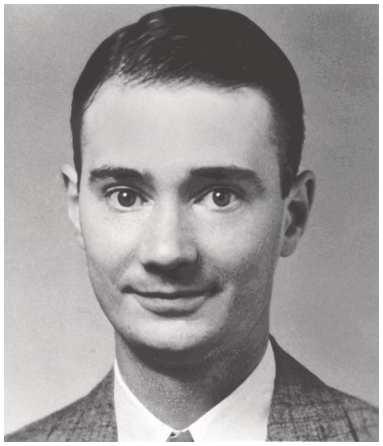
After graduating in 1933 from the Armour Institute of Technology (now the Illinois Institute of Technology) with a degree in electrical engineering, Reber held a series of jobs with various Chicago companies developing consumer broadcast radio receivers and later military electronics. While working in Chicago he wrote to Jansky, asking if he could come to Bell Labs to work on star noise,50 but he was surprised and disappointed to learn that Bell Labs did not plan any further work on cosmic radio emission. Reber then contacted various observatories and university departments but he found little interest among the astronomers of the time, who were busy with their own projects. He tried to interest Otto Struve and other astronomers at the nearby Yerkes Observatory in Williams Bay, Wisconsin, but Struve was dismissive of Reber’s inquiry. As Reber later described it, “The astronomers were afraid, because they didn’t know anything about radio, and the radio people were not interested, because it was so faint it didn’t even constitute an interference – and so nobody was going to do anything. So I thought, well if nobody is going to do anything, maybe I should do something”51 (Figure 1.11).
Grote Reber at age 27.
Reber was aware that attempts to interpret and understand Jansky’s observations failed by a large factor. So he did not want to merely confirm Jansky’s work, but wished to understand the nature of the galactic radio emission by investigating “how does the intensity at any wavelength change with position in the sky,” and “how does the intensity at any position change with wavelength?”52 He recognized that instruments used by Jansky and others were effectively monochromatic, that is they worked only at one frequency or over a very small range of frequency. As he later explained, Reber decided to build on techniques used in optical astronomy, asserting that, “I consulted with myself and decided to build a dish.”53 To supplement his background in engineering and to enhance his understanding of optics and astronomy, Reber took classes at the University of Chicago. As part of the requirements for Philip Keenan’s class in astrophysics, Reber wrote a report on “Long Wave Radiation of Extraterrestrial Origin,” in which he tried to interpret the surprisingly strong Milky Way radio emission reported by Jansky.54
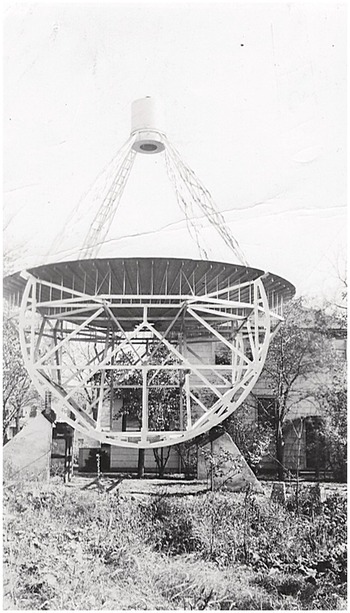
So that he could better estimate the sensitivity he would need to detect interstellar radio emission, in April 1937, Reber wrote again to Jansky inquiring about the absolute intensity of the galactic radio emission.55 After receiving Jansky’s response, Reber took leave from his job at Stewart, Warner, and Belmont Radio in Chicago and, that summer, at the age of 25, using his own funds, he designed and built a 31.4 foot (9.6 m) parabolic dish in a vacant lot next to his mother’s house.56 Except for some help from his next door neighbor with the heavy lifting of the metal surface plates, Reber worked entirely by himself with no outside contractors. To keep the construction simple, Reber’s dish moved only in elevation and was oriented to observe along the meridian. In contrast to Jansky’s antenna, that moved only in azimuth, Reber’s antenna could look at any elevation and depended on the rotation of the Earth to scan across the sky. Except for the galvanized iron surface plates and fasteners, Reber constructed his antenna entirely out of wood.57 Like Jansky, Reber made use of scrapped parts from an old Model T truck as part of the elevation drive system. Curious neighbors could only speculate about the purpose of the unfamiliar structure rising in the small town of Wheaton, but Reber’s mother found it a convenient place to hang her washing (Figure 1.12).
Reber’s 32 foot Wheaton antenna, with the Reber family home in the background.
Jansky’s observations were made at 20.5 MHz (14.5 m). Reber understood that a heated body would radiate over a wide range of the electromagnetic spectrum, and that for any given temperature the level of radiation should increase as the square of frequency.58 Also, he wanted to go to as high a frequency (short wavelength) as possible, to obtain the best possible angular resolution to study the distribution of galactic radio noise.59 He initially decided to observe at 9 cm (3,300 MHz) which was the shortest feasible wavelength for the then existing technology. At that frequency, he anticipated that galactic radio noise would be about 25,000 times stronger than Jansky had observed at 20.5 MHz and where he would have a resolution of about 0.5 degrees compared with Jansky’s resolution of about 35 degrees.
Using his experience and skills as an electrical engineer and radio amateur, Reber meticulously designed and built a radio receiver using a homemade crystal detector followed by an amplifier. He placed his receiver and half wave dipole feed at the focal point of his antenna, with the connecting wires running through a coal chute to his observing room in the basement of his mother’s house. By the spring of 1938 he had completed the construction of his antenna and receiver and eagerly anticipated being able to detect radio emission from the Galaxy. But to his surprise and disappointment, Reber was unable to detect any cosmic radio noise. After pointing his antenna toward the Milky Way, he also tried to detect radio noise from a few bright stars, the Sun, the Moon, and several nearby planets, all with negative results.
Although disappointed by his inability to confirm Jansky’s detection of galactic radio noise, as well as the failure to find radio emission from the other likely targets, Reber drew the important conclusion that “Perhaps the actual relation between the intensity of celestial radiation and frequency was opposite from Planck’s law,”60 and so was not ordinary thermal radiation. This was the first recognition of what is now called nonthermal radio emission.
Undeterred, Reber rebuilt his receiver to operate at the longer wavelength of 33 cm (910 MHz) where more sensitive and more stable instrumentation was available. But still, he had no success. Finally, he reluctantly decided to accept the reduced resolution of going to an even longer wavelength and built yet another receiver that operated at 1.9 m (162 MHz) closer to the 20 MHz system used by Jansky. In order to improve the sensitivity of the 160 MHz receiver, Reber used a regenerative vacuum tube detector preceded by a newly-developed RCA tube as a radio frequency amplifier. With this more sensitive equipment, in late 1938 Reber finally succeeded in detecting Jansky’s galactic radio noise at 1.9 m wavelength, which he called “cosmic static.” But he was only able to study this cosmic static at night when interference from passing automobile ignition was at a minimum and when the stability of his receiver was not degraded by solar heating. Having no recording equipment, Reber laboriously wrote down the output of his receiver every minute. In the daytime Reber returned to his job designing broadcast radios in Chicago, where he commuted one hour each way by train.61 Upon arriving home, Reber would catch a few hours’ sleep each evening before returning to his night’s observing. On weekends, he analyzed his data. By the summer of 1939, just before the start of the Second World War, he was able to confirm Jansky’s observations that the maximum radiation came from a direction close to the center of the Galaxy. Again, he attempted to detect radio emission from a few bright stars such as Vega, Sirius, and Antares, as well as Mars and the Sun, and he made the important conclusion that there is little correspondence between the brightness of the sky at radio and optical wavelengths.
Grote’s younger brother, Schuyler, who was a student at the Harvard Business School, put Grote in contact with Fred Whipple and Harlow Shapley at the Harvard College Observatory.62 Although Whipple expressed interest in Reber’s accomplishments,63 Shapley, who had previously been in contact with Jansky, remained reluctant to get involved with something that no one at Harvard knew anything about and claimed that they could not start any new activities as they were already over-committed to other programs.64
Wanting to reach out to astronomers, Reber submitted his paper, with the title “Cosmic Static,” to the Astrophysical Journal (ApJ), where it was received with skepticism by the editor, Otto Struve. According to Jesse Greenstein, then a young astronomer at the Yerkes Observatory, since Reber had no academic connection and unclear credentials, his paper produced a flurry of excitement and uncertainty at the ApJ editorial offices at the Yerkes Observatory located north of Chicago.65 Reber later complained that, since the astronomers didn’t understand how the radio waves could be generated, they felt that “the whole affair was at best a mistake and at worse a hoax.”66 At various times, Bart Bok, Otto Struve, Subrahmanyan Chandrasekhar, Philip Keenan, Jesse Greenstein, and Gerard Kuiper traveled to Wheaton to evaluate Reber’s radio observations and equipment and also to evaluate Reber. According to Greenstein, Kuiper apparently only reported that Reber’s apparatus “looked modern” and that his work “looked genuine.”
Fortunately, Harvard professor Bart Bok wisely cautioned Struve that he could not afford to turn down the paper because it might “be a great success.”67 Reber’s former professor at the University of Chicago, Philip Keenan, put in a good word for Reber and, after extensive exchanges of letters between Reber and Keenan, Struve finally published “Cosmic Static” as a short note in the ApJ.68 But the ApJ paper did not include Reber’s theoretical speculations that the galactic radio emission was due to electron–ion interactions in the interstellar medium.69 Meanwhile, fed up with the delays at the ApJ, Reber submitted a very similar paper to the Proc. IRE where Jansky had published most of his pioneering papers. Proc. IRE also questioned Reber’s interpretation, but nevertheless published his manuscript in full, four months before the ApJ paper appeared, ironically including his theoretical analysis that had been rejected by the ApJ.70 As Reber later claimed,71
Otto Struve didn’t reject my 160 MHz paper. He merely sat on it until it got moldy. I got tired of waiting, so I sent some other material to the Proceedings of the IRE. It was published promptly in the February, 1940 issue. From a much slower start, this beat the ApJ by four months. During the early days of radio astronomy, the astronomy community had a poor track record. The engineering fraternity did much better!
Struve finally became convinced that Reber’s work had promise and encouraged him to seek external funding. With the encouragement of Struve and Jesse Greenstein, Reber unsuccessfully tried to negotiate with the University of Chicago and the Office of Naval Research (ONR) to move his antenna to a quieter site at the McDonald Observatory in Texas. But they could not agree on how to recover the cost of moving the antenna and operating a radio observatory in Texas. Greenstein had also been fascinated by Jansky’s discovery of cosmic radio noise and, following his visit to inspect Reber’s equipment, Greenstein and Reber became “moderately good friends”72 and together wrote what was the first review of the new field of radio astronomy.73 Greenstein and Struve suggested that Grote receive an appointment at the University of Chicago, so the university could administer the program and collect overhead costs from ONR. But Reber insisted on preserving his independence and was not interested in working for the university. He explored the possibility of continuing his astronomy research while remaining an employee of his company, that he proposed would administer ONR funding, but this never came to fruition. Later, following an exchange of letters with George Southworth, Reber explored the possibility of funding from Bell Laboratories, but that too turned out to be unrealistic.
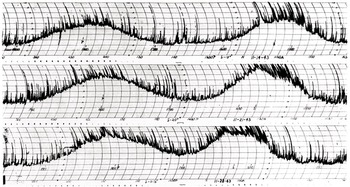
Due to a chronic hearing impairment, Reber was exempt from Second World War military service. From about the age of 40, he wore a hearing aid, that he found convenient to turn off if he did not want to bother hearing what others were talking about. During the War, he worked for a limited time at the Naval Ordnance Laboratory in Washington on the protection of naval vessels from underwater explosive devices. After returning to Wheaton, Reber made several improvements to his system. He built a new, more sensitive receiver with an RF amplifier, modified the feed, increased the bandwidth, and importantly purchased a chart recorder so he did not need to be present to write down the meter readings. He reported these technical improvements in a new paper published in Proc. IRE,74 along with a discussion of the impact of automobile ignition noise. As in his two previous papers, as well as those to follow, Reber again used the title, “Cosmic Static” (Figure 1.13).
Reproduction of Reber’s 160 MHz chart recordings from three separate days in late 1943. Each scan is at a different declination. The two bumps indicate the plane of the Milky Way on the left and the Sun on the right. The multiple sharp spikes show ignition noise from passing automobiles.
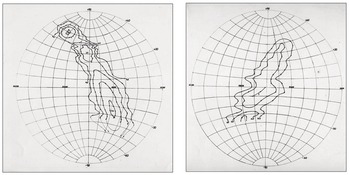
Using his new instrumentation, Reber went on to systematically map the entire sky visible from Wheaton by changing the elevation of the antenna each day and letting the rotation of the Earth scan the sky. He converted his fixed elevation scans of the sky to a two-dimensional 160 MHz map that he published in the ApJ.75 Reber’s maps (Figure. 1.14) clearly showed the pronounced maxima at the Galactic Center and what were later recognized as the Cygnus A/Cygnus X complex of sources, the Cassiopeia A (Cas A) radio source, and evidence for galactic structure. Reber was also finally able to detect radio emission from the Sun. Although he noted that the Sun was a surprisingly strong radio source, like Jansky, he realized that even if all the stars in the Galaxy radiated with the same radio intensity as the Sun, this would fail to account for the radio emission from the Milky Way by a factor of 10 billion.
160 MHz maps of galactic radio emission. Left image, looking toward the central region of the Galaxy. Right image, looking toward the outer parts of the Galaxy away from the Galactic Center.
As a result of his Chicago job as a radio engineer, Reber had access to state-of-the-art test equipment and the latest microwave vacuum tubes, so he set out to build a new receiver and feed to work at a shorter wavelength of 62 cm (480 MHz) with the goal of improving his angular resolution. But he was surprised that the 62 cm radiation was weaker than at 1.9 m, although he later appreciated that he made the important discovery that the celestial radiation was not due to thermal radiation described by the Raleigh-Jeans radiation formula, but was a new type of nonthermal radiation.76 Over a 200 day period in 1946, Reber repeated his observations at 480 MHz and produced a more detailed map of the radio sky. His new higher resolution observations now separately revealed what was later recognized as the strong radio galaxy Cygnus A, the supernova remnants Cassiopeia A and the Crab Nebula, a structure in the Milky Way, and showed the presence of the strong radio source at the center of the Galaxy.77 The identification of the strong Cas A radio source and the Crab Nebula with the remnants of supernovae that occurred near the end of the seventeenth century and in 1054 CE, respectively, is discussed in Chapter 3.
Encouraged by his successes and increasing interest from the astronomy community, Reber developed an ambitious plan to build a 220 foot (61 m) fully steerable version of his Wheaton antenna. But he was not able to raise the money for his dish, which he estimated would cost $100,000. Nevertheless, his design became the basis for the next generation of large radio telescopes that were built much later at Jodrell Bank, Effelsberg, and in Green Bank.
By 1947, Reber realized he could no longer effectively compete with the increasing government funded radio astronomy activities in the United Kingdom and Australia as well as in several US laboratories. In 1948, he went back to Washington to work at the National Bureau of Standards (NBS) and sold his antenna and receivers to the Bureau. He had his antenna disassembled and moved to Sterling, Virginia, near the present location of the Dulles International Airport, where it was re-erected on a turntable, so that it could be steered in azimuth as well as elevation. But there is no record of any successful use of Reber’s dish at the Bureau of Standards. In 1959, the dish was re-erected, with Reber’s supervision and help, near the entrance to the National Radio Astronomy Observatory in Green Bank, West Virginia.
While at the Bureau of Standards, Reber began to build a set of matched dipoles covering the frequency range from 25 to 110 MHz to measure the absolute intensity of the cosmic static, with the important goal of determining how the intensity of galactic radio emission varies with frequency, and the equally important (to the Bureau) goal of establishing the best frequencies to be used for radio communication. At the same time Reber planned to obtain better resolution using his dish at frequencies up to 1,420 MHz and to construct a larger 100 foot diameter dish.78 However, he never got approval to build the larger dish and there is no record that he ever completed the frequency-dependent measurements to study the variation of galactic radiation with frequency, or attempted to observe the predicted transition of interstellar atomic hydrogen at 1,420 MHz discussed in Chapter 7.
During this time, Reber tried to reach out to a broader audience with accounts of his “Cosmic Radio Noise” and other recent postwar discoveries in the semi-popular magazine Radio-Electronic Engineering, followed by articles in Sky and Telescope, Scientific American, and in the popular Leaflets of the Astronomical Society of the Pacific.79 In these articles, Reber not only described his own work, but speculated, with some imagination, on the origins of cosmic static, that he emphasized could not be understood in terms of free–free interactions of thermally agitated electrons.
But Reber did not fit in well with the Washington government laboratory culture. He apparently left NBS one day, for a vacation in Hawaii, and never bothered to return. In Hawaii, Reber erected a rotating antenna near the 10,000 foot summit of Haleakala on the island of Maui. This was the first of what would subsequently be many mountain-top telescopes in Hawaii. But he detected more interference than cosmic noise, and his antenna fell down in a storm before he could get any useful observations. Realizing that mountain tops were not the best place for radio telescopes, Reber then turned his attention to very long wavelengths, at the same time that the growing mainstream radio astronomy effort was moving toward shorter wavelengths.
When Reber arrived in Tasmania in 1955, it was near the minimum of the 11 year solar cycle. Although he was encouraged by his initial observations made between 0.5 and 2 MHz (600 and 150 m) at a time of unusually low level of ionospheric absorption,80 subsequent sunspot minima were less favorable for low frequency radio astronomy, and he faced increasing levels of broadcast interference. Nevertheless, Reber built what was then, and probably still is, the largest radio telescope ever built, with a square kilometer of collecting area. But, despite initial optimism, it proved difficult to get any useful astronomical results. He tried, unsuccessfully, to obtain a demobilized ICBM to carry a load of liquid hydrogen into the ionosphere where it would combine with free electrons to make the ionosphere transparent to long wavelength cosmic radiation. For over two decades he relentlessly wrote letters to colleagues, friends, observatory directors, NASA officials, and congressmen to solicit their help, and refused to accept no for an answer. Finally, in 1985, he was able to arrange for the ill-fated NASA Challenger space shuttle to ignite its engines when passing over Tasmania, hoping to create a temporary hole in the ionosphere that would allow the 144 m cosmic radio waves to pass through. The results were encouraging, but it was unrealistic to follow up with more extensive studies.81
Unlike Karl Jansky, whose work was supported by arguably the world’s leading industrial laboratory, Grote Reber worked alone as an amateur, relying on his deep curiosity along with his imagination and skills as a professional engineer, combined with a persistent forceful personality and stubborn disregard for conventional views. While Jansky was uniformly described by his colleagues as quiet and modest, Reber, by contrast, proudly believed in himself and paid no attention to establishment science, except to express his disdain. “There were no self-appointed pontiffs,” he explained, “looking over my shoulder giving bad advice. The kinds of things I want to do are the kind establishment men will not have any part of.”82 As his nephew Jeff Reber (Schuyler’s son) later noted, “He obviously learned to ignore the opinions of those he didn’t agree with.”83 Reber had no patience for negotiation or compromise, and he was always forcefully direct in choosing his words. Grote Reber always made it clear what he wanted and why he wanted it.
Working by himself, Reber relentlessly pursued his own study of Jansky’s important discovery, and for a decade he was the only person in the world devoting significant effort to this new and unexplored field. After designing and building his own antennas, receivers, and test equipment, he worked in a previously unexplored region of the electromagnetic spectrum. His 31.4 foot home-built radio telescope was the largest parabolic dish ever built at that time, and remained so until 1951, when the US Naval Research Laboratory built a 50 foot dish in Washington, DC. Although Karl Jansky was the first to detect cosmic radio noise, it was Grote Reber who finally convinced astronomers that the radio spectrum was a new window to understanding the Universe. Through his meticulous investigations at 160 MHz and then 480 MHz, Reber
(a) built the first facility intended to investigate cosmic radio emission;
(b) demonstrated the concentration of radio noise along the Galactic Plane with evidence for structure possibly associated with the location of the spiral arms in the Milky Way;
(c) provided the first clear demonstration that the galactic radio emission was nonthermal in origin;
(d) showed the first evidence for the discrete radio sources, including what later were identified with two supernova remnants, a radio galaxy, and the center of the Milky Way;
(e) independently discovered the nonthermal emission from the quiet Sun and later the intense solar radio bursts;
(f) understood that if all the stars in the Galaxy were like the Sun, it could not explain the observed level of galactic radio emission;
(g) was the first to recognize and advocate the importance of long wavelength radio astronomy, although it would be more than half a century before the technology was sufficiently mature to make possible instruments such as LOFAR in the Netherlands and the Murchison Widefield Array (MWA) in Australia; and
(h) brought radio astronomy to the attention of future leaders of the field such as Jesse Greenstein, who later started the radio astronomy program at Caltech and was instrumental in the creation of the National Radio Astronomy Observatory (NRAO), and Otto Struve, who became the first director of NRAO.
Like Jansky, Reber never won a Nobel Prize, although he was nominated in 1950, two years after Jansky.84 His first maps of the nonthermal galactic radio emission provided much of the incentive for the discoveries discussed in later chapters of this book. He remained active in research nearly until he died in 2002, two days before his 91st birthday, but his most productive years were those in Wheaton before age 35. Except for the three years that he spent in Washington at the National Bureau of Standards, Reber never received a salary for his radio astronomy work, or support from any of the conventional funding sources such as the National Science Foundation, NASA, or the Department of Defense. Except for a total of about $200,000 in grants he received from the privately operated Research Corporation from 1951 to 1981, his research was supported entirely from his personal funds. As a result of a small inheritance from his father, wise investments, and a frugal lifestyle, Reber was financially comfortable and was able to fund his own research.
To save the cost of postage, Reber reused stamps by writing “return to sender” in replying to correspondence, and rather than hire someone to cut his grass, he allowed his neighbor’s sheep to graze in his yard. In order not to waste paper, he drew circuit diagrams and wrote letters and reports on the back of old bank statements or received letters. Being independent of conservative referees and committees that constrain modern research (Chapter 12), and driven by his own curiosity, engineering skills, and uncanny insight, Reber was able to initiate his unconventional research that has changed our understanding of the Universe in a fundamental way.
From the time he left Wheaton in 1947, Reber became increasingly outspoken against the growing trend to build large expensive facilities for radio astronomy, which he felt was a waste of money.85 Although, unlike Jansky, Reber was recognized with several major prizes for his pioneering discoveries, his determined rejection of mainstream astronomy, and his reluctance to accept conventional wisdom without detailed scrutiny led to his increasing isolation from the astronomical community. But his broad curiosity about everything he came in contact with steered him to additional research in a variety of fields ranging from radio circuitry and ionospheric physics, to cosmic rays, meteorology, botany, geophysics, and archeology. He held several patents, including one on a radio sextant that could be used to determine terrestrial positions on cloudy days. His controversial experiments growing beans and observing the difference between vines that wound clockwise and those that wound counter-clockwise brought considerable notoriety.86
Other Early Investigations of Galactic Radio Noise
While Karl Jansky’s discovery of galactic radio noise generated a lot of interest within the astronomical community, professional astronomers, who had little understanding of radio or electronics, considered his star noise as more of an interesting curiosity rather than an opportunity for further research. There were, however, a few important exceptions. One astronomer who took notice of Jansky’s discovery was Joel Stebbins, the Director of the University of Wisconsin’s Washburn Observatory. Karl’s father proudly informed him that in a lecture that he attended in Madison, Stebbins compared Jansky’s discovery to Charles Lindbergh’s solo flight across the Atlantic, although greater.87 But Stebbins, like other astronomers of the time, did not appear to entertain any thoughts of extending Jansky’s observations to other frequencies or to other possible cosmic sources of radio emission.
After his 1933 Chicago talk, Jansky sent copies of his paper to Princeton astronomer Henry Norris Russell, and to Harlow Shapley, Director of the Harvard College Observatory. Later he met with both Russell and Shapley to discuss the implications of his discovery and how his work might be extended. Shapley considered repeating Jansky’s experiments at Harvard, but, discouraged by the cost and Harvard’s unfamiliarity with anything to do with radio or electronics, he apparently lost interest and did not pursue it. However, Fred Whipple, who was a young Harvard professor, had a clever idea on how to confirm Jansky’s discovery. Whipple proposed building a directional rhombic antenna on the dome of the Harvard 60 inch telescope so he could use the rotation of the dome to scan his antenna around the sky but was unable to get permission from Shapley and never got to try his scheme.88
Caltech Professors Fritz Zwicky and Gennady Potapenko were also impressed by Jansky’s work and similarly thought about building a steerable rhombic antenna to detect galactic radio emission. But they were apparently unable to convince Caltech president Robert Millikan to support the project.89 Potapenko gave a talk at the Caltech Astronomy and Physics Club on “The Work of the Bell Laboratories on the Reception of Shortwave Signals from Interstellar Space,”90 and in the spring of 1936, Potapenko and his student Donald Folland tried to reproduce Jansky’s work. First, they built a small loop antenna on the roof of the Caltech Physics Building to detect Jansky’s star noise at 20.55 MHz (14.6 m), close to the frequency used by Jansky. But automobile ignition noise from their site overlooking busy California Boulevard frustrated their experiments. To get away from the noise of Pasadena, they moved their experiment out to the nearby desert, where they fastened one end of a 35 foot wire to a 25 foot mast. One person walked the slanted wire around the pole to exploit the directivity of the arrangement while the other took data. They were able to detect a maximum radio signal toward the direction of the Galactic Center and later a second maximum in the Cygnus constellation, but Millikan discouraged them from publishing their results and was unwilling to support their proposed joint research with Zwicky (Figure 1.15).
Potapenko and Folland’s late 1930s experimental setup confirming Jansky’s reported galactic radio noise.

Other early confirmations of galactic radio noise were by John H. DeWitt in the United States, Kurt Fränz in Germany, and K. F. Sander in the United Kingdom.91 DeWitt, who had previously been an associate of Jansky at Bell Labs, tried unsuccessfully to confirm Jansky’s results in 1935 using a simple 300 MHz (1 m) antenna. But in 1940, he succeeded in detecting galactic radio emission at 111 MHz using a large rhombic antenna and confirmed that the maximum signal came from a direction close to that of the Galactic Center. DeWitt later went on to head Project Diana, that successfully bounced the first radio signals off the Moon in January 1946 (Chapter 9).
During the early years of the Second World War, the German Luftwaffe used a 30 MHz navigational aid known as Knickebein to support aircraft raids on Britain. Kurt Fränz was a German radio engineer who, like Jansky, was an expert on radio noise and had read Jansky’s Proc. IRE papers. Fränz had studied physics, chemistry, and mathematics at Berlin University under people like Einstein, Heisenberg, Schrödinger, and Planck, so he knew his physics. While working at the large German Telefunkenen Laboratories, Fränz received reports from military authorities of excess noise in their 30 MHz radar receivers, which he recognized as probably related to Jansky noise. Fränz followed up by building a simple dipole array, using it to confirm that the direction of maximum sky noise was in the direction of the Galactic Center. His wartime paper reported his measurements of the apparent radio temperature of the Milky Way as between about 10,000 K and 100,000 K and significantly noted that it was considerably stronger than Reber had observed at 160 MHz. In this surprising wartime German publication of potentially sensitive radar-related technology, Fränz was the first to describe cosmic noise in terms of an astrophysical meaningful temperature.92
Shortly after the end of the Second World War, K. F. Sander, working at the British Radar and Research Development Establishment, observed galactic radio noise at 60 MHz using a simple 4-element dipole array, and demonstrated the rapid decrease in intensity with increasing frequency. Fränz and Sander were primarily trying to understand under what conditions external (cosmic) noise limited radio communication and when it was limited by internal noise generated in the receiver circuits. Grote Reber, however, was primarily motivated by trying to understand the implications of galactic radio emission to astrophysics.
Understanding Star Noise and Cosmic Static
With little serious interest shown by the astronomical community, and trained as a physicist, Jansky was probably the first person to seriously try to understand the source of his star noise. He made the important connection between properties of his comic “hiss” and “the sound produced in the receiver headset.” As he wrote to his father,93
I now have what I think is definite proof that the waves come from the Milky Way. However, I am not working on the interstellar waves any more. Friis has seen fit to make me work on the problems and methods of measuring noise in general. A fundamental and necessary work, but not very interesting as the interstellar waves, nor will it bring me near as much publicity. I’m going to do a little bit of theoretical research of my own at home on the interstellar waves however …
At the July IRE meeting in Detroit and in his 1935 Proc. IRE paper Jansky made the first crude steps toward understanding the nature of the radio emission from the Milky Way writing,94
One is immediately struck by the similarity between the sounds they produce in the receiver headset and that produced by the thermal agitation of electrical charge. In fact the similarity is so exact, that it leads one to speculate as to whether or not the radiations might be caused by the thermal agitation of charged particles. Such particles are found not only in the stars, but also in the very considerable amount of interstellar matter that is dispersed throughout the Milky Way.
Also, with great perception, Jansky realized that if all the stars in the Milky Way are like our Sun, it could not explain his observed noise from the Milky Way, and so there may be “other classes of heavenly bodies found in the Milky Way,” whose ratio of radio emission to that of heat and light must be much greater than from the Sun. As we now understand, galactic radio noise is indeed generated by the motion of charged electrons, although not by their thermal agitation in the interstellar medium as suggested by Jansky but by synchrotron radiation from electrons accelerated to nearly the speed of light moving in weak magnetic fields. However, Jansky’s bold prediction that there are “classes of heavenly bodies” that radiate more radio emission than they do in the familiar “form of heat and light” has been dramatically confirmed with the subsequent discoveries of such entities as radio galaxies, quasars, pulsars, and cosmic masers that are discussed in Chapters 3, 4, 7, and 8.
As already mentioned, Reber’s interpretation of his 160 MHz observations of cosmic noise as free–free transitions in ionized interstellar hydrogen was deleted from his published paper by the ApJ editor, Otto Struve. However, after an exchange of letters between Reber and his former University of Chicago teacher, Philip Keenan, Struve included a note by Luis Henyey and Keenan, following Reber’s paper, that refined Reber’s calculations. Henyey and Keenan confirmed Reber’s analysis that his cosmic static could be understood in terms of emission from electron–ion interactions in ionized interstellar hydrogen at a temperature of about 10,000 degrees, but they also stressed that “in the case of Jansky’s data the discrepancy is serious.”95
Even earlier, Caltech Professor R. M. Langer was one of the first scientists to try to understand possible mechanisms to explain Jansky’s radio emission from the Milky Way. Langer wrote to Jansky to get a better understanding of the radio observations, and in 1936, he gave a talk to the American Physical Society suggesting that Jansky’s star noise was the result of free electrons combining with ionized dust particles.96
Two astronomers who thought hard about Jansky’s star noise were Harvard graduate student Jesse Greenstein, and Fred Whipple, then a young Harvard faculty member. Whipple and Greenstein correctly noted that, since Jansky had detected galactic radio emission over a range of wavelengths, it could not be the result of any atomic or molecular transition but had to be “a continuum of radiation.” They then went on to consider blackbody radiation, and following up on Jansky’s suggestion they tried to interpret the radio noise as thermal radiation from interstellar cold dust.97 However, as in the case of Henyey and Keenan, their model failed by a factor of 10,000 to account for the intensity of galactic radiation reported by Jansky. Charles Townes, who later won a Nobel prize for his invention of the maser, was a contemporary of Jansky at Bell Labs. Following discussions with Feldman, Jansky and Southworth, Townes was puzzled by extraterrestrial radio noise and, after detailed theoretical calculations, noted that, while Reber’s results might be explained as thermal radiation from interstellar ionized gas at 10,000 degrees, Jansky’s measurements and those of Friis and Feldman indicated temperatures more than an order of magnitude greater.98
None of the calculations based on variations of free–free radiation involving thermally agitated motion of electrons or thermal emission from interstellar dust could explain the large observed intensity of galactic radio emission. Grote Reber was probably the first to recognize that the systematic decrease in intensity with increasing frequency was inconsistent with any thermal radiation process and later commented, “If the data doesn’t fit the theory, change the theory not the data.”99 Although, in 1945, Henk van de Hulst, like any good theoretician, rather than modify the theory, suggested instead that Jansky’s measurement was “too high by a factor of 10 and more.”100
The observation of intense radio emission from the Milky Way by Reber at 160 and 480 MHz, and especially by Jansky at 20 MHz clearly presented a problem for astrophysicists. Curiously, the first clues to breaking the puzzle of the origin of cosmic radio emission came not from any observatory or university but from the General Electric (GE) Company Research and Development Center Laboratory in Schenectady, New York, where GE operated a synchrotron that accelerated electrons to velocities very close to the speed of light. The GE scientists noticed that the so-called ultra-relativistic electrons emitted a bright beam of white light within a narrow cone directed along their direction of motion.101 The complex theory of what later came to be called synchrotron or magneto-bremsstrahlung radiation from ultra-relativistic electrons was independently derived by Julian Schwinger at Harvard and Vasiliĭ Vladimirsky in the USSR based on a long forgotten paper by the British mathematician George Schott.102
The frequency, νmax, of maximum synchrotron radiation depends on the strength of the magnetic field, B, and the square of the electron energy, E, and is given by

where E is expressed in GeV, and B in Gauss. For typical values of E and B found in particle accelerators, νmax is in the visible spectrum as observed by the GE scientists. However, with the much weaker cosmic magnetic fields, synchrotron emission occurs in the radio spectrum.103
Scandinavian scientists, Hannes Alfvén and Nicolai Herlofson, made the connection and suggested that cosmic radio emission might be due to synchrotron radiation from ultra-relativistic electrons moving in weak stellar magnetic fields, an idea that was extended to interstellar magnetic fields by Karl-Otto Kiepenheuer.104 But it was not until the more quantitative papers by the Russian astrophysicists, Vitaly Ginzburg and Iosef Shklovsky, that the astronomical community accepted that synchrotron radiation could explain the observed radio emission from the Milky Way as well as from the newly-discovered radio galaxies, and later quasars, as discussed in Chapters 3 and 4, respectively.105 A crucial step came from Ginzburg’s student, German Getmansev, who showed that if the cosmic ray electron energy distribution is a power law with an exponent, γ, the spectral energy distribution of the radiation is also a power law, with a spectral index α = (1 − γ)/2.106 For cosmic ray electrons with γ = 2.5, the corresponding radio spectral energy distribution is then a rapidly decreasing power law with an exponent ‒0.75, consistent with the observed spectral index of the Milky Way. Since the middle of the twentieth century, synchrotron radiation has been the basis for understanding galactic radio emission, as well as that from extragalactic radio sources. In an extreme example of the competition that sometimes drives scientists, until their deaths in 1985 and 2009, respectively, Shklovsky and Ginzburg bitterly argued over who was first and who deserved the credit for recognizing the importance of synchrotron radiation in understanding cosmic radio emission.


