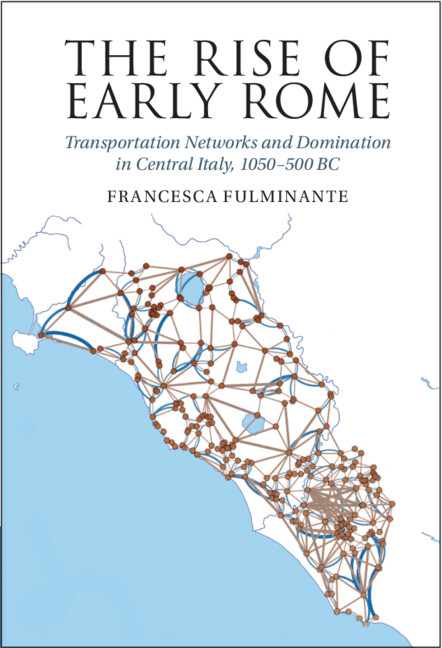

The trajectory of Rome from a small village in Latium vetus, to an emerging power in Italy during the first millennium BC, and finally, the heart of an Empire that sprawled throughout the Mediterranean and much of Europe until the 5th century CE, is well known. Its rise is often presented as inevitable and unstoppable. Yet the factors that contributed to Rome's rise to power are not well understood. Why Rome and not Veii? In this book, Francesca Fulminante offers a fresh approach to this question through the use of a range of methods. Adopting quantitative analyses and a novel network perspective, she focuses on transportation systems in Etruria and Latium Italy from ca. 1000–500 BC. Fulminante reveals the multiple factors that contributed to the emergence and dominance of Rome within these regional networks, and the critical role they in the rise of the city and, ultimately, Roman imperialism.
‘Fulminante’s book is clearly structured and well-written...This book offers a new perspective on the development of early Rome, as well as being a valuable contribution to those interested in applying network science to past transportation systems.’
Joseph Lewis Source: TRAJ, Theoretical Roman Archaeology Journal
‘… it is imperative to underscore the significance of Fulminante’s scholarly endeavor. The book combines the insights of the author’s previous work with innovative methodologies to investigate the early development of Etruria and Latium Vetus, thereby contributing to the scholarly discourse on central Italy.’
Nikoline Sauer Source: Bryn Mawr Classical Review
Loading metrics...
* Views captured on Cambridge Core between #date#. This data will be updated every 24 hours.
Usage data cannot currently be displayed.
This section outlines the accessibility features of this content - including support for screen readers, full keyboard navigation and high-contrast display options. This may not be relevant for you.
Accessibility compliance for the HTML of this book is currently unknown and may be updated in the future.
