
Skip to main content Accessibility help
×
  • Cited by 3
    • Show more authors
    • You may already have access via personal or institutional login
    • Select format
    • Publisher:
      Cambridge University Press
      Publication date:
      12 January 2023
      09 February 2023
      ISBN:
      9781009036450
      9781316511046
      Dimensions:
      (279 x 216 mm)
      Weight & Pages:
      1.22kg, 356 Pages
      Dimensions:
      Weight & Pages:
    • Subjects:
      Art, Western Art
    You may already have access via personal or institutional login
  • Selected: Digital
    Add to cart View cart Buy from Cambridge.org
    Subjects:
    Art, Western Art

    Book description

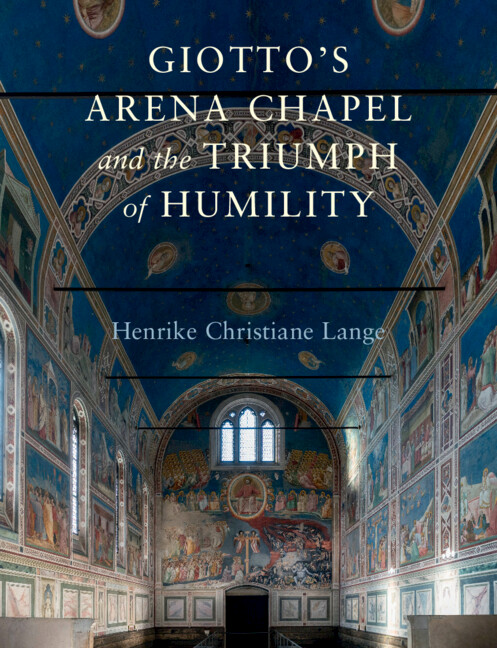
    In this book, Henrike Lange takes the reader on a tour through one of the most beloved and celebrated monuments in the world – Giotto's Arena Chapel. Paying close attention to previously overlooked details, Lange offers an entirely new reading of the stunning frescoes in their spatial configuration. The author also asks fundamental questions that define the chapel's place in Western art history. Why did Giotto choose an ancient Roman architectural frame for his vision of Salvation? What is the role of painted reliefs in the representation of personal integrity, passion, and the human struggle between pride and humility familiar from Dante's Divine Comedy? How can a new interpretation regarding the influence of ancient reliefs and architecture inform the famous “Assisi controversy” and cast new light on the debate around Giotto's authorship of the Saint Francis cycle? Illustrated with almost 200 color plates, this volume invites scholars and students to rediscover a key monument of art and architecture history and to see it with new eyes.

    Awards

    Winner, 2024 PROSE- Humanities, Association of American Publishers

    Reviews

    ‘Giotto’s Paduan masterpiece, the Arena Chapel (ca. 1300–1307), has impressed, but also puzzled scholars since its modern fame began around 1800. Now, Henrike Lange has provided a masterly account of the Chapel as an artistic and theological reconfiguration of Roman triumphalism in the service of the Christian view of the Savior’s triumph through humility. Calling on a wide range of historical and art-historical sources, as well as the theology of Saint Augustine, Lange analyzes the Chapel as a unified structure that constitutes ‘a unique space of transformative painting.’ This rich and challenging work will be of interest to all who are concerned with understanding one of the premier works of Western art.’

    Bernard McGinn - Naomi Shenstone Donnelley Professor Emeritus, Divinity School, University of Chicago

    ‘Dr. Lange’s subject, broadly speaking, is the very foundation of modern Western painting. Her writing grows from a distinctly historical approach and probes the Roman roots of Giotto’s sense of history (which bears strong resemblances to Dante’s thinking about Roman history in the Divine Comedy) … Lange has the rare ability to build bridges for the reader, for instance with her command of European languages that are indeed her metaphorical bridges and allow her to lay out the vast libraries of research on Giotto written in different linguistic and scholarly traditions. The very elegance and clarity of her writing suggest that Lange’s will be a contribution of real significance and will have quite an impact on medieval and Renaissance studies.’

    Giuseppe Mazzotta - Sterling Professor of Italian Language and Literature, Yale University

    ‘A great reading experience … Lange delivers an ingenious treatment of Giotto’s framing faux architecture and meaningful Rahmenbeiwerk. This absorbing book does not see its hero, Giotto, as liberated from ancient Rome, but rather demonstrates that it is exactly Giotto’s resistance to the ghost of pagan antiquity which contributes to his greatest achievements. Lange shows how Giotto creates a Christian form of similitude and overcoming, as triumph - typologically, a triumph of humility as a critical form, and therefore as an argument for Giotto’s modernity.’

    Wolfgang Kemp - Professor of History of Art, University of Hamburg

    Refine List

    Actions for selected content:

    Select all | Deselect all
    • View selected items
    • Export citations
    • Download PDF (zip)
    • Save to Kindle
    • Save to Dropbox
    • Save to Google Drive

    Save Search

    You can save your searches here and later view and run them again in "My saved searches".

    Please provide a title, maximum of 40 characters.
    ×

    Contents

    Metrics

    Altmetric attention score

    Full text views

    Total number of HTML views: 0
    Total number of PDF views: 0 *
    Loading metrics...

    Book summary page views

    Total views: 0 *
    Loading metrics...

    * Views captured on Cambridge Core between #date#. This data will be updated every 24 hours.

    Usage data cannot currently be displayed.

    Accessibility standard: Unknown

    Why this information is here

    This section outlines the accessibility features of this content - including support for screen readers, full keyboard navigation and high-contrast display options. This may not be relevant for you.

    Accessibility Information

    Accessibility compliance for the HTML of this book is currently unknown and may be updated in the future.
