
Skip to main content Accessibility help
×
  • Cited by 3
    • Show more authors
    • You may already have access via personal or institutional login
    • Select format
    • Publisher:
      Cambridge University Press
      Publication date:
      05 May 2022
      26 May 2022
      ISBN:
      9781009058216
      9781316512296
      9781009061018
      Dimensions:
      (229 x 152 mm)
      Weight & Pages:
      0.44kg, 204 Pages
      Dimensions:
      (229 x 152 mm)
      Weight & Pages:
      0.31kg, 204 Pages
    You may already have access via personal or institutional login
  • Selected: Digital
    Add to cart View cart Buy from Cambridge.org

    Book description

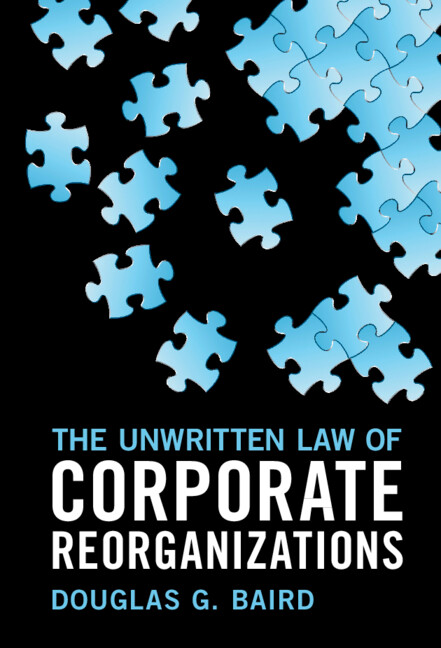
    The law of corporate reorganizations controls the fate of enterprises worth billions of dollars and has reshaped entire sectors of the economy, yet its inner workings largely remain a mystery. Judges must police a small and closed fraternity of professionals as they sit down at a conference table and forge a new future for a distressed business, but little appears to tell judges how they are to do this. Judges, however, are in fact bound by a coherent set of unwritten principles that derive from a statute Parliament passed in 1571. These principles are not simply norms or customary practices. They have hard edges, judges must enforce them, and parties are bound by them as they are by any other law. This book traces the evolution of these unwritten principles and makes accessible a legal world that has long been closed off to outsiders.

    Reviews

    'When the leading bankruptcy scholar of the past generation writes his magnum opus, The Unwritten Law of Corporate Reorganizations is what we get. Reaching back through the centuries, with an especially acute lens on the period from the late nineteenth century to today, Douglas Baird flips the conventional wisdom about corporate reorganization on its head, demonstrating that the solution to financial distress has not been technical legal rules; it has been the unwritten practices of generations of bankruptcy insiders. Baird tells the story in a way no other legal scholar can, with remarkable historical discoveries, vivid anecdotes, subtle analysis, and a prose style that makes The Unwritten Law of Corporate Reorganizations the most unlikely of page turners. It is destined to be a classic not just of bankruptcy, but of American business history.'

    David A. Skeel - S. Samuel Arsht Professor of Corporate Law at the University of Pennsylvania Law School

    ‘An insightful journey through over 200 years of debtors and creditors dealing with financial distress, with fascinating stories brilliantly illuminating the many ‘rules' governing modern restructuring practice. A thoroughly enjoyable must-read for understanding this crucial part of the American economy.'

    Richard Levin - Partner, Jenner & Block, and co-drafter of the Bankruptcy Code

    ‘… Baird’s account of unwritten law yields a framework for making sense of an otherwise puzzling and troubling tendency of bankruptcy law.’

    Vincent S. J. Buccola Source: The Yale Law Journal

    Refine List

    Actions for selected content:

    Select all | Deselect all
    • View selected items
    • Export citations
    • Download PDF (zip)
    • Save to Kindle
    • Save to Dropbox
    • Save to Google Drive

    Save Search

    You can save your searches here and later view and run them again in "My saved searches".

    Please provide a title, maximum of 40 characters.
    ×

    Contents

    Metrics

    Altmetric attention score

    Full text views

    Total number of HTML views: 0
    Total number of PDF views: 0 *
    Loading metrics...

    Book summary page views

    Total views: 0 *
    Loading metrics...

    * Views captured on Cambridge Core between #date#. This data will be updated every 24 hours.

    Usage data cannot currently be displayed.

    Accessibility standard: Unknown

    Why this information is here

    This section outlines the accessibility features of this content - including support for screen readers, full keyboard navigation and high-contrast display options. This may not be relevant for you.

    Accessibility Information

    Accessibility compliance for the HTML of this book is currently unknown and may be updated in the future.
