

Global trade and colonial extraction drew the early modern world closer together, carving out circuits in which silver and gold crossed oceans and continents.Footnote 1 What forms did these metals take, and whose practices constituted these forms? The 3,500 coins in the collection of the Dutch lawyer and numismatist Pieter Verkade offer some answers to this question.Footnote 2 When it was sold in 1849, the public could view it in the Huis met de Hoofden in Amsterdam. Just like the house, which once belonged to the metal trading families De Geer and Grill, the collection was a relic of the time when one axis of world trade had run through the marshlands of Holland before it tilted further to the English southwest. As visitors pulled out the drawers of Verkade’s finely carved mahogany cabinets, a wide world unfurled that was tightly interwoven by coined metal. The collection was naturally rich in Dutch ducats, rixdollars, lion dollars, and ducatons, destined to serve as trading coins in the Baltic, the Levant, and the East Indies. There were rich pickings from all around the Baltic, the Mediterranean, and the Atlantic, of groszys and kopeks, denars and paolis, and escudos and reis. Most foreign coins stemmed from France and England, the principal trading partners, while Indian and Chinese coins were scarce. In short, Verkade’s collection contained some flotsam of a steady flow of bullion, most of which originated in Mexico and Potosí and much of which ended up in China and India.Footnote 3 It was not a representative picture of the early modern world, but its biases and indeed its very existence reflect how Holland served as an important way-station for American silver as it journeyed around the world and filtered through Europe, to be minted and reminted in myriad ways.
This book takes a fresh look at the plurality of European money that leaps out from the pages of Verkade’s catalogue by investigating everyday practices of accounting and material scrutiny. Medieval and early modern Europe was politically fragmented, and many princes, cities, and religious institutions issued their own currency.Footnote 4 Historians writing in a nationalist mould used to describe this as a state of chaos, which was ended only when nation-states consolidated territorial currencies in the eighteenth and nineteenth centuries.Footnote 5 Recent work has upended this narrative as historians developed a conceptual framework, ‘complementarity’, to understand how people used several monies in combination. Akinobu Kuroda has suggested that the chaos is only apparent, as in ‘most if not in all cases, the coexistence of monies was not incidental but functional, since they worked in a complementary relationship. That is, one money could do what another money could not, and vice versa.’Footnote 6 As Kuroda and other historians have shown, people in periods and places as diverse as eighth- and twentieth-century China, medieval central Asia, Dutch colonial South East Asia, nineteenth-century Scandinavia, and the Red Sea region around 1900 combined several currencies, not because they had no other choice, but because they benefited from a division of labour between them.Footnote 7
Complementarity between currencies can also be found in medieval and early modern Europe.Footnote 8 The plethora of currencies in old-regime France looks confusing only to modern observers who assume that money is an all-purpose means of exchange. In contrast, Frenchmen or women of the age found the choice of the right currency less challenging as the standing of their transaction partners gave them clear cues.Footnote 9 Similarly, in the southeast of the Netherlands around 1800, small copper coins served for everyday transactions such as purchasing food or buying drinks in the tavern while larger specie was used for saving, paying taxes, and buying livestock and real estate. People were also very aware of where certain coins were more likely to be accepted, and chose them accordingly.Footnote 10
This new research suggests that knowledge practices such as accounting and material scrutiny, performed at the microlevel of exchange, are key for understanding how early modern currency systems worked. The economist and historian Jérôme Blanc (following Charles Rist) suggests that the structure of complementary currency systems can be understood only if money is ‘viewed from the inside’, that is, from the point of view of the user, and not ‘from the outside’, or from the point of view of an ideal observer. ‘From the inside, it appears that complexity is far lower than only observed from the outside. This difference comes from the fact that money instruments referred to specific uses, areas, social groups, etc.’Footnote 11 The task for historians, then, is to reconstruct how users made these decisions in their everyday life. This book does some of this work for early modern Europe, using rural communities in the Dutch Republic as a vantage point.
Early Modern Money Viewed from the Inside
How did users deal with the potentially confusing monetary system of early modern Europe? What were the everyday practices by which people referred money objects to specific uses, areas, and social groups? How did the existence of multiple currencies give them agency that users of tightly patrolled national currency might not have? This book tackles these questions for the Dutch Republic, an important hub in Europe’s financial system. Emerging in the 1570s through armed struggle for independence from Habsburg Spain, the small country was able to support a large navy and army, protecting its territorial integrity and commercial interests, because of its tradition of public debt and high taxes.Footnote 12 Much of the land that the Dutch rebels claimed as their territory was shielded from the sea and rivers by dykes, sluices, windmills, and accounting systems.Footnote 13 The Bank of Amsterdam, storing gold and silver in its vaults and enabling cashless payments between account holders, became the linchpin of an international payment system soon after its foundation in 1609.Footnote 14 Throughout the Republic’s perceived economic and political decline during the eighteenth century, it remained awash with capital, both in cash and in paper, and exports of coin and bullion remained high or expanded.Footnote 15
This book investigates practices of making and knowing because doing so, I argue, is crucial to understanding the internal logic of early modern money. One focus is on accounting, a set of practices fundamental to early modern trade and finance.Footnote 16 How did merchants, stewards, farmers, and church wardens categorise money objects, and how did they work out the value of goods with pen and paper? Viewed from up close, their practices resemble those of scholars and bureaucrats, which makes the history of information management and metrology directly relevant to this book’s argument.Footnote 17 A second focus is on practices of material scrutiny. The governance of early money relied crucially on artisanal practices of manipulating matter, which means that history of science and technology can help us to answer a number of questions.Footnote 18 How did those working in mints and governments use chemistry and mathematics to define the material value of coins, in spite of fluctuations in the price of silver and gold? How did users investigate the material properties of money objects that they received and spent?Footnote 19 In short, then, this book attempts a new way of historicising money by paying close attention to skilled practices that have created, sustained, and undone the ability of objects (such as coins) to serve as money. In order to capture this dynamic between skilfully made objects and knowledgeable users, the notion of money as social technology is developed in Chapter 1 and used throughout the narrative.
This focus on making and knowing aligns my project with debates on the emergence of capitalism, in which the Dutch Republic plays an important role.Footnote 20 Recent work argues that basic categories of capitalism are contingent outcomes of conceptual change and material processes.Footnote 21 Commodities are not given, as in the analysis of social scientists, but rather are the product of cultural practices that have a place and a time.Footnote 22 Markets do not simply exist but are the historical result of the labours of countless, nameless clerks interacting with office technology.Footnote 23 Transforming cash into capital required bookkeeping technology but also certain habits of the mind; capitalism has therefore been ‘a way of seeing, a mode of organizing and conveying knowledge’.Footnote 24 The economy, new work has argued, is assembled, and even time itself, within which capitalism operates, has been shown to be the result of its very operations.Footnote 25 In the following chapters, I extend this line of inquiry into another basic category of capitalism and analyse money and price formation within the political and economic framework of the Dutch Republic.
Within this political economy, money was created and circulated both by public institutions and by private individuals, which means that ‘state’ and ‘market’ actors have to be studied in interaction. Concretely, this book looks at how the practices of minters, assayers, and government officials interlocked with those of farmers, merchants, and accountants. It investigates how public authorities counted on users to uphold monetary standards, and how individuals used public money to sustain their livelihoods. This approach builds on recent work about the ‘complementary relation between private and public institutions’Footnote 26 in medieval and early modern trade. Ingrid Houssaye Michienzi, Oscar Gelderblom, and Francesca Trivellato have shown how merchants combined institutional support from European cities and states, networks within their communities, and codes of conduct shared across cultures to trade in the fragmented world of early modern Europe.Footnote 27 Their argument resonates with recent work in the history of money. Kuroda suggests that merchants and peasants were generally happy to use state currency as long it was accepted by their trading partners; if not, they resorted to issuing their own, endogenous money.Footnote 28 In a similar vein, Luca Fantacci argues for Renaissance Italy that there was complementarity between the ‘laws of the prince’ setting the value of small coin often above their material value, and ‘laws of international markets’ which kept the value of large gold and silver coins stable.Footnote 29 Princes frequently debased (that is, reduced the precious-metal content of) smaller coins because their value in street-level transactions did not depend as much on their material value as it did on the laws of the realm. The weight and fineness of gold coins, in contrast, were rarely altered because these qualities were what made them valuable in other territories. Issuers and users of currency worked in tandem towards the ‘maintenance’ of the system.Footnote 30 The Enlightenment philosopher Adam Smith and his followers have argued that money is essentially the result of private individuals agreeing on a common means of exchange, whereas the German economist Georg Friedrich Knapp and the chartalist school have considered it primarily a creation of the state.Footnote 31 This book is agnostic about the origin and essence of money, and instead studies how market and state actors joined forces to make money work.
The following chapters strategically foreground a rural society far removed from the commercial and political centres of the Dutch Republic, because this will put the interaction of public institutions and private individuals into greater relief. Most historians of the Dutch Republic have tended to focus on professionals in urban settings.Footnote 32 In contrast, the narrative of this book unfolds from communities in the eastern provinces near the German border, that were rural, engaged in subsistence rather than commercial farming, and were governed by aristocratic families through a bundle of feudal rights and obligations (see Figure 0.1). What was life like in this region? Dutch paintings of the period often show the marvellous polder landscapes of Holland and Zeeland, that were reclaimed from the sea, gridded with canals, and dotted with windmills. Soils in those areas were rich, and richly manured, and commercial farming yielded plentiful harvests. The countryside was replete with villages, the next town or city was never far, and, as a consequence, population densities were higher than in most parts of Europe, or indeed, the world.Footnote 33 In contrast, the landlocked regions in the east of the Dutch Republic were nothing like this.Footnote 34 They were composed of sandy ridges forced up by glaciers and strewn with swampy lowlands. Only a limited range of crops would grow in these poor soils, typically winter rye in a three-year crop cycle with buckwheat (rye–rye–buckwheat), and also flax.Footnote 35 The capital-intensive, large-scale reclamation and improvement schemes so common in Friesland or Holland were unknown in these regions before the nineteenth century. Most people lived in the countryside, and the population density was low compared with Holland, but much in line with the rest of continental Europe.Footnote 36 Nuclear villages and free-standing farmsteads were nested on small elevations, girdled by arable land and surrounded by large swathes of common land where turf was cut and sheep were grazed. The rural setting meant that households were arguably more open to non-monetary exchange, as the division of labour was less developed than in more urbanised areas. They produced a similar basket of goods and had a large pool of non-specialised manual labour; marketplaces were further away and the distribution of goods through resident shopkeepers and itinerant pedlars was less developed.Footnote 37
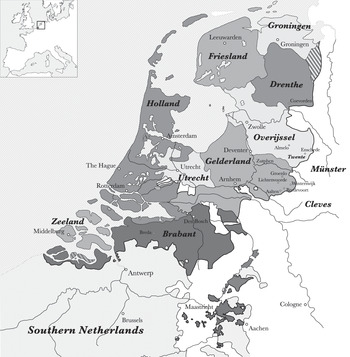
Yet through its markets and its manors, this region was part of the Dutch world-economy. For example, the aristocrat Ursula Philipota van Raesfeld (1643–1721) belonged to the commercial and fashionable world of European nobility as the wife of the important diplomat and military leader Godard van Reede, but she was also the lady of a small manor house in eastern Gelderland, from which she collected rents, fees, and dues.Footnote 38 These payments came in a mix of coin and commodities. Tenants paid twenty large silver coins (daalders), a pig (or four daalders), six pounds of flax, a goose, two chickens, fifty eggs, four cartloads of peat, and a third of the harvest. This was the standard fare for eastern Gelderland tenants at that time, but that was not all of it. They also paid six pounds of sugar from the Canary Islands, a pound of pepper, and a pound of ginger.Footnote 39 Where did Philipota’s tenants procure these products from? In all likelihood from a local retailer. In nearby Winterswijk in 1639, a farmer ordered sugar from the town of Deventer some 50 km away to impress his wedding guests; by 1694, ginger, pepper, and sugar were readily available at the village shop.Footnote 40 By the end of the Golden Age, commodity chains extended from Asia and America to ‘traditional’ economies in the rural east of the Dutch Republic.Footnote 41 The barns and kitchens of the east were as much part of a globalising world as the Bourse of Amsterdam. Both marginal and closely linked to the powerhouse of Dutch merchant capitalism, the eastern fringe of the Dutch Republic is therefore an excellent vantage point from which to take a fresh look at early modern money.
The details of the Republic’s monetary system and the increasing monetisation of the social fabric of the Netherlands are well known.Footnote 42 However, scholars have rarely put an emphasis on how people combined many types of money in their everyday life.Footnote 43 Most of this book’s narrative proceeds by analysing the monetary practices of farmers, stewards of manors, country merchants, church wardens, priests, and preachers. Pioneers such as Natalie Zemon Davis have shown that such a view from the ground up can deepen our understanding of social and cultural history, while Francesca Trivellato has used microhistory to write about understudied aspects of early modern trade.Footnote 44 Anne Goldgar reconstructed a single event, tulipmania, in vivid detail to explore how Dutch society at large was ‘grappling with its material values and the relations they bore to their social ones’.Footnote 45 Sceptics of this approach may ask how the stories of a small number of individuals can tell us anything about early modern history in general. The answer is obvious, as Ulinka Rublack pointed out in a recent monograph about one single witchcraft trial: ‘by setting them in broad enough context’.Footnote 46
In sum, then, this book studies money as social technology in the early modern world from the vantage point of the Dutch Republic. It aims to view early modern money ‘from the inside’ by studying everyday practices of makers and users of money, especially in a rural society in the east of the Dutch Republic. It analyses how public institutions (through minters, assayers, and government officials) and private individuals (farmers, merchants, and accountants) interacted in the creation and maintenance of Europe’s system of currencies. The specific focus of this book is on accounting practices and practices of material scrutiny because, I argue, they offer a key to understanding the internal logic of early modern money.
The Book’s Narrative
The book’s narrative picks up at the apogee of the Dutch Republic in the seventeenth century, when the country was a major centre in the European world-system and when hundreds of monies were used alongside each other. It concludes at a point when this plurality was profoundly reconfigured by more uniform national currency in the nineteenth century. The book argues that everyday practices generated and sustained the ability of money objects to be exchanged for something else across time, space, and social divides. Mints, banks, and professionals but also ‘ordinary users’ such as farmers and labourers forged links between matter and value by creating evidence about objects and by circulating or accepting this information. They could also undo these links by voicing doubts and refusing other people’s evidence. Objects then lost their ability to act as money. The book shows how over time links between matter and value were made more durable through increasing attention to the material properties of money objects and how, paradoxically, this made it more plausible to think of money in immaterial terms. The rationalisation of early modern monies into national currency was pursued by state officials, patriotic economists, and financial experts at political centres, and it ultimately diminished the role that users played in the maintenance of the system.
Chapter 1 develops the notion of money as social technology which carries the analysis throughout the subsequent, more narrative chapters. The vivid case of a clandestine Catholic congregation in the east of the Netherlands, which used money to restore its social and material fabric, is placed alongside insights drawn from scholarship about Chinese, African, and Pacific history. The core idea is that technology is a relationship between people, objects, and meaning. Technology refers to a technique exercised within a social context which gives meaning to both the maker and the made object. In the present case this means that an object is turned into money when makers and users make it fungible, that is, when they imbue it with qualities that allow it to be reliably exchanged for something else. This technological approach brings into focus how money objects bring forth and change social structure; and, conversely, where social structures are techniques that create and transform money objects.
Farmers and other rural folk are often pictured as distant from financial centres and invoked as the last groups to monetise their transactions during a long process of modernisation. By treating grain as money and by comparing barns to banks, Chapter 2 raises important questions about this accepted picture and about the boundaries of financial history as a discipline. This chapter explores how a community in eastern Gelderland sowed, tended to, harvested, stored, and kept track of grain. People, I argue, sustained the material integrity of grain, but, more importantly, they also sustained grain’s ability to act as currency in social interaction. Volume measures, owned privately but calibrated by local authorities, were key for the monetisation of grain. Furthermore, I introduce the notion of ink money, normally associated with urban merchants and bankers who made and unmade money by formal accounting, in order to make sense of farmers’ finance in the Dutch countryside. Unlike trade among merchants, where both parties could produce ledgers when challenged, farmers keeping accounts often dealt with illiterate people. These account books provide indirect evidence that day-labourers and smallholders could record and transact monetary value by way of mental accounting. This memory money was more precarious than its written counterparts, but could be validated by oral testimonial in local courts.
Chapter 3 shows how stewards of the princes of Orange-Nassau employed a specific money of account, the Artois pound, to manage land, livestock, and corvée labour across the family’s fifty domains, one of which was the lordship of Bredevoort. The Artois pound was not minted as coins, and nobody in Bredevoort used it to make or receive payments. As an accounting convention, it existed only as ink on slips of paper and in bound volumes and thus required constant scribal labour to be valuable. The stewards’ trained eyes and hands parsed the multiplicity of Bredevoort’s coins, animals, grains, and labour into homogeneous money objects that had currency across the entire accounting system, but not beyond. As the chapter shows, such a system using homogeneous money was also imagined by the mathematician and engineer Simon Stevin, and while he failed to install double-entry bookkeeping in the domains of the Orange-Nassau family, the stewards shared his ideals of surveillance and profit. A series of instructions provided the script for the audit rituals that were performed year after year and that left their traces on the pages of the accounts. Even the divine played a role in sustaining the value of Artois pounds, as God was invoked in the oath that stewards swore.
The first three chapters develop a method of studying money as social technology by reconstructing the techniques that turned objects into money and sustained their monetary qualities. The subsequent two chapters use this method to understand the workings of coinage, which was the type of money that arguably had the widest social and geographical reach in the early modern world. The Dutch guilder served as a global currency in the seventeenth and eighteenth centuries, but its production was intensely local. Chapter 4 explores how artisanal knowledge helped sustain early modern monetary order by making and unmaking the intrinsic value of precious metal. Intrinsic value was a conceptual tool and a material practice that allowed people to collapse many coins into one another and to forge units from multiples. Effectively, this meant establishing a network of corresponding values between specific batches of coins. The papers of a family of assayers from The Hague offer a fine-grained picture of the processes involved. Small differences in the precious-metal content of coins aroused creeping suspicion, anger, and even physical violence because it was believed that the metal of a coin reflected the mettle of a person. This was particularly true for the masters of the mint, whose reputation was tied to the reputation of their coins. Making coins, and making them work, involved financial and legal expertise, but the artisanal knowledge of assayers and other metal-workers was key. Their practices such as sampling, using high-precision balances and powerful acids, note-taking, the rule of three, and algebraic calculation allowed people to hold on to the convention that metals had an intrinsic, quantifiable value in spite of fluctuations in the price of silver and gold, both across time and across the globe.
Chapter 5 examines taxonomic practices of merchants and other users of money to better understand how early modern coins worked in circulation. After-death inventories offer insights into people’s domestic taxonomies, that is, into practices of classifying, labelling, and compartmentalising the money that people encountered as they went about their lives. Mercantile and institutional account books show how people linked different currencies. Assayers’ conclusions, derived from testing tiny specks of matter, were disseminated widely in broadsheets, coin tariffs, and conversion tables, but also in privately collated notes and letters. This information allowed early modern people to relate coins to one another and to convert them into monies of account which were much more homogeneous. I argue that this work was more than merely coping with chaos. People’s ability to match coins with transaction types and geography marked out circuits for specific currencies. The spaces in which currencies like the Dutch guilder could circulate freely thus emerged from the ground up. Users’ taxonomic practices were just as crucial for upholding monetary order as the knowledge work performed by assayers, minters, and government officials.
Chapter 6 chronicles how money as social technology was reconfigured during the eighteenth and nineteenth centuries. It examines economic and philanthropic discourse as well as government practice between 1750 and 1850 to explain the motives for a quick succession of currency reforms in the nineteenth century, that profoundly transformed the material properties of public money in circulation. Over the seventeenth, eighteenth, and nineteenth centuries, the technology of refining and minting changed until industrial-scale manufacturing of coins became the norm. Cheap but precise mass production was especially important in order to issue low-denomination coins, used primarily for wage payments and retail, that would be fully conversant with the official monetary standard. The chapter aims to explain why the Dutch came to take a more hostile stance towards multiple currencies circulating in their territory; and how they came to believe that a clear break from their tradition of monetary plurality would be necessary to ease the exchange of goods. In particular, it delineates how a ‘national economy’, forged through monetary exchange, became first an ideological and then a bureaucratic reality. The ideals and practices of a national economy favoured centralised management, but they took shape in civic societies that drew their energy from local initiative. While national currency did not do away with plurality of money in use, especially in the Dutch–Prussian borderland that is the main locale of this book, the strong discourse of technological superiority of uniform, centrally managed currency made it more difficult to think about plurality as something other than chaos – which, as noted above, is this book’s point of departure. The Conclusion returns to main points in the light of the material presented, and offers suggestions on how unresolved questions could be addressed, especially the question of why some things were used as money while others were not.

