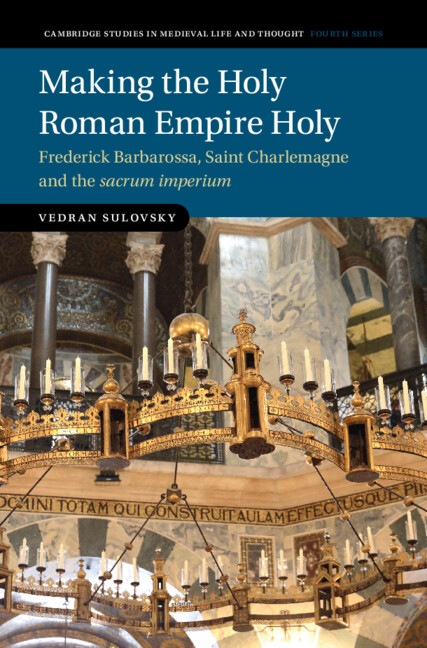
Making the Holy Roman Empire Holy

-
Select format
-
- Publisher:
- Cambridge University Press
- Publication date:
- 16 May 2024
- 23 May 2024
- ISBN:
- 9781009203470
- 9781009203487
- Dimensions:
- (229 x 152 mm)
- Weight & Pages:
- 0.71kg, 398 Pages
- Dimensions:
- Weight & Pages:
You may already have access via personal or institutional login
Show more authors 
You may already have access via personal or institutional login
Book description
How did the Holy Roman Empire (sacrum imperium) become Holy? In this innovative book, Vedran Sulovsky explores the reign of Frederick Barbarossa (1152–1190), offering a new analysis of the key documents, artworks, and contemporary scholarship used to celebrate and commemorate the imperial regime, especially in the imperial coronation site and Charlemagne's mausoleum, the Marienkirche in Aachen. By dismantling the Kulturkampf-inspired view of the history of the Holy Roman Empire – which was supposedly desacralised in the Investiture Controversy, and then resacralised by Barbarossa and the Reichskanzler Rainald of Dassel – Sulovsky, using new evidence, reveals the personal relations between various courtiers which led to the rise of the new, holy name of the Empire. Annals, chronicles, charters, forgeries, letters, liturgical texts and objects, relics, insignia, seals, architecture and rituals have all been exploited by Sulovsky to piece together a mosaic that shows the true roots of sacrum imperium.
Awards
Long-listed, 2025 First Book Prize, The Royal Historical Society
Reviews
‘Sulovsky has produced a work that is breathtaking in its range, its erudition and the reimagining of this important moment in the history of the Holy Roman Empire. Its significance in the understanding of modern German historiography is another rich element in this study. The connection between visual culture and historical interpretation is another highlight of this work. This book is stimulating, thought-provoking, and should be read by anyone interested in this period in German history.’
Judith Collard Source: Parergon
‘Sulovsky’s work is meticulous, especially the first two chapters investigating the diplomatics of the Aachen chancery. … This is important work … Sulovsky sets a very high bar for any future work on this question, but he also points to new avenues for work within the existing manuscript evidence.’
Evan Kuehn Source: Reading Religion
Contents
Contents
Metrics
Full text views
Full text views helpTotal number of HTML views: 0
Total number of PDF views: 0 *
 Loading metrics...
* Views captured on Cambridge Core between #date#. This data will be updated every 24 hours.
Usage data cannot currently be displayed.
Accessibility standard: Unknown
Why this information is here
This section outlines the accessibility features of this content - including support for screen readers, full keyboard navigation and high-contrast display options. This may not be relevant for you.
Accessibility Information
Accessibility compliance for the HTML of this book is currently unknown and may be updated in the future.