
Skip to main content Accessibility help
×
  • Cited by 3
    • Show more authors
    • You may already have access via personal or institutional login
    • Select format
    • Publisher:
      Cambridge University Press
      Publication date:
      30 March 2023
      06 April 2023
      ISBN:
      9781009221627
      9781009221658
      9781009221672
      Dimensions:
      (229 x 152 mm)
      Weight & Pages:
      0.67kg, 344 Pages
      Dimensions:
      (229 x 152 mm)
      Weight & Pages:
      0.52kg, 344 Pages
    You may already have access via personal or institutional login
  • Selected: Digital
    Add to cart View cart Buy from Cambridge.org

    Book description

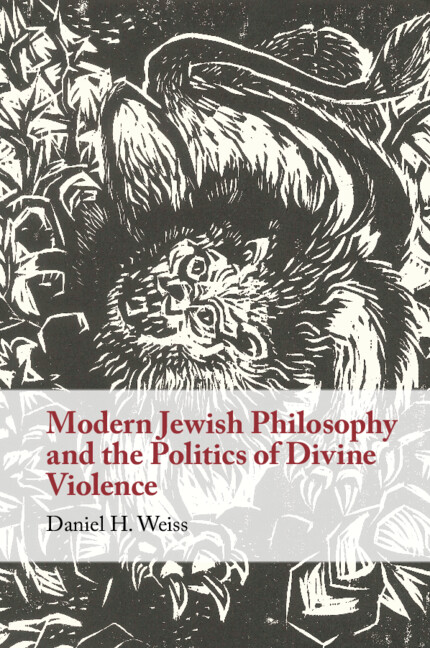
    Is commitment to God compatible with modern citizenship? In this book, Daniel H. Weiss provides new readings of four modern Jewish philosophers – Moses Mendelssohn, Hermann Cohen, Franz Rosenzweig, and Walter Benjamin – in light of classical rabbinic accounts of God's sovereignty, divine and human violence, and the embodied human being as the image of God. He demonstrates how classical rabbinic literature is relevant to contemporary political and philosophical debates. Weiss brings to light striking political aspects of the writings of the modern Jewish philosophers, who have often been understood as non-political. In addition, he shows how the four modern thinkers are more radical and more shaped by Jewish tradition than has previously been thought. Taken as a whole, Weiss' book argues for a fundamental rethinking of the relationship between Judaism and politics, the history of Jewish thought, and the ethical and political dynamics of the broader Western philosophical tradition.

    Reviews

    ‘Bridging modern Jewish philosophy and classical rabbinic sources, Daniel Weiss argues that a commitment to divine sovereignty does not produce but rather mitigates human violence. Weiss offers new and compelling readings of a number of seminal modern Jewish philosophers, while also setting forth a provocatively fruitful vision of modern Jewish philosophy as not merely the product of modern Europe but rather as the rightful inheritor of classical Jewish thought. Anyone interested in Judaism, modern philosophy and indeed the relationship between religion and politics will have much to gain from this timely and important book.’

    Leora Batnitzky - Princeton University

    ‘Weiss shows the urgent relevance of both the classical rabbinic tradition and modern Jewish philosophy by reading each in light of the other – with unexpected results that challenge our understanding of human and of divine violence. What begins as a close study of surprising continuities within Judaism becomes a forceful critique of the Western philosophical tradition and its insufficient regard for the living individual.’

    Holger Zellentin - University of Tübingen

    ‘Daniel Weiss has written a highly original consideration of the relationships between modern German-Jewish thought, classical rabbinic thought, and some of the core questions of political violence. Every thinker considered appears in a new light: Mendelssohn and Cohen are no longer so staid and bourgeois, Rosenzweig no longer so otherworldly, Benjamin no longer so disconnected from rabbinics. Instead, all four appear as rabbinic-anarchic critics of sovereign violence, articulators of an alternative mode of reason that challenges philosophy and political theology alike.’

    Samuel Hayim Brody - author of Martin Buber’s Theopolitics

    ‘With refreshingly careful treatment of Moses Mendelssohn, Hermann Cohen, Franz Rosenzweig, and Walter Benjamin, Weiss shows how their Jewish theopolitical thought is informed by rabbinic Judaism. Along the way he demonstrates that they have been poorly understood by their Christian and other mainstream critics, who in turn have subjected their thought to the terms of dominant discourses and imaginaries. Weiss thus walks the reader through a rich and inspiring landscape of these Jewish critical engagements with the structures of the modern state and its corresponding violence. Christian political theologians and others will find in Modern Jewish Philosophy and the Politics of Divine Violence a badly needed window for understanding early Christian theopolitics, which, considered without such Jewish sensibilities, have been systematically domesticated to authorize and fuel the violence of the modern state. I expect that the book will be for others what it has been for me, a gift for the imagination of a messianic politics.’

    Tommy Givens - Fuller Theological Seminary

    ‘Weiss’s readings of these canonical philosophical works is always generative and persuasive, especially insofar as he emphasizes Jewish philosophy as a site of resistance to Christian political supremacy.’

    Martin Kavka Source: The Journal of Religion

    Refine List

    Actions for selected content:

    Select all | Deselect all
    • View selected items
    • Export citations
    • Download PDF (zip)
    • Save to Kindle
    • Save to Dropbox
    • Save to Google Drive

    Save Search

    You can save your searches here and later view and run them again in "My saved searches".

    Please provide a title, maximum of 40 characters.
    ×

    Contents

    Metrics

    Altmetric attention score

    Full text views

    Total number of HTML views: 0
    Total number of PDF views: 0 *
    Loading metrics...

    Book summary page views

    Total views: 0 *
    Loading metrics...

    * Views captured on Cambridge Core between #date#. This data will be updated every 24 hours.

    Usage data cannot currently be displayed.

    Accessibility standard: Unknown

    Why this information is here

    This section outlines the accessibility features of this content - including support for screen readers, full keyboard navigation and high-contrast display options. This may not be relevant for you.

    Accessibility Information

    Accessibility compliance for the HTML of this book is currently unknown and may be updated in the future.
