


4.1 Introduction
After formally adopting their respective competition laws, India and Pakistan were faced with the task of implementing them. The first step in this regard, for both countries, was to establish their national competition authorities. The Indian government adopted a measured approach in doing so: on 31 March 2003 it brought certain provisions of the Indian Act into force, and on 19 June 2003 it brought into force certain others. On 14 October 2003, the Indian government issued a notification for establishing the Competition Commission of India, the CCI.Footnote 1 However, even before the government had issued the notification establishing the CCI, a petition was filed before the Indian Supreme Court challenging the provisions relating to the CCI’s composition.Footnote 2 The decision in this petition led to the amendment of the Act and to the reconstitution of the CCI.Footnote 3 Consequently, it was only in 2009 that the CCI was properly constituted and commenced operations, however only with respect to anti-competitive agreements and abuse of dominant postition.Footnote 4 Unlike its Indian counterpart, the Pakistan government acted with alacrity and certitude in operationalising the Pakistani competition regime: it brought all sections of the Pakistan Competition Ordinance 2007 into force at the same time and established the Competition Commission of Pakistan – the CCP – within six weeks of the promulgation of the 2007 Ordinance.Footnote 5 Consequently, while the CCP started issuing orders in respect of anti-competitive agreements, abuse of dominant position and mergers from 2008, the CCI’s first orders were only issued in 2009 and then only in respect of anti-competitive agreements and abuses of dominance.
The different paths through which the CCI and the CCP had been established notwithstanding, they were (and are) the instruments through which the Indian and Pakistani competition legislations were translated from being laws on the books to laws in in action. The operations of the CCI and CCP also provide critical insight into the impact of the process through which competition legislation is adopted, on its subsequent implementation. Both the CCI and CCP derive their structure, composition, and mandate from the provisions of their competition legislations, which had been shaped through the transfer mechanisms and institutions employed by the countries at the adoption stage. In issuing their orders, both the CCI and CCP interpret and enforce provisions of their respective legislations, which orders therefore reflect not only the interplay of the structures, compositions, and mandates of the CCI and the CCP, but also reveal their understanding of their role in their respective economies. In this way, the decisions of the CCI and CCP are shaped not only by their internal dynamics but also the extent of the compatibility and legitimacy of the competition legislation under which they have been established. This chapter provides an overview of the operations of the CCI and the CCP with the aim of establishing the relationship between the adoption and implementation stages of the Indian and Pakistani competition laws.
To this end, this chapter is organised as follows: Section 4.2 introduces the CCI and the CCP as the first tier Indian and Pakistani competition authorities focusing on their structures, composition, and mandates, the types of orders they may issue, and the processes through which they arrive at their decisions; Section 4.3 traces the implementation trajectories envisaged by the Indian and Pakistani competition laws and identifies the potential points of interaction between the competition systems established under the adopted competition legislations and the pre-existing legal systems of the two countries; Section 4.4 identifies, evaluates and compares these indicators to assess the success (or lack thereof) of the CCI and CCP in enforcing the competition. Finally, Section 4.5 examines the extent to which the CCI and CCP’s performance may be traced back to the mechanisms and institutions employed by the countries in the adoption stage and their respective compatibility and legitimacy in their contexts.
4.2 The Indian and Pakistani Competition enforcement Authorities
Notwithstanding the differences in the motivations, mechanisms, and institutions through which India and Pakistan adopted their competition legislations, the competition authorities established by these legislations not only have similar structures, mandates, and compositions but also adopt comparable procedures for sanctioning infringements.
4.2.1 CCI and CCP: their Structures, Mandates, and Compositions
The structure of a competition authority refers to its organizational design – is it established as an independent body or is it embedded within the pre-existing system? Is it collegiate or hierarchical? Is it self-funded, or dependent on the government for funding? The mandate refers to the powers of the authority to take cognisance of infringements of the competition legislation and to issue orders in respect of these infringements while its composition refers to the requirements for appointing and removing members to the authority.
4.2.1.1 Structures: The Limits of Independence
The Indian Act and Pakistani Act (as well as the three Ordinances that preceded it) respectively provide for the CCI and the CCP to be established as autonomous, statutory collegiate bodies. The CCI comprises a chairperson and between two and six members,Footnote 6 while the CCP comprises a chairperson and between five and seven members.Footnote 7 Both the CCI and CCP are bound by policy directives issued by their respective governments,Footnote 8 and are required to meet their operational expenses with monies derived from the Commission Fund. In terms of the Indian Act, the Commission Fund comprises all government grants and fees received by the CCI and the interest accrued on these amounts,Footnote 9while under the Paksitani Act in addition to government grants, fees and interest accrued thereon, the Commission Fund includes contributions from local and foreign donors or agencies, and a percentage of the fees and charges levied by other regulatory agencies in Pakistan.Footnote 10
An important difference between the CCI and the CCP is that while the CCI was envisaged exclusively as a regulatory body with all appeals from its orders lying to the independently constituted Indian Tribunal and more recently to the NCLAT,Footnote 11 the CCP includes an ‘Appellate Bench’ to hear appeals from orders issued by single members or officers of the CCP.Footnote 12 In terms of the Pakistani Act appeals from all other orders of the CCP lie to the independent Pakistani Tribunal.Footnote 13
4.2.1.2 Mandates and Powers of the Authorities
Both the CCI and the CCP have the power to take cognisance of agreements in respect of production, supply, distribution, storage, acquisition or control of goods or provision of services, that have a negative effect on competitionFootnote 14 and abuse of dominant positionFootnote 15 Both authorities also have the power to review mergers and acquisitions.Footnote 16 CCP also has additional powers to deal with deceptive marketing practices.Footnote 17 Both the CCI and the CCP have jurisdiction over all anti-competitive practices that distort competition in India or Pakistan regardless of where they may have originally occured.Footnote 18
In both India and Pakistan, the government has the power to exempt certain entities or agreements from the operation of the competition legislations if it is required to do so in pursuance of international obligations or in the national or public interest.Footnote 19 Further, the Indian government has the power to supersede the CCI if it is of the opinion that the CCI is unable to discharge its functions or perform its duties; if it fails to comply with the directions given by the government which causes its financial position or its administration to suffer; or if it is necessary to do so in the public interest.Footnote 20 There is no provision in the Pakistani legislation which confers on the government the express power to supersede the CCP, however, it the Act stipulates that it is incumbent upon the CCP to comply with all policy directives issued by the government.Footnote 21
4.2.1.3 Composition of the Authorities
Both the Indian and the Pakistani Acts provide for appointing persons of the highest calibre as members or Commissioners of the CCI and the CCP respectively. The Indian Act seeks to appoint to the CCI persons of ‘ability, integrity and standing’ having special knowledge or professional experience of minimum fifteen years in fields of international trade, business, commerce, law, finance, accountancy, management, industry, public affairs, administration, or any other area which the government deems useful for the CCI’s purposes.Footnote 22 Similarly, the Pakistani Act seeks for the CCP, persons of ‘integrity, expertise, eminence’ and experience of a minimum of ten years in industry, commerce, economics, finance, law, accountancy, or public administration or holding such further qualifications as the government may prescribe.Footnote 23 In case of the CCP, the Pakistani legislation further stipulates that only two members may be government employees.Footnote 24 There is no comparable requirement in the Indian Act. In terms of the Indian Act members of the CCI may serve a term of five years while under the Pakistani legislation, members of the CCP may serve a term of three years. Both the Indian and Pakistani legislations allow members to be re-appointed until they have reached the age of retirement or if they are removed under the relevant provisions of the Acts.Footnote 25
In terms of the Indian Act, as amended in 2007, members of the CCI may only be appointed at the recommendation of a ‘selection committee’ comprising among others the Chief Justice of the Indian Supreme Court and designated government representatives. This selection committee is required to recommend a panel of potential members to the government, who then selects members from the panel.Footnote 26 The Act further provides that a member may be removed by the government only on the grounds specified in the Act and after a Supreme Court inquiry into the reasons for the removal.Footnote 27 In terms of the Pakistani legislation, read with the rules made by the government in this regard, the government has exclusive discretion to appoint the CCP chairman. The government also appoints the members in consultation with the chairman.Footnote 28 The legislation further provides that members of the CCP may be removed by the order of the court or by the government on grounds specified in the Act, in accordance with rules made by the government and after an impartial inquiry.Footnote 29 At the time of writing the Pakistani government had not made rules for this purpose.Footnote 30
4.2.2 Types of Enforcement Orders that the CCI and CCP May Issue
In terms of the Indian and Pakistani competition acts, the CCI and the CCP may issue a range of orders in respect of infringements and impose penalties or prescribe behavioral remedies as appropriate.Footnote 31
For instance, in respect of anti-competitive agreements and abuse of dominant position, the CCI may direct a party to discontinue the agreement or practice and prohibit it from entering into such agreement or engaging in such practice in the future.Footnote 32 The CCI may also order the amendment of an anti-competitive agreement,Footnote 33 or division of a dominant entityFootnote 34 and may penalise parties for entering into anti-competitive agreements or for abusing their dominant position in the relevant market. The quantum of these penalties may be calculated as a percentage of the turnover (of the entity) or income (of the person or association as appropriate).Footnote 35 In certain circumstances and upon satisfaction of certain conditions, the CCI may impose a lesser penalty.Footnote 36 In respect of mergers and acquisitions, the CCI has the power to approve, restrain, or modify the schemes put forward by the parties.Footnote 37
The CCP may issue orders in respect of anti-competitive agreements, abuse of dominant position, mergers and acquisitions, and deceptive marketing practices. In case of abuse of dominant position, the CCP may order a party to take measures to restore competition and to refrain from activities that led to the abuse.Footnote 38 In case of an anti-competitive agreement, the CCP may issue an order for its annulment or amendment and prohibit parties to the agreement from continuing with or entering into such agreement in the future.Footnote 39 The CCP may also impose penalties calculated either as fixed sums or as a percentage of turnover,Footnote 40 or if the circumstances warrant, it may grant leniency.Footnote 41 In approving a merger or acquisition, the CCP may approve it with or without conditions, order a further review, or undo or prohibit it altogether.Footnote 42
4.2.3 How do the CCI and CCP Decide? Issuing Orders at the Authorities
A review of the Indian and Pakistani legislations suggests that the CCI and the CCP arrive at their decisions regarding anti-competitive practices through comparable processes. Both the CCI and CCP take cognisance of possible anti-competitive agreements and abuses of dominant position by (a) taking suo motu notice of a suspected violation;Footnote 43 (b) acting upon a complaint received from a person, entity,Footnote 44 or an association;Footnote 45 or (c) responding to a government reference.Footnote 46 This section outlines how the CCI and CCP proceed with and decide matters that come before them.
(i) Decision making at the CCI. In terms of the Indian Act irrespective of the source through which a matter arrives before the CCI, , the CCI’s first responsibility is to form a prima facie view as to whether or not there is a case to be investigated.Footnote 47 If, after the examining the information before it, the CCI decides that there is no prima facie case, it may close the matter.Footnote 48 If, however, it forms the view that there is a prima facie case, it may refer the matter to the Director General Investigations (DG) and direct him to submit his report to the CCI within a specified time.Footnote 49 If the DG reports that there is a contravention of the Act, the CCI may share the investigation report with the parties and, if necessary, may order further enquiry.Footnote 50 If, however, the DG reports that there is no contravention, the CCI in its discretion may either still share the report with the parties and invite their comments and objections before finally deciding the matter or it simply close the matter.Footnote 51 This discretion is not available to the CCI in matters referred to it by the government or a statutory body in which case it is mandatory for CCI to share the report with the referring entity and to invite its comments before finally deciding the matter.Footnote 52 In all cases CCI may only finally decide a matter after hearing the comments and objections of the relevant parties and after examining the report of a further enquiry, if any.Footnote 53 Even in cases where the CCI proceeds to hear the matter on the basis of the DG’s report, it is not bound to agree with the DG’s conclusions and may close the matter or arrive at a different conclusion.Footnote 54 In the event that after a detailed hearing the CCI finds a contravention of the Act, it may issue such directions or impose such penalties on the entities as it deems appropriate.Footnote 55 The CCI also has the power to issue interim orders in the course of hearings before it.Footnote 56
(ii) CCP’s process for decision-making. Regardless of whether it takes suo motu notice of a violation of the competition legislation or responds to a complaint filed before it, the CCP is required to make an initial assessment as to whether or not there is a contravention of the Pakistani competition legislation.Footnote 57 If the CCP finds that the complaint is ‘false and vexatious,’ or if it forms the view that the facts do not warrant a further investigation’, the CCP may close the matter.Footnote 58 If, however, it has reason to believe that there is sufficient evidence of a violation, it may either issue a show cause notice to the parties or initiate further investigation.Footnote 59 In issuing the show cause notice, it is incumbent upon the CCP to inform the entity of the case against it, to invite it to state its case in writing, and to present it before the CCP either in person or through an authorised representative. The CCP may issue a final order after examining the submissions made by the entity and/or after providing it an opportunity of being heard. If the entity chooses not to submit to the CCP’s jurisdiction, the CCP may decide the matter ‘ex parte’.Footnote 60 The CCP also has the power to issue interim orders in the course of hearings before it.Footnote 61
4.3 Achieving the Benchmarks of Success in the Indian and Pakistani Contexts
In issuing their orders, the CCI and the CCP not only engage their structures, mandates, and compositions but also reflect the extent to which the competition legislation is understood, utilised, and applied in the country. However, in both India and Pakistan competition enforcement does not proceed along the linear pathway outlined in the statutes. This section outlines the competition enforcement pathways prescribed in the Indian and Pakistani Act, the possible sources of interference in this pathway and its implication for the ‘success’ of the competition enforcement in the Indian and Pakistani contexts.
4.3.1 Enforcing Competition Laws: Pathways Prescribed for CCI and CCP
As first-tier competition enforcement authorities the CCI and CCP may take cognisance of all infringements of their respective competition legislations and the manner in which they interpret and apply the provisions of the Acts is shaped by the interplay of their respective structures and compositions. In passing orders in respect of anti-competitive practices (whether anti-competitive agreements or abuses of dominance), the CCI and CCP define the scope of their respective legislations and declare the repercussions of infringing these. In doing so they perform an important advocacy function and create public awareness of the scope and authority of their respective competition legislations. In this way each order of these authorities not only impacts the compatibility and legitimacy of the competition legislations but also the extent to which the legislations are understood, applied, and utilised in theit countries and the pace at which they integrate into their pre-existing legal systems.
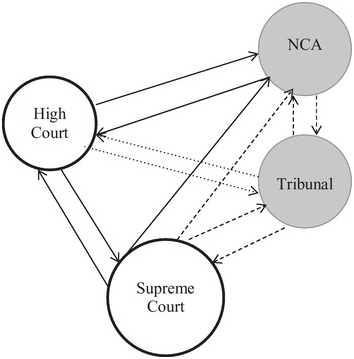
However, the CCI or CCP’s understanding and application of provisions of their respective competition legislations is not final word on enforcement as both the Indian and the Pakistani Acts, provide for appeals from orders of the CCI or the CCP to lie to Indian and Pakistani Tribunals as the second-tier competition enforcement authorities established under the Acts. Until 2017, the Indian Tribunal was envisaged as an independent, statutory body,Footnote 62 comprising one judicial and two technical members,Footnote 63 and had the power to hear appeals from all orders of the CCI.Footnote 64 In 2017, however, the Indian Act was amended to replace the specialist Indian Tribunal with the more generalist National Company Law Appellate Tribunal (NCLAT) established under section 410 of the Indian Companies Act 2013.Footnote 65 In Pakistan, prior to the enactment of the Pakistani Act, appeals from orders passed by more than one member of the CCP (under the 2007 and 2009 Ordinances) lay directly to the Supreme Court, and from orders issued under the 2010 Ordinance to the high court.Footnote 66 The Pakistani Tribunal was first provided for in the Pakistani Act as an independent statutory body, comprising one judicial member and two technical members who would have ‘expertise in international trade, economics, law, finance and accountancy’ (Figure 4.1).Footnote 67
Competition enforcement pathways in India and Pakistan
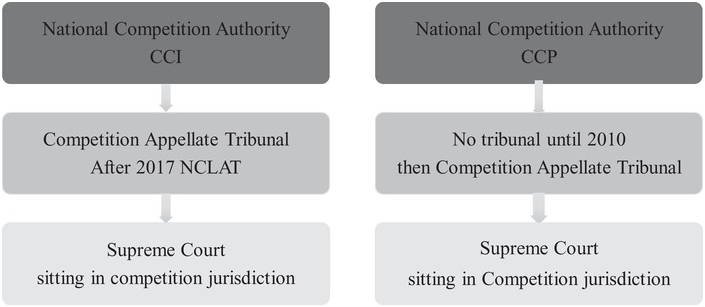
In both India and Pakistan, appeals from orders of the Tribunals lie to the Supreme CourtsFootnote 68 which are apex courts established under the Indian and Pakistani constitutions. Judges appointed to these Supreme Courts are generalists, most often elevated after serving at the high courts for at least ten years. In both India and Pakistan, the Supreme Courts exercise their statutory competition jurisdiction in addition to the constitutional and appellate jurisdiction conferred upon them under the respective Constitutions of the countries. In both countries orders of the Supreme Courts issued in exercise of their competition jurisdictions are final and may not be challenged before any courts or forums in the country.
The nearly identical enforcement pathways prescribed in the Indian and Pakistani Acts do not have similar histories of activation. The Indian government had established the Competition Appellate Tribunal in May 2009 almost simultaneously with making the CCI operational,Footnote 69 and other than minor interruptions the Indian Tribunal had remained functional until it was replaced by the NCLAT. In Pakistan, the first member and chairman of the Pakistani Tribunal was appointed only in July 2011 more than nine months after the enactment of the Pakistani Act.Footnote 70 The remaining technical members were not appointed for another year.Footnote 71 Further, the Pakistani Tribunal had only been functional for about five months when in April 2013 one member resigned and the other retired. It was only in 2015 after the lapse of another two years that the government appointed new members and re-constituted the Tribunal.Footnote 72
4.3.2 Interventions in the Competition Enforcement Pathways
Competition matters do not always proceed along the linear implementation pathways prescribed in the Indian and Pakistani Acts largely due to intervention of the general courts pre-existing in the legal systems of these countries. In both India and Pakistan in addition to appealing orders or actions of the CCI or CCP to the Indian and Pakistani Tribunals (since 2017 to the NCLAT in India) and those of the Tribunals to the Indian or Pakistani Supreme Courts, entities aggrieved by the actions or orders of the CCI, CCP or the tribunals have the right to challenge these before the general courts on constitutional grounds by filing constitutional writ petitions before the high courts in their countries.Footnote 73 In filing these petitions aggrieved entities invoke the inherent and inalienable original jurisdiction of the general courts and may do so even while proceedings before the enforcement authorities are still pending. However, they must demonstrate that there is no adequate, alternate remedy of appeal available to them against the actions or orders of the enforcement authorities. (Figure 4.2).Footnote 74
Interaction between the competition enforcement and the pre-existing systems
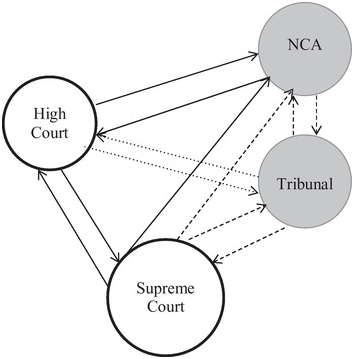
Given that these petitions lie outside the competition enforcement pathways envisaged in the competition legislations in both India and Pakistan (see Figure 4.1) these may lead to unexpected consequences for competition enforcement in the two countries. In case the aggrieved parties invoke the constitutional jurisdictions of the high courts while proceedings are still pending before the CCI, or the CCP, or the Tribunals they most often also file an application for restraining the CCI or the CCP, or the Tribunal as the case may be, from continuing with the proceedings. In the event that the high courts grant a restraining order, the proceedings before the relevant competition authority are not only temporarily halted but also pulled out of the linear competition enforcement pathway prescribed in the Indian and Pakistani Acts. If the restraining or final order granted by the high courts is further appealed to the Supreme Court (sitting in its constitutional jurisdiction), and the Supreme Court imposes or continues the restraint, the temporary halt in competition enforcement may be inordinately extended, depending on the speed with which the pre-existing legal system is equipped to deal with petitions.
This suggests that the intervention of the general courts has a considerable impact on competition enforcement. The precise nature of this impact depends on large part on the manner in which the courts respond to these competition-related challenges. Where the courts delay their decisions or pass orders which convolute and compound rather than resolve the issues brought before them, they not only obstruct the competition authorities in fulfilling their mandate, but in doing so also hinder the development of competition jurisprudence and thereby weaken both present and future competition enforcement in the country. However, in cases where the courts decide the petitions that come before them with alacrity and clarity, they not only clarify the due process norms and rules of natural justice as applicable to competition matters, but also provide guidance in respect of similar matters that may be brought before them in the future. As the general courts decide each successive competition matter they bring the competition legislation into greater alignment with the legal norms prevalent in the country and thereby contribute to the pace at which it integrates into the pre-existing legal system.
4.3.3 The Pathways and the Benchmarks of Success
The extent to which an adopted competition legislation integrates into the adopting country’s pre-existing legal system is an important marker of its overall success. Whether and at what pace that is likely to happen in India and Pakistan depends on the extent to which their competition legislations are understood, utilised, and applied in their adopting countries and on the nature and quality of their interaction with their pre-existing legal systems. This in turn depends on the extent of compatibility and legitimacy the adopted legislations enjoy in their contexts: an adopted legislation that is more compatible with the context of the adopting country and enjoys greater legitimacy in it, is likely to be better understood and utilised by the stakeholders and enforcement authorities. The authorities established in pursuance of a more compatible and legitimate legislation are also likely to engage more productively with the country’s pre-existing legal system and thereby to facilitate the steady integration of the adopted law into it.
In the Indian and Pakistani contexts, the extent of understanding, utilisation, and application of the adopted competition legislations and the extent of their compatibility and legitimacy in their respective contexts may be inferred and assessed by the number of matters that are brought, before the first-tier competition implementing authorities (ie the CCI or the CCP) in the first instance, the range of economic sectors to which these matters relate, and the number of matters that the CCI or CCP decide and dispose of. At the CCI and the CCP these matters are evaluated by competition specialists, however as matters proceed along the enforcement pathways prescribed in the Indian and Pakistani competition legislations, they are also examined by a combination of competition specialists and judicial members (at the Indian and Pakistani Tribunals)Footnote 75 and finally determined by generalist judges. In an ideal scenario as a matter proceeds along this pathway it becomes more harmonised with the country’s pre-existing legal system so that when it is finally decided by the Supreme Court sitting in its competition jurisdiction, it becomes a part of the legal system of the country until such time as it may be distinguished by an equally competent forum. As more and more cases on different aspects of competition enforcment proceed along this pathway and are decided by the Supreme Courts, the competition legislations as a whole become more and more integrated into the pre-existing legal system of the country.
The nature and quality of the interactions between the adopted competition legislation and the pre-existing legal system of the country also relates to the extent of the compatibility and legitimacy of the adopted legislations. To understand these interactions in India and Pakistan the competition-related challenges filed before the high courts in their constitutional jurisdictions as well as the response of the courts to these challenges must be examined.Footnote 76 It may be argued that an adopted legislation that is more compatible with the pre-existing legal system of the adopting country and enjoys greater legitimacy in it, is likely to generate fewer challenges (or at least challenges on a smaller range of grounds) and is also likely to be better understood and better received by the general courts. However, given that courts sitting in their constitutional jurisdiction may only evaluate the constitutionality of actions and orders of competition authorities and are neither equipped nor empowered to comment on the correctness or otherwise of the application of competition principlesFootnote 77 their decisions even when issued with clarity and alacrity are directly advance competition jurisprudence in the country. However, they do have an important indirect impact on competition enforcement: they bring the adopted legislation into conformity with country’s legal system and validate its provisions and thereby, enhance its compatibility with the context, and its legitimacy in the country.
4.4 Measuring the Performance and Interaction of Competition Statutes
Having established the benchmarks for assessing the performance and interactions of the Indian and Pakistani Acts, the next step is to measure these. This section argues that orders of competition authorities are the most appropriate source of data for this purpose because they not only reflect the interplay of institutions and mechanisms at the adoption stage that shaped the provisions under which these authorities have been established but also offer an insight into the enforcement strategies adopted by these authorities for the implementation stage.
4.4.1 Orders of CCI and CCP as Data for Evaluating Benchmarks of Success
Orders of the Indian and Pakistani competition authorities, particularly of the first tier CCI and CCP, are an important source data for assessing the performance and interactions of the Indian and Pakistan competition legislations in their respective countries these orders are strong measures of the performance of the competition authorities in that they establish the number of cases decided by the CCI and CCP, and identify the sectors in which the authorities have intervened. The orders of the CCI and the CCP also form the best available evidence of the interaction between the competition legislations and the pre-existing legal system of the countries. Orders of the CCI and CCP in proceedings which had also given rise to petitions before the courts record the details of these petitions as well as the orders of the courts in respect of these challenges, or where the courts are still to pass orders, they record the status of these challenges. In this way, orders of the CCI and CCP provide important information about the range of grounds on which the proceedings before the CCI and CCP are challenged as well as rationale adopted by the courts in response to these grounds In in the absence of readily available court documents the orders of the CCI and the CCP form the only record of the interactions between the competition authorities and the courts.Footnote 78
The performance and interadtion indicators derived from the orders of the CCI and the CCP also offer insight into the nature and extent of the compatibility and legitimacy of the competition legislations in their respective countries.
The orders of the CCI and the CCP are also particularly suited for the comparative analysis of the performance and interactions of the Indian and Pakistani Acts as the two competiion authorities arrive at these through comparable decision-making processes. It is important to clarify that the orders considered for this analysis are the final rather than interim orders of the CCI and the CCP. In the case of the CCI this means orders passed under sections 26(6) and 27 of the Indian Act, while in the case of CCP this means orders issued in pursuance of section 31 of the Pakistani Act.
4.4.2 The Relevant Indicators and their Significance
The orders of the CCI and the CCP yield important information regarding the quality of their performance and interactions as well as how these have evolved over time. The following indicators derived from the orders are particularly relevant in this regard:
(i) Total number of final orders passed and the sectors to which these relate: the combination of these indicators reveals the extent and range of competition enforcement in India and Pakistan and serves as a proxy for the extent to which their competition legislations are understood, utilised, and applied in their contexts.
(ii) Number of orders passed in proceedings initiated on the basis of complaints versus number of orders passed in proceedings initiated suo motu:Footnote 79 Proceedings before the CCI or CCP may be initiated by a complaint; by the CCI or CCP themselves taking notice of a possible infringement; or on reference from a governmental authority. Of these, the first two mechanisms for initiating competition proceedings are of particular interest because while complaints indicate the extent to which members of the public understand and utilise the competition legislations, proceedings initiated by the CCI or CCP at their own initiative ie suo motu, reflect the authorities’ understanding of the provisions of the Acts and their keenness to enforce them. A comparison of the number of orders passed in matters initiated by complaints versus suo motu also indicates the extent to which the Acts have been accepted in the contexts of their countries.
(iii) Number of orders in which judicial precedents are cited and relied upon: the number of orders in which the CCI and CCP cite or rely upon judicial precedents (whether domestic or international) or decisions of other competition authorities, indicates the CCI and CCP’s strategy for interpreting the provisions of the Indian and Pakistani Acts. The nature and extent of this reliance also indicates the compatibility and legitimacy of these competition legislations: acts that enjoy greater compatibility and legitiamcy are less likely to rely on foreign materials to establish their meaning or assert their authority.
(iv) Number of orders which prescribe sanctions: in terms of the Indian and Pakistani Acts, the CCI and CCP may give directions to entities found acting in vioaltion of the competition legislations or impose penalties on them. The number of orders in which CCI and CCP sanction entities whether through penalties or directions indicate the extent to which the CCI and CCP have utilised and applied the competition legislations in the exercise of their mandates as well as the need of the authorities to assert their authority or the confidence they feel in their respective contexts. The number of sanctioning orders therefore also reflect the extnet of compatibility and legitiamcy of the competition legislations.
(v) Number of orders which record petitions filed before courts: the number of orders of the CCI or CCP which record petitions filed before the high courts while proceedings are still pending before the CCI and CCP, the grounds on which these petitions are filed, and the response of the courts to these petitions provide important insight into nature and quality of the interaction between the adopted competition legislations and the pre-existing legal systems of the countries and arguably a more productive interaction between the competition and pre-existing systems reflects the greater compatibilty and legitimacy of the competition legislations.
4.4.3 Analysing the Indicators as per the Orders of the CCI and CCP
The indicators may be observed and compared in the orders issued by the CCI and CCP in respect of abuse of dominant position and anti-competitive agreements in the years since the authorities have been in operation to understand the extent and quality of their performance and interactions in their respective contexts.
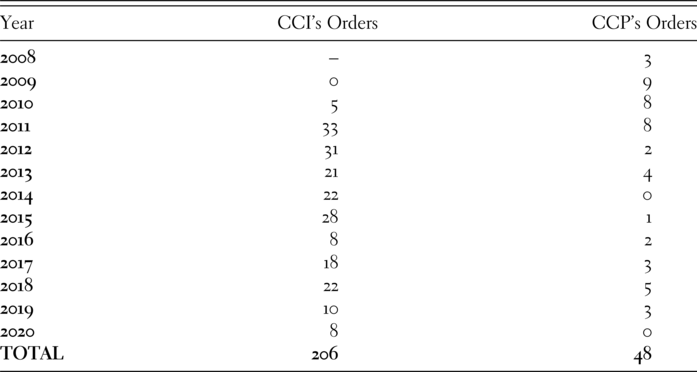
(i) Total number of orders and the sectors to which these relate. The provisions relating to anti-competitive agreements and abuse of dominant position in the Indian Act were only brought into force in 2009, while similar provisions in the Pakistani competition law had been in force since 2007.Footnote 80 Table 4.1 compares the orders of the CCI and CCP in respect of these two infringements in the from the time the two authorities became operational until 2021.
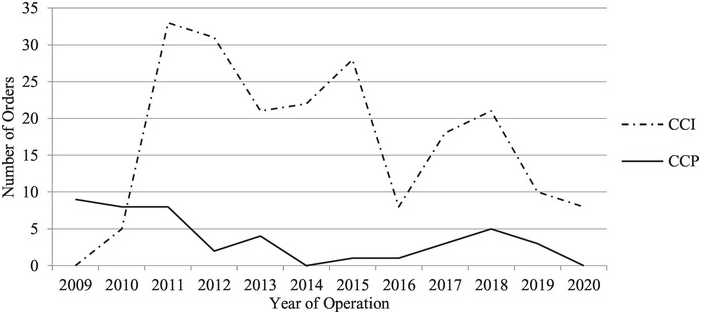
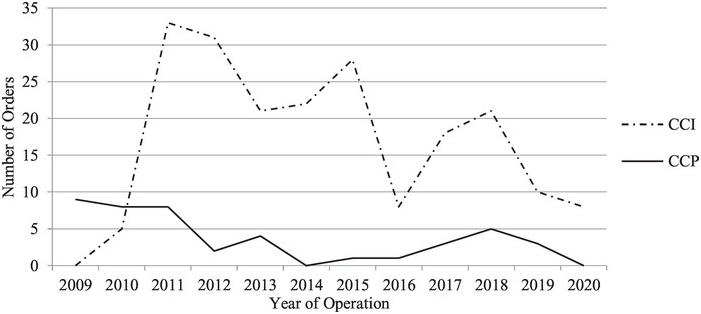
A yearwise comparison of this data reveals that while the CCP commenced enforcement robustly, the CCI had a more modest and cautious start. However, the comparison further reveals that after its initial burst of activity, the CCP’s enforcement steadily declined, coming to a halt in 2014. Although enforced resumed in 2015, it never quite regained initial levels.Footnote 81 In contrast, after a slow start, the CCI’s enforcement increased dramatically in the first few years of its operations and although the number of orders issued by CCI has been uneven in subsequent years, CCI’s operations did not come to a halt at any time (Figure 4.3).

Comparison of total orders issued by the CCI and CCP (2007–20)
A sector-wise analysis of these orders suggests that the disparity in the total number of orders passed by the CCI and the CCP notwithstanding, both authorities have taken cognisance of competition infringements in at least eighteen sectors across their economies, across their economies, including real estate, financial sector/capital markets, entertainment and media, health and pharmaceuticals, automobiles, information technology and telecom, petroleum and gas, railways and shipping, civil aviation, power and electricity, iron and steel, coal, food and beverage, professional services (including chartered accountants), education, and cement. However, the two authorities have not prioritised these sectors equally: for instance, while the CCI has passed the highest proportion of its total orders (nearly 16.2 per cent) in respect of entertainment and media only about 5.2 per cent of the CCP’s orders are in this sector. Similarly, while the CCP has issued the highest proportion of its orders (nearly 13.2 per cent) in the food and beverage sector, only approximately 3.2 per cent of CCI’s orders relate to this sector.
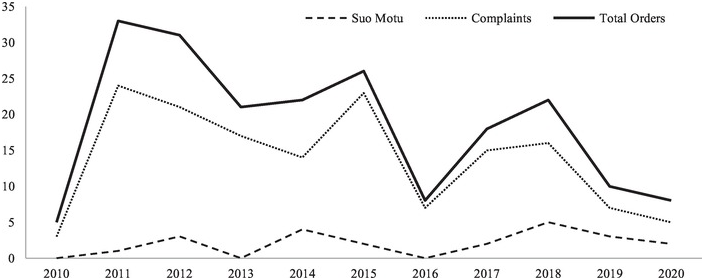
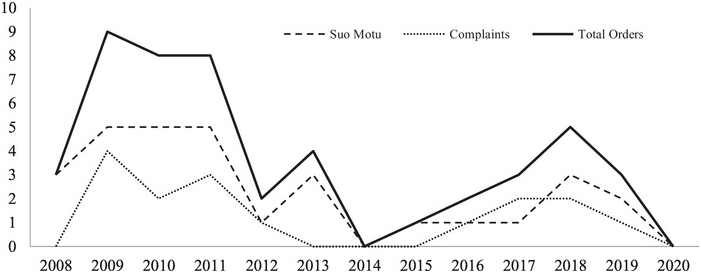
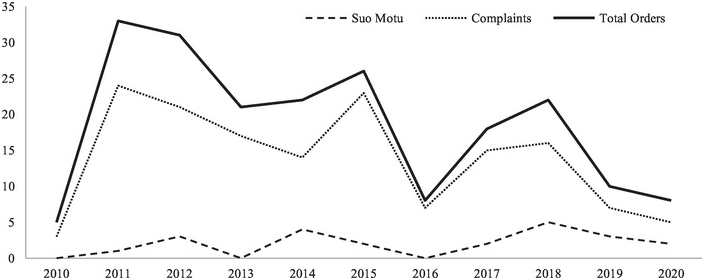
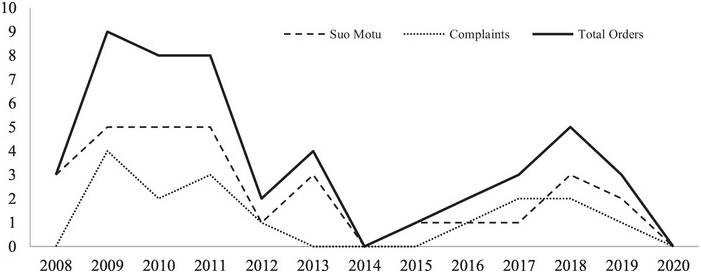
(ii) Number of orders passed in proceedings initiated on the basis of complaints versus proceedings initiated suo motu. The data suggests that while the number of cases transferred to the CCI or the CCP from their predecessor authorities and those initiated by them on the basis of references received from the governments are comparable,Footnote 82 there is considerable disparity in the numbers of cases initiated by them on the basis of complaints and suo motu on their own volition: the CCI has issued only 10.67 per cent of its total orders in suo motu cases while more than 62.5 per cent of the CCP’s orders are in this category and the CCI has issued more than 73.78 per cent of its orders on the basis of complaints, while only 33.3 per cent of the CCP’s orders have been initiated by complaints received from members of the public (Table 4.2).
It is further interesting to note that for both the CCI and the CCP the proportion of orders issued in response to complaints received versus orders in respect of suo motu notices has not changed over time: in the case of the CCI, matters initiated on the basis of complaints remain consistently higher than matters initiated on the basis of suo motu notices, while in the case of the CCP orders in respect of matters initiated by suo motu notices consistently exceed matters initiated on the basis of complaints. Data further suggests that the decline in CCP orders in suo motu matters is attributable to a decline in its total orders rather than a shift towards matters initiated through complaints. Similarly, the decline in the CCI’s orders in matters initiated on the basis of complaints is due to a decline in the total number of orders issued rather than a shift towards orders in suo motu cases (Figures 4.4 and 4.5).
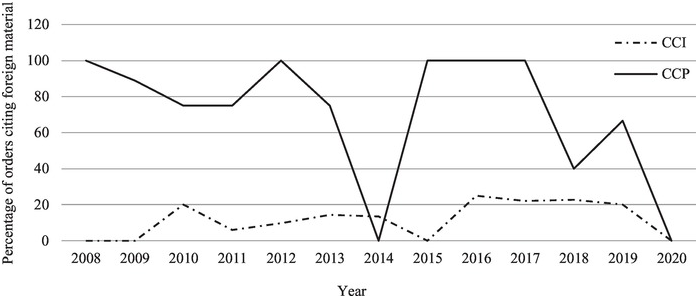
(iii) Number of orders in which judicial precedents and materials are cited: A review of the orders of the CCI and CCP reveals that the CCP has relied more extensively and expressly on judicial precedents and materials (particuarly foreign materials and precedents) as compared to the CCI which appears to prefer interpreting the text of the Indian Act without overtly doing so (Table 4.3).
When they have relied on judicial precedents and materials, both the CCI and CCP have cited orders of their respective Supreme Courts and sometimes high courts, orders of the European Commission (EU Commission), the European Court of Justice (CJEU), and decisions and materials of United States anti-trust authorities. The CCI has also drawn upon materials and precedents from the Organisation for Economic Cooperation and Development (OECD), Brazil, United Kingdom (UK), Canada, Greece, Australia, and South Africa, while the CCP has cited decisions and materials from the OECD, UK, Singapore, Nordic countries, South Africa, Italy, Albania, Brazil, Hungary, Korea, and Turkey. However, the CCI has expressly referred to foreign materials and precedents in only 12.1 per cent of its orders, while the CCP has made express references to foreign precedents in 79.16 per cent of its orders. Over the years the CCI’s express reliance on foreign precedents appears to have declined, and from 2013 onwards the CCI has increasingly relied upon its own earlier decisions. In the case of the CCP reliance on foreign precedents has remained consistently high, however, over time like the CCI, the CCP has increasingly relied on its own earlier decisions (Figure 4.6).
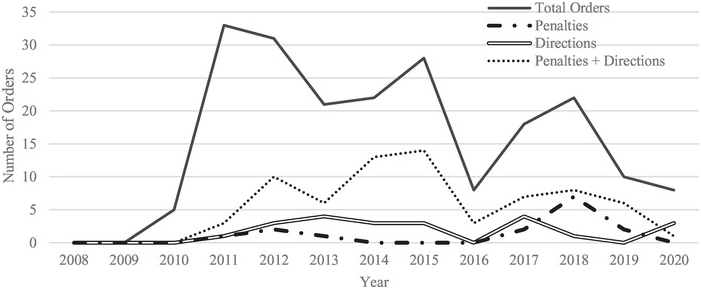
(iv) Number of orders which prescribe sanctions. Under their respective competition legislations, both the CCI and CCP may penalise entities engaging in anti-competitive practices, prescribe behavioural remedies for them, or stipulate a combination of penalties and behavioural remedies. In the years since they were first made operational, the CCI and CCP have exercised all these powers, albeit to varying degrees (Table 4.4).
This data reveals that while the CCI sanctioned parties in 52.41 per cent of the cases in which it issued final orders, the CCP did so in 85.3 per cent of all such matters. The data further suggests that the preference of both the CCI and CCP for imposing penalties plus prescribing directions, the CCI doing so in 65.7 per cent of all orders in which it imposes sanctions, and the CCP in 43.9 per cent of such orders.Footnote 84

CCI orders in cases initiated through suo motu notices versus complaints
CCP orders in cases initiated through suo motu notices versus complaints

Comparison of orders of CCI and CCP citing foreign materials

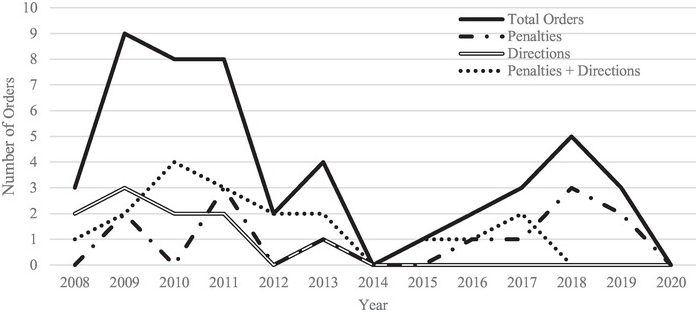
The year-wise trends for both the CCI and CCP suggest that the proportion of orders in which CCI has imposed sanctions has remained reasonably consistent over the years. It further appears that while the CCI has utilised all sanctioning strategies available to it, it has demonstrated a preference for different strategies at different times: for instance, between 2013 and 2019 it appears to have relied upon penalties plus directions as compared to either penalties or directions, while from 2019 onwards the number of cases in which it has imposed penalties (even with directions) appears to have declined as compared to orders in which it has issued directions only (Figure 4.7).
Trends in CCI’s sanctioning strategy (2008–20)
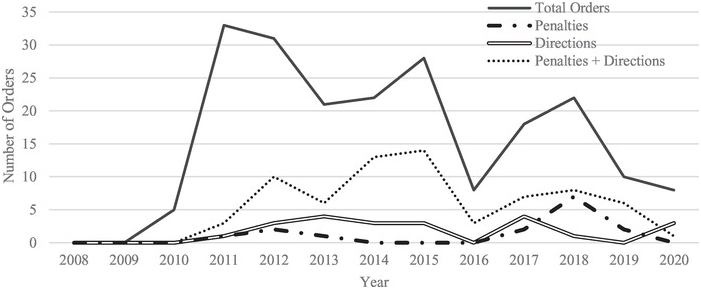
A year-wise trend of the CCP’s orders also reveals that it has, like the CCI, utilised all sanctioning options available to it under Pakistani competition law. However, it appears that while the CCP issued directions in several cases prior to 2014 (even when these directions were given along with penalties), after 2014 it has almost entirely abandoned the practice, and in recent years has demonstrated a clear preference for imposing penalties even as compared to combining penalties with directions (Figure 4.8).
(v) Number of orders which record petitions filed before courts. Proceedings initiated before the CCI or CCP, or interim orders passed by them in the course of these proceedings, have been regularly challenged before Indian or Pakistani high courts on constitutional grounds. Although orders of the CCI and CCP that record these challenges are a reliable source of data for these challenges that are dispersed across high courts in India and Pakistan they only provide a partial picture in that they do not capture challenges filed in respect of proceedings are still pending before the CCI or the CCP at the time of writing, or orders in respect of these proceedings have not been posted on the official websites of the CCI or the CCP for some reason.
However, even this partial data provides important insights into the relationship between the competition authorities and the general courts in both India and Pakistan. It is evident, for instance, that more proceedings are challenged in India (47.9 per cent of all proceedings pending before the CCI) than in Pakistan (only 16.2 per cent of all proceedings pending before the CCP). However, it also appears that more proceedings before the CCP have given rise to multiple of challenges as compared to proceedings before the CCI (Table 4.5).Footnote 85
Trends in CCP’s sanctioning strategy (2008–20)

Further, to the extent that the orders of the CCI and CCP record the decisions of the high courts in respect of these challenges, it appears that while the Indian courts restrained the CCI in 32.35 per cent challenges filed before them, several of these restraining orders were swiftly vacated and the CCI was allowed to proceed with the matters before it. Conversely, while the recorded number of restraining orders issued by Pakistani courts is low, almost none of these orders have been vacated. This is also borne out by the fact that while the Pakistani courts have only finally decided 17.2 per cent of the competition-related challenges brought before them the Indian courts have decided nearly 76.47 per cent of such matters (Table 4.6).

** Interim orders replaced by final orders of the courts while proceedings before CCI were still pending.
4.5 Evaluating the Indicators in the Adoption–Implementation Continuum
The indicators derived from the orders of the CCI and CCP offer a rare insight into the compatibility and legitimacy of the Indian and Pakistani competition legislations by indicating the extent to which these are understood, utilised, and applied in their respective contexts as well as the quality of their interactions with the pre-existing legal systems in their countries. This in turn indicates the extent to and pace at which these adopted legislations are integrating into their country’s legal system at the implementation stage and may therefore be regarded as successful.
The extent to which the Indian and Pakistani Acts are understood, utilised, and applied in their respective contexts may first be assessed on the basis of the number of orders that the CCI and CCP have issued since they commenced operations, and the sectors in which they have intervened.Footnote 88 It appears that although both the CCI and CCP have cast a reasonably wide net in terms of the range of sectors in which they have intervened, the numbers of their orders in respect of anti-competitive practices (which include anti-competitive agreements and abuse of dominant position) has remained somewhat erratic: while the CCI has gradually gained momentum after a slow start the CCP has lost pace despite a robust start even coming to a complete halt in 2014. Although the CCP has re-commenced enforcement since then, its total orders remain considerably lower than in its early years.
The numbers of orders of the CCI and CCP that have been issued in response to complaints filed before them as compared to orders issued in proceedings commenced suo motu by them, offers further insight into the extent to and manner in which the Indian and Pakistani competition legislations are utilised.Footnote 89 Where the number of orders issued in matters initiated by complaints outweigh the number of orders issued in matters in which the authorities have taken suo motu notice, as in the case of India, it may be argued that the Act is better understood, utilised and applied by members of the public while where orders in respect of matters initiated suo motu outweigh orders issued on the basis of complaints (as in the case of Pakistan) it may be argued that while the authority itself understands and is committed to utilising and applying the competition legislation, members of the public, appear neither to understand the import of the Act nor trust the ability the ability of the CCP to deliver, or both.
The link between complaints and the extent of the understanding, utilisation and application of the competition legislation by the public notwithstanding, a decline in the number of complaints received by the CCI over the years does not automatically indicate a fall in the overall understanding or utilisation of the legislation. A review of the nature of complaints lodged before CCI over the years and the number of dismissals of complaints relative to the those that culminated in sanctions reveals that a significant proportion of complaints filed in the CCI’s early years did not strictly relate to competition and, therefore, the decline in the number of complaints in successive years may be due to a better understanding of the remit of the legislation and the attendant decline of frivolous complaints.Footnote 90
The interpretive strategies adopted by the CCI and CCP indicate their understanding of their roles and the direction in which they propose to proceed with the enforcement of their competition legislations. With regard to their interpretive strategies the fact that the CCI has relied less on precedents and materials as compared to the CCP and that it has preferred domestic rather than foreign sources. suggests that while the CCI views itself as a public-facing regulatory body that needs to make itself understood primarily to its complainants or to the entities complained about, the CCP sees itself as a judiciary-facing adjudicatory body and draws upon the authority of foreign precedents and materials to bolster its authority and to give legal cover to its opinions. The fact that the CCI relies more on domestic case law as compared to the CCP that draws extensively upon foreign authorities further suggests that while the CCI desires to assert its domestic legitimacy by expressing its alignment with India’s pre-existing legal system, the CCP is keener to leverage its international legitimacy by associating with Western competition models and interpretations. Besides helping understand their substantive arguments, the interpretive strategies of the CCI and CCP also impact the extent to which their decisions, and by extension, the competition legislations they interpret, are likely to be understood and utilised by the public which in turn will bolster the future performance of the CCI and the CCP. The fact that over time, both the CCI and CCP increasingly cite their own orders suggests that both authorities have foreclosed fresh analysis of certain issues and have become more deeply entrenched their early interpretations.
Similarly the penal strategies adopted by the two authoritiesFootnote 91 offer an insight into how the CCI and CCP perceive their abilty to take strong enforcement action which in turn reflects their legitimacy in their contexts. The data reveals that both the CCI and CCP have utilised the entire range of sanctions available to them, which suggests that both have accepted their enforcement role and have understood and applied their mandate. However, the data also suggests that the CCI, in combining directions and penalties has preferred a balanced sanctioning strategy, which suggets that it sees its role as primarily corrective. The CCP on the other hand the CCP with its greater proclivity for penalties assumes a more punitive character. It may be argued that the CCI’s relatively milder strategy in this regard is designed to safeguard its domestic legitimacy and to enhance public engagement with the Indian Act and thereby to increase acceptance of the Act in the Indian context. Conversely, the more punitive strategy adopted by the CCP appears to be designed to assert its international legitimacy in the Pakistani context and to leverage it to gain domestic legitimacy. In the longer term this strategy is likely to have a contradictory effect: it may lead aggrieved parties to block the CCP’s attempts to recover penalties and encourage future complainants to approach the CCP to seek redress for their grievances.
Finally, a comparison of the interactions between the CCI and CCP and India and Pakistan’s general courtsFootnote 92 reveals that although a comparable number of proceedings pending before the CCI and CCP have been challenged before the Indian and Pakistani general courts, the Indian courts have decided and disposed of more challenges filed before them than their Pakistani counterparts that have, until very recently, opted for restraining the CCP and keeping the petitions pending.Footnote 93 The more productive engagement between the CCI and the Indian courts reflects the relatively greater legitimacy of the Indian Act in its national context and has allowed the CCI to incrementally adapt its decisions to the requirements of India’s pre-existing legal system, and thereby to increase the compatibility and legitimacy of the Act and the extent to which its provisions are understood and may be utilised by stakeholders in the coutnry. On the other hand, the lack of co-operation on the part of the Pakistani courts and the adopted competition systems seems to stem from the initially weak legitimacy of the Pakistani competition legislations which has not only deprived the CCP of much needed clarity and certainty in its operations and has thereby impeded the enforcement of the Pakistani competition legislation, but has also prevented the Pakistani Act from gaining a firm foothold in the country.
Two conclusions are evident from this assessment: first, that the Indian Act is gradually and steadily being transformed from a law in the books to a law in action and integrating into India’s pre-existing legal system, while the Pakistani Act remains largely a law in the books alone and has achieved only a superficial connection with Pakistan’s pre-existing legal system. Second, that a legislation which attains a higher degree of compatibility and legitimacy at the adoption stage, is more likely to be understood, utilised and applied in its context and enjoy a productive interaction with other elements in the pre-existing legal system of the host country and thereby acheives a higher degree of ‘success’ in the implementation stage as compared to a legislation, such as the Pakistani Act, which only achieves superficial compatiblity and legitimacy.
The compatibility and legitimacy generated through India’s primary transfer mechanism of socialisation, which was delivered through the interplay of a wide range of bottom-up, participatory, and inclusive institutions, drawn from the executive, legislature, and the judiciary, that had the capacity to aggregate public opinion and consent led to the ‘Indianisation’ of the Act which in turn allowed the Act to be accepted and utilised as a valid part of the Indian legal system. However, this compatibility and legitimacy also seems to have rendered the CCI more cautious about preserving the space it had created for itself in the course of adoption. This manifests in the CCI’s relatively conservative approach towards penal sanctions: at the deliberation stage, the Raghavan Committee had recommended that India’s national competition authority recognise that the Indian economy was transitioning from a controlled to a liberal economy and, therefore, not be harsh in sanctioning violations. This principle appears to continue to guide the CCI’s sanctioning strategy even today, and while it makes the CCI more acceptable to the Indian economy, it detracts from the effectiveness of competition enforcement in the country.
Conversely, Pakistan adopted its early competition legislation through coercion through a narrow range of exclusive, and top-down institutions and only introduced an element of socialisation in the adoption of the Pakistani Act by engaging in which it engaged more inclusive, bottom-up institutions that were designed to aggregate local information even if their actual experience of doing so was limited. However, just as the impact of socialisation in the Indian context is not all positive, the impact of coercion in the case of Pakistan is not all negative. The adoption of the Pakistani competition legislation through a narrow range of top-down, exclusive institutions allowed the Pakistani government to establish and operationalise the CCP within days of the promulgation of the 2007 Ordinance and thereby to achieve an early and decisive start to its competition enforcement.
However, the negative impact of coercion has been more far-reaching its positive effect. The compatibility and legitimacy deficit of the 2007, 2009, and 2010 Ordinances was only marginally rectified by the knowledge aggregated by the more bottom-up, participatory, and inclusive institutions engaged in the enactment of the Pakistani Act. Consequently, the compatibility and legitimacy of the Pakistani Act remained weak and manifested in the general reluctance of stakeholders to bring matters before the CCP either because they did not understand the underlying rationale for the legislation or because they did not recognise its legitimacy and in the CCP’s continuing to operate largely on the basis of suo motu notices. The weakness in the compatibility and legitimacy of the Pakistani legislations also influenced the extent to which the CCP relied on case law and precedents, particularly foreign case law and precedents to establish its foreign antecedents and thereby to leverage its international legitimacy to gain domestic legitimacy. The CCP’s penal strategy also seems to be designed for the CCP to assert itself in the domestic context in a further attempt to plug its legitimacy deficit. The fact that for a brief period the CCP issued directions only or accepted ‘voluntary’ commitments from the entities that had infringed competition law does not necessarily detract from the overall thrust of the CCP’s penal strategy and is more likely to be a response to the CCP’s inability to recover penalties due to restraining orders granted by the general courts. However, it may also be interpreted as the CCP shrinking its enforcement until such time as its legitimacy is endorsed by the courts. Finally, the hesitant response of the Pakistani courts to the competition-related matters filed before them may be attributed at least in part to the fact that the Pakistani judiciary had been largely excluded from the deliberations at the adoption stage and that the superior judiciary’s first brush with the competition legislation was when a package of ordinances introduced by a discredited military president were brought before it in the Sindh High Court Bar Association case, rather than with its aims or substantive provisions.






 Open access