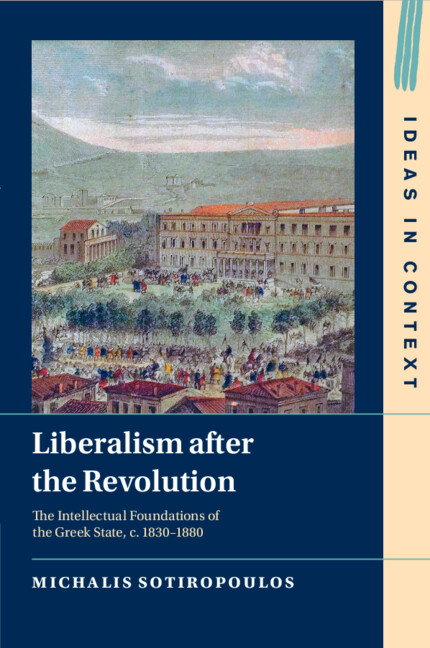

How is a new state built? To what ideas, concepts and practices do authorities turn to produce and legitimise its legal and political system? And what if the state emerged through revolution, and sought to obliterate the legacy of the empire which preceded it? This book addresses these questions by looking at nineteenth-century Greek liberalism and the ways in which it engaged in reforms in the Greek state after independence from the Ottomans (c. 1830-1880). Liberalism after the Revolution offers an original perspective on this dynamic period in European history, and challenges the assumptions of Western-centric histories of nineteenth-century liberalism, and its relationship with the state. Michalis Sotiropoulos shows that, in this European periphery, liberals did not just transform liberalism into a practical mode of statecraft, they preserved liberalism's radical edge at a time when it was losing its appeal elsewhere in Europe.
Winner, 2024 Edmund Keeley Book Prize, Modern Greek Studies Association
Loading metrics...
* Views captured on Cambridge Core between #date#. This data will be updated every 24 hours.
Usage data cannot currently be displayed.
This section outlines the accessibility features of this content - including support for screen readers, full keyboard navigation and high-contrast display options. This may not be relevant for you.
Accessibility compliance for the HTML of this book is currently unknown and may be updated in the future.
