

The gravest public health challenge in a century has disrupted and transformed our civil justice system. In the span of weeks, courts across the country were forced to make countless, rapid, and difficult decisions. Many courts suspended in-person hearings and moved proceedings to online platforms, such as Zoom. While a shift to virtual courts has been lauded by technological enthusiasts and reformers for decades, little research has examined how this technological change may affect vulnerable unrepresented persons and low-income people in the United States on the “have-not” side of the digital divide.
In this chapter, we seek to cast light on how virtual proceedings unfold for these low-income unrepresented persons in the everyday. It is important to do so. To date, much of the conversation has lauded Zoom court proceedings as the future of civil justice, centering this praise on idealized forms of online proceedings and their conveniences, without interrogating the impact of the precarity that low-income people contend with or persistent digital divides.
In marked departure, we examine how these new technologies affect the experiences of low-income unrepresented persons who encounter, and contend with, adversities within virtual court proceedings. We examine how these new technologies reconfigure the features, affordances, and barriers present within the civil justice system, and the impact of these new technologies on the psychology of judges, lawyers, and unrepresented persons, as well as the impact of these new technologies on the meaning of the judicial role and on a person’s unrepresented status. As political theorist of science and technology Langdon Winner observes, “[i]f the experience of modern society shows us anything … it is that technologies are not merely aids to human activity, but also powerful forces acting to reshape that activity and its meaning.”Footnote 1 In fact, we must “pay attention not only to the making of physical instruments and processes … but also, to the production of psychological, social, and political conditions as part of any significant technological change.”Footnote 2
Here we adopt Winner’s perspective by focusing not on an idealized future for virtual courts under techno-optimistic conditions, but on the actual practice and experience of low-income unrepresented persons in virtual courtrooms today. We do so to allow a forthright consideration of policies and reforms needed to improve access to justice. Unlike debating the costs and benefits of in-person versus virtual proceedings under idealized conditions, looking to the bottom casts light on the actual needs, experiences, and outcomes of real people in virtual proceedings. Moreover, we believe that examining how virtual proceedings unfold in the everyday will contribute to the development and refinement of accurate and useful theories about our dynamic civil justice system and best practices for enhancing access to justice in virtual proceedings. Finally, we center our analysis not just on the experiences of those on the “have” side of the digital divide or those who are the most powerful in these settings – judges and lawyers – but also on those on the “have-not” side of the digital divide: low-income people who contend with adversities and confront challenges when seeking justice in virtual courtrooms.
Past research on videoconference hearings is mixed on whether the use of videoconferencing negatively impacts assessments and outcomes.Footnote 3 Research does suggest that defendants appearing in videoconferences may be disadvantaged.Footnote 4 Indeed, one widely cited study revealed that video bail hearings resulted in bail amounts that were 51 percent higher for those who appeared virtually as opposed to those who had their hearings in person.Footnote 5 Yet these studies are dated, and the technologies employed in virtual courts during the global pandemic have vastly improved. Moreover, little attention has been paid, to date, to the implications of video conferencing for unrepresented persons, let alone cases involving asymmetries of representation involving low-income persons. In short, there is pressing need for a new and thorough look at the access-to-justice implications of virtual hearings.
In this chapter, we report the first phase of a multiphase research program made possible with funding from the Pew Charitable Trusts. In this preliminary phase, our research team engaged in observations of over 500 live-streamed Zoom/Webex proceedings in small claims courts in Indiana, most of which were eviction and debt collection cases. Our research revealed that the vast majority of low-income persons in these cases are unrepresented (98.6 percent), and a majority are dialing into virtual court (e.g., Zoom/Webex hearings) on their cell phones (64.4 percent) without access to the virtual capabilities of these remote proceedings, including cameras. In the main, these cases involve representational asymmetries, in which repeat-player plaintiff lawyers litigate against low-income persons who are unrepresented. Troublingly, these cases entail an additional layer of technological asymmetry, in which repeat-player lawyers regularly employ the full range of virtual interaction and videoconferencing capabilities of Zoom/Webex, while the low-income unrepresented persons whom they sue, because they dial into these proceedings, are limited to the audio-only capabilities of their cell phones.
The chapter proceeds as follows. Section 10.1 introduces the theory of “doing” unrepresented status, with an emphasis on the social production of unrepresented persons and the social construction of pro se status, orienting the reader toward the social-cognitive processes of judges, lawyers, and unrepresented persons. Section 10.2 describes persistent digital divides in the US. Section 10.3 reports results from empirical observations in virtual civil courts, including the surprising (to us) finding that low-income unrepresented persons are overwhelmingly using cell phones to dial into Zoom/Webex-based virtual hearings, limited to audio-only capabilities. Section 10.4 discusses our observations, considering the asymmetries in affordances, barriers, and constraints created by technological asymmetries and the impact of these asymmetries on the social cognition of judges, lawyers, and unrepresented persons.
10.1 Doing Unrepresented Status: The Social Production of Unrepresented Persons and the Social Construction of Pro Se Status
Over 15 million cases filed each year in our state civil justice systems involve one or more unrepresented persons,Footnote 6 and the percentage of unrepresented people has risen rapidly in case categories where basic human needs are at stake, including evictions, family law, and debt collection cases.Footnote 7 Many unrepresented persons are members of racially and socially disadvantaged groups.Footnote 8 They encounter our civil justice system without legal representation to defend their basic civil legal rights.
The theory of doing unrepresented statusFootnote 9 posits the social production of unrepresented persons. That is, the very presence, and the vast percentage, of unrepresented persons within our civil justice system is not a fixed, natural, or inherent quality of that system.Footnote 10 Rather, society produces unrepresented persons and the manner in which they appear, participate, and engage with our civil justice system through societal decisions and public policy choices – including public policy choices about the technologies that we employ to organize the civil justice system. These policy choices shape how unrepresented persons access and appear in the civil justice system, how they are perceived and socially constructed by court officials and other actors, and in turn, how they interact with others as a result.Footnote 11 These social dynamics create feedback loops, recursive processes, or self-fulfilling prophecies, in which expectations and social roles affect everyday interactions between persons within the civil justice system.
Second, the theory of doing unrepresented status posits the social construction of pro se persons.Footnote 12 That is, an unrepresented person’s pro se status is an active process, involving social cognitive processes (how we think and feel about others), social identity processes (how we think and feel about social identities), and behavioral processes (how we speak and act toward others) that people do and ascribe onto unrepresented persons. Legal officials impute and apply mental schemas, expectations, stereotypes, and beliefs about the characteristics of pro se parties onto people navigating the civil justice system without lawyers.Footnote 13 This aspect of doing unrepresented status centers on the cognition, affect, and behavior of judges and lawyers toward these persons, and the intergroup interactions that unfold as a result within the civil justice system.Footnote 14 Everyone with whom an unrepresented person comes into contact within the civil justice system makes use of shared meanings and mental representations about what it means for people, in general, to be pro se within the civil justice system and why they are unrepresented. These shared meanings invariably shape how unrepresented persons are perceived and the interactions that unfold between unrepresented persons and others within the civil justice system. Many judges, lawyers, and court officials hold subtle (and sometimes overt) negative attitudes about unrepresented persons. Moreover, merely being unrepresented can serve as a justification for treating unrepresented persons poorly, particularly those who are racial/ethnic minorities or who belong to socially disadvantaged groups.
Finally, the theory of doing unrepresented status also posits that different classes and groups of unrepresented persons will experience pro se status somewhat differently.Footnote 15 For example, these structural and psychological processes may unfold differently for persons who belong to advantaged societal groups who are on the “have” side of the digital divide than for low-income persons who belong to racially or socially disadvantaged groups on the “have-not” side of the digital divide.Footnote 16
10.2 Doing Pro Se Status in Online Court: Persistent Digital Divides
How the digital divide impacts virtual court proceedings, especially given the technological asymmetries among represented and unrepresented parties, is a critical but unanswered question.Footnote 17 The digital divide and differential access to modern information technology (e.g., internet communication technology, computing technology, high-speed internet) impinges on the ability of low-income Americans to participate in important dimensions of modern social-political life online, including: learning, seeking out employment, working, identifying and obtaining social services, and participating in democratic institutions.Footnote 18 Americans find themselves increasingly separated into “digital haves,” with easy and fluent access to information technology, high-speed internet, and technical savvy, and “digital have-nots,” who rely primarily on smartphones for internet access, or the “smartphone dependent,” often with interrupted and low-quality connections.Footnote 19
Troublingly, given these existing digital divides, the shift from in-person to virtual proceedings may exacerbate societal inequalities in the courtroom. In other words, if many courtrooms are using Zoom/Webex videoconferencing technologies, many low-income unrepresented persons may not have the stable access to internet communication technologies necessary to fully participate in hearings that affect their life outcomes.Footnote 20 Consistent with the theory of doing unrepresented status – and the social production of unrepresented persons in particular – we posit that these first-order digital divides lead many low-income unrepresented persons to use cell phones to dial into Zoom/Webex hearings with audio-only capabilities, rather than videoconferencing capabilities. These unrepresented persons who access Zoom hearings in audio-only form would visually appear to judges and lawyers in these Zoom hearings as depersonalized black Zoom tiles.Footnote 21
10.2.1 First-Order Digital Divide(s): Access to Technology and Stable Internet Connection
Many unrepresented persons – indeed, those facing the most economic precarity – do not have reliable access to the Internet or the videoconferencing technologies to fully participate in virtual hearings. According to the Pew Research Center, many low-income Americans rely on their cellphones to access the Internet and are “smartphone-dependent” internet users, meaning that they access the Internet on their cellphones and do not have broadband internet at home. About one-in-three do not have a cell phone at all. Moreover, there are substantial disparities in access to internet broadband and computers at home,Footnote 22 with Black, Hispanic,Footnote 23 and ruralFootnote 24 households residing on the “have-not” side of the digital divide.
Troublingly, bridging these first-order digital divides by providing initial access may not be enough to ensure true, reliable, material access or meaningful participation. Material access is a multidimensional construct,Footnote 25 and the ongoing struggle to ensure material access may be better understood through a lens of technology maintenance.Footnote 26 Technology maintenance refers to the burdens of time, energy, and money required to maintain digital access even after ownership of a cell phone.Footnote 27 Technology maintenance practices that limit functionality include: counting cell phone minutes to avoid “going over”; switching between cell phones depending on minutes; or “beeping” (calling and hanging up) to communicate without minutes.Footnote 28 Moreover, users share cell phones with family members, which requires maintenance of personal relationships.Footnote 29
While most low-income Americans have intermittent access to the Internet, this access is often unstable and characterized by frequent periods of disconnection and cycles of reliable unreliability.Footnote 30 Low-income Americans contend with temporarily disconnected service, broken hardware, and barriers on public access. These disruptions diminish access to unemployment, healthcare, education, and social support.Footnote 31
10.2.2 Second-Order Digital Divide(s): Inequalities in Technological Capabilities and Efficacy
The persistence of a second-level digital divideFootnote 32 refers to the fact that differences in digital proficiencies produce inequality, often revealed by limited digital literacy or efficacy in navigating the web.Footnote 33 Barriers to first-order access and the frictions of technological maintenance compound to produce negative attitudes toward, and perceived lack of utility of, the Internet.Footnote 34 Relatedly, low-income Americans who lack a computer at home experience higher emotional costs than others when using computing technology. That is, barriers on home computers engender psychological friction toward computing technology.Footnote 35 Undoubtedly, first-order structural inequalities contribute to a vicious cycle: Structural inequalities produce second-order digital divides by reducing technological efficacy, creating psychological friction, and affecting the type and quality of online activity,Footnote 36 ultimately conditioning the benefits of being online.
10.3 Observations in Virtual Court
In spring 2020, we engaged in over 500 structured observations of virtual proceedings in Indiana in small claims courts among 20 Indiana judges who handle high volumes of small claims cases, debt-collection cases, and evictions online. Within these observations, our research team observed that the vast majority of low-income unrepresented persons are dialing into Zoom virtual hearings with their cell phones. The vast majority of these cases involve representational asymmetries in which opposing counsel has the full video capabilities of Zoom, while these unrepresented persons are limited to audio capabilities. In many instances, these unrepresented persons are members of racial and ethnic minorities, as judged by their paralinguistic intonations on the phone. These preliminary findings suggest that the effects of moving to virtual proceedings, both benefits and costs, are not evenly distributed between the “have” and “have-not” sides of the digital divide or between lawyers and low-income unrepresented persons. We now turn to the preliminary findings of this first phase of our multi-phase research program.
10.3.1 Study Overview
Method. A team of six law student observers at the Indiana University Maurer School of Law and Stanford Law School engaged in structured observations of over 500 live-streamed virtual proceedings among twenty Indiana judges who handle high volumes of small claims cases (e.g., evictions, debt collection, small claims) online. These observations were conducted between March 1 and April 23, 2021 (a seven-week window). These observers accessed the virtual hearings via the Indiana Office of Court Service’s live-streaming website. To ensure that these observations focused on small claims, debt-collection, and eviction cases, these observers accessed the courts’ public daily hearing calendars and private weekly hearing calendars provided by the Indiana Office of Court Services. A detailed coding scheme was developed, and these law students were trained over the course of two weeks on how to implement this coding scheme. The observation data was inputted via a Qualtrics survey.
Measures. For purposes of this chapter, which reports preliminary results, we report three coded measures: (1) Represented by an attorney? (2) Dialed in by phone to virtual hearing (e.g., Phone number on Zoom tile or only voice heard)? and (3) Camera on? The observers coded these features of each of the over 500 live-streamed hearings, indicating in categorical terms whether these features occurred: yes, no, unsure, NA.
Data preparation. Data was entered in Qualtrics, and analyses were performed in R version 4.0.2. The full dataset of live, virtual proceeding observations included n = 503 observations, and included hearings without a subject matter indicator. These miscellaneous hearings were removed from the dataset, and the dataset was narrowed to n = 455, which included observations of small claims cases, debt-collection cases, and evictions. Next, n =106 of these 455 cases were observed by multiple law students. Accordingly, we developed an inter-rater coding analysis strategy in which data in the above-mentioned measures were retained for purposes of analysis when a majority of these multiple observers agreed when resting whether (1) a party was represented or not at the virtual hearing, (2) a party dialed into the hearing on their phone or not, or (3) a party’s camera was on or not. In the vast majority of instances, coders agreed about these aspects of a party’s appearance at the hearing. After removing the duplicate observations from the dataset, n = 349 unique observations remained. Regarding the subject matter of these cases, these n = 349 cases entailed eviction cases (n = 150), debt-collection cases (n = 103), small claims cases (n = 90), and other cases (n = 6) appearing on these high-volume dockets.
10.3.2 Preliminary Results
Representational asymmetries. We first analyzed representational asymmetries (n = 349), and in doing so, we categorized parties as represented if a lawyer appeared in their case and classified cases in which defendants/respondents defaulted as cases in which they did not have counsel. As anticipated and consistent with the literature (Figure 10.1), a majority of hearings involved representation asymmetries in which plaintiffs/claimants were represented and defendants/respondents were not (n = 209, 59.9 percent). Defendants/respondents were rarely represented (n = 5, 1.4 percent). Both parties were unrepresented in nearly 40 percent of cases (n = 135, 38.7 percent).

Figure 10.1 Virtual proceedings represented status
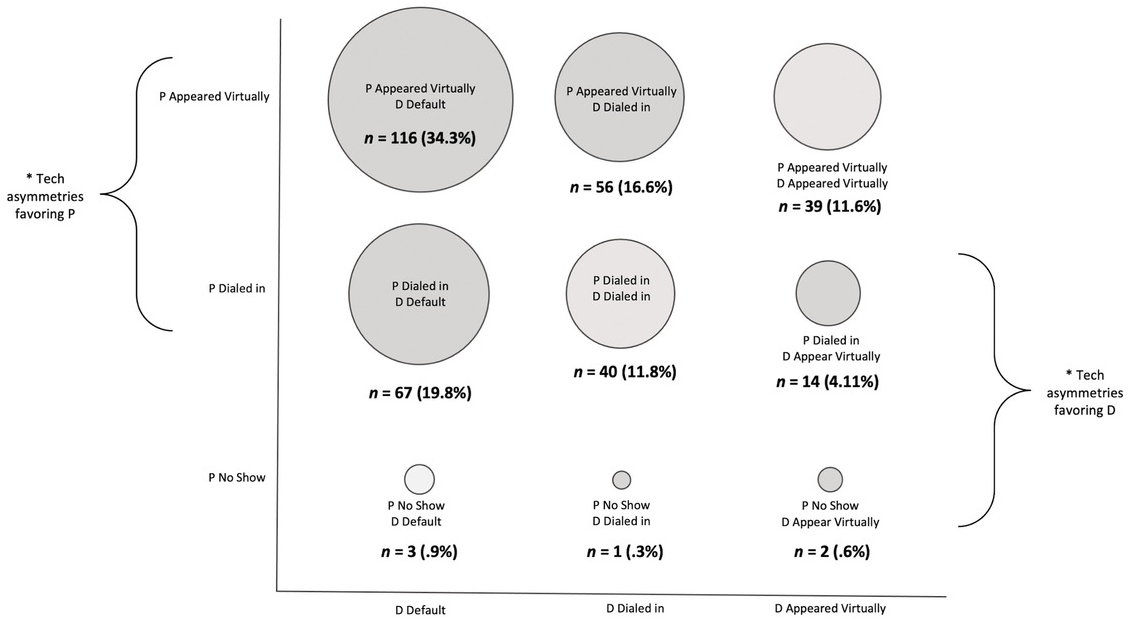
Technological asymmetries. We first analyzed technological symmetries in a manner that included defaults by defendant/respondents and no-shows by plaintiffs/claimants (n = 338). As revealed in Figure 10.2, the most notable observation when including defaults and no-shows is that, despite the apparent conveniences provided by remote proceedings, defendants/respondents nevertheless default in approximately 55 percent of cases (n = 186, 55.0 percent), whereas plaintiffs/claimants rarely no-show (n = 6, 1.8 percent).
While this apparently reflects a decrease in the default rate, the conveniences provided by remote hearings are not a panacea for addressing the challenge of defaults in these cases. Over half of defendants/respondents still default in these cases; as such, the conveniences of remote proceedings may need to be coupled with other interventions that discern and more effectively address the underlying reasons why many defendants do not to attend court hearings.
Turning now to Figure 10.3, which describes virtual proceedings where both plaintiffs/claimants and defendants/respondents actually attend (i.e., excluding defaults) (n = 149), we found that a majority of these hearings involved scenarios in which defendants/respondents dialed into these Zoom/Webex hearings on their cell phones (n = 96, 64.4 percent). Many of these instances involved technological asymmetries in which the plaintiff had full Zoom virtual capabilities and the defendant/respondent dialed into the hearing (n = 56, 37.6 percent). Rarely did the technological asymmetry favor the defendant/respondent (n = 14, 9.4 percent). In many instances, the parties both dialed into these hearings, despite the possibility of appearing virtually on Zoom (n = 40, 26.8 percent). Both parties appeared virtually in a minority of cases (n = 36, 24.2 percent). Finally, we also revealed instances in which a party appeared via Zoom with their camera off, which is distinct from dialing in per se. In these scenarios, for example, a person would be able to see others on Zoom, but their camera would be turned off and they would not be able to be seen. This occurred in an extremely small fraction of cases (n = 3, 2.0 percent). In these cases, the defendant/respondent had turned their camera off, whereas the plaintiff/claimant had their camera on, another technological asymmetry.

Figure 10.3 Virtual proceedings matrix of tech asymmetries (excluding defaults)
Representational asymmetries × technological asymmetries. We then focused specifically on cases in which lawyers appeared for the plaintiff and unrepresented defendants appeared in these remote hearings (n = 96). This analysis (Figure 10.4) reveals ways in which representational asymmetries compound with technological asymmetries. In other words, the technological asymmetries are even more pronounced when plaintiffs with lawyers face unrepresented defendants.

Figure 10.4 Virtual proceedings matrix of tech asymmetries lawyers versus unrepresented/SRL defendants
As reflected in Figure 10.4, we found that a majority of these hearings involved scenarios in which unrepresented defendants/respondents dialed into these Zoom/Webex hearings on their cell phones (n = 68, 70.8 percent). Nearly half of these cases involved technological asymmetries in which plaintiff lawyers had full Zoom virtual capabilities while unrepresented defendants/respondents dialed into the hearing (n = 45, 46.9 percent). Rarely did the technological asymmetry favor unrepresented defendants/respondents (n = 6, 6.2 percent). In many instances, both a lawyer and an unrepresented defendant dialed into these hearings (n = 23, 24.0 percent). Both parties appeared virtually in a minority of cases (n = 20, 20.8 percent).
Again, we also revealed instances in which either the lawyer or unrepresented defendant appeared via Zoom with their camera off, which is distinct from dialing in. Although this rarely occurred (n = 2, 2.1 percent) and, when it did, it was the unrepresented defendant/respondent whose camera was off, and the plaintiff lawyer whose camera was on, compounding the technological asymmetries.
10.3.3 Discussion
In summary, we found that a majority of low-income defendants/respondents in these virtual hearings are unrepresented and most are dialing into virtual court (e.g., Zoom/Webex hearings) on their cell phones. These cases involve representational asymmetries, in which repeat-player plaintiff lawyers litigate against low-income defendants who are unrepresented. Troublingly, these cases also involve technological asymmetries, in which repeat-player plaintiff lawyers regularly employ the full range of virtual interaction and videoconferencing capabilities of Zoom/Webex, while low-income unrepresented defendants whom they sue are often limited to the audio-only capabilities of their cell phones.
10.4 Unrepresented in Virtual Court: The Social Production of Unrepresented Persons
Drawing on these findings, we now return to our framework, organized around Winner’s core insight that “the complex interaction between law, technology and human institutions … may lead to unanticipated and adverse social policy outcomes.”Footnote 37 In this section, we turn first to the social production of unrepresented persons in virtual hearings and discuss the situational affordances and barriers, and technological features and constraints, entailed by virtual hearings and how they may differentially affect lawyers and unrepresented individuals in virtual courtrooms. Then we turn to the social construction of unrepresented persons in these virtual hearings and discuss ways in which the social cognitive processes of judges, lawyers, and unrepresented persons are likely influenced by these asymmetries.
By way of background, our civil justice system presents persons navigating within the system with situational affordances and barriers, that is, conditions that prompt or permit some actions and conditions that conceal or foreclose others.Footnote 38 Often people are not consciously aware of the influence of these situational affordances and barriers; nevertheless, these conditions powerfully guide and constrain behavior, and influence how this behavior is understood by oneself and others. These conditioning factors include the use of technology in virtual hearings. In this regard, theories of mediated communication explain the relationship between features of these technologies, affordances, and the communication that ultimately results from using those technologies.Footnote 39 These mediated communication theories reveal that videoconferencing technologies (e.g., Zoom/Webex) and audio-only technologies (e.g., speaking over the telephone) entail qualitatively different features, affordances, and constraints. For example, these different modalities alter the range of communication possible – including whether facial expressions, head nods, gestures, gaze, and visual perception can occur – in turn, altering the process, content, and outcome of communication possible.Footnote 40
We focus first on the asymmetric affordances and constraints that shape how lawyers and low-income persons access and appear in virtual courts – that is, how technology produces unrepresented persons. Following that, we turn to how unrepresented persons are perceived by judges and other courtroom actors – that is, how technology constructs unrepresented status in the eyes of others. To raise just one possibility, might a judge’s motivations, perception, and empathy be shaped by an asymmetry in which a lawyer appears in a hyper-personalized visual form, while a low-income unrepresented person is depersonalized into a black Zoom tile in the virtual hearing?
10.4.1 Overview: Social Production of Unrepresented Persons
The civil justice system presents courts, lawyers, and unrepresented persons with a set of situational affordances and barriers.Footnote 41 In this section, we will examine the ways in which virtual courts asymmetrically allocate situational affordances and barriers, and technological features and constraints, to lawyers and unrepresented persons. For example, lawyers can engage in fully virtual interactions, where they are able to hyper-personalize and can also Zoom in from staged law offices with reliable high-speed internet connections. Lawyers can also gaze directly into the camera – simulating eye contact with the court – while also using and perceiving nonverbal behavior to persuade. In contrast, low-income unrepresented persons who dial into Zoom court on their cell phones can only speak and hear from a distance, are often depersonalized into a black tile on the screen, cannot use or perceive nonverbal behavior, and are unable to use or perceive documents in Zoom hearings. These conditions and constraints are highly skewed and appear to exacerbate asymmetries between lawyers and unrepresented persons in virtual courts.
10.4.2 Lawyers
Situational affordances and technological features. Virtual courts provide lawyers a variety of situational affordances and technological features that may enhance their efficiency and effectiveness.
Virtual courts reduce the time and cost borne by lawyers who would otherwise have to travel to court and wait in courtrooms to attend in-person proceedings.Footnote 42 As a result, lawyers can reallocate this time to prepare for other cases and multitask while waiting for their virtual hearings to be called, which we observed. Moreover, lawyers often have stable, reliable internet access in their law offices and homes, and these home and law offices often contain legal resources, equipment, and staff – for instance, case files on computers, phones, fax machines, scanners, access to online legal databases, and administrative support – not available to lawyers physically present in courtrooms. We observed an instance, for example, in which a judge asked a lawyer for information specific to a case, which the lawyer did not have in hand but was able to obtain after a brief pause from a colleague in an adjacent room during the hearing.
Second, research has revealed that the inclusion of gaze awareness and upper-body nonverbal cues in a video frame may engender empathy.Footnote 43 High-quality videoconferencing systems that preserve gaze and upper-body cues have been found to be as effective as face-to-face meetings in preserving empathic concern. However, when systems do not preserve these cues, empathy and rapport are degraded.Footnote 44 The challenge, again, is the asymmetry: lawyers are more likely to have this high-quality videoconferencing technology than low-income unrepresented persons who dial into these hearings.
Finally, Zoom virtual hearings allow lawyers and others with the most technological capital, capabilities, and expertise to enhance their self-presentation above and beyond what may have been possible in an in-person hearing. This phenomenon is referred to as hyper-personalization.Footnote 45 Lawyers can carefully curate their online impression in Zoom hearings, using filters to soften and touch up their images, placing their names on Zoom tiles, and by staging their background (whether actual or virtual).
Barriers and constraints. As many lawyers have stable, reliable high-speed internet access and the technologies necessary to participate in Zoom proceedings effectively from their home or law offices, the shift from in-person to Zoom hearings appears to impose few situational barriers. Furthermore, lawyers who Zoom into virtual hearings face few technological constraints as compared to low-income unrepresented persons who dial into Zoom hearings. These lawyers will often have access to videoconferencing equipment that preserves their gaze awareness and nonverbal behavior and have the ability to hyper-personalize their self-presentation.
10.4.3 Unrepresented Persons
Situational affordances and technological features. Like lawyers, unrepresented persons may gain conveniences, including reduced travel and child-care burdens.Footnote 46 They may also enjoy the comfort of attending Zoom hearings from home or work (rather than attending court in person). Indeed, the Self-Represented Litigation Network has noted that virtual court proceedings may reduce the time and expenses associated with traveling, transportation, childcare, and other day-to-day costs that litigants incur when going to court.Footnote 47
Relatedly, we observed instances where at least some unrepresented persons who attended these virtual hearings behaved quite confidently, perhaps more confidently than would be the case within an in-person hearing. This may be because, for some unrepresented persons, the convenience and lack of formality may decrease the sense of intimidation that may be present in an in-person hearing, an avenue for future research.
These conveniences may be translating to higher appearance rates, as suggested by the National Center for State Courts.Footnote 48 Yet caution is warranted before celebrating these court statistics.
For example, when a low-income person dials into a Zoom courtroom on a cell phone, this audio-only entry is counted as an “appearance.” However, these low-income persons can neither see nor be seen by other court participants, unlike the lawyers who Zoom into these virtual courts. They are unable to perceive the facial expressions and nonverbal behaviors of other courtroom actors or to review documents used by lawyers and judges in these virtual hearings. In short, not all “appearances” are appearances in the conventional sense of what it means for something to appear to someone as an object of sight perception. In the future, we should consider the utility of moving beyond a strict dichotomy of whether a party “appeared” or not, and consider a construct that considers a continuum of the qualities of what it means for a person to appear in court. Certainly, this continuum will lend itself to many important questions that go beyond mere access, centering on equity and the experience of attending court whether online or in person.
Barriers and constraints. Unlike lawyers, the shift from in-person to Zoom hearings imposes notable situational barriers and technological constraints on low-income persons.
First, unrepresented persons must prepare exhibits and documents in advance of hearings. While these documents are filed before Zoom proceedings, courts use these documents within the proceedings themselves. When low-income persons dial into Zoom proceedings, they are unable to see the court or documents shared by or with the court during the hearing. We observed that this led to miscommunication about documents (and negative outcomes) during Zoom hearings.
Second, the shift to Zoom removes situational affordances available to low-income people who attend court in person: mainly, access to in-court self-help ecosystems. This shift may impair the ability of navigators, self-help professionals, and legal-aid providers to help unrepresented persons. Relatedly, in immigration and criminal proceedings, lawyers have experienced difficulty meeting and privately conferring with their clients before virtual hearings.Footnote 49 Moreover, when low-income persons dial in to Zoom proceedings, they lose the ability to observe others and learn how the full complexity of the courtroom unfolds. While this may be of little value to lawyers, unrepresented persons often learn by watching. Without this opportunity to learn by watching, many unrepresented persons may not understand the process or the expectations of the court, which may decrease the effectiveness of their self-representation.Footnote 50
Third, most low-income unrepresented persons access the Internet via cell phones that are, themselves, reliably unreliable.Footnote 51 Relatedly, many low-income Americans who have cell phones are on pay-as-you-go data plans and cannot afford to pay for the data required to attend. When these low-income Americans dial in to these hearings, they are depersonalized into black Zoom tiles in the hearing, set against a black Zoom backdrop, often with a case number (or phone number) attached to the Zoom tile. Many other low-income persons do not appear on the screen at all; rather, these Zoom tiles are hidden from the screen, and judges and lawyers merely hear their voice. For these persons, aside from this auditory presence, there is no sign that these unrepresented persons appeared at hearings at all.
10.5 Social Construction of Pro Se Persons
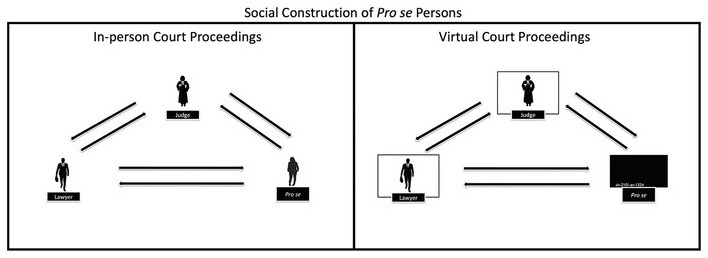
This section turns to the way in which the asymmetric affordances, barriers, and constraints present in these virtual proceedings may influence the social cognitive processes and social perception of judges, lawyers, and unrepresented persons. We present a model of these social cognitive processes and the ensuing civil justice interactions, with an emphasis on the contrast between in-person and virtual court proceedings in Figure 10.5. In this section, we outline the possible implications of our findings to date for unrepresented persons exhibiting digital disparities in court proceedings and underscore areas that we will seek to address in future stages of this research.
10.5.1 Judge’s Perspective
From the judge’s perspective, judges can only see and be seen by the lawyer. From the judge’s vantage point, low-income unrepresented persons who dial into Zoom hearings appear as a black Zoom tile with a case ID or phone number appended to the black tile. As such, the asymmetries created by this technology may, despite the well-meaning of judges, subtly affect their impressions, empathy, and motivations. These affordances and barriers will alter the judicial role.
Motivation. The shift from in-person proceedings to Zoom virtual hearings may affect the motivation and goals of judges and court personnel who operate under severe resource constraints. While courts have shifted to a therapeutic or problem-solving orientation when addressing in-person cases, including evictions,Footnote 52 the shift to Zoom court may affect this orientation. When low-income unrepresented persons dial into a Zoom virtual hearing, they appear as black Zoom tiles with a phone number (or merely a case ID), and this may hinder the empathic concern necessary for a therapeutic or problem-solving orientation.
Perception and impressions. Video-mediated communication alters the way people are perceived and the impressions formed.Footnote 53 In this context, unrepresented persons who appear in Zoom virtual hearings via video, rather than in person, may be perceived as less warm and competent than those who appear in person, especially relative to the lawyers who appear virtually in court.Footnote 54
Cognitive depletion. “Zoom fatigue” is depleting because video conferences are cognitively demanding, requiring one to “focus more intently on conversations in order to absorb information,” as opposed to the nonverbal cues we usually rely upon.Footnote 55 Relatedly, Zoom participants have the ability to watch oneself during these video conversations. Yet seeing one’s own video generates a state of objective self-awareness, which may increase the cognitive load of engaging in these technologies, and may impact a person’s interactions in a videoconference.
Empathy. These technologies also affect the empathy expressed and experienced. Facial expressions, gaze awareness, and nonverbal behaviors build trust and empathy between people, and they affect person-perception as well. When these technologies interrupt or conceal these nonverbal behaviors, empathy may be reduced. For example, the video framing of cell phones (if video is available at all) and a stable mounted computer will have different effects on the inducement of empathyFootnote 56 because the video framing of stable mounted computers may capture these nonverbal features of the upper body and correct for gaze error. Moreover, empathy is more easily generated between people who have ongoing relationships or frequent conversations; thus, strangers are at a distinct disadvantage when presenting over video.Footnote 57
Digital inequalities between lawyers and many low-income unrepresented persons may translate into disparities in the ability to gaze at the judge during these virtual hearings. Gaze awareness is an important factor that affects whether people are perceived as generally interested, trustful or approving, or attentive.Footnote 58 Gazing is an important expression of interpersonal attitude or affect. Indeed, lawyers are taught to gaze in order to enhance their persuasion,Footnote 59 ingratiate themselves to the judge and jury,Footnote 60 or assert dominance over opposing witnesses and parties.Footnote 61 Because those who dial into these Zoom proceedings are unable to gaze at the judge or opposing lawyer, they may be construed as being “defensive” or “evasive.”Footnote 62 Moreover, eye contact is an important ingredient to social interactions and may prompt recursive processes of trust and rapport, whereas an inability to gaze may generate distrust and harm rapport in intergroup encounters.
The increased psychological distances that these technologies create may lead to depersonalization or, in the worst scenario, dehumanization.Footnote 63 This may be in part because these technologies may shape the way others are construed: whether they are construed more abstractly or individuated, whether they are experienced as close or far,Footnote 64 which may impact depersonalization. The risk in the scenario at hand is that low-income unrepresented persons who dial into these Zoom virtual hearings may be depersonalized, that their appearance in a Zoom tile with a number and a disconnected voice may subtly dehumanize them in the eyes of the court officials and lawyers.
Behavior. At least two studies suggest that Zoom virtual hearings may elicit faster interactions and decisions than in-person hearings. That is, that the discrete hearing time is faster than would otherwise be the case because of the social-cognitive dynamics produced by the technology employed. This was observed, for example, in the impact of videoconferencing in judicial decision-making about deporting immigrantsFootnote 65 and is documented in research on the effect of videoconferencing on team performance.Footnote 66
Contingent nature of the judicial role. Interactions between judges, lawyers, and unrepresented persons and their performances in the courtroom are contingent on the technologies employed within the civil justice system.Footnote 67 These court performances are shaped, in part, by the technological capital of these various actors.Footnote 68 For example, Rowden and Wallace, in studying the introduction of videoconferencing in Australia, found that the introduction of this technology had “a profound impact on the production, management and consumption of judicial images, [which] has implications for the judge’s in-court role both as traditionally conceived and in practicing new types of therapeutic jurisprudence that require increased emphasis on engagement with other court participants.”Footnote 69 In general, virtual hearings are associated with more distant or impersonal communication. Yet the introduction of these technologies has occurred at a time when there has also been a strong move toward more engaged styles of judging.Footnote 70
10.5.2 Lawyer’s Perspective
Like the judge, but unlike low-income persons who dial into these Zoom hearings, a lawyer will be able to see and be seen by the judge. This will affect their adversarial orientation and potentially exacerbate asymmetries against unrepresented people. These asymmetries may affect opposing lawyers, who are in an adversarial orientation, making it more likely for them to use nonverbal behaviors and documents that unrepresented people are unable to see. It may also lead them to dehumanize these unrepresented persons.
Initial face-to-face interactions and preexisting relationships. Initial face-to-face meetings are crucial for enhancing later virtual interactions.Footnote 71 Research on distributed teams in the business context reveals that conflict is mitigated by in-person meetings followed by regular video conferences, which can help to maintain a cohesive team and a sense of shared identity. One leading study noted that people who met in person before video-mediated meetings were better at establishing trust with other group members than those who had not met beforehand.Footnote 72 Another likewise found evidence that initial in-person contact could benefit later virtual conferences.Footnote 73 This research suggests that video conferences may be more effective for lawyers who are already acquainted with judges and have preexisting relationships with them.
10.5.3 Unrepresented Person’s Perspective
Finally, unlike judges and lawyers, an unrepresented person who dials into a Zoom hearing cannot see or be seen, and they appear as a black Zoom tile on the judge’s and lawyer’s computer screens. This may affect their participation, experience of justice, and the outcomes obtained.
Construal and meaning-making. When low-income unrepresented persons dial into Zoom virtual hearings, they have access to audio-conferencing capabilities only and are unable to see a courtroom at all. This will undoubtedly affect the sense of realism, solemnity, and gravity of the proceedings, when compared to in-person or videoconferencing enabled proceedings. This may leave them apathetic or confused, experiencing the process as less “real.” Moreover, friction and barriers accessing these Zoom virtual courtrooms may lead unrepresented persons to infer that these virtual court proceedings are not truly designed for people like them.
Experiences of procedural justice. Research suggests that in-person participation may be perceived as more procedurally just than technologically mediated participation.Footnote 74 For example, research in organizational justice has concluded that applicants were less attracted to organizations that used video interviews compared to in-person interviews.Footnote 75 Other studies have noted that in-person interviews were regarded as fairer than video-mediated interviews, resulting in higher levels of job acceptance.Footnote 76 In still another study, interviewees rated their interviewers as less friendly during the video-mediated interviews (in comparison to in-person and telephone interviews).Footnote 77 This research suggests that some unrepresented persons may experience videoconference proceedings as less procedurally just than in-person proceedings. Extrapolating this research a step further, one can infer that unrepresented persons may find it procedurally unjust to be limited to audio-only capabilities when their adversaries have access to the full range of video-conference capabilities.
Relational feedback, turns, interruptions. Physical proximity supports the interaction and cohesion of groups.Footnote 78 This is, in part, because of bandwidth and network cost limitations that reduce the rate, clarity, and frequency of communicative turns.Footnote 79 Because low-income unrepresented persons are unable to observe or communicate with nonverbal behavior, this may exacerbate miscommunication, while at the same time making judges, lawyers, and unrepresented persons slower to correct these misunderstandings.Footnote 80 Indeed, we observed several instances in which this kind of miscommunication occurred for unrepresented persons who were not proficient in English. Unfortunately, these unrepresented tenants dialed into Zoom court and were not able to overcome the language barrier. Similar issues may occur for persons with disabilities, though virtual proceedings may also increase access for persons with mobility-impairing disabilities as well.Footnote 81
One challenge is that these faster hearing times may be coupled with more problematic intergroup interactions. The asymmetries in these interactions may harm intergroup interactions in virtual environments. For example, many judges and lawyers are majority group members, while many low-income members are racial or ethnic minorities or belong to vulnerable groups. Past research has found that an audiovisual lag in an interaction may incite tension in intergroup interactions, particularly when persons are not well acquainted.Footnote 82
Participation. If unrepresented persons experience the process as procedurally unjust, their participation and engagement may be dampened. Indeed, researchers have suggested that videoconferencing technologies may have prompted declines in participation, which may have explained adverse outcomes in research involving bail decisionsFootnote 83 and immigration removal decisions.Footnote 84
Contingent nature of unrepresented persons. Finally, these technologies and the digital inequalities engendered reveal the contingent nature of being a self-represented litigant in the civil justice system. As has been described, the very act of appearing in court is altered and dependent on the technologies employed within these proceedings. At the same time, this technology may benefit the most advantaged unrepresented persons who have technological capital, capacity, and wherewithal. Technological capital is a subset of, and an addition to, Pierre Bourdieu’s cultural, economic, and social forms of capital in the information age,Footnote 85 marked by first-order and second-order digital divides in internet access, skill, and experience.Footnote 86 These societal patterns may, in part, explain why so many unrepresented persons dial into Zoom virtual hearings from their cell phones without videoconferencing capabilities.
10.6 Conclusion
In this chapter, we sought to illuminate how virtual proceedings unfold for low-income persons in the everyday by examining how these new technologies affect the experiences of low-income persons who encounter, and contend with, adversities within virtual court proceedings. Our preliminary findings revealed troubling phenomena in many small claims cases, including eviction and debt-collection cases, winding through virtual court proceedings in Indiana. We found that a majority of low-income persons in these cases are unrepresented, and most are dialing into virtual court (e.g., Zoom/Webex hearings) on their cell phones. The vast majority of these cases involve representational asymmetries, in which repeat-player lawyers litigate against low-income persons who are unrepresented. Of concern, many of these cases also involve technological asymmetries, in which repeat-player lawyers regularly employ the full range of virtual interaction and videoconferencing capabilities of Zoom/Webex, while the low-income unrepresented persons whom they sue are often limited to the audio-only capabilities of their cell phones.
We believe that examining how virtual proceedings unfold in the everyday contributes to the development and refinement of accurate and useful theories about our dynamic civil justice system and best practices for enhancing access to justice in virtual proceedings.


 Open access