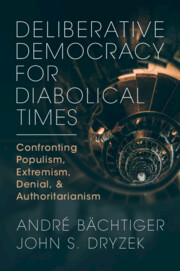
The continued rise of deliberative democracy as an approach to the theory, practice, and empirical study of democracy has coincided with a retreat of democracy on the world stage. This is, to say the least, disconcerting to those of us who believe in the power of public deliberation (which we can characterize as involving inclusive mutual communication and reflection about common concerns). What we try to do in this book is establish the relevance and strength of a deliberative democracy program in a world that seems to be troubled on several democratic fronts. We assume no prior knowledge on the part of the reader, so hope that this book can also act as a kind of advanced introduction to deliberative democracy.
This trouble we address is sometimes captured as “the crisis of democracy.” For reasons that we will elaborate in Chapter 1, we now prefer to think in terms of an interconnected set of diabolical challenges to democracy, as opposed to one overarching crisis. These challenges are multiple, complex, and interconnected, but what makes them truly diabolical is that clever actors have figured out how to prosper from them and so intensify the challenges to democracy. The devil is clever.
When we did think in terms of the crisis of democracy, we organized a paper on “The Crisis of Democracy and the Science of Deliberation” that was published in Science in 2019 and that in some ways is the precursor to this book.
The specific challenges to which we devote most attention come from right-wing populism, extremism, denial, and authoritarianism (each of which has its own varieties). But they flourish in a diabolical soundscape, whose challenges we confront from a deliberative perspective in Chapter 3.
Chapters 4–7 are entitled “deliberating with and against” the category of people in question (populists, extremists, deniers, authoritarians). But “deliberating with” does not necessarily mean engaging bilaterally (or even multilaterally) with the individual or group in question. We hope we are a bit more subtle than that. What we have in mind in each case is how to advance deliberative encounters in the vicinity of the group in question with a view to drawing as many people as possible into productive engagement. At issue here are larger patterns of communication in the public sphere, only some of which may involve direct encounters with the problematic group in question. Throughout, we are careful to distinguish between the diabolical behavior of elites who may indeed be beyond deliberative reach – think Trump, Orbán, or the leaders of fossil fuel corporations funding climate denial – and the citizens who may be attracted to their misleading recipes. It is generally only elites (and some activists) whose behavior can be characterized as diabolical. It is also important to note that most citizens do not fall into the four problematic categories but still play a key role in any democratic response to them – which is why we address “deliberating with everybody” in Chapter 8. We need to establish that citizens can be up to the deliberative task – which is why in Chapter 2 we set the scene for the subsequent chapters by taking on critics who question the political competence of ordinary citizens.
We allow that there is more to democracy than inclusive deliberation, and where appropriate we will point to non-deliberative responses to the challenges we identify (e.g., changes to electoral institutions). But we shall also analyze their interactions with deliberative practices. Ultimately it is citizens who must set communicative constraints on diabolical elite communications, and it is deliberating citizens who must be central.
Likewise, we allow that there are profound challenges to democratic societies beyond those we address here. These include an unstable Earth system (which one of us had addressed elsewhere; see Dryzek and Pickering Reference Ercan, Hendriks and Dryzek2019), extreme income inequality, and crises such as pandemics. But we believe there is no conflict with anything we say here and what we might say about responses to these other challenges. Indeed, securing the deliberative foundations of democracy against the diabolical threats we enumerate is absolutely necessary for establishing the basis on which these other threats might be confronted. To put it crudely: If someone like Trump flourishes, there is no way the Earth system gets protected.
This book has its origins in a gathering at the University of Stuttgart organized by André Bächtiger in 2018 and attended (in alphabetical order) by Simone Chambers, John S. Dryzek, Andrea Felicetti, Jürgen Habermas, Hélène Landemore, Jenny Mansbridge, Sofie Marien, Simon Niemeyer, Maija Setälä, and Rune Slothuus.
John S. Dryzek has given talks on deliberative responses to aspects of democratic crisis and diabolical times at a number of conferences and universities around the world. These include the Colombian Political Science Association in 2016; Victoria University (New Zealand) in 2017; the European Network for Argumentation and Public Policy Analysis 2017 (Lisbon); the University of Stuttgart in 2018; the Chinese University of Hong Kong in 2019; the American Political Science Association Annual Conference 2019; the Oxford Philosophy, Politics, and Economics Society 2020; the Academy of the Social Sciences in Australia Symposium on Democracy: Risk, Relevance, Revival 2022 (Melbourne); and the International Ethics seminar organized by Toni Erskine (Canberra, 2023). He thanks hosts and audiences at all those locations. He also thanks all his colleagues in the Centre for Deliberative Democracy and Global Governance at the University of Canberra for providing such an excellent environment to do work of this sort and for organizing a seminar series involving an exchange with Axel Bruns in 2023 on Digital Media and the Public Sphere. He has drawn on joint projects with Nicole Curato, Selen Ercan, Jordan McSwiney, and Simon Niemeyer for some of the ideas developed here.
For comments on draft chapters, we thank Peter Balint, Max Bey, Axel Bruns, Tony Connolly, Nicole Curato, Jamie Druckman, Toni Erskine, Archon Fung, Mathias Koenig-Archibugi, Jane Mansbridge, Jordan McSwiney, Cian O’Driscoll, Jonathan Pickering, Jensen Sass, Ana Tanasoca, and Julien Vrydagh. Steven Brown and Gareth Wall provided information on relevant studies.