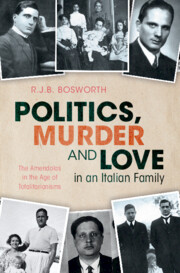


It has brought me a great pleasure putting together in 2020–2 this study of the Amendolas, father (liberal democrat, Anti-Fascist, saint and martyr) and son (communist). In my narration I have remained an ‘indipendente di sinistra’ (Australian-Oxfordian or rootless cosmopolitan-style). I have never renounced an Anti-Fascism of my own slant. In my research for this book, I have been helped by email contact with the liberals Elio D’Auria and Antonella Amendola, who may well end up wondering if Rosario Romeo was not right about me and ‘Botany Bay’. Giovanni Cerchia, from further to current Left and the academic director of the Fondazione Giorgio Amendola, together with Prospero Cerabona, the foundation’s president, have also generously assisted me, both in my research and, importantly, in obtaining quality reproductions of many of the photographs that illustrate this text, whether sourced directly from the foundation or from the Istituto Gramsci in Rome.
When it came to the intriguing Bulgarian face of Giovanni Amendola’s life and his relationship with Nelia Pavlova, I am in debt to Maria Todorova of the University of Illinois Urbana-Champaign and her contacts in the Sofia archives (where are located quite a few photographic images of Pavlova). I was further assisted by Yavor Siderov, once of the University of Western Australia and now of Sofia. John Pollard has kept Mike’s and my locked-down spirits up by blending food and history conversations. Paul Corner has been ready to receive news of Afghanistan’s cricket successes (and failures), while in Italy patiently awaiting a jab. Patty Rizzo, Nerida Newbigin and Ros Pesman sent through details about Altro polo that I had forgotten. Gianfranco Cresciani, Rob Stuart and David Laven have been subeditors extraordinaire. David also found for me Nelia Pavlova’s Paris address. My book is dedicated to David, in a similar spirit of gratitude and inadequacy that I once had with my frequent teaching partner, Tony Cahill, at the University of Sydney.1 Many academic people say to me, with implied deep doubts over my activities, ‘Richard, you write so much’ (even in lockdown). I know. I can’t stop. But I do deeply admire colleagues who know so much more than I ever shall and who are much better at not writing all the time.
As ever, Michal has put up with me retreating to my study, putting on one opera or another as blot-out-music, writing and writing some more (and making bad jokes about ‘2020 vision’). March 2022 signals the sixtieth anniversary of when we met in Ernest Bramsted’s second-year History Honours Class at the University of Sydney; I think the Jewish, Social Democrat refugee from Nazism may have mentioned Mazzini in his course on nineteenth-century Europe but I don’t recall other Italian names. Down the road in present-day Oxford, there is also our criminologist daughter, Mary, her art historian husband, Anthony Gerbino, and two clever, beautiful, granddaughters, Ella and Sophia. Frequently on the phone has been our banker son, Edmund. We Bosworths have held up through the barren weeks and months of pandemic in a way that shows ‘family’ means something to us, too.
How wonderful it has also been, with the assistance of Michael Watson and Liz Friend-Smith, and their two perceptive manuscript readers, to be publishing what surely must be my last book and doing it with Cambridge University Press, the elegant and scholarly publishers of my first, Italy, the Least of the Great Powers. A tiny reference to Giovanni Amendola can be found in its pages. It has also been a delight to be assisted in the familiar publication processes by Judith Forshaw, Divya Arjunan and Stephanie Taylor, with their highly honed professional skills. I, and they, were duly dependent on Diana Volpe for the book’s New Model index. While surviving that process, I have been regularly enlightened by old-age colleagues at Jesus College. I am also especially grateful for the help I have received from Prospero Cerabona and Giovanni Cerchia, President and Director, respectively, of the Fondazione Giorgio Amendola in Turin. All the photographs are reproduced with the permission of the Fondazione and the Istituto Gramsci in Rome, with the exception of Figure 4.1, which is reproduced with permission of the Central Bulgarian State Archives in Sofia, where it can be found in the Hristov papers.
I trust, in this current work, those who are scanning these pages have enjoyed pondering the lights and shadows in the Amendolas’ lives more fully and perceiving the extent to which they illuminate the human condition, even in a world where (social) democracy often seems so permanently trumped.2
