
Skip to main content Accessibility help
×
  • Cited by 4
    • Show more authors
    • You may already have access via personal or institutional login
    • Select format
    • Publisher:
      Cambridge University Press
      Publication date:
      16 November 2023
      30 November 2023
      ISBN:
      9781009282352
      9781009282345
      9781009282338
      Dimensions:
      (229 x 152 mm)
      Weight & Pages:
      0.84kg, 474 Pages
      Dimensions:
      (229 x 152 mm)
      Weight & Pages:
      0.68kg, 473 Pages
    You may already have access via personal or institutional login
  • Selected: Digital
    Add to cart View cart Buy from Cambridge.org

    Book description

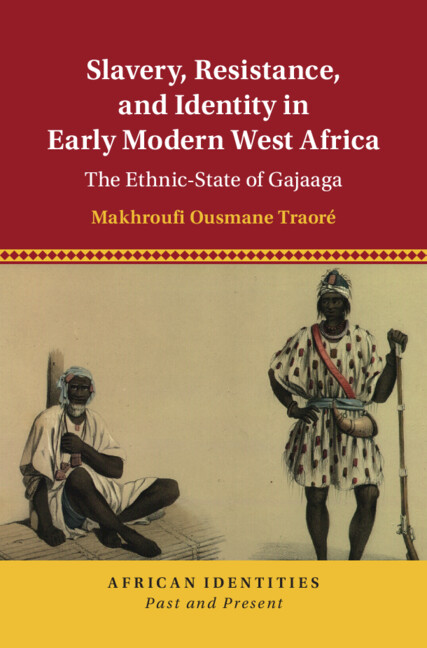
    Between the seventeenth and eighteenth centuries, more than fifteen million people were uprooted from West Africa and enslaved in the Trans-Saharan and Transatlantic slave systems The state of Gajaage, located on the West African hinterland, offered a doorway to the Atlantic Ocean and played a central role in the wide-scale trade system that connected the histories of Africa, the Americas, and Europe. Focussing on the Soninke of Gajaaga, Makhroufi Ousmane Traoré demonstrates how their resistance to the slave trades led to the formation of a united community bound by an awareness of identity. This original study expands our understanding of the various modes of resistance West Africans employed to stem the encroaching tide of Arab imperializing efforts, European mercantile capitalism, and the Atlantic slave trade, whilst also highlighting how ethnic and religious identities were constructed and mobilized in the region.

    Awards

    Finalist, 2025 Gilder Lehrman Frederick Douglas Book Prize, Gilder Lehrman Institute of American History

    Reviews

    ‘The book will provoke new and interesting scholarly discussions and bring an important area of West Africa into broader historical conversations from which it has previously been missing. The work is highly original, both in the research presented and in the ideas it explores. It will be more than welcome to historians of precolonial Africa, the slave trade, Islamic Africa, French empire, and comparative slavery.’

    Rebecca Shumway Source: American Historical Review

    Refine List

    Actions for selected content:

    Select all | Deselect all
    • View selected items
    • Export citations
    • Download PDF (zip)
    • Save to Kindle
    • Save to Dropbox
    • Save to Google Drive

    Save Search

    You can save your searches here and later view and run them again in "My saved searches".

    Please provide a title, maximum of 40 characters.
    ×

    Contents

    Metrics

    Altmetric attention score

    Full text views

    Total number of HTML views: 0
    Total number of PDF views: 0 *
    Loading metrics...

    Book summary page views

    Total views: 0 *
    Loading metrics...

    * Views captured on Cambridge Core between #date#. This data will be updated every 24 hours.

    Usage data cannot currently be displayed.

    Accessibility standard: Unknown

    Why this information is here

    This section outlines the accessibility features of this content - including support for screen readers, full keyboard navigation and high-contrast display options. This may not be relevant for you.

    Accessibility Information

    Accessibility compliance for the HTML of this book is currently unknown and may be updated in the future.
