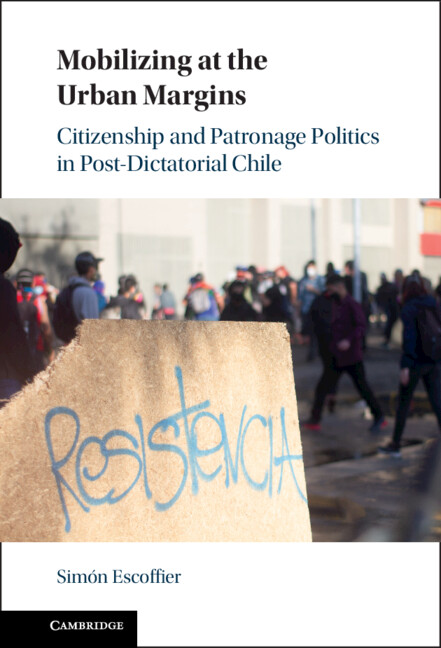

In October 2019, unprecedented mobilizations in Chile took the world by surprise. An outburst of protests plunged a stable democracy into the deepest social and political crisis since its dictatorship in the 1980s. Although the protests involved a myriad of organizations, the organizational capabilities provided by underprivileged urban dwellers proved essential in sustaining collective action in an increasingly repressive environment. Based on a comparative ethnography and over six years of fieldwork, Mobilizing at the Urban Margins uses the case of Chile to study how social mobilization endures in marginalized urban contexts, allowing activists to engage in large-scale democratizing processes. The book investigates why and how some urban communities succumb to exclusion, while others react by resurrecting collective action to challenge unequal regimes of citizenship. Rich and insightful, the book develops the novel analytical framework of 'mobilizational citizenship' to explain this self-produced form of political incorporation in the urban margins.
‘Throughout the world the urban poor struggle against oppression and dispossession by organising in their neighbourhoods. Simón Escoffier’s study of two contrasting neighbourhoods in Santiago, Chile, shows how people mobilise citizenship for cultivating radical democratic activism. This shift to mobilising citizenship in the neighbourhood is brilliant and inspiring.’
Engin Isin - Queen Mary University of London
'… this is a magnificent contribution to social movement studies and a vital backdrop to understand the momentous events in Chile since 2019. It should be widely read beyond Latin American studies.'
Ronaldo Munck Source: Journal of Latin American Studies
‘This text is useful not only for scholars of urban poor neighborhoods and contentious action but also for undergraduate and graduate students and anyone asking broad questions about the differential capacity for collective action. Additionally, it offers a very pedagogical explanation of how methodological comparisons are constructed in space and time.’
Emmanuelle Barozet Source: PoLAR: Political and Legal Anthropology Review
‘Escoffier’s Mobilizing at the Urban Margins is a remarkably grounded account of multiple forms of grassroots politics. As I considered these questions myself, I was struck by the global implications of an account that self-consciously roots itself in two particular neighborhoods in one particular city. This is a great testament to Escoffier’s capacity to link theory to empirics in his observations of Santiago, and, in doing so, to generate a profoundly relevant account and argument.’
Benjamin H. Bradlow Source: Perspectives on Politics
Loading metrics...
* Views captured on Cambridge Core between #date#. This data will be updated every 24 hours.
Usage data cannot currently be displayed.
This section outlines the accessibility features of this content - including support for screen readers, full keyboard navigation and high-contrast display options. This may not be relevant for you.
Accessibility compliance for the HTML of this book is currently unknown and may be updated in the future.
