
Skip to main content Accessibility help
×
  • Cited by 1
    • Show more authors
    • You may already have access via personal or institutional login
    • Select format
    • Publisher:
      Cambridge University Press
      Publication date:
      30 June 2023
      27 June 2024
      ISBN:
      9781009339841
      9781009339827
      Dimensions:
      (229 x 152 mm)
      Weight & Pages:
      0.507kg, 272 Pages
      Dimensions:
      Weight & Pages:
    You may already have access via personal or institutional login
  • Selected: Digital
    Add to cart View cart Buy from Cambridge.org

    Book description

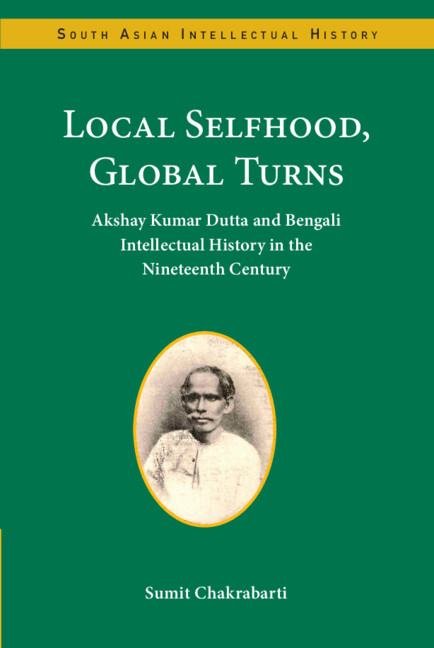
    The book examines the works of Akshay Kumar Dutta (1820–1886), who can be seen as ideologically inhabiting the cusp between religion and rationalism – the two most crucial avenues of debate and discussion in the public sphere in nineteenth-century Bengal. While nineteenth-century Bengal has been an important discourse within South Asian history, major figures of reform such as Rammohun Roy, Debendranath Tagore, Iswarchandra Vidyasagar, or Keshub Chunder Sen have generally been the focus. The book attempts to rescue Dutta from the clutches of academic amnesia, and to locate him as one of the foundational figures of intellectual refashioning among the common albeit educated public in nineteenth-century Bengal.

    Reviews

    ‘In this sumptuous intellectual history, Chakrabarti conducts a fine-grained analysis of Akshay Kumar Dutta’s thought, situating him as a precursor to Bankimchandra, and reading him alongside luminaries like Vidyasagar and Bhudev Mukhopadhayay. Defying easy categorization into nationalist, liberal, or ‘culturalist’, Dutta contributed to a variety of fields, from religion to science to creative translations of European phrenology, that shine through this innovative book. Showcasing a deep knowledge of Dutta’s vast oeuvre as well as global historical scholarship from Europe and North America, this book offers invaluable reflections on conceptions of jati, science, nation, and affect in colonial modern milieus. Local Selfhood, Global Turns will command the attention of all intellectual historians interested in conceptions of the global, the local, and those interstitial spaces resonant with postcolonial societies throughout the world.’

    Neilesh Bose - author of Recasting the Region: Language, Culture, and Islam in Colonial Bengal

    ‘Not quite a reformer like Rammohun nor yet a nationalist like Bankim, Akshay Kumar Dutta was the epitome of an era in transition, dedicated to the vernacularization of political, natural, and moral philosophy in mid-nineteenth century Bengal. Sumit Chakrabarti situates Akshay within the global ebb and flow of scientific rationality, liberal politics, and romantic culturalism, illuminating Akshay’s vision of India as informed by, but not beholden to, European modernity. It may have been Akshay’s path to tutor rather than to command, but even so his embrace of methodical reason was fuelled by dreams of possibility. Appreciating his quietly consequential legacy requires both erudition and affection, and Chakrabarti writes with both.’

    Brian A. Hatcher - author of Hinduism Before Reform

    Refine List

    Actions for selected content:

    Select all | Deselect all
    • View selected items
    • Export citations
    • Download PDF (zip)
    • Save to Kindle
    • Save to Dropbox
    • Save to Google Drive

    Save Search

    You can save your searches here and later view and run them again in "My saved searches".

    Please provide a title, maximum of 40 characters.
    ×

    Contents

    Metrics

    Altmetric attention score

    Full text views

    Total number of HTML views: 0
    Total number of PDF views: 0 *
    Loading metrics...

    Book summary page views

    Total views: 0 *
    Loading metrics...

    * Views captured on Cambridge Core between #date#. This data will be updated every 24 hours.

    Usage data cannot currently be displayed.

    Accessibility standard: Unknown

    Why this information is here

    This section outlines the accessibility features of this content - including support for screen readers, full keyboard navigation and high-contrast display options. This may not be relevant for you.

    Accessibility Information

    Accessibility compliance for the PDF of this book is currently unknown and may be updated in the future.
