

It was after a day of interviewing in July 2010. I was waiting for my dinner, and it suddenly dawned on me; I don’t know what I am studying. What is the IPCC? I had just interviewed a member of Working Group I’s (WGIs) technical support unit (TSU) for the third assessment report (TAR). I struggled to keep up. She was both a scientist describing her research on climate change and a member of the TSU. In the TSU, she was scheduling the timeline of the assessment, facilitating meetings, supporting the chair and, at the same time, an author in the technical summary and ‘making sure the science is ok’ (interview 07.07.2010a). She was performing multiple roles in the assessment and described an organisation that I had not grasped from the literature. I decided then and there, as I scribbled on the menu, that one thing I’ve got to do is accurately describe this organisation. This is the aim of the chapter. I reconstruct the IPCC by exploring its historical emergence through the actors, activities and forms of authority that constitute its present form, as I learned it through descriptive interviews and later, personal observation.
The IPCC has been of particular interest to scholars within IR, STS and human geography. Despite differences in disciplinary approaches, two core concerns are shared within the literature. The first is the relationship between science and politics: how this shapes the organisation and its knowledge products and informs the collective response. The second is participation and particularly its diversity in terms of gender, academic disciplines, forms of knowledge and critically to this study, asymmetries between developed and developing country participation. Many of the studies reviewed in this chapter provide historical accounts of the organisation’s establishment and identify the forces that have shaped its development. However, in focusing on scientific and political relations and dynamics within the IPCC and its work, they overlook aspects of the organisation that could not necessarily be identified as either, such as the TSU. Applying the framework of the book makes it possible to take the IPCC apart as an organisation and to identify and describe all actors, activities and forms of authority regardless of whether they could be labelled as scientific or political. Doing this enables the chapter to build on the study of asymmetries in knowledge production and its effects, not just within the authorship of reports as previous studies provide, but in the everyday conduct of the organisation and its practice of writing climate change.
4.1 Constructions of Science and Politics in the IPCC
Established in 1988 under the co-sponsorship of WMO and UNEP, the IPCC was mandated to assess the science of climate change, its social and economic impacts and policy response strategies (UNGA res 43/53). This task was divided between three Working Groups (WG), each charged with assessing a dimension of the climate change problematic: the physical scientific basis of climate change (WGI); the impacts of climate change (WGII); and response options (WGIII). This remit was adjusted after the first assessment report (FAR), when the responsibility for formulating policy response options was transferred to the newly established International Negotiating Committee (INC) and WGIII was re-focused to assess ‘cross-cutting economic issues’ (IPCC 1992a, 14). While the remit of the WGs has adjusted with advances in understanding and the needs of its users, the focus on producing comprehensive assessments has remained constant over 30 years and 6 rounds of assessment reports. These assessment reports, along with special and methodological reports and the accompanying technical summary and summary for policymakers (SPM), provide governments with the accepted knowledge base for negotiating climate action within the UNFCCC. It is the IPCC’s role in informing the global community’s response to climate change that has made the organisation a key site for studying science in politics.
As reviewed in Chapter 2, the early origins and historical development of the IPCC are conceived as the successful outcome of an epistemic community of climate scientists, performing their function by bringing the causes and consequences of climate change to the attention of policymakers and framing the issue for collective debate (Lunde Reference Lunde1991; Boehmer-Christiansen Reference Boehmer-Christiansen1994a, Reference Boehmer-Christiansen1994b; Paterson Reference Paterson1996; Haas Reference Haas2000; Newell Reference Newell2000). The establishment of the IPCC in 1988 is viewed as the product of this successful politicisation process (Paterson Reference Paterson1996). Despite the success of the IPCC’s intergovernmental process in raising the political profile of climate change and initiating an international negotiating process, scholars from within IR in particular have been critical of the political involvement of member governments in the IPCC, questioning the organisation’s capacity to function as an information or scientific advisory institution to the climate change regime (Biermann Reference Biermann1999, Reference Biermann2002; Haas Reference Haas2000, Reference Haas2004; Haas and McCabe Reference Haas and McCabe2001; Haas and Stevens Reference Haas, Stevens, Lidskog and Sundkvist2011; Stavins Reference Stavins2014). It is the intergovernmental nature of the IPCC and the proximity between science and politics this creates, which makes the IPCC and its assessment products an ideal site for unpacking how science informs politics and how both are shaped through these interactions.
Early contributions to this body of research originate from the Global Environmental Assessment (GEA) project (Parson et al. Reference Parson, Agrawala, Patt, Keohane, Mitchell, Botcheva, Clark, DeSombre, McCarthy and Shea1997; Mitchell et al. Reference Mitchell, Clark, Cash and Dickson2006).Footnote 1 This multidisciplinary group of scholars expanded knowledge of assessment activities, conceived as ‘the entire social process’ through which expert knowledge of a particular issue ‘is organised, evaluated, integrated and presented in documents to inform policy or decision-making’ (Parson et al. Reference Parson, Agrawala, Patt, Keohane, Mitchell, Botcheva, Clark, DeSombre, McCarthy and Shea1997: 53). The GEA’s conception of assessments incorporates both the ‘products and reports, and the process that generates them’ (Parson et al. Reference Parson, Agrawala, Patt, Keohane, Mitchell, Botcheva, Clark, DeSombre, McCarthy and Shea1997), with the aim of understanding how organised scientific efforts shape societal response to global environmental change. The project’s workshops and fellowships generated some of the most detailed historical accounts of the IPCC’s establishment (Agrawala Reference Agrawala1998a, Reference Agrawala1998b; Biermann Reference Biermann2000, Reference Biermann2002; Miller Reference Miller and Jasanoff2004). These empirical studies illuminate the role that organisations like the IPCC perform in meditating between science and politics in producing credible knowledge, suggesting that success is reliant upon participant’s ability to maintain the distinction or a ‘boundary’ between the worlds of science and policy in and through the assessment process (Guston Reference Guston1999, Reference Guston2001).
As study of the IPCC has matured, ‘boundary organisation’ and ‘boundary work’ have emerged as central concepts for characterising the IPCC and its assessment activities, with the IPCC identified as ‘the most significant’ or ‘preeminent’ boundary organisation on climate change (Adler and Hirsch Hadon Reference Adler-Nissen2014: 663; O’Neill et al. Reference O’Neill, Williams, Kurz, Wiersma and Boykoff2015: 380; Beck et al. Reference Beck, Forsyth, Kohler, Lahsen, Mahony, Felt, Fouché, Miller and Smith-Doerr2016).Footnote 2 The metaphor of boundary has brought insights on how science and politics are intertwined in the organisation and how this intertwinement shapes final knowledge products (Shackley and Wynne Reference Shackley and Wynne1996; Shaw Reference Shaw2000, Reference Shaw2005; Skodvin Reference Skodvin2000a; Miller Reference Miller2001b, Reference Miller and Jasanoff2004; Siebenhüner Reference Siebenhüner2003; Fogel Reference Fogel2005; Petersen Reference Petersen2006; Lövbrand Reference Lövbrand2007; Hoppe, Wesselink, and Cairns Reference Hoppe, Wesselink and Cairns2013; Beck et al. Reference Beck, Forsyth, Kohler, Lahsen, Mahony, Felt, Fouché, Miller and Smith-Doerr2016; Lahn and Sundqvist Reference Lahn and Sundqvist2017; Beck and Mahony Reference Beck and Mahony2018; Gustafsson Reference Gustafsson2019; Livingston and Rummukainen Reference Livingston and Rummukainen2020). One of the most revealing studies in this regard is Clark Miller’s analysis of the Subsidiary Body for Scientific and Technological Advice (SBSTA).Footnote 3 Miller identifies the institutional arrangements within the SBSTA and the IPCC as ‘amalgamations of social practice drawn from the worlds of both science and politics’, rather than two distinct domains as they may appear on the surface or as claimed by those within them (Miller Reference Miller2001b, 483). Miller uses hybrid to refer to institutions that house these amalgamations of practice, suggesting that to maintain a productive relationship, boundary organisations like the IPCC need to be able to manage hybrids ‘ – that is, to put scientific and political elements together, take them apart, establish and maintain boundaries between different forms of life, and coordinate activities taking place in multiple domains’ (Miller Reference Miller2001b, 487).
One of the ways this management of hybrids has been studied is through the concept of boundary work, which enables exploration of the intertwinement of science and politics in practice. Fogel, for example, describes how both authors and member governments undertake boundary work during the approval of IPCC reports when they assert claims to science through notions of objectivity, bias and policy prescriptiveness in their attempts to maintain or revise the content (Fogel Reference Fogel2005). This has led scholars to conceptualise IPCC products, particularly elements that travel to or emerge from the negotiating process as ‘boundary objects’ (Lahn and Sundqvist Reference Lahn and Sundqvist2017; Livingston and Rummukainen Reference Livingston and Rummukainen2020; Beek et al. Reference van Beek, Oomen, Hajer, Pelzer and van Vuuren2022; Lahn Reference Lahn, De Pryck and Hulme2022). These studies reveal that while the organisation’s authority may in part rest on maintaining and promoting the demarcation between science and politics, the relevance of its products requires drawing these worlds together and making concrete connections across the two domains (Lahn Reference Lahn, De Pryck and Hulme2022).
This scholarship provides rich empirical accounts of the ongoing and negotiated relationship between science and politics in the IPCC and its products. However, scientific and political actors, activities and forms of authority are not the only social dynamics and structuring forces that shape the IPCC or its practice of writing. The TSUs have greater day-to-day contact with the assessment than any other actor, and yet the activities they undertake and the forms of authority this gives them over the assessment are not accounted for in this scholarship. To identify the valued properties – or forms of authority – that shape the conduct and content of the assessment and their distribution, in Section 4.2, I return to the historical emergence of the organisation when its cultural foundations were laid. This makes it possible to explore a second core concern in IPCC scholarship, namely the asymmetries in developed and developing country participation.
Developing country participation has been an issue for the IPCC since its establishment (IPCC 1988, 1989; Schneider Reference Schneider1991; Sagar and Kandlikar Reference Sagar and Kandlikar1997; Biermann Reference Biermann1999, Reference Biermann2000, Reference Biermann2002; Kandlikar and Sagar Reference Kandlikar and Sagar1999; Siebenhuner Reference Siebenhüner2002; Gupta Reference Gupta2013; Hughes Reference Hughes2015, Reference Hughes2023; Okereke Reference Okereke2017; Yamineva Reference Yamineva2017). Although the IPCC has supported some developing country participation at IPCC meetings since 1989 (IPCC 1990a) and made mandatory support for at least one developing country author on every chapter since the second assessment report (SAR) (Agrawala Reference Agrawala1998b), research continues to identify the extent that economic and cultural barriers impede research and authorship from the global south. Studies on research expenditure and its link to output reveal how economic resources, as measured by Gross Domestic Product (GDP), impede developing countries from generating their own climate knowledge and related expertise (Ho-Lem et al. Reference Ho-Lem, Zerriffi and Kandlikar2011; Pasgaard and Strange Reference Pasgaard and Strange2013; Livingston et al. Reference Livingston, Waring, Pacheco, Buchori, Jiang, Gilbert and Jha2016). The dominance of the English language is a compounding factor, impacting the peer-reviewed literature assessed as well as non-native speaker communication within chapter teams (Ho-Lem et al. Reference Ho-Lem, Zerriffi and Kandlikar2011).
The literature has highlighted how domestic forces also shape developing country contribution to the IPCC’s assessment practice. Historically emerging out of scientific interest in Europe, the international climate research agenda has been led by the investment and research interests of the US and the UK (Kellogg Reference Kellogg1987; Hart and Victor Reference Hart and Victor1993; Hecht and Tirpak Reference Hecht and Tirpak1995; Edwards and Lahsen Reference Edwards and Lahsen1999; Shackley Reference Shackley1999). Scientific interest in climate change was not matched in developing countries, where other pressing social and environmental issues commanded the attention of researchers and the limited resources of governments. For instance, when the IPCC was established in 1988, scientific efforts in India were concentrated on local pollution issues that were considered of greater social and political relevance (Kandlikar and Sagar Reference Kandlikar and Sagar1999), with a similar situation in Brazil (Lahsen Reference Lahsen, Jasanoff and Martello2004: 167). Even a decade after the IPCC’s establishment, Indian government funding agencies did not give as much value to lead authorship in the IPCC reports compared to North America and Europe, which limits the career benefits for authors contributing to this time-consuming process (Biermann Reference Biermann1999; Mahony Reference Mahony2014:113–14). As Borland, Morrell and Watson’s (Reference Borland, Morrel and Watson2018) study of one climate research centre in South Africa highlights, the constraints of limited resources have to be seen in combination with conscious decision-making to invest in local development priorities, industry partnerships and policymaking. As a result, the national context may not place as much value on international journal publications as a measure of contribution and scientific authority as the social order within IPCC author teams (Corbera et al. Reference Corbera, Calvet-Mir, Hughes and Paterson2016; Hughes and Paterson Reference Hughes and Paterson2017).
Sociological study into the global economy of knowledge reveals that southern countries that have emerged as important climate knowledge producers, such as Brazil, continue to remain dependent on theories, techniques and models developed in the global north (Connell et al. Reference Connell, Pearse, Collyer, Maia and Morrell2018a, Reference Connell, Pearse, Collyer, Maia and Morrell2018b). The result is ‘asymmetrical partnerships’ in North-South research collaboration, with Southern partners valued as local experts rather than as co-producers in theoretical and methodological problem construction (Connell et al. Reference Connell, Pearse, Collyer, Maia and Morrell2018b: 5–8). Taken together, the impact of these disparities on IPCC assessments is threefold: first there remains a lack of data for some of the most climate vulnerable regions in the world (IPCC 2007b; Pasgaard and Strange Reference Pasgaard and Strange2013; Pasgaard et al. Reference Pasgaard, Dalsgaard, Maruyama, Sandel and Strange2015; Livingston, Lövbrand and Olsson Reference Livingston, Lövbrand and Olsson2018). Second, developing country authors are perceived as less credible scientific contributors to the assessments and have less influence over the content (Corbera et al. Reference Corbera, Calvet-Mir, Hughes and Paterson2016 Hughes and Paterson Reference Hughes and Paterson2017). Third, developing county knowledge, perspectives and concerns on issues that have profound effects on domestic and global climate decision-making are not adequately represented in scientific literature and IPCC assessments of this (Kouw and Petersen Reference Kouw and Petersen2018; Livingston, Lövbrand and Olsson Reference Livingston, Lövbrand and Olsson2018; Biermann and Möller Reference Biermann and Möller2019).
IPCC scholarship discerns how disparities between research expenditure, interest and investment impact on developing country authorship and the content of the final assessment. However, work remains to be done to unpack how and to what extent economic and cultural properties also structure the broader social order of the IPCC and the everyday conduct of producing a report. To what extent do measures of and asymmetries in knowledge production and scientific authority impact relations in the panel, in the bureau and in the administrative and technical support of the assessment and with what effect for developing country participation? To explore this systematically, there is a need to disaggregate the different sets of actors that make up the IPCC, to describe the activities they undertake and to identify the distinct forms of authority this gives them in and over the assessment.
4.2 The Units of the IPCC
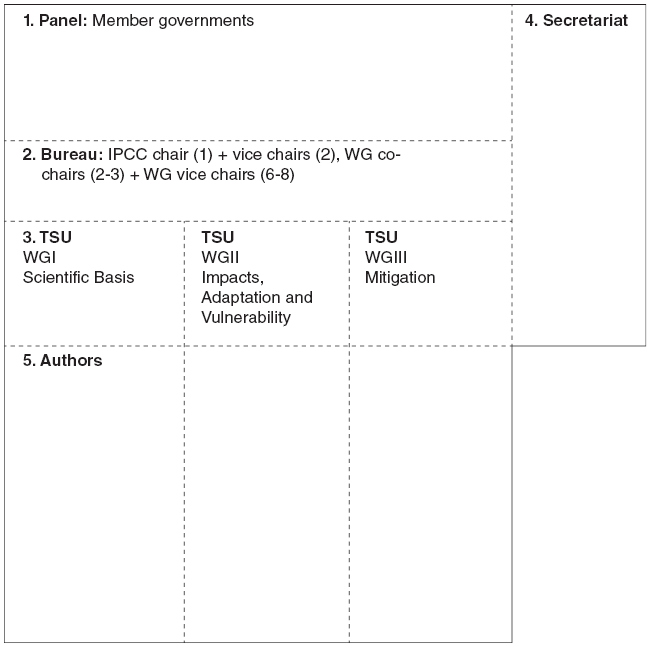
The remainder of this chapter aims to describe the IPCC as it has historically emerged as an organisation in its current form, which can be identified as five distinct units: the panel, the bureau, the TSUs, the secretariat and the authors (see Figure 4.1). For the majority of the actors that make up these units, IPCC activities are not a full-time occupation: it is an author’s contribution to climate change knowledge from within the field of science and a delegate’s position within the meteorological office or ministry of the environment that authorises actors to participate in the IPCC’s assessment practice. However, over time and through participation, distinct scientific, diplomatic and administrative ways of practicing knowledge production have developed a shared way of realising an intergovernmental assessment of climate change. In achieving this, activities and authorities have been divided, distributed and struggled over within and between these units as each attempts to access, gain authority and increase their symbolic power in and over the IPCC’s practice of writing. It is the combination between the imperative of realising the mandate, internal social dynamics and the external forces generated from its central location in climate politics that structure the organisation and its assessment practice today as described in remainder of the book.
The IPCC represented as five distinct units: (1) panel; (2) bureau; (3) secretariat; (4) TSUs; and (5) authors. Units 1–4 come together for the IPCC plenary and have access and share information with each other. WG bureau and TSU have direct contact with the authors. First published in Hughes Reference Hughes2023. This schematic does not include the Task Force on National Greenhouse Gas Inventories (TFI).
4.2.1 The Panel
The Panel is the IPCC’s member governments that meet once or twice a year in plenary session (see Figure 4.2). Membership to the panel is open to all member countries of WMO and UNEP and there are currently 195 members (IPCC n.d.). However, only half regularly send representatives to plenary, and for reasons unpacked later, about one quarter could be described as engaged in panel activities (IPCC 2009a). The panel is involved at every stage of the IPCC’s assessment practice, apart from the authorship of the report, and governments have considerable influence over the organisation and its work (Hughes Reference Hughes, De Pryck and Hulme2022). Although member governments are not directly involved in the authorship of assessments, governments approve the report outline, nominate authors, elect the bureau, review draft reports and accept and approve the final products (see Table 4.3). Financially, the IPCC is dependent on donations, and all IPCC expenditure is agreed by the panel, which gives governments the final decision over the organisation’s continuation, its assessment activities and the expert meetings and workshops supporting these.
The panel: Government delegates seated in alphabetical order at the 40th plenary of the IPCC (Copenhagen, Denmark, 24–31 October 2014).

The nationally designated focal point is usually based within the meteorological office or environment and related departments and acts as an intermediary or conduit between the IPCC, the government and the national scientific community. Between plenary meetings, this actor is engaged intermittently in IPCC work, overseeing the national process for identifying and nominating authors, managing the government review of draft reports and preparing for plenary and approval meetings (IPCC 2010d). To become a meaningful member of the panel, governments must invest the economic and human resources necessary to fulfil this broad range of activities, and through the conduct of these, governments can gain authority in the organisation and influence over the direction and content of the report. This includes, through the bureau election and approval of the next report outline (Chapter 5), nominating authors and submitting review comments (Chapter 6), and interventions, requests and red lines during the approval of the key findings of the reports (Chapter 7). This symbolic power in and over the IPCC’s practice of writing is not equally distributed between member governments, with historical involvement and, relatedly, knowledge of the process being the most important forms of cultural capital structuring relations within the panel.
4.2.1.1 Historical Involvement
Those countries that played a leading role in the founding of the IPCC and in the production of its FAR lay the cultural foundations of the IPCC’s assessment practice, which distinguished the valued properties within the panel. The IPCC’s FAR was originally envisioned as an exercise for a small group of core members and although all WMO and UNEP members were invited to the IPCC’s first plenary session, only 30 countries sent delegates (IPCC 1988; interview with BM 1.07.2010). Of the 90 government representatives at this meeting, 61% came from 8 countries: US (15); Japan (11); Canada (8); USSR (5); Australia (4); France (4); Netherlands (4) and; UK (4). The first IPCC chair, the Swedish scientist Bert Bolin, recognized the importance of broadening geographical participation and in 1989 the panel set up a special committee to assess and increase developing country representation (IPCC 1989; Bolin Reference Bolin2007: 55). By this time, however, the mandates and work plan of the three working groups (WG) had been established and the principles for their operation formulated, principles that would later be codified and adopted by the panel as the rules and procedures governing IPCC assessment activities.
The current modus operandi of the IPCC is underpinned by the valued properties and principles of its founding members. As documented by the Australian delegate to the first IPCC session and later a long-standing bureau member, Australia’s ‘emphasis on the importance of objectivity, the involvement of subject matter experts and the use of peer-review procedures during its interventions at the first session, significantly shaped the character of the IPCC in its early years’ (Zillman Reference Zillman2007: 873), and it was on US insistence that peer-review was incorporated into the assessment practice (Zillman Reference Zillman2007). The acceptance of these scientific principles without debate (Bolin Reference Bolin2007: 49–52) indicates the shared nature of scientific practice and corresponding cultural values within and between US, Canada, Northern Europe and Australia who were leading the process. This embodied working style, or habitus, was infused into IPCC proceedings, as summarised in Bolin’s address to the panel, in which he urged members’ decision-making to be grounded in scientific and technical arguments:
He reminded the panel that the IPCC is not a negotiating body…. He hoped there would not be much need for decision-making by voting in the IPCC…. In this process, it was most important that the developing countries were given adequate opportunity to take part because the process then led to mutual learning, benefitting not only the developing countries but also the developed countries…. So orderly conduct of business in a free and scientific manner with participation by all or as many as possible should be the IPCC working mode.
This statement designates an appropriate style of conduct, privileging scientific and technical forms of argumentation in panel discussions and automatically empowering those embodying this way of operating. This contrasts with the view from developing country delegates, many of whom identified gaps in national data and scientific capacity (IPCC 1991) and felt a ‘sense of frustration’ in the process because of the human resources required (in speech by Mostafa Tolba, IPCC 1991: 5). Many developing countries contested the scientific and technical framing of climate change and called for the issue to be recognized as a developmental issue and be assessed in the context of sustainable development (see Zimbabwe speech to first session in IPCC 1998 annex 3, 11; Borione and Ripert Reference Borione, Ripert, Mintzer and Leonard1994: 81). Thus, while membership to the panel rapidly expanded from 1988 onwards (Agrawala Reference Agrawala1998b), and in theory it is possible for all member governments to gain or increase influence in and over assessment activities, countries must possess the economic capital to invest in participation and act according to the cultural mode embodied in the IPCC’s practice of writing.
4.2.1.2 Knowledge of the Process
Knowledge of the process is a valuable source of cultural capital within the IPCC (see Table 4.1). There are several avenues through which to accrue knowledge of the process, including length of participation, involvement in panel activities and having a national expert elected as a bureau member. Governments with an elected bureau member can attend bureau meetings and draw on this contact within and between sessions, which provides these governments with greater insight into the assessment process. This knowledge of the process is a valuable source of cultural capital in the IPCC – translating into symbolic power during plenaries and report approval sessions when delegates can draw on their insider perspectives to make informed interventions and authoritative reasons for altering proposed text.Footnote 4 As Table 4.2 indicates, those countries intervening most in plenary proceedings all have bureau members. This relationship is strongest where a developed country co-chairs the WG, and hosts the TSU, with these governments intervening most frequently during plenary sessions. The US delegation is symbolically powerful in this regard. Actors from within the United States played a critical role in establishing the IPCC and laying its cultural foundations (Hecht and Tirpak Reference Hecht and Tirpak1995; Agrawala Reference Agrawala1998a, Reference Agrawala1998b), and the United States hosted a WG chair and TSU for five consecutive assessments (see table 4.4). This role in the establishment of the organisation, chairing of WG assessments, and hosting of TSUs has ensured that US cultural ideals and principles of scientific legitimacy, expertise and authority have underpinned the development of the IPCC’s practice of writing and the representations it generates.


* Member countries with a bureau member.
1 Only interventions from the floor, and not presentations by delegates or bureau members chairing contact groups, were included.
In contrast, the majority of developing country members have struggled to acquire the necessary capital to act as authoritative participants in the panel. An important factor in understanding this is the organisation of participation domestically. The national focal point acts as an intermediary between the government, national scientific community and the IPCC and the location of this actor within the government bureaucracy matters. While 32% (59/185) of national focal points to the IPCC are located in the meteorological department (IPCC n.d., IPCC focal points), out of the 10-member governments that took up 69% of the airtime at the 32nd plenary (Table 4.3), today only 1 of these continues to have a focal point located in the meteorological department, Sweden.

In part, the location of the focal point is a marker of the recognition given to the IPCC and the climate issue domestically as well as how international relations are organised in the country. When the IPCC was established, most governments coordinated their participation through the meteorological or related department. However, as the salience of climate change has increased, coordination has tended to move to environment-focused departments, with some country particularities, such as the US, where national participation to international organisations is coordinated by the State Department. The location of the focal point impacts on the coordination and degree of investment in IPCC activities (interviews 17.09.2010; 5.10.2010), such as the identification of experts for author nomination, who within the government (if anyone) participates in the government review of assessment reports and the relaying of information between the IPCC and UNFCCC processes. Interviews with past and present focal points reveal the level of investment that countries, including Australia, United Kingdom and the United States, put into coordinating IPCC-related activities (interviews 26.07.2010; 13.12.2010; 13.12.2010), which translates into symbolic power during the approval of IPCC products.
4.3 The Bureau
The IPCC bureau oversees and manages the production of IPCC assessment reports and in this function is an intermediary between the member governments of the panel that authorise the assessment and the expert authors that produce the report. In relation to the panel, the bureau’s main purpose is to provide scientific and technical advice to guide member governments (IPCC 2011, see Table 4.3), and the opinion of the bureau has a significant influence on panel decision-making. Today, the bureau and the panel are distinct units within the IPCC, each with specific functions and forms of authority over the assessment process. This distinction between the bureau and panel has developed over time and in response to pressures from within and outside of the organisation.
As indicated earlier, the IPCC’s establishment was led by a relatively small group of individuals identified as representatives of government, the parent organisations (WMO and UNEP) and/or prominent members of the international climate science community. The original structure and work programme of the IPCC was largely agreed between these actors before the first IPCC session and accepted during the plenary without much debate (IPCC 1988; Bolin Reference Bolin2007: 49–50; Zillman Reference Zillman2007: 872). A bureau of fifteen was appointed to oversee the work of the FAR at the first session, which included the IPCC chair, a vice-chair, a rapporteur and a chair and vice-chair for each of the three WGs (IPCC 1988).Footnote 5 It was decided that to ‘provide for the best possible co-ordination’ that appointed bureau members should be, ‘where possible, Principle Delegates of their respective countries in IPCC’ (IPCC 1988: 6). This indicates the fine line between the bureau and the panel at the time of the IPCC’s establishment. However, as political interest in climate change has increased, so has the government’s interest in the work of the IPCC and the desire for greater autonomy over the organisation and its assessment activities.
To ensure regional representation, today’s bureau has 34 members representing the 6 WMO regions, plus additional representatives from Africa and Asia.Footnote 6 The line between bureau and panel membership is today distinct, with few of today’s national delegates serving on the bureau and vice versa. Some perceive that this has led to a loss of authority for bureau members in relation to the panel (interview 13.02.2010), while others consider it a necessary development (interview 9.11.2010). As described earlier, key bureau members, particularly the IPCC chair, played a central role in instilling the cultural values of the international scientific habitus in plenary proceedings, which distinguished the value of scientific and technical forms of authority in the order of relations.Footnote 7 This means that bureau members were able to deploy scientific conventions and measures of authority for the purpose of containing and channelling political forces during decision making and approval of text. However, over time, panel members have become resistant to these challenges, seeking to instil a more familiar negotiating style, which is oftentimes judged as confrontational and obstructionist by bureau members.
The development of cultural contestation between the bureau and the panel over the conduct of IPCC proceedings is epitomised in the controversy surrounding the election of the IPCC chair, which also illustrates these competing cultural forces.Footnote 8 In 2002, the incumbent IPCC chair, Dr Robert Watson, was not re-elected for a second term in an election process that divided opinion within the panel (Lawler Reference Lawler2002; Zillman Reference Zillman2007: 875).Footnote 9 This was the first time in the IPCC’s history that it was necessary for the panel to take a vote on the position of chair, a decision that until then was reached by acclamation between panel and bureau members. This precedence and the lack of codified procedure for its resolution further complicated the process. Although the IPCC chair is said to be stateless, the two most commonly cited explanations are US opposition to Watson’s re-election and the necessity of the chair position to be held by a developing country member (interview 13.12.2010; Bolin Reference Bolin2007: 185–87). The United States supported the election of Dr Rajendra Pachauri from India, who unlike his predecessors was a WGIII expert with a PhD in industrial engineering and economics. There was a perception amongst some within and outside of the IPCC that WGIII did not do real science, which reveals the cultural hierarchisation of knowledges.Footnote 10 Pachauri was neither recognised for his contribution to climate science or for work on earlier international environmental processes, which automatically called his credibility into question (Lawler Reference Lawler2002).Footnote 11 US support for Pachauri’s election was perceived by some as an attempt to undermine the scientific authority of the IPCC, or at the very least to contain its influence over the climate field at a time when the administration was hostile to the UNFCCC negotiating process and its Kyoto Protocol (Haas Reference Haas2004).Footnote 12
Despite the panel’s attempt to demarcate itself from the bureau and the cultural contestation between the panel and the bureau to determine the order of proceedings, the panel remains reliant on the bureau to oversee the production of IPCC assessment reports. The developed country co-chairs are amongst the most powerful actors in this regard. Recognised for a combination of scientific contribution and experience of similar international environmental processes, the WG co-chairs are responsible for the management and production of the WG assessment. The WG co-chairs are contracted by the national government for a percentage of their time to work on the IPCC process, alongside technical and administrative support in the form of a TSU, which is housed in or near the co-chair’s institution, as described in Section 4.4. The developed country co-chair leads every stage of the report’s compilation: drawing up the report outline (Chapter 5); selecting the authors (Chapter 6); overseeing the assessment (Chapter 6); preparing the summary for policymakers (Chapter 7); and chairing the approval of this document (Chapter 7) (see Table 4.4). The WG vice-chairs assist the co-chairs in this role, and the degree to which the vice-chairs and developing country co-chairs imprint their expertise on the process depends on their scientific credentials, experience of assessment processes and the extent to which they invest themselves in IPCC work, with considerable variation noted by bureau members during interviews.

Bureau members are supported in IPCC activities by their government or the IPCC trust fund and have professional responsibilities outside of the IPCC, the majority working within research institutes, government departments and/or international organisations. The pressure of time and a lack of financial resources particularly constrain the investment of developing country bureau members (interview 17.09.2010; 20.01.2011). Developing country expertise is highly sought after by international organisations, and these individuals may have to balance IPCC with commitments to other international agencies and assessment efforts (interview 17.09.2010). Historically, the majority of bureau members have not received research assistance to support them in this capacity. As involvement in the IPCC process does not tend to offer developing country participants the same degree of cultural recognition, experts from these regions may be both less able and less willing to invest themselves in the process (Yamineva Reference Yamineva2010: 58–59). The economic capital structuring developing country bureau members’ capacity to invest in the IPCC process is augmented by the attitudes and perceptions of developed country bureau members, many of whom have historically regarded their counterparts as political appointees (Bolin Reference Bolin2007: 84), not adequately qualified for the task (IAC 2010b, 261 and 587). These judgements overlook the economic resources necessary for a country to (1) become interested and invested in IPCC activities, (2) accrue the cultural capital to meaningfully impact the assessment and (3) have the technical and administrative support to ensure their vision, and representations are incorporated in draft outlines, reports and summaries.
4.4 The Technical Support Units
The construction of each WG assessment report is coordinated and administered by a TSU. Although WG co-chairs are responsible for overseeing the production and approval of the assessment, they would not be able to fulfil this role without considerable organisational, administrative and technical support, as housed within the TSU. As Table 4.5 indicates, the TSUs play a significant role at every stage of the assessments production: preparing and administering the timeline for the report’s construction; identifying and processing the selection of authors (Chapter 6); managing the authors in writing the report; editing, harmonising and polishing submitted material (Chapter 6); and compiling the finished product for panel approval and publication (Chapter 7). Although technical support staff are the only unit within the organisation working full time on putting the assessment together, have the most contact with the report as it is assembled, and TSU heads are authoritative figures in and over the IPCC’s practice of writing, the TSUs are barely mentioned in the scholarly literature and have not been considered a noteworthy component for analysing and understanding this organisation and the meanings it generates.Footnote 13

The introduction of TSUs to the IPCC’s assessment practice is said to have been an innovation of the first WGI chair, Sir John Houghton,Footnote 14 when it became apparent that WG specific technical and administrative support would be necessary to realise the finished product (Zillman Reference Zillman2007: 878). These units would subsequently become a central feature of all three WGs and one of the most significant institutional innovations of the IPCC’s assessment practice. The TSUs are set up once the decision to repeat the assessment has been taken and the new bureau elected. They are funded by the government of the developed country co-chair and are generally hosted within the chair’s institution, such as the university, the met office or the environment agency. To date, there have been eight countries that have hosted TSUs, with both the United Kingdom and the United States holding the WG chair post for five of the six assessment rounds, see Table 4.4.
The WG TSUs are not homogenous units, and although a newly elected chair and appointed staff seek input and advice from outgoing TSUs, the set-up of this unit and the style of work it adopts develop over the course of the assessment as shaped by the WG chair, the appointments they make and the host country. These units have grown over time to keep pace with increasing author numbers and volumes of knowledge, and today they have between five and fifteen members of staff. Nearly all staff will be new hires, as only a few serve on multiple TSU teams and the demands of TSU head make it a difficult role to repeat (interview 14.07.2010). While the TSUs are set up to assist both the developed and developing country co-chairs, this assistance is uneven. The TSU team regularly update and seek the input of the developing country co-chair, but their main focus is on meeting the requirements of the chair that they work alongside (interview 25.02.2011). The administrative support for developing co-chairs has increased over subsequent assessments, for example, China has co-chaired WGI since the TAR and developed its own technical and administrative capacity within the China Meteorological Administration. However, disparities persist and continue to structure the extent to which a developing country co-chair can invest in the process and imprint on the final product.
The majority of TSU staff are technical and administrative, however, some members of the team are hired specifically for their scientific credentials and experience of previous assessment exercises. The most notable in this regard is the TSU head or the science lead.Footnote 15 It is the responsibility of the TSU heads to implement and manage the production of the assessment as envisioned by the WG chair and approved by the panel. The importance of the task is reflected in the credentials of those hired, many of whom are established within a field of science relevant to the WG and have previously contributed as an IPCC author, bureau member and/or a national delegate (interviews 25.07.2010; 5.10.2010).Footnote 16 The combined expertise of the WG co-chair and TSU head is critical for gaining the support of the authors. Authors tend to perceive and measure authority through the scientific habitus, if they do not recognise the scientific credentials of those leading the process and trust in their capacity to produce an authoritative assessment, they may invest less in the process. While the scientific capital of the TSU distinguishes it from other administrative units of the organisation, most importantly the secretariat, it is not the unit’s main source of capital.
The WG TSUs make an IPCC assessment report possible, binding the assessment practice, and the actors that constitute it, through their day-to-day activities. The TSU’s symbolic power lies in the IPCC’s dependence on this unit for achieving its mandated task (see Table 4.5). The TSU’s position within the organisation gives the unit unrivalled access to the authors and the assessment under construction. The TSU introduces authors to the IPCC and is the main point of contact throughout the assessment. Through emails and author meetings, the TSU staff instil in authors the appropriate procedures and values for conducting the assessment and have the editorial power to ensure that these are adhered to in the compilation of chapters. The TSU’s management of the report’s construction also gives it unmatched technical knowledge of the process and progress of the report, which makes the TSU an important contact point for secretariat, panel and bureau members for informed position taking and decision-making prior to and during bureau and plenary proceedings. This makes establishing and maintaining links to WG TSUs a vital source of social capital and an avenue for acquiring cultural capital (insider knowledge of the process), sources of capital that are most accessible to the member countries hosting these units and the bureau members that work alongside them.
4.5 The Secretariat
The Secretariat is the organisational centre of the IPCC and its only permanent body. Despite its permanence and symbolism as the focal point of the organisation, the secretariat is an enabler rather than a direct contributor to the IPCC’s assessment practice. The secretariat plays an active role at the start of the assessment cycle, particularly in assisting the chair and panel in formulating the work program and instilling IPCC values and procedures in the incoming bureau members and TSU staff. However, the secretariats direct involvement in the assessment decreases with the formation of the new WG TSUs. The secretariat is an important actor in plenary and bureau meetings: presenting the agenda and reports of previous sessions, providing support to the chair, introducing budgetary matters, responding to government enquiries and generally ensuring the orderliness of proceedings (see Table 4.6). Between these events the secretariat is regularly in contact with national focal points and bureau members and once the assessment is under way information flows daily between the secretariat and WG TSUs.

Although the secretariat is situated within WMO headquarters in Geneva and its roughly half-dozen staff are employees of the UN, the unit is answerable to member governments of the panel, and it is governments that decide the size and remit of the secretariat (IPCC 2009c).Footnote 17 Organisationally, however, the secretariat adheres to WMO procedures in formal administrative and financial arrangements and the secretary reports to the IPCC chair and executive councils of WMO and UNEP (IPCC 2009c). The secretary is an important figurehead within the organisation and to date there have been two long-standing IPCC secretaries, with a third appointed in 2016. These actors have a similar career trajectory to other actors managing the IPCC process, including bureau members, panel members and TSU heads.Footnote 18
In recent years, the authority of the secretariat has been challenged and different factors and events account for this. The distance between the secretariat and the production of IPCC assessment reports has increased with the strengthening of TSUs. As studies of bureaucratic authority indicate, secretariat staff possess a wealth of experience and knowledge, including historical knowledge of the organisation and its policies and procedures. This cultural capital makes the secretariat a valuable contact between plenary and bureau proceedings when government and bureau members seek information and advice from the secretariat to inform decision-making (Bauer Reference Bauer2006; Depledge Reference Depledge2007; Jinnah Reference Jinnah2010).Footnote 19 While this knowledge is valued within the IPCC, the most valuable form of cultural capital is knowledge of the assessment and its progress in practice, and the secretariat no longer houses science staff and has minimal direct involvement in the day-to-day construction of the assessment reports compared to TSUs. Thus, while the secretariat is the principle point of contact for members of the IPCC and observer organisations, the secretariat cannot provide participants with the same detailed knowledge on the progression of the report as TSU staff.
Between the AR4 (2007) and AR5 (2014), the secretary sought to stem this loss of authority by increasing the scientific capacity of the secretariat and its proximity to the IPCC’s assessment practice. However, this brought the secretariat in conflict with TSU staff and led to further erosion of authority. In 2008, the panel set up a task group to undertake a review of the secretariat’s staffing requirements, as the unit was widely regarded as over-stretched (IPCC 2008a: 4, 2009c: 2). The secretary, Dr Renate Christ, proposed adding two science officers to the staff and indicated that she saw an expanded role for the secretariat in providing technical and administrative support to the IPCC chair and bureau members on issues and themes that cut across the three working groups and in assessing the grey literature used in reports (IPCC 2009c). The task group dismissed the secretary’s request for additional science staff, indicating that:
…the working group and task force TSUs are primarily responsible for the preparation of the assessment reports and methodologies and provide the in-house scientific expertise of the IPCC. IPCC interviewees were strongly of the view that the Secretariat should continue to focus on corporate and administrative issues, concerned with the quality and efficiency of processes rather than with their substance.
After the panel’s review, the post of Scientific Officer in the secretariat was amended to Programme Officer (personal observation). The secretariat’s position was further undermined by the media attention surrounding errors over the Himalayan glacier in the AR4 and the resulting InterAcademy Review (IAC), which held the secretariat and IPCC chair responsible for the organisation’s ‘sluggish response’ to these events (IAC 2010a: 47).
In addressing the IAC’s recommendations, the panel sought to tighten the remit of the secretariat. This time, however, it was member government’s attempts to amend the secretariat’s terms of reference that were thwarted. Comments from WMO and UNEP asserted their parental authority over the IPCC, reminding the panel that: ‘mutual consent of UNEP and WMO is required to amend the terms of reference of the IPCC Secretariat’ (IPCC 2012b 1). Since these events, the secretariat has created a niche for itself in managing external representation of the IPCC and has expanded its expertise in communication and media relations (IPCC n.d.). This extends to providing bureau members and other IPCC actors with training and preparation before media appearances. This demonstrates how units can adapt to changing circumstances to ensure their continued relevance. It also highlights that while scientific expertise and proximity to the assessment are the most valued properties, including within the administration of the organisation, they are not the only activities and forms of authority that matter.
4.6 The Authors
The authors of IPCC assessment reports are largely insulated from the internal social dynamics described above. IPCC authors are experts that have nominated themselves or have been nominated by their government or international organisation and are selected by the WG bureau to assess and review the material relevant to their expertise (Chapter 6) and the government-approved outline (Chapters 5). As with panel and bureau members, producing the assessment is not a full-time job (on paper), and they are not paid by the IPCC for their time. The majority of experts nominated and selected as authors work as knowledge producers and reside within universities, research institutes, government departments and agencies and international governmental and non-governmental organisations. It is from these sites that they contribute to climate change knowledge production, and it is this contribution to a particular body of knowledge, such as the economics of climate change, its health impacts or modelling the general circulation of the atmosphere, which constitute them as climate experts and qualify them to participate in the IPCC’s assessment practice. For most authors, their participation in the IPCC is a series of author meetings, email exchanges, and intense periods of reviewing, compiling, assessing and writing to meet the deadlines of the drafting cycle (see Table 4.7).

The social order within the three WGs is largely governed by the scientific habitus, and the forms of authority it recognises, with some variance between WGs depending on the academic composition of its authorship. WGI is the most coherent in epistemic terms. Charged with assessing the physical science of the climate system and climate change, its remit has remained constant since the organisation’s establishment. The WG is composed of natural scientists interested in documenting and modelling historic, present and future changes in the composition of the atmosphere, oceans and cryosphere and the relationship to global temperature. The dominance of the natural sciences is reflected in the journal articles referenced in the report, in the TAR, three-quarters of references belonged to Earth science journals, including ‘Geosciences’, ‘Oceanography’ and ‘Meteorology’ (Bjurstrom and Polk Reference Bjurström and Polk2011: 10). Overall, 84% of references in this report were journal articles, with a small number of journals frequently cited (Bjurstrom and Polk Reference Bjurström and Polk2011: 4). A similar pattern is likely to be observed in subsequent WGI reports. This highlights that while the focus and coverage of individual reports is shaped by advances in scientific knowledge as scoped and outlined by the co-chairs and approved by the member governments, the production of the assessment remains governed by the shared scientific practices of authors and epistemic conventions for establishing and recognising scientific authority.
The epistemic coherence of WGI is not replicated in the other two WGs. WGII’s focus on the impacts of climate change necessitates a multidisciplinary authorship. The majority of WGII authors are again natural scientists, which is reflected in the journal material referenced, the most important fields being the ‘Earth sciences’, ‘Biology’ and ‘Environmental science’ (Bjurstrom and Polk Reference Bjurström and Polk2011: 10–13). However, WGII covers a broader range of topics and fields of knowledge than WGI, and ‘social sciences’, ‘energy and resources’ and ‘medicine’ are important subjects within the assessment (Bjurstrom and Polk Reference Bjurström and Polk2011). Furthermore, 59% of WGII references in the TAR are journal articles compared to WG I’s 84%, and these references span three times the number of journal titles (Bjurstrom and Polk Reference Bjurström and Polk2011: 4). This highlights that WGII’s assessment of climate change impacts, adaptation and vulnerability relies upon more varied reference material and sources than WGI, including non-peer reviewed material. This is also a reflection of regional chapters and assessment of climate impacts in developing countries, where non-peer reviewed materials are used to fill the gaps in the published literature (interview 7.07.2010). Thus, while the scholarly habitus continues to order relations within the WG and between the chapter team members, the integration of the different fields of knowledge and inequalities in the coverage of knowledge, alongside the negotiation of disciplinary specific scholarly conventions, epistemologies and terminologies are important forces in the conduct of the WGII assessment.
The remit of WGIII has been subject to the most substantial change compared to the other WGs. In the FAR, WGIII was focused on policy response options, and the report was authored by low-level policymakers and negotiators alongside a few independent legal and environmental experts (Skodvin Reference Skodvin2000a: 119). In authoring the assessment, this group could not rely on a clearly identifiable body of knowledge for the content of the report or scholarly conventions to structure working relations. As a result, Tora Skodvin suggests that ‘the informal rules of politics’ became ‘natural guides’ (Skodvin Reference Skodvin2000a: 120). These author meetings effectively served as policy-debating forums – ‘where governments could learn about the disputes that would be generated by specific policy options’ (Boehmer-Christiansen Reference Boehmer-Christiansen1994a: 149), and where preliminary drafting for a convention was undertaken (interview 07.09.2010). After the publication of the FAR, the IPCC’s position in the emerging field of climate politics and relation to the international negotiations was not yet formalised (Section 3.1). To ensure the continued relevance of the IPCC’s assessment, the leadership at the time adjusted the focus of WGIII to provide an assessment of the cross-cutting economic and other related issues (Bolin Reference Bolin2007: 81). There was also a desire to bring the assessment practices of WGII and WGIII closer to those of WGI and to recruit authors of ‘comparable stature’ as those within WG I (Bolin in IPCC 1992a: 4), which put economics at the centre of WG III’s authorship.
In the end, the bureau’s confidence in the political relevance of economics and the scientific authority of economists threatened to undermine the legitimacy of WGIII’s contribution to the SAR. Aspects of the economic construction of the climate change proved difficult for countries in the global south to digest, as the statistical value of human life in developing countries was calculated as one tenth of that in developed countries.Footnote 20 Nevertheless, economics has remained the dominant form of knowledge in IPCC assessments of climate mitigation (Bjusrstöm and Polk Reference Bjurström and Polk2011: 11; Corbera et al. Reference Corbera, Calvet-Mir, Hughes and Paterson2016; Hughes and Paterson Reference Hughes and Paterson2017). The social order of relations within WGIII and the conduct of its assessment today are largely governed by the same forms of authority as operate in WGI and WGII: contribution to knowledge (publications), institutional affiliation, and prior IPCC/international assessment experience (Hughes and Paterson Reference Hughes and Paterson2017). At the same time, the composition of WGIII authorship remains more varied than WGI, including a higher percentage of authors from government agencies, international governmental and non-governmental organisations and industry.
The controversy that surrounded WGIII’s construction of climate mitigation in the SAR highlights the impact that disciplinary make-up has on the conduct of a WG assessment, the representations of climate change this generates and on the fields of knowledge themselves.Footnote 21 Inclusion in IPCC assessment reports demonstrates the social and political relevance of climate change research, and this has made the IPCC an object of competition and struggle within and between different fields of science. Historically, General Circulation Models of the atmosphere have been regarded as the most important scientific and policy tool for knowing and defining the climate change problematic, which is reflected in the number of authors and space given within WGI reports to this form of knowledge (Shackley and Wynne Reference Shackley and Wynne1995; Shackley et al. Reference Shackley, Young, Parkinson and Wynne1998; Edwards Reference Edwards1999, Reference Edwards, Miller and Edwards2001; Shackley Reference Shackley1999; Demeritt Reference Demeritt2001; Guillemot Reference Guillemot, De Pryck and Hulme2022). Scholarly criticism has identified the limitations of this disciplinary narrowness and the role that social science has to play (Hulme Reference Hulme2008; Nordlund Reference Nordlund2008; Yearley Reference Yearley2009; Hulme and Mahoney Reference Hulme and Mahony2010), although disciplinary diversity has increased, modelling remains central to WGI and WGIII’s constructions of future emissions and the climatic and societal responses through Integrated Assessment Models (Beck and Mahony Reference Beck and Mahony2018; Cointe Reference Cointe, De Pryck and Hulme2022). Criticism has also grown over the lack of Indigenous knowledge and representation in IPCC reports (Ford, Vanderbilt and Berrang-Ford Reference Ford, Vanderbilt and Berrang-Ford2012; Ford et al. Reference Ford, Cameron, Rubis, Maillet, Nakashima, Willox and Pearce2016). This is a more challenging issue for the organisation to address as the culture of scientific authority risks further reproducing and entrenching extractive partnerships and practices (Klenk et al. Reference Klenk, Fiume, Meehan and Gibbes2017; David-Chavez and Gavin Reference David-Chavez and Gavin2018; Latlippe and Klenk 2020; van Bavel, Macdonald and Dorough Reference van Bavel, MacDonald, Dorough, De Pryck and Hulme2022).
Although the scientific habitus remains an important ordering force within the WG chapter teams; bureau, TSU and panel attempts to increase geographical and gender representation and standardise authorship roles and assessment practices across the three WGs have meant that the authorship has diversified and IPCC’s practice of writing has been subject to increasing levels of codification.Footnote 22 As covered in depth in Chapter 6, the selection of authors and conduct of early assessments were largely governed by the fields of knowledge and expertise of those that made up the WGs. However, as IPCC reports and scientific findings have been subject to criticism after publication, and as those managing the process have sought to respond and protect the IPCC and to maintain its authority within the climate field, the scientific habitus has been confronted and at times overruled by other organisational imperatives. To explore this interplay between scientific authority, geographical representation and the codification of the IPCC’s practice of writing further, Chapter 6 follows the pathway of the assessment report from the nomination and selection of authors through to the government review.
4.7 Summing Up
In this chapter I have sought to describe the IPCC as I came to understand it through interviews and observation and the analytical framework that developed from this. This is an account of an organisation that has emerged over thirty years and six rounds of assessment and as seen through actor’s own description of the everyday activities they undertake in the production of the assessment. Through these activities, actors acquire distinct forms of authority in and over the practice of writing climate change and I describe the valued properties or forms of capital that have emerged to order relations in the IPCC. Historically, relations within the panel were shaped by the epistemic nature of the organisation’s mandate and the adherence to scientific conventions and scientific authority by those leading its establishment. However, as member governments have become more familiar and comfortable with their role in the panel and production of an assessment, as the stakes in climate politics have increased and the potential for IPCC knowledge to shape these become more apparent, panel members have asserted their political authority over bureau attempts to contain and channel these forces. While political authority ultimately lies in member governments decision-making power, as with all actors in the IPCC, panel members can accrue IPCC distinct forms of authority through investing time and resources in their specific tasks, such as chairing a task force or contact group and preparing and submitting comments through which a deeper knowledge of the process and social relations with other actors are formed. Following member governments into the production of the assessment over the coming pages enables us to explore how, through participation, delegates acquire symbolic power in the organisation and with what effects in and over the writing of climate change.
Describing the social order within and between the panel, the bureau, the TSUs and the secretariat begins to make clear the value of social relations within the IPCC as a conduit for information sharing and accruing the most valued forms of authority within the organisation: knowledge of the process and proximity to the assessment. It is the organisation’s dependence on the co-chairs for realising the assessment, and on the TSUs for its day-to-day production that makes these forms of authority so valuable, after all, the ultimate raison d’être of the IPCC is to produce assessments of climate change. This finding is important to the core concerns of IPCC scholarship. It highlights the value in studying all actors within an organisation rather than privileging those that have recognised forms of power and/or expertise. Thus, while relations within the organisation could not be understood without reference to their scientific and political content, the order of relations and conduct of the organisation are not limited to this. Unique forms of authority emerge within an organisation in response to its mandated task and the necessity of achieving this, as shaped by the actors and field of professional activity engaged to undertake this. Identifying and describing the unique forms of authority in operation within an organisation like the IPCC is also critical for studying the persistence in asymmetry.
As I highlighted from the outset of the chapter, geographical representation is both a core concern to the IPCC and scholars studying this body. Again, it is returning to the historical establishment of the IPCC – those actors that lay the cultural foundations of the organisation – that identifies the properties that were designated of value and which came to organise and order relations within the panel and the bureau. Previous study indicates that while scientific interest and knowledge were growing in the global north, they were not well established in developing countries, where there was both a lack of data and scientific capacity and a focus on other pressing development concerns. This meant that while the IPCC was in formation, many developing country participants were attempting to secure the necessary resources and their continuity to ensure representation at the meetings. This brings to the fore how all forms of authority that are identified and described in this chapter are conditional on having the economic resources to be in the room, to participate and over time to acquire the social relations and forms of authority that meaningful participation is dependent upon. The depth of these asymmetries becomes apparent once we take into account the role of the TSUs, and the extent to which this dedicated technical and administrative unit enables the developed country co-chair to lead at each stage of the assessment’s development. However, to really discern this in practice, I need to take you on the journey through the production of an IPCC assessment report, from the outline (Chapter 5), through the order of authorship in the assessment (Chapter 6), to the final approval of its key findings (Chapter 7).


 Open access